Introduction
Subjective reports of various types of sleep disturbance are described in all phases of bipolar disorder (BD), including remission (Harvey et al. Reference Harvey, Schmidt, Scarna, Semler and Goodwin2005; Harvey, Reference Harvey2008; Kaplan et al. Reference Kaplan, Gruber, Eidelman, Talbot and Harvey2011; Kanady et al. Reference Kanady, Soehnera and Harvey2015; Ng et al. Reference Ng, Chung, Ho, Yeung, Yung and Lam2015) but with substantial variability in prevalence between studies. Meta-analyses of studies objectively estimating sleep variables in remitted BD patients demonstrated prolonged total sleep time (TST), increased wakenings after sleep onset greater variability of sleep–wake variables and reduced sleep efficiency (Geoffroy et al. Reference Geoffroy, Scott, Boudebesse, Lajnef, Henry, Leboyer, Bellivier and Etain2014; Ng et al. Reference Ng, Chung, Ho, Yeung, Yung and Lam2015). These meta-analyses highlighted that there has also been little consistency in the way sleep and circadian rhythm has been measured and assessed. Studies have used a range of actiwatches and algorithms for calculating sleep and wake estimates and utilized variable recording periods, making comparisons across studies challenging. There is a need for methodological improvements, including longer recordings to allow improved analysis of circadian rhythm measures. Thus it is currently unknown what proportion of sleep disorder relates to a circadian rhythm disorder (CRD). Furthermore, none of the published actigraphy studies in BD have performed respiratory sleep studies to screen for primary sleep disorders, such as obstructive sleep apnoea (OSA), that may additionally contribute to hypersomnia and sleep fragmentation. The aim of this study was to describe the different sleep–wake phenotypes in an opportunistic cohort of patients with BD and age-matched healthy controls with a comprehensive battery of objective and subjective assessments of sleep and circadian variables, including urinary melatonin levels and respiratory sleep studies analysis.
Method
Participants
The study was approved by the National Research Ethics Service Committee North East – Newcastle & North Tyneside. Outpatients with BD type I or II, in any mood state, were recruited from a research database, patient support groups, and NHS services in the North East of England. Healthy controls, matched by age and gender, were recruited from Newcastle University, local volunteer databases and hospital staff and their families. All participants provided written informed consent before taking part in the research. Participants were aged 18–65 years, fluent in English and able to provide consent. Exclusion criteria were: verbal IQ <90 assessed with the National Adult Reading Test (NART; Nelson, Reference Nelson1982), any significant medical or neurological disorder that might interfere with sleep or cognition, current alcohol or substance misuse disorder (defined with DSM-IV criteria; APA, 2000), current shift work and previous significant head injury. A BD diagnosis meeting DSM-IV criteria was confirmed using the Mini International Neuropsychological Interview (MINI; Sheehan et al. Reference Sheehan, Lecrubier, Sheehan, Amorim, Janavs, Weiller, Hergueta, Baker and Dunbar1998). Patients with BD were excluded if they had had any changes to their psychotropic medication in the previous 4 weeks. Exclusion criteria for controls were: personal or first-degree relative's history of a DSM-IV Axis I disorder as determined by clinical history, prescribed psychotropic medications and any known sleep disorder. Additionally controls had to be psychiatrically well, confirmed by MINI interview, have a Hamilton Depression Rating Scale (HAMD-17) score <7, a Young Mania Rating Scale (YMRS) score <5, a Pittsburgh Sleep Quality Index (PSQI) score <5 and an Epworth Sleepiness Scale (ESS) score <10.
Overall study design
The study was cross-sectional, with participants assessed over a 3-week period.
Psychiatric symptoms and subjective sleep assessments
Participants were assessed on days 1 and 21. A comprehensive battery of questionnaires and rating scales were used to assess mood, anxiety and functioning. These included: the 17-item GRID-HAMD (Williams et al. Reference Williams, Kobak, Bech, Engelhardt, Evans, Lipsitz, Olin, Pearson and Kalali2008), Beck Depression Inventory (BDI; Beck et al. Reference Beck, Ward, Mendelson, Mock and Erbaugh1961), YMRS (Young et al. Reference Young, Biggs, Ziegler and Meyer1978), the State and Trait Anxiety Inventory (STAI; Spielberger et al. Reference Spielberger, Gorsuch, Lushene, Vagg and Jacobs1983), the Functioning Assessment Short Test (FAST; Rosa et al. Reference Rosa, Sanchez-Moreno, Martinez-Aran, Salamero, Torrent, Reinares, Comes, Colom, Van Riel, Ayuso-Mateos, Kapczinski and Vieta2007). Quality of life (QoL) was assessed with the BD-specific scale, the QoL.BD (Michalak & Murray, Reference Michalak and Murray2010). Subjective sleep and circadian rhythm was assessed using: the Biological Rhythms Interview of Assessment in Neuropsychiatry (BRIAN; Giglio et al. Reference Giglio, Magalhaes, Andreazza, Walz, Jakobson, Rucci, Rosa, Hidalgo, Vieta and Kapczinski2009), the PSQI where a score >5 indicates clinically significant poor sleep quality (Buysse et al. Reference Buysse, Reynolds, Monk, Berman and Kupfer1989) and the ESS where a score ⩾10 indicates excessive daytime sleepiness (Johns, Reference Johns1991). A short version of the morningness/eveningness questionnaire (Horne & Ostberg, Reference Horne and Ostberg1976) was also used on day 1 of the study to assess chronotype. All medications used by the patients in the BD group were recorded.
Assessment for sleep apnoea
A single night of home partial polysomnography, using the Embletta Gold Polygraphy System (Embla Systems, USA), was used to screen for sleep apnoea. Respiratory events were scored according to the standard criteria of the American Association of Sleep Medicine (AASM; Kushida et al. Reference Kushida, Littner, Morgenthaler, Alessi, Bailey, Coleman, Friedman, Hirshkowitz, Kapen, Kramer, Lee-Chiong, Loube, Owens, Pancer and Wise2005) and the apnoea hypopnoea index (AHI) and oxygen desaturation index (ODI) derived. An AHI of >5/h was considered abnormal and indicative of sleep apnoea. Severity was defined as mild (AHI 5–15), moderate (AHI 15–30) or severe (AHI >30).
Assessment for Restless Legs Syndrome (RLS)
Participants completed the Restless Legs Syndrome Rating Scale to assess for the presence and severity of RLS (Walters et al. Reference Walters, LeBrocq, Dhar, Hening, Rosen, Allen and Trenkwalder2003). This scale includes 10 questions each scoring 0–4 with a score of 1–10 representing mild RLS, 11–20 moderate RLS, 21–30 severe RLS and 31–40 very severe RLS.
Assessment of sleep–wake cycle
Subjects wore a triaxial wrist accelerometer (GENEActiv; Activinsights, UK) on their non-dominant wrist for all 21 days of the study and completed a daily sleep log recording lights out, out of bed time and any daytime naps. Unlike older actigraphs which record movement in brand-specific activity counts modern accelerometers record high-resolution data in universal units of gravitational acceleration (raw accelerometry). These data can be analysed to estimate both physical activity and sleep. Data recorded in SI units rather than brand-specific activity counts allows for the comparison of data recorded from any brand of device which records in SI units and therefore allows direct comparisons between studies and the pooling of data (te Lindert & Van Someren, Reference te Lindert and Van Someren2013). In this study the accelerometer was set to sample at 30 Hz in order that the battery would continuously record for a period of at least 21 days. The raw accelerometer data was analysed using an open source R package sleep detection algorithm, GGIR, that has already demonstrated a high sensitivity and specificity to detect periods of sleep (van Hees et al. Reference van Hees, Sabia, Anderson, Denton, Oliver, Catt, Abell, Kivimaki, Trenell and Singh-Manoux2015). This algorithm uses a novel method of accelerometer-derived arm angle to detect sleep. Estimated arm angles are averaged per 5-s epoch and used to assess change in arm angle between successive 5-s epochs. Periods of time during which there is no change in arm angle >5° over at least 5 min are classified as bouts of sustained inactivity, or potential sleep periods. The algorithm utilizes the sleep log to distinguish nocturnal sleep from daytime naps. The following variables were derived: sleep onset time, sleep offset time, TST, time in bed (TIB), sleep efficiency (defined as TST/TIB) and mean 24-h sleep duration (defined as nocturnal sleep plus daytime naps). Intra-subject variability in sleep variables was defined by the between night standard deviation over the assessment period for individual participants. Correlation analysis was performed to check agreement between sleep logs and accelerometer-derived sleep variables. The relative amplitude between day and night activity was calculated from mean acceleration recorded in milli gravitational units (milli-g) during the least active 5 h (L5) and most active 10 h (M10) according to previously published methods (Van Someren et al. Reference Van Someren, Swaab, Colenda, Cohen, McCall and Rosenquist1999). Using both accelerometry-derived sleep estimates and the visual sleep–wake actograms produced by the algorithm participants were then identified as normal sleepers (6–10 h sleep within 24 h with a regular sleep–wake cycle), short sleepers (<6 h nocturnal sleep), long sleep (>10 h sleep within 24 h) and circadian rhythm disturbance evidenced by either a delayed sleep phase (habitual sleep onset after 2 a.m.), advanced sleep phase, an irregular sleep–wake pattern (3–4 periods of sleep but no consolidated overnight period) or a non-24-h pattern in keeping with the circadian rhythm types within the International Classification of Sleep Disorder – 3rd edn (ICSD-3; American Academy of Sleep Medicine, 2014). Therefore those sleeping >3 h outside of societal norms, e.g. habitual sleep time 3 a.m., or rise time that varied day to day by >3 h in the absence of shift work. Those sleeping <6 h or >10 h were also defined as abnormally short or long sleepers again based on the normative sleep period defined within ICSD-3.
Melatonin measurement
To further explore possible mechanisms of circadian dysfunction 6-sulphatoxymelatonin (aMT6s) was measured. This metabolite of melatonin, was measured in urine over a 48-h period, once during the first week of the study period and once during the third week of the study period with analysis according to previously published protocols (Wulff et al. Reference Wulff, Joyce, Middleton, Dijk and Foster2006).
In brief, participants recorded the time of their last toilet visit and then passed each subsequent full volume of urine into a measuring jug at 4-h intervals (or 8 h overnight) for the next 48 h. The total volume of urine and exact clock time it was passed were recorded and a 5-ml sample taken and stored at −20 °C before being sent for analysis by radioimmunoassay to determine aMT6s concentrations (Aldhous & Arendt, Reference Aldhous and Arendt1988).
Statistical analysis
All statistical analyses were performed using SPSS statistical package v. 22 (IBM Corp., USA). Normality of distribution of data was tested using the Shapiro–Wilk test. Log10 or square-root transformations were used where necessary to normalize the data. Parametric tests were used unless the data remained non-normally distributed despite transformation when equivalent non-parametric tests were used. A significance threshold of p < 0.05 was used for all analyses. The aMT6s profiles were evaluated using cosinor analysis, based on the least square approximation of the time series using a cosine function with a period of 24 h (Minors & Waterhouse, Reference Minors and Waterhouse1988) and the following parameters obtained: acrophase time – time of the peak aMT6s concentration or maximum of the fitted cosinor function; mesor – mean aMT6s value for all the samples included in the cosinor analysis; and amplitude – difference between the mesor and the peak aMT6s concentrations. Two estimates of ‘goodness of fit’ were used to determine the validity of the cosinor-derived indices: (i) the percentage rhythm or percentage data variability accounted for by the cosine curve: 100% rhythm = all data points fall on the cosine curve; 0% rhythm = none of the data points falls on the cosine curve and (ii) the likelihood of the data points fitting a straight line as opposed to a cosine curve, expressed as a p value. Data were considered acceptable if the % rhythm was ⩾50 and the cosinor fit was significant at the 95% level (p < 0.05) (Minors & Waterhouse, Reference Minors and Waterhouse1988).
Ethical standards
The authors assert that all procedures contributing to this work comply with the ethical standards of the relevant national and institutional committees on human experimentation and with the Helsinki Declaration of 1975, as revised in 2008.
Results
Participants
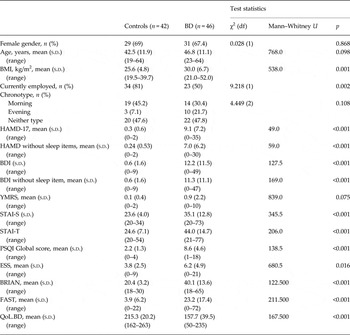
Eighty-eight participants, 46 with BD (16 BD I, 30 BD II) and 42 controls, completed the study protocol and provided accelerometer data [mean 19.7 (s.d.=3.0) days]. Table 1 shows the participants’ characteristics. Groups did not differ significantly with regard to age or gender but participants with BD had a greater body mass index (BMI), were more likely to be unemployed, and scored more highly on mood and anxiety ratings and lower on QoL. Twenty-one participants with BD scored ⩾8 on the HAMD-17 (range 8−35), but none of the patients were considered clinically to be manic or hypomanic for the duration of the study (YMRS range 0–10).
Characteristics of participants

BD, Bipolar disorder; s.d., standard deviation; df, degrees of freedom; BMI, body mass index; HAMD-17, 17-item Hamilton Depression Rating Scale; BDI, Beck Depression Inventory; YMRS, Young Mania Rating Scale; STAI-S/T, State and Trait Anxiety Inventory – State/Trait; PSQI, Pittsburgh Sleep Quality Index; ESS, Epworth Sleepiness Scale; BRIAN, Biological Rhythms Interview of Assessment in Neuropsychiatry; FAST, Functional Assessment Short Test; QoL.BD, Quality of Life in Bipolar Disorder Questionnaire, morning and evening chronotypes include both definite and moderate subtypes.
Subjective description of sleep
On the PSQI, patients with BD scored on average 6.4 points higher than healthy controls (Table 1), with 30 (65.2%) scoring ⩾5, indicative of some form of sleep disturbance (note that a PSQI score of ⩾5 was an exclusion criteria for healthy controls). Many patients with BD described subjective problems with their sleep. Their average score across the three HAMD-17 sleep items was 2.13 (s.d.=1.9), with 12 (26.1%) patients scoring ⩾4. The ESS, validated for identifying excessive daytime sleepiness, was >10 in nine BD patients. In terms of chronotype, the BD group contained more participants with an evening preference than the control group but the difference was not statistically significant (χ²=4.449, p = 0.108).
Sleep apnoea
Forty-one of 46 participants with BD and 40 of the 42 controls completed the overnight partial polysomnography providing good quality respiratory data. Significantly more participants with BD than controls had OSA [BD: n = 12 (29%), controls n = 4 (10%); χ²=4.742, p = 0.029]. Four participants with BD had moderately severe OSA (AHI 15–30) but no participant in either group had severe sleep apnoea (AHI >30). One participant with BD was already on continuous positive airways pressure (CPAP) treatment for known OSA and was therefore counted as AHI <5 and hence with ‘normal’ sleep. The BD patients with OSA were older than normal BD sleepers (44 years v. 51 years, p = 0.054).
Two participants with BD with moderately severe OSA went on to successfully start treatment with CPAP with a decrease in ESS on therapy recorded.
RLS
Two participants with BD, but no controls, reported moderate or severe restless legs symptoms.
Accelerometry-defined sleep–wake cycles
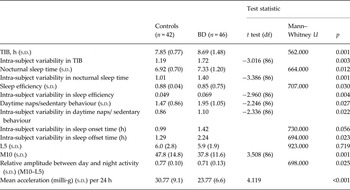
Compliance with the accelerometry was very good with the mean number of nights of data collected being 20.1 for controls and 19.2 for the BD group. Accelerometry measures showed participants with BD spent significantly longer TIB, have significantly longer nocturnal sleep time and also more unstable and variable sleep–wake patterns, alongside longer daytime napping periods, than those in the control group (see Table 2). Compared to controls participants with BD spent around 51 min per night longer in bed, spent 24 min longer asleep at night and had lower sleep efficiency. Daytime napping/sedentary behaviour was also on average significantly longer by 29 min/day in participants with BD. The relative amplitude between the most active 10 h and least active 5 h was significantly lower in the participants with BD than controls, driven primarily by significantly lower M10 activity. The intra-subject variability in all sleep variables was significantly greater in participants with BD, indicating instability in sleep–wake patterns compared to controls.
Summary accelerometer data

BD, Bipolar disorder; TIB, time in bed; Intra-subject variability in sleep variables was defined by the between night standard deviation over the assessment period for each subject, daytime naps/sedentary behaviour is the sum of all time epochs that meet the algorithm defined sleep criteria but are outside of the nocturnal time window defined by the sleep diary; L5, mean acceleration over the least active 5-h window in each 24-h period; M10, mean acceleration in the most active 10-h window in each 24-h period.
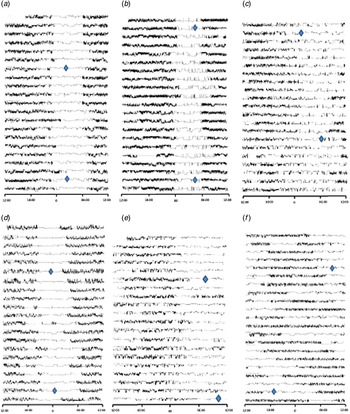
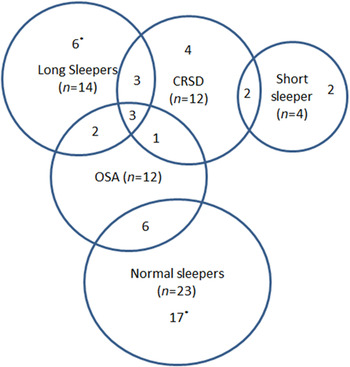
Visual representations of typical actograms are shown in Fig. 1. The actograms could clearly distinguish different sleep–wake patterns. Using the definitions described above, 23 of the BD patients had normal sleep length and 23 had abnormal sleep length or CRD. Four (2.2%) were short nocturnal sleepers (<6 h) and 14 (30.4%) were long sleepers (>10 h) over each 24-h period. Within the long sleepers, this included daytime naps. Twelve (26.1%) had CRD including delayed sleep phase pattern (n = 3), advanced sleep phase pattern (n = 1), irregular sleep–wake phase (n = 3) non-24 h sleep/wake phase disorder (n = 4) and circadian sleep–wake disorder not otherwise specified (n = 1). This compared with just four control participants with CRD, one with an advanced sleep phase and three with delayed sleep phase. There was significant overlap between the various sleep patterns and circadian dysrhythmia as shown in Fig. 2. Two of the four BD patients who were short sleepers and six of the 14 long sleepers also had evidence of CRD. OSA was also a potential explanation of long sleep in five patients with BD.
Actograms demonstrating the sleep–wake cycle over 21 days and timing of 6-sulphatoxymelatonin (aMT6s) acrophase from six different sleep phenotypes. Actigraphic data are 48-h double-plotted with successive days on vertical axis starting at midday. The diamonds represent the timing of the acrophase of aMT6s taken at two different time points over the 21 days of actigraphy. This is a marker for the phase of the circadian clock. (a) Normal sleeper with a well entrained circadian rhythm. Mean nocturnal sleep duration = 6.9 h. (b) Short sleeper with a well entrained circadian rhythm. Mean sleep duration = 5.76 h. (c) Long sleeper mean sleep duration = 10.95 h. Note mildly irregular sleep–wake times and aMT6s period length = 24.40 h. (d) Advanced sleep phase with well entrained circadian rhythm. Mean sleep onset time = 20.25, mean nocturnal sleep duration = 7.23 h. (e) Delayed sleep phase with well entrained circadian rhythm. Mean sleep onset time = 01.43, mean nocturnal sleep duration = 08.59 h. (f) Non-24-h sleep–wake rhythm. Actogram demonstrated an irregular sleep–wake cycle with evidence of free-running sleep onset during the final 8 days. aMT6s period length = 24.40 h.

Sleep phenotypes and their overlap in the bipolar disorder group. Normal sleepers = >6 and <10 h nocturnal sleep and no CRSD; long sleepers = total 24 h sleep >10 h; short sleepers = nocturnal sleep <6 h. CRSD, Circadian rhythm sleep disorder; OSA, obstructive sleep apnoea. * Three of the participants in the long-sleep-only cohort and two of the normal sleepers did not complete the test for sleep apnoea.

Melatonin assays
Thirty-nine controls and 38 BD participants provided at least one urine collection that had a clear melatonin rhythm assessed with cosinor analysis. An additional two participants with BD provided good samples but had a 24-h aMT6s output that was too low to detect a rhythm (<3 µg/24 h). Fifty-seven (30 controls, 27 BD) participants provided two urine samples allowing a period to be calculated. Two participants in the control group and five BD participants had a non-24-h melatonin period (defined as ⩾24.2 h or ⩽23.8 h). Controls demonstrated a significantly greater aMT6s secretion (μg/24 h) than the BD group [18.0 (s.d. = 9.1) v. 12.8 (s.d. = 8.5); Mann–Whitney=476.0, p = 0.003], a greater mesor (μg) (rhythm-adjusted mean) [controls 12.1 (s.d.=6.1) v. BD 9.0 (s.d.=6.0); t = 2.56 (75), p = 0.012] and amplitude (μg) [controls 14.5 (s.d.=8.0) v. BD 9.8 (s.d. 7.7); t = 3.03 (75), p = 0.003]. Control participants also differed from BD participants in that they demonstrated a significantly earlier mean acrophase (h) (time of peak aMT6s concentration) which was on average 1 h 26 min earlier [controls 3.24 (s.d. = 1.88) v. BD 4.67 (s.d. = 2.23); Mann–Whitney U=476.0, p = 0.004]. The later acrophase in the BD group is indicative of a delayed biological rhythm compared to the controls, in keeping with the larger number of evening chronotypes in the BD group (see Table 1).
Comparison of mood, sleep, function, QoL and melatonin in normal and abnormal sleeping BD patients
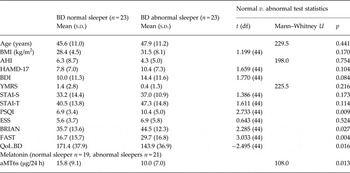
Differences in mood, anxiety, psychosocial function and QoL were explored within the BD group comparing those with accelerometer-defined normal (n = 23) and abnormal sleep (n = 23) (Table 3). There were no statistically significant differences in age, BMI, numbers with OSA or mean AHI, mood or anxiety between the groups. Abnormal sleepers subjectively rated their sleep as lower quality than normal sleepers on the PSQI although it is noteworthy that normal sleeping BD participants still scored in the clinically significant range for poor sleep quality (>5). BRIAN scores were also significantly greater in abnormal compared to normal sleepers indicating greater difficulty maintaining good 24-h rhythms. However, there was no significant difference in daytime sleepiness scores measured on the ESS with both groups scoring in the normal range (ESS <10).
BD normal v. abnormal sleepers

BD, Bipolar disorder; BMI, body mass index; AHI, Apnoea Hypopnoea Index; PSQI, HAMD-17, 17-item Hamilton Depression Rating Scale; BDI, Beck Depression Inventory; YMRS, Young Mania Rating Scale; STAI-S/T, State and Trait Anxiety Inventory – State/Trait; Pittsburgh Sleep Quality Index; ESS, Epworth Sleepiness Scale; BRIAN, Biological Rhythms Interview of Assessment in Neuropsychiatry; FAST, Functional Assessment Short Test; Qol.BD, Quality of Life in Bipolar Disorder Questionnaire; aMT6s, 6-sulphatoxymelatonin.
While mood ratings did not differ between normal and abnormal sleeping groups, there was a significant correlation between both HAMD-17 and BDI scores (with sleep items removed) and PSQI total score in the BD group [Spearman's rank-order correlation: r 2(46) = 0.413, p < 0.004; r 2(46) = 0.529, p < 0.001, respectively], although no correlation between objective actigraphy measures and mood. There was, however, significantly poorer psychosocial functioning (t test 3.033, p < 0.004) and lower QoL (t test −2.495, p = 0.016) in abnormal v. normal sleeping patients with BD. These differences remained when covarying for either HAMD-17 (FAST: F = 6.502, df = 1,43, p = 0.014; QoL.BD: F = 6.436, df = 1,43, p = 0.015) or BDI (FAST: F = 7.527, p = 0.009; QoL.BD: F = 8.839, p = 0.005). Therefore abnormal sleep identified with actigraphy was associated with reduced function and QoL independently from mood.
The aMT6s 24-h secretion also differed significantly within the BD group. BD participants with normal sleeping patterns demonstrated significantly greater 24-h aMT6s secretion than abnormal sleeping participants (Table 2), but did not differ from normal sleeping controls [BD 15.8 (s.d.=9.1) v. controls 17.5 (8.3); Mann–Whitney U=266.0, p = 0.367].
The possible role of medication in sleep phenotype was explored. Significantly more long sleepers (42.9%) took hypnotics than normal sleepers (6.3%) (Fisher's exact test p = 0.031). There were no other significant differences in the medications between subgroups of patients (Supplementary Fig. S1). We did assess whether age of patient correlated with sleep–wake pattern. Abnormal sleepers were older than normal BD sleepers (49 years v. 43 years, p = 0.029). The BD patients with OSA were older than normal BD sleepers (51 years v. 44 years, p = 0.054). Otherwise there were no significant differences in age between normal sleepers and long sleepers or normal sleepers and CRD sleepers.
Discussion
This is the most comprehensive study to date to assess sleep and circadian rhythm in patients with BD compared to controls. Of the patients with objective measures of abnormal sleep, a high proportion had CRD (26.1%) and there was considerable overlap between different sleep and circadian rhythm phenotypes. Abnormality in circadian rhythm in BD was further demonstrated in the BD group by significant differences in melatonin secretion compared to healthy controls, particularly a decreased 24-h output seen in the patients with abnormal sleep patterns. Those BD patients with abnormal sleep had similar mood symptoms to those with normal sleep but less stable biological rhythms, worse psychosocial functioning and reduced QoL.
The patients with BD in our study spent longer in bed, had more fragmented sleep and had more unstable and irregular sleep–wake patterns. However we were also able to show different sleep phenotypes within individual participants. It was possible to determine that within the BD group, 23 retained normal sleep–wake patterns with a stable circadian rhythm and total sleep time between 6 h and 10 h. However, 23 had clearly abnormal sleep with striking circadian dysrhythmia in 12 of the patients. Although a number of previous studies have reported different patterns of sleep disturbance in BD, these have usually relied on only short periods of sleep diary or accelerometry data to assess the sleep–wake cycle. Two different studies, each with just 19 BD patients compared group actigraphy variables over periods of 5 and 7 days, respectively, with controls, but did not define different sleep phenotypes between individual BD subjects and simply reported mean activity levels (Millar et al. Reference Millar, Espie and Scott2004; Jones et al. Reference Jones, Hare and Evershed2005). One problem with the detection of CRD is that patients may appear to have either an insomnia or hypersomnia pattern if the period of recording is too short and this is particularly true of a non-24-h period disorder. The recently revised ICSD-3 diagnostic criteria for this disorder stipulate at least 2 weeks of sleep logs and accelerometry should be performed to make the diagnosis alongside clinical interview (American Academy of Sleep Medicine, 2014). Our data also supports this view given the high rate of patients with subjective descriptions of insomnia (as captured by the HAMD sleep items) while objective accelerometry data showed a low rate of short sleepers. Nine of the 12 patients who had CRD scored the maximum of 2 on at least one of the HAMD sleep items suggesting many of the patients complaining of ‘insomnia’ actually have CRD.
There is increasing evidence for an intrinsic circadian rhythm dysfunction within a number of psychiatric disorders and some previous studies of melatonin levels in BD patients have shown reduced melatonin compared to controls as well as a later onset, although others have not shown any difference in light suppression response compared to controls (Beck-Friis et al. Reference Beck-Friis, von Rosen, Kjellman, Ljunggren and Wetterberg1984; Souetre et al. Reference Souetre, Salvati, Belugou, Pringuey, Candito, Krebs, Ardisson and Darcourt1989; Lam et al. Reference Lam, Berkowitz, Berga, Clark, Kripke and Gillin1990; Kennedy et al. Reference Kennedy, Kutcher, Ralevski and Brown1996; Nurnberger et al. Reference Nurnberger, Adkins, Lahiri, Mayeda, Hu, Lewy, Miller, Bowman, Miller, Rau, Smiley and Davis-Singh2000; Robillard et al. Reference Robillard, Naismith, Rogers, Scott, Ip, Hermens and Hickie2013; Novakova et al. Reference Novakova, Prasko, Latalova, Sladek and Sumova2015). Repeated measurements are required to look at the period to estimate whether it is near 24 h or longer as previous studies have not reported this. In our study, between group comparison of patients and controls showed both reduced melatonin output and a delayed acrophase (time of peak melatonin concentration) within BD compared to controls. However the differences were most marked in those BD patients with abnormal sleep and/or circadian rhythm where total amount of melatonin was significantly lower than BD patients with normal sleep–wake rhythms. There could be a number of potential reasons. Those with fragmented sleep may have abnormal light exposure in rooms with increased light levels or have light on during the night that suppresses melatonin output. Alternatively, a subset of BD patients could have an intrinsic circadian rhythm abnormality although all the controls and the majority of patients with BD had a normal pattern and timing of melatonin secretion, even some with abnormal accelerometry data. Some of those who reported fragmented night sleep had very low melatonin levels of <3 µg/ml and this may provide a mechanistic explanation for the failure to consolidate night sleep for some and this may provide a therapeutic target. We looked for but did not find evidence that mood-stabilizing medication such as lithium affected the circadian rhythm, those on hypnotics had longer sleep time but this might simply reflect the drugs effect.
Overnight respiratory sleep studies analysis showed mild or moderately severe OSA in 29% of patients with BD compared to 10% of controls. There is increasing recognition that secondary consequences of inactivity, weight gain and metabolic syndrome possibly related to medication all increase the risk of conditions such as OSA in those with psychiatric disease. As expected the BD group had an increased BMI compared to the control group. OSA will fragment night sleep and contribute to daytime sleepiness, sedentary behaviour and potentially hypersomnia. Indeed nearly half of the patients with OSA were also rated as long sleepers. Three of the 12 BD patients with OSA were prescribed hypnotics and these patients had a longer mean nocturnal sleep duration (8.9 v. 7.7 h) and 24-h sleep duration (11.3 v. 9.7 h) than those not prescribed hypnotics. It is possible that undiagnosed OSA may lead to the misdiagnosis of other sleep disorders such as insomnia and lead to inappropriate prescription of hypnotics which may excessively prolong both nocturnal and daytime sleep and may be at least partially responsible for the increased prevalence of long sleepers in this study. While the sample of patients with BD was not an epidemiological one, the prevalence of OSA of 29% in our sample, is consistent with previous research (Kelly et al. Reference Kelly, Douglas, Denmark, Brasuell and Lieberman2013; Soreca et al. Reference Soreca, Buttenfield, Hall and Kupfer2015) and highlights the need for screening and treatment of OSA in this patient group given the association between OSA and serious cardiovascular morbidity (Butt et al. Reference Butt, Dwivedi, Khair and Lip2010).
Those participants with BD with any cause of abnormal sleep had significantly worse psychosocial functioning and QoL compared to those with normal sleep. The differences between groups remained after covarying for depressed mood suggesting that accelerometry defined abnormal sleep was associated with lower function and QoL independently of mood. Although we found a moderate correlation between mood and subjective sleep quality measured on the PSQI we found no differences in mood scores between the groups of normal and abnormal BD sleepers. This may be because subjective and objective assessments measure different dimensions of sleep. Other studies have however found associations between disturbed sleep and mood (Eidelman et al. Reference Eidelman, Talbot, Gruber and Harvey2010; Talbot et al. Reference Talbot, Stone, Gruber, Hairston, Eidelman and Harvey2012) but both these studies used sleep diaries to assess sleep function whereas in this study we classified normal and abnormal sleep using accelerometry which may account for the difference in findings.
The impact of targeting specific sleep problems therapeutically on the course of BD needs to be examined further. A preliminary randomized controlled trial assessed the effects of cognitive behavioural therapy for insomnia in patients with BD and shown that not only was it possible to improve sleep efficiency and decrease the severity of insomnia, but time in episode of mood disturbance decreased (Harvey et al. Reference Harvey, Soehner, Kaplan, Hein, Lee, Kanady, Li, Rabe-Hesketh, Ketter, Neylan and Buysse2015).
Strengths of the study include a well characterized group, multiple measures of mood and comprehensive measures of sleep and circadian rhythm across 21 days. The use of a triaxial accelerometer that records acceleration in SI units rather than brand-specific activity counts and the fact that the raw accelerometry data was analysed on an open access algorithm meaning future datasets recorded in SI units can use identical analysis methodology thereby making different datasets directly comparable.
Weaknesses of the study include a lack of the gold standard measure of sleep using video polysomnography. However this was a field study and it was felt that studying patients with partial polysomnography in their own homes would increase compliance and the main aim of the home sleep study was to screen for all forms of sleep-disordered breathing. The sample was opportunistic with a potential bias for over-representation of patients with BD and sleep disorders, while controls were screened out if they suffered significant sleep problems. A larger, more representative, sample size would have allowed more accurate assessment of the prevalence of sleep and circadian disorders as well as greater sub group analysis of the differential effect of the different patterns of sleep and circadian rhythm. Future studies might include those with other psychiatric disorders or control subjects with primary sleep disorders to study the impact upon cognition.
In conclusion we have found that many patients with BD that have sleep disorders have CRD and/or OSA. BD participants with abnormal sleep had lower function and QoL which was not accounted for by lower mood. Abnormal sleep in BD is also characterized by reduced 24-h melatonin secretion compared to both healthy controls and those with BD and normal sleep. There is a need for the use of objective markers of the sleep–wake cycle and respiratory function to accurately determine different sleep patterns within clinical populations and assess the impact of specific therapies targeted at these sleep and circadian disorders on long term outcomes of the psychiatric disorders.
Supplementary material
The supplementary material for this article can be found at https://doi.org/10.1017/S0033291717000186.
Acknowledgements
We thank all of the participants for taking part in the study. The study was sponsored by Northumberland, Tyne and Wear NHS Foundation Trust. Some funding to cover running costs was received from Eli Lilly as an unrestricted investigator-initiated and -led award. The design, conduct and analysis of the study was entirely under the control of the authors.
Declaration of Interest
None.