




No CrossRef data available.
Some connections between linguistic change and the written language: The behavior of speakers aged 3 to 20
Published online by Cambridge University Press: 05 January 2006
Abstract
After the Franco dictatorship, written Catalan started to be taught officially in the schools of Catalonia. This teaching has involved a change in some phonetic, morphological, and lexical habits, especially among speakers schooled in Catalan as a first language. The present study shows a linguistic change process observed in Northwestern Catalan linguistic communities. Its focus is the study of absolute initial prestressed vowels spelled 〈e〉 which have traditionally been uttered with solution [a] in forms such as encara ‘yet’ or estudi ‘study’. The population analyzed is the one that is receiving or has received the biggest influence from written language: speakers between 3 and 20 years of age. The data obtained allows us to observe a phonetic change directly connected to writing.I would like to thank Carlos van Oosterzee and James McCullough for discussion. This research was supported by HUM2004-01504/FILO (MEC & FEDER).
Information
- Type
- Research Article
- Information
- Copyright
- © 2006 Cambridge University Press
The oral language learning process is gradual and is directly connected with the biological development of individuals and the social and cultural influences that they receive throughout their lives, especially during their raising and their education stage. This is why children's sociocultural modeling goes through different general and particular linguistic filters according to the environment in which they develop (see Guy & Boyd, 1990; Labov, 1989; Roberts & Labov, 1995). Among the general filters, the dialectal variety spoken by each member of a speech community is a determining factor. Among the particular filters, their social status becomes decisive.
Apart from this, written language can also influence the linguistic manifestations of each individual, and in more literate societies, it seems to affect their speakers' oral language (see, e.g., van Bergem, 1995). However, in societies where only a minority has knowledge of the written language, this knowledge is unlikely to modify the speakers' oral uses.
If we relate these general points to the trajectory of oral Catalan1
Catalan is a Romance language spoken in the northeast of Spain, in Catalonia, Valencia, and the Balearic Islands. It is also spoken in the south of France, l'Alguer (in Sardinia), and Andorra.
- During the three first decades of the 20th century, oral Catalan received no general influence from the written language because schooling and, consequently, the learning of Catalan took place in a very unequal manner among Catalan people.
- During a second stage, comprising all of Franco's dictatorship, the use of oral Catalan was less influenced by the written language than by the new language that was being imposed: Spanish.
- Finally, after the 1970s, since the approval of the Estatut d'Autonomia (1979), the creation of the Direcció General de Política Lingüística (1980), and the passing of the Llei de Normalització Lingüística (1983), written Catalan has burst into the schools and started to be learned in a progressive, normativized, regulated, and collective manner. Nowadays, oral Catalan is receiving clear influences from the written language, and adopts a much more specific dimension that it did not have in previous stages (see Segarra, 1985).
AIM AND LOCATION OF THE STUDY
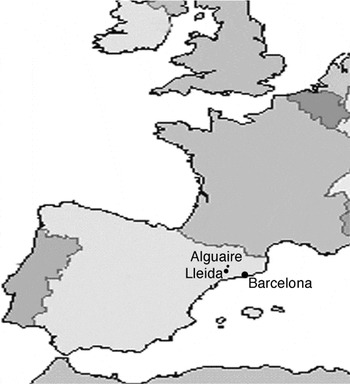
This study focuses on two towns located in the northeast of the Iberian Peninsula (see Figure 1). These two towns are Alguaire, on the one hand, a rural locality of 2,800 inhabitants, and Lleida, on the other hand, a city with 120,000 inhabitants, which is the cultural, and therefore linguistic, irradiating center for all the surrounding villages. In these towns, Lleidatà, the Lleida variety of Western Catalan, is spoken. Western Catalan differs from the Eastern variety, among other aspects, in the unstressed vowel system. Thus, Lleidatà has 6 unstressed vowels

, whereas the Eastern variety has three unstressed vowels

(Veny, 1982:129–131; Recasens, 1991/1996:59–151).

Location of the study.
In Alguaire and Lleida, a linguistic change in progress has been observed in some prestressed vowels in absolute initial position spelled 〈e〉, as in enciam ‘lettuce’, escola ‘school’, or edifici ‘building’. The realization of these vowels, traditionally uttered [a] in Lleidatà2
In eastern varieties,

is the vowel uttered in the unstressed position.
The purpose of this study is, therefore, to consider the productive variability of prestressed 〈e〉 and the perception of vowels [a] and [e] in absolute initial prestressed position in words such as escola ‘school’, edifici ‘building’ or encara ‘yet’ by speakers aged 3 to 20 from Alguaire and Lleida. The aim is twofold: to prove that an ongoing linguistic change at the phonic level is taking place within the generations born between 1974 and 1991,3
In this article, I focus on the youngest population in Alguaire and Lleida because of the importance of schooling in Catalan. However, it is part of a much wider study analyzing the behavior of speakers aged 3 to 80 (Carrera-Sabaté, 2002).
Phonetic variation in Catalan has been well studied within the framework of sociolinguistic variation. In this sense, there are different studies which focus on the production of several phenomena: Colomina (1985), Mier (1986), Montoya (1989, 1995), Alturo and Turell (1990), Escrivà (1993), Pradilla (1993, 1995), Pla (1995), Plaza (1995), and Segura (2003). Apart from studying production, Montoya (1989), Pons (1992), Escrivà (1993), Pradilla (1993), and Carrera-Sabaté (2002) incorporate a complementary analysis of speakers' subjectivity, with Pons (1992) and Carrera-Sabaté (2002) being the basis for the present study.
METHODOLOGY
The variables
The phonic variation I am studying only affects speakers who have Catalan as a first language (L1). Hence, taking into account the relativity of the concept “native” that Trudgill (1983), among others, pointed out, I decided to establish a far more restrictive constraint regarding the choice of informants: both the informants and their parents had to be born in Alguaire or Lleida, thus being speakers of Lleidatà.
The social variables I have considered are: community type, style, age, studies, knowledge of written Catalan, gender, and social status.4
At first, I included both gender and social status in my initial statistical analysis. The presence of genderlect (Trudgill, 2003) could shed light on possible differences between the language use of men and women (see, e.g., Thomas, 1988; Edwards, 1992); and social status could also explain phonetic variation related to the speakers' background (see, e.g., Trudgill (1975/1978), Labov (1990), and Cheshire (2002)). Contrary to my initial hypothesis, the results did not help to explain the phenomenon and for this reason, they are not taken into account in this study.
The style5
For a review of style and the nonlinguistic resources marshaled in the creation of distinctive styles, see Schilling-Estes (2002).
As age is a crucial variable for the development of individual language, I took three-year-old speakers as a starting point to properly analyze different phases before the acquisition of writing. At this stage, three years old, the essentials of linguistic structure have been acquired (Gesell, 1940), and it is possible to study the speakers' natural language because they have not been influenced by instruction and therefore reflect the sociocultural situation of their families (as is pointed out by Chaney, 1992; Guy & Boyd, 1990; Labov, 1989; Roberts & Labov, 1995; Roberts, 2002).
The criteria I have considered to divide informants are based on the following academic hierarchy: preschool (3 to 5 years old, born between 1989 and 1991), primary school (6 to 13 years old, born between 1981 and 1988), and secondary school (14 to 20 years old, born between 1974 and 1980). Informants from 6 to 20 years old are the first generations who had schooling in Catalan. In these speakers, it is possible to observe how schooling in Catalan is related to new linguistic habits.
The analysis
The informants' productive and perceptual competence is analyzed so as to explain the process under study, since both production and perception “coexist in cooperation rather than in competition” (Cutler, 1987:38), and are essential components in the study of variation (Janson, 1983:24). In this sense, Ohala's work (1986) proved the fact that variation in the production of some words in a given speech community can be either not detected by its speakers or considered as an error or mistake and therefore reconstructed. Sometimes this reconstruction does not match the original realization and this causes progressive distortions in speech, leading to phonic alterations.
Two surveys were carried out in order to study the speakers' productive and perceptual competence:
The productive survey
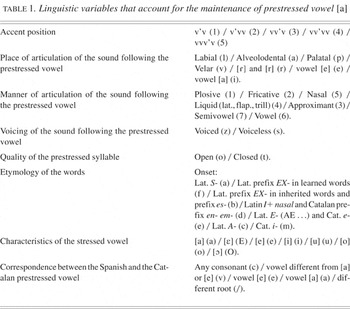
This stage consists of two basic surveys: a one-answer-only question set and a semidirected interview. The questionnaire is used to determine vowel variation in prestressed position in 80 lexical forms. The words chosen for the questionnaire were selected from a simple Catalan vocabulary (Assessoria de Didàctica del Català, 1975) so that they would be familiar to all speakers, including children from 3 to 5 years old. The lexical entries contain a variation in the absolute initial prestressed position (such as escola, ‘school’) and present formal differences, such as phonic context, stressed vowel, etymology, and so forth (see Table 1). The prestressed Catalan vowel presents a low frequency of occurrence, so I used a one-answer-only questionnaire to obtain a significant sample of these vowels in nondirected speech.
Linguistic variables that account for the maintenance of prestressed vowel [a]

The second part of the research consists of a semidirected interview following the Labovian proposal.6
See Feagin (2002) for an explanation of the design of a sociolinguistic interview.
In general, the analysis of phonetic production quantifies the data into percentages and probabilities to observe the variation of prestressed vowels according to generational, social, cultural, sexual, and communicative factors.
The perceptual survey
The research into the subjects' own perception analyzes their subjective judgements in relation to six words containing the prestressed vowels [a] and [e] played twice on a tape. The choice of lexical forms was based on certain observations taken from other perception studies, usually from the field of psycholinguistics. Among the most specific are: (1) frequency, because the most frequently used words are the easiest to detect (Cutler, 1990/1995:113); (2) context of occurrence, as it has been proved that the accuracy of perception improves when the studied sounds appear in isolated words (Cole, 1981:101); and (3) the position of sounds within a sentence, as there is a gradation from higher to lower probability of discrimination of sounds according to whether they occur in initial, final, or medial position in a sequence (Cole, 1981:107–108).
The selection of the words used in the perception test was based on the results from the initial questionnaire. In this way, we distinguish: (1) forms produced mostly with the vowel [a], as in embenat, ‘bandaged’; (2) words with variation of the prestressed vowel, which give different results depending on the generational group, such as escola, ‘school’; and (3) forms produced mostly with [e], such as edifici, ‘building’.
As part of the investigation, the subjects listened twice to two groups of words: first, embenar ‘to bandage’ and esquerra ‘left’ spoken in this sentence: li van embenar el dit de l'esquerra ‘they bandaged the finger on his left hand’; next, the words edifici ‘building’, elefant ‘elephant’, enciam ‘lettuce’, and escola ‘school’ spoken separately. All the words were heard once with the solution [a] and once with [e]. Informants were asked to discriminate possible phonetic differences in the sentence or in the isolated words. If they did well, they were asked about which vowel they considered to be the most appropriate. The specific questions were: (1) Which is the vowel you consider to be the appropriate one in each word and in your speech community? and (2) Which is the vowel used in your speech community and in each word?
The goal of this part of the investigation is, first, to determine the subjects' ability to identify vowel contrast in the prestressed position of these words (each representing a very different performance of the [a] solution). Second, is to analyze the connotations of both pronunciations according to the subjects and according to the generally accepted use of each phonic solution within the speech community. The analysis of the subjects' perception of linguistic change allows us to observe their index of linguistic insecurity by noting the differences between how they speak and what they consider to be ‘correct’ (see Gadet, 1989; Labov, 1966; Macaulay, 1975; Marcellesi & Gardin, 1974). It also helps, however, to determine the tolerance level of a given speech community for certain phonic solutions. All of these factors help us to better understand the speakers' attempts “to accommodate to or acquire higher status speech forms” (Trudgill, 2003:81).
The statistics
The statistical analysis of the data collected in this study was performed using the program goldvarb 2001 to analyze the results, with percentages and tables showing the intersection of percentages and probabilities. With goldvarb 2001 I calculated the probability of occurrence of a phonic form, from a productive point of view. For the perception data, I have only used percentages because of the scarce results obtained.
RESULTS AND DISCUSSION
Production results
Linguistic data
Having observed the answers to the one-answer-only question set that was given to people from 3 to 20 years old, we can prove a connection between the process of change of the prestressed vowel and some linguistic conditioning according to the following factors. I present data from Alguaire and Lleida to support my explanations, but in Lleida the change process is more advanced than in Alguaire [Input Lleida: 0.299 (p = .000); Input Alguaire: 0.537 (p = .000)]. For this reason, the results from Lleida are not significant despite the fact that we can observe the same tendency in both locations.
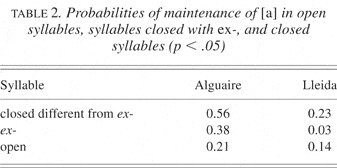
One of the linguistic factors that most influences the variation of the prestressed vowel is the sound structure of words. Thus, the use of prestressed vowel [a] splits the set of words into three groups (see Table 2):
- Words with a closed initial syllable except ex-, such as enciam ‘lettuce’ or escola ‘school’.
- Words starting with ex-, such as examen ‘exam’ or excel·lent ‘excellent’.
- Words with an open initial syllable, such as eleccions ‘elections’ and egoista ‘selfish’.
Probabilities of maintenance of [a] in open syllables, syllables closed with ex-, and closed syllables (p < .05)

In these words the use of [a] decreases gradually from the first group to the second or third one in all the informants in such a way that, in general terms, the maintenance of [a] in the first group is very high, whereas in the second and third group it is much lower.
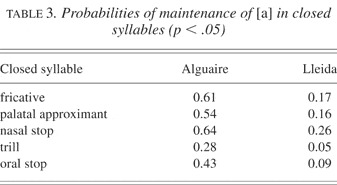
Apart from that, within the words with a closed initial syllable different from ex- (see Table 3), we can establish two minor groups, which are shown in order from higher to lower probability of maintenance of [a] as follows:
- Words in which the prestressed vowel is followed by either a fricative, a palatal approximant, or a nasal stop. These words present a higher maintenance of [a].
- Words in which the prestressed vowel is followed by either a trill or an oral stop. These words present a lower maintenance of [a].
Probabilities of maintenance of [a] in closed syllables (p < .05)

These observations can be related to different theoretical approaches that explain sound change from two perspectives, which, in this particular case, are complementary: gradual change and lexical change (see Labov, 1981). In the examples provided, gradual sound change of [a] to [e] can be observed in words having the prestressed vowel in the initial open syllable or followed by ex-. In these forms (electricista ‘electrician’ or excel·lent ‘excellent’), substitution of [a] by [e] appears systematically and earlier than in the other words with initial closed syllables different from ex- (such as enciam ‘lettuce’). On the other hand, examples of lexical change can be observed in words having similar sound structure and different frequency of [a]-utterance, as in esquerra ‘left’ (one of the words most uttered with [a]) and estrelles ‘stars’ (which presents very few utterances with [a]).
Social data
Prestressed vowel alternation is modified especially by social variables such as birthplace, style, age, academic level, and knowledge of written Catalan.7
Genderlect and sociolect were not significant.
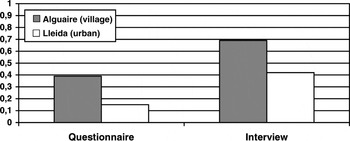
- Birthplace and style: As we have seen in the linguistic results,
there is a higher maintenance of [a] in Alguaire (a rural
village) than in Lleida (a city) (see Figure 2).
This fact is directly connected with the behavior and the progression of
other linguistic changes described in the specialized literature (see,
among others, Eckert, 1988; Labov, 2001). Furthermore, this process of change is
also determined by the speakers' style-shifting. In general, it is
rare to maintain the traditional solution [a] with lexically
similar forms while speaking in a formal situation, such as during the
questionnaire in this study. On the other hand, maintaining the
traditional solution [a] is more frequent during an interview,
where the subjects' linguistic control is not as high. Accordingly,
the substitution of the traditional vowel [a] by vowel
[e], which corresponds to the written form, must be defined as a
process that occurs especially in formal situations (see Figure 2).8
For the analysis of less formal speech in Alguaire: input (0.6); p = (.000). For the analysis of less formal speech in Lleida: input (0.4); p = (.000).
- Age, instruction, and knowledge of written Catalan: One of the most
relevant variables to explain the maintenance of the vowel [a]
in prestressed position is the age of informants, as there is a direct
connection between the use of the vowel [a] and the historical
conditioning of each generational group, such as schooling in Catalonia
and the learning of Catalan. Taking this connection into account, and to
place the phenomenon into a general tendency, I will explain the
performance of all the Alguaire and Lleida informants, which is part of a
larger study.9
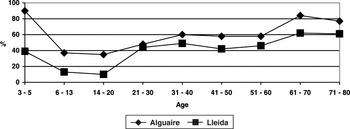
I will only briefly explain the answers to a question set administered to the informants that were grouped as follows: (a) from 61 to 80 years old; (b) from 21 to 60 years old; (c) from 6 to 20 years old, and (d) from 3 to 5 years old (see Figure 3). Further on, I will develop in detail the performance of the informants from 3 to 20 years of age in the studied locations.
For more details, see Carrera-Sabaté (2002).

Probability of maintenance of [a].

Percentage of use of [a] in speakers from 3 to 80 years old in the questionnaire results.
General Results. The informants from 61 to 80 years of age (born between 1914 and 1933) who had schooling, learned to read and write in Catalan before the Franco dictatorship. They present the highest percentages of maintenance of solution [a]. The reason for this performance is related to the maintenance of the traditional dialectal features observed in these informants, especially those who live in Alguaire.
The informants from 21 to 60 years old, born between 1934 and 1973, maintain the solution [a] to a lesser extent, compared with older and younger informants. Some causes that have probably influenced this differentiation are the prestige of written forms and also the effect of the youngest informants on these 21-to-60-year-old informants.10
In fact, although many of these informants have learned to read and write mainly in Spanish, they are parents of young people and their children convey both behavior (music, fashion) and linguistic innovations to them (for similar examples, see Labov, 1994).
The informants from 6 to 20 years of age, born between 1974 and 1988, use solution [a] very little. Reasons to explain this descent in the use of the traditional form [a] in favor of the written form [e] in a more successful way are grounded on the influence of schooling and the acquisition of reading and writing, this being in Catalan.
The informants from 3 to 5 years old, born between 1989 and 1991, are, like all children, at an early linguistic stage. They are not very conscious of style shifts and they use nonstandard, colloquial forms. As a result, prestressed vowel [a] is used in nearly all utterances in the same proportion as speakers from 61 to 80 years of age.
As we can see in Figure 3, the maintenance of vowel [a] is reflected by a curvilinear pattern throughout the speakers' age. This pattern is connected to the speakers' instruction and knowledge of written Catalan, in such a way that those who are receiving schooling in Catalan maintain the traditional vowel [a] less.
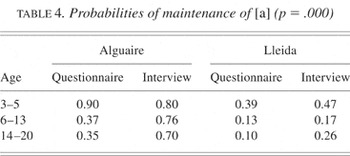
Speakers from 3 to 20 Years Old. If we focus on the speakers aged 3 to 20 and connect the results for the maintenance of the variant [a] with the historical and social context in which they have learned Catalan, the following patterns can be observed (see Table 4).
Probabilities of maintenance of [a] (p = .000)

Informants aged 6 to 20, born between 1974 and 1988, were the first to have schooling in Catalan after Franco's dictatorship. In this historical framework, the overrating of orthography in teaching probably triggered this tendency to adapt oral language to the forms of the written language, especially in careful speech. However, in relation to these informants, other factors, which may have affected the development of their language and also the phonetic variation under analysis, must be considered.
Ages 6 to 13 correspond to the period in which the people surveyed went through primary education, and their starting of compulsory schooling led them to learn new ways of speaking and writing so that they could interact through tasks and functions different from the ones they performed at home. During this stage, acquisition of writing is particularly relevant for the ongoing change reported in this article, because reflection about written language makes the child: (1) have a more exhaustive consciousness of segmental aspects, as Teberosky (1996) pointed out; and (2) identify the forms of written and oral language, mainly when learning new words through writing. Probably, in people from Alguaire, this learning process involves the fact that some words stop being pronounced with the variant [a] and some others are learned and uttered following the indications of orthography.
During adolescence, there are crucial aspects such as the social identity of each individual and consciousness of stylistic variation as a specific referent of each social group.11
“Next to childhood, adolescence seems a particularly formative period for accent adaptation, and many subjects report that their own accents were influenced by charismatic models among their secondary school teachers, including speakers of both the standard and paralects” (Honey, 1997:104).
Children aged 3 to 5, born between 1989 and 1991, do not seem to be influenced by written forms yet, and thus have acquired the constraints on variation that are specific to their family groups and their community, as reported in different studies like Labov (1989), Roberts and Labov (1995), Kerswill (1996), and Kerswill and Williams (2000). The major influence of the parental norms of variation on younger children (rather than on the older ones) would explain the high occurrence of [a], especially in Alguaire, regardless of the style. The different performance of the children from the village compared to the children from the city can be explained through social structure. In the rural village, children are more in contact with aged people than in the city, because children go home walking, everybody knows each other, and there is more linguistic contact between the elderly and the youngest members of the society.
The process of phonic substitution analyzed in this article is determined by the relationship between speakers and written language in the sense that some of the people surveyed attribute a unanimous relationship between sounds and ways of spelling in Catalan. Some of them tend to subordinate spoken language to written forms. This subordination, moreover, is reinforced at school and in Lleida careful speech. This attitude is, after all, a prestige sign (see Cabré, 1993).
Perception results
Capacity for discriminating [a] and [e]
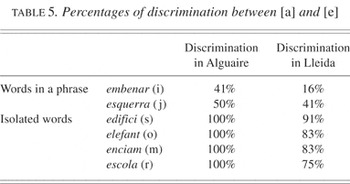
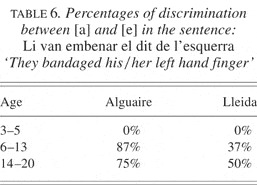
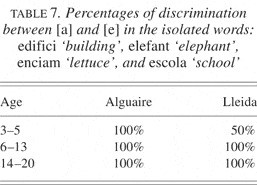
After analyzing the capacity for discriminating the vowel contrast between some words, the comparison of the results leads us to affirm the following (see Table 5). As different studies have shown (Cole & Jakimik, 1978; Cole, 1981), the discrimination between vowels is more accurate when the reference unit is a word than when it is a meaningful sentence because: “Words heard in isolation are acoustically different from the same words in running speech” (Vihman, 1993:166). Furthermore, the length of the words also seems to make the perception of errors more difficult, as “longer words provide more contextual cues, producing stronger expectations of the deleted phoneme” (Samuel, 1981:1130). After analyzing words uttered in a sentence and isolated words, data confirm these theoretical suppositions: embenar ‘bandaged’ and esquerra ‘left’, uttered in sentences, are less accurately perceived than edifici ‘building’, elefant ‘elephant’, enciam ‘lettuce’, and escola ‘school’, uttered in isolation.
Percentages of discrimination between [a] and [e]

The capacity for distinguishing prestressed vowels in Alguaire and Lleida can be explained through generational and schooling differences. According to this, the speakers detecting phonetic contrast to a lower degree are the ones from 3 to 5 years old (see Tables 6 and 7).
Percentages of discrimination between [a] and [e] in the sentence: Li van embenar el dit de l'esquerra ‘They bandaged his/her left hand finger’

Percentages of discrimination between [a] and [e] in the isolated words: edifici ‘building’, elefant ‘elephant’, enciam ‘lettuce’, and escola ‘school’

As I explained before, the learning and knowledge of reading facilitate the development of metalinguistic awareness and enable the speakers to evaluate language more accurately (see Donaldson, 1978). Apart from this, phonological consciousness is an important part of the oral language acquisition process and it seems to be developed parallel to language. For this reason, different authors (Clark & Andersen, 1979; Marshall & Morton, 1978), based on the existence of error detection mechanisms, consider the capacity of reflection about language to be essential for tackling and correcting errors. This capacity is also essential in the language development process, which is directly related to schooling and the learning of grammar. This explains why speakers from 3 to 5 years of age find real difficulties in observing vocalic changes.
Furthermore, these difficulties can also be explained because the informants aged 3 to 5 need more acoustic information to process messages than the others, as Walley (1988) pointed out in other studies. In addition, they use the low vowel [a] more frequently, as the production results demonstrate (see Table 4). Apart from this explanation, it is important to take into account what psychology has described as the restoration effect. By means of this effect, the auditory system is able to correctly present a sound in a word that has not been uttered or that has been changed with relation to the expected utterance (see Fowler, 1986). In the case of the youngest informants, when they hear vowel [e] in prestressed position, they substitute it automatically with vowel [a] and, consequently, do not observe any difference.
Speakers aged 6 to 20 perceive phonetic contrasts very clearly in both locations and they are the greatest innovators in the phonetic change, as we saw in Figure 2. If we compare the percentages of discrimination of timbres between Alguaire and Lleida we observe that the detection of the phonetic contrast is lower and less systematic in Lleida than in the rural nucleus. This observation seems to be contrary to the tendency observed in production, and speakers from Lleida could be expected to discriminate vowels to a higher degree. However, we have to take into consideration that in a situation of change like the one I am analyzing, the prestige of a form can become very high in places where it is not fully widespread, as occurs in Alguaire with vowel [e]. For this reason, children and youth between ages 6 and 20 from Alguaire seem to be more aware of variation and have internalized the prestigious phonic solution more, with both vowels being more successfully discriminated.
Speakers' subjectivity
This analysis only takes into account the responses of subjects who detected the difference in timbre between two pronunciations of the same word. Furthermore, there were some subjects who were not able to answer the questions, even though they did detect the timbre of the prestressed vowels. For this reason, the results must be interpreted provisionally as a qualitative contribution to an initial approach to the subjects' subjectivity.
The results of the subjectivity analysis show that there is a direct connection between the tolerance level of the subjects' solutions [a] and [e] (taken as the proper vowel) and the substitution of the vowel [a] with [e]. In addition, we can observe a direct relationship between the degree of acceptance of a certain pronunciation and its frequency of use by the speakers from Alguaire and Lleida. Considering this information, some general aspects of the subjects' perception can be explained.
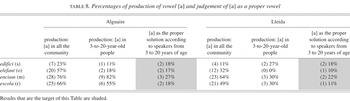
1. In general, speakers rarely tolerate vowel [a] in prestressed position and there is a tendency to tolerate to a certain extent pronunciations that are not regularly used in their speech community. For example, for the word enciam, ‘lettuce’, the vowel [e] was not always qualified as native, because this word is almost always uttered with the prestressed solution [a]. In spite of this, subjects accept more readily the pronunciations with [e] of a word that has experienced phonetic change, as is the case of elefant, ‘elephant’ (see Table 8).
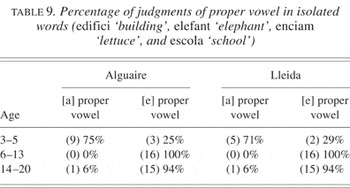
2. The tolerance level of a certain pronunciation within a generational group is proportional to the frequency of that pronunciation in the speech of members of the group. As expected, solution [a] is tolerated by the youngest informants (those from 3 to 5 years of age, who cannot read or write). In these communities, written language is considered to be more prestigious than spoken language and has a considerable influence on the oral pattern. The appearance of the vowel [e] in spoken language, which is found in written Catalan, is accepted in many instances by people aged 6 to 20, who are especially familiar with written Catalan (see Table 9). This can explain the acceptance of the vowel [e] in words in which it is hardly ever pronounced, such as enciam ‘lettuce’ (see Figure 4).
3. Vowel [a] is not often considered as belonging to their own speech community. In this sense, some subjects between 14 and 20 years of age from Lleida, with knowledge of written Catalan, considered vowel [a] in prestressed position to be a vowel proper of the Eastern Catalan dialects because of the similarity between [a] and the schwa. Furthermore, some informants between 6 and 20 years of age from Alguaire usually attribute [a] to older people who have not had access to written language. This attribution results from the fact that in Alguaire there is more maintenance of [a] than in Lleida.
Percentages of production of vowel [a] and judgement of [a] as a proper vowel

Percentage of judgments of proper vowel in isolated words (edifici ‘building’, elefant ‘elephant’, enciam ‘lettuce’, and escola ‘school’)


Use of [a] in Alguaire and Lleida. Percentage of judgements of proper vowel in isolated words by subjects from 6 to 20 years of age.
GENERAL CONSIDERATIONS
The observation of the performance of people aged 3 to 20 from Alguaire and Lleida allows us to identify different pronunciation patterns according to linguistic data; birthplace and style; age, instruction, and knowledge of written Catalan; capacity for discriminating [a] and [e] and the speaker's subjectivity.
First, the change especially affects words with a closed initial syllable except if it is ex-. Furthermore, this change begins in the urban center (from where it is spread to rural villages), and it occurs in formal situations.
The results obtained by the analysis of the performance and the subjectivity of speakers show that people who have been schooled in Catalan produce forms according to spelling. This influence of the written language on the oral language is very high in speakers who are attending primary school, and is not important in children aged 3 to 5, who are not influenced by the written forms.
As for the subjectivity of speakers, the acceptability of one vowel depends on its use in the speech community. According to this, the appearance of the vowel [e], which is found in written Catalan, is mostly accepted by people aged 6 to 20, whereas the vowel [a] is tolerated by the youngest speakers.
This process of change has allowed me to detect the speakers' tendency to match the phonic forms of speech to written models. This matching can be explained from a historical perspective as a natural reaction to the lack of written Catalan knowledge that a large part of the population had because of their schooling in Spanish. However, the consideration of written language as the prestigious variety to the detriment of oral language is an expanding attitude. It is becoming widespread across generations and affects the youngest speakers, who, with the help of their schooling in Catalan, are losing the dialectal richness they are entitled to as linguistic inheritors of a speech community.
References
REFERENCES
Alturo, Núria, &
Turell, M. Teresa.
(1990).
Linguistic change in el Pont de Suert: The study of variation of
/[yogh]/.
Language Variation and Change
2:19–30.Google Scholar
Assessoria de Didàctica del Català.
(1975).
Vocabulari bàsic infantil i d'adults.
Barcelona:
Biblògraf.
Cabré, Teresa.
(1993).
Interferència, ortografia i gramàtica. In
R. Alemany,
A. Ferrando, &
L. I. Meseguer (eds.),
Actes del Novè Col·loqui Internacional de Llengua i
Literatura Catalanes III.
Barcelona:
PAM.
97–109.
Carrera-Sabaté, Josefina.
(2002).
Escola catalana i variació fonètica: Una
evolució del vocalisme àton a Alguaire i a Lleida.
Lleida:
Pagès Editors.
Carrera-Sabaté, Josefina.
(2003).
Variació verbal al Segrià: La pronunciació del
morfema de 3a persona en diversos àmbits d'ús.
Noves SL: Revista de sociolingüística.
1–12. (http://cultura.gencat.net/llengcat/noves)
Chaney, Carolyn.
(1992).
Language development, metalinguistic skills, and print awareness in
3-year-old children.
Applied Psycholinguistics
13:485–514.Google Scholar
Cheshire, Jenny.
(2002).
Sex and gender in variationist research. In
J. K. Chambers,
P. Trudgill, &
N. Schilling-Estes (eds.),
The handbook of language variation and change.
Oxford:
Blackwell.
423–443.
Clark, Eve V., &
Andersen, Elaine S.
(1979).
Spontaneous repairs: Awareness in the process of acquiring
language.
Papers and Reports on Child Language Development
16:1–12.Google Scholar
Cole, Ronald A.
(1981).
Perception of fluent speech by children and adults.
Annals of the New York Academy of Sciences
379:92–109.Google Scholar
Cole, Ronald A., &
Jakimik, Jola.
(1978).
Understanding speech: How words are heard. In
G. Underwood (ed.),
Strategies of information processing.
London:
Academic Press.
67–116.
Colomina, Jordi.
(1985).
La diftongació de /E/ i d'altres canvis
vocàlics a la Canyada de Biar. In
L'alacantí: Un estudi sobre la variació
lingüística.
Alacant:
Institut d'Estudis “Gil-Albert.”
94–109.
Cutler, Anne.
(1987).
Speaking for listening. In
A. Allport,
D. Mackay,
W. Prinz, &
E. Scheerer (eds.),
Language perception and production: Relationships between listening,
speaking, reading, and writing.
London:
Academic Press.
23–40.
Cutler, Anne.
(1990/1995).
Spoken word recognition and production. In
J. L. Miller &
P. D. Eimas (eds.),
Speech, language, and communication.
San Diego:
Academic Press.
97–136.
Donaldson, Margaret.
(1978).
Children's achievement at school-entry age as a function of
mothers' and fathers' teaching sets.
Elementary School Journal
81:245–253.Google Scholar
Eckert, Penelope.
(1988).
Adolescent social structure and the spread of linguistic
change.
Language in Society
17:183–208.Google Scholar
Edwards, Walter.
(1992).
Sociolinguistic behavior in a Detroit inner city
neighborhood.
Language in Society
21:93–115.Google Scholar
Escrivà, Vicent.
(1993).
Aproximació sociolingüística al procés
d'assimilació de la variable [e] àtona final
a Oliva.
In
R. Alemany,
A. Ferrando, &
L. Meseguer (eds.),
Actes del Novè Col·loqui Internacional de Llengua i
Literatura Catalanes III.
Barcelona:
PAM.
121–136.
Feagin, Crawford.
(2002).
Entering the community: Fieldwork. In
J. K. Chambers,
P. Trudgill, &
N. Schilling-Estes (eds.),
The handbook of language variation and change.
Oxford:
Blackwell.
20–39.
Fowler, Carol. A.
(1986).
An event approach to the study of speech perception from a
direct-realist perspective.
Journal of Phonetics
14:3–28.Google Scholar
Gadet, François.
(1989).
Le français ordinaire.
Paris:
Colin.
Gesell, Arnold.
(1940).
The first five years of life.
New York:
Harper & Row.
Gregory, Michael, &
Carroll, Susanne.
(1978/1986).
Language and situation.
London:
Routledge & Kegan Paul.
Guy, Gregory R., &
Boyd, Sally.
(1990).
The development of a morphological class.
Language Variation and Change
2:1–18.Google Scholar
Halliday, Michael.
(1976).
Language as social semiotic: The social interpretation of language
and meaning.
London:
Routledge & Kegan Paul.
Honey, John.
(1997).
Sociophonology. In
F. Coulmas (ed.),
The handbook of sociolinguistics.
Oxford:
Blackwell.
92–106.
Kerswill, Paul.
(1996).
Children, adolescents, and language change.
Language Variation and Change
8:177–202.Google Scholar
Kerswill, Paul, &
Williams, Ann.
(2000).
Creating a new town koine: Children and language change in Milton
Keynes.
Language in Society
29:65–116.Google Scholar
Labov, William.
(1966).
The social stratification of English in New York City.
Washington, DC:
Center for Applied Linguistics.
Labov, William.
(1970).
Stages in the acquisition of Standard English. In
H. Hungerford,
J. Robinson, &
J. Sledd (eds.),
English Linguistics.
Glenview, IL:
Scott Foresman.
275–302.
Labov, William.
(1989).
The child as linguistic historian.
Language Variation and Change
1:85–97.Google Scholar
Labov, William.
(1990).
The intersection of sex and social class in the course of linguistic
change.
Language Variation and Change
2:205–254.Google Scholar
Labov, William.
(1994).
Principles of linguistic change: Internal factors.
Oxford:
Blackwell.
Labov, William.
(2001).
Principles of linguistic change. Social factors.
Oxford & Cambridge (Massachusetts):
Blackwell.
Macaulay, Ronald.
(1975).
Negative prestige, linguistic insecurity, and linguistic
self-hatred.
Lingua
36:147–161.Google Scholar
Marcellesi, Jean Baptiste, &
Gardin, Bernard.
(1974).
Introduction à la sociolinguistique: La linguistique
sociale.
Paris:
Larousse.
Marshall, John C., &
Morton, John.
(1978).
On the mechanics of Emma. In
A. Sinclair,
R. J. Jarvella, &
W. J. M. Levelt (eds.),
The child's conception of language.
Berlin:
Springer-Verlag.
225–239.
Mier, Jeanne Z.
(1986).
Estudi sociolingüístic de certs aspectes de la llengua
catalana.
Treballs de Sociolingüística Catalana
6:33–112.Google Scholar
Montoya, Brauli.
(1989).
Estratificació de la variació lingüística
a Petrer.
In
F. Gimeno &
B. Montoya (eds.),
Sociolingüística.
València:
Publicacions de la Universitat de València.
67–95.
Montoya, Brauli.
(1995).
L'observació del canvi fonològic en el
català balear.
In
M. T. Turell (ed.),
La sociolingüística de la variació.
Barcelona:
Promociones y Publicaciones Universitarias.
165–219.
Ohala, John J.
(1986).
Against the direct realist view of speech perception.
Journal of Phonetics
14:75–82.Google Scholar
Pla, Joan.
(1995).
L'obertura de la [[schwa]] a Barcelona: El xava i
altres varietats.
In
M. T. Turell (ed.),
La sociolingüística de la variació.
Barcelona:
Promociones y Publicaciones Universitarias.
139–162.
Plaza, Carme.
(1995).
Lleialtat lingüística, edat i nivell educatiu: La
e posttònica a la Conca de Barberà. In
M. T. Turell (ed.),
La sociolingüística de la variació.
Barcelona:
Promociones y Publicaciones Universitarias.
117–138.
Pons, Lídia.
(1992).
Iodització i apitxament al Vallès.
Barcelona:
Institut d'Estudis Catalans.
Pradilla, Miquel A.
(1993).
Variació i canvi lingüístic en curs al
català de transició
nordoccidental/valencià.
Ph.D. dissertation,
Universitat Rovira i Virgili.
Pradilla, Miquel A.
(1995).
El desafricament prepalatal en el català de transició
nord-occidental/valencià.
In
M. T. Turell (ed.),
La sociolingüística de la variació.
Barcelona:
Promociones y Publicaciones Universitarias.
53–116.
Recasens, Daniel.
(1991/1996).
Fonètica descriptiva del català.
Barcelona:
Institut d'Estudis Catalans.
Roberts, Julie.
(2002).
Child language variation. In
J. K. Chambers,
P. Trudgill, &
N. Schilling-Estes (eds.)
The handbook of language variation and change.
Oxford:
Blackwell.
333–348.
Roberts, Julie, &
Labov, William.
(1995).
Learning to talk Philadelphian: Acquisition of short a by
preschool children.
Language Variation and Change
7:101–112.Google Scholar
Romaine, Suzanne.
(1984).
The language of children and adolescents: The acquisition of
communicative competence.
Oxford:
Blackwell.
Samuel, Arthur G.
(1981).
The role of bottom-up confirmation in the phonemic restoration
illusion.
Journal of Experimental Psychology: Human Perception and
Performance
7:1124–1131.Google Scholar
Schilling-Estes, Natalie.
(2002).
Investigating stylistic variation. In
J. K. Chambers,
P. Trudgill, &
N. Schilling-Estes (eds.),
The handbook of language variation and change.
Oxford:
Blackwell.
375–401.
Segarra, Mila.
(1985).
Història de l'ortografia catalana.
Barcelona:
Empúries.
Segura, Carles.
(2003).
Variació dialectal i estandardització al Baix
Vinalopó.
Alacant/Barcelona:
IIFV/PAM.
Spillner, Bernd.
(1987).
Style and register. In
U. Ammon,
N. Dittmar, &
J. Mattheier (eds.),
Sociolinguistics.
Berlin:
Mouton de Gruyter.
273–285.
Teberosky, Ana.
(1996).
L'entrada a l'escrit.
Guix. Monogràfic. Aprenentatge de la
lectura-escriptura
219:5–10.Google Scholar
Thomas, Beth.
(1988).
Differences of sex and sects: Linguistic variation and social
networks in a Welsh mining village.
In
J. Coates &
D. Cameron (eds.),
Women in their speech communities.
London:
Longman.
51–60.
Trudgill, Peter.
(1975/1978).
Sex, covert prestige and linguistic change in the urban British
English of Norwich.
In
T. Barrie &
N. Henley (eds.),
Language and sex: Difference and dominance.
Rowley, MA:
Newbury House.
88–104.
Trudgill, Peter.
(1983)
On dialect.
New York:
New York University Press.
Trudgill, Peter.
(2003).
A glossary of sociolinguistics.
Edinburgh:
Edinburgh University Press.
van Bergem, Dick R.
(1995).
Perceptual and acoustic aspects of lexical vowel reduction, a sound
change in progress.
Speech Communication
16:329–458.Google Scholar
Veny, Joan.
(1982).
Els parlars catalans.
Palma de Mallorca:
Raixa.
Vihman, Marilyn M.
(1993).
Vocal motor schemes, variation and the production-perception
link.
Journal of Phonetics
21:163–169.Google Scholar
Walley, Amanda C.
(1988).
Spoken word recognition by young children and adults.
Cognitive Development
3:137–165.Google Scholar
Wolfram, Walt, &
Fasold, Ralph.
(1974).
The study of social dialects in American English.
Englewood Cliffs. NJ:
Prentice-Hall.
Location of the study.
Linguistic variables that account for the maintenance of prestressed vowel [a]
Probabilities of maintenance of [a] in open syllables, syllables closed with ex-, and closed syllables (p < .05)
Probabilities of maintenance of [a] in closed syllables (p < .05)
Probability of maintenance of [a].
Percentage of use of [a] in speakers from 3 to 80 years old in the questionnaire results.
Probabilities of maintenance of [a] (p = .000)
Percentages of discrimination between [a] and [e]
Percentages of discrimination between [a] and [e] in the sentence: Li van embenar el dit de l'esquerra ‘They bandaged his/her left hand finger’
Percentages of discrimination between [a] and [e] in the isolated words: edifici ‘building’, elefant ‘elephant’, enciam ‘lettuce’, and escola ‘school’
Percentages of production of vowel [a] and judgement of [a] as a proper vowel
Percentage of judgments of proper vowel in isolated words (edifici ‘building’, elefant ‘elephant’, enciam ‘lettuce’, and escola ‘school’)
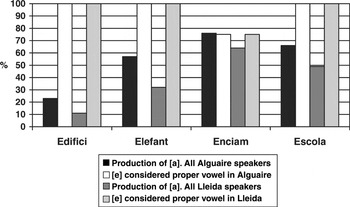
Use of [a] in Alguaire and Lleida. Percentage of judgements of proper vowel in isolated words by subjects from 6 to 20 years of age.
 You have
Access
- 2
- Cited by