Introduction
Impaired social cognition has consistently been observed in individuals with schizophrenia who perform approximately one standard deviation below healthy controls across a range of domains (e.g. theory of mind, social perception, social knowledge, attributional bias, and emotion processing) (Pinkham et al., Reference Pinkham, Penn, Perkins and Lieberman2003; Green et al., Reference Green, Penn, Bentall, Carpenter, Gaebel, Gur, Kring, Park, Silverstein and Heinssen2008). Social cognition impairments are important treatment targets because they are associated with poor quality of life and functional outcome (Mancuso et al., Reference Mancuso, Horan, Kern and Green2011). Unfortunately, pharmacological, psychosocial, and social cognitive skills training programs that have targeted social cognition in schizophrenia have produced modest effects and inconsistent results (Penn and Combs, Reference Penn and Combs2000; Penn et al., Reference Penn, Roberts, Combs and Sterne2007; Horan et al., Reference Horan, Kern, Shokat-Fadai, Sergi, Wynn and Green2009; Bradley and Woolley, Reference Bradley and Woolley2017). Alternative treatment approaches are therefore needed to produce improvements in social cognition that are robust enough to result in changes in community functioning.
Oxytocin is a pharmacological agent that has received increased attention due to its apparent promise for enhancing social cognition and functioning in the general population and individuals diagnosed with a range of psychiatric disorders (Bradley and Woolley, Reference Bradley and Woolley2017). This neuropeptide is produced endogenously in the hypothalamus and released into the peripheral circulation, as well as the central nervous system where it binds to receptors in brain areas integral for social cognition (Churchland and Winkielman, Reference Churchland and Winkielman2012). Several studies have shown that when oxytocin is administered exogenously via intranasal spray, social cognition is enhanced in psychiatrically healthy individuals across a number of domains (e.g. facial emotion recognition, trustworthiness, empathy, and theory of mind) (Guastella and MacLeod, Reference Guastella and MacLeod2012), potentially achieving its effect by augmenting the activity of areas, such as the amygdala, medial prefrontal cortex, anterior cingulate, and insula (Adolphs, Reference Adolphs2009; Bethlehem et al., Reference Bethlehem, van Honk, Auyeung and Baron-Cohen2013).
Given promising early results suggesting that oxytocin may enhance social cognition in healthy individuals and psychiatric populations (Guastella et al., Reference Guastella, Howard, Dadds, Mitchell and Carson2009; Luminet et al., Reference Luminet, Grynberg, Ruzette and Mikolajczak2011; Guastella and MacLeod, Reference Guastella and MacLeod2012; Keech et al., Reference Keech, Crowe and Hocking2018), there has been considerable interest in examining oxytocin in schizophrenia (Bürkner et al., Reference Bürkner, Williams, Simmons and Woolley2017). Several studies have evaluated endogenous oxytocin levels in cerebrospinal fluid and plasma, producing inconsistent results. Some studies reported that people with schizophrenia who are polydipsic have lower endogenous oxytocin levels than healthy controls (Goldman et al., Reference Goldman, Marlow-O'Connor, Torres and Carter2008, Reference Goldman, Gomes, Carter and Lee2011), other studies reported higher levels in people with schizophrenia (Beckmann et al., Reference Beckmann, Lang and Gattaz1985; Strauss et al., Reference Strauss, Keller, Koenig, Gold, Frost and Buchanan2015a, Reference Strauss, Keller, Koenig, Gold, Ossenfort and Buchanan2015b, Reference Strauss, Keller, Koenig, Sullivan, Gold and Buchanan2015c), and others report no group differences (Rubin et al., Reference Rubin, Carter, Drogos, Pournajafi-Nazarloo, Sweeney and Maki2010, Reference Rubin, Carter, Drogos, Jamadar, Pournajafi-Nazarloo, Sweeney and Maki2011, Reference Rubin, Carter, Bishop, Pournajafi-Nazarloo, Harris, Hill, Reilly and Sweeney2013, Reference Rubin, Carter, Bishop, Pournajafi-Nazarloo, Drogos, Hill, Ruocco, Keedy, Reilly, Keshavan, Pearlson, Tamminga, Gershon and Sweeney2014). Despite these inconsistencies in mean group differences, lower endogenous oxytocin levels have been associated with poor social cognition on a variety of tasks (e.g. social cue perception, facial affect perception, identification of emotional body gestures, and hedonics) (Rubin et al., Reference Rubin, Carter, Drogos, Jamadar, Pournajafi-Nazarloo, Sweeney and Maki2011; Strauss et al., Reference Strauss, Keller, Koenig, Gold, Frost and Buchanan2015a, Reference Strauss, Keller, Koenig, Gold, Ossenfort and Buchanan2015b, Reference Strauss, Keller, Koenig, Sullivan, Gold and Buchanan2015c), particularly among females (Rubin et al., Reference Rubin, Carter, Drogos, Jamadar, Pournajafi-Nazarloo, Sweeney and Maki2011).
Given evidence for the association between endogenous oxytocin abnormalities and social cognitive impairment, several studies have examined whether exogenously administered oxytocin enhances social cognition. Studies administering a single dose of oxytocin via intranasal spray have produced inconsistent results. Several studies indicate that oxytocin enhances tasks measuring domains of ‘higher-order’ social cognition (i.e. tasks requiring inferential processes that incorporates knowledge not directly present in the stimuli, such as theory of mind) (Davis et al., Reference Davis, Lee, Horan, Clarke, McGee, Green and Marder2013; Fischer-Shofty et al., Reference Fischer-Shofty, Brüne, Ebert, Shefet, Levkovitz and Shamay-Tsoory2013; Woolley et al., Reference Woolley, Chuang, Lam, Lai, O'Donovan, Rankin, Mathalon and Vinogradov2014, Reference Woolley, Chuang, Fussell, Scherer, Biagianti, Fulford, Mathalon and Vinogradov2017; Guastella et al., Reference Guastella, Ward, Hickie, Shahrestani, Hodge, Scott and Langdon2015), but not lower-level social cognition (i.e. tasks requiring minimal inferential processes beyond what is directly presented in the stimulus, such as facial affect labeling) (Goldman et al., Reference Goldman, Gomes, Carter and Lee2011; Davis et al., Reference Davis, Lee, Horan, Clarke, McGee, Green and Marder2013; Gibson et al., Reference Gibson, Penn, Smedley, Leserman, Elliott and Pedersen2014; Horta de Macedo et al., Reference Horta de Macedo, Zuardi, Machado-de-Sousa, Chagas and Hallak2014; Woolley et al., Reference Woolley, Chuang, Lam, Lai, O'Donovan, Rankin, Mathalon and Vinogradov2014, Reference Woolley, Chuang, Fussell, Scherer, Biagianti, Fulford, Mathalon and Vinogradov2017; Guastella et al., Reference Guastella, Ward, Hickie, Shahrestani, Hodge, Scott and Langdon2015; Shin et al., Reference Shin, Park, Jung, Park, Yun, Jang, Kim, Han, Kim and Kang2015; Brambilla et al., Reference Brambilla, Cotelli, Manenti, Dagani, Sisti, Rocchi, Balestrieri, Pini, Raimondi and Saviotti2016) (see Mancuso et al., Reference Mancuso, Horan, Kern and Green2011). There are inconsistent results, however, across studies and among individual social cognition tasks and domains (for a meta-analysis see Bürkner et al., Reference Bürkner, Williams, Simmons and Woolley2017).
Results of multi-dose studies have also been inconsistent. Pedersen et al. (Reference Pedersen, Gibson, Rau, Salimi, Smedley, Casey, Leserman, Jarskog and Penn2011) administered 14 days of oxytocin at 24 IU, two times per day. They found significant improvement on a theory of mind task, but not a trust task where participants rated faces for trustworthiness and approachability. Gibson et al. (Reference Gibson, Penn, Smedley, Leserman, Elliott and Pedersen2014) administered 24 IUs of oxytocin twice daily over a 6-week period and found that oxytocin enhanced emotion recognition and theory of mind to a greater extent than placebo; however, improvement on attributional bias was not greater than placebo. Thus, there is mixed evidence for the efficacy of oxytocin on social cognition in schizophrenia in both acute challenge and longer-term multi-dose trials that have examined social cognition.
One reason for inconsistent effectiveness of oxytocin may be that oxytocin has typically not been administered concurrently with psychosocial interventions. A relevant metaphor for this issue involves the use of steroids in sports: athletes may be taking a drug capable of enhancing their athletic performance, but if they do not work out concurrently, they will not build muscle and see tangible gains in their athletic performance. It may be necessary for individuals with schizophrenia to receive concurrent psychosocial treatment while taking oxytocin to have the context needed to make gains in social cognitive skills. An enriched rehabilitation context may also improve transfer of enhanced social cognition skills to tangible improvements in community functioning. Only two studies have examined combined treatment effects. Davis et al. (Reference Davis, Green, Lee, Horan, Senturk, Clarke and Marder2014) administered 6 weeks (12 sessions) of social cognitive training that targeted facial affect recognition, social perception, and empathy. Participants received 40 IU of oxytocin 30 min prior to social cognitive training, with the expectation that oxytocin would enhance learning social cognition skills during sessions. They found that oxytocin enhanced empathic accuracy, but not facial affect recognition or social perception. Cacciotti-Saija et al. (Reference Cacciotti-Saija, Langdon, Ward, Hickie, Scott, Naismith, Moore, Alvares, Redoblado Hodge and Guastella2015) combined 6-weeks of social cognition training (two 1 h sessions per week) with oxytocin administered at morning (12 IU) and night (12 IU), as well as 15 min prior to each weekly session (24 IU). There was no effect of oxytocin on measures of emotion recognition, theory of mind, or attributional bias. Thus, studies combining oxytocin and psychosocial interventions suggest minimal added benefit of oxytocin beyond social cognitive training; however, these trials were both brief in duration (6 weeks), and it may be necessary to administer psychosocial treatment along with oxytocin for longer periods and in an enriched rehabilitation context to observe an effect.
The current study examined the efficacy of combining oxytocin and a longer-term (24 weeks) Cognitive-Behavioral Social Skills Training (CBSST) (Granholm et al., Reference Granholm, McQuaid and Holden2016) group psychosocial intervention infused with elements of Social Cognition and Interaction Training (SCIT) (Roberts et al., Reference Roberts, Penn and Combs2015). Participants received baseline (0 weeks), mid-point (12 weeks), and end-of-study (24 weeks) evaluations examining several domains of social cognition that have been enhanced by oxytocin in prior studies, including facial emotion recognition, trustworthiness, empathic accuracy, and theory of mind. The following hypotheses were made: (1) CBSST would enhance performance on each of the social cognition measures relative to baseline, demonstrating efficacy for CBSST on social cognition; (2) the group receiving CBSST + oxytocin would demonstrate enhanced social cognition on the empathic accuracy and trust game, but not facial emotion recognition task and reading mind in the eyes tests that measure emotion recognition relative to the group receiving CBSST + placebo. Exploratory analyses were also conducted on eye-tracking data obtained in the facial emotion recognition task to determine whether oxytocin increased gaze time to the most informative target regions of the face (eyes and mouth) to a greater extent than placebo.
Method
Participants
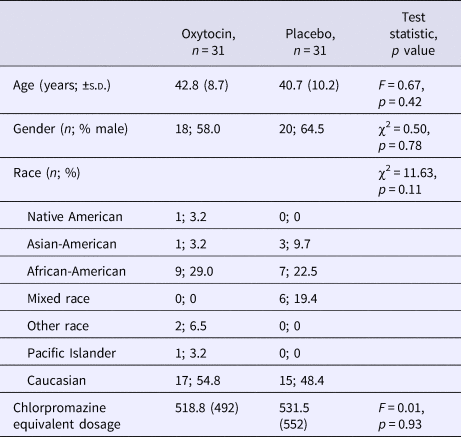
Sixty-two outpatients between the ages of 18 and 55 years, who met Diagnostic and Statistical Manual of Mental Disorders (DSM)-IV-TR criteria for schizophrenia or schizoaffective disorder, were recruited from two sites: (1) the Maryland Psychiatric Research Center and (2) the University of California, San Diego and Veterans Affairs San Diego Healthcare System (see Table 1). Diagnoses were made using a best estimate diagnostic approach, which utilized information from the Structured Clinical Interview for DSM-IV (First et al., Reference First, Spitzer, Gibbon and Williams2002), family informants, and medical records. Enrollment criteria required a minimum level of social function impairment, defined as a score of ⩾2 on the Scale for the Assessment of Negative Symptoms (SANS) asociality item (i.e. a decrease in social interactions with others). All participants were clinically stable, as defined by no change in medication type for at least 2 months or dose within the last 1 month. Participants were excluded if they: (1) met DSM-IV-TR criteria for current alcohol or substance dependence (except nicotine) within the last 6 months; (2) met DSM-IV-TR criteria for alcohol or substance abuse (except nicotine) within the last month (urine toxicology was also performed at baseline to rule out recent substance use); (3) met DSM-IV-TR criteria for mental retardation; (4) had a past history of polydipsic hyponatremia (defined by sodium levels <130 mmol/L); (5) had a current sodium level below 135 mmol/L; (6) had uncontrolled medical conditions; (7) displayed EKG evidence of cardiac arrhythmias (QTc prolongation: males: ⩾450 ms, females: ⩾470 ms; atrial fibrillation; ventricular of supraventricular tachycardia; or second or third degree A-V Block); and (8) were pregnant and lactating females.
Demographic and baseline clinical characteristics

SANS, Scale for the Assessment of Negative Symptoms; BPRS, Brief Psychiatric Rating Scale; CDS, Calgary Depression Scale; CGI, Clinical Global Impression.
The University of Maryland School of Medicine and the VA IRBs approved the study protocol and informed consent procedures. The Clinicaltrials.gov registration was NCT01752712.
Study design
The study consisted of a 2-week Evaluation Phase, a 24-week Double-Blind Treatment Phase, and a week 36 follow-up evaluation visit. Social cognition tests were administered at baseline, 12-weeks, and 24-weeks. Twelve weeks after the last CBSST session, a follow-up visit took place where symptom and functional outcome assessments (but not social cognition measures) were obtained to evaluate persistence of treatment gains.Footnote †Footnote 1 Participants were randomly assigned to intranasal oxytocin (36 IU, BID) or placebo intranasal oxytocin using a permuted block randomization system. On the CBSST session days, oxytocin was administered 45 min before a session, with direct observation of participant administration of intranasal oxytocin.Footnote 2 Medication compliance was assessed by weight of returned intranasal bottles. All participants who received 75% or more of their assigned study medication were considered compliant.
All participants received CBSST, with participants randomized to oxytocin or placebo attending the same therapy groups. CBSST was delivered in four modules (i.e. Cognitive, Social, Problem-Solving, and Social-Cognition Skills). Using elements from the SCIT manual (Roberts et al., Reference Roberts, Penn and Combs2015), the following modifications were made to the standard version of CBSST (Granholm et al., Reference Granholm, McQuaid and Holden2016) to enhance the treatment focus on social cognition and adherence to oxytocin use: (1) Reminders, motivational interviewing techniques, self-monitoring, and reinforcement were used to facilitate adherence to oxytocin between sessions; (2) in the Social Skills module, eye contact, attending to and labeling facial affect, and expressing facial affect were emphasized more extensively in behavioral role plays; (3) in the Cognitive Skills module, greater emphasis was placed on correcting defeatist attitudes (e.g. ‘I will be rejected’) and mistakes in thinking (e.g. jumping to conclusions) that contribute to social avoidance and paranoia/distrust; and (4) a Social Cognition Skills module was created based on SCIT manual sessions, including emotions and social situations, defining and guessing people's emotions, suspicious feelings, and jumping to conclusions. The four six-session modules were repeated, to compensate for cognitive impairment and to improve sense of mastery and self-efficacy, for a total of 48 sessions. Two sessions were delivered per week over 24 weeks. A modular rolling admissions approach was used, whereby participants could enter groups at the start of any new module. All therapists underwent extensive training and fidelity was systematically assessed throughout the project by JH and EG.
Social cognition measures
Social cognition assessments included: (1) Reading the Mind in the Eyes Test (RMET) (Baron-Cohen et al., Reference Baron-Cohen, Wheelwright, Hill, Raste and Plumb2001); (2) Empathic Accuracy Task (EAT) (Zaki et al., Reference Zaki, Bolger and Ochsner2008); (3) Trust Game (TG) (Baumgartner et al., Reference Baumgartner, Heinrichs, Vonlanthen, Fischbacher and Fehr2008; Van't Wout and Sanfey, Reference Van't Wout and Sanfey2008); and (4) Facial Emotion Recognition Test (FERT) (Marsh et al., Reference Marsh, Henry, Pine and Blair2010). Tasks were selected based on prior studies indicating beneficial effects of exogenous oxytocin administration on these measures in healthy individuals (Kosfeld et al., Reference Kosfeld, Heinrichs, Zak, Fischbacher and Fehr2005; Domes et al., Reference Domes, Heinrichs, Michel, Berger and Herpertz2007; Baumgartner et al., Reference Baumgartner, Heinrichs, Vonlanthen, Fischbacher and Fehr2008; Guastella et al., Reference Guastella, Mitchell and Dadds2008a, Reference Guastella, Mitchell and Mathews2008b; Savaskan et al., Reference Savaskan, Ehrhardt, Schulz, Walter and Schächinger2008; Marsh et al., Reference Marsh, Henry, Pine and Blair2010; Bartz et al., Reference Bartz, Zaki, Bolger and Ochsner2011).
(1) (RMET: A computerized version of the RMET was administered, which presented participants with 36 black-and-white facial stimuli depicting just the eyes region of Caucasian males and females. Four mental state terms accompanied each stimulus (three foils and one target) and were presented in the corners of the screen. To facilitate task comprehension, the definitions of each mental state term, which are typically presented in the appendix of the paper RMET version and provided if participants did not know the meaning of a word, were presented in smaller font beneath each mental state term. Participant accuracy served as the dependent variable.
(2) EAT: Participants used a nine-point rating scale (1: very negative; 5: neutral; 9: very positive) to continuously rate how positive or negative another person (referred to as the target) shown in a video-clip was feeling. The six video clips from the UCLA version of the task (Kern et al., Reference Kern, Penn, Lee, Horan, Reise, Ochsner, Marder and Green2013) were approximately 2–3 min in length and depicted the target (three males and three females) recounting a positive (three videos) or negative (three videos) life experience. The participant's ratings were compared to the target's own continuous ratings of how they reported feeling during the video-taped segment, and an empathic accuracy score was derived by calculating time-lagged correlations between the target's ratings of their experienced affective state and the participant's judgment of the target's affective state.
(3) TG: Participants were told that they would be playing a computer game with either another person or with a computer. On each trial, they were given a small sum of money and told that they could transfer any amount of this money in $1 increments over to the partner for that round (whom they were told is either a computer or another person playing online). If the participant decided to trust their partner then the amount of money that they decided to transfer was multiplied by four and transferred to the partner. They were then told whether their partner had decided to repay their trust. When trust was repaid by the partner, the partner sent back a proportion of the transferred, multiplied amount to the participant. If the partner did not repay trust, then the participant was notified of this and told that either no money was returned back to them by the partner or that less money than they had initially transferred was returned back to them. The total amount of money that the participant received was shown at the end of each trial, and participants received a portion of that amount at the end of the task. At the end of the study, participants were debriefed and told that all partners in the game were the computer, and that the purpose of the task was to examine trust behavior when trust is repaid or abused for humans v. computers. Total amount trusted by the participant served as the primary dependent variable.
(4) FERT: Emotional and neutral stimuli taken from the Japanese and Caucasian facial expressions of emotion and neutral faces (JACFEE and JACNeuF) (Matsumoto and Ekman, Reference Matsumoto and Ekman1995). The stimuli featured one of six basic emotions: anger, disgust, fear, happiness, sadness, and surprise. Each facial stimulus was morphed with a neutral expression in 20% increments of emotion intensity from 20% of the emotion (80% neutral) to 100% of the emotion (0% neutral). There were a total of five practice stimuli (one from each emotion condition presented at 100% intensity; these images were not part of the experimental stimulus set) and 100 experimental stimuli. There were 20 stimuli from each emotion condition, including five male and five female actors, with four stimuli (one male, one female each presented twice) at 20, 40, 60, 80, and 100% intensity levels. All stimuli included Caucasian actors only. Participants were instructed to identify the facial emotion as quickly and accurately as possible.
Participant eye movements were recorded monocularly from the right eye at 2000 Hz using an SR Research Eyelink 1000 desk-mounted system. A nine-point calibration was used and drift-correction was performed prior to each trial. Participants were seated 70 cm from a 19″ LCD monitor operating at a refresh rate of 60 Hz, with head positioned in a chin-and-forehead rest to reduce motion artifacts.
Dependent variables included accuracy per condition, as well as proportion of fixations within target interest areas (eyes and mouth) selected based on prior studies (Loughland et al., Reference Loughland, Williams and Gordon2002; Williams et al., Reference Williams, Loughland, Green, Harris and Gordon2003; Guastella et al., Reference Guastella, Mitchell and Dadds2008a).
Clinical Assessments: Participants also received a battery of clinical assessments. These are reported in a separate paper focused on social function and symptom outcomes. These measures included: The Birchwood Social Functioning Scale (BSFS) (Birchwood et al., Reference Birchwood, Smith, Cochrane, Wetton and Copestake1990), SANS (Andreasen, Reference Andreasen1982), Brief Psychiatric Rating Scale (BPRS) (Ventura et al., Reference Ventura, Lukoff, Nuechterlein, Liberman, Green and Shaner1993), Calgary Depression Scale (CDS) (Addington et al., Reference Addington, Addington and Schissel1990), and Clinical Global Impression (CGI) (Guy, Reference Guy1976).
Data analysis
Skewness was evaluated for dependent variables on each task. Moderately skewed variables (0.50–0.99 or −0.50 to −0.99) were transformed using the square root transformation. These included: empathic accuracy total score (all videos), empathic accuracy negative videos, and FERT total accuracy. Substantially skewed variables (>1.0 or < −1.0) were transformed using the Log10 transformation. This included: empathic accuracy positive videos. All other variables were approximately normally distributed and not transformed.
Primary analyses were then conducted using mixed-models analysis of covariance (ANCOVA) using baseline performance as a covariate. Models evaluated main effects of treatment (CBSST alone, CBSST + oxytocin) and week (12 and 24), as well as the Treatment × Week interaction. Analyses were conducted on each task.
Exploratory analyses were conducted on the FERT data to explore potential effects on individual emotions and intensity level. Separate mixed model ANCOVAs were conducted using FERT accuracy and percent dwell time in target interest areas as dependent variables to examine fixed effects for Treatment, Week, Emotion (anger, fear, happiness, sadness, and surprise), Intensity (20, 40, 60, 80, and 100%), and all relevant two-way, three-way, and four-way interactions. Baseline performance was used as a covariate.
Results
Primary analyses
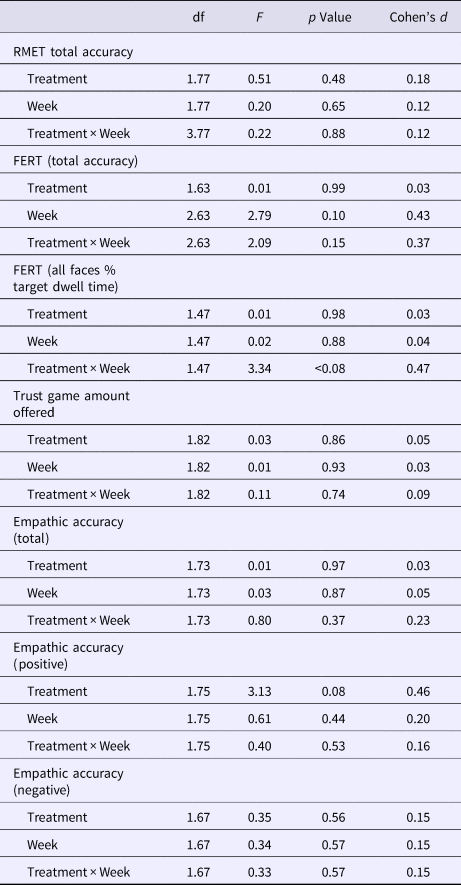
Mixed model ANCOVAs examined fixed effects for Treatment, Week, and the Treatment × Week interaction using baseline performance as a covariate (see Fig. 1 and Table 2). There were no significant main effects or interactions for any task. These findings suggest that CBSST failed to enhance social cognition and oxytocin failed to have an additive effect beyond CBSST.Footnote 3
Social cognition primary outcome results. (a) FERT: Facial Emotion Recognition Test Accuracy; (b) FERT: Facial Emotion recognition Test % Dwell Time in target Interest Areas; (c) RMET: Reading the Mind in the Eyes; (d) Trust game Amount Trusted to partner; (e) Empathic Accuracy total Score; (f) Empathic Accuracy Positive Video Score; and (g) Empathic Accuracy Negative Video Score.

Results for primary social cognition outcomes

RMET, reading the mind in the eyes task; FERT, facial emotion recognition test.
Exploratory analyses
FERT accuracy
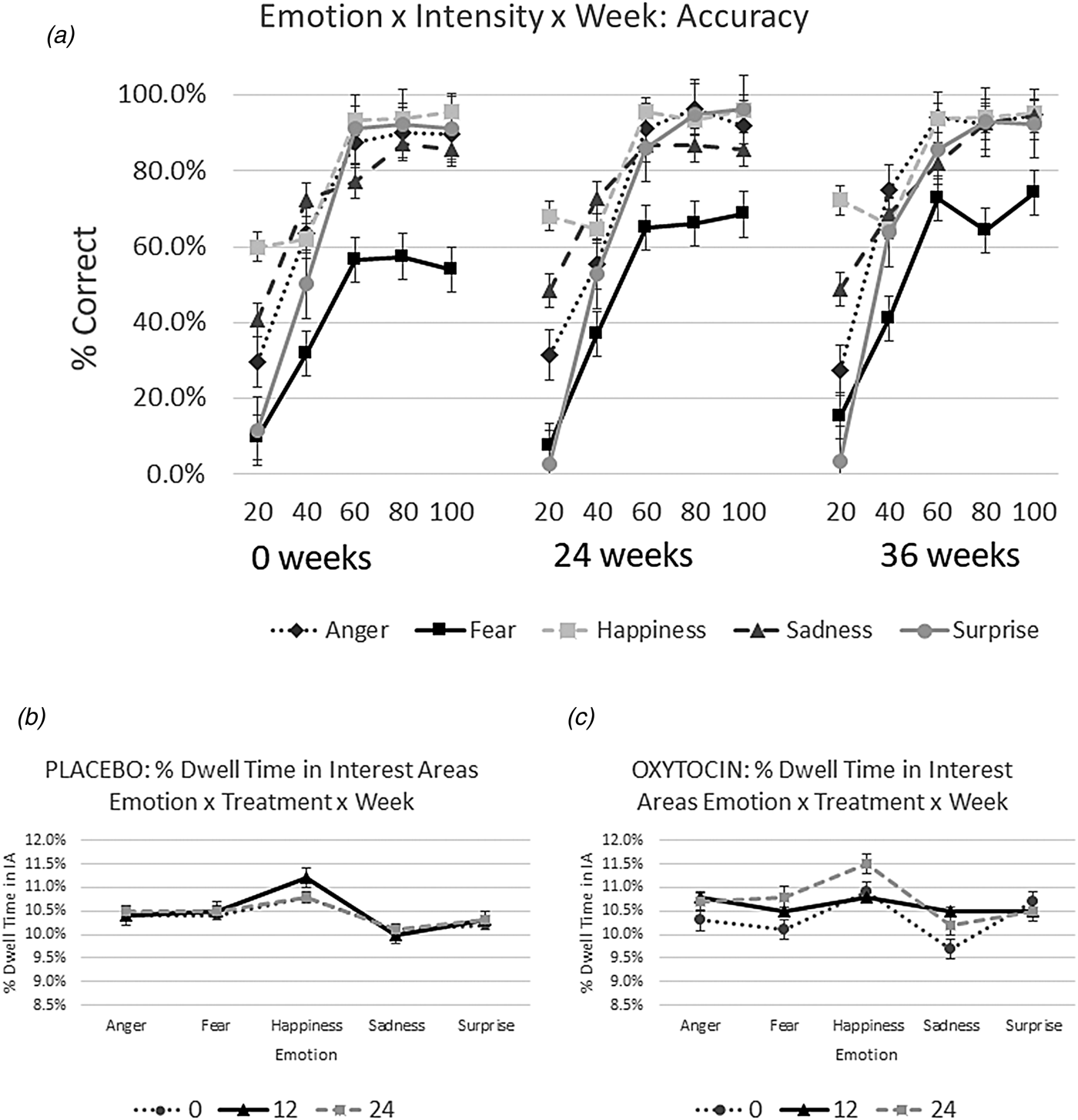
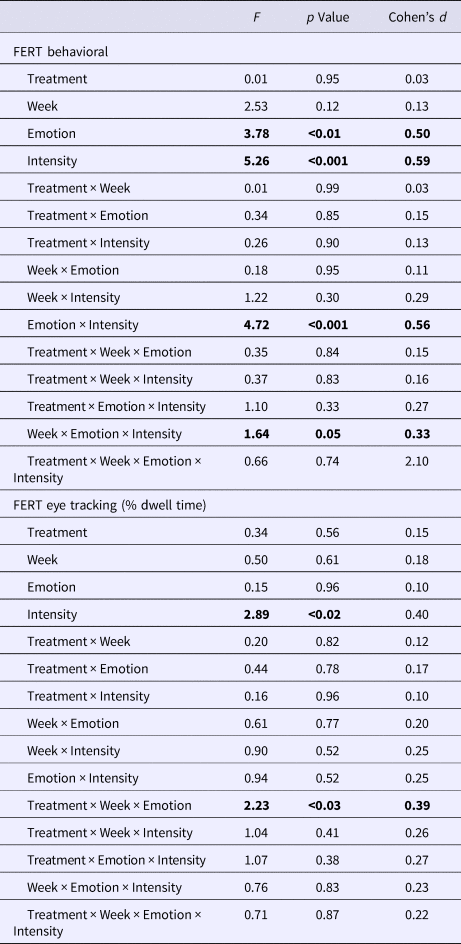
The main effects of Emotion and Intensity were significant, as well as the Emotion × Intensity interaction, reflecting relatively greater increases in accuracy with higher levels of stimulus intensity for anger and fear than happiness, sadness, or surprise. There was also a significant Week × Emotion × Intensity interaction indicating relatively greater gains in fear and sadness with increasing stimulus intensity than other emotions from week 0 to 36. All other main effects and interactions were non-significant (see Table 3 and Fig. 2).
Exploratory facial emotion recognition test results. (a) FERT accuracy; (b) placebo % dwell time in areas of interest; and (c) oxytocin % dwell time in areas of interest.

Results for secondary social cognition outcomes on the FERT

FERT, facial emotion recognition test.
Significance levels are included in the p Value
FERT eye tracking
The main effect of intensity was significant, suggesting greater gaze to target areas for higher intensity stimuli. There was also a significant Treatment × Week × Emotion interaction (see Table 3 and Fig. 2). As depicted in Fig. 2, this interaction reflects greater dwell time within target interest areas by the oxytocin than placebo group for happy faces as the duration of treatment increases.
Separate per protocol analyses were also conducted to evaluate those who met adherence criteria based on intranasal spray bottle weights. The analytic approach was identical to the primary and exploratory analyses. Results paralleled the intent to treat analyses and the pattern of results did not change for any of the variables of interest. Chlorpromazine equivalent dosage was not significantly correlated with task performance at baseline, end of study, or change from baseline to end of study.
Discussion
The current study examined the combined effects of oxytocin and CBSST on social cognition in schizophrenia. Results indicated that oxytocin had no added benefit above CBSST for enhancing behavioral indices of social cognition on any task. However, given that CBSST did not enhance social cognition in the placebo group, the current study represents a negative trial for social cognition. CBSST has not previously been tested for social cognition. We expected that the SCIT components added to the standard group CBSST protocol might lead CBSST to enhance social cognition. However, the CBSST + Placebo group showed improvements on only one task (FERT), as indicated by relatively greater gains in fear and sadness with increasing stimulus intensity than other emotions from week 0 to 36. The effect size for the FERT performance was comparable to prior SCIT studies. However, the addition of oxytocin prior to each group CBSST session had no additional benefit beyond CBSST alone for enhancing accuracy on discrete emotion conditions of differing intensity levels. Thus, the lack of an additive effect of oxytocin should be interpreted with caution given that the expected effect of CBSST on social cognition was not as prominent as one might expect based on the inclusion of therapeutic elements that targeted trust and empathy, in addition to facial affect perception.
There are several potential explanations for these null effects. First, CBSST was largely ineffective at enhancing social cognition, even when SCIT elements were added. The failure to see significant improvement in social cognition from CBSST across weeks suggests that it may not have been an adequate psychosocial intervention to combine with oxytocin for the purposes of enhancing social cognition. Given the failure to observe an effect of CBSST on social cognition, it is impossible to conclude whether the steroids in sports metaphor proposed in the introduction contributes to the null effects found in prior trials that administered oxytocin without a combined psychosocial treatment. Second, there are several additional methodological considerations beyond the limited effect of CBSST on social cognition. It is clear that oxytocin's effects are more complex than was originally assumed, and that many methodological and biological factors influence whether effects are observed on social cognition tasks (e.g. dosing, pharmacodynamics, whether oxytocin reaches intended neural structures, and receptor distribution) (Guastella and MacLeod, Reference Guastella and MacLeod2012; Bakermans-Kranenburg and Van Ijzendoorn, Reference Bakermans-Kranenburg and Van Ijzendoorn2013; Freeman and Young, Reference Freeman and Young2016; Leng and Ludwig, Reference Leng and Ludwig2016; Quintana and Woolley, Reference Quintana and Woolley2016; Quintana et al., Reference Quintana2018). It is possible that several of these factors contributed to the null additive effects of oxytocin. To disentangle these potential confounds, future studies could consider systematically manipulating certain variables. For example, it will be important to manipulate dose and observe clearance from the cerebrospinal fluid and blood to determine whether dosing impacts social cognition response. Interactions between arginine vasopressin and oxytocin should also be examined since differing doses may impact the relative equilibrium between these two neuropeptides (Manning et al., Reference Manning, Misicka, Olma, Bankowski, Stoev, Chini, Durroux, Mouillac, Corbani and Guillon2012). It will also be important to manipulate time between task and intranasal spray administration to determine whether pharmacodynamics have a direct effect on task response. Other person-related clinical (e.g. symptom severity and antipsychotic dosage), demographic (e.g. sex and age), and biological (e.g. shape of the nasal cavity and genetics) factors should also be systematically examined in large-scale trials (Bradley and Woolley, Reference Bradley and Woolley2017). Methodological influences should be considered carefully before ruling oxytocin in or out as an effective adjunctive pharmacological treatment.
Certain limitations should be considered. First, we did not obtain peripheral oxytocin levels to evaluate their role in individual differences in treatment response or establish an effect of treatment on changing endogenous oxytocin. This could have been important given that prior studies have demonstrated that individual differences in endogenous oxytocin levels at baseline are a significant predictor of treatment response (Parker et al., Reference Parker, Oztan, Libove, Sumiyoshi, Jackson, Karhson, Summers, Hinman, Motonaga, Phillips and Carson2017; however, see Lee et al., Reference Lee, Wehring, McMahon, Liu, Linthicum, Verbalis, Buchanan, Strauss, Rubin and Kelly2016). Second, we did not control for antipsychotic treatment, which has been shown to have important moderating effects on oxytocin treatment response in some studies (Bradley and Woolley, Reference Bradley and Woolley2017). Third, although prior studies have made a distinction between higher-order and lower-level social cognition, not all of our tasks map cleanly onto those dimensions, making conclusions about higher- v. lower-level social cognition difficult. Finally, this was a pilot trial designed as a preliminary test of efficacy. The study was by design not adequately powered to detect small and medium effects, such as those observed on the social cognition tasks.
Acknowledgements
The authors would like to express appreciation to the participants who devoted their time and effort to completing the study, as well as staff in Maryland and San Diego who facilitated the completion of the study. In particular, the authors want to acknowledge the late Claudia Denton, a master therapist who conducted treatment in the study and dedicated her life to helping individuals with psychosis.
Financial support
Supported by R34 MH100362 (P.I.: Robert W. Buchanan, M.D.) and R34 MH100410 (P.I.: Eric Granholm, Ph.D.).
Conflict of interest
The authors have no relevant conflicts of interest.
Ethical standards
The authors assert that all procedures contributing to this work comply with the ethical standards of the relevant national and institutional committees on human experimentation and with the Helsinki Declaration of 1975, as revised in 2008.