Introduction
Exposure to traumatic and life-threatening combat events leads to a diagnosis of post-traumatic stress disorder (PTSD) in approximately 14% of combat veterans (Schell & Marshall, Reference Schell, Marshall, Tanielian and Jaycox2008), and subthreshold symptoms are observed in many veterans who do not meet full diagnostic criteria. The broad range of PTSD symptoms observed in response to trauma, and the diverse clinical manifestations of the disorder, challenge the view that PTSD is a monolithic, categorical entity. As such, increased understanding of the neurobiological mechanisms underlying maladaptive responses to trauma may benefit not by contrasting groups of individuals with and without a categorical diagnosis, but rather by investigating continuous variability in different features of this heterogeneous disorder (Insel et al. Reference Insel, Cuthbert, Garvey, Heinssen, Pine, Quinn, Sanislow and Wang2010).
Recent neuroimaging studies in combat veterans have identified relationships between elevated hyperarousal symptoms and reduced amygdala volume (Pietrzak et al. Reference Pietrzak, Averill, Abdallah, Neumeister, Krystal, Levy and Harpaz-Rotem2015), and between re-experiencing symptoms and disrupted hippocampal resting-state connectivity (Spielberg et al. Reference Spielberg, McGlinchey, Milberg and Salat2015). Additionally, in civilian trauma survivors performing an emotional Stroop task, increased hyperarousal symptoms were associated with reduced medial prefrontal cortex (mPFC)–amygdala functional connectivity, and re-experiencing symptoms were associated with altered hippocampus–insula connectivity (Sadeh et al. Reference Sadeh, Spielberg, Warren, Miller and Heller2014). These studies implicate brain regions commonly identified in neuroimaging studies of PTSD – the amygdala, hippocampus and mPFC (Etkin & Wager, Reference Etkin and Wager2007; Milad et al. Reference Milad, Pitman, Ellis, Gold, Shin, Lasko, Zeidan, Handwerger, Orr and Rauch2009; Hayes et al. Reference Hayes, Hayes and Mikedis2012; Admon et al. Reference Admon, Milad and Hendler2013) – while suggesting that this circuitry may not be uniformly affected across all manifestations of PTSD. Instead, these brain regions may show distinct alterations corresponding to the relative dominance of particular symptoms.
To date, few studies have related specific dimensions of PTSD symptomatology to task-based functional magnetic resonance imaging (fMRI) activation, with one study investigating functional connectivity during emotional processing (Sadeh et al. Reference Sadeh, Spielberg, Warren, Miller and Heller2014) and a second relating state (rather than trait) symptomatology to brain activation during script-driven imagery (Hopper et al. Reference Hopper, Frewen, van der Kolk and Lanius2007). A particularly relevant but largely unexplored task in which to apply this analytic strategy is threat anticipation under conditions of uncertainty (Grupe & Nitschke, Reference Grupe and Nitschke2013). Exposure to threatening stimuli, such as mild electric shock, is a robust and ecologically valid stressor, and concurrent manipulations of uncertainty can illuminate individual differences of relevance for clinical anxiety that are not observed under conditions of certainty (Lissek et al. Reference Lissek, Pine and Grillon2006; Grillon et al. Reference Grillon, Pine, Lissek, Rabin, Bonne and Vythilingam2009). The anticipation of unpredictable threat should in particular target hypervigilance and hyperarousal symptoms, which are especially prevalent in veteran populations: one study reported equivalent levels of hypervigilance in veterans without PTSD as in civilian trauma survivors with PTSD (Kimble et al. Reference Kimble, Fleming and Bennion2013). Although maintaining a constant state of vigilance is adaptive in unpredictable and dangerous combat zones, this tendency is maladaptive for veterans returning to objectively safe, non-combat environments, and may contribute to other symptoms of hyperarousal such as disrupted sleep, increased startle responsivity, irritability and difficulty concentrating (Wilson et al. Reference Wilson, Friedman, Lindy, Wilson, Friedman and Lindy2001).
The current study investigated relationships between task-based functional activation and continuous variability in discrete PTSD symptoms related to combat trauma. We collected fMRI data from 51 combat-exposed veterans using a novel paradigm that orthogonally manipulated threat of shock and temporal predictability. In contrast to fear conditioning and extinction studies, cue–outcome associations were explicitly provided to minimize learning and memory demands. We related individual differences in different symptom clusters to anticipatory activation on a voxelwise basis within the dorsomedial and ventromedial PFC (dmPFC/vmPFC), amygdala and hippocampus, the regions most frequently implicated in neuroimaging studies of PTSD. We hypothesized that elevated symptomatology would be associated with increased dmPFC activation during threat anticipation and decreased vmPFC activation during safe anticipation (Etkin & Wager, Reference Etkin and Wager2007; Milad et al. Reference Milad, Pitman, Ellis, Gold, Shin, Lasko, Zeidan, Handwerger, Orr and Rauch2009; Hayes et al. Reference Hayes, Hayes and Mikedis2012). The specific role of the amygdala and hippocampus during prolonged periods of threat and safe anticipation is less clear (Mechias et al. Reference Mechias, Etkin and Kalisch2010; Satpute et al. Reference Satpute, Mumford, Naliboff and Poldrack2012), precluding specific directional hypotheses for these regions.
Method
Participants
Operation Enduring Freedom/Operation Iraqi Freedom veterans were recruited through community and online advertisements, and in collaboration with veterans’ organizations, the Wisconsin National Guard and the Madison VA Hospital. Following complete study description, written informed consent was obtained. A team of clinically trained interviewers administered the Clinician-Administered PTSD Scale (CAPS; Blake et al. Reference Blake, Weathers, Namy, Kaloupek, Klauminzer, Charnet and Keane1990) and Structured Clinical Interview for DSM-IV (SCID; First et al. Reference First, Spitzer, Gibbon and Williams2002) with supervision from a licensed clinical psychologist (J.B.N.). Exclusionary conditions included substance dependence within the past 3 months and current or past bipolar, psychotic or cognitive disorders. Although participants were assigned to one of two groups, we analysed data based on continuous variability in symptoms irrespective of group. Individuals in the control group were free of current Axis I disorders and had very low PTSD symptoms (CAPS scores < 10). Individuals in the post-traumatic stress symptoms (PTSS) group had PTSD symptoms occurring at least monthly with moderate intensity, and CAPS scores ⩾20. Current major depression or dysthymia was not exclusionary in the PTSS group. Current treatment with psychotropic medications (other than benzodiazepines or β-blockers) or maintenance psychotherapy was permitted if treatment was stable for 8 weeks prior to the beginning of the study (see online Supplementary Table S1 for complete participant characteristics).
A total of 58 veterans were enrolled, but due to the small number of eligible females (n = 4) analyses were conducted on male participants only. Two participants could not tolerate the shock and one was excluded due to excessive motion, resulting in a final sample of 51 subjects, 16 of whom met full PTSD diagnostic criteria. Of the other 35 veterans, 18 met diagnostic criteria for one or two of the CAPS subscales; 17 did not meet criteria for any subscales and were enrolled in the control group (see online Supplementary Fig. S1 for symptom distributions).
Procedure
During a pre-MRI visit, a series of 200-ms shocks between 0.5 and 5.5 mA were delivered to the participant's right ventral wrist to identify a stimulus rated as ‘very unpleasant, but not painful’ (a ‘3’ on the 0–5 scale). Participants then received task instructions, underwent a simulated MRI session, and completed self-report measures.
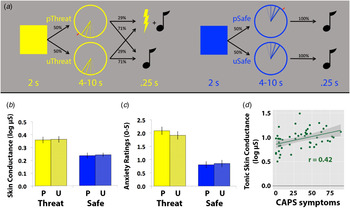
The MRI scan took place within 2 weeks of this visit. A single shock was delivered to confirm shock calibration levels, and a novel threat anticipation task (Fig. 1 a; movie 1) was delivered using PsychoPy 2 (Peirce, Reference Peirce2007). Participants were instructed on cue–outcome contingencies during the simulated MRI session and again immediately before the fMRI scan.
Threat anticipation paradigm, skin conductance responses and self-reported anxiety. (a) Schematic of the threat anticipation paradigm (see also movie 1). (b) Across all participants, skin conductance responses showed a main effect of threat, with elevated responses during threat v. safety. (c) Self-reported anxiety, collected at the conclusion of the anticipatory period on a subset of trials, revealed elevated anxiety ratings for threat v. safe trials. A significant threat x predictability interaction reflected greater (threat – safe) differences for predictable relative to unpredictable trials (F 1,50 = 12.18, p = 0.001; online Supplementary Results). (d) Post-traumatic stress disorder (PTSD) symptoms, measured using the Clinician-Administered PTSD Scale (CAPS), were positively correlated with tonic skin conductance. P, Predictable, U, unpredictable. In (b) and (c), values are means, with standard errors represented by vertical bars. In (d), the shaded area indicates 95% confidence interval. For a color figure, see the online version.

Each trial began with a 2-s presentation of a blue or yellow square, indicating threat of shock or safety from shock (counterbalanced). Next, the same color clock appeared for 4–10 s. On predictable trials, a red mark appeared in a random location and the anticipation period ended when a slowly rotating hand reached this mark. On unpredictable trials, no red mark appeared and participants could not predict the end of the anticipation period. On 12/42 threat trials, a 200-ms electric shock was delivered concurrently with a neutral tone. On the remaining threat trials and all safe trials, the anticipation period concluded with the same 200-ms tone only. Participants rated the unpleasantness of the shock on 75% of shock trials and anticipatory anxiety on 33% of no-shock trials. Trials were separated by a 5–9 s inter-trial interval.
Each of three task runs lasted 8 min and consisted of 24 trials. The scan included 42 threat trials and 30 safe trials, resulting in the same number of non-reinforced threat and safe trials (Schiller et al. Reference Schiller, Levy, LeDoux, Niv and Phelps2008). For each of the four conditions, there were twice as many trials with long (8–10 s) as short anticipation durations (4–6 s).
MRI data collection
MRI data were collected on a 3T X750 GE Discovery scanner using an eight-channel head coil and ASSET parallel imaging with an acceleration factor of 2. Data collected included three sets of echoplanar images during the threat anticipation task (240 volumes, repetition time = 2000 ms, echo time = 20 ms, flip angle = 60°, field of view = 220 mm, 96 × 64 matrix, 3-mm slice thickness with 1-mm gap, 40 interleaved sagittal slices), a T1-weighted anatomical image for functional data registration (‘BRAVO’ sequence, repetition time = 8.16 ms, echo time = 3.18 ms, flip angle = 12°, field of view = 256 mm, 256 × 256 matrix, 156 axial slices), and field map images. Visual stimuli were presented using Avotec fiberoptic goggles, auditory stimuli were presented binaurally using Avotec headphones, and behavioral responses were recorded using a Current Designs button box. Electrodermal activity was recorded from the distal phalanges of participants’ third and fourth fingers using Ag/AgCl electrodes (see online Supplementary Method).
fMRI data processing and analysis
fMRI data processing was carried out using FEAT (FMRI Expert Analysis Tool) version 6.00, part of FSL (FMRIB's Software Library; www.fmrib.ox.ac.uk/fsl). Preprocessing steps included removal of the first four volumes, motion correction using MCFLIRT, removal of non-brain regions using BET, spatial smoothing using a Gaussian kernel with 5 mm FWHM (full width at half maximum), grand-mean intensity normalization and high-pass temporal filtering.
First-level modeling of task data included predictors for threat and safe cues, each anticipation condition [unpredictable threat (uThreat), predictable threat (pThreat), unpredictable safe (uSafe), predictable safe (pSafe)], shocks, tones and the shock/anxiety rating periods. A double-gamma hemodynamic response function was convolved with a boxcar function with duration equivalent to each stimulus presentation; for the anticipation period, this regressor thus varied between 4 and 10 s (Grupe et al. Reference Grupe, Oathes and Nitschke2013). The first-level design matrix also included six motion parameters, first- and second-order motion derivatives, and a confound regressor for each time point with >0.9 mm framewise displacement (Siegel et al. Reference Siegel, Power, Dubis, Vogel, Church, Schlaggar and Petersen2014). Autocorrelation of time series data was corrected using FILM (Woolrich et al. Reference Woolrich, Ripley, Brady and Smith2001). Functional images were resampled to 2 mm3 isotropic voxels and registered to high-resolution T1 images and then Montreal Neurological Institute template space using FLIRT and FNIRT (http://www.fmrib.ox.ac.uk/fsl/fnirt/index.html).
Although participants were initially assigned to separate groups based on overall symptoms, we sought to identify neural correlates of continuous variability in PTSD symptoms irrespective of group. We thus regressed uThreat v. uSafe contrast estimates on total CAPS symptom scores across all 51 participants. Next, we conducted simultaneous multiple regression of uThreat v. uSafe contrast estimates on each of the three DSM-IV CAPS subscales: re-experiencing, emotional numbing/avoidance, and hyperarousal. This analysis accounts for shared variance across symptom clusters, and highlights unique variance in brain activation associated with specific symptoms above and beyond shared effects.
Primary analyses were conducted using small-volume correction over an anatomically defined mask including the mPFC, amygdala and hippocampus. The amygdala and hippocampus were defined using the Harvard–Oxford anatomical atlas with a 50% maximum likelihood cut-off (Desikan et al. Reference Desikan, Ségonne, Fischl, Quinn, Dickerson, Blacker, Buckner, Dale, Maguire, Hyman, Albert and Killiany2006). The mPFC was defined using the Wake Forest University PickAtlas (Maldjian et al. Reference Maldjian, Laurienti, Kraft and Burdette2003) and consisted of medial portions of Brodmann areas (BAs) 9, 10, 11, 12, 24, 25 and 32 anterior to y = 0 (Motzkin et al. Reference Motzkin, Newman, Kiehl and Koenigs2011; Shackman et al. Reference Shackman, Salomons, Slagter, Fox, Winter and Davidson2011). Secondary voxelwise analyses were carried out across the whole brain. Cluster threshold correction was applied to a priori masked regions and across the whole brain using a voxelwise threshold of p < 0.005, resulting in corrected significance of p < 0.05. All unthresholded statistical maps were uploaded to the NeuroVault.org database (http://neurovault.org/collections/1104/).
Results
Anticipatory anxiety ratings and skin conductance responses
Self-report and skin conductance data demonstrated that our novel task was effective in robustly eliciting anticipatory anxiety and physiological arousal, with greater self-reported anxiety ratings and skin conductance responses for threat relative to safe trials (Fig. 1 b, c; online Supplementary Results). Neither anxiety ratings nor phasic skin conductance responses were related to PTSD symptoms (online Supplementary Results). There was, however, a positive relationship between tonic skin conductance during the task and overall PTSD symptom severity (r 45 = 0.42, p = 0.003; Fig. 1 d) as well as scores on each CAPS subscale (re-experiencing: r 45 = 0.43, p = 0.003; avoidance/numbing: r 45 = 0.32, p = 0.03; hyperarousal: r 45 = 0.41, p = 0.004). Speaking to the specificity of this relationship to trauma-related symptoms, although Beck Anxiety Inventory (BAI) scores were also correlated with tonic skin conductance (r 45 = 0.30, p = 0.043), multiple regression analysis showed that tonic skin conductance levels were uniquely predicted by total CAPS scores (t 44 = 2.18, p = 0.035) and not BAI scores (t 44 = 0.08, p = 0.94).
Overall task activation and relationships with skin conductance responses
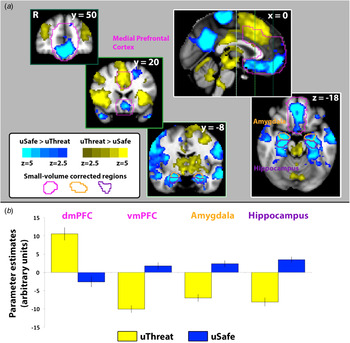
For a priori regions of interest, greater activation for uThreat v. uSafe was observed across the dmPFC, whereas greater activation for uSafe v. uThreat – resulting from relative deactivation during threat anticipation – was observed in the vmPFC and in clusters spanning the bilateral hippocampus and amygdala (Fig. 2). Across the rest of the brain, the contrast of uThreat v. uSafe showed activation consistent with previous instructed threat anticipation studies (Mechias et al. Reference Mechias, Etkin and Kalisch2010; Grupe et al. Reference Grupe, Oathes and Nitschke2013) (Fig. 2, online Supplementary Tables S2 and S3); results were highly similar for the pThreat v. pSafe contrast.
Overall task effects across the whole brain and in a priori regions of interest. (a) Results of a whole-brain corrected, voxelwise paired t test of unpredictable threat (uThreat) v. unpredictable safe (uSafe) trials, with a priori regions of interest outlined. (b) Within the medial prefrontal region of interest, greater anticipatory activation for threat v. safe trials was seen in the dorsomedial prefrontal cortex (dmPFC), whereas deactivation for threat v. safe was seen in the ventromedial PFC (vmPFC). A similar pattern of deactivation for threat relative to safe trials was seen in the amygdala and hippocampus. In (b), values are means, with standard errors represented by vertical bars. R, Right.

Regression of uThreat v. uSafe brain activation on skin conductance responses showed that elevated skin conductance responses were associated with increased anticipatory brain activation in an expansive network of threat-responsive regions (online Supplementary Fig. S2, Supplementary Table S4). Notably, the right dorsal amygdala – which did not show a main effect of threat condition – also showed this positive correlation with skin conductance responses.
Relationships between PTSD symptoms and activation in the mPFC, amygdala and hippocampus
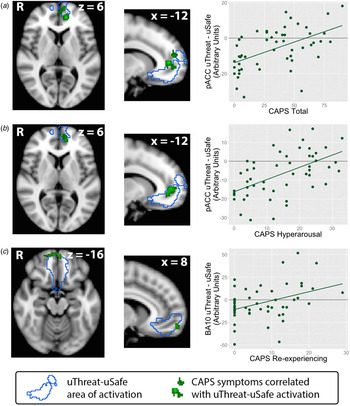
We next regressed brain activation during unpredictable anticipation on overall CAPS scores. Within the a priori masked region, CAPS scores were positively correlated with uThreat v. uSafe activation in the left pregenual anterior cingulate cortex (pACC), at the dorsal and anterior edge of the vmPFC cluster that showed deactivation for uThreat (Fig. 3 a).
Relationships between post-traumatic stress disorder (PTSD) symptoms and threat v. safe activation in the ventromedial prefrontal cortex. (a) Total scores on the Clinician-Administered PTSD Scale (CAPS) were positively correlated with anticipatory unpredictable threat (uThreat) v. unpredictable safe (uSafe) activation in the left pregenual anterior cingulate cortex (pACC, in green), in a region of the ventromedial prefrontal cortex (vmPFC) that showed deactivation for uThreat v. uSafe. (b) Simultaneous multiple regression of uThreat v. uSafe activation on all three CAPS subscales demonstrated that this relationship was driven by individual differences in hyperarousal symptoms. (c) The same regression analysis revealed a cluster at the ventral and anterior edge of the vmPFC (Brodmann area 10; BA10) in which activation was positively correlated with re-experiencing symptoms. Scatter plots illustrate relationships between symptom scores and average contrast estimates across each cluster, and do not represent independent statistical tests. Note: all clusters are small-volume-corrected (p < 0.05). R, Right.

Qualifying this relationship, however, simultaneous regression on the three CAPS subscales demonstrated that this relationship was driven specifically by hyperarousal symptoms, which were positively correlated with uThreat v. uSafe activation in an overlapping pACC cluster (Fig. 3 b). Furthermore, this simultaneous regression revealed an additional, more anterior/ventral vmPFC cluster (corresponding to BA10) in which uThreat v. uSafe activation was positively associated with re-experiencing symptoms (Fig. 3 c). In each of these vmPFC regions, relationships with PTSD symptoms were driven by responses to uThreat and not uSafe; in other words, higher symptoms were associated with less vmPFC deactivation during unpredictable threat anticipation (online Supplementary Fig. S3). Analogous regressions for predictable trials indicated that the pACC relationship with hyperarousal symptoms was specific to unpredictable trials, whereas a similar (but uncorrected) relationship between BA10 activation and re-experiencing symptoms was seen for predictable trials (online Supplementary Results; Supplementary Fig. S4).
Within the a priori masked region, hyperarousal symptoms were positively correlated with uThreat v. uSafe activation in a small, uncorrected cluster spanning the left posterior amygdala and anterior hippocampus (Montreal Neurological Institute coordinates: −22, −7, −17; 26 voxels). There were no threat-responsive dmPFC regions within the masked region that showed a relationship with total CAPS symptoms or any CAPS subscales. Furthermore, avoidance/numbing symptoms were unrelated to activation anywhere within the a priori masked region.
To address the possibility that vmPFC relationships with continuous symptom measures may have reflected categorical differences in veterans with high and low levels of PTSD symptoms, we conducted an additional regression analysis within the group of 34 subjects with elevated PTSD symptoms (see Method: Participants). Additionally, to address the possibility that current use of psychotropic medications may have affected our results, we repeated regression analyses within the 39 medication-free participants. Finally, we ran a regression analysis including BAI scores as a covariate to test whether the same effects would be observed when controlling for non-trauma-specific anxiety symptomatology. In each of these three cases, we identified highly similar small-volume-corrected vmPFC clusters that were associated with hyperarousal and re-experiencing symptoms (online Supplementary Figs S5–S7).
Relationships between PTSD symptoms and blood oxygen level-dependent activation: whole-brain results
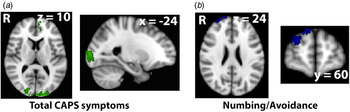
Outside of the a priori small-volume-corrected mask, total CAPS scores were positively correlated with uThreat v. uSafe activation in the lateral occipital cortex and occipital poles (Fig. 4 a). Additionally, emotional numbing/avoidance symptoms were negatively correlated with uThreat v. uSafe activation in an anterior and very superior aspect of the right medial frontal gyrus (Fig. 4 b).
Whole-brain relationships with post-traumatic stress disorder (PTSD) symptoms. (a) Across the whole brain, total PTSD symptoms on the Clinician-Administered PTSD Scale (CAPS) were positively correlated with uThreat v. uSafe activation in bilateral occipital poles. (b) Simultaneous regression of unpredictable threat (uThreat) v. unpredictable safe (uSafe) activation on all three CAPS subscales revealed an inverse relationship between emotional numbing/avoidance symptoms and activation in an anterior and very superior aspect of the right medial frontal gyrus. Note: all clusters are small-volume-corrected (p < 0.05). R, Right.

Discussion
Using a novel unpredictable threat anticipation task in a large sample of trauma-exposed combat veterans, we observed altered vmPFC responses to threat v. safety in veterans with elevated PTSD symptoms. Critically, this finding was expanded upon when considering variability in individual symptom clusters. The vmPFC cluster (corresponding to pACC) that showed a relationship with overall PTSD symptoms was actually related more specifically to hyperarousal symptoms. Furthermore, the analysis of individual symptom clusters revealed an additional vmPFC region (corresponding to BA10) in which activation was uniquely associated with re-experiencing symptoms. Thus, distinct PTSD symptom clusters were associated with functional alterations to distinct vmPFC subregions during unpredictable threat anticipation.
The presence of unique associations with distinct vmPFC regions is not surprising, given the functional heterogeneity of this region. The vmPFC is central to an array of diverse processes including self-reference, default mode function, mentalizing, prospection, memory retrieval, reward processing and valuation, autonomic control, fear inhibition and safety learning, to name a few (Roy et al. Reference Roy, Shohamy and Wager2012). Nonetheless, the extant PTSD literature has largely emphasized this region's role in safety learning and fear inhibition, and has not examined how its functional heterogeneity may be related to diverse symptoms of PTSD. Analytic strategies that treat PTSD as a unitary construct could have the consequence of smoothing across anatomically proximal (yet functionally distinct) regions that may be associated with different symptoms. Although our results warrant replication before strong conclusions can be made, they offer the intriguing possibility that examining continuous variability in distinct symptom clusters could paint a more nuanced picture of vmPFC dysfunction in different manifestations of PTSD.
Perigenual aspects of the cingulate cortex – including the pACC region associated here with hyperarousal symptoms – are centrally involved in threat appraisal and corresponding regulatory control of peripheral physiological response systems (Thayer et al. Reference Thayer, Ahs, Fredrikson, Sollers and Wager2012; Gianaros & Wager, Reference Gianaros and Wager2015). A speculative possibility is that disrupted function of this region may be associated with poorer autonomic control of heart rate or other peripheral physiological response systems, leading to the specific relationship we observed with hyperarousal symptoms. Notably, in a study of civilian trauma survivors using an analogous analytic strategy with functional connectivity data, hyperarousal symptoms were associated with altered functional connectivity between the amygdala and a similar pACC region during an emotional Stroop task (Sadeh et al. Reference Sadeh, Spielberg, Warren, Miller and Heller2014).
The relationship between re-experiencing symptoms and anticipatory activation in BA10 is interesting given this region's role – along with the hippocampus – in episodic autobiographical memory (Svoboda et al. Reference Svoboda, McKinnon and Levine2006) or projecting the self into the past or future (Tulving, Reference Tulving2002; Buckner & Carroll, Reference Buckner and Carroll2007). Re-experiencing symptoms of PTSD have previously been linked to altered hippocampus functional connectivity during the emotional Stroop task (Sadeh et al. Reference Sadeh, Spielberg, Warren, Miller and Heller2014) and at rest (Spielberg et al. Reference Spielberg, McGlinchey, Milberg and Salat2015). We did not identify a relationship between re-experiencing and task-based hippocampus activation, and it is unclear how altered BA10 function in the current study is related to these previously identified relationships between hippocampal connectivity and re-experiencing symptoms.
Activity in the vmPFC and other nodes of the default-mode network (DMN) is typically elevated at rest, and shows transient task-related deactivation (Raichle et al. Reference Raichle, MacLeod, Snyder, Powers, Gusnard and Shulman2001). In the current study, we saw deactivation in the vmPFC and across the DMN for threat v. safe anticipation (Fig. 2 a). Associations with hyperarousal and re-experiencing symptoms were primarily driven by the threat condition, meaning that greater symptoms were associated with less vmPFC deactivation during threat anticipation. This pattern of responses – similar to that observed across the DMN during negative picture viewing in major depressive disorder (Sheline et al. Reference Sheline, Barch, Price, Rundle, Vaishnavi, Snyder, Mintun, Wang, Coalson and Raichle2009) – suggests an inability to flexibly modulate activation within this region to reflect changing task conditions in the larger context of threat (Daniels et al. Reference Daniels, Mcfarlane, Bluhm, Moores, Clark, Shaw, Williamson, Densmore and Lanius2010; Sripada et al. Reference Sripada, King, Welsh, Garfinkel, Wang, Sripada and Liberzon2012; Garfinkel et al. Reference Garfinkel, Abelson, King, Sripada, Wang, Gaines and Liberzon2014). The observation of less vmPFC deactivation to instructed threat may appear at odds with previous observations of reduced vmPFC activation to learned safety in PTSD (Milad et al. Reference Milad, Pitman, Ellis, Gold, Shin, Lasko, Zeidan, Handwerger, Orr and Rauch2009; Rougemont-Bücking et al. Reference Rougemont-Bücking, Linnman, Zeffiro, Zeidan, Lebron-Milad, Rodriguez-Romaguera, Rauch, Pitman and Milad2011). One important distinction is that these previous studies found vmPFC hypoactivation for previously reinforced cues that were subsequently extinguished; by explicitly instructing our participants about cue–outcome contingencies that are never reversed, we may have tapped into distinct neurobiological processes in the current study. These discrepancies aside, a consistent finding across these studies is that PTSD is associated with undifferentiated vmPFC activation across conditions of safety and threat, whether learned or instructed, a message that resonates with recent fMRI studies linking PTSD to overgeneralization of threat responses (Morey et al. Reference Morey, Dunsmoor, Haswell, Brown, Vora, Weiner, Stjepanovic, Wagner, Brancu, Marx, Naylor, Van Voorhees, Taber, Beckham, Calhoun, Fairbank, Szabo and LaBar2015) or deficient context-appropriate modulation of vmPFC, amygdala and hippocampus activation (Garfinkel et al. Reference Garfinkel, Abelson, King, Sripada, Wang, Gaines and Liberzon2014).
We did not identify relationships between PTSD symptoms and activation in the amygdala or hippocampus, both of which showed deactivation during threat anticipation. Although these regions are not consistently implicated in instructed threat anticipation studies (Mechias et al. Reference Mechias, Etkin and Kalisch2010), the robust deactivation to threat in the amygdala was somewhat surprising, given this region's canonical role in the expression of fear and anxiety (notably, in the dorsal amygdala we observed increasing activation to threat in participants with stronger skin conductance responses; online Supplementary Fig. S2). An important consideration in interpreting this effect is the time course of amygdala involvement. The amygdala responds phasically to threat cues but does not continue to respond in the absence of new information about threat (Mechias et al. Reference Mechias, Etkin and Kalisch2010; Grupe et al. Reference Grupe, Oathes and Nitschke2013); to the contrary, deactivation to sustained periods of threat has been observed in at least four prior studies using prolonged anticipatory periods (for a review, see McMenamin et al. Reference McMenamin, Langeslag, Sirbu, Padmala and Pessoa2014). Additional work is needed to clarify the functional significance of this sustained deactivation and to investigate relationships with the frequently observed amygdala hyperactivation in PTSD (Etkin & Wager, Reference Etkin and Wager2007).
Because we focused exclusively on male combat veterans, further research is needed to determine whether findings generalize to female veterans or civilian trauma survivors. Future research is also needed in a no-trauma control group to characterize normative behavioral and neural responses on this novel task. An additional limitation of the current study is that our inclusion criteria targeted distinct ranges of CAPS scores, excluding those veterans with scores between 10 and 20. Although effects involving the entire sample were still observed in a group of 34 veterans with elevated PTSD symptoms (online Supplementary Fig. S5), future work adopting this approach should include veterans across the entire range of PTSD symptoms. Finally, nearly 25% of participants were on psychotropic medications at the time of scanning, although the exclusion of these participants resulted in the same results despite a reduced sample size (online Supplementary Fig. S6).
In summary, individual differences in hyperarousal and re-experiencing symptoms showed unique relationships with distinct regions of the vmPFC during the anticipation of unpredictable threat. These results provide a fruitful example of investigating individual differences in discrete dimensions of PTSD, and suggest that similar approaches may shed new light on neurobiological mechanisms of this heterogeneous disorder.
Supplementary material
For supplementary material accompanying this paper visit http://dx.doi.org/10.1017/S0033291716000374
Acknowledgements
The authors thank the participants for their military service and their involvement in this study, as well as the Wisconsin National Guard, the Madison VA Hospital, and other veterans’ community organizations for their assistance in recruitment. The authors also thank Kate Rifken, Andrea Hayes and Emma Seppala for help with study planning and execution; Regina Lapate and Robin Goldman for critical comments and suggestions; and Michael Anderle, Lisa Angelos, Isa Dolski, Ron Fisher, Frank Prado, Jacob Ruse and Nate Vack for technical and administrative assistance. This work was supported by a grant from the Dana Foundation to J.B.N.; a grant from the University of Wisconsin Institute for Clinical and Translational Research to Emma Seppala; grants from the National Institute of Mental Health (NIMH) R01-MH043454 and T32-MH018931 to R.J.D.; and a core grant to the Waisman Center from the National Institute of Child Health and Human Development (NICHD) P30-HD003352 to Marsha Seltzer. D.W.G. was supported by a Graduate Research Fellowship from the National Science Foundation. None of these sponsors played a role in design and conduct of the study; collection, management, analysis and interpretation of the data; preparation, review or approval of the manuscript; or decision to submit the manuscript for publication. Portions of this work were previously presented at the 20th annual meeting of the Cognitive Neuroscience Society, San Francisco, CA, 15 April 2013; at the Anxiety and Depression Conference, Chicago, IL, 29 March 2014; and at the 44th annual meeting of the Society for Neuroscience, Washington, DC, 17 November 2014. D.W.G. had full access to all of the data in the study and takes responsibility for the integrity of the data and the accuracy of the data analysis.
Declaration of Interest
R.J.D. serves on the board of directors for the following non-profit organizations: The Mind and Life Institute and Healthy Minds Innovations. D.W.G., J.W. and J.B.N. report no conflicts of interest or financial disclosures.