The rationale for creating a database to track paediatric and congenital cardiac anaesthesia
In 2007, three major manuscripts concerning cardiac arrest in children were published, one of which centred on children with congenital cardiac disease and the other two on children undergoing all types of surgical and non-surgical procedures.Reference Bhananker, Ramamoorthy and Geiduschek1–Reference Flick, Sprung and Harrison3 The Pediatric Perioperative Cardiac Arrest (POCA) registry was a multi-institutional effort in which participants anonymously reported all episodes of cardiac arrest in children aged 18 and younger resulting in chest compressions or death at the time of surgery or within 24 hours.Reference Bhananker, Ramamoorthy and Geiduschek1, Reference Morray, Geidusheck and Ramamoorthy4 This project was begun in 1994 and data collection and analysis continued through 2004, at which time further data collection was put on hiatus. Subsequent examination of the detailed data forms allowed the investigators to assess the relative contribution of anaesthesia to the cardiac arrest or death. The most recent publication from the Pediatric Perioperative Cardiac Arrest group was a follow-up to their original publication in 2000.Reference Morray, Geidusheck and Ramamoorthy4
Investigators at Children’s Hospital Boston have been collecting anaesthetic data on their own patients since January 2000.Reference Odegard, DiNardo and Kussman2 The publication of this data through December 31, 2005, as part of an internal Quality Assurance program, represents a significant effort to determine contemporary complications specific to paediatric cardiac anaesthesia, both in the Operating Rooms and in outlying locations such as the Cardiac Catheterization or Radiology Suites. One of the difficulties associated with determining causality in this patient population is the interdependent nature of anaesthesia, surgery, and patient physiology. The authors examined each incident with a panel of three paediatric cardiac anaesthesiologists, and with a subsequent review by a paediatric cardiac surgeon, before assigning causality. Children’s Hospital Boston reported that in their series of 5,213 cardiac patients from 2000 to 2005, there were 41 arrests in 40 patients for an overall frequency of 0.79%, with anaesthesia playing a significant role in 11 of the 41 cases, or in other words, 21.1 cardiac arrests per 10,000 anaesthetics. This compares to their previously reported anaesthesia-related incidence of 2.7 cardiac arrests or death per 10,000 anaesthetics in all patients during roughly the same time period.Reference Zglesweski, Graham and Hickey5
Another institution with a long history of anaesthesia data collection, The Mayo Clinic in Rochester, Minnesota, United States of America, has also recently reviewed their experience with cardiac arrests in children.Reference Flick, Sprung and Harrison3 A consistent factor in all of these studies is that children with underlying congenital cardiac defects are at a much higher risk of arrest than children without these defects. The incidence of arrest at the Mayo Clinic for children during non-cardiac procedures was 2.9 per 10,000 versus 127 per 10,000 for children undergoing cardiac procedures, a 30-fold increase in risk. This data however does not attempt to assign anaesthesia causality and therefore represents all risks. Sub-analysis related to causality, age, and type of surgery further stratified their data. Of their 92,881 patients, 4,242 were for cardiac procedures. Within the 54 children who suffered a cardiac arrest or death undergoing a cardiac procedure, age played a significant role, with neonates having the highest risk. Anaesthesia was not identified as a causative factor in any of the cardiac surgical arrests or death.
As is evident from the newest data, even the busiest of programs have a low frequency of anaesthesia-related cardiac arrests or death because of the low incidence of these events. As a consequence, it is necessary to harvest data over many years to collect any meaningful numbers, during which time major changes in patient management may occur. For example, the initial Pediatric Perioperative Cardiac Arrest study attributed many arrests to the use of the anaesthetic agent halothane, a known cardiac depressant. By the time of the follow-up publication seven years later, halothane had been replaced almost entirely in North America by sevoflurane, an anaesthetic agent with far less cardiotoxicity. Likewise, there has been a trend in recent years towards intra-operative or early extubation of cardiac patients. This trend is probably safe, but there have been no large scale studies to validate the concept or determine what, if any, complications may be occurring in these patients.
One of the only mechanisms for accurately determining the incidence and outcomes of low frequency events is to aggregate large amounts of data from multiple sources. To that end, the Congenital Cardiac Anesthesia Society has joined with the Society of Thoracic Surgeons Congenital Database Task Force to incorporate anaesthesia-specific data points into their surgical registry, which is now the largest single reporting site for children and adults undergoing surgical repair of congenital cardiac malformations in North America.
The Congenital Cardiac Anesthesia Society
The Congenital Cardiac Anesthesia Society was formed in 2005 by representatives from many of the busiest congenital cardiac surgical programs in North America, including Children’s Hospital Boston, Children’s Hospital of Philadelphia, the Hospital for Sick Children in Toronto, Texas Children’s Hospital in Houston, Lucille Packard Children’s Hospital at Stanford University in Palo Alto, California, the Cleveland Clinic Children’s Hospital, Children’s Healthcare of Atlanta Sibley Heart Center, Arkansas Children’s Hospital, Children’s Hospital Los Angeles, CS Mott Children’s Hospital in Ann Arbor, Michigan, and others. The Congenital Cardiac Anesthesia Society is a subsidiary organization of the Society for Pediatric Anesthesia and is also affiliated with the Society for Cardiac Anesthesia. Dean Andropoulos is the President of the Congenital Cardiac Anesthesia Society and David F. Vener is the Chair of their Database Committee. Membership is open to all individuals providing anaesthesia-related care for children with cardiac defects or an interest in the field. In addition to education, a major function of the organization is the development of this database.
The Joint Congenital Cardiac Anesthesia Society – Society of Thoracic Surgeons Database Initiative
After discussions with all interested parties, in order to minimize the redundancy of information and take advantage of a shared data structure, the data fields for the database were selected in coordination with the existing data fields in the databases of The Society of Thoracic Surgeons Congenital Heart Surgery Database and the The European Association for Cardio-Thoracic Surgery. For an additional fee, Society of Thoracic Surgeons Congenital Surgery Database participants may elect to submit their anaesthetic data to be pooled anonymously with the other participating centres during their annual harvest of data. The Joint Congenital Cardiac Anesthesia Society – Society of Thoracic Surgeons Database will therefore become an optional module of The Society of Thoracic Surgeons Congenital Heart Surgery Database.
The symbiotic relationship between congenital cardiac surgery and congenital cardiac anaesthesia supports the creation of a common database for these subspecialties. Multiple potential benefits can be realized through the operationalization of the planned strategy to develop this joint database initiative linking the paediatric and congenital cardiac surgical database with the paediatric and congenital cardiac anaesthesia database:
• Minimization of data entry burden
• Minimization of the cost associated with data entry
• Minimization of the cost associated with database maintenance
• Utilization of common nomenclature based on The International Pediatric and Congenital Cardiac Code [www.ipccc.net]
• Utilization of common fields of data within the database
• Utilization of common definitions within the databaseReference Jacobs, Mavroudis and Jacobs6, Reference Jacobs, Jacobs and Mavroudis7
• Utilization of common standards within the database Reference Jacobs, Mavroudis and Jacobs6, Reference Jacobs, Jacobs and Mavroudis7
• Development of common strategies to report outcomes
• Development of common quality improvement initiatives.
An example of the use of shared definitions and standards within the database is the recently published consensus definition of “the period of anesthetic care”.Reference Jacobs, Jacobs and Mavroudis7 This definition has been adopted by The Society of Thoracic Surgeons Congenital Database Task Force and the Congenital Cardiac Anesthesia Society:
“Of special note, the period of anesthetic care is the time interval that begins when the anesthesia team assumes responsibility for patient care (either at OR Entry Date and Time or at the time when the patient is picked up by the anesthesia team from another unit in the hospital) and ends either:
1. when the anesthesia team relinquishes responsibility for patient management (ie, when the patient is turned over to the postoperative care team, commonly the ICU team); or
2. at the time of discharge from the recovery room (if the patient is transported to the recovery room) or when another healthcare team assumes responsibility for the patient; or
3. when report is given to the intensive care unit nurses, in instances in which the anesthesiologist is also the intensivist.
In addition, the period of anesthetic care includes any time spent in the preoperative period during which the patient is being evaluated by the anesthesia care team.”
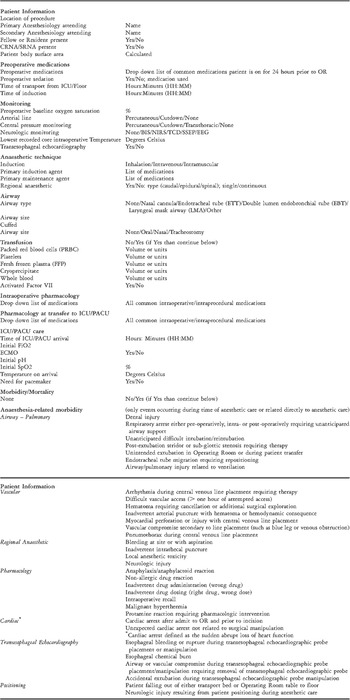
The proposed fields of data for the Joint Congenital Cardiac Anesthesia Society – Society of Thoracic Surgeons Database are shown in Table 1. These fields will be reviewed periodically and modified as necessary. At the time of the writing of this manuscript, December 2007, the Congenital Cardiac Anesthesia Society is awaiting final approval of the documents coordinating their efforts with the Society of Thoracic Surgeons before data collection begins. Interested parties may contact the first author of this manuscript directly or receive more information about the Congenital Cardiac Anesthesia Society at the following website: [www.pedsanesthesia.org/ccas].
The proposed fields of data for The Joint Congenital Cardiac Anesthesia Society – Society of Thoracic Surgeons Database Initiative.

Efforts towards globalization and international collaboration
Efforts are ongoing to make this initiative a global project. Initial collaborative discussions have taken place with Dr. Ehrenfried Schindler about the possibility of linking this initiative with the European Association of Cardiothoracic Anaesthesiologists [www.eacta.org]. Dr. Schindler and his European paediatric cardiac anaesthesiology colleagues have reviewed the planned list of fields for the database as shown in Table 1 and have provided input and suggestions to shape the evolution of this list. The final selection of database fields will be made through a collaborative effort involving surgeons and cardiologists from Europe and North America. Input from other continents is certainly welcome as well. It is certainly possible and desirable that the planned anaesthesia module of The Society of Thoracic Surgeons Congenital Heart Database has an identical module in the congenital cardiac database of The European Association for Cardio-Thoracic Surgery and The European Congenital Heart Surgeons Association. These European and North American Congenital Heart Surgery Databases have functioned as sister databases with identical nomenclature and database fields and definitions.Reference Jacobs, Mavroudis and Jacobs6–Reference Jacobs, Jacobs and Maruszewski9 The incorporation of anaesthetic data into the effort should follow a similar strategy.
This project should also ideally spread beyond North America and Europe. Efforts to involve Africa, Asia, Australia, and South America are necessary and already underway under the leadership of The World Society for Pediatric and Congenital Heart Surgery.Reference Jacobs and Anderson10–Reference Jacobs, Tchervenkov and Jonas13 The possible eventual creation of a multisocietal Global Organization for Pediatric and Congenital Heart Disease might further support the globalization of these efforts. In the interim, globalization of the collaborative surgery and anaesthesia initiative is certainly supported by multiple entities:
• The MultiSocietal Database Committee for Pediatric and Congenital Heart Disease
• The International Nomenclature Society for Pediatric and Congenital Heart Disease
• Congenital Cardiac Anesthesia Society
• The European Association of Cardiothoracic Anesthesiologists
• The World Society for Pediatric and Congenital Heart Surgery
• The Society of Thoracic Surgeons
• The European Association for Cardio-Thoracic Surgery
• The European Congenital Heart Surgeons Association
• The Congenital Heart Surgeons’ Society.
The creation of a joint cardiac surgery and anaesthesia database is another step towards the ultimate goal of creating a database for congenital cardiac disease that spans both geographical and subspecialty boundaries.
Acknowledgement
We thank The Children’s Heart Foundation (http://www.childrensheartfoundation.org/) for financial support of this research.