By most measures, Daniel Augustus Tompkins was a highly unlikely opponent of totalized Chinese exclusion. The owner of three cotton mills and a New South booster editor, Tompkins presided over a racially segregated labor force and had much to say about the necessity of white supremacy for the progress of the South, the nation, and the world.Footnote 1 So why, on March 14, 1906, did he testify before the U.S. House of Representatives' Committee on Foreign Affairs, expressing his opposition to immigration officials' overzealous enforcement of legal barriers against Chinese immigration? Existing approaches to the racial politics of migration to the United States, which have emphasized the interchangeability of anti-black and anti-Chinese racisms in the nineteenth century, make it difficult to account for Tompkins' actions: they would lead us to expect that he would defend both complete Chinese exclusion and black subordination on similar racial grounds.Footnote 2 This essay presents a new framework for conceptualizing migration, empire, and the politics of social differentiation that, among other things, will make sense of this seemingly unlikely intervention by a New South industrialist and racial ideologue in U.S. immigration politics. This framework brings together two traditionally separated fields of inquiry: migration history and imperial history.Footnote 3 By revisiting Chinese exclusion (and its seemingly odd critics) through an imperial lens, it hopes to demonstrate the value—indeed, the necessity—of connecting these two approaches in the larger effort to entangle U.S. and global histories.Footnote 4
The complex articulations between migration and empire have been mapped far more thoroughly in the historiographies of other empires: particularly in recent imperial historiographies of modern Europe, empires have been reconceived as vast, hierarchical networks of migration, information, force and rulemaking that carried and connected laborers, settlers, and administrators moving across global space.Footnote 5 With notable exceptions, the linkages between migration and empire have been far less explored in U.S. historiography, for two primary reasons. First, American scholarly paradigms for studying immigration were forged in the early twentieth-century United States in a context defined by powerful national-exceptionalist ideologies, and around the subject of European immigrants who were unconnected to the U.S. empire as conventionally defined. The result was a foundational scholarship that emphasized “voluntary” migration, the question of immigrants' “assimilation,” and the vindication of the United States as an exceptionalist “nation of immigrants.”Footnote 6
Second, and perhaps more fundamental, was a widespread, exceptionalist denial of empire as a category relevant to the United States in both scholarly and public life. Shaped by long-standing fears of “empire” as the tragic destiny of overextended republics and encouraged by Cold War ideological imperatives to attach the charge of “imperialism” to the Soviet Union as fervently as they repelled it from the United States, many American historians across the twentieth century—but far from all—rejected “empire” as a term of scholarly art. There could be no imperial history of migration, simply put, because the United States was not, or did not possess, an “empire.”
This denial of empire had decisive—and unfortunate—implications for the transnational turn in the writing of U.S. history that emerged since the early 1990s, intensifying in the early 2000s. In fact, the transnational turn consisted of two distinct conceptual shifts. The first involved a call for the rescaling of historical analysis, a compelling and much-needed summons to reject the nation-state as the privileged or even exclusive “frame” or “container” for the reconstructed past. The proponents of transnational history persuasively traced this national framing to U.S. exceptionalist ideologies in which historians were implicated; in its place, they called for histories that did not discard the nation and/or nation-state as their subject, but approached and resituated it (alongside other themes) from subnational, regional, and global scales.Footnote 7 In the case of immigration historiography, transnational approaches brought into focus as never before migration's tangled directionalities, long-distance solidarities and impacts upon “home” societies.Footnote 8 A second, more problematic move drew a stark opposition between national-territorial borders and what were understood to liberated and liberating flows of people, goods, ideas, and institutions. The metaphors here drew heavily on popular and academic accounts of “globalization” in the 1990s that celebrated an increasingly interconnected world interrupted only by the residual powers of nation-states. Despite varying commitments to capitalist globalization, the proponents of transnational history often employed its language of neoliberal cosmopolitanism, emptying transnational flows of their power and politics, which were deposited in states understood in national-territorial terms. The nation-state may have been discarded as a conceptual “frame,” in other words, but when taken as a subject of inquiry it was, ironically, still understood in highly conventional, territorial terms. This fact, and the relative marginality of empire to discussions of the transnational turn, made it difficult to see the ways that U.S. imperial power stretched beyond, as well as within, the state's territorial borders.Footnote 9
By contrast, the account here both employs a notion of the imperial as a necessary tool for charting the U.S. global past and understands it as a dimension of power defined by the cultivation and disciplining of networks and flows as well as their obstruction. Take immigration, for example. While empire builders sometimes understood their interests to consist of the blockage of in-migrants perceived to be racial or ideological threats, they just as frequently promoted, sponsored, and channeled migration in pursuit of labor power, intellectual capital, ideological legitimacy, or the weaving of networks of diffusion and influence. Viewed from this imperial approach, it becomes clearer what Tompkins was up to in 1906 when he opposed the total barring of the Chinese. An estimated one-half of North Carolina's cotton production was exported abroad, three-quarters of these exports were sent to China, and cotton exports to China depended on the back-and-forth movements of Chinese merchants.Footnote 10 Speaking to the House Committee, Tompkins spoke stridently for the continued barring of Chinese “coolies,” but he also called for “rules and regulations for the travel of that upper class of China, for the social and commercial intercourse of that upper class with our people …” Tompkins' call for sharper legal distinctions between barred “coolies” and permitted merchants was a response to changes in U.S. immigration policy: since 1897, U.S. officials had, more and more, refused to mark this distinction, tightening their enforcement of restriction and harassing and deporting Chinese migrants with certified exemptions, including many merchants and students. Starting in 1905, a massive boycott of U.S. products led by Chinese merchants and students throughout the diaspora had seized the attention of Americans with interests in China. Industrialists such as Tompkins, whose mental world connected China's treaty ports and North Carolina's mills, proved willing to make public arguments for Chinese migration—specifically, for the migration of merchant elites—on the unsentimental grounds of commercial empire. “We would not be here if we did not think it interfered with American trade,” he said.Footnote 11
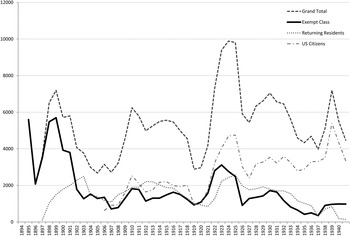
Graph of Chinese migration to the United States, 1894–1940. Significant number of Chinese migrants traveled as members of the “exempt classes”—merchants, students, teachers and tourists—as well as their families, through formidable, racialized barriers, because of the ways their transits were perceived to be beneficial to both U. S. and Chinese geopolitical projects. Figures from Helen Chen, “Chinese Immigration into the United States: An Analysis of Changes in Immigration Policies” (PhD, Brandeis University, 1980), Table 15, p. 181.

From this starting point, this essay uses an imperial approach to explore the politics of Chinese migration and exclusion in the late nineteenth and early twentieth centuries.Footnote 12 Seen in this way, the story shifts and one critical element rises into view: the class-based exemptions to the barring of Chinese migration that Tompkins was defending.Footnote 13 While after 1870, the Chinese were denied naturalization rights—birthright citizenship would only be confirmed in 1898—federal laws aimed at dramatically curtailing Chinese immigration did not bar all Chinese people from denizenship. Among the law's stipulations were entry rights given to merchants, students, teachers, and tourists: the “exempt classes,” as they were called. These small but significant holes—what might be called imperial openings—permitted 84,116 people to migrate legally between China and the United States during the exclusion era.Footnote 14 These legal breaches existed because empire builders in both China and the United States—in different ways, and bearing highly asymmetric power—freighted these social groups with geopolitical significance, as the means to advance their respective states' power. Where nativist and imperial agendas collided, the resultant policy pursued not a total absence of Chinese migrants, but the vulnerable, subordinated presence and mobility of those groups seen to be advantageous to American power.
Highlighting these “exempt classes” may prompt historians to rethink not only the history of Chinese immigration politics, but some of the basic concepts used to make sense of modern boundary-making regimes more generally. While the metaphor of a “wall” is often used to describe these policies, for example, the fact of exemption suggests that a better metaphor might be a “filter” whose gaps were carefully calibrated and relentlessly policed. To be clear, it was not that these laws were any less noxiously racist than they are usually understood to be. It was rather that they were more imperial, shaped not only by the essentializing hatreds of white nativists but by the agendas of those seeking to conquer China itself, who saw risks in a total exclusion that did not include a highly selective right to presence. The fact that the “exempt classes” were far from exempt from racist law and violence and marginalization in civil society makes their exemption from bars on migration and denizenship all the more striking and worthy of historical attention.
Fundamentally, this story is about how conflicts over the Open Door (through which American interests hoped to gain access to China) were connected to those involving the Golden Gate (through which Americans controlled Asian migrants' access to the United States). Where it was possible, U.S. diplomats, exporters, and missionaries hoped to keep these doors swinging on completely different hinges, so that commercial, missionary and state power in Asia might be compatible with “Asiatic exclusion.” (As Tompkins put it, the United States should “regulate our commercial relations with China so as not to entangle ourselves in this question of excluding Chinese labor at all, so far as that is possible.”Footnote 15) But these actors also anticipated—and were sometimes forcibly reminded by the Chinese—that a total closure of the door at San Francisco might lead to a slamming shut of the door at Shanghai. Their politically successful response, exemplified by the interventions by Tompkins and his colleagues, was to crack open the rapidly closing Golden Gate in the interests of a trans-Pacific empire. This is what might be called the politics of imperial anti-exclusion: the selective and hierarchical incorporation of foreign populations as a function of state and corporate efforts to project global power.Footnote 16
THE OLDEST AND THE NEWEST EMPIRE
By the mid-nineteenth century, the histories of China and the United States—what one missionary author called “The Oldest and the Newest Empire”—were woven together in relations of domination and interchange.Footnote 17 The United States took advantage of unequal treaties that secured legal sovereignty for Americans and unfettered commercial access in selected Chinese port cities. While U.S. corporations exported flour, kerosene, and especially cotton textiles, Protestant missionaries leveraged their exemption from Chinese jurisdiction to establish schools and mission stations in hopes of toppling “heathenism” for Christianity.Footnote 18 Chinese and U.S. societies were also profoundly linked by Chinese migration. Drawn by the Gold Rush and the labor demands of Western infrastructure, pushed by rural poverty and social dislocation, and connected by merchant-creditor and family networks, thousands of Chinese laborers traveled to the American West beginning in the mid-nineteenth century. When in 1868, a Chinese diplomatic mission headed by Anson Burlingame negotiated a reciprocal, open migration treaty between China and the United States, it represented a triumph for China's international recognition, and also meant victory for U.S. employers in their efforts to secure a displaced labor force.Footnote 19
Facing insatiable labor demands, American employers advanced the first iteration of an imperial argument for Chinese migration, casting it as an essential element of continental westward colonization: without the labor power, technical skills, and entrepreneurial acumen of the Chinese, they maintained, the western portions of North America would remain a desolate, otherwise underpopulated waste region unattractive to Euro-American “settlers.” You needed the Chinese, in other words, if you wanted California to be white.Footnote 20 This was the voice of labor contractors and employers, but also of Protestant missionaries. If, for many missionaries, God had apparently made a huge geographic mistake by placing something like one-half of humanity—the “heathen,” Asian half—on the other side of the world's largest ocean from the American and European base of the one true faith, Chinese migration to the United States was, far from a problem, a providential correction.Footnote 21
By the late 1870s, U.S. proponents of Chinese immigration were being challenged by an anti-Chinese exclusion movement anchored on the West Coast, but with growing national resonance. Anti-Chinese activists wired together racialized Republican critiques of industrial capitalism and earlier condemnations of Asian “coolies,” emerging with a racial-exclusionist ideology that fused Chinese migrants, coerced labor, racial impurity, and contagion unfreedom. Their arguments combined political-economic anxieties (the existential costs whites paid in competing with underconsuming Chinese migrant workers) and racial-sexual fears (the risks Chinese immigration posed to white American morality and purity). Increasingly, they made their power felt both in brutal mob violence against Chinese communities in the West, and in state and national electoral politics.Footnote 22
In response to nativist campaigns, President Rutherford B. Hayes sent new diplomatic missions to explore the possibility of revising the U.S. treaty with China to allow for restriction of some kind. In October 1880, a mission led by James B. Angell, president of the University of Michigan, pressed Chinese diplomats to give the United States a free hand in granting immigration rights. When Chinese diplomats refused this, the U.S. delegates advanced a treaty draft that permitted the United States to “regulate, limit, suspend, or prohibit” the “coming of laborers” but which exempted merchants, travelers, teachers and students; a “laborer” was defined as anyone not in these exempted categories. Chinese officials pushed back, insisting that artisans were not “laborers,” that restriction be limited to California, and that China have veto power over U.S. enactments on Chinese immigration. But they soon settled on an agreement that gave American authorities the unilateral power to restrict—but not exclude—Chinese immigration, as long as such restrictions were “reasonable” and communicated to the Qing government.
Ratified by the Senate in May 1881, the Angell Treaty granted the U.S. government the right to “regulate, limit or suspend” the in-migration of laborers, “other classes not being included in the limitation.” It stated that immigrants would not be subject to abuse or harassment. Teachers, students, merchants, and travelers “from curiosity” along with their household and body servants, were to be “permitted to go and come of their own free will and accord.”Footnote 23 Congress did not wait long to act. President Arthur vetoed a first bill barring Chinese laborers for twenty years on the grounds of its extreme duration, but signed into law a second bill lasting a presumably more reasonable ten years. The May 6, 1882, act, informally known at the time as the “Chinese Restriction Act,” barred “laborers” and required members of the “exempt classes” to obtain special documents—known as Section 6 certificates—to allow them to travel. The precedent-setting 1882 act, the first race- and nation-specific American bar to “free” immigration, was simultaneously a harsh prohibition and a highly selective grant of permission.Footnote 24
It makes little sense to identify this law as an exercise in either “race” or “class” politics, understood as mutually exclusive modes of power and social differentiation. It was both race and class legislation, marking a class division that applied only to the Chinese, defined as a racialized descent group. The most appropriate way of describing the nature of the law is to say that it registered both absolutizing and civilizing distinctions, permitting the transit of civilized and civilizing elements within the Chinese population, while barring those larger populations whose lack of civilization was thought to pose a threat to the United States.Footnote 25 This form of civilized restriction—directed exclusively at Chinese “laborers”—was perceived by influential elites in both the United States and China to be both compatible with their larger interests and easier to justify than a wholesale entry ban.
EXEMPT CLASSES
Between the passage of the 1882 act implementing the Angell Treaty and its repeal in 1943, tens of thousands of elite Chinese migrants (and those who successfully pretended to be elite) managed to enter the United States through openings in U.S. immigration law. It must be emphasized that these openings were sharp-edged: migrants bearing Section 6, “exempt class” documents were still frequently interrogated; harassed; and imprisoned; and often required legal challenges and the interventions of others, such as U.S. officials and missionaries, in order to enter the country. Despite these humiliating and costly obstructions, Bureau of Immigration statistics record that between 1894 and 1940, 84,116 members of the “exempt classes” were permitted entry, comprising 34 percent of the 248,298 legal Chinese admissions during these years; the rest divided between U.S. citizens (39 percent) and returning residents (27 percent).Footnote 26 The number of exempt entrants fluctuated greatly during these years, rising from a height of 7,195 in 1898, then crashing to a floor of just 714 in 1907 (for reasons that will soon become clear), then slowly climbing to an average of 1,338 in the 1910s. By 1923, it rose to a post-1898 high of 9,889, then was pressured downward by the highly restrictionist Johnson-Reed Act of 1924, steadying out at an average of 1,336 for the rest of the decade, and plummeting again after 1930. With regard to Chinese students, data collected by philanthropic groups after 1928 shows that during the last fifteen years of the exclusion era, an average of about 1,240 Chinese students was enrolled each year in U.S. colleges and universities. These figures indicate the extent to which U.S. policies constituted not a wall but a filter, permeable by design to those who reached the strict bar of civilization.
Exemption for the civilized shaped the sexual demographics of Chinese migration, alongside other factors. Into the early twentieth century, the exempt classes were presumed to be male by both U.S. officials and the courts. But by the 1910s, an increasing number of Chinese women were claiming exemption for themselves: between 1910 and 1924, 5 percent of Chinese women admitted to the United States did so as members of the “exempt classes” (especially as students); the first Chinese woman claimed merchant status in 1915. But exemption most affected Chinese women as wives and daughters, granted entry rights through their connections to exempted men. Between 1910 and 124, 35 percent of the 8,986 Chinese women admitted to the United States were either the wives or daughters of exempt men, the rest either U.S. citizens or the wives of returning laborers. This policy clasped exemption to heteronormativity: the exempt class was understood to be civilized, in part, where it was seen to conform to norms of domesticity and heterosexuality, in stark contrast with popular imaginings of “lewd,” unattached Chinese women or immoral, “bachelor” communities of Chinese men.Footnote 27
Unsurprisingly, questions of class definition troubled Chinese American diplomacy over the decades that followed the passage of the 1882 act. It was a problem that the world's identities and employments did not funnel neatly into the categories of laborers, merchant, teacher, student, and traveler “from curiosity.” These were all slippery categories of themselves—the state's metric of “curiosity” has yet to surface in the archives—and they were contingent and changeable in individuals' lives.Footnote 28 Especially early on, definitional ambiguity provided some opportunities for Chinese diplomats, who attempted to bend open exclusion's indistinct bars. During a congressional debate in 1882, for example, Chinese minister Cheng Tsao-ju forcefully argued that the ban against the migration of “laborers” should not include “skilled” workers. But by the mid-1880s, such efforts had failed: Congress insisted on the expansive restriction of “skilled and unskilled” Chinese laborers in 1882; in 1884, it narrowed the category of “merchant” to exclude hucksters, peddlers, and fishmongers; in 1893, the McCreary Amendments to the restrictionist Geary Act tightened the class vice further, denying “merchant” status to miners, fishermen, and launderers. In the move from legislation to enforcement, potentially explosive class ambiguities remained, as would become clear by the early twentieth century.Footnote 29
Why did Chinese officials concede to civilized restriction, initially in the Angell Treaty and later in the still more restrictive Gresham-Yang Treaty in 1894? For one, Qing diplomats found themselves in an extremely weak bargaining position: they were, after all, negotiating with a state that already exercised legal sovereignty over key corners of their own territory. And Qing officials felt they needed an ally in the United States, a “lesser barbarian” to balance against the “greater barbarians” that pressed in on it, especially Britain, Russia, and Japan. It helped that many saw the United States as a special aggressor, one that supported China's territorial integrity, unlike its rivals, and that (at least until 1898), had abstained from overseas colonialism. This larger imperial context meant that, however frustrating they found U.S. restriction, Qing officials felt they could only press the U.S. government so far.Footnote 30
China's diplomats in the United States also faced the complicated question of which of restriction's thrashing hydra-heads to strike at. They strove to gain legal and police protection for migrants, to win indemnity payments in the proliferating instances of violence or official abuse, to lessen the overall duration of restriction laws, and to protect the transit rights of all migrants across U.S. territory, all in a context in which Chinese diplomacy was novel, initially inexperienced, and overstretched. (The first Chinese ministers to the United States were also tasked with Cuba and Peru.)Footnote 31
There were, however, also changing perceptions of migrants and class politics among Qing officials. Into the mid-nineteenth century, the Qing empire legally barred outmigration, seeing emigrants as disloyal, decultured, and potentially revolutionary. Merchants—prominent within the Chinese diaspora—were denigrated within Confucian social hierarchies; returnees were subject to official and popular persecution. Qing prohibitions had not prevented the growth of an extensive Chinese diaspora throughout Southeast Asia, East Asia, and the Pacific, stretching as far as North America, the Caribbean, and South Africa, although notably the state had not trailed those migrants with consuls and diplomatic protection: until the late-1870s, the Middle Kingdom received delegations rather than sending them.
Initially, the protection of Chinese migrants in the United States (to the extent that it existed) was in the hands of the Chinese Consolidated Benevolent Association (CCBA), a coalition of native-place organizations run by merchants that loaned to, legally defended, provided relief to, and policed Chinese migrants. But by the 1870s, Qing officials concluded that the powers' intrusions in China and a mistreated diaspora demanded an overseas diplomatic presence; the fact that migrants could be exploited and attacked with impunity became symbolic of the Qing state's larger weakness and subordination. Beginning in 1873, the Zongli Yamen, the Qing state's foreign office, began opening overseas consulates in order to report on overseas communities, cultivate their loyalty, and encourage them to direct their resources back to the metropole.
Both the CCBA and the consulates that inherited its official functions had an ambivalent relationship to migrants, particularly to workers and the poor. As merchant-creditors, the leaders of the CCBA profited from labor migrants, but in times of economic crisis, these same groups could demand material support; they were also thought to attract white working-class violence with alarming frequency. For many Qing diplomats, workers, with their reputation for crime and immorality, were a liability as China sought civilized international standing. Even as they sought to blunt the abuse of laborers, both the CCBA and Qing diplomats demanded moral behavior from migrants, repatriated the indigent, and aided American police forces in repressing migrant activities perceived to invite white brutality, from opium dens and prostitution to secret and revolutionary societies. As early as the mid-1880s, officials' response to anti-Chinese violence in the United States involved preventing labor migrants from leaving China, “to restrict the evil at its very root,” as the Zongli Yamen put it.Footnote 32
At the same time, a rising generation of scholar-diplomats was finding its way toward a new, more affirmative vision of elite migrants that connected them to new, modern visions of Chinese empire. While emigrants were traditionally seen as a threat to empire, for reformers such as Huang Tsen-hsien and Hsueh Fu-ch'eng, migrants who cycled back to metropolitan China might strengthen it. Traveling merchants meant customs receipts, vectors for the importation of crucial Western technologies, and the accumulation of capital and expertise necessary for Chinese industrialization. Circulating students and tourists might take lessons away from the industrial powers for possible adaptation. To cultivate these migrants' loyalties, the Qing state not only needed to protect them abroad, but to prevent their harassment at home. “To drive fish into other people's nets, or birds into other people's snares is not a clever policy, but this is what we have been doing,” observed Hsueh in a June 1893 memorial to the Qing court. Britain, Holland, and other nations had “used our subjects to cultivate deserted islands and have succeeded in turning them into prosperous ports.” Properly channeled, migrants might provide an economic lifeline in China's struggle to reconstitute its sovereignty. “Once China is in trouble and needs help, it can depend on its overseas subjects,” Hsueh concluded, citing the Confucian axiom “if [the] branches flourish, the truck will be secure.”Footnote 33
By the turn of the twentieth century, many Chinese officials had embraced exemption for the civilized not only as a necessity but as a virtue, emphasizing the restriction of migrant laborers (ideally by the Chinese state) and the protection of elite migration, which would both direct resources to the metropole and project the most civilized image abroad. Ideally, restriction would be achieved not by unilateral, stigmatizing U.S. legislation, but by means of a treaty that would itself acknowledge China's diplomatic standing. Wu Ting-Fang, China's minister to the United States at the turn of the twentieth century, defended exemption for the civilized against an onslaught of exclusionist pressure in a July 1900 essay in the North American Review entitled “Mutual Helpfulness between China and the United States.” Wu had no objection to the restriction of Chinese laborers. “If [Americans] think it desirable to keep out the objectionable class of Chinese,” he wrote, “by all means let them do so.”Footnote 34
But as enforced, the law “scarcely accomplishe[d] the purpose for which it was passed.” Intended “to provide for the exclusion of Chinese laborer only, while freely admitting all others,” ignorant U.S. officials had failed to discriminate between “the worthy and unworthy.” As a result, “the respectable merchant, who would be an irreproachable addition to the population of any country, has been frequently turned back, whereas the Chinese high-binders, the riff-raff and scum of the nation, fugitives from justice and adventurers of all types,” managed to enter “without much difficulty.” In place of exclusionist approaches that stigmatized all Chinese people, Wu sought to segregate—but not by race—the cosmopoli of the civilized and the unwashed. “Would it not be fairer,” he asked, “to exclude the illiterate and degenerate classes of all nations rather than to make an arbitrary ruling against the Chinese alone?” A literacy test for all immigrants would accomplish Chinese restriction's fundamental aims. It would have the virtues of both efficacy (it would be “practically prohibitory as far as all except the best educated Chinese are concerned”) and hegemonic legitimacy (it would be “just in spirit and could not arouse resentment in the Chinese breast.”)Footnote 35
Wu was responding to a newly aggressive, exclusionary phase in the enforcement of restriction that had begun in 1897, with President McKinley's appointment of Terence Powderly, an exclusionist and former labor leader, to the position of Commissioner of Immigration. Over the next ten years, Powderly and his successor, Frank Sargent, used administrative means to turn restrictionist laws to exclusionist purposes—filters into walls, one might say—in the hope of ending the Chinese presence in the United States. Armed with new legal decisions, officials whittled the “exempt classes” down to nearly nothing, relentlessly scrutinizing Section 6 certificates with new rigor and suspicion, erring on the side of expulsion, and arresting and deporting migrants with little semblance of due process. In 1901, Powderly reported that of the 2,702 migrants claiming exemption, the bureau had rejected 918, or one-third. In the first three years of his tenure, successful Chinese arrivals plunged by over 60 percent. After 1902, Sargent pursued a similarly stringent course.Footnote 36
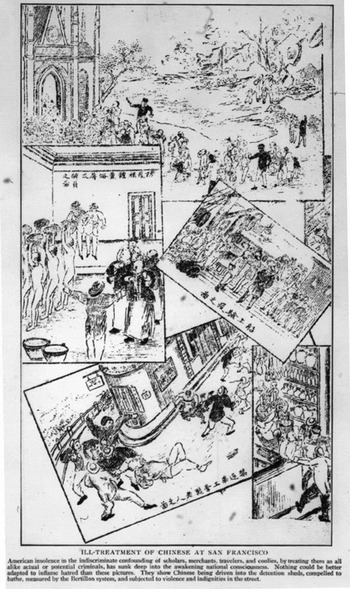
Chinese Americans had for decades refused to submit to oppressive restrictionist laws and policies, challenging them in court; subverting them; and, in the case of compulsory registration, openly refusing to comply.Footnote 37 But the Powderly and Sargent regulations appear to have represented an especially painful assault, subjecting even the most influential and Western-educated to both harassment and deportation. Ng Poon Chew, a San Francisco author, editor, and publisher of the newspaper Sai Yat Po, expressed his outrage at the exclusionist turn in a 1908 pamphlet entitled “The Treatment of the Exempt Classes of Chinese in the United States.” He railed against Powderly's and Sargent's “enlarging the definition of laborers to include many who were not laborers,” and their “narrowing the definitions of teacher, student and merchant so as to exclude many who were certainly of these classes.” He described the persecution and humiliating of Chinese students and merchants, from the arbitrary challenging of their documents, to intrusive medical examinations, to the demeaning use of the Bertillon system (an anthropometric mode of identification, used for criminals, which required subjects to strip naked.) The most concrete technology and symbol of abuse was the “Chinese” detention shed on the mail docks at San Francisco, a cramped, filthy warehouse—cleansed only of most human rights—where Chinese migrants were incarcerated while their cases were pending. He quoted the Secretary of Commerce and Labor affirmatively to the effect that it had never been the government's purpose “to exclude persons of the Chinese race merely because they are Chinese, regardless of the class to which they belong, and without reference to their age, sex, culture or occupation, or the object of their coming or their length of stay.” It had been, rather, “to exclude a particular and well defined class.”Footnote 38
Ng invoked Chinese bitterness and its potential to undermine U.S. imperial ambition in China itself. “Americans desire to build up a large trade with the Orient,” he wrote, “but they can scarcely expect to succeed if the United States Government continues to sanction the illegal and unfriendly treatment of Chinese subjects.” Exclusion had not only caused hard feelings but had been “disastrous also to commercial interests.” The great merchants who had previously paid an estimated one-third of San Francisco's customs receipts had returned home or chosen to do business in other countries. “If all classes of merchants, traders and business men had been encouraged to come and go freely,” he speculated, “it is probable that the trade between China and America would have increased rapidly and would now be much greater than it is.” The same estrangement had overtaken Chinese students who, finding themselves suddenly restricted, “go to other countries, and when they return to China do not speak favorably of the United States.” Those who had suffered “indignities” in the United States went home “full of resentment, and urge their countrymen to resist the violation of the treaty.” As the recent boycott demonstrated, exclusion—as opposed to restriction—gave rise to “irritating consequences.”Footnote 39
THE PROFIT OF BROAD-MINDEDNESS
By the time Ng penned these words, this particular line of argument—that the wrong kinds of Chinese restriction jeopardized U.S. imperial projects in China—was at least three decades old. Launched as early as the first waves of exclusionist politics in the 1870s, it comprised a second iteration of imperial anti-exclusion.Footnote 40 This version, promoted by U.S. diplomats, missionaries, educators and agricultural and industrial exporting interests, reflected late nineteenth-century structures of empire, characterized not by the question of labor power and the infrastructural colonization of North America, but the projection of U.S. market, military, and colonial power in Asia and the Pacific.Footnote 41 It offered little if any support for the migration rights of Chinese laborers, except to the extent that restricting them might alienate powerful Chinese actors. Instead, it centered on the cultivation, education, and disciplining of elites through their facilitated, back-and-forth movements between Asia and the United States: an empire of migrants more supple, stable, and invisible than an empire of territories.Footnote 42 By fomenting such privileged migrations, the United States might accrue what the Wall Street Journal called, in praise of Chinese students' education in the United States, “the profit of broad-mindedness.”Footnote 43
This new formulation of imperial anti-exclusion depended upon two distinct but interlocking understandings of the relationship between migration and empire. The first involved diffusion: the “exempt classes” must continue to be exempted because Chinese merchants, students, teachers, and tourists would serve as agents for the spread of American goods, beliefs, practices, and institutions in China itself. Merchants closed out of American warehouses and showrooms by exclusion laws, and engineering students restricted away from American blueprints and equipment models, would reject American product lines and find alternatives in more hospitable metropoles. The second element was legitimacy: the complete exclusion (rather than restriction) of the Chinese would undermine the minimal thresholds of goodwill required for ongoing influence and diffusion in China. A customer might buy your wares if he suspected you thought he was beneath you, but not if you slapped him across the face. If you did so, you courted serious backlash, with potentially crippling imperial consequences both overseas and domestically.
Missionaries enlisted these arguments constantly in their activism against exclusion. They had long opposed anti-Chinese restriction and violence, some on the grounds of spiritual equality, and some because keeping out exempted Chinese migrants would sever evangelical networks and sour promising converts on ostensibly “Christian” America.Footnote 44 Like commercial exporters with whom they were allied on the question of migration, missionaries sharpened their objections during the Powderly/Sargent eras, fearing that exclusion would staunch the necessary flow of actual or potential converts and brake the Gospel's forward movement into benighted China. While anti-Chinese demagogue Dennis Kearney had once rallied San Francisco mobs with the infamous applause line “The Chinese Must Go!,” missionary Esther Baldwin, by contrast, plaintively titled her otherwise sardonic, pro-immigration reply Must the Chinese Go? The exemplary figure here was missionary Luella Miner who, in 1902, lobbied on behalf of two Chinese converts, Kung Hsiang His and Fei Chi Ho, who had traveled to the United States with seemingly impeccable documents to study at Oberlin, only to be harassed and imprisoned by West Coast immigration authorities. Miner emphasized the men's indispensability to the evangelical enterprise in China: during the Boxer Rebellion of 1900, when “bloodthirsty mobs” had torched Protestant outposts, both men remained at the missionaries' side until the last possible moment. If the reign of Christ and the extension of Americanism were to be achieved in China and beyond, men and women such as Kung and Fei must pave the way but sadly, these “Christian heroes” who had “loyally stood by American citizens at the gates of death, were denied the privilege of landing on American shores.” The two men eventually arrived at Oberlin months into the school year, but only through the intervention of missionary advocates, the Chinese consul-general and, ultimately, the U.S. Attorney General.Footnote 45
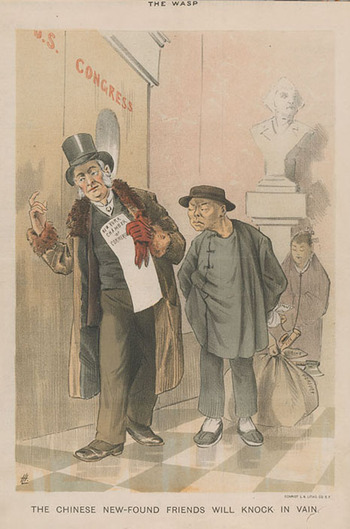
This 1889 cartoon from The Wasp criticizes the U.S. corporate efforts—here represented by the New York Chamber of Commerce—to lobby Congress on behalf of the entry of Chinese migrants and the vices they carry with them. The woman standing behind the Chinese man may be his wife—a reference to the permission granted to the spouses of the “exempt” to migrate—or she may (in reference to the “Vices” in the man's bag) be a symbol of prostitution, consistent with the attribution of “immorality” to Chinese migrant women. Source: The Wasp: v. 23, July–Dec. 1889, Library of Congress.

If missionaries lent moral energy to anti-exclusion, its power was ultimately rooted in commercial export. Imperial anti-exclusion's most consistent journalistic home was in the pages of trade publications, especially the New York Journal of Commerce and the journal of the American Asiatic Association (AAA), a lobbying organization consisting of U.S. exporters to Asia. In these settings and the lobbying efforts they spurred, exporters made the case for the exemption of the civilized and against total exclusion as the way to secure the smooth transit of goods across the Pacific.
It was never the goal of most imperial anti-exclusionists to change Americans' minds about the Chinese—”This is not a time, of course, to defend the Chinese race,” steamship entrepreneur Maxwell Evarts put it during a February 1902 Congressional hearing—but the pursuit of empire produced, and perhaps called for, visions of the Chinese sharply at odds with both exclusionist and Jim Crow formations.Footnote 46 While exclusionists cast the Chinese en masse as irreconcilable others, anti-exclusionists made what they thought were careful class distinctions that complicated (without fully undermining) the racialization of the Chinese. Some Chinese were civilized: enough like Americans to consume and diffuse their goods, practices and institutions; these baseline similarities and expanding Chinese wants would produce a happy, upward spiral of assimilation. As many anti-exclusionists would relate, virtually any American who had spent time haggling with merchants, relying on compradors and interpreters, or educating mission students could tell you that it was ridiculous not to mark distinctions of civilization among the Chinese. Speaking to congressional audiences, Tompkins had employed a striking analogy to illustrate the importance of registering class distinctions among Chinese migrants. The United States, he said, must deal with “two sets of people as wide apart as the upper and lower classes of China” as it had with “two classes who were as far apart as the slaveowner and the slave.”Footnote 47
John Barrett, commercial enthusiast and former U.S. minister to Siam, offered a similar kind of unsentimental education in the middle of a January 1900 essay on “Our Interests in China.” Americans who thought of “the Chinaman” as “a barbarian or a savage” labored under “sad error.” It was true that the “civilization of the masses” was “far below ours,” but the Chinese were “not an uncivilized people in the sweeping sense of the term.” There were a “large number of clean, well-dressed, bright-appearing men sprinkled among the countless coolies” on streets and in stores; and in coastal cities, Barrett had witnessed a “surprisingly large” proportion of “able, wealthy and prepossessing men.” The Chinese were also trustworthy: foreign merchants placed “implicit dependence” in their compradors. China's civilization was also observable in its receptivity to the outside world, “the capacity of the Chinese for assimilation of new ideas and methods of life and business.” There was a strong elective affinity between Chinese civilization and American desires to export; as Barrett put it, “our interests in China must naturally depend largely on the capacity and quality of the inhabitants.”Footnote 48
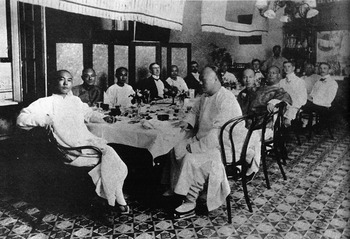
Proponents of civilized restriction upheld Chinese American sociability of the kind represented here—in a photograph of American merchants and Chinese compradors in Shanghai at the turn of the twentieth century. Proponents of civilized restriction upheld Chinese American sociability of the kind represented here as a superior venue in which to get to know the “character” of China and the Chinese. Such settings taught them—as they hoped to teach other Americans—of the differences that separated China's “exempt” classes from others. Source: Lynn Pan, Shanghai: A Century of Change in Photographs, 1843–1949 (Hong Kong: Hai Feng Publishing, 1993).

Arguments based on such street-corner ethnography, however, were subordinated to those that stressed expedience: the very real threats that overenthusiastic and insufficiently discriminating restriction policies posed to U.S. interests in China, especially through a possible boycott. Efforts to ground anti-exclusion politics in interest rather than, for example, anti-racial reform, can be seen in the prominence of Southern industrialists such as Tompkins among anti-exclusion lobbyists. There were materialist reasons for this, as noted above, but there were also ideological ones. Missionaries and educators opposing exclusion had been vulnerable to charges of soft-hearted philanthropy. But when the masters of Jim Crow industry lobbied Congress for the safe passage of Chinese elites to American shores, nobody believed that they acted out of humanitarianism.
Arguments for the practical necessity of civilized migration between China and the United States extended not only to exempted men but to their wives (whose existence in part defined the men as civilized in the first place). When, for example, in August 1897, Mrs. Gue Lim, the wife of a merchant, was admitted to the United States only to be arrested as an unregistered “laborer,” a judge decided to admit her in part on the basis of U.S. trade interests in Asia. “The maintenance and extension of American commerce with Oriental countries must redound to the benefit of the American people as a whole,” he wrote. Chinese merchants were “doing an important part in fostering this important interest,” and “no benefit whatever can accrue to the people of this country by depriving them of liberty to dwell within our borders, with their families…”Footnote 49
John Foord, tireless secretary of the AAA, condensed the core arguments against totalized exclusion—ones that he advanced in proliferating articles, petitions, and public testimonies—in a February 1902 editorial in the New York Times on “The Business Aspect of Chinese Exclusion.” Fearing that Congress might give legislative sanction to Powderly's harsh procedures, Foord requested a two-year extension of existing laws that would buy diplomats the time to negotiate a new U.S.-China treaty. Rising U.S. trade with China had produced a new landscape of imperial stakeholders in the politics of migration that transcended region and sector:
When gentlemen representing two-thirds of the cotton mill capital of South Carolina make a special trip to Washington to appear before a committee in Congress in opposition to more stringent measures of Chinese exclusion, and are reinforced by representatives of the mills of New England, or New York commission houses, and of the great exporting firms, it becomes evident that some new interests have become vitally concerned about the preservation of friendly relations with the Chinese Empire.
Foord prophesied the coming of a “new China” that, while it must “place itself in line with modern progress or cease to be a nation,” was also unlikely to “be content to be treated as if it were a pariah among nations.” Anticipating the potentially effectiveness of a Chinese boycott, he called for greater American attention to the “danger of provoking resentment and reprisal on the part of China by the imposing of insulting and humiliating conditions on the entrance of her people in the United States.” Could Americans “rightfully demand from China better treatment for our merchants than we accord to hers; the free admission of American students and travelers to all parts of her empire, while treating Chinese students and travelers as if they were potential criminals or the bearers of pestilence to our shores?”Footnote 50 Exclusionists' answer to this question—yes—would soon be challenged.
IRRITATING CONSEQUENCES
Until 1905, the threat of retaliation that always lurked in turn-of-the-century arguments for imperial anti-exclusion remained largely hypothetical. To be sure, the Boxer Rebellion's disruption of the American export trade with China had jolted manufacturers into a new and palpable sense of exposure, even as its devastation of Protestant enclaves had heightened missionaries' anxiety. In its wake, textile magnate Daniel Tompkins had introduced Minister Wu Ting-Fang to the ghosts of the uprising as they stalked the American South, in the form of shuttered textile mills. “Until two years ago,” Wu observed in 1902, “who would have thought that there was any connection between a local disturbance in the north of China and the cessation or interruption of the cotton industries of the Southern States of this country? But so it was.”Footnote 51 Wu appears to have relished the plausibility of this previously implausible connection, raising the specter of a Chinese boycott against U.S. restriction as early as 1900. But the powers had crushed the rebellion; the fear that Chinese activists might obstruct U.S. commercial empire initially kept few export capitalists awake at night.
This was the case despite the fact that restriction was entering a particularly harsh and expansionary phase. In 1897, Powderly had inaugurated his campaign to end the Chinese presence in the United States. Then, in 1898, the United States had destroyed the Spanish fleet at Manila Bay, occupied Manila, and wrested the Philippines from Spain at the bargaining table, if not from the Philippine Revolution on the ground. After February 1899, it was involved in a second war, this one to suppress an independent Philippine government. To whatever extent Chinese hopes for the United States were predicated on its anticolonialism, they were now fatally undermined; by trans-Pacific force of arms, the United States had become a “neighbor.” Most problematically, U.S. military officials had extended Chinese restriction to the Philippines, and to newly annexed Hawaii; in the former case, this threatened to cut off the regional lifelines of a centuries-old, commercially powerful Philippine Chinese population.Footnote 52
The intensification and expansion of Chinese restriction—particularly exclusionists' pursuit of congressional sanction for Powderly's new procedures—stirred imperial anti-exclusionists to action. In early January 1902, Foord was instructed to travel to Washington to gather testimony for a hearing before the Senate Committee on Immigration. On January 21, 1902, in the first of three public delegations he would organized over the next four years, Foord and an impressive cohort—industrialists and exporters from the Northeast and South, labor leaders, a former Secretary of State—ominously connected Powderly's exclusion of exempted Chinese migrants and the fortunes of U.S. commercial empire in China. They would return to these arguments once the boycott struck in July 1905, their tone one of deepening dread. Prior to the boycott, the prospect of declining U.S. commerce, educational power, and political influence was diffuse; during and after it, withering power was directly measurable in sagging orders for cotton goods, flour, and railroad equipment. Accordingly, the politics of imperial anti-exclusion took on a very urgent public life.
In their public presentations, AAA members and affiliates emphatically supported the ongoing restriction of laborers—“the laws against the admission into this country of that class of Chinese cannot be too stringent,” one witness put it—while hoping for “even more lenient clauses in those laws affecting the coming of Chinese merchants, travelers and scholars to the United States.”Footnote 53 Students played a key role in corporate imaginations of migration. These “people of light and leading,” as one speaker called them, would return to China with political allegiances, cultural orientations, and product familiarities that could prove critical in cutthroat imperial rivalries.Footnote 54 Charles Hamlin of the Boston Merchants' Association warned that a formalization of Powderly's rules would exclude forever “every young student, and those are the classes who come here and learn American methods and return to China and obtain positions of power and influence…”Footnote 55 For many, there were tangible ties between educational and commercial power: trade might not follow the flag, but it did follow the college tie. “It has been an almost invariable rule,” warned Silas D. Webb, a merchant based in China, that “it is impossible for Americans to do business in those places where students have been educated either in Germany, England or France.”Footnote 56 AAA lobbying on Chinese restriction was always self-consciously instrumental, surging and ebbing with feared or actual Chinese reprisal, on the one hand, and perceived extremities of enforcement, on the other. When Foord was asked by a member of the House Committee if he would be interested in restriction apart from its trade implications, he replied succinctly: “We are not pleading any altruistic principles …”Footnote 57
The boycott emerged from multiple histories, but its immediate trigger was the failure of Chinese and U.S. diplomats to settle on a new treaty to replace the expiring Gresham-Yang Treaty in 1904. As the existing treaty neared its end date, Chinese minister Liang Cheng proposed a replacement in August that he hoped would end administrative abuses and clarify and stabilize restriction, while liberalizing it and rendering it reciprocal. It boldly inversed restrictionist practice: rather than exempting specific elite categories from the rule of exclusion (and, thus, restricting expansively), Article 1 exempted “laborers” from the rule of admission, even as it defined laborers broadly. This might be summarized as a shift from “guilty until proven exempt,” to “innocent until proven laborer.” Liang's treaty draft also gave “non-laboring” Chinese residence rights throughout the United States, secured transit rights, guaranteed migrants due process of law, did not extend to Hawaii or the Philippines, and allowed China to enact restrictions on U.S. citizens in China. This modified version of exemption proved acceptable to U.S. diplomats. Indeed, W. W. Rockhill, Secretary of State Hay's advisor on Asian affairs, called Liang's treaty draft a “decided improvement” over the previous treaty; when it came to “non-laborers,” he wrote, “we should do everything possible to encourage and facilitate their coming to the United States.”Footnote 58
The Bureau of Immigration did not agree. Recognizing correctly that Liang's goal was to destroy administrative exclusion as it had encrusted around restrictionist law since 1897, the bureau's legal advisors rejected it, and countered with a draft that pressed further toward total Chinese exclusion. By November, this draft had won over the administration, but Liang nonetheless proposed another, still more assertive treaty in January, one that granted the Chinese state the power to bar and regulate U.S. labor migration to China. This was also dismissed by the bureau. By spring 1905, migration diplomacy and hopes for civilized, treaty-based restriction had collapsed.Footnote 59
For better or worse, the logjam was blown open with the May 1905 announcement in Shanghai of a boycott of U.S. exports, to begin in August. Although the idea had surfaced earlier, the boycott arose at the juncture of several historical streams, especially rising currents of Chinese nationalism that had been swelling in response to China's subordination to the powers, genuinely exclusionist enforcement on the West Coast, and a desire to strengthen the hands of Qing diplomats as the struggle over a new treaty imploded.Footnote 60 Among its most active sectors were students animated by nationalist sentiments (and who often opposed the United States' abusive treatment of Chinese migrants, regardless of class), and merchants alienated by the increasingly rough treatment of the previously exempted on the West Coast. Some protesters explicitly took on the question of class, insisting that activists' goal should not be the restoration of class exemption, but rather than the eradication of barriers to working-class and elite migration alike. “If the boycott is just for a few people's rights, it is not morally right, and our conscience will never be at peace,” wrote the novelist Wu Woyao to Zeng Shaoqing, a boycott leader in Shanghai.Footnote 61 In the 1907 protest novel Golden World, Biheguan Zhuren recounted divisions in the boycott movement in Shanghai between academic groups that wanted to repeal anti-Chinese restriction, and business sectors that sought only its modification. At a climactic moment, the novel's protagonist Zhang Shi, a beautiful, educated and Progressive female activist—and a direct descendent of a Ming dynasty general—calls a meeting seeking to eliminate American restriction laws and, speaking before five hundred women, rejects arguments for the restoration of class-based restriction:
Sisters! Aren't we the mothers of Chinese citizens?… In the eyes of a mother, there are only children, there are no classes/levels… Today we talk of boycott because foreigners have abused our overseas nationals. Of the overseas Chinese, workers are the most numerous, and they also suffer the most. If workers can get out of the bitter sea to the happy land, merchants and students will automatically have the same [opportunity]. If we revise the treaty in order to benefit the merchants and students only, workers will not have the same right. Sisters! Aren't they our children as well?Footnote 62
On the other hand, American officials eagerly sought and found Chinese interlocutors interested in the restoration of pre-Powderly class restriction, so long as guarantees of better treatment were forthcoming. As early as late July, Chinese merchants in San Francisco had approached a U.S. immigration official offering to oppose the boycott should the United States return to class-based exemption.Footnote 63 In September, Taft was sent from the Philippines to Guangdong, where he met with anxious American exporters, audaciously warned Qing officials that the boycott violated the existing treaty, and consulted with Chinese merchants whom he concluded would settle for the admission of non-laborers, the definitive acceptance of consular certificates, and the end of the detention sheds.Footnote 64 The struggle came to a head on December 3, when boycott leaders in Guangdong drafted a 15-point list of demands that closely followed the Liang treaty, including the exclusion of “laborers,” the admission of “non-laborers,” and non-restriction from U.S. territories. But both the list and a subsequent revision were rejected by a majority of delegates, who insisted on ending restriction itself.Footnote 65
For AAA officers, the news of a looming boycott was unsurprising. Its phantom having been raised for years, mass Chinese retaliation—an actually existing contradiction between the Open Door in Asia and the closing Golden Gate—was finally upon them. Indeed, the AAA appears to have welcomed the announcement of the boycott (if not the boycott itself) for its effectiveness in seizing the executive branch's attention. The irrepressible Foord was able to arrange a meeting with President Roosevelt at the Willard Hotel in Washington on June 12, 1905. The association's testimony against exclusion was thick with imperial anti-exclusionist tropes: sophisticated elites treated like “coolies,” disgruntled merchants, fleeing students, deflating sales figures. But two things set this meeting apart from the previous hearing in 1902. First was the unprecedented breadth and depth of Foord's bench of imperial interests: the anti-exclusionist, pro-restriction petition he submitted was signed by 29 corporate leaders representing banks, steel manufacturers, cotton mills, and trans-Pacific trading companies, more than half of them from the South. Second was the meeting's fearful tone: Foord worked hard to convey to Roosevelt the “extreme danger” the moment held for U.S. power.
The AAA succeeded in converting Roosevelt, who had favored the total exclusion of the Chinese to favor exemption for the “civilized,” which he pushed to restore by executive and diplomatic means. Two days after his meeting with the AAA, Roosevelt instructed Victor Metcalf, his exclusionist Secretary of Commerce and Labor, to issue “rigid instruction” that his officials be “courteous.” In a second letter, he called for orders “sufficiently drastic to prevent the continuance of the very oppressive conduct of many of our officials toward Chinese gentlemen, merchants, travelers, students, and so forth.”Footnote 66 Metcalf was intransigent, but found himself outnumbered on the Cabinet. On June 24, he begrudgingly issued Circular No. 81, which marked the official end of the Powderly/Sargent exclusion policy. In it, Metcalf reminded officials that “[t]he purpose of the Chinese exclusion laws is to prevent the immigration of Chinese laborers, and not to restrict the freedom of movement of Chinese persons belonging to the exempt classes.” Section 6 certificates were not to be challenged, and those possessing them “must be allowed to come and go of their own free will and accord.”Footnote 67
This collection of boycott flyers, gathered and reprinted by missionary Arthur H. Smith in 1906, shows Chinese people in the United States being attacked in the streets by American mobs, driven into detention sheds and forced to bathe. The lesson Smith took away from them was that “the indiscriminate confounding of scholars, merchants, travelers, and coolies” had “sunk deep into the awakening national consciousness.” From “A Fool's Paradise,” Outlook 82:12 (March 24, 1906), pp. 701–6.

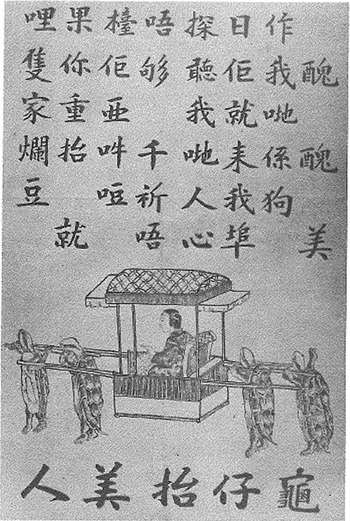
This popular boycott-era cartoon by Pan Dawei, a supporter of Sun Yatsen’s Revolutionary Alliance, was turned into a handbill and distributed in Canton on the eve of a 1905 “goodwill trip” to China by Alice Roosevelt, the President’s daughter. It urges local carriers to refuse Americans their labor. The caption reads: “Disgraceful! Disgraceful! Disgraceful! Americans take us for dogs. They’re going to come here and see if we’ve got enough heart… Whatever you do, don’t carry them!! Idiots!! If you carry them, you’re no better than a rotten bean in the corner of the house.” According to Chinese historian Ruth Rogaski, the image itself, of turtles carrying a woman in a sedan chair, works through visual puns. “Beauty” (Mei) is also the Cantonese word for America (A-mei-li-jia) or “Mei-guo” (Beautiful Country), while turtles are used in curses (a turtlehead is shorthand for penis, or “dick.”) “The 1911 Revolution in Guangdong: The ‘Anti-American Boycott’ Awakens Nationalism (2nd Installment),” Yangcheng Wanbao, excerpted in Renmin Wang, September 21, 2011. My thanks to Wong Sin Kiong for bringing this image to my attention, and to Ruth Rogaski for her interpretation.

Meanwhile, Roosevelt engaged the Qing government both before and after the boycott's official start on July 20. American diplomats who suspected that some Qing officials welcomed the boycott as a bargaining tool demanded that the Chinese state suppress it. They were not entirely wrong: the Qing state found itself in an awkward position, unaccustomed to mass protest, and fearful it might turn against the monarchy, but nonetheless pleased at the relative, if still meager, solicitude it had elicited from the Americans. When the initial Qing edict of August 31 yielded weak results, U.S. pressure intensified. Following a massacre of missionaries at Lienchow in November and riots in Shanghai in December, Roosevelt sent a naval force to Chinese coastal waters and considered military intervention. At the same time, now facing boycott pressure, the executive branch now evinced interest in precisely the kind of exemption policy that had been rejected previously. Rockhill arrived in Peking in May and bargained over treaty terms from June until August, only to find his agreements with Chinese officials vetoed by the Department of Commerce and Labor, as had Liang's. In mid-August, Rockhill suspended discussions, refusing to negotiate in the face of “coercion.” Chinese diplomats held out the hope that congressional action might break the deadlock.Footnote 68
During his December 5 State of the Union address, Roosevelt rejected exclusion and asked Congress for class-based restriction legislation. Even as his comments voiced familiar executive branch reservations about the possible repercussions of excessive Chinese restriction, they reflected the distinct conditions of the new century: the influence of commercial-imperial lobbies, a sharpened sense of the projection and fragility of American power overseas, a confidence about class restriction as a viable solution, and the imperial-presidential impulse to reassign certification to officials more directly controlled by the executive branch. Roosevelt was unequivocal on the need to exclude “the entire Chinese coolie class,” but in pursuit of this goal, “grave injustice and wrong have been done by this Nation to the people of China, and therefore ultimately to this Nation itself.” Drawing on the counsel of the AAA, Roosevelt called for two fundamental shifts: the certification of migrants in China rather than the United States, and inverted restriction, the exempting of “laborers” from the rule of admission:
Chinese students, business and professional men of all kinds—not only merchants, but bankers, doctors, manufacturers, professors, travelers, and the like—should be encouraged to come here, and treated on precisely the same footing that we treat students, business men, travelers, and the like of other nations.Footnote 69
He called for reform in the name of fairness, but also—shoehorned in at the end of his address—as a response to the ongoing boycott, “the resentment felt by the students and business people of China, by all the Chinese leaders, against the harshness of our law toward educated Chinamen of the professional and businesses classes.”Footnote 70 Refining—civilizing—restriction would mollify the specific interests he believed to be at the heart of Chinese protest.
These principles were embodied in the Foster Bill, drafted by Foord and introduced to the House by Congressman David J. Foster of Vermont on January 24, 1906. The restrictionist bill barred Chinese “laborers” (defined broadly) from entry to the United States or its territories, but allowed “all Chinese persons other than laborers” rights of entry and residence upon presentation of certificates. Moreover, credentials produced in China could not be challenged at American ports of entry. In support of the bill he had authored, Foord mobilized a third, impressive gathering of exporters, merchants, and manufacturers to testify before the House Committee on Foreign Affairs. Introducing the delegation on March 14, Foord claimed the bill would end the boycott by restoring class restriction and unblocking American commercial access to China, an assertion other witnesses echoed.Footnote 71
If there was a single weak spot that hostile committee members exploited in the claims of anti-exclusionist witnesses, it was the charged issue of American “concessions” in the face of Chinese “coercion,” what Congressman Denby called “the apparent yielding” to boycott tactics that passage of the Foster Bill might convey.Footnote 72 Faced with the question of “whether we would seem to be receding from our position upon the demand of China,” Tompkins went on the attack. “China has no right to make demands upon us,” he said, “but we should stand in the face of those demands and demand of them and send the necessary force to correct them.”Footnote 73 Bishop D. H. Moore of the Missionary Society of the Methodist Episcopal Church was still more bellicose. “Concede to the Chinese?,” he asked. The United States should “concede everything that justice requires us” to China and other nations, but after that, “if they encroach upon our prerogatives, then will be the time for smokeless powder and shrapnel.”Footnote 74
By late March, despite the AAA's formidable turnout, the Foster Bill was in trouble. Sargent conveyed the Bureau of Immigration's opposition, while Samuel Gompers of the American Federation of Labor spoke out stridently against it. Meanwhile, Californians on the subcommittee suggested that the boycott itself was a fiction; that even in its class-restrictionist guises, the treaty was a Trojan horse for “coolie” immigration. Roosevelt explored alternatives, but all were rejected by California delegates, who had promised committee members that their state would deliver a solid Republican delegation to Congress if they killed all action on restriction. Similar restrictionist efforts were fought back in the Senate. In both houses, the legislative reassertion of class restriction had proved impossible.Footnote 75
On one level, this was remarkable: large and commanding corporate interests had supported restriction, as had State Department officials, educators, and missionaries. But organized exclusionists had also come out in force, especially the AFL and the newly formed Asiatic Exclusion League (inclusive of Japanese and Koreans as targets), in an electoral context in which California's say was often final. The proponents of imperial anti-exclusion had also never managed to work through a defining paradox. While the boycott in effect made American empire-builders' arguments for them—the Open Door and the Golden Gate were fastened—answering it with reform proposals made them vulnerable to the accusation of caving to “outside” demands, surrendering American sovereignty to disorderly Asians.
The San Francisco earthquake of April 18, 1906, and resulting fire dealt a paralyzing blow to the diasporic protest campaign. Chinese Americans, whose financial support had sustained the boycott in China, suddenly confronted the destruction of Chinatown and a desperate struggle against physical removal. By this point, the Qing state had yielded to American demands, sending out new, sterner orders to officials on March 1 to repress the boycotters. By summer, the movement had diminished enough to allow both Chinese and U.S. officials to pretend it no longer existed. Diplomatic and legislative attempts to reassert class restriction had utterly failed.
Over the next year, however, exemption for the civilized would be rebuilt by executive power, as Roosevelt used his office to restore and strengthen imperial openings as a way of anticipating and absorbing resistance. In February 1906, new regulations were issued that broadened the legal definition of “student” and other exempt categories and dispensed with the insufferable Bertillon identification system. In March, the State Department issued more precise definitions of the exempt classes to its consuls overseas. In December, Roosevelt replaced as Secretary of Commerce and Labor the stubborn exclusionist Metcalf (who became Secretary of the Navy), with Oscar S. Straus, a German Jewish immigrant dedicated to restrictionist legality. Straus telegraphed his break with the Powderly/Sargent era in an April 1908 article entitled “The Spirit and Letter of Exclusion”: rather than seeking “to exclude persons of the Chinese race in general,” he wrote, “the real purpose of the Government's policy is to exclude a particular and well-defined class,” meaning Chinese laborers.Footnote 76
Speaking in Shanghai in October 1907 at a banquet hosted by the American Association of China, Secretary of War William Howard Taft celebrated the end of the recent unpleasantness. He attributed the recent “great improvement” in Sino-American relations to Roosevelt's efforts to render Chinese restriction more “considerate”; the “inquisitorial harshness” with which “classes properly admissible to the United States under the treaty between the two countries” had once been subjected had been “entirely mitigated without in any way impairing the effectiveness of the law.” The boycott crisis was happily “a closed incident, a past episode.”Footnote 77 (This last claim, at least, was false; as early as December 31, 1906, reports had surfaced in Hong Kong of a renewed boycott centered in Guangdong.)Footnote 78
The most significant expression of the new order was the immigration station at Angel Island, opened in 1909: the built environment of Progressive restriction.Footnote 79 Here executive branch aspirations for bureaucratic autonomy were written in water and rock: while the station's professional civil servants were more politically remote from West Coast labor politics, its detention halls were, by geographic plan, separated from possible intervention by Chinese families and communities in San Francisco. But despite its deliberate detachment, Angel Island was not impervious to Chinese activism. Protestors charged, for example, that witnesses testifying on behalf of their imprisoned compatriots lost an entire day in travel to the island and were treated disrespectfully by U.S. officials once there. When their demands for interpreters went unheeded, the nationalist Chinese Self-Government Society in Guangdong initiated another boycott; the Secretary of Commerce and Labor capitulated, allowing legal counsel and interpreters to attend hearings and permitting the Commissioner-General of Immigration to authorize witnesses to testify on shore.Footnote 80
By this point, Chinese restriction was more methodical, physically hygienic, “courteous” in its practical execution, and thoroughgoing in its distinctions of class (alongside those of citizenship and returnee status) than ever before. For all this, it received praise from many who had criticized the seemingly arbitrary exercise of restrictive power under Powderly and Sargent. Here, after over a decade of volatile, totalized exclusion, was a functioning exemption regime: it respected legal (and, for many, geopolitically necessary) distinctions between civilized and uncivilized Chinese migrants; it established its civilized character through a mysterious, technical, and self-referential language of procedure. More than previously, it respected the dignitary rights of those few migrants presumed to have dignity.Footnote 81
The bolstered restrictionist order altered the character of Chinese resistance. In many respects, the success of the new proceduralism was in evidence when protestors launched technocratic critiques that sought more palatable exercises of restriction, rather than the end to anti-Chinese restriction that some boycott activists had pursued. The normalizing of exemption for the civilized widened the gulf between exempted groups, U.S. citizens and returnees, on the one hand, and excluded “laborers” on the other. Ng's 1908 pamphlet, for example, had criticized complete exclusion by affirming exemption, quoting Roosevelt, Taft, and Straus on this score. “Chinese laborers of all classes have been excluded from the United States by mutual agreement,” he wrote, “and the Chinese themselves are not now asking for any change in this arrangement.” But they did ask for “fair treatment as other nationalities receive in relation to the exempt classes.”Footnote 82 When San Francisco's Chinese Chamber of Commerce petitioned President Taft in April 1911 for a variety of technical reforms, it did not “complain of the present exclusion laws,” but only asked “that they be fairly administered”; they did “not ask that Chinese laborers, skilled or unskilled, be suffered to come into the country.”Footnote 83
This essay has explored the geopolitics of Chinese exclusion and class-based exemption, as one window onto the historiographic prospects of an imperial history of trans-Pacific migration. This approach may have far broader implications for the writing of nineteenth- and twentieth-century histories. Take, for example, clashes between the United States and Japan over migration between 1905 and 1924. If the inter-imperial settlement that resulted, the “Gentlemen's Agreement,” left Japan more power and standing than had similar conflicts with China (it avoided stigmatizing laws by Congress), the practical outcome—class-based restriction that barred workers while permitting the entry of elites, within an overarching, racially differentiated framework—was strikingly similar.Footnote 84 While imperial history helps explain fractures in the edifice of anti-Asian restriction, it also sheds light on its ultimate dismantling during the Cold War, when its opponents argued that, as an element of the national origins quota system, it proved too rigid when it came to refugee admissions, and too offensive when it came to the pursuit of global legitimacy.Footnote 85 The structures of nineteenth-century anti-Chinese restriction—forged in the violent crucible where white settler colonialism melded with labor republicanism—would long endure, but ultimately prove incompatible with an aspirational mid-twentieth-century domain that was global, decolonizing, and contested by rivals, such as the Soviet Union, which projected anti-racist ideologies.
From 1882 through its repeal, and well beyond, Chinese restriction delivered enormous hardship and suffering to Chinese migrant families and communities. But the totalized racial separation desired by exclusionists proved elusive from the outset. It was made so by Chinese migrants' assertions of treaty protection, by the creative, coordinated deceptions of the “paper sons” of merchants; by the claims of U.S. citizens of Chinese descent; and by the pursuit of undocumented, cross-border immigration. Yet it was also true that, at the dawn of the twentieth century, much of the infrastructure of Chinese exclusion was vulnerable from “within.” The labor-republican political culture that had animated its working-class elements—casting “Asiatic” labor as the sinister antithesis of “American” work and wage standards—was being crushed by a new corporate-industrial order. The decentralized state structures that had permitted early twentieth-century federal immigration authorities on the West Coast to view Washington as merely another constituency that must be balanced against local, nativist forces (or not), were being reined in by centralizing bureaucracies. The territorial sense of imperial power that had animated the conquest and incorporation of North America through metaphors of absolute boundaries—moving borders become protective walls—was giving way to a sense that empire could transcend territory and achieve global scale by cultivating, managing, and controlling flows that served the ends of state power and capital accumulation. Borders continued to play an indispensable role in such an empire, but less as impermeable barriers than as restrictive channels that might harness global movements for purposes of state and corporate power.
Viewed in this light, the political survival of the “exempt classes” and the legislative failure of totalized exclusion in favor of exacting restriction are less surprising. Also less surprising is the vulnerability of a racial formation predicated on notions of utter separation, relative to a civilizing alternative that held out exemption and mobility—if not citizenship and social membership—to those who demonstrated the right kinds of moral, material and political self-mastery. For all the misery that exclusionists brought into the world, the future was not theirs.