The administration of perioperative antibiotics is recommended to reduce the risk of surgical site infections (SSIs). Reference Bratzler, Dellinger and Olsen1 Current guidelines recommend β-lactam surgical prophylaxis given proven efficacy, safety, and tolerability over non–β-lactams. Reference Bratzler, Dellinger and Olsen1,Reference Blumenthal, Ryan and Li2 For most procedures, cefazolin, or an equivalent cephalosporin, is the preferred, first-line surgical prophylaxis. Reference Bratzler, Dellinger and Olsen1 Administration of a non–β-lactam surgical prophylaxis (eg, vancomycin, clindamycin, etc) increases the subsequent risk for SSI by 50% or more. Reference Blumenthal, Ryan and Li2 Patients reporting an allergy to penicillin may not be prescribed cephalosporins due to fear of cross reactivity; however, a more comprehensive allergy history may lead to more optimal prescribing. Reference Solensky, Earl and Gruchalla3
Notably, β-lactams are the most common antibiotic class associated with allergic reactions. Approximately 10% of patients self-report a penicillin allergy; however, many reported allergies result from mild, cutaneous reactions, or from adverse effects (eg, diarrhea). Truly life-threatening, immunoglobin E (IgE)–mediated reactions are rare (<1%). Furthermore, IgE antibodies wane quickly within a 10-year period, and the cross reactivity of these antibodies to cephalosporins is ~2%. Collectively, these data indicate that >95% of penicillin-allergic patients are able to safely tolerate a cephalosporin. Reference Solensky and Khan4,Reference Shenoy, Macy and Rowe5
The Centers for Disease Control (CDC) and the American Nurses Association (ANA) designate high-quality allergy assessments as a major role for nurses within the antimicrobial stewardship program. 6 We implemented a quality improvement initiative using preoperative, nursing-driven, structured allergy assessments to improve the utilization of optimal surgical prophylaxis in elective surgery patients.
Methods
This quality improvement initiative was implemented at a quaternary-care academic medical center which performs >60,000 invasive procedures and admits ~55,000 patients annually. Patients with complex comorbidities may be referred to a preprocedure outpatient clinic (PPOC), staffed by trained nurses under the supervision of an anesthesiologist. The PPOC evaluates ~26,000 patients annually for a wide variety of procedures. Prior to this intervention, allergy assessments were conducted by nurses without the use of a structured allergy assessment tool.
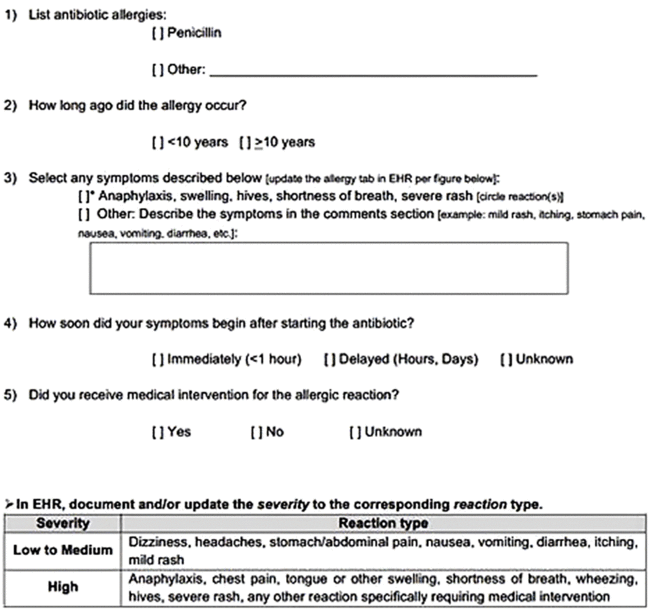
A simple, paper-based, 5-question, structured allergy assessment was developed by a multidisciplinary antimicrobial stewardship team to better characterize β-lactam reactions (Fig. 1). A job aid was included with the structured allergy assessment to help distinguish IgE-mediated reactions from non–IgE-mediated reactions, and nurses were trained to ask whether the patient had received other β-lactam antibiotics.
Structured screening tool.

The structured allergy assessment was implemented on December 14, 2017. Roll-out of the tool followed the “Plan, Do, Study, Act” principle. Nurses utilized the assessment for all patients presenting to the PPOC who reported a β-lactam allergy. Concurrently, antimicrobial stewardship pharmacists provided a series of in-service education sessions to nursing staff on using the structured allergy assessments, importance of allergy assessments, and optimization of surgical prophylaxis. Allergy information was documented in the electronic medical record (EMR) according to the normal routine during the PPOC visit, and nurses were encouraged to document relevant details from the structured allergy assessment in the EMR. Surgical prophylaxis was prescribed at the discretion of the surgeon.
The completed structured allergy assessments were collected and analyzed in aggregate after 5 months. Manual chart review evaluated allergy documentation in the EMR, surgical prophylaxis received, and any potential perioperative reaction to antibiotics. Only patients who subsequently received surgical prophylaxis after their PPOC visit were included in the analysis.
To assess the impact of the intervention on surgical prophylaxis administration, the EMRs of all patients who received surgical prophylaxis following PPOC evaluation from 2015 to 2016 were retrospectively reviewed for utilization of β-lactam surgical prophylaxis. Descriptive statistics were utilized to summarize the findings from the structured allergy assessments, and categorical variables were assessed using a 2-tailed Fisher exact test in SAS version 9.4 software (SAS Institute, Cary, NC).
Results
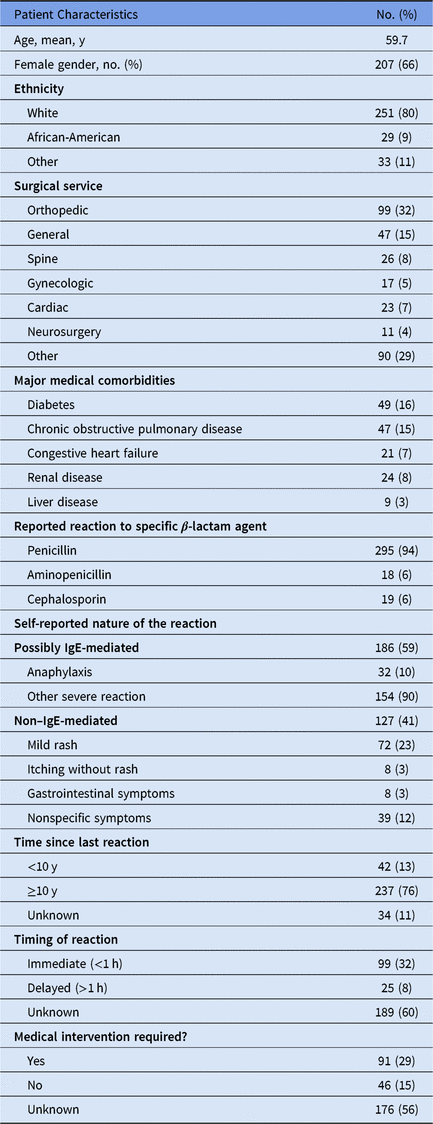
Between December 14, 2017, and May 17, 2018, the structured allergy assessment was conducted for 364 patients reporting a β-lactam allergy in the PPOC visit; 313 subsequently received surgical prophylaxis and were included in the analysis. Baseline characteristics are described in Table 1.
Clinical Characteristics of Patients Reporting a History of β-Lactam Reaction Presenting to the Presurgical Clinic and Who Underwent a Structured Allergy Assessment (n = 313)

Of 313 patients for whom a β-lactam allergy was reported, 295 (94.2%) reported an allergy to penicillin, 18 (5.7%) reported an allergy to an aminopenicillin, and 19 (6.1%) reported an allergy to a cephalosporin (18 patients reported allergies to multiple antibiotic classes). Overall, 271 patients (86.6%) described remote reactions (>10 years prior or could not recall). Symptoms possibly consistent with an IgE-mediated reaction were reported by 186 patients (59%). Mild or nonallergic reactions were described by the remaining 127 patients (41%), most often involving mild rash.
A β-lactam was ultimately administered in 245 of 313 patients (78.3%) who previously reported a β-lactam allergy, without any clinically significant reactions. Patients describing a mild or non-IgE type reaction were more likely to receive β-lactam prophylaxis (110 of 127, 86.6%) compared to those who reported a possible severe or IgE-type reaction (135 of 186, 72.6%) (odds ratio [OR], 2.44; 95% confidence interval [CI], 1.34–4.47; P = .0033).
We observed 135 patients who safely tolerated β-lactam prophylaxis (cefazolin in 131 of 135, 97.0%) despite initially reported symptoms consistent with a possible severe or IgE-type β-lactam reaction. Nearly all of these patients (131 of 135, 97.0%) described β-lactam reactions only to penicillin or aminopenicillins. The most common reactions described were hives (79 of 135, 58.5%) and swelling (34 of 135, 25.2%). Among these patients, most reported a remote reaction history (113 of 135, 83.7%), lack of immediate onset (77 of 135, 57.0%), and/or could not recall requiring medical intervention for the reaction (83 of 135, 61.5%).
In the preimplementation group, 1,182 patients with reported β-lactam allergies were evaluated at the same PPOC visit from January 2015 to December 2016 and subsequently received surgical prophylaxis. Among them, 857 patients (72.5%) received β-lactam surgical prophylaxis, which was significantly fewer than our postimplementation cohort (OR, 1.37; 95% CI, 1.01–1.87; P = .04). These patients had demographics (ie, age, gender, ethnicity, medical comorbidities, and surgical service) similar to those of our postimplementation group.
Discussion
Implementing a brief structured allergy assessment in a PPOC is a simple and effective way to increase the use of preferred β-lactam surgical prophylaxis in patients reporting prior β-lactam reactions. Our findings are consistent with those of Vaisman et al, Reference Vaisman, McCready and Hicks7 who reported that the use of alternative surgical prophylaxis decreased after implementing structured allergy histories. Importantly, this approach demonstrates the profound value of engaging nurses in antimicrobial stewardship programs to optimize antibiotic use. Nurses are often the first medical provider patients encounter in both inpatient and outpatient settings; thusly, their expertise in patient assessment is paramount in elucidating an accurate allergy history.
Our findings support the notion that most patients reporting a prior reaction to penicillin can safely receive alternative β-lactams (eg, cefazolin) and that historically reported β-lactam reactions are not a contraindication for future use of β-lactams. This finding is particularly exemplified by the substantial number of patients reporting a possible IgE-mediated β-lactam reaction yet safely tolerating β-lactam surgical prophylaxis. This finding is likely explained by waning antibody response, low rates of penicillin-cephalosporin allergy cross reactivity, and adverse drug reactions mistaken for allergies. Reference Solensky and Khan4,Reference Shenoy, Macy and Rowe5
Our study has several limitations. First, this study was a nonrandomized quality improvement project, and our results may have been confounded by other factors, such as an increasing awareness among prescribers of the safety of cephalosporins in patients with a reported allergy to penicillin. Second, evaluation of surgical prophylaxis was limited to patients encountered in the PPOC, which does not encompass the entire presurgical patient population of the medical center. Third, in patients with a primary penicillin allergy, receipt and tolerance of a cephalosporin does not rule out the primary penicillin allergy. Lastly, we acknowledge the relatively small sample size and limited time frame of the study.
In summary, we observed that the implementation of a simple structured allergy assessment by nurses in a PPOC was associated with a modest increase in patients receiving first-line β-lactam surgical prophylaxis. Expanding the role of structured allergy assessments across the spectrum of patient care has the potential to optimize the use of first-line antimicrobial therapy.
Acknowledgments
We would like to thank our nursing colleagues in the pre-anesthesia clinic, without their diligent patient allergy assessment, this work would not have been possible.
Financial support
No financial support was provided related to this research.
Conflicts of interest
The authors do not have any actual or perceived conflicts of interest related to this research.