Introduction
The whitefly Bemisia tabaci (Gennadius) (Hemiptera: Aleyrodidea) is one of the most damaging agricultural pests worldwide, attacking a wide range of agricultural, fibre, vegetable and ornamental crops through direct feeding and vectoring geminiviruses (Brown et al., Reference Brown, Frohlich and Rosell1995; Boykin et al., Reference Boykin, Shatters, Rosell, McKenzie, Bagnall, De Barro and Frohlich2007; De Barro et al., Reference De Barro, Liu, Boykin and Dinsdale2011). While the pest status of some genetic groups of B. tabaci has long been recognized, whether this whitefly is a complex species or a species complex has been a subject of debate for a long time due to its enormous genetic diversity and lack of reliable morphological characters for taxonomic classification (Brown et al., Reference Brown, Frohlich and Rosell1995; Perring, Reference Perring2001; for a literature review, see Dinsdale et al., Reference Dinsdale, Cook, Riginos, Buckley and De Barro2010; Xu et al., Reference Xu, De Barro and Liu2010; De Barro et al., Reference De Barro, Liu, Boykin and Dinsdale2011).
Previous studies have revealed that B. tabaci contains numerous well-defined genetic groups (De Barro et al., Reference De Barro, Driver, Trueman and Curran2000; Maruthi et al., Reference Maruthi, Colvin, Thwaites, Banks, Gibson and Seal2004; De Barro et al., Reference De Barro, Trueman and Frohlich2005; Boykin et al., Reference Boykin, Shatters, Rosell, McKenzie, Bagnall, De Barro and Frohlich2007). More recently, Dinsdale et al. (Reference Dinsdale, Cook, Riginos, Buckley and De Barro2010) refined the global analysis of genetic boundaries within B. tabaci using 198 unique haplotypes, and their results indicated that the whitefly is a cryptic species complex composed of at least 24 morphologically indistinguishable species. The delineation of 24 putative species in Dinsdale et al. (Reference Dinsdale, Cook, Riginos, Buckley and De Barro2010) was partially supported by the subsequent analysis of Xu et al. (Reference Xu, De Barro and Liu2010), who collated the available data of crossing experiments in the past 20 years from various parts of the world and found that crossing trials had been conducted among 11 of the 24 putative species and revealed an overall pattern of reproductive isolation among the putative species. However, the analysis of Xu et al. (Reference Xu, De Barro and Liu2010) also revealed the need for more extensive data on the reproductive compatibility among the putative species because the reported case studies covered only a small proportion of the potential crosses; and, moreover, in a few cases where viable F1 hybrids were produced between two putative species, the fertility of the F1 females were never critically examined (De Barro et al., Reference De Barro, Liu, Boykin and Dinsdale2011).
Among the 24 putative species within B. tabaci delineated by Dinsdale et al. (Reference Dinsdale, Cook, Riginos, Buckley and De Barro2010), two of them, namely the ‘Mediterranean’ and ‘Middle East-Asia Minor 1’, have attracted particular attention in the past 20 years. This has occurred because the Mediterranean putative species contains what has been commonly referred to as the Q biotype, in addition to the J, L, Sub-Saharan Africa silverleaf biotypes; and the Middle East-Asia Minor 1 putative species contains what has been commonly referred to as the B biotype, in addition to the B2 biotype. The pest status of the B and Q biotypes has been increased in the past 30 years in their presumed origins around the Mediterranean regions (Oliveira et al., Reference Oliveira, Henneberry and Anderson2001; Pascual, Reference Pascual2006; De Barro et al., Reference De Barro, Liu, Boykin and Dinsdale2011). More importantly, the B biotype has been invading many parts of the world since late 1980s; and, in many regions of invasion, the B biotype has displaced or has been displacing indigenous populations of B. tabaci (Brown et al., Reference Brown, Frohlich and Rosell1995; Perring, Reference Perring2001; Boykin et al., Reference Boykin, Shatters, Rosell, McKenzie, Bagnall, De Barro and Frohlich2007; Liu et al., Reference Liu, De Barro, Xu, Luan, Zang, Ruan and Wan2007). In the last five years, the widespread invasion of the B biotype has been followed by the Q biotype (Horowitz et al., Reference Horowitz, Denholm, Gorman, Cenis, Kontsedalov and Ishaaya2003; Chu et al., Reference Chu, Zhang, Brown, Cong, Xu, Wu and Zhu2006; Ueda & Brown, Reference Ueda and Brown2006; Martinez-Carrillo & Brown, Reference Martinez-Carrillo and Brown2007; McKenzie et al., Reference McKenzie, Hodges, Osborne, Byrne and Shatters2009). In Zhejiang Province of China, the B biotype probably arrived in the late 1990s and has been rapidly displacing the indigenous B. tabaci (Liu et al., Reference Liu, De Barro, Xu, Luan, Zang, Ruan and Wan2007; Xu, Reference Xu2009). The Q biotype appeared in 2005. Its rapid spread in the following years changed the composition of B. tabaci; and, in some locations, the Q biotype has become the only or predominant B. tabaci in the field (Xu, Reference Xu2009).
Due to the widespread invasions of the B and Q biotypes and their obvious impact on world agriculture, much research has been done on these two biotypes of B. tabaci, including their reproductive compatibility. Ronda et al. (Reference Ronda, Adan, Cifuentes, Cenis and Beitia1999) presented an abstract to show that B and Q could produce some hybrid females, but fertility of the hybrids was not tested. Ma et al. (Reference Ma, Hadjistylli, Gorman, Denholm and Devine2004) also reported in a conference that inter-biotype crosses of B and Q could occasionally produce viable F1 females, but these females were sterile as their F2 generation failed to develop. Unfortunately, this data set has not been published. Jones et al. (Reference Jones, Gorman, Denholm and Williamson2008), in the discussion of their paper, state that successful mating between the B and Q biotypes is ‘extremely rare, if it occurs at all (Rothamsted Research, unpublished data)’. Similarly, Crowder et al. (Reference Crowder, Sitvarin and Carriere2010b) state in their paper without presenting the actual data that female progeny was occasionally produced in crosses between B and Q but always sterile. Another relevant report comes from Byrne et al. (Reference Byrne, Cahill, Denholm and Devonshire1995), who demonstrated a very low frequency of heterozygote produced between the B and L biotypes; note that the L biotype also belong to the Mediterranean putative species as the Q biotype (Dinsdale et al., Reference Dinsdale, Cook, Riginos, Buckley and De Barro2010). Recently, Elbaz et al. (Reference Elbaz, Lahav and Morin2010) showed that the B and Q biotypes did not produce any hybrids and further documented that heterogeneous couples of the two biotypes did not copulate when enclosed together for four hours. Moya et al. (Reference Moya, Guirao, Cifuentes, Beitia and Cenis2001) examined samples of B. tabaci from six locations in southern Spain, where both the B and Q biotypes had been co-existing, and did not detect any hybrids. The B and Q biotypes have also been found to co-occur in many locations in Israel, but molecular analyses of field samples for several years produced no evidence for in-field fertilization between them (Khasdan et al., Reference Khasdan, Levin, Rosner, Morin, Kontsedalov, Maslenin and Horowitz2005). Analysis of molecular variance among field-derived colonies of the B and Q biotypes from Israel also suggests a reproductive barrier between them (Elbaz et al., Reference Elbaz, Lahav and Morin2010).
All these reports seem to indicate a high level of reproductive incompatibility between the B and Q biotypes. However, most of the reports did not present the experimental data, and thus the information available becomes limited. In particular, few studies have tested the fertility of the F1 females, and so the extent of possible gene flow remains unclear. In addition, with the widespread invasions of the B and Q biotypes, populations in different parts of the world may show variations in their reproductive compatibility. Such potential variations are possible especially in view of the rapid evolutionary changes that have been observed in many alien organisms in the processes of invasion (Cox, Reference Cox2004). Thus, further investigations are required to examine the reproductive compatibility between the B and Q biotypes, especially in regions under invasion. The new information will be necessary for studies on the invasions by the two biotypes, as well as on the competition between them. Moreover, the information will aid further analysis on the systematics of the B. tabaci species complex (Dinsdale et al., Reference Dinsdale, Cook, Riginos, Buckley and De Barro2010; Xu et al., Reference Xu, De Barro and Liu2010; De Barro et al., Reference De Barro, Liu, Boykin and Dinsdale2011).
In this study, we first carried out two sets of crossing experiments using populations of the B and Q biotypes of B. tabaci collected from different locations in Zhejiang, China, an area recently invaded by these whiteflies. With two sets of crossing experiments that involved different field populations, the results would provide a more comprehensive data set for evaluating the reproductive incompatibility between the two biotypes. Next, we then conducted a series of observations on the mating behaviour related to reproductive incompatibility between the two biotypes. Finally, we examined the compositions of endosymbiotic bacteria in the two biotypes and their F1 hybrid females. Our objectives were to examine the degree of reproductive isolation between the B and Q biotypes in Zhejiang and part of the mechanisms determining their reproductive isolation.
Materials and methods
Whitefly cultures and plants
Two sets of crossing experiments were conducted using two populations of the B biotype and two populations of the Q biotype collected from different field sites in different years. The first set of experiments used a B population (mtCO1GenBank Accession No. AJ 867555) collected from a field crop of cabbage, Brassica oleracea var. capitata (Brassicaceae), in 2003 in a suburb of Hangzhou, Zhejiang, China (30°16′30″N, 120°11′37″E, with an elevation of 41 m above sea level: Zang et al., Reference Zang, Jiang, Xu, Liu and Zhang2006) and a Q population (mtCO1GenBank Accession No: DQ473394) collected from a field crop of pepper, Capsicum annuum var. longrum (Solanaceae), in 2006 in a suburb of Hangzhou (30°19′51″N, 120°16′54″E, with an elevation of 41 m above sea level). The second set of crossing experiments used a B population (mtCO1 GenBank Accession No: GQ332577) collected in 2008 from a field crop of egg plant, Solanum melongena (Solanaceae), in Rui'an, Zhejiang, China (27°49′13″N, 120°27′17″E, with an elevation of 21 m above sea level) and a Q population (mtCO1 GenBank Accession No: GQ371165) collected in 2009 from a field crop of pepper in Ningbo, Zhejiang, China (29°54′17″N, 121°29′46″E, with an elevation of 13 m above sea level). The cultures of the four populations were maintained in separate climatic cubicles on cotton, Gossypium hirsutum (Malvaceae) cv. Zhe-Mian 1793. The cultures were regularly tested for purity using random amplified polymorphic DNA polymerase chain reaction (RAPD-PCR) with the primer H16 (5′-TCTCAGCTGG-3′), and the detailed protocol is described in De Barro & Driver (Reference De Barro and Driver1997).
Plants of cotton (cv. Zhe-Mian 1793) were cultivated with a potting mix (a mixture of peat moss, vermiculite, organic fertilizer, perlite in a 10:10:10:1 ratio by volume) in plastic pots in whitefly-proof glasshouses to the 5–7 fully expanded true leaf stage when they were used in the experiments. Before the insects were placed onto the plants, all leaves from each plant were thoroughly examined using a 20× hand lens to ensure that only insect-free plants were used. All the experiments were conducted at 27±1°C, L14:D10 photoperiod (light 06:00–20:00 h) and 70±10% r.h.
Collection of newly-emerged virgin adults for initiating crosses
In order to ensure that the adults used were virgin, in the evening prior to the day when newly emerged adults were used to initiate the various crosses, the cotton leaves with whitefly pupae (late fourth instar nymphs with red eyes) from the whitefly cultures were collected, and then each individual pupa with the attached portion of the leaf was cut and placed singly into a 5×0.5 cm glass tube. The next morning, newly emerged adults were collected singly and their sex determined using a stereo microscope before they were used in a given treatment. This procedure ensured that the newly emerged adults did not have any chance to interact with each other before they were used in a given treatment (Luan et al., Reference Luan, Ruan, Zang and Liu2008).
First set of crossing experiments
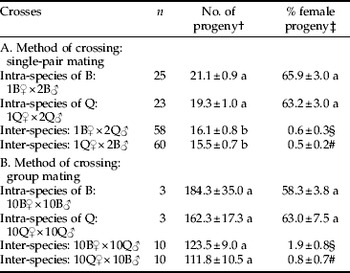
For each of the two sets of crossing experiments between B and Q, two types of treatments were conducted. In the first type, one female and two males were used in each replicate, and this type of treatment is referred to as ‘single-pair mating’. The use of two males instead of one in a replicate was to ensure that every female in the intra-putative species crossing treatments was mated because preliminary trials showed that occasionally males would die without successful copulation. In the second type, ten females and ten males were used in each replicate, and this type of treatment is called ‘group mating’. Group mating treatments provide multiple choices for mates and represent a more natural situation for the whiteflies which usually feed in groups on plant leaves. For each of the two types of treatments, control and reciprocal crosses were performed (tables 1 and 2).
Progeny production in the first set of crossing experiments between the B biotype and Q biotype, which belong, respectively, to the Middle East-Asia Minor 1 and Mediterranean putative species of Bemisia tabaci.

† Mean±SEM numbers of progeny produced per female in the four treatments of single-pair mating or mean±SEM number of progeny per replicate (ten females) in the four treatments of group mating. For each method of crossing, means followed by different letters differ significantly at P<0.05.
‡ Mean±SEM percentages of females in the progeny. For each method of crossing, only the two means of intra-species crossing were compared as no or very few female progeny were produced in the two treatments of inter-species crossing. Means followed by the same letters do not differ significantly at P<0.05.
§ For the B♀×Q♂ inter-species crosses, in the 58 replicates of single-pair mating, only five produced 1–2 female progeny each; while, in the ten replicates of group mating, five produced 3–8 female progeny each.
# In the Q♀×B♂ inter-species crosses, in the 60 replicates of single-pair mating, only five produced one female progeny each; while, in ten replicates of group mating, five produced 1–3 female progeny each.
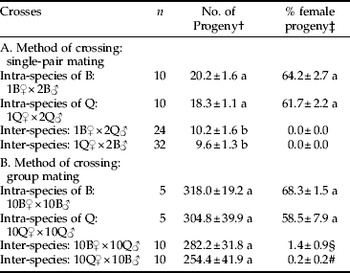
Progeny production in the second set of crossing experiments between the B biotype and Q biotype, which belong, respectively, to the Middle East-Asia Minor 1 and Mediterranean putative species of Bemisia tabaci.

† Mean±SEM numbers of progeny produced per female in the four treatments of single-pair mating or mean±SEM numbers of progeny per replicate (ten females) in the four treatments of group mating. For each method of crossing, means followed by different letters differ significantly at P<0.05.
‡ Mean±SEM percentages of females in the progeny. For each method of crossing, only the two means of intra-species crossing were compared as no or very few female progeny were produced in the two treatments of inter-species crossing. Means followed by the same letters do not differ significantly at P<0.05.
§ In this inter-species crossing treatment, only in two of the ten replicates 31 and 18 female progeny were produced, respectively.
# In this inter-species crossing treatment, only in one of the ten replicates eight female progeny were produced.
In single-pair mating treatments of the first set of crossing experiments, newly emerged adults for a replicate were introduced onto the lower surface of a plant leaf enclosed in a clip cage. This ventilated clip cage was made from a clear plastic cup, a metal clip and white plastic mesh; the cage measured 30 mm in diameter, 30 mm in height and 5 g in weight, and covered a leaf area of approximately 7 cm2. The adults were enclosed on the leaf of a cotton plant to mate and oviposit for five days. After that, they were collected using a small aspirator and stored at –20°C for later RAPD-PCR confirmation of biotype identity when required. All eggs produced were allowed to develop on the caged leaves. When all the progeny were estimated to have had enough time to develop to adulthood (about 30 days), the leaves with the adult whiteflies, still enclosed in clip-cages, were removed from plants and stored at –20°C for one day to kill all the adults, these were then counted and sexed.
In group mating treatments of the first set of crossing experiments, newly emerged adults for a replicate were introduced to a cotton plant enclosed in a whitefly-proof screen cage (L55×W55×H55 cm, 100 mesh). Five days later, the 20 adults were collected using a small aspirator and stored at –20°C for later RAPD-PCR confirmation of biotype identity when required. Cages were then left undisturbed until all the progeny were estimated to have had enough time to develop to adulthood (about 30 days). Then all the F1 adults in each replicate, either alive or dead, were collected into a glass tube and stored at –20°C for one day to kill all the adults, these were then counted and sexed.
Second set of crossing experiments
The procedures for initiating the various treatments of both single-pair mating and group mating were the same as those in the first set of crossing experiments (table 2). A few female progeny were produced in various inter-species crosses in the first set of experiments, and so a different procedure was used here to collect newly emerged F1 adults to test their fecundity and fertility. When the earliest-deposited eggs in a replicate were estimated to have had enough time to develop to adulthood (15 days after oviposition), the replicate was observed daily to collect any newly emerged adults, which were placed singly into 0.5×5.0 cm glass tubes and examined under a stereo microscope to determine their sex. When F1 females were found, each of them was introduced with two F1 males from the same replicate (namely the two males having the same putative species identity as the female parent) onto the lower surface of a plant leaf enclosed in a clip cage. At the same time, control treatments with F1 progeny from each of the two intra-species crosses were also set up (table 3). The adults in each replicate were enclosed on the leaf of a cotton plant to mate and oviposit for five days. After that, they were collected using a small aspirator and stored at –20°C for later RAPD-PCR confirmation of biotype identity. All eggs produced were allowed to develop on the caged leaves. When all the progeny were estimated to have had enough time to develop to adulthood (about 30 days), the leaves with the adult whiteflies, still enclosed in clip-cages, were removed from plants and stored at –20°C for one day to kill all the adults, and the adults were then counted and sexed.
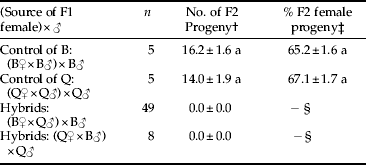
F2 generation produced by female progeny of crosses between the B biotype and Q biotype, which belong, respectively, to Middle East-Asia Minor 1 and Mediterranean putative species of Bemisia tabaci.

† Mean±SEM numbers of F2 generation produced by the female F1 individuals; only the two means of intra-species crossing were compared as no female progeny were produced in the two treatments of inter-species crossing. Means followed by the same letters do not differ significantly at P<0.05.
‡ Mean±SEM percentages of females progeny in the F2 generation. Means followed by the same letters do not differ significantly at P<0.05.
§ Not applicable.
Detection and identification of F1 hybrids
When female progeny from inter-species crosses were found, the identity of the ‘parent’ whiteflies and all the F1 females was checked by RAPD-PCR, as well as by mitochondria CO1 sequencing. The protocols for RAPD-PCR and mitochondria CO1 sequencing were the same as those described in Xu et al. (Reference Xu, De Barro and Liu2010).
Observations on mating behaviour
Observation and recording of courtship and copulation events on plants were carried out using the video recording system as described by Ruan et al. (Reference Ruan, Luan, Zang and Liu2007). Whitefly adults were placed onto the lower surface of a plant leaf enclosed by a ventilated clip cage supported by a metal stand. The front opening of the clip-cage was covered with a thin, clear plastic film. The movement and behaviour of adults on the leaf lower surface inside the cage were recorded continuously for 72 h or 120 h using a video camera (DCR-HC43E; Sony, Shanghai, China). The video recording was then replayed and watched continuously on a television set to determine the timing and number of courtship and copulation events, as judged by the observation of 2–4 min of continuous body overlap coupled with wing vibration of the male. This characteristic act of body overlap and wing vibration is a reliable indicator of copulation for the genetic groups under study (Liu et al., Reference Liu, De Barro, Xu, Luan, Zang, Ruan and Wan2007; Ruan et al., Reference Ruan, Luan, Zang and Liu2007).
We used whiteflies of the two populations for the second set of crossing experiments in behavioural observations. The use of these two populations in these trials was purely by chance because at the time the cultures of the two populations for the first set of crossing experiments were already terminated (to help keep the workload for whitefly culture maintenance at a manageable level in the laboratory). The details of mating behaviour, including events of courtships and copulations, were observed for both single-pair mating and group mating (table 4). In the group mating, we conducted treatments with two densities, namely five females with five males or ten females with ten males, to examine whether whitefly density would affect frequency of copulation. Continuous recording was conducted for 72 h for all treatments except two of the inter-species treatments where ten males and ten females were used in each replicate and the recording was conducted for 120 h. Courtship was always initiated by males, and a courtship event was judged by the following criteria: (i) a male positioned himself parallel to a female and used one of his antennae to touch one antenna of the female, and (ii) the pair remained in that parallel position for ≥60 s (usually >240 s unless interfered with by a second male) during which antennal drumming and male abdominal undulation occurred from time to time.
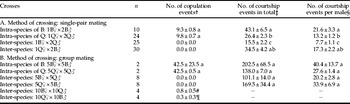
Frequency of copulation events as well as courtship events between the B biotype and Q biotype, which belong, respectively, to the Middle East-Asia Minor 1 and Mediterranean putative species of Bemisia tabaci.

† Mean±SEM numbers of copulation events between putative species in the treatments of single-pair or small group mating; only the two means of intra-species crossing were compared as no or very few copulation events occurred in the inter-species treatments. Means followed by the same letters do not differ significantly at P<0.05.
‡ Mean±SEM numbers of courtship events in various intra- or inter-species treatments. For either single-pair or group mating, means followed by the same letters did not differ significantly at P<0.05. For the group mating, only the four treatments with five females and five males in each replicate were compared.
§ Mean±SEM numbers of courtship events per male in the single-pair or small group treatments. For each method of crossing, means followed by different letters differ significantly at P<0.05.
# In this B♀×Q♂ group mating treatment, copulation events were observed only in two replicates for one or two times in each.
¶ In this Q♀×B♂ group mating treatments, copulation events were observed only once in one replicate.
Screening for the presence of endosymbionts
The DNA of five pairs of parent adults of the B biotype, five pair of the Q biotype and some of their F1 hybrid females was individually extracted according to Luo et al. (Reference Luo, Yao, Wang, Yan, Hu and Zang2002). The presence of Rickettsia, Hamiltonella, B group Wolbachia, Cardinium, Arsenophonus and Fritschea in the samples was determined using genus-specific primers for amplifying 16S rDNA gene fragments (Chiel et al., Reference Chiel, Gottlieb, Zchori-Fein, Mozes-Daube, Katzir, Inbar and Ghanim2007; Gottlieb et al., Reference Gottlieb, Ghanim, Gueguen, Kontsedalov, Vavre, Fleury and Zchori-Fein2008). The presence of A group Wolbachia was detected based on polymerase chain reaction-restriction fragment length polymorphism analysis of Wolbachia 16S rDNA (Li et al., Reference Li, Lin and Guo2007).
Data analysis
For crossing experiments, the number of progeny, as well as the female ratio of F1 in the intra- and inter-putative species crossing treatments, were analyzed using one-way analysis of variance (ANOVA); and, when a significant effect was detected (P<0.05), the means were compared using a LSD test. The data were tested for their normality prior to ANOVA, and all proportion data were transformed by arcsine square root before the analysis.
For behavioural observations, events of courtship and copulation between various intra- and inter-species treatments were analyzed using one-way ANOVA or independent samples t-test. When a significant effect was detected by ANOVA (P<0.05), the means were compared using a LSD test.
All statistical analyses were conducted using the statistical software STATISTICA 6.1 (StatSoft Inc., 2003).
Result
First set of crossing experiments
In the reciprocal crossing treatments using single-pair mating, the mean numbers of progeny in the two intra-species crosses were higher than those in the two inter-species crosses (F3, 162=8.25, P<0.001); moreover, the proportions of females in the progeny were 63–66% in the intra-species crosses but were only 0.5–0.6% in the inter-species crosses (table 1).
In the reciprocal crossing treatments using group mating, the mean numbers of progeny in the two intra-species crosses were again higher than those in the two inter-species crosses, although in this case the differences were not statistically significant due to apparently the relative small number of replicates and large variance between replicates (F3, 22=2.58, P=0.08). The percentages of females in the progeny differed obviously, 58–63% in the intra-species crosses but only 0.8–1.9% in the inter-species crosses (table 1).
Second set of crossing experiments
In the reciprocal crossing treatments using single-pair mating, the mean numbers of progeny in the two intra-species crosses were significantly higher than those in the two inter-species crosses (F3, 72=9.01, P<0.001); the proportions of females in the progeny were 62–64% in the intra-species crosses, but no female progeny were produced in either of the two inter-species crosses (table 2).
In the reciprocal crossing treatments using group mating, the mean numbers of progeny in the intra-species crosses appeared higher than those in the inter-species crosses, but the differences were not significant (F3, 26=0.50, P=0.68). As in the first set of crossing experiments, the proportions of females in the progeny were 59–68% in the intra-species crosses but only 0.2–1.4% in the inter-species crosses (table 2).
In the experiments to examine the fecundity and fertility of the F1 hybrid females, the numbers of progeny, as well as the proportions of female progeny produced in both the B and Q intra-species treatments, were comparable to those in the previous generation; whereas, none of the F1 females in the inter-species crosses produced any progeny (table 3).
Detection and identification of F1 hybrids
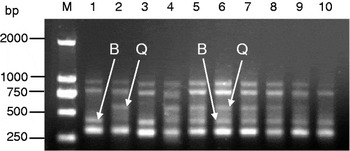
In each of the replicates in the inter-species crosses where both male and female progeny were produced, all the parent adults showed RAPD-PCR profiles characteristic of their respective putative species, demonstrating that no contamination errors had occurred in the experiments. In each of the replicates of the inter-species crosses where one or more female progeny was produced, hybrid females were always detected by RAPD-PCR profiles characteristic of both parents, although in four of the replicates where several F1 females were produced not every one exhibited a RAPD-PCR profile characteristic of both parents (part of the data is presented in fig. 1). The results of mtCO1 sequencing showed that the mtCO1 sequence of F1 hybrids were always the same as their female parent (data not shown). Thus, the occasional failures in obtaining a RAPD-PCR profile characteristic of both parents for F1 females were probably due to some minor inconsistence in the RAPD-PCR procedure.
RAPD-PCR profile of F1 progeny from crosses between B and Q biotypes of Bemisia tabaci using primer H16. M, DNA marker DL 2000; 1, B adult; 2, Q adult; 3, male progeny produced in F1 generation of cross B♀×Q♂; 4, male progeny produced in F1 generation of cross Q♀×B♂; 5–7, female progeny produced in F1 generation of cross B♀×Q♂; 8–10, female progeny produced in F1 generation of cross Q♀×B♂. The ‘B’ and ‘Q’ letters and arrows indicate the characteristic bands of B and Q.

Mating behaviour
In the treatments of single-pair mating, the females in the two intra-species crosses copulated on average 9–10 times during the first 72 h post-emergence, whereas the females in the inter-species crosses did not copulate al all (table 4). Interestingly, courtship events were frequent in both intra- and inter-species crosses, although the mean numbers of events differed significantly between the treatments (F3, 85=8.58, P<0.001). B males were more active than Q males in initiating and achieving courtships in both intra- and inter-species crosses. Moreover, the courtship events for the B males did not differ between intra- and inter-species crosses, whereas the courtship events of the Q males were significantly reduced in the inter-species cross compared to those in the intra-species cross (table 4).
In four treatments of group mating where five males and five females were used in each replicate, mean numbers of copulation events in the first 72 h post emergence in the two intra-species were both 42.5, whereas no copulation events were observed in either of the two inter-species treatments (table 4). As in the single-pair mating, courtship events were very frequent in both intra- and inter-species crosses, although here the mean numbers of events did not differ significantly between the four treatments due to apparently the large variances in the two treatments where B males were involved and the relatively low numbers of replicates (F3, 16=1.65, P=0.22). Interestingly, in the two inter-species treatments where in each replicate ten males and ten females were enclosed in a clip-cage for 120 h, a few events of copulation were observed in some of the replicates (table 4). For these two inter-species treatments, we recorded only the number of copulation events as the courtship events were too frequent to count and the actual numbers of courtship events were not critical for the behavioural analysis here.
Compositions of endosymbionts
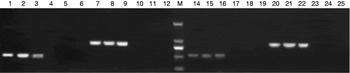
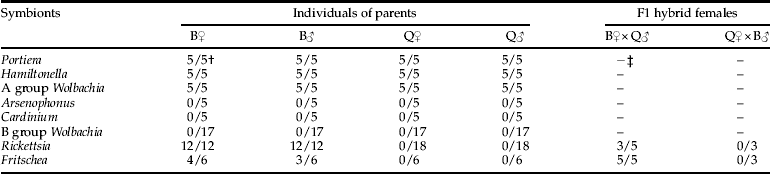
Portiera, Hamiltonella and A group Wolbachia were detected in every individual of the parents of both the B and Q biotypes, whereas Arsenophonus, Cardinium and B group Wolbachia were not detected in either of the biotypes (table 5). In contrast, Rickettsia was detected in every individual of the B biotype parents, but not in the Q biotype; Fritschea was detected in some individuals of the parent B biotype parents, but not in the Q biotype (table 5). In the screening for Rickettsia and Fritschea in the hybrids, all F1 females of B♀×Q♂ harboured Rickettsia, and some F1 females of B♀×Q♂ harboured Fritschea; in contrast, no F1 females of Q♀×B♂ harboured either of the two symbionts (table 5, fig. 2).
PCR screening for the presence of endosymbionts Fritschea and Rickettsia in the B and Q biotype of Bemisia tabaci and their F1 hybrid females using specific primers for amplifying 16S rDNA gene fragments. 1–3, Fritschea in B biotype; 4–6, Fritschea in Q biotype; 7–9, Rickettsia in B biotype; 10–12, Rickettsia in Q biotype; M, DNA marker DL 2000, 1000, 750, 500, 250; 14–16, Fritschea in the females produced from the cross B♀ and Q♂; 17–19, Fritschea in the females produced from the cross Q♀ and B♂; 20–22, Rickettsia in the females produced from the cross B♀ and Q♂; 23–25, Rickettsia in the females produced from the cross Q♀ and B♂.

Symbiont compositions in the two populations of the B and Q biotypes of Bemisia tabaci as well as in their F1 hybrid females.

† Number detected/number tested.
‡ Not tested.
Discussion
In this study, we conducted two sets of crossing experiments using B and Q populations collected from different field sites in different years (tables 1 and 2). In terms of mtCO1 sequences, the two B haplotypes (AJ867555, GQ332577) show 0.12% divergence, and the two Q haplotypes (DQ473394, GQ371165) also 0.12% divergence. Although the data of the two sets of experiments differed in some details, they as a whole demonstrated that the two biotypes, when kept in captivity under favourable laboratory conditions, could only rarely produce viable hybrids, and the hybrids were always sterile (fig. 1, table 3). Parallel observations on mating behaviour showed that the males and females from different biotypes could only rarely achieve successful copulation, although courtship events between them were frequent (table 4). These data demonstrated that the B and Q populations of B. tabaci examined in this study are completely isolated in reproduction, and the isolation was due to mainly a copulatory, prezygotic barrier, but post-copulation barriers were also involved as F1 hybrids were all sterile.
The levels of reproductive isolation revealed in the B and Q biotypes in Zhejiang, China, agree in general with those reported previously for other populations/haplotypes of the two biotypes (Ronda et al., Reference Ronda, Adan, Cifuentes, Cenis and Beitia1999; Ma et al., Reference Ma, Hadjistylli, Gorman, Denholm and Devine2004; Jones et al., Reference Jones, Gorman, Denholm and Williamson2008; Crowder et al., Reference Crowder, Sitvarin and Carriere2010b). However, our study represents the first in which the fecundity and fertility of F1 hybrids were examined in detail, and the behaviour of mating interactions of B and Q were observed continuously on live plants for several days. Due to unavailability of the actual data from most of the previous reports, we are only able to compare the details of our study with some of those reported in Elbaz et al. (Reference Elbaz, Lahav and Morin2010). That study placed three males and three females on a cotton seedling in each replicate for both intra- and inter-biotypes crosses and did not detect any hybrids. In view of the variations that occurred in the two sets of our crossing experiments (tables 1 and 2), the difference between the data of Elbaz et al. (Reference Elbaz, Lahav and Morin2010) and ours could be due to variations in experiments, but potential differences between whitefly populations in the two studies could not be ruled out. With regard to mating behaviour, Elbaz et al. (ibid) placed adults of the opposite sex from B and Q in one arena for only four hours and did not detect any copulation event. As we observed copulation events only when adults of the opposite sex from B and Q were placed in dense cohorts for >3 days, their observations on the Israel populations of the two biotypes seemed to agree with ours on the populations from Zhejiang (table 4).
Hybridization studies between closely related species may present hints of the physiological and molecular mechanisms responsible for the reproductive incompatibilities. Sterility of F1 hybrids indicates that the hybrids may carry inherited lethal or sterile factors (Merrell, Reference Merrell1981; Zhao et al., Reference Zhao, Dong, Tang, Yan, Gelbic, Van Loon and Wang2005). A copulatory barrier, as shown between B and Q in this study (table 4), could effectively prevent the wastage of gametes that produce unviable, sterile or poorly adapted hybrids. Heterospecific matings without effective hybrid formation has been considered to be types of reproductive interference with the highest fitness costs; switching from post-zygotic isolation to pre-zygotic isolation would thus be advantageous (Gröning & Hochkirch, Reference Gröning and Hochkirch2008).
The populations of B and Q used in the crossing experiments differed in their composition of secondary endosymbionts (table 5). In particular, B harboured Rickettsia and Fritschea, but Q did not. Interestingly, the F1 hybrid females produced by B females also harbored these two symbionts, but F1 hybrid females produced by Q females again did not (fig. 2). The roles of various secondary endosymbionts in the reproductive isolation between B and Q, as well as other genetic groups of B. tabaci, remain unknown (Elbaz et al., Reference Elbaz, Lahav and Morin2010). We noted that the symbiont compositions in B and Q from Israel and those from China differ obviously. For example, B from our study in China harboured Wolbachia but none of the B colonies from Israel harboured this symbiont; likewise, our Q harboured Hamiltonella but the Q from Israel did not (table 5: Gottlieb et al., Reference Gottlieb, Ghanim, Gueguen, Kontsedalov, Vavre, Fleury and Zchori-Fein2008; Elbaz et al., Reference Elbaz, Lahav and Morin2010). However, the patterns of reproductive isolation between B and Q in the two countries appear to be the same. Thus, how important the symbionts are in the reproductive isolation between B and Q remains to be investigated. In our results, whether Rickettsia and Fritschea or other symbionts were involved in causing the sterility of F1 hybrid females of B and Q presents an interesting question for future study.
Although the barrier for copulations between B and Q is strong, extensive and frequent courtships occurred between the two biotypes (table 4: Pascual, Reference Pascual2006; Elbaz et al., Reference Elbaz, Lahav and Morin2010). Similar phenomena have been observed between several other putative species of B. tabaci (De Barro & Hart, Reference De Barro and Hart2000; Maruthi et al., Reference Maruthi, Colvin, Thwaites, Banks, Gibson and Seal2004; Liu et al., Reference Liu, De Barro, Xu, Luan, Zang, Ruan and Wan2007). The high frequency of courtship events between B and Q indicates that these two biotypes have incompletely isolated mate recognition systems (Perring & Symmes, Reference Perring and Symmes2006; Elbaz et al., Reference Elbaz, Lahav and Morin2010). It is generally believed that the B and Q biotypes of B. tabaci went through allopatric (geographic) divergence, followed by secondary contact (Moya et al., Reference Moya, Guirao, Cifuentes, Beitia and Cenis2001; Dinsdale et al., Reference Dinsdale, Cook, Riginos, Buckley and De Barro2010). The present sympatry of B and Q in Zhejiang, like those in many other locations in Asia and America, has been brought about through human-mediated biological invasions in recent years. It is known that closely related, allopatric species often share much of their mate recognition systems (Gröning & Hochkirch, Reference Gröning and Hochkirch2008). Thus, it is not surprising to find that B and Q exhibit extensive courtship behaviour between them.
Mating behavioural interactions between closely related species resulting from incompletely isolated mate recognition systems may lead to reproductive interference that is often asymmetric and can have serious population consequences for the species (Liu et al., Reference Liu, De Barro, Xu, Luan, Zang, Ruan and Wan2007; Gröning & Hochkirch, Reference Gröning and Hochkirch2008; Crowder et al., Reference Crowder, Horowitz, De Barro, Liu, Showalter, Kontsedalov, Khasdan, Shargal, Liu and Carriere2010a,Reference Crowder, Sitvarin and Carriereb). In some cases, mating interactions can even lead to reproductive facilitation for one of the competitors (Liu et al., Reference Liu, De Barro, Xu, Luan, Zang, Ruan and Wan2007). The frequent courtship events between B and Q (table 4) mean that behavioural interactions between them can be intense. The data of fecundity in the crossing experiments showed that the numbers of eggs laid in the inter-species crosses tended to be lower than those in the intra-species crosses (tables 1 and 2), and this reduction in fecundity was caused, at least in part, by interspecific mating interference. This inference is further supported by the observation of Luan et al. (Reference Luan, Ruan, Zang and Liu2008) that in B, ZHJ1 and ZHJ2 whiteflies, mated females and unmated (virgin) females produced similar numbers of eggs in the first five days post emergence, indicating that lack of copulation did not reduce oviposition. Such a reduction in fecundity caused by interspecific mating interference has also been observed for Q by Elbaz et al. (Reference Elbaz, Lahav and Morin2010) as well as for several other putative species of B. tabaci (De Barro & Hart, Reference De Barro and Hart2000; Xu et al., Reference Xu, De Barro and Liu2010). The differences in courtship events between B and Q (table 4) suggest that the interference from B to Q may be stronger than that from Q to B. This difference in mating interference between B and Q found here seems to agree with that reported previously for these two biotypes by Pascual (Reference Pascual2006) and Crowder et al. (Reference Crowder, Horowitz, De Barro, Liu, Showalter, Kontsedalov, Khasdan, Shargal, Liu and Carriere2010a,Reference Crowder, Sitvarin and Carriereb). Crowder et al. (Reference Crowder, Horowitz, De Barro, Liu, Showalter, Kontsedalov, Khasdan, Shargal, Liu and Carriere2010a,Reference Crowder, Sitvarin and Carriereb) further showed that this difference between B and Q may offer advantage to B in its competition with Q.
Field populations of Q are generally more resistant than those of B to most of the insecticides used against these whiteflies (Luo et al., Reference Luo, Jones, Devine, Zhang, Denholm and Gorman2010). The complete reproductive isolation between the B and Q, as demonstrated in this study, means that the resistance traits in the two biotypes (species) evolve independently. We speculate that the generally higher resistance to insecticides in Q populations would offer Q an advantage in its competition with B, and the roles of differences in insecticide resistance between B and Q in their competition and displacement warrant particular investigation in areas invaded by both of them such as China (Crowder et al., Reference Crowder, Horowitz, De Barro, Liu, Showalter, Kontsedalov, Khasdan, Shargal, Liu and Carriere2010a).
The B and Q haplotypes examined in this study show 4.3% divergence in mtCO1 sequence, which is typical for haplotypes of B and Q from different parts of the world (Dinsdale et al., Reference Dinsdale, Cook, Riginos, Buckley and De Barro2010). Many haplotypes of B. tabaci show 4–20% divergence in mtCO1 sequence (Boykin et al., Reference Boykin, Shatters, Rosell, McKenzie, Bagnall, De Barro and Frohlich2007; Dinsdale et al., Reference Dinsdale, Cook, Riginos, Buckley and De Barro2010). With more case studies of reproductive compatibility between putative species of B. tabaci, the relationships between levels of mtCO1 sequence divergence and degrees of reproductive isolation can be explored (De Barro et al., Reference De Barro, Liu, Boykin and Dinsdale2011).
Acknowledgements
We thank Professor Geoff Gurr, Charles Sturt University, Australia for comments on the manuscript. Financial support for this study was provided by the National Basic Research Programme of China (2009CB119203) and the National Natural Science Foundation of China (30730061).