INTRODUCTION
State institutions across the globe are facing a legitimacy deficit defined by decreasing levels of civic trust (van Ham, et al. Reference van Ham2017). This phenomenon is especially pronounced in “post” societies (postsocialist, postcommunist, postcolonial) with less established legal institutions and social norms supporting them (Prato Reference Prato, Pardo and Giuliana2019). The legitimacy gap, in turn, complicates fundamental processes of governance (social communication, civic participation, tax collection) necessary for promoting and protecting the welfare of society.
Procedural justice has a potentially critical role to play in strengthening the rule of law and state legitimacy. Its core idea—that fair treatment by authorities matters most in people’s assessments of the law and their compliance with it—serves as a powerful counterargument to conceptualizations of legitimacy as a function of either favorable outcomes (Whalan Reference Whalan2013) or fear of punishment (Hyde Reference Hyde1983, 426). As a result, institutions facing legitimacy deficits or noncompliance with their rules have a less expensive and less punitive option for fostering popular support (Tyler Reference Tyler2007).
A wealth of empirical work supports the procedural justice thesis. Yet, questions linger concerning the legal institutions, cultural settings, and methodological designs used to test it. Police interactions have received the most attention in the literature, while other justice settings—criminal and civil courts and different correctional pathways—have received considerably less (Hamm Reference Hamm2019). This research has also primarily been based in the United States, the United Kingdom, and Australia—countries that possess legal institutions and a legal culture distinct from their global counterparts. Finally, studies often rely on surveys with respondents lacking recent direct experience with legal authorities (see Mazerolle, et al. Reference Mazerolle and Bennett2013).
This study looks to address these gaps through an empirical analysis of the legal experiences of 192 civil court participants in Poland. It considers three competing explanations for the impact of legal experiences on legitimacy: procedural justice—that experiences of fair treatment by authorities are tied to higher assessments of institutional legitimacy; outcome satisfaction—that favorable outcomes with authorities correlates to greater perceived institutional legitimacy; and institutional effectiveness—that perceptions of authorities effectively carrying out their responsibilities are connected to higher ratings of institutional legitimacy.
Using confirmatory factor analysis (CFA), ordinary least squares (OLS) regression analysis, and t-tests of survey data drawn from litigants contacted immediately following the cessation of their cases, we find that voice, the key dimension of procedural justice, and outcome satisfaction correlate nearly equally with perceived legitimacy of courts. Legal cynicism also shares a relationship with legitimacy, while institutional effectiveness does not. Additionally, using independent samples t-tests to compare mean scores for our key variables, and regression analysis to check for interaction effects, we fail to demonstrate significant differences in dimensions of procedural justice and legitimacy between plaintiffs and defendants or those represented by counsel and those appearing pro se. Still, the consistent differences suggest the issues of role and representation may merit further scrutiny.
Taken as a whole, this study suggests that the procedural justice thesis holds for civil courts, even in a national context of judicial crisis. We interpret these results by understanding procedural justice as what van den Bos and Lind (Reference van den Bos, Allan Lind and Zanna2002) refer to as an uncertainty management heuristic—fairness by authorities reduces the uncertainty facing litigants who are brought to court by others and lack legal representation. As a result, the findings underscore the importance of fostering procedural justice in support of institutional legitimacy.
The article is divided into four main sections. It begins with a review of the procedural justice literature, with a particular focus on court settings and posttransition societies. It then explains the sample, survey data, and analytical approach used. The findings of the confirmatory factor analysis, OLS regressions, and t-tests are presented next. The article concludes with a discussion of the relevance of the findings for lingering debates on procedural justice as well as future work addressing legal legitimacy and the rule of law in social contexts of institutional distrust.
LITERATURE REVIEW
Procedural Fairness and Legal Institutions
The procedural justice thesis rests on two interrelated mechanisms. First, procedural justice, as measured by the quality of treatment and the quality of decision making by authorities, influences people’s assessments of their interactions with authorities more than the substantive outcomes of these encounters. Second, people experiencing procedural justice are more likely to perceive authorities and rules as legitimate and voluntarily comply with them (Tyler, et al. Reference Tyler, Anthony, Jeffrey, Tracey, Robert, Chris, Braga, Fagan and Meares2007). This counterintuitive claim is supported by a large and ever-growing body of literature examining a variety of settings, including police encounters, courtrooms, correctional facilities, state services, and the workplace (van den Bos, van der Velden, and Lind Reference van den Bos and van der Valden2014; Bottoms and Tankebe Reference Bottoms and Justice2012; Murphy Reference Murphy2003; Tyler Reference Tyler2007; Sunshine and Tyler Reference Sunshine and Tyler2003; Tyler and Huo Reference Tyler and Huo2002; Tyler and Blader Reference Tyler and Blader2000). Significant as well, the hypothesis holds regardless of race and gender differences (Tyler Reference Tyler, Demoulin, Leyens and John2009). Procedural justice carries powerful policy implications (Skogan, Van Craen, and Hennessy Reference Skogan, Maarten Van and Cari2015), since it offers that the best way for public and private authorities to build legitimacy among those they serve or work with, even where racism and other forms of inequality exist, is through fair treatment rather than rewards or punishment (Tyler, et al. Reference Tyler, Anthony, Jeffrey, Tracey, Robert, Chris, Braga, Fagan and Meares2007).
Despite extensive empirical support, a number of lingering doubts remain for the procedural justice thesis (Nagin and Telep Reference Nagin and Telep2017; Worden and McLean Reference Worden and McLean2017). One central question concerns the institutional contexts in which this thesis holds. The vast majority of research on state authorities examines the public’s interaction with the police. These studies have consistently found that police explaining decisions and providing respect and voice to citizens translates into higher levels of compliance and/or trust (Pryce, Johnson, and Maguire Reference Pryce, Devon and Maguire2017; Mazerolle, et al. Reference Mazerolle and Bennett2013; Tyler Reference Tyler2007). Organizational justice scholars have also demonstrated how fairness relates to increased job satisfaction and organizational commitment in the workplace, although procedural justice in these studies tends to be defined in narrower terms than in criminological research (see Brockner and Wiesenfeld Reference Brockner, Wiesenfeld and Alan Lind2019; Cropanzano, Ambrose, and Van Wagoneer Reference Cropanzano, Ambrose, Phoenix and Alan Lind2019; Colquitt and Zipay Reference Colquitt2015).Footnote 1
Court-related studies, in turn, are far less common. This gap in the literature is curious. Pioneering work on procedural justice focused on courts (Thibaut and Walker Reference Thibaut and Laurens1975; Tyler, 1984; Reference Tyler1988). And courts are central to various aspects of the rule of law and effective governance. Popular distrust of courts may discourage people from accessing them to pursue justice claims or encourage them to seek extralegal ways to resolve their disputes (Robinson and Robinson Reference Robinson2018). Litigants dissatisfied with their court experience may also refrain from fulfilling their court-imposed duties (Rottman and Tyler Reference Tyler2014; Rottman Reference Rottman and Ismaili2010). Or they may appeal decisions even when there is no sound legal basis for doing so, which imposes costs for individual parties and the justice system alike.
The research that does exist on criminal courts has tended to confirm the general tenets of the procedural justice thesis. Criminal defendants are more likely to leave court with a positive impression of their experience when they perceive the court process as fair, regardless of whether they win or lose their case (Sifrer, Mesko, and Bren Reference Sifrer, Mesko, Bren and Tankebe2015; Farley, Jensen, and Rempel Reference Farley and Jensen2014; Frazer Reference Frazer2006; Tyler Reference Tyler2007; Tyler and Huo Reference Tyler and Huo2002). Also, perceptions of fairness have been linked to an increased likelihood that litigants will comply with court orders and follow the law in the future (Farley, Jensen, and Rempel Reference Farley and Jensen2014; Tyler Reference Tyler2007; Tyler Reference Tyler and Tonry2003). It is possible that courts, which are designed to give laypeople voice either as litigants or jurors, foster fairness (Hamm Reference Hamm2019; Machura Reference Machura2003). More recent research focusing on specialized, problem-solving courts, for instance, has found that defendants in drug courts and community courts report higher levels of procedural fairness, which reflects the less adversarial, more deliberative design of these settings (Connor Reference Connor2019; Somers and Holtfreter Reference Somers2018, see also Dollar, et al. Reference Dollar and Ray2018; Atkin-Plunk and Armstrong Reference Atkin-Plunk and Armstrong2016; McIvor Reference McIvor2009).
The handful of studies on civil courts, meanwhile, add complexity to our understanding of procedural justice (Creutzfeldt and Bradford, Reference Creutzfeldt and Ben2016; Ohbuchi, Sugawara, Teshigahara, and Imazai, Reference Ohbuchi and Teshigahara2005; Tyler Reference Tyler1997). Fairness has been shown to matter less than distributive justice for civil litigants (Rottman and Tyler Reference Tyler2014). Other research has demonstrated that “the nature and magnitude of the association between procedural justice and trust in judges depends on outcome concerns, and other sociolegal moderators such as outcome importance and prior court experience” (Grootelaar and van den Bos Reference Grootelaar2018, 1). These findings reflect how winning may figure differently in civil proceedings than in criminal matters. Civil cases involve disputes between private parties over stakes (child custody, money, etc.) mutually valued by each side. Court authorities play a more peripheral role in civil cases than in criminal justice settings. And litigants tend to be novices and drawn from a broader swath of society than criminal cases, which often involve “repeat players” (Galanter Reference Galanter1974) from marginalized groups (Sifrer, Mesko, and Bren Reference Sifrer, Mesko, Bren and Tankebe2015). As a result, the courtroom might be less familiar to civil litigants than other types of court participants.
Court studies also add nuance to our understanding of the relationship between fairness and legitimacy. First, going to court involves different roles for individuals, and these roles can shape experiences of justice. People with higher stakes in the outcome of a court case but less control over it, defendants for example, express less confidence in state and local courts than do those with lower stakes and more control, such as jurors (Longazel, Parker, and Sun Reference Longazel2011; Benesh Reference Benesh2006; Benesh and Howell Reference Benesh and Howell2001, 199). Roles matter for court actors too. Judges and lawyers cite distributive justice and instrumental concerns as more important factors influencing confidence in courts than quality of treatment (Tyler Reference Tyler2008). But among attorneys with lower levels of court involvement, procedural justice tends to matter more (Rottman and Tyler Reference Tyler2014, 1056).
These considerations illustrate why civil court cases provide an interesting setting for testing the generalizability of the procedural justice hypothesis. To the extent that winning is more clearly defined in civil cases and that the stakes are mutually valued by each side, it might be thought that outcomes will matter more to participants than fair treatment. Conversely, to the extent that participants in civil court cases are novices and that the main representative of the state in civil disputes is the judge, it might be thought that fair treatment will carry more weight among participants. Finally, the roles within proceedings might influence assessments of both fairness and legitimacy.
Procedural Fairness in “Post” Societies
Another lingering question regarding the procedural justice thesis is its generalizability across national borders. Procedural justice research originated in the American academy and has largely concentrated on legal institutions and interactions in the US, UK, and Australia, where rule of law is well established and authorities enjoy considerable trust (see Sun, et al. Reference Sun, Yuning, Rong and Ashley2017). However, a considerable gap in institutional trust exists between older democracies and countries transitioning from communist and colonial rule, or “post” societies (postsocialist, postcommunist, postcolonial) (Habibov, Afandi, and Cheung Reference Habibov and Afandi2017; Pearce Reference Pearce2010; Mishler and Rose Reference Mishler and Richard2001; Steen Reference Steen1996). Institutional trust in transitional countries has developed under very different circumstances than in established democracies. Some scholars trace the trust deficit back to Communist rule (Gati, Reference Gati1996). In addition, the development of new democratic institutions following Communism has often occurred during periods of political and economic uncertainty (Habibov, Afandi, and Cheung Reference Habibov and Afandi2017). And corruption is endemic in many “post” societies, which erodes confidence in political parties and government institutions (Habibov, Afandi, and Cheung Reference Habibov and Afandi2017).Footnote 2
But research has also tied the trust deficit to endogenous (e.g., the performance of institutions) rather than exogenous factors (e.g., cultural values incongruent with democratic practice) (Mishler and Rose Reference Mishler and Richard2001). And fairness, measured in terms of both distributive and procedural justice (Kluegel and Mason Reference Kluegel and Mason2004, Linde Reference Linde2012), is central to people’s assessment of political systems and authorities. Those who hold a more positive view of the fairness and integrity of public officials are more likely also to express support for the performance and principles of democratic regimes (Linde Reference Linde2012). This provides some grounds for optimism that legitimacy can be engendered from the top-down by encouraging institutional actors to behave in a fairer and more transparent manner (Pearce Reference Pearce2010; Mishler and Rose Reference Mishler and Richard2001).
In this context, efforts to examine the procedural justice thesis outside North America and Western Europe take on added importance (Kim, Kwang, and McLean Reference Kim, Ra and McLean2019; Akinlabi and Murphy, Reference Akinlabi and Murphy2018; Jackson Reference Jackson2018; Reisig, Tankebe, and Mesko, Reference Reisig, Justice and Gorazd2013; Tankebe, Reisig, and Wang, Reference Tankebe2016). This research has tended to focus on citizen evaluations of police encounters. And it has generally confirmed the basic relationship between fair treatment and institutional legitimacy.Footnote 3
But these studies have also highlighted forces other than fairness that influence legitimacy. Fear of punishment, or what Tankebe (Reference Tankebe2009) refers to as “dull compulsion,” looms in the minds of citizens in places with endemic corruption and/or poor rule of law (see also Gao and Zhao Reference Gao and Jinhua2018). The perceived institutional effectiveness of the police has also been shown to predict citizens’ willingness to cooperate with authorities and comply with the law in settings where crime rates are high and public officials corrupt (see Tankebe Reference Tankebe2009 and Akinlabi and Murphy Reference Akinlabi and Murphy2018 for studies on Ghana and Nigeria, respectively). A national survey of South Africans similarly found that respondents placed greater emphasis on police efficiency in fighting crime than procedural fairness (Bradford, et al. Reference Bradford and Huq2014). In Pakistan too, perceptions of police effectiveness in controlling crime were found to be more strongly linked to police legitimacy than perceptions of procedural fairness (Jackson et al. Reference Jackson and Asif2014).Footnote 4
Fewer studies have examined courts in international contexts, whether in “post” societies or not. Those that have all found support for the importance of procedural justice. Procedural fairness has been positively associated with court legitimacy among residents of Hong Kong, a postcolonial society (Cheng Reference Cheng2018; see also Cheng Reference Cheng2017). In Poland, a postcommunist country, a survey of criminal defendants found that procedural justice correlated most strongly with the perceived legitimacy of courts (Burdziej, Guzik, and Pilitowski 2019). In an early study on the cultural ramifications of legitimacy and procedural justice, Leung and Lind (Reference Leung and Allan Lind1986) demonstrated that Chinese students shared their American peers’ preference for adversary criminal procedure due to enhanced opportunities for voice. And in the only study we are aware of examining fairness in civil matters outside the US, Ohbuchi, et al. (Reference Ohbuchi and Teshigahara2005) found that procedural justice had a significant impact on the overall evaluation of courts in Japan, a country with a strong collectivist tradition where individual expectations of fair treatment might be expected to carry less significance.
In sum, extensions of procedural justice research outside Anglo-American legal settings have both confirmed the importance of fair treatment and introduced competing explanations—dull compulsion and institutional efficiency—for legitimacy. This research, together with that examining civil court settings, demarcates key debates facing the fairness thesis. Additional research on litigant experiences in civil courts outside the US would help establish then how fairness might matter differently in different national settings.
METHODS AND DATA
To address these debates, this study presents results from a survey of 192 civil litigants in Poland. Poland provides an ideal national setting for this study. The country has recently witnessed a series of controversial court reforms initiated by the ruling Law and Justice (Prawo i Sprawiedliwość) Party.Footnote 5 The reforms started in 2016 with a move to take control of the Constitutional Tribunal.Footnote 6 That same year, the offices of the Minister of Justice and the Prosecutor General were merged, with the former assuming the role of the latter.Footnote 7 In early 2017, the government undertook a major revision of the National Judicial Council—a body tasked with the selection and promotion of judges—in order to increase the representation of lower court judges, but critics charged the changes politicized the council. Finally, the government embarked on a comprehensive overhaul of the Supreme Court, which included terminating judgeships due to new, lowered age limits and creating two new chambers: the Extraordinary Appeals Chamber, with the power to challenge high court judgments made during the last twenty years, and the Disciplinary Chamber, with the authority to sanction the country’s lawyers and judges for misconduct (Zoll and Wortham Reference Zoll and Leah2019, 945).
These reforms sparked street demonstrations and pushed the president to present less radical versions of the bills. The European Commission also launched an infringement procedure against the measures, which it won before the Court of Justice of the European Union. Polish judges boycotted the elections for the new National Council of Judiciary, and in January 2020, the Supreme Court ruled that procedural flaws in its candidate selection process could be raised in appeals to decisions issued by judges selected by the new Council. Any rulings by the Disciplinary Chamber were also considered invalid, and the Chamber itself has not been recognized as a court of law. The government’s reaction to these rulings was to tighten disciplinary measures and prohibit judges from questioning the judicial status of their newly selected or promoted colleagues. The European Commission then referred Poland to the European Court of Justice for this law as well as for the Disciplinary Chamber continuing to sanction judges (e.g., removing their immunity and imposing temporary suspensions and salary reductions for judges with criminal cases against them) (European Commission 2021).
Poland thus represents a “post” society where political disputes unfolding in the shadow of the country’s Communist past (Ornatowski Reference Ornatowski2011) have placed the judiciary at the center of public debates. There are some indications that the politicization of the Polish judiciary has diminished citizens’ trust in courts.Footnote 8 But how this environment shapes litigants’ courtroom experiences and their perceptions of courts more generally remains an open question.
Sample
Data were collected from four district courts and a regional court in Krakow, Poland, with a small number of respondents recruited from district and regional courts from smaller towns in the region.Footnote 9 A pencil-and-paper survey was completed by research assistants with participants immediately following the completion of their cases in the civil division of the given court.Footnote 10 Respondents were offered a small remuneration (10 PLN, roughly $2.50 USD) for taking the survey.
We obtained a convenience sample of two hundred civil litigants. However, eight respondents were excluded because they either were involved in a criminal case, or they had not yet obtained a verdict in their civil case. This left us with a final sample of 192 respondents.
In terms of demographics (see Appendix 1), respondents ranged in age from twenty-two to eight-four years old, with a mean of approximately forty-seven. Information on respondents’ gender was accidentally lost for eighty-three respondentsFootnote 11 —the remainder of the sample consisted almost equally of women (52 percent), and men (48 percent), and there is no reason to believe that this breakdown was not reflective of the sample as a whole. In terms of economic status, 37.5 percent of the respondents described their financial situation as having “just enough, but could not afford larger expenses,” 36.5 percent declared that they “live comfortably” or “meet expenses without extras,” 10.9 percent said they had “forego many things to survive,” and 3.1 percent said their earnings were “not enough for basics.” 69.8 percent of the sample lived in larger cities (over 100,000 inhabitants)—Krakow in this case— while 16.6 percent came from smaller surrounding towns (20,000–100,000 inhabitants). 44.8 percent of respondents claimed higher education as their highest level of educational achievement, with 38.5 percent reporting secondary education, 10.4 percent vocational education, and 3.6 percent elementary education only. On the whole, this sample could be described as wealthier, more urban, and better educated than the general population in Poland.Footnote 12
Measures
The survey instrument used in our study consisted of forty-two items tailored to capture core concepts from past procedural fairness research. The indicators were mostly ordinal variables with five categories, ranging from 1 (strongly agree) to 5 (strongly disagree) (see Appendix 2). Our procedural justice scale was comprised of twelve items based on the four-component model proposed by Blader and Tyler (Reference Blader and Tyler2009). This included items measuring process control (voice and understanding) and fairness of treatment (neutrality and respect). Overall, the scale had good reliability (α = 0.82).
The operationalization of legitimacy is subject to considerable debate in the academic literature. Researchers routinely treat perceived duty to obey and trust in authorities as components of legitimacy, while others approach them as separate variables (Pryce, et al. Reference Pryce, Devon and Maguire2017).Footnote 13 Adding to the confusion, research also suggests that procedural justice is constitutive of legitimacy (Sun, et al. Reference Sun, Yuning, Rong and Ashley2017), a claim that has been disputed on methodological, empirical, and theoretical grounds by others (Jackson and Bradford Reference Jackson and Ben2019). Our study measured legitimacy with a six-item scale covering two dimensions: obligation to obey and trust in courts (α = 0.82).
Following a growing number of studies (see Moule, Fox, and Parry Reference Fox and Moule2021; Gau Reference Gau2015; Riesig, Wolfe, and Holtfreter Reference Reisig, Wolfe and Kristy2011), legal cynicism was measured separately from legitimacy. Here, we used two items drawn from research on contexts and countries where respect for authority is notoriously absent (Reisig, Bratton, and Gertz 2007; Sunshine and Tyler Reference Sunshine and Tyler2003; Tyler and Huo Reference Tyler and Huo2002; Sampson and Bartusch Reference Sampson1998). The items were adapted to capture the specificity of the Polish context, where experience with the “culture of illegality” during the communist regime is still present (see Kurczewski Reference Kurczewski2007).
Given the potential importance of outcomes in civil court settings, we included three items to measure outcome favorability (α = 0.82). To consider the impact of perceived court effectiveness, the survey contained three items covering perceived length and timeliness of the proceedings, an issue consistently cited by respondents in public opinion polls as the largest problem plaguing the Polish justice system. The scale had good reliability (α = 0.78).
We finally included items to capture the specificity of civil court cases and proceedings. For instance, we asked a question about case significance to see whether court experiences were influenced by the importance that litigants placed on their cases. We also included questions on litigants’ role in the case (plaintiff versus defendant) and presence of a lawyer (self-appointed, ex-officio, or pro se/no lawyer).
These last survey items helped define the characteristics of litigants and their cases. As Appendix 2 shows, in terms of case significance, the majority of respondents (56.8 percent) said their case was “very significant” to them, while 32.8 percent reported it was “rather significant.” Compared with other studies on courts and police, which often involve either misdemeanor cases, police contacts, or hypothetical legal scenarios that are of little real significance to study participants, our survey respondents reported having a clear stake in the outcome of their cases. The sample was also made up of 51 percent plaintiffs versus 49 percent defendants. This split is important for testing the relative importance of roles in the experience of fairness and perception of courts. Finally, a comparable number of litigants declared appearing at court with representation and without—46 percent reported that they had a self-appointed lawyer, 15 percent were awarded an ex-officio lawyer, and 39 percent had no lawyer at all, appearing pro se.Footnote 14 The variability in representation provides the opportunity to determine whether presence of lawyer, which is unique to court settings and carries attributes of voice, impacts experiences and subsequent assessments of courts.
Confirmatory Factor Analysis
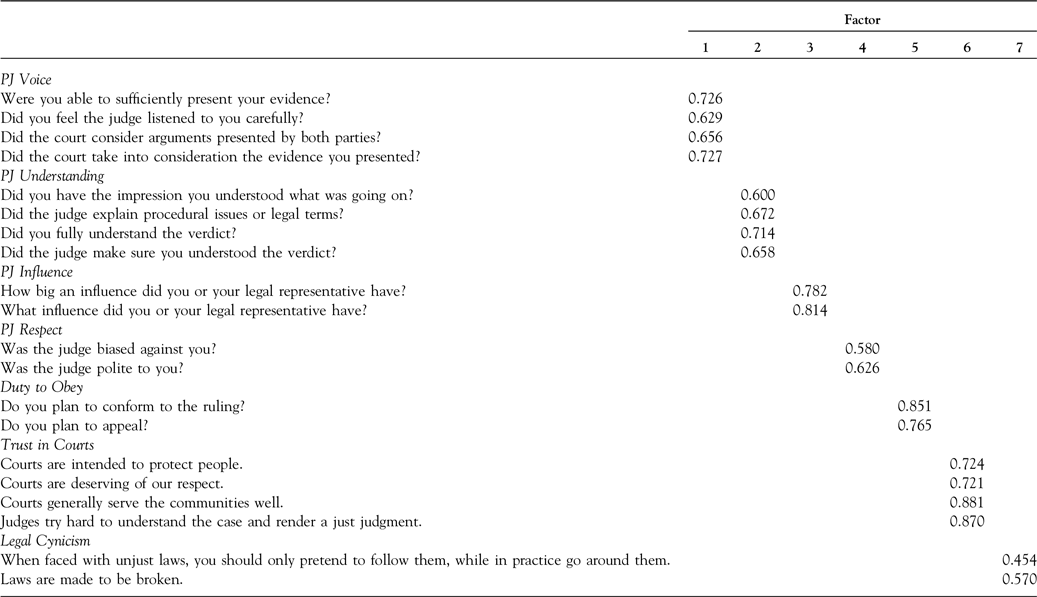
Confirmatory factor analysis (CFA) was performed to validate a series of measurement models for our latent variables (see Gau Reference Gau2010 for a useful review). A seven-factor solution produced a model with the best overall fit. While the χ2 goodness-of-fit test was significant, fit assessments are usually most reliable when multiple indices are taken into consideration (Brown Reference Brown2006). The comparative fit index (CFI) was .955 (CFI values exceeding .90 are considered acceptable fit, and those .95 or higher suggest very good fit (Hu and Bentler Reference Hu and Bentler1999)). The root mean square error of approximation (RMSEA) was 0.047, and the standardized root mean square residual (SRMR) was 0.046, with both indices indicating good fit. Finally, the indicators for each latent variable all loaded significantly (all loadings were significant at a level of p < .01). We list all items and factors used in the analysis in Table 1.
Confirmatory factor analysis of the seven-factor model

Note: Principal components analysis, Varimax rotation. Only factor loadings >.40 are displayed
Confirmatory factor analysis confirmed our operationalization of key variables. Our four-dimensional operationalization of procedural justice and two-dimensional operationalization of legitimacy were consistent with the data in our sample. One of the two items measuring legal cynicism loaded poorly, but we decided to retain it due to theoretical concerns and overall good model fit.
RESULTS
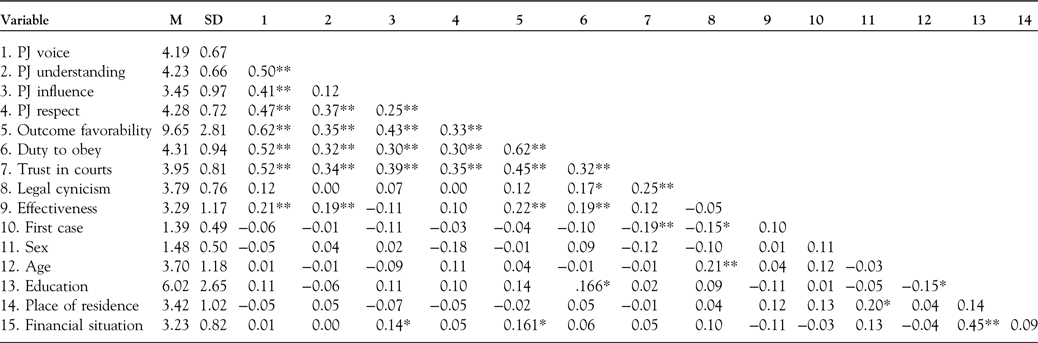
With the main variables for the study defined, we next examined the relationship between them. The correlation matrix in Table 2 shows the results of this analysis. Each of our key variables (the four dimensions of procedural justice, the two dimensions of legitimacy, outcome satisfaction, legal cynicism, and court effectiveness) were correlated in the expected direction. This provided preliminary support for the different theoretical models regarding the factors that influence perceived legitimacy of courts.
Correlation between variables

Note: N = 192
*p < .05; **p < .01
Out of the demographic variables (sex, age, education, residence, finances), financial situation possessed a modest, positive correlation with influence upon proceedings and outcome favorability, and education exhibited a small positive correlation with duty to obey. Interestingly, and somewhat surprisingly, first court experience was negatively correlated with trust in courts and legal cynicism, suggesting that those who were in court for the first time tended to trust the courts less, but were also less cynical about the law.
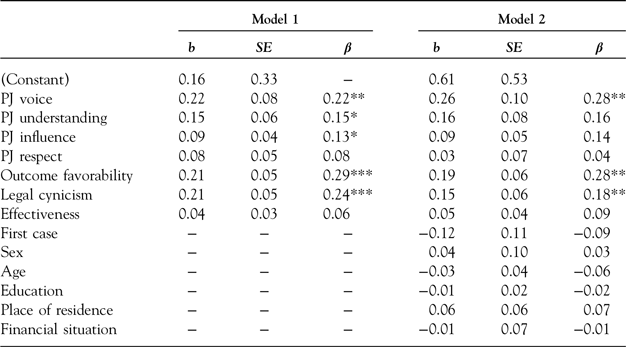
Ordinary least squares (OLS) regression analysis was then performed. Two models were compared: a baseline model including only those variables shown to be correlated in Table 2, and a full one, with all sociodemographic variables. Model 1 explained 53 percent of the variability of courts’ perceived legitimacy among participants (R2 = .54, SE = .46866, F = 31.232, p < .001). Model 2 explained 46 percent of the variability (R2 = .46, SE = .46823, F = 8.170, p < .001) (see Table 3). Given the high correlation between our key variables, the variance inflation factor (VIF) and tolerance level were calculated for both models. The highest VIF was 2.21 (mean VIF = 1.48) and 2.34 (mean VIF = 1.43) for Models 1 and 2, respectively, and the tolerance exceeded 0.43. This indicates that multicollinearity was not an issue.
Linear Regression Models for Perceived Court Legitimacy

Note: N = 192. Model 1, F: 31.232***, R2: .54; model 2, F: 8.107***, R2: .46.
*p < .05. **p < .01. ***p < .001.
In Model 1, outcome favorability emerged as the strongest predictor of legitimacy (β = .29), followed by legal cynicism (β = .24) and the three dimensions of procedural justice—voice, understanding and influence (β = .22, β = .15 and β = .13, respectively). In Model 2, outcome favorability and voice were equally significant and strong (β = .28) predictors of legitimacy followed by legal cynicism (β = .18). These findings support both the idea that perceived fairness of decision-making, epitomized by voice, matters greatly for civil litigants and that winning is also of great importance. Effectiveness—defined in this study as the perceived timeliness of court proceedings—was not a statistically significant predictor of institutional legitimacy in either of the two models.
Having established the significance of fair treatment, outcomes, and legal cynicism in litigants’ assessments of court legitimacy, we next sought to contextualize their court experiences. To do this, we focused on the relationship between the key variables in our study (legitimacy, procedural justice, outcome satisfaction, legal cynicism, effectiveness) for two subsets of our sample—first, plaintiffs and defendants and, second, those appearing with counsel and those appearing pro se. As prior research suggests, the role that one plays at court can be expected to shape the experience of fairness and perceptions of legitimacy (Longazel, Parker, and Sun Reference Longazel2011; Benesh Reference Benesh2006; Benesh and Howell Reference Benesh and Howell2001, 199), while there is good reason to assume representation would do the same (Swank Reference Swank2005).
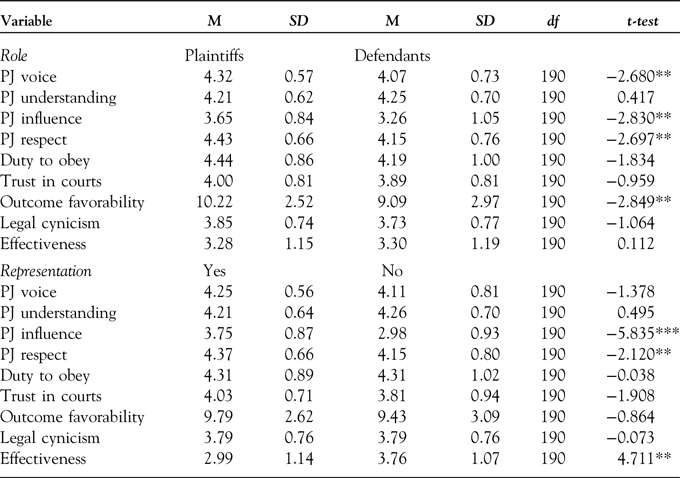
Mean scores on key variables for plaintiffs and defendants as well as for respondents appearing with and without representation suggested noteworthy trends (see Table 4). Plaintiffs ranked higher than defendants on seven out of nine variables, and respondents accompanied by a lawyer ranked higher than pro se litigants on five out of nine variables. These mean differences were consistent with expectations. That is, plaintiffs thought they had more voice and influence and were happier with verdicts. Perhaps, as a consequence, they also ranked higher on both legitimacy dimensions than defendants. Also as expected, those represented by lawyers declared having more voice and influence upon the court proceedings and were more satisfied with the outcome. At the same time, they were more critical of court efficiency.
Independent samples t-tests

*p < .05 ** p < .01
Independent samples t-tests showed significant differences in voice (
 $\overline x$
= 4.32 vs. 4.07), influence (
 $\overline x$
= 3.65 vs. 3.26), respect (
 $\overline x$
= 4.43 vs. 4.15), and outcome favorability (
 $\overline x$
= 10.22 vs. 9.09) for plaintiffs and defendants. Significant differences were also present for those with legal representation and those appearing pro se with regard to influence (
 $\overline x$
= 3.75 vs. 2.98), respect (
 $\overline x$
= 4.37 vs. 4.15), and effectiveness (
 $\overline x$
= 2.99 vs. 3.76) (see Table 4).
Following Fox, et al. (Reference Fox and Moule2021), we then tested a series of regression models for any interaction effects between our key variables (the four dimensions of procedural justice, outcome favorability, legal cynicism, and effectiveness), and the respondents’ role (plaintiff versus defendant) and presence of a lawyer (represented versus pro se). Each model tested one interaction effect. While our analysis failed to demonstrate any significant interaction effects for respondents’ role and presence of lawyer, it is worth considering these two factors in further research. We discuss these findings in the next section.
DISCUSSION
This is the first study we are aware of that tests the procedural justice thesis in a civil court setting in a posttransition country. The findings speak to different debates concerning the generalizability of the procedural justice thesis across legal and geographic boundaries. The limited prior research on judicial settings provides reasons to question the importance of fairness at court (Grootelaar and van den Bos Reference Grootelaar2018; Rottman and Tyler Reference Tyler2007). However, as this study demonstrates, voice as a dimension of fair treatment by authorities predicts legitimacy as strongly (Model 2) or slightly less strongly (Model 1) than outcome favorability. This provides clear support for the claim of Tyler and colleagues (Tyler, et al. Reference Tyler, Anthony, Jeffrey, Tracey, Robert, Chris, Braga, Fagan and Meares2007) that the importance of fairness knows no institutional bounds.
At the same time, the findings encourage us to consider the institutional specificity of civil courts in people’s legal experiences. While our findings reach the same basic conclusion as many previous studies examining policing, criminal courts, and corrections, it is important to consider that outcomes figured as centrally for respondents as voice. This likely reflects the study’s institutional setting. Compared to police interactions, it is probably the case that outcomes weigh more heavily in people’s thinking about courts. As noted before, the basic structure of civil court hearings—with two private parties making arguments before a single state authority entrusted to render a decision—can be thought to foster expectations about outcomes on the part of litigants. The more uncertain nature of police interactions—where citizens usually cannot anticipate when they will be stopped, how many officers will be present, and which officers hold more authority—might foster receptivity to fairness rather than outcomes. The limited nature of our survey data prevents us from being able to say more about the individual thinking of participants. However, we return to this point on the structure of legal interactions and their importance for legal experiences below.
The political and cultural context of this study is also meaningful. Prior work examining court settings in “post” societies, such as Hong Kong (Cheng Reference Cheng2018) and Poland (Burdziej, Guzik, and Pilitowski 2019), have supported the importance of procedural justice to institutional legitimacy. At the same time, other international research (Kim, et al. Reference Kim, Ra and McLean2019; Woo, Maguire, and Gau Reference Woo, Maguire and Gau2018) underscores how cultural context can mediate the experience of fair treatment (Brockner, et al. Reference Brockner and Ackerman2001; Cohn, White, and Sanders Reference Cohn, White and Joseph2000; Lind and Earley Reference Lind and Earley1992; Leung and Lind Reference Leung and Allan Lind1986). Studies have found that people are more likely to comply with the law or deem authorities legitimate when they face punishment (“dull compulsion”) (Gao and Zhao Reference Gao and Jinhua2018; Tankebe Reference Tankebe2009) or perceive legal actors such as the police to be fulfilling their duties effectively (Sun, et al. Reference Sun, Yuning, Rong and Ashley2017; Tankebe Reference Tankebe2009).
Perceptions of court effectiveness did not prove significant in our analysis. Legal cynicism did, however. This likely captures the legacy of Poland’s Communist past and/or its politically contentious present (Ornatowski Reference Ornatowski2011). The “culture of illegality” (Kurczewski Reference Kurczewski2007) tracing back to Communist rule tints people’s assessments of court. That said, it is encouraging that voice, as a dimension of procedural justice, exhibited a stronger influence on legitimacy in our full model. The fact that procedural justice figured centrally in people’s assessment of court legitimacy and that we saw no difference in the views of urban versus rural residents suggests that the legitimacy of courts is informed more by people’s experiences at court than political debates at the national level.Footnote 15 This study thus lends support to the view that fair treatment is important universally, even in “post” societies such as Poland where popular dissatisfaction with the judiciary exists and politicians embark on reforms curtailing judicial independence.
In addition to speaking to lingering debates from previous studies, this research also offers new findings to reflect upon. Important here is the finding that role and representation may partly mediate the experience of fairness and its relationship to legitimacy. Again, defendants and pro se litigants reported different experiences of procedural fairness, outcome satisfaction/favorability, and other key variables than plaintiffs and those appearing with counsel. While the interaction effects were not statistically significant, it is possible that procedural justice serves as an uncertainty management tool for those with less feelings of control or certainty at court (Pickett, Nix, and Roche Reference Pickett, Justin and Sean2018; Lind, et al. Reference Lind1990). As other research has noted, behavioral inhibition in the courtroom may contribute to feelings of anxiety and uncertainty on the part of litigants (Hulst, et al. Reference Hulst and Van den Bos2017). In civil cases, defendants are typically brought to the court by another private citizen who initiates the proceeding—as a result, the former may feel less secure than the latter. Similarly, those appearing pro se may feel less certain about what to expect at court than those appearing with counsel. These processes might be enhanced in “post” societies, where laws and authorities change more frequently and legacies of institutional trust may be absent (Habibov, Afandi, and Cheung Reference Habibov and Afandi2017). Fair treatment by authorities then—in the form of providing respect and voice to litigants and ensuring that they understand the proceedings—can serve as an indicator of the quality of the institution as a whole, regardless of outcomes. As increasing numbers of litigants appear at court without legal representation, it will behoove court administrators to invest in efforts, such as self-help centers (Vickrey, Claro-Quinn, and Wright Reference Vickrey, Claro-Quinn and Wright2011; Gracean Reference Gracean2011; Hough Reference Hough2010) and access to justice mapping (Sandefur and Smyth Reference Sandefur and Smyth2011), to ensure all litigants, especially those in court for the first time, experience fair treatment.
The study is not without its limitations. Most centrally, the findings are based on cross-sectional data from a convenience sample. This is not atypical of studies of procedural justice and institutional legitimacy. But as critical reviews of the procedural justice literature have noted (Nagin and Telep Reference Nagin and Telep2017; Worden and McLean Reference Worden and McLean2017), cross-sectional designs prevent establishing the direction of the relationship between fairness and legitimacy. It is altogether possible that extant perceptions of institutional legitimacy shape how litigants interpret their interactions with legal authorities. The availability sample, meanwhile, limits the generalizability of the findings. As noted before, our sample was wealthier, more urban, and better educated than the general population in Poland, and those demographic characteristics could have shaped perceptions of legitimacy relative to other factors in respondents’ court experiences.Footnote 16 Finally, the nature of our survey data prevents inferring too much about individual experiences at court, which limits our ability to discern the forces behind key findings.
These limitations as well as the preceding points of discussion help clarify lines for future research. First, to address the limitations of the study, future research would do well to collect longitudinal panel data from a random sample of litigants that tracks experiences at court over time. In addition, future research might also consider including qualitative measures of people’s experiences, drawn from open-ended questions or semi-structured interviews. More practically speaking, research could also examine the extent to which courts and other legal institutions are able to foster legitimacy through purposive strategies designed to enhance people’s interactions with legal authorities, whether that involves the training of judges and attorneys or more nontraditional approaches such as self-help centers and access to justice technologies.
By way of conclusion, this study and the Polish context offer a cautionary tale. A judiciary alienated from the social experience of justice runs the risk of executive intervention subverting judges’ independence. By extension, investing in procedural justice could boost legitimacy and help protect judicial independence against political pressures. As the populist turn in national politics continues across the globe, it will be important to continue studying local-level courts to determine how the increased politicization of the judiciary impacts users’ experiences. By pursuing these lines of investigation, we will expand our understanding of how civility matters in civil matters.
Appendix 1. Sample Characteristics

Appendix 2. Relative Frequencies for Select Survey Items

Coding scheme 1: 1 = completely insignificant, 2 = rather insignificant, 3 = unsure, 4 = rather significant, 5 = very significant
Coding scheme 2: 1 = five times or more, 2 = four times, 3 = three times, 4 = twice, 4 = once
Coding scheme 3: 1 = very significant, 2 = significant, 3 = unsure, 4 = rather insignificant, 5 = completely insignificant
Coding scheme 4: 1 = strongly agree, 2 = agree, 3 = unsure, 4 = disagree, and 5 = strongly disagree.
Coding scheme 5: 1 = strongly disagree, 2 = disagree, 3 = unsure, 4 = agree, and 5 = strongly agree.
Coding scheme 6: 1 = less favorable, 2 = as favorable as expected, 3 = more favorable
Coding scheme 7: 1 = no, 2 = yes, self-appointed, 3 = yes, ex-officio