I. INTRODUCTION
Dissimilar joining of materials has been frequently used in many industrial applications such as chemical, petrochemical industries, aerospace, and nuclear industries due to the economical benefits and sometimes to satisfy the service necessities. Reference Prabaharan, Ramkumar and Arivazhagan1 Hastelloy C-276 is a solid solution strengthened nickel-based superalloy which offers better combination of mechanical properties as well as corrosion resistance and has been extensively used as a suitable candidate material for high-temperature equipments used in nuclear power plants. Reference Manikandan, Arivazhagan, Rao and Reddy2 However, Hastelloy C-276 being an expensive alloy could be replaced with an inexpensive material in less severe environmental conditions and consequently cut down material costs. For such purpose, Type 321 is a stabilized ASS grade (presence of Ti avoids sensitization) used as a tubing material to fabricate tubes in steam gas reformers and would be a good alternative for Hastelloy C-276. Reference Sayiram and Arivazhagan3 Therefore, it seems very important to explore the dissimilar combination of Hastelloy C-276 and Type 321 ASS, which are unavoidable in many high temperature applications and has not been studied till now.
Joining of dissimilar metals is relatively challenging as compared to similar welding of metals due to differences in chemical, physical, and thermal properties. Reference Prabaharan, Ramkumar and Arivazhagan1 Conventionally, gas tungsten arc welding (GTAW) is a widely used fusion welding technique. This technique is widely used in industrial applications on account of its low cost and high efficiency. However, due to the higher heat input associated with fusion welding methods, metallurgical problems such as micro-fissuring, solidification cracking, and precipitation of topologically closed packed (TCP) intermetallic phases (such as sigma, P and μ) would appear in the weld metal microstructures during nonequilibrium solidification of such dissimilar weldments. Reference Ramkumar, Sai, Sridhar, Reddy, Prabaharan, Arivazhagan and Sivashanmugham4 These TCP phases are brittle intermetallic compounds which result in the depletion of useful elements (such as Cr and Mo) from the matrix and affects the mechanical properties and especially corrosion resistance. Reference Dupont, Banovic and Marder5 Besides, the GTA welds associated with slower cooling rate possessed the coarser columnar dendritic structure and consequently acts as preferable sites for segregation of such deleterious phases during solidification. Reference Hashim, Babu, Duraiselvam and Natu6 To overcome such problems in dissimilar welding employing GTAW process is cumbersome and needs to be analyzed. Some investigations have been carried out on the GTAW of dissimilar combinations. Sridhar et al. Reference Sridhar, Devendranath Ramkumar and Arivazhagan7 investigated the dissimilar joints between Inconel 625 and duplex stainless steel SAF 2205 prepared by employing ER2209 and ERNiCrMo-3 filler materials. They observed that the toughness value was improved by almost five times by employing ERNiCrMo-3 filler wire as compared to ER2209 filler wire. The lower toughness value for ER2209 filler wire could be attributed to the formation of carbides (M23C6, M6C) as confirmed by the EDS results. Hosseini et al. Reference Hosseini, Shamanian and Kermanpur8 investigated the effect of filler wire (Inconel 82, Inconel 617 and 310 SS) on the microstructural and mechanical properties of GTA welded Inconel 617/310 dissimilar welds. The results concluded that amongst all the filler wire used, Inconel 617 offered better mechanical properties with no evidence of any cracking possible in these dissimilar combinations. Mithilesh et al. Reference Mithilesh, Varun, Reddy, Reddy, Ramkumar, Arivazhagan and Narayanan9 studied the GTA welded dissimilar combination of Inconel 625 and Type 304 using ERNiCrMo-3 filler wire. The authors inferred that susceptibility to hot cracking was reduced by employing both Mo-rich filler wire and lower heat input during GTAW. Pandit et al. Reference Pandit, Joshi, Agrawal, Manikandan, Devendranath Ramkumar, Arivazhagan and Narayanan10 carried out investigations on GTA welds of Monel 400 and C-276 and reported the formation of intermetallic compounds at the weld zone and HAZ of Hastelloy C-276 which has contributed to the higher strength of weldments. The above literature made it clear that no systematic investigation has been carried out on the dissimilar combination of Hastelloy C-276 and Type 321 ASS and emphasizing the necessity to investigate the microstructural evolution and elemental segregation during multi-pass GTAW. Further, the detrimental effect of secondary phases (associated with conventional welding techniques) on the mechanical properties and corrosion resistance needs to be addressed.
Therefore, the main aim of the present study is to investigate the bimetallic joint of Hastelloy C-276 to Type 321 ASS, which is still an untouched area. A detailed structure–property correlationship was made to improve the consistency and performance of this bimetallic combination. The outcomes of the present work would be of an assistance for petrochemical and nuclear power plant industries to substitute an expensive superalloy Hastelloy C-276 with cost-effective Ti-stabilized Type 321 ASS and subsequently led to the viable design of the components.
II. EXPERIMENTAL PROCEDURE
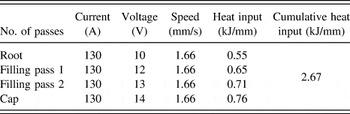
The base metals (BMs) used in the present study were 6 mm thick plates of Hastelloy C-276 and Type 321 ASS with 6 mm thickness. Table I shows the chemical composition of the BMs and the filler wire (ERNiCrMo-4). The solution annealing of the BMs was carried out at 1067 °C (1 h) and 1100 °C (1 h) for both Hastelloy C-276 (Ref. Reference Tawancy11) and Type 321 ASS Reference Moura, Kina, Tavares, Lima and Mainier12 respectively, followed by water quenching. Each plate was cut into dimensions of 110 × 55 × 6 mm and single V-groove butt joint configuration (having size land of 1 mm, root gap of 2 mm, and an included angle of 80°) has been prepared on plate edges. A special jig fixture with copper backup plates was designed to ensure proper gripping and alignment of parts during solidification. Welding was carried out by GTAW process in four passes and the inter-pass temperature was kept as 150 °C to minimize the tension during solidification. The heat input for GTAW process was calculated using Eq. (1).
 $${\rm{HI}} = \eta \cdot I \cdot V{\rm{/}}s\quad ,$$
where, η correspond to the efficiency of the welding process considered as 70% for GTAW process, Reference Neissi, Shamanian and Hajihashemi13 I is welding current (A), V is the voltage (V), and s is the welding speed (mm/s). The welding parameters and heat input calculations for each weld pass are given in Table II.
Chemical composition (wt%) of base and filler metals.

Process parameters used in GTAW.

The microstructure of the dissimilar weldment was determined using electrolytic etching [5 V for 25 s in chromic acid solution (100 cc H2O + 10 g CrO3)] using potentiostat (Solartron-1285, AMETEK, Inc., Wokingham, England). Macro and microstructural examination were carried out using an optical microscope (Zeiss “AxioLab A1”, Carl Zeiss AG, Göttingen, Germany) and JEOL “6380 A” scanning electron microscope (SEM; JEOL Ltd., Tokyo, Japan). The extent of segregation across the weldments was evaluated by using EDS equipped with SEM. Hardness test was carried with a force of 4.90 N for a dwell period of 15 s by microhardness tester (Shimadzu Microhardness tester, Shimadzu Corporation, Atsugi, Japan). 14 Furthermore, tensile test was carried out using Instron universal testing machine (model 4467; Instron, High Wycombe, England), fabricated as per ASTM E8 M-04. 15 Consequently, Charpy V-notch impact test was executed on the sub-sized samples prepared in accordance with ASTM E23-12C standards. 16 The electrochemical test was carried out in 0.5 M H2SO4 + 0.01 M NH4SCN solution by potentiostat “Solartron-1285” at room temperature (RT). 17 The steady state condition of open circuit voltage (OCP) was attained after 30 min of specimen immersion in the test solution. The sweep potential for anodic polarization was kept within the range of −0.5 to 1.5 V at a scan rate of 1 mV/s. The saturated calomel electrode (SCE) was supplied as the reference electrode whereas a platinum electrode as an auxiliary electrode. In addition, the performance of dissimilar weld was also evaluated by conducting a destructive test. The welded tensile sample was immersed in a boiling (11.9% H2SO4 + 1.3% HCl + 1% FeCl3 + CuCl3) solution popularly known as “Green death” for 24 h at 100 °C. Reference Zhang, Liu, Chen, Yao and Collier18 The samples were then subjected to tensile test and the fractured surface was examined employing SEM. A flowchart for showing brief methodology of the experimental procedure has been given in Fig. S1.
III. RESULTS AND DISCUSSION
A. Base metals microstructures
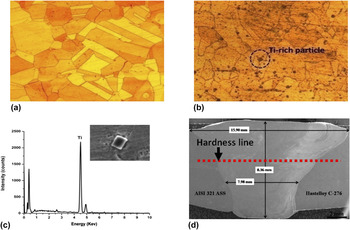
The microstructure of the Hastelloy C-276 BM consisted of an austenitic equiaxed grains as shown in Fig. 1(a). On the other hand, BM of Type 321 ASS consisted of fine austenitic grains along with small cuboidal inclusions of titanium carbides as shown in Figs. 1(b) and 1(c), respectively.
Optical micrographs of BMs; (a) Hastelloy C-276; (b) Type 321 ASS; (c) EDS spectrum showing presence of cuboidal shape Ti-rich particles; (d) image showing macrograph of dissimilar welded Hastelloy C-276 and Type 321 ASS.

B. Macrostructural examination
Macrostructural examination was carried out on the dissimilar joint fabricated by GTAW as depicted in Fig. 1(d). The macrograph showed proper fusion and good weld bead profile, which construed that the parameters chosen and the selection of filler material were suitable with the BMs.
C. Microstructural examination of the dissimilar weldments
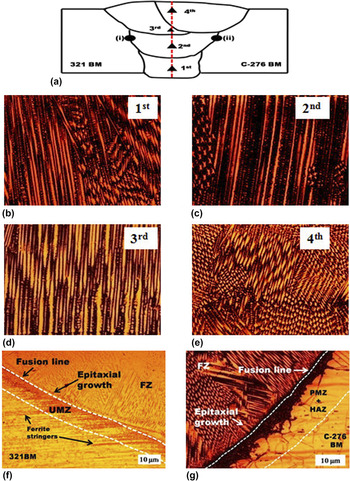
The fusion zone (FZ) microstructure to a great extent depends on the cooling rate and has a significant influence on the mechanical properties of welded joints. Reference Dupont, Banovic and Marder5 Fig. 2 showed that the FZ microstructures obtained upon solidification were fully austenitic due to the presence of austenite promoting elements (such as Ni, Mo, and Co). Reference Baghjari and Mousavi19 However, the morphology of the subgrain solidified structure differed across the various passes [locations shown in Fig. 2(a)]. The subgrain solidification structure in the root pass and the cap pass mostly consisted of a combination of columnar and equiaxed morphology [Figs. 2(b) and 2(e)] as compared to coarser columnar dendritic structure appeared in filler pass-1 and filler pass-2 [Figs. 2(c) and 2(d)]. As reported in the literature, the tendency of the structure to change from the columnar dendritic structure to equiaxed dendritic structure increases with increasing cooling rate. Reference Kuo and Lee20 The higher temperature gradients at the root and cap passes resulted in faster cooling rate and hence induced variation in the solidification dendritic structure. Reference Ramkumar, Anirudh, Singh, Goyal, Gupta, George and Arivazhagan21
(a) Schematic view of FZ containing different passes; optical microstructures of (b) 1st: root pass (c) 2nd: filler pass-2 (d) 3rd: filler pass-3 (e) 4th: cap pass; (f, g) weld interfaces on Type 321 ASS side and Hastelloy C-276 side, respectively.

Figures 2(f) and 2(g) shows the optical microstructures at the interface of dissimilar welded Type 321 ASS and Hastelloy C-276 joints. Owing to the similarity in the crystal structures of both the BMs and FZ, crystal orientations of the BM influence the microstructure of the weld and lead to form the epitaxial growth region. Reference Baghjari and Mousavi19 The interfacial microstructures showed a well-defined fusion line along with dendritic growth at the weld interface on both Type 321 ASS and Hastelloy C-276 side [locations mentioned as (i) and (ii) in Fig. 2(a) respectively]. Figure 2(f) showed the presence of an unmixed zone (UMZ) at the interface on Type 321 ASS side. This occurs when the melting point of filler metal (≈1370 °C) is similar/higher to that of BM (≈1400 °C), then only a small fraction of the BMs can be melted and no dilution takes place in the re-solidification stage which ends up in the formation of an UMZ. Reference Sayiram and Arivazhagan3 Furthermore, the presence of δ-ferrite stringers was also observed at the heat affected zone (HAZ), which has a beneficial effect of minimizing grain growth and decreasing propensity to HAZ liquation cracking. Reference Kumar, Ramkumar and Arivazhagan22 On the other hand, the microstructures at the weld interface of Hastelloy C-276 side had undergone grain coarsening in the HAZ and also divulged small presence of a partially melted zone (PMZ) characterized by grain boundary melting and thickening as shown in Fig. 2(g). The generation of higher heat input during GTAW might have caused the formation of PMZ and also to the weld pool convection which causes separation of the partially melted grains from the solid–liquid (S–L) mixture surrounding the weld pool. Reference Ramkumar, Naren, Paga, Tiwari and Arivazhagan23
D. SEM/EDS analysis of the dissimilar weldments
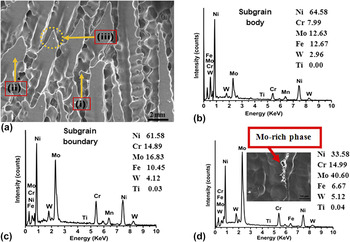
The amount of segregation occurred upon solidification often lead to the precipitation of harmful secondary phases which affects the mechanical properties as well as corrosion resistance of the welded joints. Reference Dupont, Banovic and Marder5 It has been reported in the literature that a coarser columnar dendritic structure associated with conventional fusion welding (such as GTAW) processes mostly results in high degree of segregation and are more prone to the hot cracking phenomenon as compared to cellular/equiaxed dendritic structure. Reference Hashim, Babu, Duraiselvam and Natu6 SEM-EDS point analysis was carried out across the weldment to evaluate the extent of microsegregation occurred within the dissimilar joints. The SEM image confirmed the presence of columnar dendrites in FZ as shown in Fig. 3(a). Further, EDS point analysis results showed that the subgrain bodies [Fig. 3(b)] were depleted in Mo and W and enriched in Ni and Fe as compared to subgrain boundaries [Fig. 3(c)]. This trend is believed to be based on the atomic size where elements of similar atomic radii mostly exhibit considerable solubility compared to elements having larger atomic radii. The size of both Fe (1.56 Å) and Cr (1.66 Å) is quite similar to matrix element Ni (1.49 Å) and hence do not segregate while Mo (1.90 Å) and W (1.93 Å) being larger in size (compare to Ni) segregate aggressively upon solidification of the weld. Reference Dupont, Banovic and Marder5 The occurrence of white tiny particles occupying the subgrain boundaries of the columnar dendritic structure were also noticed in the FZ. These particles were highly enriched in Mo and W and depleted to a greater degree in Ni as shown in Fig. 3(d). As reported in the literature, it might be possible that some amount of intermetallic TCP phases such as sigma, P and μ could have formed during solidification of weld due to the slower cooling rate associated with GTAW process which needs further characterization. Reference Manikandan, Arivazhagan, Rao and Reddy24
SEM/EDS point analysis on the GTAW (a) FZ; (b–d) EDS analysis of (i) weld subgrain body; (ii) weld subgrain boundary; (iii) Mo rich phase; respectively.

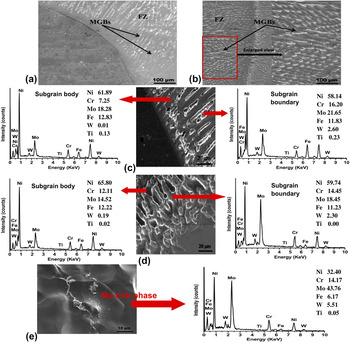
Figures 4(a) and 4(b) revealed the presence of migrated grain boundaries (MGBs) at the interface on both Type 321 ASS side and Hastelloy C-276 side, respectively, which were not clearly visible in optical micrographs. MGBs are commonly prevalent in fully austenitic welds or due to the reheating actions occurred during multipass welding. Reference Sayiram and Arivazhagan3 Figs. 4(c) and 4(d) showed the enlarged view of the interface region on both Type 321 ASS and Hastelloy C-276. EDS point analysis results depicted that the segregation of elements between weld interface subgrain boundaries and subgrain bodies were also noticed on both sides. Similar to FZ, the appearance of white tiny phases were also observed at the weld interface on Hastelloy C-276 side. However, the extent of segregation was comparatively higher at the weld interface of Hastelloy C-276 as compared to FZ as depicted in Fig. 4(e). Therefore, weld interface region was found to be more susceptible to hot cracking phenomenon as compared to FZ. Reference Sayiram and Arivazhagan3 However, no sign of cracking was noticed in the present study which might be due to the proper selection of welding parameters.
(a, b) Images showing weld interfaces of Type 321 ASS and Hastelloy C-276 respectively; (c, d) enlarged view of interfaces on Type 321 ASS and Hastelloy C-276 side respectively along with EDS results; (e) EDS results showing precipitation of Mo-rich phase at the weld interface on Hastelloy C-276.

E. SEM/EDS analysis for compositional gradient across the composite region
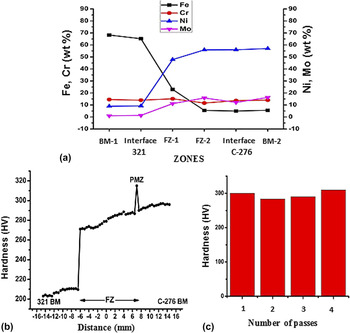
Compositional gradient is considered as one of the important concerns during dissimilar joining of materials and leads to the movement of elements from higher concentration region to lower concentration region. The composite region which includes various zones [Type 321 ASS (BM + UMZ) + FZ (ERNiCrMo-4) + (PMZ + HAZ + BM) Hastelloy C-276] was subjected to SEM-EDS point analysis and results are shown in Fig. 5(a). The alloying elements (Fe, Cr, Mo, and Ni) which impose major influence on the properties of dissimilar weldments and also form a major part of the BMs matrix were chosen for EDS point analysis.
(a) SEM-EDS point analysis results across the weldment employing GTAW process; (b) horizontal microhardness plot from Type 321 BM to Hastelloy C-276 BM; (c) vertical microhardness plot from face passes to root passes.

A significant variation in the amount of Fe and Ni had observed to be migrated across Type 321 ASS/FZ interface. This enormous variation could be attributed mainly due to the huge concentration difference between Type 321 BM and filler wire. In addition, fast diffusion of Fe and Ni in the melt pool had also led to the large variation on account of small atomic radii as compared to other alloying elements. In addition, a slight movement of Mo from FZ toward Type 321 side was also observed. This might be due to the difference in the chemical composition of filler material (17%) and Type 321 BM (nil). However, variation in the Cr concentration was found to be almost negligible as both the BM and filler material consisted of an almost same amount. On the other hand, at the FZ/Hastelloy C-276 interface, lesser migration of element took place as the concentrations of these elements were almost similar. However, the concentration of Mo in the filler wire is 17%. From the EDS analysis, it was noticed that Mo has been depleted at the interface on Hastelloy C-276 side as compared to the center part of FZ and Hastelloy C-276 BM, as the percentage of Mo was found to be 12%. Formation of secondary phases [appeared as white in Fig. 4(e)] at the weld interface of Hastelloy C-276, had led to the depletion of this element. This might have happened due to the lower cooling rate coupled with GTAW process, which provides ample time for elements to get diffused and segregation to occur. In addition, when the solidification occurred in such a manner that the last solidifying liquid is predominantly rich in Mo and deprived in Ni, one could end up in the formation of secondary phase (s) and the same has happened at the weld interface of Hastelloy C-276. Reference Manikandan, Arivazhagan, Rao and Reddy24
F. Mechanical characterization
Microhardness measurement was carried out firstly in the longitudinal direction [location shown in Fig. 1(d)] that is on a plane perpendicular to the weld direction as shown in Fig. 5(b). It was observed that there was an increase in hardness as the indentor moves from Type 321 ASS BM side to Hastelloy C-276 BM side. The compositional difference associated with the BMs could be one of the reasons for such trend in microhardness. Reference Hosseini, Shamanian and Kermanpur8 The average hardness at the FZ was found to be in between the hardness of BMs (281.6 HV) and could be attributed to the presence of columnar dendritic structure as reported by Sakthivel et al. Reference Sakthivel, Vasudevan, Laha, Parameswaran, Chandravathi, Mathew and Bhaduri25 In addition, the microhardness increases suddenly at the fusion line on Hastelloy C-276 due to the presence of partially melted grains, which are partially adopted as nuclei by the new precipitating phase of the FZ during the solidification stage. Reference Vashishtha, Taiwade, Khatirkar, Ingle and Dayal26 The variation in microhardness from cap pass to root pass is shown in Fig. 5(c). The results showed that microhardness near the top of the weld bead (cap pass) and also at the root region was higher as compared to other two passes. The reason for this could be attributed to the higher cooling rate at the surface of weld bead and root pass (the use of Cu back plates which promotes the cooling rate) which resulted in finer dendritic structure and consequently increased the hardness at both these passes. Reference Kuo and Lee20
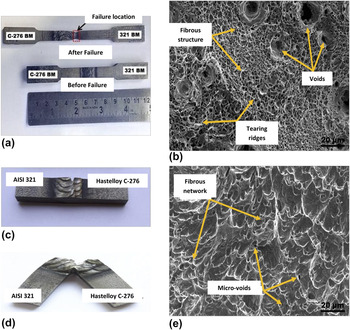
Tensile test was conducted to ascertain the behavior of the weldment toward gradually increasing load. The rupture location propensity did not vary with increasing passes, so multi-pass welding could be an irrelevant factor in the tensile test. Reference Kuo and Lee20 Further, the results showed that the fracture occurred at the weaker parent material side (i.e., Type 321 ASS BM) and tensile strength obtained was coming out to be 685.50 MPa as shown in Fig. 6(a). The hardness result was found to be in complete agreement with tensile results as Type 321 ASS BM experienced lower hardness. Reference Ramkumar, Anirudh, Singh, Goyal, Gupta, George and Arivazhagan21 This also confirmed that the weld strength was quite higher compared to weaker parent material and the precipitation of Mo-rich phases in the FZ as well as the interface of Hastelloy C-276 did not weaken the matrix. Reference Ramkumar, Anirudh, Singh, Goyal, Gupta, George and Arivazhagan21 As the failure occurred in the Type 321 ASS BM, it would be indecisive to comment on the role of FZ microstructure in case of TS. However, the presence of columnar in combination with equiaxed dendritic structure might have increased the restraint of FZ against failure. Reference Sathiya, Mishra, Soundararajan and Shanmugarajan27 Fractured surface of the tensile specimen was observed to characterize the failure mode and the SEM fractograph is shown in Fig. 6(b). The SEM fractograph confirmed that the weldment failed due to ductile fracture by showing micro-voids/dimple appearance which coalesces together to undergo plastic deformation. Reference Anand, Tamilmannan and Arivazhagan28
Images showing (a) tensile specimen before and after failure; (b) SEM fractograph of tensile tested specimen; (c, d) images showing impact specimens before failure and after failure, respectively; (e) SEM fractograph of the impact tested specimen.

The images of impact specimens before and after the failure are shown in Figs. 6(c) and 6(d), respectively. The image clearly showed that the failure of specimen did not occur abruptly and had undergone sufficient deformation under impact loading. The average impact energy was found to be (182 J). This might be due to the fully austenitic structure which resulted in higher toughness of dissimilar welded joints. Reference Manikandan, Arivazhagan, Rao and Reddy24 In addition, it has also been reported in the literature that as compared to columnar dendritic structure, equiaxed dendrites can accommodate higher strains and considered to be more ductile. Reference Baghjari and Mousavi19 Therefore, the presence of equiaxed dendrites might also have contributed for increment in toughness value. The presence of fibrous network and micro-voids confirmed the ductile mode of failure as shown in Fig. 6(e).
G. Corrosion test
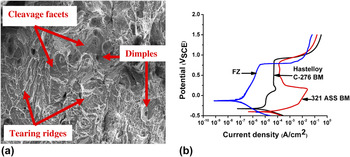
The dissimilar weldment was immersed in a “Green death” chloride solution to see the influence of corrosive environment on the tensile strength. The sample was removed after 24 h (at 100 °C) from the solution and later subjected to the tensile test. It was observed that the failure of the tensile specimen again took place in the Type 321 ASS BM, in a similar manner as in Sec. III.F. Moreover, the TS reduction was found to be in reduced amount as compared to obtained in the case without immersing in a corrosive environment (610 MPa). However, the SEM fractograph of the fractured surface showed a slight transition in the failure mechanism as shown in Fig. 7(a). The fractograph showed a large amount of ductile dimples along with cleavage facets. This showed that the continuous exposure of dissimilar welds in chloride environment was not enough to cause any sign of pitting and inter-granular corrosion even in weaker parent material that is Type 321 ASS BM. Therefore, Type 321 ASS would be a better alternative to replace Hastelloy C-276 in such chloride environment.
(a) SEM fractograph of tensile specimen tested in corrosive solution; (b) polarization curve of Hastelloy C-276 BM, Type 321 ASS BM and FZ.

The potentiodynamic polarization of both the BMs and FZ were carried out in 0.5 M H2SO4 + 0.01 M NH4SCN solution at RT as depicted in Fig. 7(b). The addition of acidified ammonium thiocyanate to H2SO4 was found to be helpful in simulating an oxidizing medium so that the transition from an active-to-passive region of the BMs could be easily investigated. Reference Pujar, Dayal, Malhotra and Gill29 It was observed that both the FZ and Hastelloy C-276 BM displayed better passivation and this could be attributed to the presence of Mo and W in the matrix. The E pit value was lower for FZ compared to Hastelloy C-276 BM and Type 321 ASS BM. The reason for this could be attributed to the presence of Mo-rich secondary particles which might have weakened the matrix and consequently formed the basis for such pits to occur. Reference Pulkkinen, Apajalahti, Papula, Talonen and Hanninen30 Moreover, Type 321 ASS BM being a comparatively inferior material had shown good resistance to the increase in current density followed by formation of the passive film. This might be due to the higher amount of Cr content in the alloy composition which contributed for such behavior in the passive film formation. Hence, the choice of replacing Hastelloy C-276 by cost-effective Type 321 ASS would be a great alternative for industrial applications.
IV. CONCLUSIONS
The present study investigated the dissimilar welds of Hastelloy C-276 and Type 321 ASS obtained by multi-pass GTAW using an austenitic ERNiCrMo-4 as filler wire. The present study systematically represents the microstructural evolution, elemental segregation across the various regions and their subsequent effect on mechanical properties and corrosion resistance. From this investigation, following conclusions are obtained.
-
(1) The macrograph of the bi-metallic joint between Hastelloy C-276 and Type 321 ASS weld showed good weld bead profile with proper penetration by employing multi-pass GTAW using ERNiCrMo-4 as filler wire.
-
(2) The dendritic morphology in the FZ exhibited transition from cellular to columnar and to an equiaxed dendritic structure with change in the welding passes. The formation of the columnar dendritic structure was observed in filler pass-2 and filler pass-3 whereas both columnar and equiaxed dendritic structure were formed in root and cap passes due to faster cooling rate.
-
(3) The microstructures of weld interface of Type 321 ASS side revealed the presence of UMZ. SEM images witnessed the occurrence of grain boundary migrations at the weld interface on both Hastelloy C-276 and Type 321 ASS sides due to the multi-pass welding.
-
(4) SEM images observed the occurrence of MGBs at the weld interface of both Hastelloy C-276 and Type 321 ASS side. SEM-EDS analysis confirmed the formation of brittle intermetallic phases in FZ as well as at the weld interface of Hastelloy C-276.
-
(5) The average tensile strength of ERNiCrMo-4 dissimilar weld was observed to be higher (685.50 MPa) than weaker parent material that is Type 321 ASS BM (672 MPa). Hence the FZ possessed good resistant to failure and consequently fracture occurred in the weaker Type 321 ASS BM side. Charpy V-notch studies showed that the average impact toughness of the dissimilar weld (182 J) was greater than one of the base material, Hastelloy C-276 (51 J).
-
(6) The pitting potential of the FZ (0.76 VSCE) decreased due to the formation of secondary precipitates while comparable pitting potential was observed for both the Hastelloy C-276 BM (0.86 VSCE) and Type 321 BM (0.81 VSCE). It further strengthens the replacement potential of cost-effective Type 321 ASS. It was observed from the destructive test that the fractured surface of Type 321 BM showed a slight change in appearance from ductile to cleavage and hence resulted in drop in tensile strength (610 MPa).
Based on the present study, it is highly recommended to employ such dissimilar combination of multi-pass GTA welded Hastelloy C-276 and Type 321 ASS using ERNiCrMo-4 filler wire in industrial applications from economical as well as performance point of view.
LIST OF SYMBOLS

Supplementary Material
To view supplementary material for this article, please visit https://doi.org/10.1557/jmr.2017.235.