INTRODUCTION
South-West England is characterized by the occurrence of a series of ria-type estuaries distributed along the coasts of Devon and Cornwall (Castaing & Guilcher, Reference Castaing, Guilcher and Perillo1995). The main species of barnacles found in intertidal areas of these estuaries are Elminius modestus Darwin, Semibalanus balanoides Linneaus and Chthamalus montagui Southward (Dixon, Reference Dixon1986; Hiscock, Reference Hiscock1986; Hiscock & Moore, Reference Hiscock and Moore1986; Horsman, Reference Horsman1986; Rostron, Reference Rostron1987; Moore, Reference Moore1988; Little, Reference Little1988, Reference Little1989; Frid, Reference Frid1989; Gill & Mercer, Reference Gill and Mercer1989). Elminius modestus is dominant throughout the intertidal in most of these estuaries. Chthamalus montagui is typically restricted to seaward regions of estuaries, while the distribution of S. balanoides and E. modestus extends to mid and upper estuarine areas (Southward, Reference Southward1976; Crisp et al., Reference Crisp, Southward and Southward1981).
Elminius modestus is an Australasian species typically found in estuarine and sheltered marine areas (Crisp, Reference Crisp1958; Crisp & Southward, Reference Crisp and Southward1959; Barnes & Barnes, Reference Barnes and Barnes1961, Reference Barnes and Barnes1965; Foster, Reference Foster1978, Reference Foster and Southward1987). This species invaded British and European waters during World War II and became well established (Bishop, Reference Bishop1947; Stubbings, Reference Stubbings1950; Den Hartog, Reference Den Hartog1953, Reference Den Hartog1956; Crisp, Reference Crisp1958; Barnes & Barnes, Reference Barnes and Barnes1960a, Reference Barnes and Barnesb, Reference Barnes and Barnes1961, Reference Barnes and Barnes1965, Reference Barnes and Barnes1969; Jones, Reference Jones1961; Fischer-Piette & Forest, Reference Fischer-Piette and Forrest1961; Barnes & Stone, Reference Barnes and Stone1972; Hiscock et al., Reference Hiscock, Hiscock and Baker1978; Flowerdew, Reference Flowerdew1984). The current dominance of E. modestus is a consistent feature of many European estuaries (Reise et al., Reference Reise, Gollasch and Wolff1999; Wolff, Reference Wolff1999; Nehring, Reference Nehring2006). This dominance is probably a consequence of several traits of this species, such as higher tolerance to low salinity (Foster, Reference Foster1970; Davenport, Reference Davenport1976; Cawthorne, Reference Cawthorne1978, Reference Cawthorne1979; Cawthorne & Davenport, Reference Cawthorne and Davenport1980) and siltation (Crisp, Reference Crisp1958); higher cirral activities (Southward, Reference Southward1955; Barnes & Barnes, Reference Barnes and Barnes1962); higher fecundity (Crisp & Davies, Reference Crisp and Davies1955; Barnes & Barnes, Reference Barnes and Barnes1968); and shorter generation time (Crisp & Davies, Reference Crisp and Davies1955; Barnes, Reference Barnes1989), which presumably confer advantage over native species (Crisp, Reference Crisp1958; Harms, Reference Harms1999; Watson et al., Reference Watson, O'Riordan, Barnes and Cross2005).
Salinity and sedimentation are among the main physico-chemical factors that influence the distribution of benthic organisms in estuarine intertidal shores (Sanders et al., Reference Sanders, Mangelsdorf and Hampson1965; Carriker, Reference Carriker and Lauff1967; Wolff, Reference Wolff and Ketchum1983; Attrill & Thomas, Reference Attrill and Thomas1996). Salinity fluctuations and low salinities affect osmotic equilibrium and consequently physiological condition and behaviour of barnacles (Foster, Reference Foster1970; Davenport, Reference Davenport1976). High fluxes of suspended sediment and deposition of silt can have adverse effects, interfering directly on food intake or covering organisms and their substrata and acting as a physical barrier to feeding, settlement and reproduction (Day, Reference Day1959; Carriker, Reference Carriker1961; Loosanoff, Reference Loosanoff1962; Jorgensen, Reference Jorgensen1966, Reference Jorgensen1996; Levinton & Bambach, Reference Levinton and Bambach1970; Rhoads & Young, Reference Rhoads and Young1970; Aller & Dodge, Reference Aller and Dodge1974; Ellis et al., Reference Ellis, Cummings, Hewitt, Thrush and Norkko2002). In general, physical conditions become more variable and more stressful for most marine species, from the seaward to the upper regions of estuaries and these gradients may be closely related to changes in abundance and occurrence of species along estuaries.
Expansions on the geographical distribution of E. modestus in the northern hemisphere and increases on its dominance in British and European coastal systems have been noticed in the last few decades (Hiscock et al., Reference Hiscock, Hiscock and Baker1978; Little et al., Reference Little, Morritt and Stirling1992; O'Riordan & Ramsay, Reference O'Riordan and Ramsay1999; Lawson et al., Reference Lawson, Davenport and Whitaker2004; Watson et al., Reference Watson, O'Riordan, Barnes and Cross2005; Allen et al., Reference Allen, Power, O'Riordan, Myers and McGrath2006). Detailed surveys in local estuaries could reveal if this is true for England's South-West estuaries and portray a comprehensive and up-to-date picture of the horizontal patterns of barnacle distribution and abundance along sea-to-freshwater gradients. Therefore, the objectives of this work were: (1) to assess the variations in salinity and siltation in the intertidal along the sea-to-freshwater gradient of the Plym and the Yealm Estuaries; (2) to identify patterns of abundance and distribution of intertidal barnacle species along these gradients; (3) to establish the location of the upper limits of distribution of each barnacle species within these estuaries; and (4) to check on the present degree of dominance exhibited by E. modestus in these estuaries.
MATERIALS AND METHODS
Study area
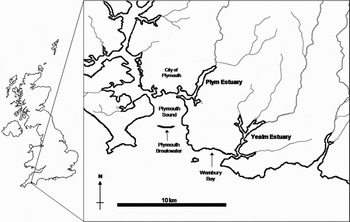
The Yealm and Plym Estuaries are located near Plymouth in South-West England (Figure 1). They are macrotidal rias with low freshwater inflow and considerable protection from wave action. The River Plym empties into Plymouth Sound, which is sheltered by the Plymouth Breakwater, and the River Yealm has its entrance at Wembury Bay, to the east of Plymouth Sound (Figure 1).
The Yealm and Plym Estuaries and their location in South-West England.

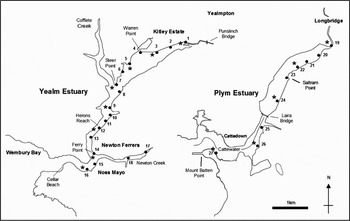
The Plym Estuary extends for 5.5 km from Longbridge to Mount Batten Point (Figure 2). The Yealm Estuary is 6.5 km long, extending from Punslinch Bridge, near Yealmpton, to its seaward limit at Wembury Bay (Figure 2). The Yealm Estuary is protected by Wembury Reef and by a sandbar at its entrance. The coastlines of these estuaries are generally characterized by gentle slopes and large areas of mud flats. In most intertidal areas mud covers the bedrock below mid-tide level, but above this level, outcrops of rock, boulders or cobbles occur. Artificial substrata are occasionally present as stone embankments and jetty walls, and these also contribute to the surfaces available for colonization by barnacles.
Close-up of the Yealm and the Plym Estuaries. Position of sites investigated in the survey and names of areas cited in the text. The geographical relationship between estuaries is shown on Figure 1. Asterisks indicate sites used for collection of physico-chemical data (salinity and/or deposition of sediment). 1, Punslinch Bridge; 2, Quay/Kitley Estate; 3, Boat House/Kitley Estate; 4, Warren Point; 5, South Creek; 6, South Creek Quay; 7, Steer Point; 8, Hanaford Green; 9, Shortaflete Creek; 10, Court Woods North; 11, Court Woods South; 12, Heron's Reach; 13, Madge Point; 14, Ferry Point; 15, Ferry Cottage; 16, Passage House; 17, Newton Creek Top; 18, Newton Creek; 19, Blaxton Meadow North; 20, Blaxton Meadow South; 21, The Amphitheatre; 22, Saltram Wood; 23, Saltram Point; 24, Laira Bridge; 25, Yacht Haven Quay; 26, Oreston; 27, Mount Batten Centre.

Physico-chemical variables
Salinity and siltation along the estuaries were assessed on three periods throughout the year (2004) in some of the sites also used for biological surveys (Figure 2). Fluctuation in salinity during spring and neap tidal cycles was measured by deployment of loggers (CT Star-Oddi Iceland) attached to the intertidal substrata. Recordings were made every 15 minutes over periods of 15 days during late winter/early spring, spring and summer in order to establish the effects of tidal and seasonal variations in salinity. These recordings revealed salinity extremes, ranges of salinity fluctuation and durations of exposure to low and high salinities to which organisms were exposed during periods of immersion.
Deposition of sediment was estimated using sediment traps. Traps consisted of squares of Astroturf mat of 100 cm2 attached to plastic bases and fixed on the shore by screws. The Astroturf mat (blades of 2 cm length) was used to simulate a complex surface able to collect sediment, and provided an index of sedimentation allowing comparisons to be made among sites. Sediment collected by the Astroturf mat at the end of each sampling period was washed from the traps and dried to constant weight. Four traps (replicates) were attached to the shore for 15 days during winter, spring and summer at each site.
Biological surveys
The sites were surveyed during October and November 2004 and were located along the length of the Yealm and the Plym Estuaries, encompassing areas with considerable influence of freshwater, at the upper limits of the estuarine area, to sites where fully marine conditions prevail. They also included the whole range of barnacle distribution on these estuaries, as preliminary surveys indicated that barnacle populations were absent upstream at Site 1 in the Yealm and Site 19 in the Plym (Figure 2). Some of the sites used here were coincident to sites sampled in a previous work carried on in the area (Hiscock & Moore, Reference Hiscock and Moore1986) in order to permit comparisons.
Hard substrata were frequently limited to outcrops of rocks or groups of isolated boulders spread along shingle, sand or mud. Surveys were made in areas of the intertidal where barnacles were abundant, usually at mid and upper shore levels, as the lower shore was mainly mud-flats or bedrock covered by mud. Surveys were performed using 10 × 10 cm quadrats. Ten quadrats were photographed at each site. Barnacle species present in the photographs were identified and counted. The relative proportion and densities (expressed in ind 0.01 m−2) of Elminius modestus, Semibalanus balanoides and Chthamalus montagui were calculated for each site sampled.
Statistical analyses
Analyses of variance (ANOVAs) were carried out using Statistica (v. 6.0, Statsoft 2002). Separate two-way ANOVAs were conducted for each estuary to test for differences in abundances. Position within the sea-to-freshwater gradient (site) and species (E. modestus, S. balanoides and C. montagui) were used as fixed factors. Data were log-transformed in order to achieve homogeneity of variance. Post-hoc comparisons were made using the Student-Newman–Keuls test (P > 0.05).
RESULTS
Salinity and siltation
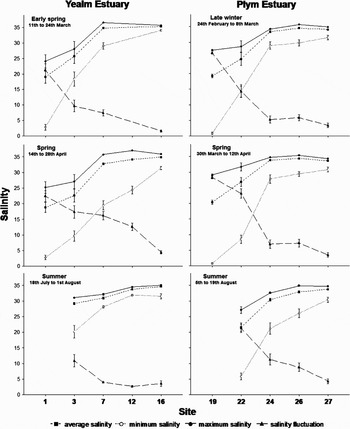
Salinity regimes observed at different periods of the year were similar in the Yealm and the Plym Estuaries (Figure 3). In both estuaries there was a high degree of penetration of saltwater during tidal cycles throughout the year. Horizontal salinity gradients in the Yealm and Plym were characterized by gradual and subtle attenuation of the saltwater influence, away from the mouth of the estuaries, up to two-thirds of the way up each estuary (between Sites 7 and 3 in the Yealm and Sites 24 and 22 in the Plym), from which point this influence was markedly reduced. This is clearly shown by the values of average mean, maximum and minimum salinities for the periods of 15 days sampled (Figure 3).
Mean, minimum and maximum salinities and salinity fluctuation during submergence for 15 days in different periods of the year in the Plym and Yealm Estuaries. Each datum point represents the average value from all immersion periods that occurred during 15-day recordings. Bars represent standard errors of the mean. Missing values in summer due to data logger failure. ■, average salinity; ○, minimum salinity; •, maximum salinity; ▴, salinity fluctuation.

This major shift in salinity clearly differentiates the two up-estuary sites (1 and 3 in the Yealm; and Sites 19 and 22 in the Plym) from the remaining sites located towards the sea in terms of salinity regimes. Salinities below 20 were encountered at all sites, but at most of them these events were occasional and restricted to certain periods of the year (spring in the Yealm; summer in the Plym). The consistent occurrence of salinities below 20 was typical of the two up-estuary sites, resulting in the lower salinities and higher salinity fluctuations (Figure 3), and indicating that greater stress for marine organisms must be found at these sites.
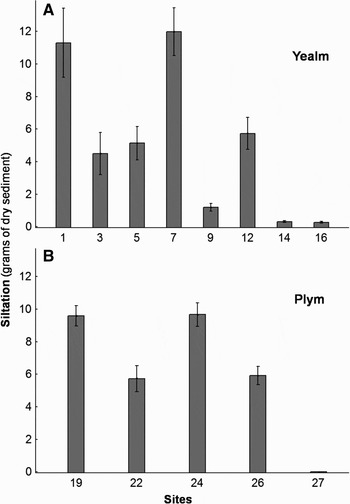
Siltation was high at all sites, except those located near the sea. At the closest site to the sea in both the Plym and the Yealm Estuaries no silt was collected by the traps. Accumulation of silt tended to increase towards the riverine end of the estuaries and decreased towards the sea, although at both estuaries the mid-sites (Site 7 in the Yealm; Site 24 in the Plym) showed the highest levels of siltation (Figure 4). During the surveys accumulation of sediment over rocks and other hard surfaces was observed, particularly at mid and up-estuary regions. On many occasions the layer of sediment was thick enough to cover barnacles completely. At these locations removal of deposited sediment often revealed individuals of E. modestus, but not S. balanoides or C. montagui.
Mean siltation at selected sites along the marine to freshwater gradient of the Yealm and the Plym Estuaries. Columns represent mean siltation for all sediment traps deployed throughout the year. Bars represent standard error of the mean.

Distribution and abundance
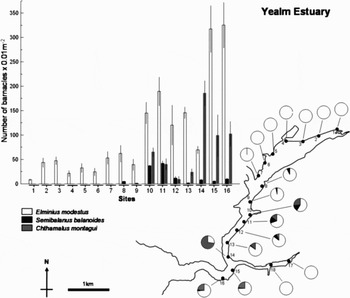
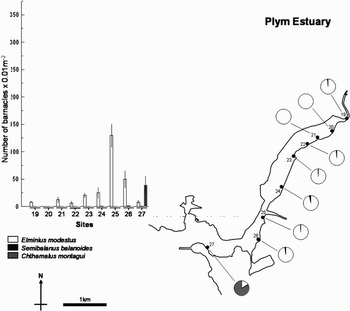
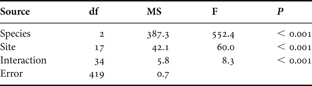
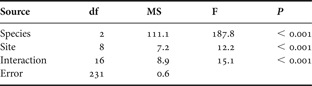
Elminius modestus was dominant on shores in both the Yealm and the Plym. There was significant interaction in abundances between species and sites both in the Plym and in the Yealm (Tables 1 & 2). Elminius modestus was the most abundant barnacle at all sites, except at one site in the Yealm (Site 14; Figure 5) and one in the Plym (Site 27, Figure 6). In these sites C. montagui showed a higher abundance, although the difference was only statistically significant in Site 27. Elminius modestus exhibited significant higher abundances than S. balanoides at all sites in the Yealm and the Plym, except for Site 22. The abundance of S. balanoides was greatest in the middle portions of the estuaries, but this species was only found at extremely low densities in the Plym (Figure 6).
Relative (pie charts) and absolute (bar charts) abundances of adult Elminius modestus, Semibalanus balanoides and Chthamalus montagui along the Yealm Estuary (mean +/− SE).

Relative (pie charts) and absolute (bar charts) abundances of adult Elminius modestus, Semibalanus balanoides and Chthamalus montagui along the Plym Estuary (mean +/− SE).

Two-way ANOVA (factor 1, species; factor 2, site) on abundances of Elminius modestus, Semibalanus balanoides and Chthamalus montagui along the Yealm Estuary.

Two-way ANOVA (factor 1, species; factor 2, site) on abundances of Elminius modestus, Semibalanus balanoides and Chthamalus montagui along the Yealm Estuary.
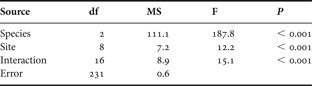
Elminius modestus was found all along the horizontal gradient of the estuaries, from the sites closest to the sea to the uppermost site investigated. Semibalanus balanoides occurred in very low abundances or was completely absent in the upper areas of the estuaries. Chthamalus montagui was the species with the lesser extensive distribution on the estuaries. Additionally, E. modestus was the only species for which young individuals were observed in the samples. Semibalanus balanoides and C. montagui were all adult and apparently more than one year old.
In the Yealm, both S. balanoides and C. montagui were completely absent from the upper third of the estuary (Sites 1 to 6). At this area the barnacle cover was composed exclusively of E. modestus (Figure 5). The middle third of the estuary, from Steer Point (Site 7) to Heron's Reach (Site 12), was characterized by the presence of all three species of barnacles (Figure 3). The upper limit of S. balanoides occurred at Steer Point (Site 7) and that of C. montagui at the south entrance of Shortaflete Creek (Site 10) (Figure 3). Semibalanus balanoides reached peak abundances in the estuary at Sites 10, 11 and 12 (Figure 5). At these sites there were no significant statistical differences in abundances between S. balanoides and C. montagui, and Site 10 was the only site where abundances of the three species did not differ statistically. In the lower third of the Yealm Estuary (Sites 13 to 16) an increase in the relative abundance of C. montagui was observed, while S. balanoides became less abundant (Figure 3). At these sites abundances of C. montagui were significantly higher than that of S. balanoides. Elminius modestus was the only species recorded at the two sites located in Newton Creek (Sites 17 and 18) (Figure 3).
In the Plym Estuary S. balanoides occurred in lower abundance than in the Yealm, but isolated individuals were found further up the estuary (Site 19; Figure 6). Contrary to the pattern observed for S. balanoides, C. montagui showed a less extensive distribution in the Plym (Figure 6) than in the Yealm (Figure 5). This species was absent in the upper and middle thirds of the Plym Estuary and was only recorded at the site closest to the sea (Mount Batten Centre, Site 27; Figure 6).
DISCUSSION
Although Elminius modestus was dominant along almost the entire extension of the estuaries investigated here, the predominance of E. modestus over native barnacle species, as indicated by their relative abundances, decreased towards the seaward margins of the estuaries. In the Plym, not only relative, but also absolute abundance of this species decreased towards the sea. Such reductions in abundance of E. modestus in sites where marine conditions prevail were expected, as this species favours the more sheltered areas, both in its original geographical area in the southern hemisphere (Moore, Reference Moore1944; Foster, Reference Foster1978, Reference Foster, Morton and Tseng1982) and in invaded environments (Fischer-Piette & Prenant, Reference Fisher-Piette and Prenant1956, Reference Fisher-Piette and Prenant1957; Crisp, Reference Crisp1958; Fischer-Piette & Forest, Reference Fischer-Piette and Forrest1961; Fischer-Piette, Reference Fischer-Piette1965). On wave-exposed shores in Britain, E. modestus is not common and is less abundant than Semibalanus balanoides or Chthamalus montagui at all vertical levels (Crisp, Reference Crisp1958; Crisp & Southward, Reference Crisp and Southward1959; Foster, Reference Foster1971; Southward, Reference Southward1991). At the local area, previous works have shown that E. modestus was less frequent on wave-exposed shores than at more sheltered areas within Plymouth Sound (Hiscock & Moore, Reference Hiscock and Moore1986; Burrows, Reference Burrows1988); and that at the mouth of the Yealm (Cellar Beach), this species was not dominant and was restricted to lower levels of the shore (Southward, Reference Southward1991).
Semibalanus balanoides and C. montagui are better adapted to life in areas with full marine conditions (Lewis, Reference Lewis1964; Southward, Reference Southward1976; Crisp et al., Reference Crisp, Southward and Southward1981), although S. balanoides is relatively common in estuaries and can be a dominant form in lower and mid-estuarine areas where suitable conditions are found (Hardwick-Witman & Mathieson, Reference Hardwick-Witman and Mathieson1983; Little et al., Reference Little, Williams, Morritt, Perrins and Stirling1988, Reference Little, Morritt and Stirling1992). For these two species, restricted penetration towards the upper regions of the estuaries, and gradual increases in abundance towards the entrance of the estuaries were expected. In the Yealm, S. balanoides occurred up to Steer Point (Site 7), a site where the species has previously been recorded (Hiscock & Moore, Reference Hiscock and Moore1986). This position corresponds closely with a sharp shift in the prevailing salinity regime, between the mid and the upper third of the estuary, from which point much lower salinities and stronger salinity fluctuations occur as shown by our results. Chthamalus montagui is also absent from the upper third in the Yealm Estuary. Effects of the salinity regime prevailing in the upper third of the estuary certainly contributed to the absence of S. balanoides and C. montagui from these areas.
Salinity, especially salinity fluctuations are important for the distribution of species in estuaries (Wolff, Reference Wolff and Ketchum1983; Attrill & Thomas, Reference Attrill and Thomas1996). The horizontal distribution of barnacle species is known to vary along environmental gradients of salinity and differences in inshore salinity between shores affect barnacle distribution (Southward & Crisp, Reference Southward and Crisp1952, Reference Southward and Crisp1956; Foster, Reference Foster1970). Barnacles respond to physiologically stressful salinities and other unfavourable conditions by closure of the opercular plates, which isolate the mantle cavity and soft body of the individual from the external environment (Barnes & Barnes, 1958; Foster, Reference Foster1969, Reference Foster1970, Reference Foster1971). The success of a barnacle species in an environment where adverse conditions are periodically encountered depends on the species abilities to: (1) feed efficiently during periods of submergence when conditions are appropriate; (2) to avoid unsuitable conditions by closure of the opercular valves; or (3) to tolerate such conditions, when they persist. In C. montagui, S. balanoides and E. modestus such abilities exist to different degrees and this is expected to affect the occupation of estuarine areas by these species.
Chthamalus montagui is unable to restrict contact with water in response to low salinity or to prevent dilution of body fluids as efficiently as S. balanoides and E. modestus (Foster, Reference Foster1970). Therefore, although C. montagui is probably unaffected by immersion at low salinity for brief periods, specimens would experience negative effects when submersed in low salinities for extended periods. At the upper estuarine sites investigated here, salinities regularly reach values below ten and persisted for a considerable proportion of the period when the organisms were submersed. Chthamalus montagui would clearly experience physiological problems in such conditions and probably would not be able to inhabit these areas. Semibalanus balanoides extended further up than C. montagui both in the Yealm and the Plym. Semibalanus balanoides and E. modestus are better adapted to cope with fluctuating and low salinities than C. montagui. These species are not only more effective at avoiding low salinity water, but are also more tolerant and able to maintain cirral activity at lower salinities (Foster, Reference Foster1970; Davenport, Reference Davenport1976).
Elminius modestus is notably more tolerant to low salinity and salinity fluctuations than S. balanoides, being able to remain active at lower salinity levels (Foster, Reference Foster1970; Davenport, Reference Davenport1976; Cawthorne, Reference Cawthorne1978; Cawthorne & Davenport, Reference Cawthorne and Davenport1980). Moreover, S. balanoides is sensitive to rates of salinity change, restricting its activity at higher salinities when salinity fluctuates at a faster rate (Davenport, Reference Davenport1976; Cawthorne, Reference Cawthorne1979), while the range of salinity in which E. modestus can remain active is unaffected by differences in the rates of salinity change (Davenport, Reference Davenport1976; Cawthorne, Reference Cawthorne1979). Changes in salinity in the Plym and the Yealm occur rapidly and this is another condition that may be detrimental to S. balanoides, but not to E. modestus. This would help explain why E. modestus occupied areas where the salinity regime appeared stressful, and neither C. montagui nor S. balanoides were found.
During the surveys it was common to find barnacles partially or completely covered by silt. It is possible that interference by silt may lead to mortality or sub-lethal detrimental effects in barnacles that affect their distribution in estuaries (Day, Reference Day1959; Carriker, Reference Carriker1961; Lewis, Reference Lewis1964; Silina, Reference Silina2002). High siltation occurs in intertidal areas in both the Yealm and the Plym and portions of the rocky intertidal are commonly covered by a layer of silt. As observed for salinity, siltation levels were more stressful in the upper estuarine regions, particularly in the upper half of the estuaries. Hence siltation is another variable that may explain low abundances or absence of barnacle species observed in certain estuarine sites. Siltation was not expected to be a problem for E. modestus, which is typically found in muddy habitats and appears well adapted to such conditions. The main mechanism by which deposited silt could affect these barnacles was by limiting contact with the water column, and consequently reducing periods of feeding. This would probably be less detrimental for E. modestus, which has a much higher cirral activity and consequently feeds more efficiently than S. balanoides and C. montagui (Southward, Reference Southward1955; Barnes & Barnes, Reference Barnes and Barnes1962; Harms, Reference Harms1999).
Although C. montagui would clearly face physiological limitations in the upper reaches of the Yealm and the Plym Estuaries, the horizontal distribution of this species in both estuaries was limited to positions located closer to the sea than where conditions appear to be physiologically intolerable (upper third of the estuaries). Moreover, this species is found in areas where turbid waters, stretches of mud and moderate salinity fluctuations and silt deposition occur in other sheltered environments (Boyden et al., Reference Boyden, Crothers, Little and Mettam1977; Crisp et al., Reference Crisp, Southward and Southward1981). As for S. balanoides, although this species was found in portions of the estuary as would be expected by its known physiological tolerances, this species was found in very low abundances. Therefore, other factors that potentially influence distribution and abundance, other than the tolerance to physico-chemical conditions, deserve brief mention.
Poor larval supply to estuarine locations may account for the failure of C. montagui and S. balanoides to effectively colonize certain estuarine areas and act as an additional factor limiting the distribution and abundances of these species in local estuaries, as suggested for other estuarine areas elsewhere (Little & Smith, Reference Little and Smith1980; Mettam, Reference Mettam1994). These two species have limited periods of reproduction/larval settlement during the year, C. montagui during the summer and S. balanoides during winter/spring. Although the timing of the surveys did not overlap with the periods of reproduction of these two species, C. montagui individuals that settled during the previous summer were expected to be recognized by their smaller sizes (Southward, Reference Southward1991). Instead, individuals recorded along the estuaries appeared to be relatively old, and hence, it is possible that larval availability plays a role in limiting abundance and distribution of these species. Elminius modestus has a much higher reproductive output and reaches reproductive maturity much faster than S. balanoides and C. montagui. Moreover, E. modestus reproduces almost all year round by multiple broods (Knight-Jones, Reference Knight-Jones1948; Crisp & Davies, Reference Crisp and Davies1955; O'Riordan & Murphy, Reference O'Riordan and Murphy2000). There is no evidence to suggest that E. modestus, which is found in substantial numbers, both as adults and as recently metamorphosed individuals, throughout the year along the whole extent of the Yealm and the Plym Estuaries, would experience limitations in producing larvae that are viable for settlement in these estuaries.
Semibalanus balanoides is regarded as the major barnacle species found on intertidal shores in Britain, but this does not hold true for some locations in the South-West, where it can be less abundant than chthamalids (Lewis, Reference Lewis1964). Furthermore, this species exhibits periods of decline and years of settlement failure associated with warmer conditions and is known to have entered into a phase of decline since the beginning of the 1990s (Southward, Reference Southward1991; Pannaciulli, Reference Pannacciulli1995). The low abundances observed for this species in estuaries reflect the trend observed on the open coast, which is related to climatic conditions (Southward, Reference Southward1991; Herbert et al., Reference Herbert, Southward, Sheader and Hawkins2004), intensified in estuarine shores by competition with E. modestus.
Elminius modestus is an important introduced species in European estuaries with potential effects on other estuarine biota. Our results highlighted the dominance of E. modestus in contrast to the relative restricted abundance and penetration of C. montagui and S. balanoides in estuaries and evidenced the sustainability of E. modestus high levels of dominance in South-West England estuaries. The establishment of E. modestus in the South-West of England is known to have occurred early during this species' process of spread (Crisp, Reference Crisp1958) and to have been closely linked to local fluctuations in the abundance of S. balanoides. When S. balanoides declined in the Plymouth area, E. modestus replaced the former species in estuaries and achieved such abundances that prevented the re-establishment of S. balanoides upon its return. As a result S. balanoides regained former abundances in outer parts of the local coast but not in estuarine areas (Crisp, Reference Crisp1958).
The introduction of a non-native species does not necessarily bring about harmful or significant effects over native habitats and species (Ruiz et al., Reference Ruiz, Carlton, Grosholz and Hines1997; Reise et al., Reference Reise, Olenin and Thieltges2006). However, considering that E. modestus is highly dominant and apparently shows a competitive superiority over native species in estuaries (Crisp, Reference Crisp1958; Harms, Reference Harms1999), the consequences of its invasion prompt concern. Elminius modestus has largely displaced S. balanoides in estuaries, especially in the South-West (Crisp, Reference Crisp1958; Southward, Reference Southward1991). Estuaries are not the primary habitat for S. balanoides, which favours open shores (Lewis, Reference Lewis1964; Foster, Reference Foster1970), and it could be expected that reductions of estuarine populations of S. balanoides would not affect this species at a larger scale. However, in combination with the effect of warmer weather conditions, the reduction of a previously available habitat found in estuaries due to increased occupation by E. modestus may become of greater relevance and have consequences for recruitment of S. balanoides to the open coast.
Comparisons to more recent data (Hiscock & Moore, Reference Hiscock and Moore1986), which were made possible by the use of coincident sampling sites, revealed a general increase in E. modestus dominance in central portions of the estuaries. This increased dominance occurred mainly due to reductions in the abundance of S. balanoides, although in some sites increased abundance of E. modestus also contributed. Reductions of S. balanoides may have influenced the abundance of C. montagui. In sites where both C. montagui and S. balanoides were previously recorded (Hiscock & Moore, Reference Hiscock and Moore1986), our comparisons showed that reductions in S. balanoides abundances were coincident to increases in that of C. montagui. The partial and complete dominance displayed by E. modestus in many estuarine areas, constitute important data which can be used as a baseline for the identification of future changes in the local distribution of barnacle species.
ACKNOWLEDGEMENTS
This work was part of a PhD done with the financial support of the Brazilian Ministry of Education, provided by CAPES (Coordenação de Aperfeiçoamento de Pessoal de Nível Superior). We would like to thank the Marine Biological Association and the University of Plymouth for providing the facilities and technical staff necessary for this work. We are especially grateful to Ann Torr, Richard Ticehurst and Pete Rendle for help in the fieldwork. We are also thankful to Professor Ray Seed and Dr Simon Rundle for the helpful comments.