Social relationships have been suggested to influence mental health in two ways (Kawachi & Berkman, Reference Kawachi and Berkman2001). First, the structural aspects of social relationships, such as having social contacts and being part of a social network, are assumed to have a general positive effect on psychological wellbeing, for example by providing a sense of belonging, recognition and self-worth. Second, the functional aspects of social relationships, such as the expectation that social support will be available if needed, are assumed to protect psychological wellbeing at times of stress, for example by influencing the appraisal of the situation or attenuating the negative emotional reaction to the stressful event.
Recent reviews confirm that few social relations and low social support – in particular low perceived emotional support – are risk factors for depression (Schwartzbach et al. Reference Schwartzbach, Luppa, Forstmeier, König and Riedel-Heller2014; Santini et al. Reference Santini, Koyanagi, Tyrovolas, Mason and Haro2015). However, the studies covered by these reviews are restricted to general population samples and the outcomes studied typically consisted of elevated symptom levels, not depressive disorder. Studies on the prognostic significance of social relationships in clinical samples have been less frequent. Poor recovery from depressive disorder has nevertheless been shown to be related to low perceived social support (Lara et al. Reference Lara, Leader and Klein1997; Ezquiaga et al. Reference Ezquiaga, Garciá, Pallarés and Bravo1999; Bosworth et al. Reference Bosworth, McQuoid, George and Steffens2002, Reference Bosworth, Voils, Potter and Steffens2008; Nasser & Overholser, Reference Nasser and Overholser2005; Leskela et al. Reference Leskela, Rytsälä, Komulainen, Melartin, Sokero, Lestelā-Mielonen and Isometsā2006; Joseph et al. Reference Joseph, Myers, Schettino, Olmos, Bingham-Mira, Lesser and Poland2011), but not to social network size or frequency of social interactions (Ezquiaga et al. Reference Ezquiaga, Garciá, Pallarés and Bravo1999; Bosworth et al. Reference Bosworth, McQuoid, George and Steffens2002, Reference Bosworth, Voils, Potter and Steffens2008). Interestingly, several studies suggested that the significance of social relationships for the course of depressive disorder may be restricted to – or greater in – younger than in older patients (George et al. Reference George, Blazer, Hughes and Fowler1989; Hughes et al. Reference Hughes, DeMallie and Blazer1993; Alexopoulos et al. Reference Alexopoulos, Meyers, Young, Kakuma, Feder, Einhorn and Rosendahl1996), and may differ between men and women (George et al. Reference George, Blazer, Hughes and Fowler1989; Brugha et al. Reference Brugha, Bebbington, MacCarthy, Sturt, Wykes and Potter1990). Depressive symptoms have, for example, been suggested to become more autonomous and less responsive to psychosocial factors with increasing age (Hughes et al. Reference Hughes, DeMallie and Blazer1993).
Loneliness has also been shown to adversely affect the prognosis of a depressive disorder, both in younger (Van Beljouw et al. Reference Van Beljouw, Verhaak, Cuijpers, Van Marwijk and Penninx2010) and older adults (Holvast et al. Reference Holvast, Burger, De Waal, Van Marwijk, Comijs and Verhaak2015). Furthermore, these studies found the prognostic value of loneliness to be independent of number of persons with whom the patient had regular and important contact. Loneliness may be conceptualised as the subjective experience that one's social relationships are deficient in quantity or quality, and that there are unfulfilled social needs (De Jong-Gierveld, Reference De Jong Gierveld1989; Luanaigh & Lawlor, Reference Luanaigh and Lawlor2008).
The diverse aspects of social relationships found to be of importance for the course of depressive disorder, raise the question which of these aspects are crucial. To develop effective interventions it is essential to know which social relational variables have independent influence on the health outcome targeted (Courtin & Knapp, Reference Courtin and Knapp2015). Aim of the current study is to examine the differential predictive values of structural, functional and experiential aspects of social relationships for the course of depressive disorder. Furthermore, we test whether these contributions are modified by gender or age. Structural aspects of social relationships refer to their number and type, functional aspects to their content, and experiential aspects to the way they are appraised by the person.
Method
Design
The present study uses data from two studies. The first, the Netherlands Study of Depression and Anxiety (NESDA; Penninx et al. Reference Penninx, Beekamn, Smit, Zitman, Nolen, Spinhoven, Cuijpers, De Jong, Van Marwijk, Assendelft, Van Der Meer, Verhaak, Wensing, De Graaf, Hoogendijk, Ormel and Van Dyck2008), included patients with a depressive or anxiety disorder aged 18–65 years. The second, the Netherlands Study of Depression in Older Persons (NESDO; Comijs et al. Reference Comijs, Van Marwijk, Van Der Mast, Naarding, Oude Voshaar, Beekman, Boshuisen, Dekker, Kok, De Waal, Penninx, Stek and Smit2011) used the same design and overlapping instruments as NESDA, but included patients with a depressive disorder of 60 years or older. The present study focuses on patients from these studies who fulfilled the criteria of a major depressive disorder according to Diagnostic and Statistical Manual of Mental Disorders, Fourth Edition (DSM-IV) criteria and had a major depressive episode in the 6 months before baseline assessment.
NESDA and NESDO are multisite naturalistic cohort studies, designed to study determinants of the course of depressive disorders, among other things. Detailed descriptions of the design and sampling procedures of these studies have been provided elsewhere (Penninx et al. Reference Penninx, Beekamn, Smit, Zitman, Nolen, Spinhoven, Cuijpers, De Jong, Van Marwijk, Assendelft, Van Der Meer, Verhaak, Wensing, De Graaf, Hoogendijk, Ormel and Van Dyck2008; Comijs et al. Reference Comijs, Van Marwijk, Van Der Mast, Naarding, Oude Voshaar, Beekman, Boshuisen, Dekker, Kok, De Waal, Penninx, Stek and Smit2011). In brief, NESDA recruited patients with a depressive disorder from the community, primary care practices and mental health care organisations; NESDO only from primary care practices and mental health care organisations. All participants received full information about the study and provided written informed consent. Both studies were approved by the Ethical Review Board of the VU University Medical Center and the local review boards of the participating centres. Unless otherwise specified, the methods described below refer to both studies.
In the present study, the course of the major depressive disorder is studied by (1) remission, i.e. absence of a major depressive episode in the 6 months before a 2-year follow-up assessment; and (2) change in depression severity over the 2-year follow-up period, with assessments at baseline, and 1- and 2-year follow-up. The social relational variables studied as predictors of depression course, were assessed at baseline, as were the demographic and clinical characteristics controlled for in the analyses.
Depression
Presence of a major depressive disorder according to DSM-IV criteria within the past 6 months was assessed at baseline and 2-year follow-up with the Composite International Diagnostic Interview (CIDI, Life time version 2.1; Wittchen et al. Reference Wittchen, Robins, Cottler, Sartorius, Burke and Regier1991). Depression severity was assessed with the 30-item Inventory of Depressive Symptomatology Self-Report version (IDS-SR; Rush et al. Reference Rush, Gullion, Basco, Jarrett and Trivedi1996) at the baseline and 2-year follow-up interviews, and a 1-year follow-up postal questionnaire. The IDS-SR enquires about presence of depressive symptoms in the past 7 days. The total sum score is used, with higher scores indicating more severe depressive symptoms.
Social relational variables
Structural, functional and experiential aspects of social relationships were assessed at baseline by: (1) social network characteristics (i.e. having a partner, number of persons living in the person's household, and number of persons one has regular and significant contact with); (2) social support received from the partner and closest friend or family member; and (3) loneliness, respectively.
With respect to partner status it was asked whether respondents had somebody they considered their ‘steady partner’, and it was explained that with a partner we mean somebody – irrespective of gender – with whom you live together or have a LAT (‘Living-Apart-Together’) relationship and consider to be your partner. An open question enquired about the number of persons living in the household, including the respondent self, which was later categorised into ‘1’, ‘2’ or ‘3 or more’. Number of significant contacts was assessed by asking respondents with how many ‘family members, friends or close acquaintances they had frequent and important contact’, only counting persons of 18 years or older who do not live in your household. This question had six ascending response alternatives, of which the highest four were later combined, resulting in the categories: ‘0–1’, ‘2–5’ and ‘6 or more’.
Social support was assessed with the Dutch adapted version of the Close Persons Questionnaire (Stansfeld & Marmot, Reference Stansfeld and Marmot1992; Hanssen et al. Reference Hanssen, Rabeling-Keus, Lucassen, Naarding, Van Den Brink, Comijs, Penninx and Oude Voshaarsubmitted), which consists of separate questionnaires to measure social support received from the partner (CPQ-p) and from the closest friend or family member (in brief ‘close friend’ hereafter; CPQ-f). Both 10-item questionnaires comprise four subscales (Hanssen et al. Reference Hanssen, Rabeling-Keus, Lucassen, Naarding, Van Den Brink, Comijs, Penninx and Oude Voshaarsubmitted). Higher scores on Emotional support indicate more feelings of being understood, on Practical support more instrumental support, on Negative experiences more negative consequences (stress, worries, feeling bad) as a result of contact with the person, and on Inadequacy of support that more support is desired from the person. The Dutch CPQ proved to be a valid and reliable measure of the four different aspects of social support for both psychiatric patients and controls (Hanssen et al. Reference Hanssen, Rabeling-Keus, Lucassen, Naarding, Van Den Brink, Comijs, Penninx and Oude Voshaarsubmitted).
Loneliness was assessed with the Loneliness Scale (De Jong-Gierveld & Kamphuis, Reference De Jong Gierveld and Kamphuis1985), an 11-item questionnaire. The sum score was used, with higher scores indicating more loneliness. The Loneliness Scale is an internationally widely used and psychometrically sound measure of loneliness (Cramer & Barry, Reference Cramer and Barry1999; Pinquart & Sörensen, Reference Pinquart and Sörensen2001).
Control variables
The analyses are controlled for the potential confounders age, gender, years of education, number of chronic somatic diseases (Kriegsman et al. Reference Kriegsman, Penninx, Van Eijk, Boeke and Deeg1996), baseline depression severity (as assessed with the IDS-SR), and comorbidity of a dysthymic or anxiety disorder (i.e. generalised anxiety disorder, panic disorder, agoraphobia or social phobia) in the 6 months before baseline (as assessed with the CIDI).
Analyses
The relationship between baseline social relational variables and depression course is examined by logistic regression analysis for remission at 2-year follow-up, and by random coefficient analysis for change in depression severity over the follow-up period. Random coefficient analysis is a specific type of linear mixed models analysis in which the development of an outcome variable (here depression severity assessed at baseline, 1 and 2-year follow-up) is estimated by a straight line, which may vary randomly between subjects in intercept and slope (Twisk, Reference Twisk2003). Models with random coefficients for intercept and/or slope per subject are compared to determine the best-fitting model, using the likelihood ratio test. The effect of a social relational variable on linear development of depression severity is tested by the interaction of that variable with time.
The logistic and random coefficient analyses are performed in three steps. First, moderation of the relationship between social relational variables and depression course by gender or age is examined, by testing for significant interactions between social relational variables and the moderator. In accordance with previous studies, which reported a significant interaction with age (George et al. Reference George, Blazer, Hughes and Fowler1989; Hughes et al. Reference Hughes, DeMallie and Blazer1993), age is dichotomised in below 60 v. 60 years or older, but results will be checked against interactions with age as a continuous variable. Second, analyses for each social relational variable separately (and their interaction terms with gender or age, if significant) are performed, to determine their predictive value for depression course irrespective of other social relational variables. Finally, all social relational variables are entered simultaneously into the prediction model (again with any significant interactions with gender or age), to determine their unique predictive value for depression course. The analyses in the latter two steps are performed with and without adjustment for potential confounders.
Results
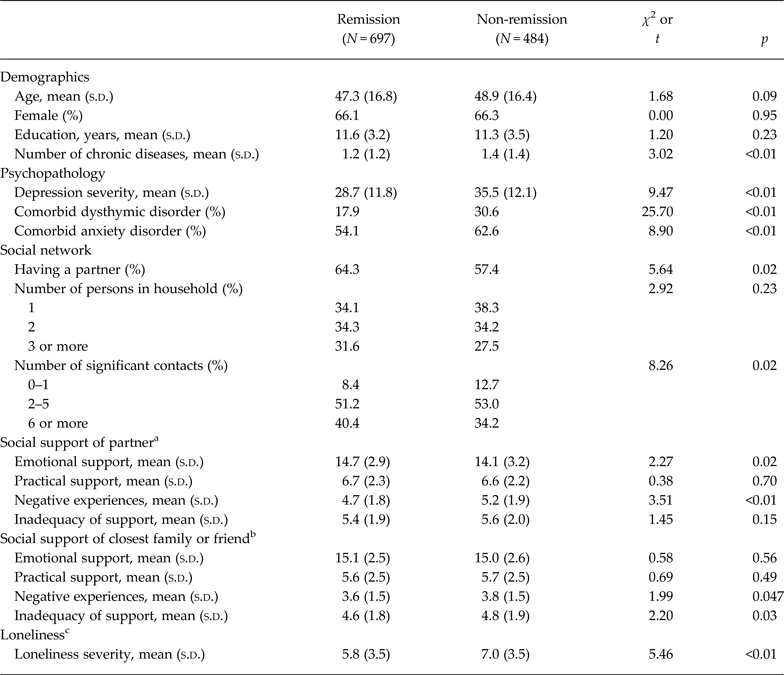
The study samples of NESDA and NESDO consisted of 1115 and 359 patients, respectively, with a major depressive disorder in the 6 months before baseline. Their age ranged from 18 to 90 years. Of these patients, 293 (19.9%) did not participate in the 2-year follow-up interview and were therefore excluded from the present study. These patients had less years of education than the 1181 included patients [M = 10.7 years (s.d. = 3.3) v. 11.5 (3.3)], a more severe depression at baseline [M = 34.8 (12.5) v. 31.5 (12.4)], more often a comorbid anxiety disorder (65.5 v. 57.7%), fewer persons with whom they had regular and significant contact (0–1 persons, 17.1 v. 10.2%; 6 or more, 30.2 v. 37.9%), and more practical support [M = 6.3 (2.6) v. 5.6 (2.5)], but also more inadequate support [M = 5.1 (2.1) v. 4.7 (1.8)] from a close friend (all p < 0.01). The groups did not differ on the other baseline characteristics listed in Table 1.
Baseline characteristics of patients in remission or not at 2-year follow-up

a The CPQ-p was answered by 439 patients in remission and 274 patients not in remission.
b The CPQ-f was answered by 515 patients in remission and 350 patients not in remission.
c The Loneliness Scale was answered by 628 patients in remission and 441 patients not in remission.
At the 2-year follow-up assessment, 697 (59.0%) of the 1181 patients were in remission; they no longer fulfilled the criteria of a major depressive disorder in the preceding 6 months. Table 1 compares the baseline characteristics of these patients with those of the 484 non-remitted patients. The latter had a more severe depression at baseline, more comorbid dysthymic or anxiety disorders, and more chronic somatic diseases.
Remission
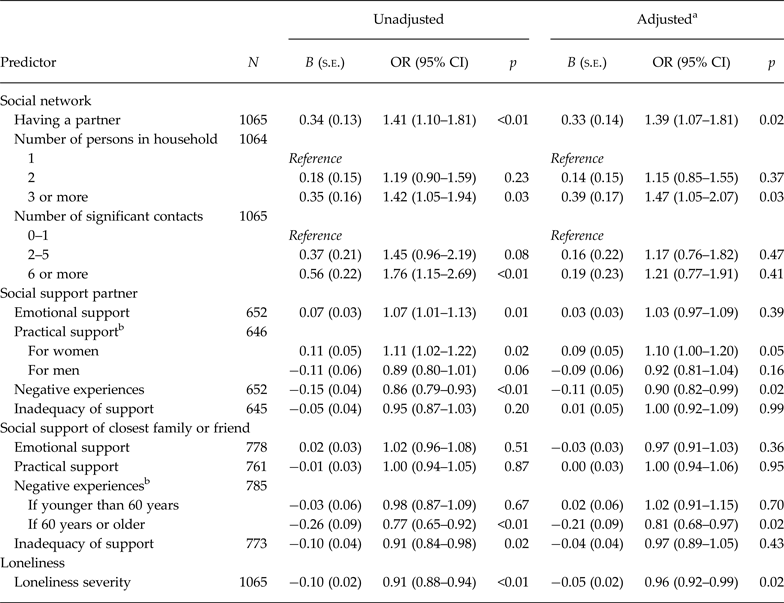
Table 2 shows the results of the logistic regression analyses of individual baseline social relational variables as predictor of remission status at follow-up. Moderation of this prediction by gender was only found for practical support from the partner and by age for negative experiences with support from a close friend (both for dichotomised and continuous age); i.e. 2 of the 24 interactions tested. Unadjusted for potential confounders, having a partner, living in a household of three or more people, having six or more significant contacts, and experiencing emotional support and – for women – practical support from the partner were positively related to remission at follow-up. On the other hand, negative experiences with support from the partner, inadequate support from a close friend, feelings of loneliness, and – for people 60 years or older – negative experiences with support from a close friend were associated with a lower chance of remission at follow-up. As shown on the right side of Table 2, most of these relationships were relatively unaffected by adjustment for potential confounders, with the exception of the relationships of number of significant contacts, emotional support from the partner, and inadequacy of support from a close friend, which became non-significant.
Individual social relational predictors of depression remission at 2-year follow-up

a Adjusted for age, gender, baseline depression severity, comorbid dysthymic disorder, comorbid anxiety disorder, years of education and number of chronic diseases.
b Interaction with gender respectively age remains significant in adjusted model (p < 0.05).
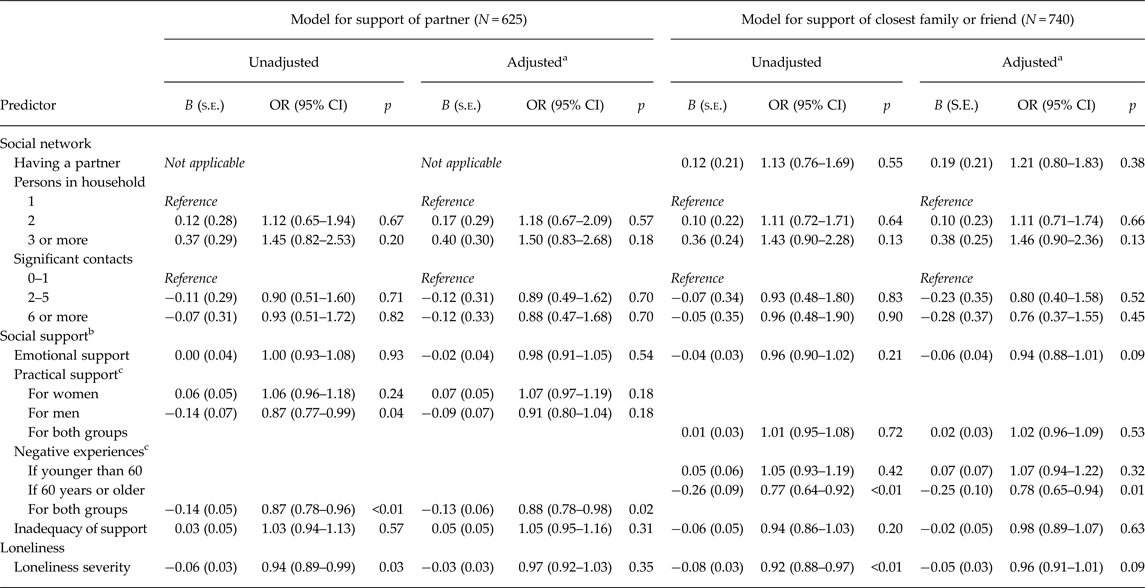
Next, the independence of the above relationships was tested by entering all social relational variables into logistic regression analysis together. Because only 508 (43.0%) of the respondents answered they both had a partner and a close friend – and hence filled out the CPQ-p and CPQ-f – an analysis including variables from both questionnaires would be restricted to this selective sample. We therefore performed two separate analyses; one including the CPQ-p variables on support from the partner and the other the CPQ-f variables on support from a close friend. In addition, 90 patients (7.6%) answered they neither had a partner nor a close friend, and could not be included in either of the combined analyses. These patients did not differ in remission at follow-up from those with a partner or close friend (odds ratio (OR) = 0.86; 95 confidence interval (CI) 0.56–1.32, p = 0.49 unadjusted and OR = 0.96; 0.60–1.52, p = 0.85 if adjusted for confounding as in Table 2). Notably, their mean loneliness score at baseline was significantly higher than that of the patients with a partner or close friend [M = 8.8 (s.d. = 2.6) v. 6.1 (3.6); t = 8.63, df = 101, p < 0.01; Cohen's effect size d = 0.76], but the association between baseline loneliness and remission status at follow-up did not differ between the two groups (p = 0.77 for unadjusted analysis and p = 0.93 for adjusted analysis as in Table 2).
Table 3 shows the combined predictive performance of the social network variables and loneliness with social support from the partner, on the left side, and with social support from a close friend on the right. Loneliness was found to be an independent predictor of remission in both analyses, and in both this association became non-significant after controlling for confounders. For men, practical support from the partner was related to a reduced chance of remission at follow-up, but again this association became non-significant after controlling for confounders. Only negative experiences with social support – from the partner for all patients and for patients 60 years or older also from a close friend – proved to be a predictor of non-remission, independent of the other social relational variables and potential confounders.
Combined social relational predictors of depression remission at 2-year follow-up

a Adjusted for age, gender, baseline depression severity, comorbid dysthymic disorder, comorbid anxiety disorder, years of education and number of chronic diseases.
b Social support measures for partner on left side of table, and for closest family or friend on the right.
c Interaction with gender respectively age remains significant in unadjusted and adjusted model (p < 0.05).
Change in depression severity
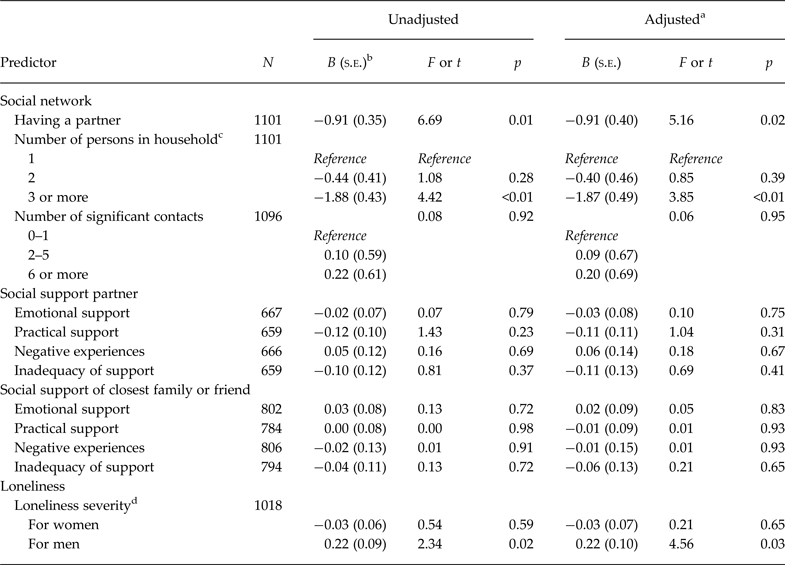
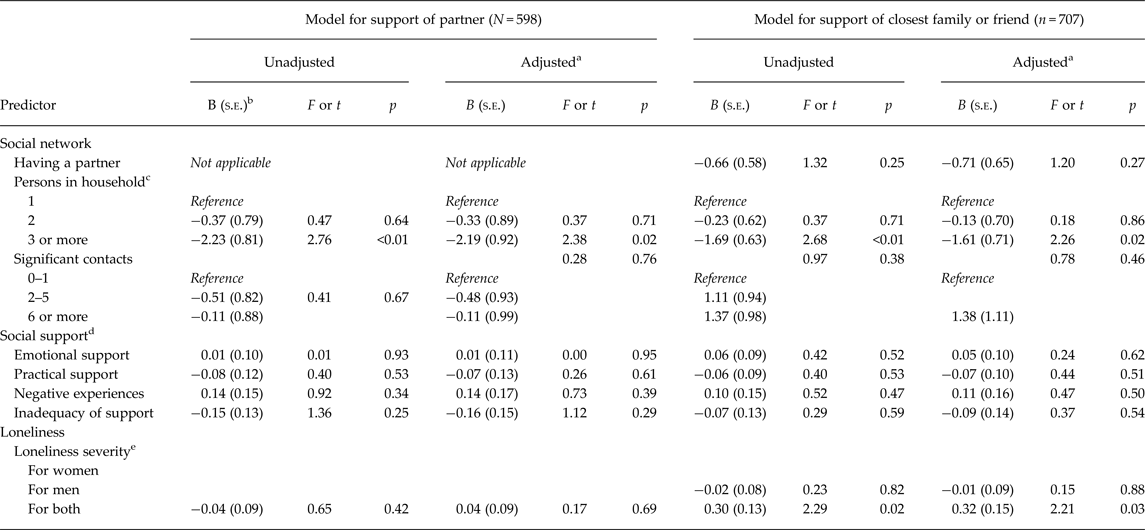
Moderation of the relationship between baseline social relational variables and change in depression severity by gender or age (either dichotomised or continuous) was only found for gender and loneliness; i.e. 1 out of 24 interactions tested. Table 4 presents the effects of individual social relational variables on change in depression severity. Both before and after adjustment for confounding, having a partner and living in a household of three or more people were related to greater decrease in depression severity, while for men loneliness was associated with a reduced decrease. When the combined predictive performance of all social relational variables was tested (see Table 5), living in a household of three or more people, and for men also loneliness, proved to be independent predictors of change in depression severity, both before and after adjustment for confounding. The prognosis of people living in a household of three or more persons was better compared with people living alone and with people having a single housemate (see note to table). Again, the 90 patients who did not have a partner or close friend could not be included in the combined analyses. These patients did not differ from those with a partner or close friend in change in depression severity over the follow-up period (B = 0.29; s.e. = 0.65; F = 0.20; p = 0.65 unadjusted and B = 0.19; s.e. = 0.75; F = 0.06; p = 0.81 if adjusted for confounding as in Table 5). Neither did these groups differ in association between baseline level of loneliness and change in depression severity over follow-up (F = 0.27; p = 0.60 in unadjusted analysis and F = 0.15; p = 0.70 in adjusted analysis; and this was independent of gender F = 0.37; p = 0.54, and F = 0.48; p = 0.49, respectively).
Individual social relational predictors of change in depression severity over 2-year follow-up

a Adjusted for age, gender, baseline depression severity, comorbid dysthymic disorder, comorbid anxiety disorder, years of education and number of chronic diseases.
b Shown is interaction effect between predictor and time.
c Three or more persons in household also different from two persons (t = 3.36, p < 0.01 in unadjusted and t = 3.37, p < 0.01 in adjusted model).
d Interaction with gender remains significant in adjusted model (p < 0.05).
Combined social relational predictors of change in depression severity over 2-year follow-up

a Adjusted for age, gender, baseline depression severity, comorbid dysthymic disorder, comorbid anxiety disorder, years of education and number of chronic diseases.
b Shown is interaction effect between predictor and time.
c Three or more persons in household also different from two persons (in models for support partner t = 3.62, p < 0.01 in unadjusted and t = 3.65, p < 0.01 in adjusted model; in models for support closest family or friend t = 2.60, p < 0.01 in unadjusted and t = 2.63, p < 0.01 in adjusted model).
d Social support measures for partner on left side of table, and for closest family or friend on the right.
e In models for support of partner there is no longer a significant interaction with gender (F = 2.40, p = 0.12 in unadjusted model and F = 2.11, p = 0.15 in adjusted model). In models for support of closets family or friend the interaction remains significant (F = 4.87, p = 0.03 in unadjusted model and F = 4.37, p = 0.04 in adjusted model).
Discussion
The present study is the first to examine the predictive values of structural, functional and experiential aspects of social relationships for the course of major depressive disorder concurrently. Multiple elements of all three aspects were found to be related to depression course, but when combined, their predictive contributions were found to overlap to a large extent. Only the structural element of living in a larger household, the functional element of negative experiences with social support, and the experiential element of feeling lonely proved to be independent predictors of depression course. But notably, all three aspects of social relationships were found to be important for the course of major depressive disorder. This contrasts with previous studies, which found poor recovery from depressive disorder to be related to low perceived social support (Lara et al. Reference Lara, Leader and Klein1997; Ezquiaga et al. Reference Ezquiaga, Garciá, Pallarés and Bravo1999; Bosworth et al. Reference Bosworth, McQuoid, George and Steffens2002, Reference Bosworth, Voils, Potter and Steffens2008; Nasser & Overholser, Reference Nasser and Overholser2005; Leskela et al. Reference Leskela, Rytsälä, Komulainen, Melartin, Sokero, Lestelā-Mielonen and Isometsā2006; Joseph et al. Reference Joseph, Myers, Schettino, Olmos, Bingham-Mira, Lesser and Poland2011) and loneliness (Van Beljouw et al. Reference Van Beljouw, Verhaak, Cuijpers, Van Marwijk and Penninx2010; Holvast et al. Reference Holvast, Burger, De Waal, Van Marwijk, Comijs and Verhaak2015), but not to social network size or frequency of social interactions (Ezquiaga et al. Reference Ezquiaga, Garciá, Pallarés and Bravo1999; Bosworth et al. Reference Bosworth, McQuoid, George and Steffens2002, Reference Bosworth, Voils, Potter and Steffens2008). The present study is the first to show that structural characteristics of social relationships, such as having a partner and number of persons in one's household, are related to depression course too. Furthermore, this study extends the findings of previous studies by showing that many of the identified social relational influences share the same predictive value for the course of major depressive disorder.
Living in a larger household of three or more people proved beneficial for the prognosis of major depression, compared with living alone or with a single housemate. Having more – and more divers – social interactions in one's principal living environment may act as unavoidable forms of behavioural activation, which counteract the tendency of many depressed persons to withdraw from activities, including pleasant ones, and thereby provide some beneficial positive reinforcement (MacPhillamy & Lewinsohn, Reference MacPhillamy and Lewinsohn1974). In addition, number of persons in the household is interrelated with having a partner, and hence with opportunities to receive social support from a partner. Having a partner and receiving social support from the partner were found to be individual predictors of depression course, whose predictive values overlapped, however, with other aspects of social relationships, including number of persons in the household. The effect of living in a larger household may therefore partly consist of the beneficial effects of having a partner and receiving support from that partner.
Negative experiences with social support were the only social relational variable, which independently predicted non-remission of depression at follow-up. That social relationships can have a negative effect on health and wellbeing, has long been neglected (Stansfeld & Marmot, Reference Stansfeld and Marmot1992; Cohen et al. Reference Cohen, Gottlieb, Underwood, Cohen, Underwood and Gottlieb2000; Vangelisti, Reference Vangelisti2009; Ibarra-Rovillard & Kuiper, Reference Ibarra-Rovillard and Kuiper2011). Social support has sometimes been explicitly defined as any process through which social relationships might promote health and wellbeing (Cohen et al. Reference Cohen, Gottlieb, Underwood, Cohen, Underwood and Gottlieb2000), and more social contacts have invariantly been regarded as beneficial. However, social interactions can be very stressful too, especially for depressed persons. Compared with non-depressed persons, depressed individuals have been found to enjoy social interactions less, to experience them as less intimate, and to feel less control over them (Nezlek et al. Reference Nezlek, Hampton and Shean2000), in particular when close relationships are concerned (Nezlek et al. Reference Nezlek, Hampton and Shean2000; Baddeley et al. Reference Baddeley, Pennebaker and Beevers2012). Furthermore, depressive symptoms may seriously tax relationships between patients and those around them (Coyne et al. Reference Coyne, Kessler, Tal, Turnbull, Wortman and Greden1987). An important finding of the present study is that if depressed persons experience difficulties in their close relationships, this may impede their recovery, and that this influence is independent of any influences of social network characteristics, positive social support or loneliness.
Previous NESDA and NESDO studies already showed that loneliness is a predictor of poor depression course, both in younger (Van Beljouw et al. Reference Van Beljouw, Verhaak, Cuijpers, Van Marwijk and Penninx2010) and older patients (Holvast et al. Reference Holvast, Burger, De Waal, Van Marwijk, Comijs and Verhaak2015). What the present study adds is that, for men, this predictive value is independent of social network characteristics and social support of the person. This corroborates findings in the general population, which also showed an independent effect of loneliness on change in depressive symptoms (Cacioppo et al. Reference Cacioppo, Hawkley and Thisted2010). Depression and loneliness are closely related mental states, which often co-occur (Stek et al. Reference Stek, Vinkers, Gussekloo, Beekman, Van Der Mast and Westendorp2005; Luanaigh & Lawlor, Reference Luanaigh and Lawlor2008). Depression refers to how people feel in general and loneliness to how they feel about their social relationships in particular (Cacioppo et al. Reference Cacioppo, Hawkley and Thisted2010). It has been suggested that depressive disorder with feelings of loneliness is of a different nature than depression without such feelings, because their combination may lead to motivational depletion and ‘giving up’ (Stek et al. Reference Stek, Vinkers, Gussekloo, Beekman, Van Der Mast and Westendorp2005). In these cases, it therefore seems imperative to address the patient's unfulfilled social needs as part of depression treatment.
We tested whether the relationship between social relational variables and depression course is moderated by gender or age, as suggested by previous studies. Some differences between men and women, and younger and older patients were found. But by and large, little evidence was found that the relationship between social relational variables and depression course is moderated by gender or age; i.e. only 3 (6%) of 48 interactions tested were significant, which is only slightly more than expected by chance.
The present study examined the prognostic significance of structural, functional and experiential aspects of social relationships in a large sample of patients, and did so longitudinally, controlling for baseline depression severity. Reverse causation of depression effects on social relationships, is therefore less likely to explain the findings of the current study.
A limitation of the study is that the included patients differed in pre-baseline duration of current depression episode and history of previous episodes. These differences were not adequately assessed and could therefore not be controlled for. In addition, the prognostic significance of social support in combination with social structural characteristics and loneliness could only be examined for social support from the partner and a close friend separately, because only a minority of patients had both a partner and close friend and answered the support questions for both types of providers. Furthermore, a group of 90 patients (7.6%) did neither have a partner nor close friend and had to be excluded from the combined predictive analyses altogether. Supplementary analyses in this group showed that they experienced substantially higher levels of loneliness than patients with a partner or close friend, but did not differ in association between loneliness and depression course, nor in actual course realised. This may, however, be due to a lack of statistical power, because of the small number of patients involved. From a clinical perspective, however, these supplementary analyses illustrate an important qualification of our findings. We studied how social relational factors are related to depression course, and tested whether this is dependent on gender or age. Not finding differences between groups in social relational predictors of depression course, however, does not preclude that these groups may differ significantly in level of adverse social relational factors, which would demand attention in depression treatment. Loneliness among patient without a partner or close friend, appears one of these factors.
Finally, the patients who were lost to follow-up had a more severe depression at baseline – as indicated by higher depressive symptom levels and more comorbidity of anxiety disorders – and had less years of education than the study sample. Their course of the depressive disorder will therefore probably have been worse than that of the patients who could be studied at follow-up. But the two groups also differed in social relational variables at baseline, with the drop-outs having less significant contacts and more practical support and inadequate support from a close friend than the patients followed-up. Drop-out may thus have weakened the associations of these social relational variables with depression course, rendering them non-significant in the current study. The generalisability of our findings to patients with a more severe depression and less education, may therefore be limited.
Several characteristics of social relationships proved to predict the course of depressive disorder. Whether this means that interventions targeting unfavourable social relationships will improve depression course, will have to be tested in randomised controlled trials, which are not available yet. However, special attention for interpersonal problems and social isolation seems warranted in depression treatment and relapse prevention. This may be found, for example, in interpersonal psychotherapy (Weissman et al. Reference Weissman, Markowitz and Klerman2000), behavioural activation (Lewinsohn et al. Reference Lewinsohn, Biglan, Zeiss and Davidson1976) or marital and family therapy, which have demonstrated efficacy in treating major depressive disorder (APA, 2010). Alternatively, interventions specifically targeting social relational problems may be added to depression treatment or relapse prevention, to strengthen the patient's resilience. Such interventions include programmes to improve social skills, enhance social support, increase opportunities for social interaction or address deficits in social cognition, which were found to have a small but significant effect on loneliness reduction (Masi et al. Reference Masi, Chen, Hawkley and Cacioppo2011). It will be of great interest to test whether these interventions can also contribute to relapse prevention in depressive disorder.
Social network characteristics, social support and loneliness are related predictors of the course of major depressive disorder, independent of other predictors. These factors are potentially responsive to therapeutic intervention. The challenge is to address these factors in depression treatment and relapse prevention, and to test whether this improves the course of the depressive disorder. It seems imperative that such interventions focus on the social relational factors with differential prognostic significance for depression course identified in the current study.
Financial support
The infrastructure for the NESDA study (www.nesda.nl) has been funded through the Geestkracht programme of the Netherlands Organisation for Health Research and Development (ZonMw, grant number 10-000-1002) and participating universities (VU University Medical Center, Leiden University Medical Center, University Medical Center Groningen). The infrastructure for the NESDO study (http://nesdo.amstad.nl) is funded through the Fonds NutsOhra (project 0701-065); Stichting tot Steun VCVGZ; NARSAD, the Brain and Behaviour Research Fund (grand ID 41080); and the participating universities and mental health care organisations (VU University Medical Center, Leiden University Medical Center, University Medical Center Groningen, UMC St Radboud, and GGZ inGeest, GG Net, GGZ Nijmegen, GGZ Rivierduinen, Lentis and Parnassia).
Conflict of Interest
None.
Ethical standards
The authors assert that all procedures contributing to this work comply with the ethical standards of the relevant national and institutional committees on human experimentation and with the Helsinki Declaration of 1975, as revised in 2008.
Availability of data and materials
Data of the NESDA and NESDO studies, on which the manuscript was based, can be requested through the websites of these studies: www.nesda.nl and http://nesdo.amstad.nl, respectively.