Introduction
The 1957–58 Asian Flu Pandemic was a global public health emergency triggered by the spread of a new influenza virus from China.Footnote 1 The crisis, which is thought to have caused up to two million deaths globally, only abated by December 1957 (Figure 1).Footnote 2
Spread of the 1957–58 Asian Flu pandemic
Source: @AjJLabs Al Jazeera

Contrary to the experience of a prolonged public health crisis that was typical across the world, Singapore's particular encounter with the Asian Flu was peculiarly confined to a month-long outbreak during May 1957. First detected as the month began, a full-blown epidemic outbreak was widely recognised in the colony by mid-month, and burnt itself out just before June. Across the island, ‘flushed’ patients who were ‘quite sick’ reported common symptoms including fever, headaches, body aches, cough, sore throat, and giddiness that were mild and typical of influenza illnesses.Footnote 3 Official statistics suggest the epidemic outbreak ultimately wrought a severe impact on Singapore's public health. With 150,000 reported influenza cases and 28 verified deaths,Footnote 4 at least 10.2 per cent of the entire colony was infected,Footnote 5 notwithstanding underreporting. Furthermore, modern estimates of the excess death toll in the colony caused by the Asian Flu range from 680 to 781Footnote 6 and are highly suggestive that Asian Flu-induced deaths in Singapore were more extensive than was historically historically reported or known. A Singaporean microbiologist at the University of Malaya, Lim Kok Ann, would eventually identify the causative agent as a new H2N2 subtype of the Influenza A virus that was christened Influenza A/Singapore/1/57.Footnote 7
The rapid yet short-lived spread of the Asian Flu within the colony in May 1957 and its unceremonious disappearance into the annals of the island's history raise important and interesting questions regarding state and public reactions to Singapore's 1957 Asian Flu epidemic outbreak: how and why did the state and colony residents of Singapore respond the way they did?
This article argues that Singapore's societal response to the epidemic outbreak bifurcated drastically between the state and colony residents because of different and contradictory perceptions of public health and epidemic severity that emerged in official and popular discourses. Under extenuating circumstances of limited disease surveillance capacities and competing priorities, the government misjudged the epidemic's severity and adopted inaction as its main public health policy posture. Even though some actions were eventually taken, overall, state interventions were reactive and insufficient, which permitted the rapid spread of Asian Flu among Singapore's population. The public, however, urgently sought active control over their fates during the epidemic outbreak. Driven by a mixture of fear, greed, and civic duty to self-medicate, profiteer, and provide aid to one another, their popular responses were no doubt exacerbated by a backdrop of inadequate state healthcare provision. Unpacking the dissonance of state and public reactions to Singapore's 1957 Asian Flu epidemic outbreak, this article consults an eclectic range of hitherto underutilised primary sources to construct a compelling socio-historical narrative that offers valuable insight into state–society relations during one of the most pivotal periods of Singapore's formative pre-independent history.
Locating Singapore within global and regional epidemic histories
Social histories of medicine and epidemics are not foreign to Southeast Asian historiographies and have raised pertinent questions concerning the intersections of political economy, health, disease, and societal life worlds in the region, especially in the context of colonialism and decolonisation. Political economy, for instance, has been used as a framework to interrogate colonial Malaya's state initiatives in health and medicine and uncover how colonial constructs influenced epidemiological scholarship and medical interventions.Footnote 8 Elsewhere, the participation of physicians and medical students in Indonesia's decolonial transition and politics has provided insight into the relationship between medicine, colonialism, and decolonisation in the Dutch East Indies.Footnote 9 As for Singapore, local scholarship has taken an interest in historicising its encounters with epidemic diseases through the lens of state–society relations. Loh Kah Seng, for example, has written on the socio-historical experience of leprosy sufferers living under laws of compulsory segregation in Singapore and has co-documented with Hsu Li Yang, the nation-state's socio-political entanglement with tuberculosis management and control.Footnote 10
Apart from Loh and Hsu's longue durée scholarship, other disease historiographies of Singapore have adopted an event-centric approach just as this article intends. Examples include Liew Kai Khiun and Matthew Kwok's studies on the integration of the 2003 SARS outbreak within Singapore's nation-building narratives, as well as Nurenee Lee's master's thesis on the 1918 Spanish Flu in Britain and Singapore.Footnote 11
From a global perspective, it is worth noting that by 1957 however, Singapore itself had already been identified as a vital node of disease surveillance networks and international health cooperation for at least several decades. In 1924, the League of Nations’ Health Committee and Council approved, in principle, the establishment of a bureau to receive and transmit epidemiological information, with special attention to ‘epidemic diseases, especially those of international importance in the major ports’.Footnote 12 Subsequently, an international conference of representatives from Far Eastern countries convened at Singapore in February 1925 and precipitated the formation of the League of Nations Health Organisation (LNHO) Eastern Bureau in Singapore where it was officially established on 1 March 1925. The bureau's primary tasks were to collect and transmit epidemiological information regarding ‘all Far Eastern Countries’, as well as changes in sanitary regulations and measures taken to ‘combat transmissible diseases and to prevent their propagation’. It, however, ceased to function in January 1942 due to the outbreak of the Pacific War.Footnote 13 The bureau's epidemiological surveillance work was revived thereafter in May 1946, as communicable diseases and movement of displaced persons at the end of the war caused an ‘urgent need for epidemiological intelligence’ in the Far East.Footnote 14 With the formation of the World Health Organization (WHO) in April 1947, the bureau was eventually transformed into the WHO's Singapore Epidemiological Intelligence Station (SEIS).Footnote 15 Charged with administering the International Sanitary Regulations and Conventions, the station served all countries and territories bordering the Indian and Western Pacific Oceans, including East Africa, Asia, and Oceania.Footnote 16 Services to be rendered by the station included:
1. Collection of epidemiological information from national, local and port health administrations;
2. Diffusion of epidemiological intelligence by means of radio broadcast, telegraphic and postal communications, and weekly publication;
3. Supply of international quarantine information to health administrations, other governmental organisations, travel agencies, etc.;
4. Clarification of questions and settlement of complaints or disputes on matters pertaining to the application of International Sanitary Regulations and Conventions.Footnote 17
The SEIS was later incorporated into the WHO's Global Influenza Surveillance Network (GISN)Footnote 18 — which was set up in 1952Footnote 19 — as a National Influenza Center. The 1957 Asian Flu Pandemic would become the GISN's first major challenge; the SEIS was responsible for alerting the WHO first to the emergence of the new flu virus.Footnote 20 Yet, as discussed later in this article, the SEIS was likely unable to discharge the full extent of its responsibilities during Singapore's 1957 Asian Flu epidemic outbreak due to the local government's non-cooperation.
How then might we situate Singapore's 1957 Asian Flu epidemic among such regional and global histories and historiographies? Direct answers remain fraught in extant literature across disciplines despite the outbreak's demonstrably dire impact on Singapore's public health by modern standards of hygiene and healthcare. The conclusion of Singapore's epidemic outbreak in 1957 was immediately accompanied by a brief, intense surge in epidemiological scholarship focused on documenting the disease's bodily effects,Footnote 21 as the Asian Flu spread to the rest of the world, igniting a global influenza pandemic. Since then, scholarly interest in the epidemic outbreak evaporated until the early 2000s when it briefly surfaced again in studies focused on public health and influenza pandemics in SingaporeFootnote 22 that were prompted by contemporary outbreaks of Severe Acute Respiratory Syndrome (SARS) and Avian Flu.
In many ways, the surfeit of literature addressing Singapore's 1957 Asian Flu epidemic outbreak parallels the dearth in literature addressing its parent event: the 1957–58 Asian Flu Pandemic. One of three major 20th-century influenza pandemics, alongside the 1918 Spanish Flu and the 1968 Hong Kong Flu pandemics, the 1957–58 Asian Flu Pandemic has received less attention owing to its lower mortality rates relative to its sisters.Footnote 23 Furthermore, although studies of individual Asian Flu epidemic outbreaks elsewhere have appeared in historiographies of South Asia and Hong Kong,Footnote 24 a social history of Singapore's 1957 Asian Flu epidemic outbreak remains absent in Southeast Asian historiography. The lack of historiographical attention paid thus far is likely attributable to the complex historical circumstances of 1950s Singapore. Politically tumultuous with decolonisation underway,Footnote 25 other pressing state priorities and healthcare issues in 1950s Singapore have received far more attention among historians.
This article therefore derives historiographical inspiration from cognate historiographies and disciplines. Consulting the Colony of Singapore's print media and official records as its main primary sources, the article adopts a social constructionist approach informed by Lachlan M. Strahan's study of the Asian Flu's racialisation in Australia and Debra Ellen Menconi Blakely's study of its social construction in American and British publications.Footnote 26 In doing so, the article constructs a brief social history of Singapore's 1957 Asian Flu epidemic outbreak that proffers insights into the state–society relations of 1950s Singapore.
Owing to the scarcity of official records,Footnote 27 this article consults annual reports from various state organs published for 1957Footnote 28 alongside the colony's leading English and Chinese dailies. While bureaucratic reports and materials provide a consolidated overview of the state's attitudes towards the epidemic outbreak, the colony's print news functions as a daily record of the epidemic outbreak and the colony's popular sentiments. Lastly, contemporaneous medical and disease surveillance literature published by the WHO, The Lancet, British Medical Journal, and Journal of the American Medical Association, serve as additional texture and reference points for the article's narrative together with photos and oral history interviews from the National Archives of Singapore.
During its month-long rampage in Singapore, references to ‘Asian Flu’ or ‘亞洲流感’ (ya zhou liu gan) were wholly absent in local presses — local media simply referred to the influenza epidemic outbreak as either ‘influenza’, ‘flu’, or ‘流行性感冒’ (‘common cold’ or ‘influenza’). The subsequent racialisation of the Asian Flu likely originated from the prevailing racialised naming conventions in anglophone medical scholarshipFootnote 29 that gradually filtered down into the global vernacular. Local presses naturally followed suit as references to ‘Asian Flu’, or ‘亞洲流感’ [ya zhou liu gan] and even ‘東南亞流行性感冒症’ [Southeast Asian Influenza] began to appear in colony newspapers as they continued to report on the Asian Flu's spread to the rest of the world. Linguistically speaking, the Asian Flu was non-existent in Singapore until after the fact.
Let it burn: Official responses and public health
Let it burn out. We can do nothing about it. (Dr M. Doraisingham, Permanent Secretary to the Ministry of Health)Footnote 30
Our narrative begins with the press statement issued by the Ministry of Health (MOH) Permanent Secretary (PS), M. Doraisingham on 5 May 1957, which effectively encapsulated the Labour Front government's overall public health posture towards the epidemic. Just three days later, Health Minister (HM) A.J. Braga doubled down on the sentiment, declaring the epidemic had ‘reached its peak and should disappear as quickly as it came’.Footnote 31 These remarks, however, would only serve as damning evidence of hubris and misjudgement as subsequent developments proved. Haughty proclamations aside, the government's responses towards the epidemic outbreak were lukewarm, to say the least.
Under extenuating circumstances of limited disease surveillance capacities and competing healthcare priorities, the state favoured a policy of inaction as its epidemic response. Even when action was taken, state interventions were reactive and insufficient in both containing and limiting the impact of the epidemic.
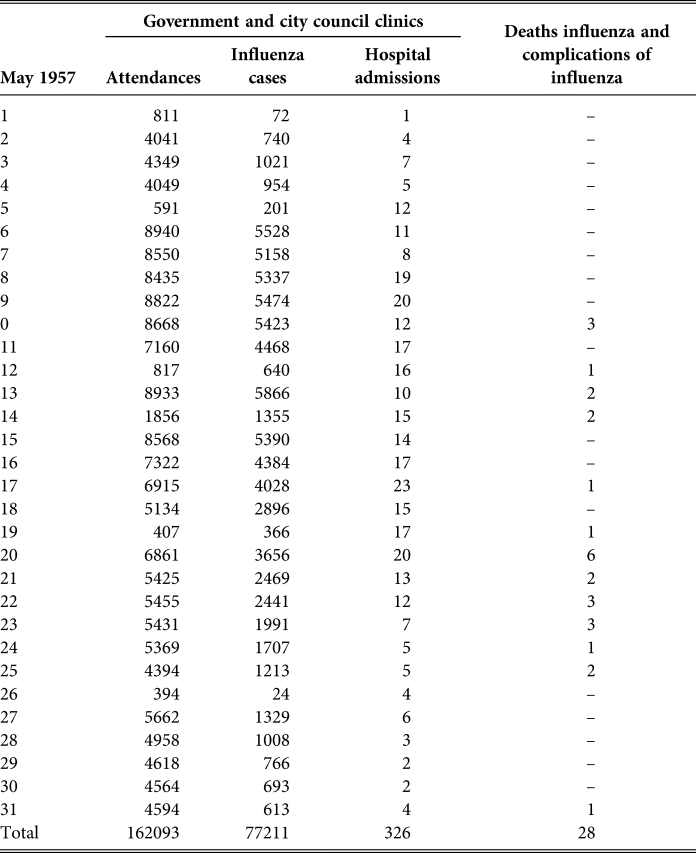
According to state narratives, the disease itself was first detected as an ‘unknown fever’ affecting over 30 people on Pulau Brani, a southern island of Singapore.Footnote 32 Following clinical investigations and ‘noticeable’ increases in Clinic and Dispensary attendances, an epidemic was officially recognised on 5 May 1957.Footnote 33 Peaking in the middle of the month, it gradually declined during the last days of MayFootnote 34 (Table 1; Figure 2). The colony's 300-odd private medical clinics were ‘kept extremely busy’,Footnote 35 suggesting that the public healthcare system had hit full capacity. Although a ‘substantial proportion’ of the population was thought to be afflicted, the disease's real incidence was unfathomable since influenza was a non-notifiable disease in the colony and remained so during the epidemic outbreak.Footnote 36
Singapore influenza epidemic

Source: Report of the Ministry of Health for the Year Ended 31 December, 1957, p. 94.
Attendance and influenza cases at GOVERNMENT and CITY COUNCIL clinics May 1957
Source: Report of the Ministry of Health for the year ended 31 December 1957, p. 94.

Public health officials — and by extension the state — consistently characterised the epidemic as mild and of little apparent consequence while emphasising the purported effectiveness of public health measures. As the Colony of Singapore's 1957 Annual Report briefly summarised:Footnote 37
Although the ‘Asian Flu’ epidemic affected [150,000]Footnote 38 people in Singapore, and schools were closed for one week, special measures were successfully taken by the Ministry of Health and there were only 4 deaths which might be attributed to its effects.
Such perceptions within official discourse of the influenza epidemic as a mild and harmless fait accompli further led to a continual rejection of containment. After all, illness typically lasted 2–4 days and in ‘practically all cases’ recovery concluded within a week.Footnote 39 As Braga explained to the Legislative Assembly, there was ‘no known preventive or cure’ for influenza, and more importantly:
The only course – which was unthinkable – was to close the port of Singapore and all the ports of the Federation of Malaya and the Siamese border against the entry of any craft whatsoever, and impose martial law to keep people in their homes until the disease had spent itself on a worldwide career.Footnote 40
His statement, however, suggests that containment measures were not implausible, but simply ‘unthinkable’. Colony ordinances equipped the government with wide-ranging powers for dealing with infectious diseases, which encompassed quarantine, disease notification, destruction of contaminated property, and social and travel restrictions.Footnote 41 These containment measures were likely deemed ‘unthinkable’ in the state's political calculus as they would have incurred socio-economic costs that were prohibitive relative to the perceived mild severity of influenza and the difficulties of implementation.
The state's overall public health posture remained consistent throughout May. Apart from his 5 May endorsement of inaction, MOH PS Doraisingham remarked that the Medical Department ‘could think of no special measures’ to stem the epidemic's spread — a sentiment shared by Chief Health Officer, Dr H.R. Morrison.Footnote 42 Doraisingham even stressed to the press that sterilised masks ‘would not be of any help,’ and only gave ‘false hopes’.Footnote 43 Health Minster Braga's subsequent 22 May ministerial statement to the Legislative Assembly as the epidemic outbreak declined, revealed that the government's stance remained unchanged. Even under the questioning of opposition parliamentarians, Braga stood firm:
It is no good kidding the public. If there was a preventive like issuing masks and so forth, we would have done it willingly to factory workers and others but I said that there is no known preventive.Footnote 44
Of course, inaction grew difficult to justify as influenza sufferers increased in numbers and the state's misjudgement of the epidemic situation became apparent. Glaring inconsistencies emerged, even in Braga's ministerial statement: in one breath, he rejected containment, in the next, he asserted ‘every possible measure to combat and control’ the epidemic had been taken.Footnote 45
Public health measures undertaken in response to the epidemic outbreak were inadequate and unsatisfactory for colony residents—the state's misjudgement of the epidemic situation drew public criticism from all quarters. Although officials hastily began to declare that the epidemic had peaked in early May, its true peak occurred only around mid-May when case numbers peaked at 5,866 on 13 May (Table 1; Figure 2). Slight dips in reported cases from 3–5 May and 9–11 May were interpreted as signs of the epidemic peaking when, in hindsight, it was not the case (Table 1; Figure 2).
Observing the inadequacies in healthcare provision, colony residents were unconvinced by the state's attempt to control the epidemic narrative. A Nanfeng Evening Post commentary titled ‘時評:再談流行性感冒’ [Commentary: Discussing influenza again] published on 7 May 1957 serves as a notable example.Footnote 46 Noting the non-lethal but highly infectious nature of the influenza, the author highlighted two major public health problems in Singapore that were spotlighted by the Asian Flu epidemic outbreak. First was the insufficiency of healthcare facilities ‘醫院設備不足’: while it was ideal to quarantine patients in hospitals where medical personnel were available, the colony lacked such facilities, making it difficult to admit all infected persons. Second was the prevalence of high-density housing (‘住戶太過擁擠’): in crowded urban areas, over ten individuals occupied a single room — a single infection risked hundreds more as social distancing and quarantine were impossible. Recognising that these structural problems were not immediately resolvable, the author brought them to public attention, hoping that they would be addressed later.
Local political and community representatives also rebuked the state's inaction. As the epidemic raged on, City Council and Rural Board members appealed to the government for medicine distribution in ‘suburban and kampong areas’, urging officials to get out of Palmer Road'sFootnote 47 ‘lethargic atmosphere’ and ‘do something concrete to check the spread of the epidemic’.Footnote 48 An unofficial Rural Board member, Mr H. J. C. Kulaisingha, went as far as to say that he did not believe the epidemic was subsiding; there instead seemed to be ‘an increase’,Footnote 49 which to his credit, was true (Table 1; Figure 2). Urging the MOH to devise a solution with community representatives, Kulaisingha lambasted that there was ‘no use in praying for the infection to die out without doing anything to beat it’.Footnote 50 He also suggested that the government should have ‘at once’ dispatched more mobile dispensaries to villages to reduce the population's dependence on private practitioners.Footnote 51
The state's lukewarm epidemic response also elicited strong political criticism, as the labour movement joined in the fray. Absenteeism had, at that point, been rampant across different sectors; public civil servants such as policemen, nurses, and postal workers were afflicted as were workers in the colony's many firms.Footnote 52 Public transport workers, in particular, were badly affected as scores of bus companies and the colony's trolley bus operator (The Singapore Traction Company) regularly reported high absenteeism rates across May.Footnote 53 Eventually, the National Union of General Workers, a ‘left-wing trade union’,Footnote 54 wrote a letter to Chief Minister Lim Yew Hock demanding that the government conduct ‘an inquiry into the causes and circumstances’ of the epidemic's spread.Footnote 55 The letter further accused MOH of failing to ‘control the epidemic’ and taking inadequate steps ‘to stop its spread’.Footnote 56 PS Doraisingham, however, responded indifferently that Singapore's experience with the Asian Flu epidemic outbreak had ‘not differed in any respect from any others’ in the past and reiterated that there was no known preventive measure for influenza.Footnote 57
Although public criticism alone did not appear sufficient to prompt state action, media pressure appeared seemed strong enough. As news reports of significant school absenteeism and influenza infection rates at various secondary schools appeared on 7 May,Footnote 58 Education Minister Chew Swee Kee ordered—after consultation with Health Minister Braga—the closure of the colony's 670 schools, the next day on 8 May.Footnote 59 Although it was expected that they would reopen again on 13 May pending a review of the epidemic, they eventually did so only on 20 May as the epidemic abated.Footnote 60
Explaining the decision made on 8 May in the news, Chew remarked that due to the epidemic's rapid spread, ‘there was nothing else’ the government could have done, while a government statement advised parents to keep their children away from crowded places.Footnote 61 While the school closures were reactive towards an unanticipated epidemic development, Braga's ministerial statement attempted to reassert state agency in the matter. In his account to the Legislative Assembly, the decision was made after consulting medical advisers and receiving Ministry of Education (MOE) reports of teacher and student absenteeism. He further cited the infection risks of school transport, transmission between schools and homes, and manpower shortages arising from absenteeism as contributing reasons. It was not unreasonable to have expected school closures to be announced as a pre-emptive measure before the epidemic spread within schools. It seems then that school closures were prompted in part, by the negative news coverage and reports of absenteeism, rather than by prudent public healthcare policy planning.
Among the other measures the government undertook were public warnings through press, radio, Rediffusion,Footnote 62 and the colony's medical services to avoid crowds and rest at home if one was sick.Footnote 63 Elective surgery was kept to a minimum while school and maternal and child health centres were turned into influenza treatment centres.Footnote 64 Two additional dispensaries were also dispatched to bolster mobile dispensary services in rural areas.Footnote 65 Although sound, these measures were reactive and insufficient in containing the impact of the epidemic outbreak. Braga's account of the epidemic outbreak in parliament did not go unopposed, as opposition parliamentarians John Ede and Lim Choong Mong challenged the adequacy of the state's epidemic response. They alleged respectively, that the radio ‘was not fully used in the early stages of the epidemic’ to notify the public in accessible language about appropriate self-treatment protocols, and that aspirin could have been provided sans consultation to ease the healthcare system's congestion.Footnote 66
Other dramatic crises continued to plague the colony and the state during the epidemic outbreak. Around mid-May, local newspapers started to carry reports of dire starvation and overwhelming infection threatening the island of Pulau Sudong.Footnote 67 As The Straits Times summarised on 15 May 1957, ‘flu and fear have gripped the inhabitants of tiny (half a square mile) Pulau Sudong’.Footnote 68 In just 10 days, the news reported three fatalities and 300 infections, among island's population of 455.Footnote 69 Fears of starvation mounted as the influenza left the fishing community's afflicted men unable to fish.Footnote 70 Families were purportedly reduced to one meal a day as they were unable to barter for necessities.Footnote 71 The Malay Welfare Council organised a humanitarian trip on 14 May to distribute essentials—the government, however, initially remained reluctant to act, refusing the island inhabitants ‘relief or special treatment’, for fear of setting a precedent for ‘all those suffering from flu all over Singapore’.Footnote 72
Yet the public disclosure of the islanders’ apparent plight likely pressured the government into action. A government medical team led by Dr K. KanagaratnamFootnote 73 and Dr Thung Ling Hooi was dispatched to Pulau Sudong and examined 51 people.Footnote 74 Only eight people, however, were found to be infected — in fact, two were new cases.Footnote 75 The island's penghulu,Footnote 76 Inche Bindol bin Bengol had ‘grossly exaggerated’ infection figures.Footnote 77
News reports never mention the exact reasons for Inche Bindol's deceit, but his lies were conceivably an attempt at eliciting state response and aid for the inhabitants of Pulau Sudong during the epidemic outbreak. An editorial published in the Singapore Standard on 16 May 1957 describes Pulau Sudong and the other 15 outer islands of Singapore as ‘forgotten isles’ bereft of public services and amenities.Footnote 78 In fact, the islands’ inhabitants were barely thought about, ‘except when their votes are required’.Footnote 79 Suffice to say, relations between the mainland government and Singapore's outer islands did not seem harmonious. In all fairness, despite the penghulu's embellishments, Pulau Sudong fishermen likely did face difficulties in fishing while avoiding infection. Not only did the incident reveal the state's sensitivity to media pressure, but it was also a superb demonstration of how colony residents could manipulate it to their advantage.
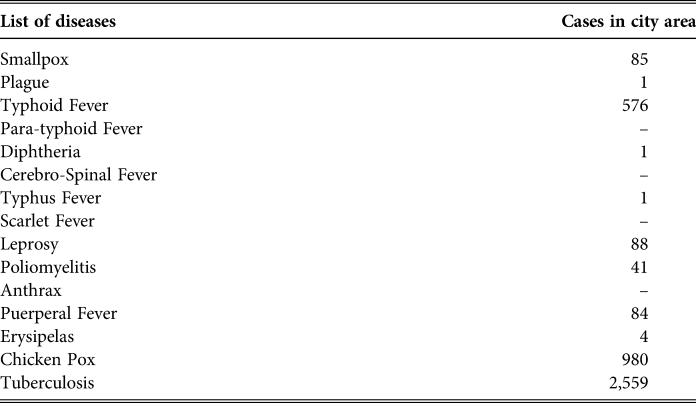
Although the state faced valid criticisms over its epidemic management, an overcrowded agenda outside and within healthcare likely sapped both political will and ability to respond to the influenza epidemic. The chief political preoccupation of the day for the Labour Front government was the colony's negotiation for full internal self-government with the British.Footnote 80 Other urgent healthcare concerns in the colony likely also overshadowed the influenza epidemic outbreak. While influenza was non-notifiable, a whole host of other deadly diseases, such as tuberculosis, smallpox, and typhoid fever, were deemed severe enough to warrant surveillance (Table 2).
Notifiable diseases May 1957

Source: Morrison, ‘Annual Report of the City Council's Health Department 1957’, p. 16.
The influenza epidemic outbreak itself also severely strained Singapore's healthcare system and disrupted the colony's other healthcare priorities. The City Council's 1957 Diphtheria Immunisation Campaign was ‘all but swept aside’ as mothers stopped bringing their infants for inoculation at infant welfare clinics while hundreds came forward for influenza treatment.Footnote 81 The insufficiencies of the colony's healthcare system in managing the epidemic are plain to see: only 267 doctors and 1,824 nursing staff served a 1.4 million-odd population in 1957.Footnote 82 The General Hospital alone recorded 1,239,281 outpatient cases for the entire year.Footnote 83 Clearly, Singapore's healthcare system was understaffed and ill-equipped to handle the Asian Flu.
How might the rapid spread of the Asian Flu in Singapore be accounted for? Local authority figures blamed the personal responsibility, or rather irresponsibility, of colony residents, casting them as gullible and ignorant perpetrators of the epidemic. On one hand, many subscribed to superstitious folk remedies. On the other, people ignored official advice and still went to crowded places such as cinemas and nightclubs. A MOH spokesman alleged that infected ‘Chinese and Indians’ avoided proper treatment and instead relied on ‘quacks who dispense a brew made from herbs, roots and carrots’Footnote 84 while a cinema chain spokesman reported ‘good business’ in spite of the epidemic.Footnote 85 Notably, doctors even blamed those who neglected the infection and indulged in folk superstitions as ‘the real danger’ for ‘spreading the virus from house to house’.Footnote 86
Upon closer examination, however, the state's inconsistent policy choices implicate it in the Asian Flu's spread within the colony. When the disease spread to the Malayan Federation in early May, influenza was quickly declared a notifiable disease there.Footnote 87 Yet, Government Gazettes in Singapore for May 1957 attest that influenza remained non-notifiable in Singapore throughout the epidemic,Footnote 88 perhaps because the state saw no point in making it notifiable. As the epidemic peaked mid-May in the colony, the World Health Organization's (WHO's) Singapore Director, Dr W. W. Yung stated that influenza warnings had been sent to Southeast Asian governments ‘some months back’ when an epidemic was reported in Japan.Footnote 89 It remains unclear if the epidemic in Japan was indeed a prelude to the Asian Flu but the failure of Singapore's public health authorities to visibly act on the intelligence is perplexing. The WHO warnings themselves were not locatable in WHO archives but archival material offers a plausible explanation for the inaction of Singapore's public health authorities. Correspondence between virologist Alick Isaacs and Dr M. Payne dated 1 January 1957 indicates that Isaacs’ warning about a ‘possible influenza epidemic’ was based on a Times report ‘describing severe influenza in Japan with 130 deaths in one day’ which turned out to be a ‘false alarm’.Footnote 90 If Singaporean public health officials had been privy to this information, then their inaction was perhaps excusable. Possibly aware of its perceived negligence, the state acknowledged in the MOH's 1957 annual report, the possible Japanese origins of the Asian Flu but firmly noted that it ‘remained a presumption’ given ‘no positive proof’.Footnote 91
Additional WHO archival material, however, gestures to active incompetence on the part of Singapore's public health authorities. Following its May rampage in Singapore, the influenza virus spread to Madras, India, via ships that left without quarantine.Footnote 92 A letter dated 21 May 1957 from the WHO SEARO Regional Director, Dr C. Mani, to Dr Timmerman, revealed the Indian Government's dissatisfaction with WHO, alleging that the organisation had been negligent in not communicating the extent of Singapore's influenza epidemic.Footnote 93 In her reply two days later, Dr Mani drily noted that despite ‘daily requests’, Singapore's public health authorities were ‘not able to supply information to our active and alert epidemiological intelligence officer stationed in SEIS [Singapore Epidemiological Intelligence Station]’.Footnote 94 Many reasons could explain this non-communication between public health authorities and WHO. It plausibly suggests weak working relations between them or intentions to avoid a diplomatic incident for indirectly causing Madras’ influenza epidemic outbreak. Alternatively, there may have simply been no disincentive to non-communication.
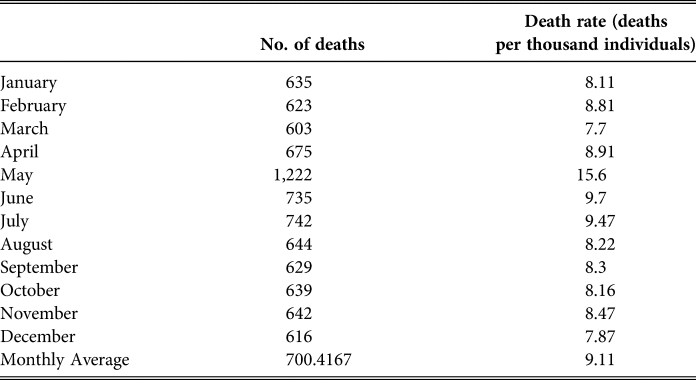
It is fair to say, however, that indisputable state negligence lay in the government's ex-post representation of the influenza epidemic outbreak in 1957. The epidemic's impact was downplayed in official records where only the small number of verified deaths was featured in the main body of their texts.Footnote 95 The high number of excess deathsFootnote 96 caused was instead relegated to an obscure appendix in the 1957 City Council Health Department Report (Table 3) with a small footnote acknowledging the ‘Asian Flu epidemic’ as its cause.Footnote 97
Deaths in Singapore, 1957

Source: H.R. Morrison, ‘Annual Report of the Health Department 1957’ (Singapore: City Council of Singapore, 1959), p. 26.
Even after the fact, the state failed to consider all available information and exerted final control over the epidemic narrative, minimising the epidemic's impact into a literal footnote in history. Ultimately, even though there were numerous points in time at which pre-emptive action could have averted further illness and loss of life during the 1957 Asian Flu epidemic outbreak in Singapore, the state did nothing of the sort and expressed neither remorse nor reflection.
Flu fighting: Popular responses of fear, greed and civic duty
FLU STRIKES SINGAPORE
(The Straits Times, 5 May, p. 1)
流行性感冒襲星染患者日見增加
[Sufferers of the Flu Attacking Singapore Increase Day by Day]
(Sin Chew Jit Poh, ‘星洲日播’. 5 May 1957)
In stark contrast to the state, residents of the colony were anything but inactive in their fight against the 1957 Asian Flu epidemic. On the morning of 5 May, alarming headlines in the colony's most prominent newspapers brought the influenza epidemic firmly to the fore of public consciousness. There had been little inkling beforehand that an influenza epidemic was imminent in the Colony of Singapore — obscure newswire reports of influenza epidemics in Hong Kong and Formosa had been published in April and early May but likely garnered little to no attention.Footnote 98 How then, did the public at large react as flu sufferers came to swamp Singapore's clinics and hospitals?
For a start, popular discourses of public health and influenza aetiology were neither consistent nor sophisticated and speculation about the mysterious influenza's origins and danger was especially rife. A rumour alleging ‘radioactive fall-out from Russian hydrogen bomb tests’ as the influenza's cause swept through Chinatown and Queenstown at one point while a Straits Times forum letter later urged the destruction of ‘dirty notes’ to stop the epidemic's spread.Footnote 99 Speculation over the influenza epidemic's fatalities became a popular news topic.Footnote 100
It would be remiss to say that the state's characterisations of the public as gullible and ignorant perpetrators of the epidemic were fair either. There was in fact little choice for the man on the street but to adopt tactics of self-medication — to varying degrees of medical legitimacy — given the state's apathy and inadequate healthcare provision. In Singapore's then prevailing medical landscape, colony residents sought out these tactics of self-medication across both western medical and Traditional Chinese Medicine (TCM) systems.
Common in pre-independence Singapore even after the Second World War's disruption of the healthcare system,Footnote 101 TCM healthcare networks, comprising medical halls, clan recuperation centres, and freelance physicians,Footnote 102 persisted into the 1950s and formed part of the colony's defence against the epidemic alongside western medicine.Footnote 103 Although TCM was not legally recognised as a medical equivalent to western medicine,Footnote 104 both systems of medicine were recognised for their effectiveness in treating influenza symptoms in the eyes of the public.Footnote 105
One immediate consequence of the influenza epidemic was therefore a commercial boom in the colony as demand for influenza curatives and preventives skyrocketed.Footnote 106 Aspirin was in ‘great demand’ while codeine-compound tablets — ‘cheapest and most effective’ influenza cure — experienced record sales in chemist shops, with sales doubling or even rising three to four times to ‘thousands of dollars’ within the first week.Footnote 107 Most customers were ‘self-doctoring’ as they brought with them old labels and word-of-mouth recommendations.Footnote 108
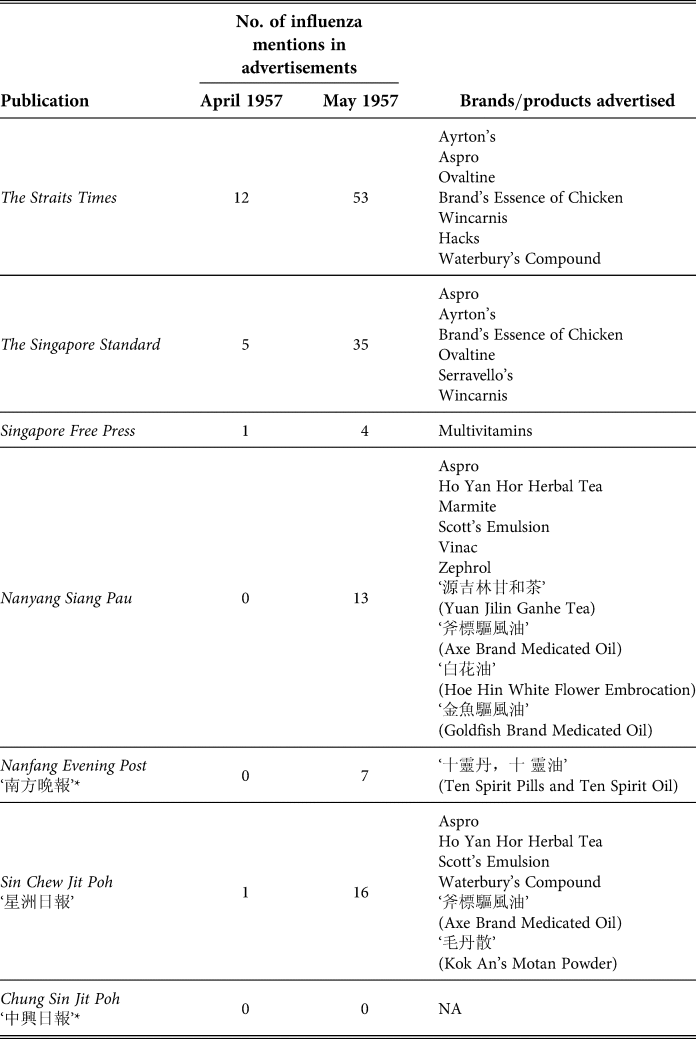
Capitalising upon the influenza fear that had gripped the colony, businesses quickly adopted influenza-related advertising rhetoric and heavily increased their advertising frequencies. Although sales figures are not available, the rapid increase in demand for influenza-fighting products can be satisfactorily surmised from the dramatic increase in the number of times advertisements referenced ‘influenza’ in May 1957. In total, 92 mentions of ‘influenza’ or ‘flu’ appeared in English language newspaper advertisements during May, a five-fold increase relative to 19 mentions of influenza in April (Table 4). Similarly, 29 mentions of ‘流行性感冒’ and ‘流感’ [common influenza] appeared in Chinese language newspaper advertisements during May, an extreme increase relative to the singular mention in April (Table 4).
Influenza mentions in newspaper advertisements, April and May 1957

Based on keyword searches of available archives on NewspaperSG
* Manual search through NUS Libraries Special Collections, Digital Gems
Advertising rhetoric also tactically pivoted during May to incorporate the influenza epidemic into product marketing. In April, Brand's Essence of Chicken was advertised with an eclectic mix of messages.Footnote 109 In May, it was suddenly touted as the ‘best defence’ against influenza.
Meanwhile, for products already known for influenza treatment in Singapore, the influenza epidemic proved to be an immense profile boost. Already advertised as a fever cure — albeit only once — in April 1957, Aspro aspirin tablets were aggressively marketed in May with taglines such as ‘Influenza hits Singapore’ and ‘Influenza hits Malaya’ emblazoned across advertisements in both English and Chinese language newspapers, encouraging consumers to ‘fight flu with Aspro’.Footnote 110
Based on their advertising distribution among the colony's English and Chinese language newspapers, it is likely that a bifurcated market existed for western medical and TCM products. While western medical products were advertised in both Chinese and English newspapers, TCM products were exclusively advertised in Chinese newspapers (Table 4). Interestingly, a news report mentions ‘Indians’ embracing a carrot-and-olive folk remedy popularised by Chinese newspapers: TCM may have also been used by the other ethnic groups against the influenza epidemic.
Some businesses saw their fortunes changed forever by the influenza epidemic. Such was the case of Ho Yan Hor Herbal Tea which became ‘famous’ as a result.Footnote 111 The company's sales representative, Chong Soo Seng, promoted it as an effective influenza remedy in the throes of the colony's influenza woes.Footnote 112 Buoyed by popular beliefs that medication hastened influenza convalescence, sales of Ho Yan Hor Herbal Tea soared.Footnote 113 Not only did stocks run out so fast that additional supply had to be rushed over from Ipoh, Malaysia, to satisfy demand, daily sales at Chinatown and Upper Chin Chew Street exceeded well over a thousand herbal tea packets.Footnote 114 The influenza epidemic was so lucrative that Chong Soo Seng followed in the Asian Flu's footsteps up north as the disease spread to the rest of the Malayan Federation.Footnote 115 Today, Ho Yan Hor Herbal Tea remains a well-known influenza remedy and the 1957 Asian Flu epidemic outbreak in Singapore has even been incorporated into the company's heritage branding.Footnote 116
As demand for TCM products continued to increase, companies ramped up production and importation. So severe were the shortages that companies such as the Three Legs Brand Wen Ken Group posted apology notices in the Chinese-language newspapers that assured the public of increased production and promised the arrival of new stock.Footnote 117 Manufacturers such as Ipoh-based Wan Chun Tang were requested by Singaporean pharmacies to airship in more of their Goldfish Brand products.Footnote 118
Fear of the influenza likely continued to linger on in the social psyche of the colony as consumers continued to purchase influenza curatives and preventives, even when the epidemic subsided.Footnote 119 All in all, influenza business was good business, and this fact was not lost on the discerning colony residents either. The Nanfang Evening Post and Chung Sin Jit Poh carried sarcastic commentaries that mocked the frivolity of influenza advertising rhetoric during the epidemic.Footnote 120
Not all tactics of self-medication deployed by colony residents, however, were grounded in medical science. Some were frivolous and bizarre by-products of folk superstition that were purportedly effective but did not address the root cause of illness.Footnote 121 Carrots and olives in particular, emerged as prominent motifs among such folk remedies. The first mention of a carrot-and-olive folk remedy appears in a Chung Sin Jit Poh column, ‘預防流行性感冒及治療方法’ [‘Influenza prevention and treatment methods’] on 6 May 1957.Footnote 122 Noting the rising popularity of ‘民間療法’ [‘folk remedies’], the column listed several which promoted drinking water boiled with carrots and raw olives, and dripping garlic or onion oil into nostrils.Footnote 123 Intense price gouging ensued after the carrot-and-olive concoction gained in popularity. While olives used to be priced at ten cents for around ten before the epidemic, a single olive cost as much as thirty cents during May.Footnote 124 Carrots too, experienced ‘a more than 10-fold increase’ in price as they sold for ten cents per tael.Footnote 125 Hundreds of housewives swamped Chinatown's markets as they rushed to buy carrots and olives.Footnote 126 Variations of the concoctions appeared over the course of May,Footnote 127 but the carrot-and-olive craze eventually subsided around mid-May.Footnote 128 This bizarre craze was, however, just one of many manifestations of public desperation for influenza protection at a time when the public's lived experiences contrasted heavily with how the state and public health officials downplayed the impact of the Asian Flu epidemic outbreak.
As the epidemic continued to spread, the apparent bizarreness of folk remedies that the public resorted to escalated in tandem. Japanese facial masks, for instance, became a trendy influenza cure at the epidemic's height, labelled humorously as a ‘Weird new facial’ by the front page of the Singapore Free Press.Footnote 129 Although it was reported that a doctor commented that they were ‘probably quite effective’, he still recommended aspirin instead.Footnote 130
Bizarreness and popularity aside, some folk remedies were clearly charlatanry peddled by the entrepreneurial. During the epidemic, the Singapore Standard reported of ‘Nepalese hill-billies’ who were ‘cashing in on the influenza epidemic’.Footnote 131 Allegedly well-known for their pharmaceutic offerings and panaceas among Malayans, they had no difficulty in obtaining customers.Footnote 132 Among their top-selling products were a supposedly constitution-strengthening potion derived from lion tail and a ‘cure-all’ medicine dubbed ‘Tabore’ purportedly made from a rare fruit.Footnote 133 Despite their peddling of often-fraudulent pharmaceuticals, these Nepalese merchants were still accepted as ‘shrewd, honest peddlars [sic]’.Footnote 134
The prominence of folk superstition among the colony's tactics of self-medication was not surprising. As a Singapore Standard editorial explained, ‘the most outrageous rumours’ always enjoyed currency among the ‘superstitious and the gullible’ during epidemics in Singapore.Footnote 135 It further accused their ‘destructive psychology’ of causing Singapore's carrot-and-olive craze, and urged the health ministry to ‘inject some sense into the minds of the ignorant’.Footnote 136 The exhaustion of both medically legitimate and dubious avenues of self-treatment by the public, however, points to the desperation of colony residents in the face of state apathy and inadequate healthcare provision during the influenza epidemic.
As much as it stoked fears and commercial appetites within the colony, the Asian Flu epidemic outbreak was also a crisis that roused civic-minded individuals and medical practitioners to action. Throughout May, both English and Chinese language newspapers consolidated influenza explainers, prevention, and treatment advice from western medicine and TCM practitioners alike for the benefit of the public.Footnote 137 The causes of influenza were explained from both western medical and TCM perspectives.Footnote 138 News articles commonly advised the public to avoid crowded places and to exercise for influenza prevention while aspirin, hydration, and home rest were commonly recommended for treatment and convalescence.Footnote 139 As the epidemic intensified around mid-May, TCM medical halls and practitioners even published usually proprietary ‘中藥方/驗方’ [TCM recipes] as ‘public service prescriptions’ for the impoverished as well as rural folk without healthcare access.Footnote 140 Often detailed, these recipes were even tailored to specific influenza symptoms and categories of flu sufferers. For example, one such public service prescription, supplied four different herbal concoctions specifically tailored for initial infection by the influenza, high fever, children, and weak constitutions, respectively.Footnote 141
Dire reports of flu sufferers also came to rouse prominent citizens and medical professionals to organise free flu clinics in support of the overwhelmed healthcare system. The Singapore Free Press painted a picture of Chinatown's social tragedy as informed by social workers at the height of the epidemic: welfare doles were left uncollected, daily wage earners faced impoverishment and families laid ‘side by side praying for the infection to disappear’.Footnote 142 The social workers even urged mobile medical teams to ‘visit congested areas and if necessary, force people to take medicine.’Footnote 143
‘Greatly moved,’ Deputy Speaker, Mr R. C. H. Lim, spearheaded the formation of free flu clinics in areas with ‘the most acute’ suffering.Footnote 144 Although the initiative received material support from government agencies and departments with medicine and equipment supplied by the health ministry, it was staffed voluntarily by medical professionals and civilians.Footnote 145 Government doctors and nurses themselves also readily volunteered along with Mrs W. W. Yung, the wife of WHO's Singapore Director, while the Civil Defence Commissioner, Col. L.T. Fairbank, provided another 20 nurses.Footnote 146 They were further joined by members of the Wesley Methodist Youth Fellowship.Footnote 147
In total, three free flu clinics opened in May. Dedicated to the vulnerable poor and sick, treatment was free, and the Social Welfare Department endeavoured to render all necessary assistance.Footnote 148 Opening first at Chinatown, then Rangoon Road, and finally Queenstown, these free flu clinics were a much-needed healthcare intervention. The Chinatown clinic treated 130 influenza sufferers alone on its opening night on 17 May 1957.Footnote 149 The Rangoon Road and Queenstown clinics opened on 18 and 21 May respectivelyFootnote 150 likely in response to further complaints of inadequate healthcare in rural areas.Footnote 151
Ultimately, much as the free flu clinics received logistical support from state organs, they were a ground-up initiative raised in support of Singapore's healthcare needs during the 1957 Asian Flu epidemic outbreak. They prove that beyond fear and greed, civic duty also prevailed in the time of influenza within the colony.
Conclusions and reflections
As this article has argued, Singapore's response to the 1957 Asian Flu epidemic outbreak split along official and popular lines due to differing perceptions of public health and epidemic severity between state officials and the public at large. Official responses favoured inaction and passive reaction under extenuating circumstances of limited healthcare infrastructure and competing priorities, with action taken only as concessions to unanticipated epidemic developments and negative media coverage of the influenza epidemic. Among the public's popular responses, altruism stood out the most amidst anxious fear and opportunistic greed as residents of the colony self-medicated, profiteered, and aided each other against a backdrop of state apathy and inadequate healthcare access and capacities. The episode revealed major structural flaws in the colony's nascent healthcare system which the government of the day could not immediately address. The state asserted control not over the epidemic's spread, but over the epidemic narrative as it sought to justify its inaction. Archival material from the WHO further suggests the state's complicity in allowing the Asian Flu to spread both within and beyond Singapore. The 1957 Asian Flu epidemic outbreak also underscored the watchdog role of the media as it facilitated state–society interactions and dialogue as seen with the school closures and Pulau Sudong incidents. Lastly, although the 1957–58 Asian Flu Pandemic raised narrative discourses of optimism and faith in science in Britain and America,Footnote 152 this article has established that it raised in 1957 for Singapore, only mayhem in May. Despite the societal impact of Singapore's 1957 Asian Flu epidemic outbreak, it has been mostly forgotten in contemporary discourse, save for Lim Kok Ann's identification of the H2N2 virus as the causative agent.Footnote 153 It is with hope that this article prompts renewed historiographical interest in the regional responses of Southeast Asian societies to the 1957–58 Asian Flu Pandemic and their unique historical experiences.