Electoral abstention is common in virtually all democracies. For example, in a typical US presidential election, at least 40 percent of eligible citizens will fail to turn out (McDonald and Popkin Reference McDonald and Popkin2001), and this number can be much higher in less salient elections. Widespread nonparticipation leads to the concern that significant segments of the population are under-represented or even ignored in the making of public policy (Verba, Schlozman and Brady Reference Verba, Schlozman and Brady1995; Lijphart Reference Lijphart1997). If those who abstain are systematically different from those who participate, then election results will not reflect the preferences of the population as a whole. This article offers a new method and several new opportunities to assess the difference in preferences between regular voters (those who vote regardless of some exogenous factor) and marginal voters (those whose decisions to turn out are sensitive to exogenous factors).Footnote 1 How much do regular voters disagree with those on the margins in terms of their partisan vote choices? The answer will vary according to the setting and the particular subsets of regular and marginal voters. However, in both cases analyzed in this article, marginal voters in the United States are systematically more supportive of the Democratic Party (and less supportive of the Republican Party) than regular voters. As a result, fluctuations in the size of the electorate can have dramatic consequences for partisan elections.
A significant scholarly literature asks, “what if everyone voted?” (for example, Highton and Wolfinger Reference Highton and Wolfinger2001; Citrin, Schickler and Sides Reference Citrin, Schickler and Sides2003; Martinez and Gill Reference Martinez and Gill2005). Unfortunately, this question may be impossible to answer convincingly in democracies with voluntary voting, because they will never witness anything remotely close to universal turnout. For the same reason, the answer to this question may be irrelevant beyond scholarly curiosity. Thus scholars have sometimes settled for a more tractable question, “what if more people voted?” (for example, Knack and White Reference Knack and White1998; Stein Reference Stein1998; Sled Reference Sled2008; Hansford and Gomez Reference Hansford and Gomez2010; Hill Reference Hill2010). However, this question has no clear meaning. Would election results be different if turnout increased by 1 percentage point? Obviously, it depends on which 1 percent of the population is mobilized. There is no single, correct answer to the question. Some increases in turnout will help one party, others will help another, and others will have no effect.
To understand the effects of increasing (or decreasing) voter turnout, we need many sources of exogenous variation in turnout. Some citizens are “regular voters” who will vote in a particular election regardless of the conditions. Others may be “never voters,” who are impossible to mobilize. However, the “marginal voters,” those whose turnout decisions can be influenced by exogenous factors, electoral policies or other idiosyncratic features of an election, are of prime importance for this study because they are the easiest citizens to mobilize or de-mobilize, and their behavior can potentially influence electoral outcomes and public policy. In order to understand the consequences of turnout, we must characterize these marginal voters and understand how their attitudes and preferences differ from the regular voters. No single analysis can answer this question. Instead, we must exploit multiple, independent sources of exogenous variation to understand how marginal voters, on average, differ from regular voters.
This article develops a simple method for directly comparing the partisan preferences of regular and marginal voters and implements it for two different sources of exogenous variation in the United States. Once a researcher has identified an exogenous source of variation in turnout, she can estimate four quantities directly from the data and solve a simple system of equations to compare the voting behavior of regular and marginal voters. In the subsequent sections, I review the previous literature on the effects of turnout, describe the empirical strategy for comparing regular and marginal voters, implement the test in two different settings and then benchmark the results against observational estimates. In both cases analyzed here, marginal voters in the United States are systematically more Democratic than regular voters, although this need not be the case in other settings. These findings suggest that voters are often unrepresentative of the greater population of possible voters, and that changes in voter turnout can have significant consequences for partisan election results.
PREVIOUS EVIDENCE OF THE EFFECTS OF TURNOUT
Previous studies of the effects of turnout are conflicted and suffer from methodological limitations. Correlations between turnout and partisan election results can be large (McAllister and Mughan Reference McAllister and Mughan1986; Nagel Reference Nagel1988; Radcliff Reference Radcliff1994; Pacek and Radcliff Reference Pacek and Radcliff1995; Fisher Reference Fisher2007; Hill Reference Hill2010), small (Nagel and McNulty Reference Nagel and McNulty1996; Grofman, Own and Collet Reference Grofman, Own and Collet1999; Martinez and Hill Reference Martinez and Hill2007) or nonexistent (DeNardo Reference DeNardo1980; Erikson Reference Erikson1995). In surveys, non-voters can be significantly more liberal than voters (Herron Reference Herron1998; Mackerras and McAllister Reference Mackerras and McAllister1999), slightly more liberal (Citrin, Schickler and Sides Reference Citrin, Schickler and Sides2003; Martinez and Gill Reference Martinez and Gill2005; Bernhagen and Marsh Reference Bernhagen and Marsh2007; Pettersen and Rose Reference Pettersen and Rose2007) or not noticeably different (Highton and Wolfinger Reference Highton and Wolfinger2001; Rubenson et al. Reference Rubenson, Blais, Fournier, Gidengil and Nevitte2007). Exogenous changes in turnout can have effects that are sizable (Hansford and Gomez Reference Hansford and Gomez2010; Anzia Reference Anzia2011, Reference Anzia2012; Fowler Reference Fowler2013) or small (Knack and White Reference Knack and White1998; Stein Reference Stein1998; van der Eijk and van Egmond Reference van der Eijk and van Egmond2007; Sled Reference Sled2008; Berry and Gersen Reference Berry and Gersen2011).
What can we make of these mixed results? One explanation is that there is no single, correct answer. The effect of increasing turnout will depend on which citizens are mobilized. While experimental and quasi-experimental studies may be the most promising avenue to answer the question at hand, each individual study will yield a different answer because the subset of marginal voters changes in every setting. Electoral reforms like early voting and vote-by-mail (Berinsky Reference Berinsky2005) and get-out-the-vote efforts (Enos, Fowler and Vavreck 2012) tend to mobilize citizens of high socioeconomic status (SES) more so than low-SES individuals. Other exogenous factors may have different electoral effects if they happen to identify a different subset of marginal voters.Footnote 2 Unfortunately, there is no easy solution to this problem. Unless governments exogenously create universal turnout through financial incentives,Footnote 3 we will never fully characterize the preferences of all non-voters. However, the repeated analysis of different, independent exogenous factors will allow us to characterize the preferences of marginal voters—those on the cusp of voting. Moreover, because universal turnout will never be achieved in most democracies, understanding the partisan preferences of different marginal voter populations may be a more relevant goal than answering the more elusive question “what if everyone voted?”
A METHOD FOR COMPARING REGULAR AND MARGINAL VOTERS
Consider an experiment where some voting-eligible citizens are randomly mobilized to turn out to vote and where we can observe the aggregate vote choices of the treatment and control groups. Within this experimental setting, there are three distinct categories of individuals. Regular voters are not responsive to the treatment because they will vote regardless of whether they receive it. Conversely, non-voters are also not responsive to the treatment because they will not vote regardless of whether they receive the treatment. Finally, the third category of marginal voters is responsive to the treatment; these individuals will vote if they are in the treatment group but will not vote if they are in the control group.Footnote 4 Suppose also that we can assume that the treatment has no systematic effect on the vote choices of the regular voters (it turns people out to vote but does not influence the vote choices of those who would have voted anyway).Footnote 5 A researcher can calculate the effect of the treatment on both turnout and partisan election results with simple difference-in-means tests. Let us call these quantities PM and ∆V, respectively.Footnote 6 PM, the turnout effect, indicates the proportion of all eligible voters that is marginal voters—individuals whose turnout decision was influenced by the treatment. ∆V, the vote share effect, indicates the extent to which the treatment changed the election result. While these estimates alone may be interesting, they do not allow us to directly compare the regular and marginal voters. We would like to know how the vote choices of marginal voters differ from those of regular voters, but this quantity cannot be calculated without more information.
Following the experiment, the researcher could also calculate the expected level of voter turnout and vote share in the absence of any treatment. Because the treatment was randomly assigned, these quantities are estimated by the mean turnout and mean vote share of the control group. These quantities indicate the number of regular voters, as a proportion of the voting-eligible population, and the proportion of regular voters that supports one party over another. Let us call these quantities PR (proportion of the population occupied by regular voters) and VR (vote preferences of regular voters).
The crucial unknown quantity is VM, the partisan preferences of marginal voters. With this quantity we can directly compute VM – VR, the preference gap between marginal and regular voters and the primary quantity of interest for this study. Unfortunately, this quantity cannot be recovered using only the typical research toolkit (regressions, averages, differences-in-means, etc.). However, we can solve the following equation to back out VM, and therefore VM – VR:
 $${\rm P}_{{\rm R}} {\rm V}_{{\rm R}} \,{+}\,{\rm P}_{{\rm M}} {\rm V}_{{\rm M}}\,=\,({\rm P}_{{\rm R}} \,{+}\,{\rm P}_{{\rm M}} )({\rm V}_{{\rm R}} \,{+}\,\Delta {\rm V}).$$
Solving for VM, we get:
 $$\eqalignno{ {\rm V}_{{\rm M}} &\,=\, [({\rm P}_{{\rm R}\,} {+}\,{\rm P}_{{\rm M}} )({\rm V}_{{\rm R}} \,{+}\,\Delta {\rm V})\,{-}\,{\rm P}_{{\rm R}} {\rm V}_{{\rm R}} ]/{\rm P}_{{\rm M}} , \cr &\, ={\rm V}_{{\rm R}} \,{+}\,\Delta {\rm V(1}\,{+}\,{\rm P}_{{\rm R}} {\rm /P}_{{\rm M}} {\rm )}{\rm .} $$
Finally, we can see that the preference gap between marginal and regular voters is
 $${\rm V}_{{\rm M}} \,{-}\,{\rm V}_{{\rm R}} \,=\,\Delta {\rm V}({\rm 1}\,{+}\,{\rm P}_{{\rm R}} /{\rm P}_{{\rm M}} ).$$
In words, the preference gap is the effect of the treatment on vote share times one plus the ratio of the regular and marginal populations.Footnote 7
Intuitively, we can identify the partisan preference of marginal voters because we know the relative populations of regular and marginal voters, the partisan preferences of regular voters and the extent to which the introduction of the marginal voters changes the election result. Knowing these quantities, we can then determine how marginal voters must have voted in order to obtain the effects that we see. The average voting behavior of the entire population is just a weighted average of the voting behavior of regular and marginal voters, with weights proportional to the populations of the two groups. Reliable estimates of uncertainty for all quantities can be obtained through bootstrap simulations.
Most studies examining the electoral effects of turnout would simply calculate the effect of a treatment on turnout and vote share without calculating the preference gap. We can see from the equations that ∆V indicates the sign of the preference gap: if ∆V is positive, then the preference gap (VM – VR) will also be positive, and vice versa. However, the value of ∆V alone provides no substantive meaning about the differences between regular and marginal voters. For the purposes of understanding political representation and characterizing marginal voters, this substantive quantity is crucial. In the next sections, I apply this test to two different sources of exogenous variation in turnout in the United States: weather in presidential elections, and the timing of gubernatorial elections. The population of marginal voters is different in each setting, so the preference gap is different as well. Nonetheless, across both settings, I find that marginal voters are systematically more supportive of the Democratic Party than are regular voters. The repeated application of this test in different settings in the United States and in other democracies will improve our understanding of marginal voting populations, the extent to which election results reflect public preferences and the consequences of electoral reforms.
MARGINAL VOTERS SENSITIVE TO WEATHER IN PRESIDENTIAL ELECTIONS
To demonstrate the descriptive power of the method, I first apply it to a known quasi-experiment previously analyzed by Gomez, Hansford and Krause (Reference Gomez, Hansford and Krause2007) and Hansford and Gomez (Reference Hansford and Gomez2010). The turnout decisions of some citizens are sensitive to weather. Specifically, these marginal voters are less likely to vote if it rains or snows, presumably due to the difficulties of getting to the polling place in these conditions. Gomez, Hansford and Krause (Reference Gomez, Hansford and Krause2007) demonstrate that rain and snow decrease turnout and benefit the Republican Party in presidential elections, and Hansford and Gomez (Reference Hansford and Gomez2010) extend this analysis with an instrumental variables study of the effects of turnout. However, neither article directly leverages the data to compare the partisan preferences of regular voters and those marginal voters who are sensitive to weather.
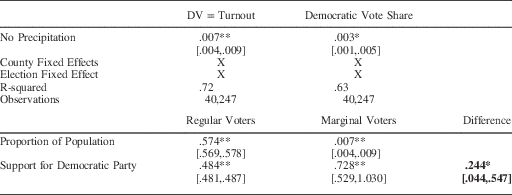
In Table 1, I reanalyze their data on county-level voting in presidential elections from 1946–2000, made publicly available by Fraga and Hersh (Reference Fraga and Hersh2011). I exclude 1968 from the analysis, because George Wallace performed well as a third-party candidate, particularly in the South, hindering the comparability of vote shares between 1968 and other years.Footnote 8 Each observation is a county-election. I code a single dummy variable that indicates whether there was any precipitation in a county on election day. Then, conducting the simplest possible tests, I estimate the effect of precipitation on turnout and Democratic vote share by regressing these outcomes on the precipitation dummy variable, county fixed effects and election fixed effects. Because of the fixed effects, these are differences-in-differences estimates, which indicate the extent to which turnout or vote share vary within counties as the presence of precipitation changes. The top panel of Table 1 shows that the lack of precipitation, on average, increases a county’s turnout by 0.7 percentage points, which in turn increases their Democratic vote share by 0.3 percentage points.
Exploiting Weather in Presidential Elections (1948–2000)

Note: Block bootstrap 95% confidence intervals in brackets; **p<0.01; *p<0.05. No Precipitation is a dummy variable indicating whether there was no precipitation in a particular county on election day. The top panel shows that good weather (relative to some rain or snow) increases turnout by 0.7 percentage points, which in turn increases the Democratic candidate’s vote share in the county by 0.3 percentage points. The bottom panel shows that these marginal voters (0.7 percent of the population) who are sensitive to the weather are 24.4 percentage points more likely to support the Democratic candidate compared to the regular voters (57.4 percent of the population) who would have voted regardless of the weather. The 1968 election is excluded from the analysis for efficiency because George Wallace performed well in the South as a third-party candidate, reducing the comparability of vote shares in that year with other years.
Having estimated the effect of some factor on turnout and vote shares, most studies would stop here, noting that these effects are “statistically significant.” However, the coefficients above, 0.7 and 0.3, do not convey the information that we care about most. Digging deeper into the data, we can extract more meaningful quantities if we are willing to impose the assumptions discussed above. In particular, we can estimate the preference gap between regular and marginal voters under the assumption that the exogenous factor has no effect on the vote choices of regular voters (analogous to an exclusion restriction). In this particular setting, it seems unlikely that weather would systematically shift regular voters toward the Democratic or Republican parties. Even if such an effect exists on the margin, perhaps for psychological reasons, its substantive size is likely negligible relative to the effect of weather on turnout.
The 0.7 percentage point effect of precipitation on turnout tells us that 0.7 percent of voting-eligible citizens are marginal voters with respect to weather. They will vote if the sky is clear, but if it rains or snows, they will abstain. Obviously, we do not know the names of these individuals, and they themselves may not know that they are part of this marginal population. However, in a typical presidential election, about 1 in 140 people will have either voted only because the weather was nice or abstained only because it rained or snowed.
Next, I quantify the number of regular voters—those who would have voted regardless of the weather. Because this was not an ordinary experiment, we cannot simply calculate the mean turnout of the control group, but the intuition is similar. After running the regression, I calculate each county’s predicted level of voter turnout under the counterfactual scenario of precipitation. Averaging across these predicted values, I obtain the expected level of turnout with rain everywhere: .574, the proportion of the voting-eligible population made up of regular voters. Applying the same logic to the vote share regression, I also calculate the expected level of Democratic vote share with rain or snow everywhere: .484, the proportion of regular voters supporting the Democratic Party.
We have now computed all of the quantities necessary to estimate the partisan preferences of the marginal voters and the partisan gap between marginal and regular voters. Solving the equation provided in the previous section, I estimate that 72.8 percent of marginal voters supported the Democratic Party. Compared to the regular voters, marginal voters are 24.4 percentage points more likely to support the Democratic Party—a significant divide. I calculate 95 percent confidence intervals for each of these quantities through block-bootstrap simulation (where counties are sampled as blocks), and all estimated quantities, including the preference gap, are statistically significant.
If we had simply looked at the top panel of Table 1—the traditional regression results—we would have missed the bigger picture. Those marginal voters whose turnout decisions are influenced by weather support the Democratic Party at a much greater level than regular voters. Obviously, these individuals are a unique subset of Americans, only 0.7 percent of the voting-eligible population. Nonetheless, these marginal citizens on the cusp of voting or abstaining are significantly different from regular voters.
MARGINAL VOTERS SENSITIVE TO TIMING OF GUBERNATORIAL ELECTIONS
The method for comparing regular and marginal voters is generally applicable to any exogenous factor that influences voter turnout and brings marginal voters to the polls (or keeps them away). Having demonstrated the power of the method with weather—a previously studied factor—I introduce a new opportunity to compare regular and marginal voters. Several recent studies have exploited the timing of US elections to understand the effects of mass participation on interest group power and policy outcomes. When local elections are held “on cycle”—meaning that they coincide with federal elections—turnout is significantly higher than when they are held “off cycle.” This uptick in participation in school board elections decreases the chances of interest group capture and leads to lower teacher pay (Anzia Reference Anzia2011, Reference Anzia2012; Berry and Gersen Reference Berry and Gersen2011). Beyond local elections, turnout in federal and statewide elections is also highly dependent on election timing. When gubernatorial and congressional elections happen to coincide with a presidential race, turnout is significantly higher. In other words, a large population of marginal voters turns out simply because of the more salient race at the top of the ticket. Even though this phenomenon is well known, no previous study has exploited election timing to compare the partisan preferences of regular and marginal voters.
States vary idiosyncratically in the timing of their gubernatorial elections. Two states—New Hampshire and Rhode Island—hold their elections every two years (in even years—2006, 2008, 2010, etc.). Two other states—New Jersey and Virginia—hold their elections in odd years following presidential election years (2005, 2009, 2013, etc.). Three states—Kentucky, Louisiana and Mississippi—hold their elections in odd years preceding presidential election years (2003, 2007, 2011, etc.). In nine states—Delaware, Indiana, Missouri, Montana, North Carolina, North Dakota, Utah, Washington and West Virginia—the elections coincide with presidential elections (2004, 2008, 2012, etc.), while the remaining 34 states hold their gubernatorial elections in mid-term years (2002, 2006, 2010, etc.).
The timing of each state’s elections was typically established long ago, for arbitrary reasons unrelated to the state’s political orientation. Reviewing the history of each state’s electoral calendar, I found that 12 states have maintained the same electoral calendar since the founding of the state. In each of these cases, the timing was determined by the first year that each state could hold a gubernatorial election, and that timing has remained unchanged. In three other states, the timing was influenced by the death of the sitting governor (Delaware and Kentucky) or a governor who ascended to the Senate in the middle of his term (California). In each of these cases, the state had no established law regarding the replacement of a sitting governor, so they established that law at the time and kept their electoral calendar in place from that point on. In the vast majority, 31 states, the timing of gubernatorial elections was set when the state decided to switch from 2- or 3-year terms to 4-year terms. The particular timing of the elections was typically set for whenever the next election could be held, and this decision was likely unrelated to the political leanings of the state.
Finally, there are five remaining states—Louisiana, Maryland, Minnesota, Florida and Illinois—which actively changed their electoral calendar through a state law. Louisiana switched from presidential years to odd years in 1879, Maryland switched from odd to mid-term years in 1926, and Minnesota, Florida, and Illinois switched from presidential to mid-term years in 1930, 1966 and 1978, respectively. For the purposes of this study, these five states could be problematic, because they may have strategically changed their electoral calendar for partisan, political reasons. However, looking into these legislative debates, the primary arguments given for switching are non-partisan. Legislators on both sides of the aisle in Florida, for example, wanted to move away from presidential years so that the gubernatorial race would not be drowned out by the presidential campaign. Importantly, concerns about strategic timing in these five states do not influence the subsequent empirical results. The findings are unchanged if these five states are removed or if they are treated as non-compliers in an instrumental variables framework.
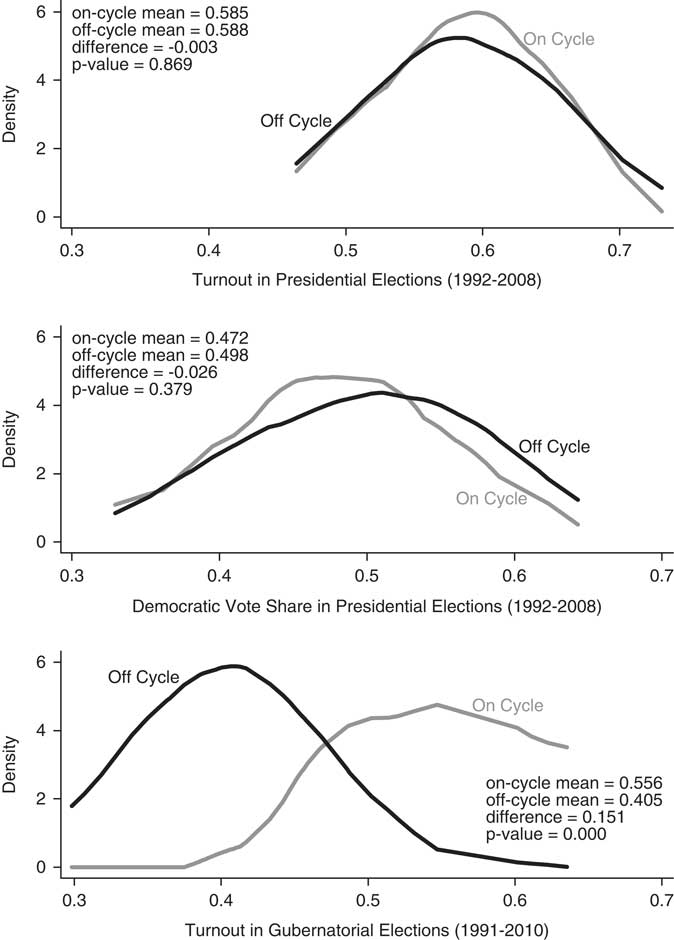
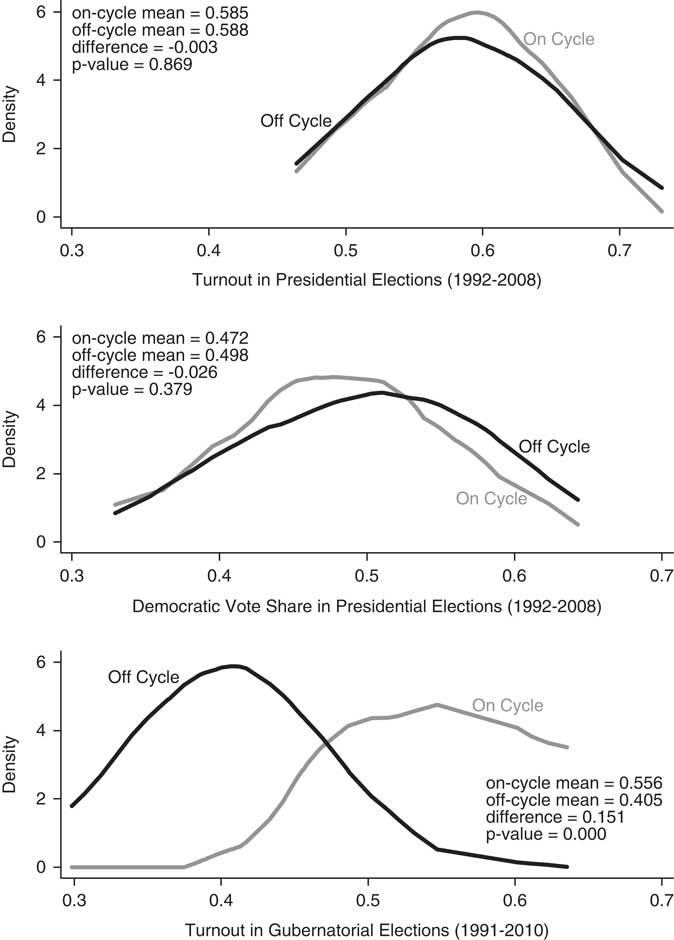
This history of gubernatorial election calendars suggests that states with a calendar that happens to coincide with the presidential calendar are, on average, no different from those with another calendar. As a result of various historical accidents, these two groups of states, despite being comparable in terms of their governments, partisan leanings and demographic makeup, happen to elect their governors at a time when many more people turn out to vote. Figure 1 compares the two groups of states that I leverage in my analysis: “on-cycle” states with gubernatorial elections that coincide with presidential elections and “off-cycle” states with elections that occur at other times. Consistent with the claim that these electoral calendars are idiosyncratically determined, these two groups of states are nearly identical in their average voting behavior in presidential elections. They turn out and support Democratic candidates at the same rates. However, the “on-cycle” states turn out at much higher rates in gubernatorial elections, providing the necessary leverage to compare regular voters and marginal voters who only turn out when there is also a presidential race. Statistical tests of balance reveal no substantively or statistically significant differences in turnout (difference=−.003; p=.869) or vote share (difference=−.026; p=.379) between on-cycle and off-cycle states in presidential elections. However, the turnout differential in gubernatorial elections is substantively large (15.1 percentage points) and statistically significant (p<.001).
Comparing states with on- and off-cycle gubernatorial elections Note: The figure compares “on-cycle” states (those with gubernatorial elections coinciding with presidential elections) to “off-cycle” states. New Hampshire, Vermont and Rhode Island are excluded from the figure because they had both on- and off-cycle elections during this period. Kernel density plots show that on- and off-cycle states are nearly identical in terms of their voting behavior in presidential elections. They turn out at the same rates and support Democratic candidates at the same rates. However, in gubernatorial elections, on-cycle states turn out at much higher rates, providing the opportunity to compare the preferences of regular voters to those of marginal voters (citizens who are mobilized to vote in a gubernatorial election because it happens to coincide with a presidential race).
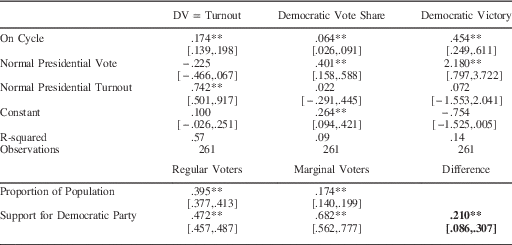
In Table 2, I estimate the effect of “on-cycle” gubernatorial elections on voter turnout, Democratic vote share and the probability of Democratic victory. Each observation is a state election from 1991–2010.Footnote 9 Each observation is weighted by the voting-eligible population in each state (see McDonald and Popkin Reference McDonald and Popkin2001), because the unit of substantive interest is the voter. However, unweighted estimates yield very similar results. These effects are estimated from regressions of each dependent variable on a dummy variable for an “on-cycle” election (meaning that the election coincided with a presidential race) and two control variables—each state’s average level of turnout and Democratic vote share in the past three presidential elections. Because on- and off-cycle states are balanced in terms of these variables, controls are unnecessary for unbiased estimates, but they are included for statistical precision. These regressions indicate that on-cycle gubernatorial elections, on average, increase turnout by 17.4 percentage points and the Democratic candidate’s vote share by 6.4 percentage points. Moreover, because most gubernatorial races are competitive, this increase in Democratic vote share is enough to increase the probability of Democratic victory by 45.4 percentage points. While weather is unlikely to change many election results because the small effects are attenuated in close races (Fraga and Hersh Reference Fraga and Hersh2011), election timing appears to influence many election outcomes.
Exploiting the Timing of Gubernatorial Elections (1991–2010)
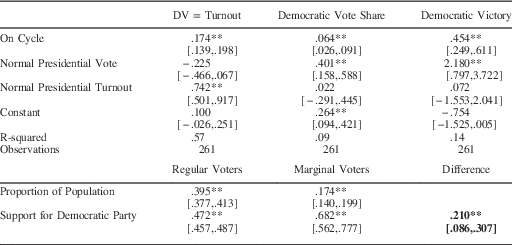
Note: Block bootstrap 95% confidence intervals in brackets; **p<.01. On Cycle is a dummy variable indicating whether an election coincided with a presidential election. Normal Presidential Vote is a control variable indicating the state’s average Democratic vote share in the past three presidential elections. Normal Presidential Turnout is a control variable indicating the state’s average turnout in the past three presidential elections. The top panel shows that on-cycle elections increase turnout by 17.4 percentage points, which in turn increases the Democratic candidates’ vote shares by 6.4 percentage points. Because most gubernatorial elections are competitive, this is enough to increase the Democratic candidate’s probability of winning by 45.4 percentage points. All three regressions are weighted by the voting-eligible population of the state, because the appropriate unit of analysis is the individual citizen. The bottom panel shows that marginal voters (17.4 percent of the population) who are mobilized by the occurrence of a presidential election are 21.0 percentage points more likely to support the Democratic Party compared to the regular voters (39.5 percent of the population), who would have voted regardless of the presidential race.
Applying the method for comparing marginal and regular voters, I find that regular voters (39.5 percent of the voting-eligible population) support Democratic gubernatorial candidates 47.2 percent of the time while marginal voters (17.4 percent of the voting-eligible population) support Democratic candidates at a rate of 68.2 percent. Again, with a different, independent sample of marginal voters, I find a massive preference gap between regular and marginal voters. The citizens whose turnout decisions are influenced by gubernatorial election timing are 21 percentage points more likely to support the Democratic Party than regular voters. As before, I estimate 95 percent confidence intervals for all quantities with block-bootstrap simulations (in this case states are sampled as blocks), and all estimates are statistically different from zero (p <.01). Those voters comprising the regular electorate are systematically different from those on the margins, and when marginal voters are introduced into the electorate, partisan election results can change dramatically.
In this case, the relevant exclusion assumption—that election timing has no effect on the partisan vote choices of regular voters—may be more doubtful than in the case of weather. Many factors, including campaign strategies, press coverage and voter attention, differ between on- and off-cycle elections, which might influence the vote choices of regular voters. However, while these factors are important, they will only bias my estimates if they lead regular voters to systematically shift toward a party in on- vs. off-cycle elections, and I cannot think of compelling explanations for such a systematic partisan shock. In my view, the most likely explanation, by far, for systematically different election results between on- and off-cycle years is the differing views of regular and marginal voters, although these results should be interpreted cautiously in light of other possibilities.
This design could be applied in other electoral settings in which elections coincide with more salient races in some years but not in others. For example, one could compare congressional elections in presidential and mid-term years. However, this design is less clean than the gubernatorial design, because there are other forces at work in congressional elections that are less relevant for gubernatorial races. For example, presidential coattails and nationwide forces would lead to statistical inefficiency. Yet Gubernatorial elections are more plausibly independent from one another and from national forces. Moreover, the inclusion of control variables that account for national forces does not alter the previous results (see the appendix for more details). For all of these reasons, recent gubernatorial elections provide the best available opportunity to use election timing to compare regular and marginal voters.
OBSERVATIONAL ESTIMATES OF PARTISAN PREFERENCE GAPS
Across two different settings, I have identified preference gaps of 24 and 21 percentage points between marginal and regular voters, respectively. In both cases, the marginal voters are systematically more supportive of the Democratic Party. In both cases, the estimates have arisen from exogenous changes in electoral participation, which mitigates concerns about confounding variables and survey misreporting. How different would our results be if we relied entirely on observational or survey evidence? In this section, I benchmark the quasi-experimental estimates against several observational estimates, some familiar and others new. Results are shown in Table 3.
Observational and Quasi-experimental Estimates of Preference Gaps between Regular and Marginal Voters

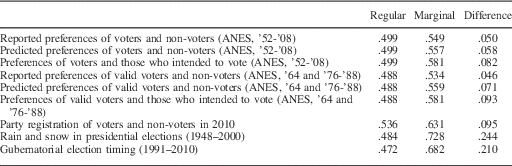
Note: The table presents nine different comparisons of regular and marginal voters. Row 1 shows the reported presidential preferences (1=Democratic candidate; 0=Republican candidate) of voters and non-voters in ANES surveys from 1952–2008. Only those individuals who expressed a preference for one of the two major party candidates are included in the analysis. Row 2 shows the predicted preferences of these individuals generated from a multinomial logit model using age, race, income and education to predict vote choice. Both approaches yield nearly identical results: a 5–6 percentage point preference gap between voters and non-voters. Row 3 compares the stated preferences of voters to that of non-voters who intended to vote before the election. Rows 4–6 repeat the first three rows using only data on validated turnout (as opposed to reported turnout). This information is available for 1964, and 1976–88. Row 7 compares the party registration of voters and non-voters in 2010 who were registered with one of the two major parties (1=registered Democrat; 0=registered Republican). Non-voters are 9.5 percentage points more likely to side with the Democratic Party. The final two rows re-print the results from Tables 1 and 2, where those voters sensitive to weather and election timing are compared to regular voters. Across all tests, non-voters or marginal voters in the United States are systematically more supportive than regular voters of the Democratic Party.
One obvious way to estimate the partisan preference gap is to directly ask non-voters how they would have voted. Averaging across all ANES surveys in presidential years from 1952–2008 (all years when non-voters were asked about their presidential preferences) and focusing on only those individuals who expressed a preference for one of the two major parties, I find that 49.9 percent of voters supported the Democratic Party, while 54.9 percent of non-voters supported the Democratic Party. Previous studies that used these survey questions (for example, Wolfinger and Rosenstone Reference Wolfinger and Rosenstone1980; Highton and Wolfinger Reference Highton and Wolfinger2001) failed to detect this gap because they never calculated this particular quantity of interest.
Instead of directly asking respondents how they would have voted, we can statistically model their likely vote choices, following Herron (Reference Herron1998), Citrin, Shickler and Sides (2003), and Martinez and Gill (Reference Martinez and Gill2005). Examining the same ANES sample from 1952–2008, I conduct a multinomial logit analysis (McFadden Reference McFadden1974) in which each respondent’s probability of voting for a Democrat, voting for a Republican or abstaining is predicted using her age, gender, race, income and education level. Unlike Martinez and Gill, I do not include attitudinal variables such as party identification, because those preferences are endogenous to the decision to turn out. With these predicted probabilities, I calculate the conditional probability that each respondent would support the Democratic candidate if she voted: Pr(D)/[Pr(D)+Pr(R)]. As expected, the average conditional probability for voters is nearly identical to the average level of Democratic support—49.9 percent. Remarkably, the average predicted probability for non-voters is similar to the average level of reported preferences—55.7 percent. These approaches estimate a 5–6 percentage point preference gap between voters and non-voters, on average, across all presidential elections from 1952–2008.
One interesting group of ANES respondents is those who intended to vote before the election but did not. These individuals—7.1 percent of all respondents—may be similar to other groups of marginal voters in this study because they may have been on the cusp of voting but failed to turn out for one reason or another. Perhaps they were busier than expected on election day, could not find their polling place or were deterred by bad weather. According to their survey responses, 58.1 percent of these individuals preferred Democratic candidates, which creates an 8.2 percentage point gap between voters and those who intended to vote but did not.
The above analyses of survey data rely upon respondents’ reports about their own turnout behavior, which are often unreliable. Ansolabehere and Hersh (Reference Ansolabehere and Hersh2011) argue that analyses of reported turnout may overstate the actual differences between voters and non-voters, but Rogers and Aida (Reference Rogers and Aida2013) find the opposite. To address concerns in either direction, the next three rows of Table 3 repeat the previous analyses using data on turnout that was validated through public records. The ANES conducted this validation in only five presidential elections (1964, 1976, 1980, 1984 and 1988), so these analyses are restricted to these years. The estimates are virtually unchanged, suggesting that the use of reported vs. validated turnout has little consequence in this particular case.
State records of registered voters represent another valuable source of information on marginal voters. All states maintain records of which individuals turned out in recent elections, and 31 states keep records of party registration. Analyzing these voter lists, as compiled by Catalist Inc., following the 2010 election and focusing exclusively on those states with party registration, we can assess the partisan difference between voters and non-voters. Of the 42 million individuals who are registered with a major party and voted in 2010, 53.6 percent of them support the Democrats. Alternatively, among the 34 million individuals registered with a party who did not vote, 63.1 percent of them support the Democrats. Between these two groups of citizens, we see a 9.5 percentage point preference gap.
The final two rows of Table 3 present the quasi-experimental comparisons of regular and marginal voters that represent the crux of this study. Across all comparisons, non-voters or marginal voters are more Democratic than regular voters, and the size of these differences is substantively significant. However, in each case, the observational estimates of partisan preference gaps are smaller than the quasi-experimental estimates. Surely, the marginal voters whose turnout decisions are sensitive to weather or election timing differ from the other populations of marginal voters and non-voters analyzed in the observational analyses. However, the observational approaches are likely biased because of the difficulties in predicting what individuals would do in a counterfactual scenario, and these results suggest that the extent of these biases could be significant. When focusing on exogenous sources of variation in turnout, I find even larger disparities between regular and marginal voters.
CONCLUSION
The academic literature on the effects of turnout can be confusing, because different studies ask different questions (Grofman, Own and Collet Reference Grofman, Own and Collet1999). What if everyone voted? How different are voters and non-voters? Does higher turnout benefit one party or the other? The first two questions are hard to answer, and the third question has no definite answer. Higher turnout could help either party, depending on who is mobilized. This article focuses on the more relevant and achievable goal of comparing regular voters to those marginal voters whose decisions to turn out are sensitive to exogenous factors. For the purposes of understanding political representation and the effects of electoral reforms, we may care most about the attitudes of those citizens right at the margins. No single regression can resolve the debate. However, the repeated analysis of multiple, independent, exogenous factors and the repeated use of the tools in this article will help us characterize these marginal voters.
This article presents a simple method for comparing the preferences of regular and marginal voters and applies it in two different settings. The major contribution of the method is that it translates opaque regression coefficients into a valuable quantity of interest: the partisan preference gap between regular and marginal voters. Moreover, this method is general enough that it can be used by future researchers to characterize marginal voters in many different electoral settings within and outside the United States. And while this article has focused on partisan preferences, this method could be used to compare regular and marginal voters on any observable binary characteristic. For example, exit poll data on issue positions, wealth, education, demographics, etc. could be used to uncover differences between regular and marginal voters on many dimensions. However, the method is not a magic bullet. Researchers must still work hard to identify new, exogenous sources of variation in turnout that provide opportunities to understand marginal voters.
All tests in this article point in the same direction. Regardless of the setting or the particular sample of marginal voters, regular voters are not representative of the larger pool of possible voters. Citizens on the margins differ from regular voters, and this gap may have significant electoral consequences. In many cases, the introduction of marginal voters into the electorate could potentially influence election outcomes, candidates’ platforms or the distribution of public services. In most advanced democracies, voters are unrepresentative of the greater population, and the repeated testing of preference gaps between marginal and regular voters may improve our understanding of this phenomenon and identify solutions for this participatory inequality.
APPENDIX REGULAR VOTERS, MARGINAL VOTERS AND THE ELECTORAL EFFECTS OF TURNOUT
Alternative Version of Table 2 with Controls for National Tides
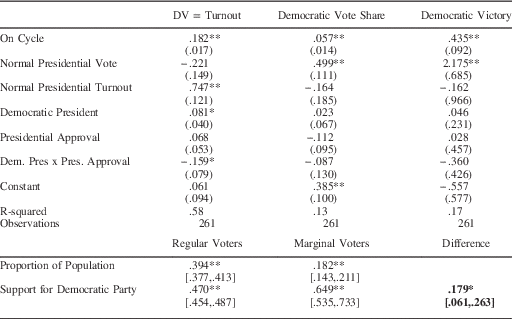
Table A1 presents an alternative version of the gubernatorial election analysis in Table 2. Here, I include additional controls to account for national tides in public opinion and partisan support. Specifically, I measure presidential approval by taking the average of all presidential approval polls within two weeks of the election. This variable, which ranges from 24.6–86.4 percent across this time period is then rescaled from 0 to 1 to improve the interpretability of the regression coefficients. Then, I include this variable as a covariate in the regressions along with a dummy variable indicating the party of the president and the interaction of the two. The covariates capture the possibility that gubernatorial election results will be sensitive to changes in national opinion and sentiment.
Alternative Gubernatorial Analysis

As Table A1 shows, the inclusion of these controls has virtually no consequence for my estimates of the partisan preference gap or the other quantities of interest. Moreover, none of these covariates significant predict gubernatorial election results, suggesting that gubernatorial elections are not particularly sensitive to national tides in opinion. If the fortunes of partisan gubernatorial candidates fluctuated with national opinion, we would expect a large, positive coefficient on the interaction between the party of the president and presidential approval in the 2nd and the 3rd columns. However, these coefficients are actually negative and statistically indistinguishable from zero.