Introduction
In 1683, the Qing (1644–1912), with its formidable fleets and advanced cannons, decimated the Zheng's maritime apparatus. The Manchu then took possession of Taiwan. Shi Lang (1621–96), the native Fujian commander-in-chief of the Qing navy, led this military offensive. Ironically, the commander had originally served the Zheng camp and was once considered a valuable member of the Zheng family. Yet, by the mid-1600s, he had turned his back on his former allegiances and sided with the Manchu.
Shi Lang's relationship with the Zhengs was intriguing and complex. This is especially so of his relationships with Zheng Zhilong (1604–61) and Zheng Chenggong (1624–62, whom Westerners know as Koxinga), the two respective headsmen of the Zheng's maritime enterprise. Zheng Zhilong was the founder of the Zheng force and the first leader to recognize Shi Lang's proficiency in naval warfare. In 1640, he appointed Shi Lang as captain of the navy's left vanguard, gradually promoting him to ever-higher ranks. However, in 1646, quite startlingly, Zheng Zhilong began to consider the possibility of defecting to the Manchu, and this had a profound impact on Shi Lang's career. Knowing that some Ming generals, who had gone over to the Qing, were being treated favourably, Zhilong decided to withdraw his resistance against the Manchus. This left the Zhejiang passes unguarded and allowed the conquerors to capture Fuzhou.Footnote 1 As a result of this Manchu victory, Zheng Zhilong was substantially rewarded. Yet the leader failed to persuade all of his followers to serve the Qing,Footnote 2 most notably his son, Zheng Chenggong, and his right-hand man, Shi Lang.
With Zheng Zhilong no longer opposing the Manchu, Zheng Chenggong became the legitimate successor of the maritime empire, and Shi Lang continued to be a reliable subordinate. However, whereas Shi Lang was once Koxinga's sworn brother, he failed to maintain a harmonious relationship with his new leader. Koxinga had always been jealous of the bond of trust that existed between Shi Lang and his father.Footnote 3 Added to this were the many occasions during which Shi Lang offended Koxinga, both publicly and privately.Footnote 4 The most intense conflict between the two men occurred after Koxinga's military loss at Xiamen. Shi Lang had accurately predicted Xiamen's vulnerability and, therefore, grew increasingly arrogant and often openly questioned Koxinga's military tactics.Footnote 5 In late 1651, no longer able to bear Shi Lang's arrogance and temperament, Koxinga imprisoned him on a boat, along with his father and younger brother. But two sympathetic followers helped Shi Lang escape to the Qing, where he surrendered to the Manchu. Meanwhile, back in Taiwan, Koxinga showed no mercy to Shi's family. In a single night, he executed Shi Lang's father, brother, son, and nephew. Shi Lang considered this bloody retaliation to be unforgiveable and vowed to never rejoin the Zheng camp. Instead, he committed himself to serving the Manchu and seeking revenge for the death of his family.Footnote 6
The Qing court valued Shi Lang, during his first decade of service, for his extensive naval experience and his network of commercial contacts in East Asia. Shi swiftly attained the rank of assistant brigadier general. In 1668, Shi proposed a plan to eliminate the Zhengs by invading Taiwan and the Pescadores.Footnote 7 Yet, at that time, the Qing was mired in the Three Feudatories Revolt (1673–81), which prevented the country from launching another campaign at sea. It was not until 1681 that the Kangxi emperor (r. 1661–1722) finally approved Shi's plan and tasked him with organizing and training the navy. The obvious objective was to declare war on Taiwan.Footnote 8 In July 1683, Shi Lang led a fleet of 300 vessels, mainly crewed by Fujian soldiers, to a great naval victory in the Pescadores. The following October, he proceeded to Taipei and forced Zheng Keshuang (1670–1707), the grandson of Koxinga and the last ruler of the Zheng force, to capitulate.Footnote 9 For his success in this campaign, Shi Lang was bestowed the title of marquis (jinghai hou)—an honour that was passed down to his ancestors, in perpetuity (shixi wangti).Footnote 10
This is a brief account of one of the Qing's most remarkable admirals and officials. However, the aim of this article is not to unpack the eventful life of this notable figure—from his shifting loyalties to his bitter antagonism toward the Zheng's camp. What follows does not even provide an outline of how Shi Lang defeated the Zheng fleet in the Taiwan Strait and the Pescadores—a textbook case of a significant achievement in the Great Qing, in both diplomacy and military effectiveness and prowess, as it meant conquering Taiwan. Nor does this article say much about the way Shi Lang administrated the island of Taiwan after it was annexed by the Qing. Scholars and historians of the rapidly growing field of maritime Asian studies have conducted substantial research on the life and times of Shi Lang; and they continue to uncover new information and make it available to Chinese and Anglophone audiences.Footnote 11 This article differs from these other promising works of scholarship. Here, we are about to explore the evolving legacy of Shi Lang through the production and (re)interpretation of history, in China and Taiwan, since the late seventeenth century.
Representations of Shi Lang, in China and Taiwan, as seen in private writings, commentaries, scholarly articles, books, comics, film, television, and other media, have wildly diverged, especially over the last decade. Commentaries on the Qing, produced in China, present Shi Lang as a promising admiral who helped consolidate and expand Qing rule. However, his legacy did not receive much attention during the Republican period and the first few decades of the People's Republic of China (PRC). It was not until the 1980s that Shi Lang became viewed as a maritime hero (haishang yingxiong) for his momentous victory over the Zheng force—a reputation that has endured to this very day. From the 1980s on, discussions of Shi have periodically emerged in PRC productions that use him and his story as a vehicle with which to disseminate a variety of political messages. In Taiwan, by contrast, Shi's legacy continues to be disputed. There, for some time, he has been cast as neither a superb general nor a national hero, but rather as a defector to the Ming and, later, as an autocratic governor of Taiwan. It was only in the 1990s that historians and the general public began to re-evaluate his significance. Accordingly, I will argue that these divergent discourses reflect the influence of, if not the subjugation to, the official agendas and political aspirations of scholars in the field, and that these have persisted throughout the twentieth century. For over 100 years, the story of Shi Lang has conformed to the official line of the Qing, the Nationalists and, later, the communist authorities. In other words, the story itself has provided a kind of operational resource that respective governments have used utilized as a means to (de)construct history in order to achieve their political goals. The diverse dichotomizing approaches toward Shi Lang suggest that, when leaders on one side appropriate an historical narrative, those on the other side will find it necessary to reject that interpretation so as to avoid embracing the political and cultural meanings that are associated with the contested party.
Nonetheless, these government indoctrinations did not always maintain the upper hand. These centralized master narratives were also tangled up in local and regional politics, particularly in the Minnan region. On many occasions, the reception of the official narratives was complicated and contingent upon the local conditions within Minnan, which did not precisely fit within the ‘central direction’ (zhongyang luxian) of the discourse. Accordingly, this article will also focus on the state's relationship with this (dis)connected Minnan articulation. We will look at three patterns of Minnan's distinctive cultural development, during its long history, from the Qing to the present day. We will also proceed by comparing the commentaries on the official narratives of Shi Lang and the local interpretations of this historical figure and how they interact with each other.
As we shall see, within the Minnan region, not only do intellectuals challenge the official narrative by disputing certain presentations of this historical figure, but also ordinary citizens arrive at their own significant interpretations that are based on their need to see Shi Lang from their own cultural or localized point of view. And these are often in opposition to the official version put forth by the state. Because of this continual oscillation between different perspectives and actions, we will come up with a picture that moves between levels that are usually either conflated or framed within the settings of separate states, spaces, generations, and practices. In a nutshell, in this article, we will complicate the ways in which the legacy of Shi Lang functioned as it percolated throughout Chinese history. I am interested not only in delineating how the story has evolved as a legacy, but also in exploring the rich variety of ways in which an individual or a community has adapted the contents of Shi Lang's story to suit the demands of various historical situations. As Paul Cohen cogently argues in his Speaking to History: The Story of King Goujian in Twentieth-century China, when a historical narrative is positioned in different historical settings, it carries different meanings.Footnote 12 Thus the focus of this article is the relationship between the historical narratives of Shi Lang and the circumstances under which people are compelled to attach special meaning to these narratives.
Historical figures and their legacies
The psychologist Jerome Burner, in Making Stories: Law, Literature, Life, has this to say about the connection between historical narratives and situations: ‘[W]e cling to narrative models of reality and use them to shape our everyday experiences. We say of people we know in real life that they are Micawbers or characters right out of a Thomas Wolfe novel.’ In Burner's understanding, such fictional stories and characters become ‘templates for experience’.Footnote 13 He adds that the feature of these templates ‘is that they are so particular, so local, so unique—yet have such reach. They are metaphors writ large or root metaphors of the human condition’.Footnote 14 Although Burner developed this theoretical insight from a variety of examples taken from the West, the same can be said about the Chinese situation. In fact, almost all cultures have shared stories, legends, myths, and celebrated historical figures. Some historical figures are widely known throughout a culture, others are known primarily within particular subgroups of a culture, still others are familiar only to the educated or the upper class.
Like the West, China has its own storehouse of well-known historical figures and culturally shared stories. But, as Paul Cohen points out, what distinguishes China from the West is the utmost importance for the ‘Chinese to communicate through stories and historical figures what they want their fellow Chinese to feel and think’.Footnote 15 Arguably, the very reason for this is because, from ancient times, the Chinese had developed an ancillary set of justifications for the importance of conveying information through stories and historical figures. That is, as with Shi Lang, the Chinese view other characters as embodying particular meanings and functions in collective contexts throughout Chinese history. These characters include King Guojian (r. 496–65 bc), Guan Yu (160–219), Wen Tianxiang (1236–83), Yue Fei (1103–42), and Koxinga.Footnote 16 Not only do historical characters bridge the past and the present, but their legacies also become powerful instruments with which the central authority can define a specific cultural meaning, either objectively or subjectively. In other words, central authorities can (re)interpret these historical figures so that they address these authorities’ present needs and also point to some future direction. These legacies, thereby, permit authorities to forge a form of symbolic sharing that is essential both to a culture's objective existence and to an individual's subjective sense of belonging to that culture. As Mark Elvin puts it, ‘shared stories [of some historical figures] define the space’, while a particular human group operates ‘its conceptualized physical landscape’.Footnote 17 That being said, the functions historical figures perform would mainly be determined by the specific political and cultural milieu in which these figures are represented.
Shi Lang in the Great Qing
Throughout the eighteenth and nineteenth centuries, the Qing officially viewed Shi Lang as a prominent general who consolidated Qing rule in South China. In a similar fashion, Shi was favourably assessed in unofficial accounts (yeshi) compiled by local writers and gentry scholars who were writing in the Confucian tradition. Most commentaries followed the Kangxi emperor's tone. In fact, shortly after the conquest of Taiwan, the emperor admitted that Shi Lang was ‘a brilliant admiral who knew the islands (including Taiwan) very well’.Footnote 18 The emperor even disclosed the fact that he enjoyed discussing with Shi Lang ‘almost every strategy related to Taiwan’. He further noted: ‘Because of his remarkable achievement (in pacifying Taiwan), I will grant Shi Lang wealth and glory ever after.’Footnote 19
After Kangxi, the literati of Fujian, Jiangsu, and Zhejiang were the source of most of the unreserved praise for Shi Lang. For instance, in his Minhai jiyao, Xia Lin praised Shi's military skill and courage.Footnote 20 Zha Shenxing (1650–1727) and Chen Kangqi (1840–90) concurred that Shi Lang achieved great success in elevating Qing rule to another level and in bringing peace to the sea off the Fujian coast (the Minhai).Footnote 21 The prolific writer Ji Liuqi (1622–?) even dedicated a chapter in his Mingji nanlüe to Shi Lang. It was entitled ‘The sea rebel captured and beheaded (qinzhan haizei)’. In it, Ji Liuqi praised Shi's gallantry and triumph over the Zhengs.Footnote 22 These positive narratives converged over the course of the Qing: they lauded Shi as a significant contributor to Qing solidification (goji maozhu)Footnote 23 and they noted that his accomplishment in conquering the Zhengs surpassed his image as a defector who defied the Confucian concepts of loyalty and piety when he forsook his allegiance to the Zheng camp.
Despite these positive assessments of Shi Lang, it is worth noting that some of these literati, such as Xia Lin, also wrote sympathetic accounts of the Zheng family. Yet, to a large extent, their writings on the Zheng were constrained by the Qing's cultural dictatorship, which has been broadly referred to as a literary inquisition. The writings under this inquisition covered all topics, genres, and styles, from official governmental documents to personal essays. The Qing carried out a rigorous literary inquisition, together with measures to enforce an ideological orthodoxy that labelled the Zheng family as rebels and pirates who fought against the Great Qing. Under such strict censorship, few literati dared extend their appreciation, if any, toward the Zheng family. They could only express their sympathy and appreciation through subtle narratives. For example, when recording the death of Zheng Chenggong and the aftermath of his kingdom, Xia Lin described it as a ‘misfortune’ and, when commenting on Zheng's administrative style,Footnote 24 Xu Zi, another historian on the Qing, assessed it as ‘impartial and above board (qiuqin jianyong, shangfa wusi)’.Footnote 25
Additionally, most of these scholarly appraisals were written from an ‘outside-Taiwan’ perspective—that is, by those who had neither visited nor lived in Taiwan. In contrast, some writers and officials who were more familiar with the island, or who may have visited/lived there, adopted a different view of Shi Lang. They saw him as an incompetent, imperious minister who had caused a series of difficulties for the island. For instance, Huang Shujing (1682–1758), the first imperial high commissioner to Taiwan, condemned the ‘sea blockade policy’ Shi Lang had implemented when he was the administrator of Taiwan. ‘Due to his unfavourable ploy,’ as Huang decried it, ‘the connections between Guangdong and Taiwan were severely damaged, thereby harming the economy of both sides and aggravating the problem of piracy along the Guangdong coast.’Footnote 26 In Yu Yonghe's (1645–?) Bihai jiyou, which is considered one of the most popular writings about Taiwan during the Qing, the author did not mention Shi Lang, not even in the chapter entitled ‘Anecdote of the unendorsed Zhengs (Wei Zheng yishi)’.Footnote 27 It is not entirely clear why Yu Yonghe did not include Shi Lang in his treatise, but, from these examples, we are able to see that eighteenth-century assessments of Shi Lang were not always untainted. At some point, Shi was even seen as an amoral opportunist and a treacherous officer.Footnote 28 However, we should not conclude that these negative assessments all came from a ‘local Taiwanese perspective’, since we would never identify Huang Shujing and Yu Yonghe as having been local Taiwanese subjects at the time. After all, as administrators of the island, they were representing the Qing court.
When Japan and France encroached on Taiwan, in the late nineteenth century,Footnote 29 the Qing court continued to uphold the official notion that Shi Lang's military capabilities were exemplary; the Qing wanted to remind not only these countries, but also the Chinese community, that Taiwan was an integral part of the Qing empire. For the Qing, the use of historical figures and precedents to justify its current policies and agendas constituted an effective mechanism of its governance. In grave and difficult times, authorities would promote the image of a particular figure and imbue it with the requisite positive spirit so as to inspire loyalty among officials and society. Thus, in official memoirs, such as Zhang wenxianggong zouyi, and local gazetteers, such as Guangxu Shuntian fuzhi, there are accounts of the Qing using the image of Shi Lang as the commander of the conquest of Taiwan so as to justify its annexation of the island.Footnote 30 A number of scholars, likewise, echoed the Qing court in promoting the legacy of Shi Lang. For instance, the renowned writers Xu Ke (1869–1928) and Zheng Guangying (1842–1922) both underscored the crucial role Shi Lang played in Taiwan's history and place within the Qing empire. Both writers concur that Shi Lang was a gifted hero, who excelled in sea battles, and that he was also the key unifier who made possible the ‘Qing-Taiwan integration’.Footnote 31 Jin Wuxiang, in his Suxiang suibi, was even more explicit:
In the 22nd year of Kangxi (1683), the emperor bestowed a poem on Shi Lang, parsing his remarkable victory in conquering Taiwan and extinguishing the rebels …. In the preface of his poem, the emperor explained his reason for not giving up Taiwan. It is mainly because he was so worried about the deteriorating coastal economy and he could hardly bear to see his citizens, who used to live along the coast, suffer from the worsening situation. He, thus, appointed Shi Lang to lead the navy and pacify Taiwan without further delay. Thanks to Shi Lang and his faithful soldiers, the Zheng soon surrendered to the Qing. The emperor indicated, in the preface, that he still remembered that he received the report of victory during the mid-autumn festival. Convinced that his empire would have fewer hindrances after the Taiwan issue was settled, he cheered. He bestowed Shi Lang with the garment he was wearing on the day the news of victory arrived. In addition, the emperor also wrote Shi a poem expressing his highest appreciation.Footnote 32
Although a detailed summation of Jin Wuxiang's recounting of the ‘Taiwan story’ would be superfluous here, the connection between the emperor and Shi Lang is particularly noteworthy. In some respects, Jin idealizes Shi Lang even more than the earlier-discussed positive commentaries do. Jin does not give much attention to Shi's military talents. Instead, he focuses on the aftermath of the conquest and highlights the emperor's exceptional treatment of Shi Lang. In dynastic times, receiving a poem from an emperor was no doubt an honour and being bestowed with an emperor's garment would have been a supreme privilege. This treatment reinforces the sense that, at least for the Kangxi emperor, Shi Lang had been indispensable in the conquest of Taiwan. Jin's account also reveals the notion that the imperial consensus of the early Kangxi era continued to influence some of the late-Qing narratives on Shi Lang.
The Treaty of Shimonosaki, in 1895, ceded Taiwan to the Japanese. Prior to the arrival of the Japanese army, Tang Jingsong (1841–1903), the governor of Taiwan Province, had sought to establish a Republic of Formosa (Taiwan minzhuguo). But the Japanese swiftly suppressed this initiative and it collapsed within five months. Shi Lang was nowhere to be found during this short-lived period of reformation. At the time, neither Tang Jingsong nor his followers recognized Shi's importance. Instead, they celebrated the legacy of Zheng Chenggong (Koxinga), who had successfully defeated foreign invaders (the Dutch) in the seventeenth century and had used Taiwan as a base from which to resist a Manchu incursion. In a temple in Tainan, which was erected in commemoration of Zheng Chenggong, Tang Jingsong even dedicated a couplet to this ‘national hero’, which is emblazoned in the temple's entrance, as follows:
From scholar to king, (Zheng Chenggong) is an exceptional model of all intellectuals in the world (you xiucai feng wang, wei tianxia dushuren biekai shengmian).
Expelling foreigners from the country, (he) revitalizes and rejuvenates all aspirants in China (qu yizu chujing, yu Zhongguo youzhizhe zaigu xiongfeng).
By contrast, after the Qing ceded Taiwan to Japan, Shi Lang was omitted from the list of celebrated figures. And, when Zheng Chenggong was being worshipped as a remarkable hero, Shi Lang failed to garner any positive appraisal because he was viewed as having defected from the Zheng to the Manchu. During the period of Japanese occupation (1895–1945), his legacy remained in almost total obscurity. The Japanese did not even mention Shi Lang in most of their official press and newspapers, such as the Taiwan jiho and Taiwan nichinichi shipo. Perhaps this was because they were attempting to efface the Qing–Taiwan connection since it had taken place during a period of colonial control.Footnote 33 Additionally, as Shi Lang was a Qing symbol that had united Taiwan and the mainland, he was also erased from Taiwanese narratives. However, despite the official ‘nihilistic’ approach toward Shi Lang, his legacy was not completely removed from the histories that were written in colonial Taiwan by both Chinese and Taiwanese scholars—as we will discuss in further detail in subsequent sections.
Shi Lang in the Republican and early Communist era
In 1912, the Qing dynasty came to an end and was replaced by Republican China. In the aftermath of the Qing, however, China incurred one crisis after another—from Yuan Shikai's (1859–1916) monarchy, to the May Fourth Movement, followed by years of warlordism, a civil war between the Communists and the Nationalists, in the early thirties, the Second Sino-Japanese War, and the second civil war (1937–49). Although there were progressive developments, during this period, the Republican era was one during which hope was persistently frustrated and nationalism became widespread. Also during this period, the notion of overthrowing everything Qing gained appeal. The Qing was China's last dynasty and it came to be seen as symbolizing the country's backwardness, enfeeblement, and passiveness. As with other heroic Qing figures, such as Zheng Guofan (1811–72), Zuo Zongtong (1812–85), and Li Hongzang (1823–1907), Shi Lang did not receive the same attention he had been accorded in previous centuries.Footnote 34 Instead, the public revived its interest in Zheng Chenggong. This was especially so during the 1920s and 1930s, which was a period of mounting Japanese aggression. Zheng Chenggong was acknowledged mainly because he had liberated Taiwan from the Dutch, in the seventeenth century, thereby convincingly illustrating that, at the time, the Chinese had been able to resist and even eradicate foreign control.Footnote 35 Other figures from China's past, such as Qi Jiguang (1528–88, who repelled Japanese wako pirates), Shi Kefa (1601–45, who gave his life defending the Ming against the Manchus), and Yue Fei (the notable national hero of Southern Song), were also celebrated, in the Republican era, for their heroic resistance to invasions from foreign encroachments.Footnote 36 Although Shi Lang had helped the Zheng fight off the Manchu before he joined the Qing, he was not included in the above cluster, most likely because he had been overly idolized during the Qing. In essence, during the Republican period, he was seen as an unwelcome Qing figure and was not treated favourably. In the Draft History of [the] Qing (Qingshi gao), Zhao Erxun (1844–1927) portrayed Shi Lang as a ‘leading figure’ who had pacified Taiwan, yet he only briefly mentioned Shi's achievements.Footnote 37 However, as Zhao was a Qing loyalist, it is possible that he might have purposely downplayed Shi in his narrative, whereas, due to his scholarship, his assessments of Shi Lang and the Qing–Taiwan unification should have been extensively and objectively documented. Additionally, in the General History of Taiwan (Taiwan tongshi), Lian Heng (1878–1936) even depicted Shi Lang as a defector who had made a serious mistake:
Formerly, he had been a subordinate of the Zheng kingdom; he defected to the Qing because he had offended the Zheng ruler. It is infuriating to think that he intended to overthrow the only pro-Ming resistance at that moment. I went to great pains to understand how he had put his personal feelings against the Zheng above larger national interests.Footnote 38
It is worth noting that Lian Heng produced his Taiwan tongshi under a specific political climate. His rationale and mentality were therefore very different from those of scholars who had lived and written during the Qing (such as those scholars who were introduced in the previous section) or in Republican China (such as Zhao Erxun). Lian Heng was 17 when the Qing was defeated in the First Sino-Japanese War (1894–95). It was presumably because of such a humiliating defeat that Lian Heng saw the Qing as a weak and declining empire and one to which he did not establish a strong attachment. Later, during the colonial period, Heng was recruited as an editor of the official Tainan News Daily. Working as a journalist exposed him to the idea of nationalism, wherein he came to realize that the Taiwanese must have felt passionate about their indigenous heritage, language, and culture. Thus, Heng's Taiwan tongshi was seen as a manifesto on the importance of a national Taiwanese identity. As Shi Lang represented not only a Qing subject, but also a defector from a Taiwan-based Zheng empire, it is understandable that he was abased.
Between the 1950s and the 1970s, Shi's legacy received more superficial treatment in the PRC. The only exception was in Fujian, within the academic community, as it was where Shi Lang was born and raised. Here, most of the research on Shi Lang appeared in university journals, in Fujian, and it focused on the admiral's social background and military talents. This type of narrative persisted well into the 1990s. On the other side of the Taiwan Strait, however, a strong wave of negative assessments impugned Shi Lang's reputation, thereby mirroring the contestation between the two Chinas. The exiled Kuomintang government, in Taiwan, saw Shi Lang as a convenient scapegoat who defected from the Zhengs (and the pro-Ming resistance against the Manchu) to serve the Qing. In contrast, the revolutionaries transformed Zheng Chenggong from a ‘symbol of loyalty to a fallen dynasty to one of national self-determination’.Footnote 39 According to the Nationalists, like the Communists, the Qing and the Manchus had destroyed authentic Chinese culture.Footnote 40 Therefore, the primary task of the Kuomintang government was to eradicate Qing influence. As Shi Lang was seen as a symbolic embodiment of the Qing and the mainland, he became the subject of criticism and his achievements were downplayed. On most occasions, he was tainted as hangjian, zougou, minzu zuiren, and/or erchen, all of which are derogatory terms that were used to describe a traitor or renegade. Shi Lang was badly demeaned due to the discomforting associations that linked him to the ‘barbarian’ Qing and the PRC.Footnote 41 By contrast, in this political climate, the Zhengs became known as the founders of an independent and sturdy maritime kingdom.
Shi Lang after the Cultural Revolution
During the devastating Cultural Revolution (1966–76), as was the case for most historical topics, research on Shi Lang came to a halt. Amid a radical movement to ‘break from the past’, libraries, museums, and archives were ransacked, and many priceless artefacts, texts, and documents were destroyed. It was only in the relaxed political climate of the 1990s that academic interest in Shi Lang was revived. Over the two decades since the 1990s, academic appraisals of Shi Lang's legacy in mainland China have been aligned with the official narrative that has developed during the most recent period of renewed cross-strait tension. This ‘renewed tension’ arose towards the end of the Cold War, when the balance of power dramatically shifted and completely reconfigured cross-strait relations (liang'an guanxi).
Following the ruling principle of his predecessor Chiang Ching-kuo (1910–88), Lee Teng-hui shelved his plan to seek independence from the mainland and, instead, moved toward formulating a new and unique Taiwanese identity that was separate from the PRC.Footnote 42 In 2000, Lee's successor, Chen Shuibian, continued to support these aspirations. The president even initiated increasingly provocative steps to bolster Taiwan's position in the international community and to sever the island's cultural and historical ties to the mainland.Footnote 43 Meanwhile, as the Lee and Chen administrations were directing Taiwan toward a separate course, the government of the PRC sought to ascend to the top of the international order by becoming a twentieth-first century superpower—a mission the Chinese Communist Party eagerly seized upon.Footnote 44 For the PRC, the recovery of all its lost territories, such as Hong Kong, Macau, and Taiwan, became preconditions for the restoration of China's past greatness and its march toward a new direction for the future.Footnote 45
In political, economic, and cultural respects, the PRC has used instrumentalism to strengthen its claims to Taiwan. As such, most of the historiography of the mainland, during this period, conveyed a singular view that reflected this political agenda: ‘Taiwan is an inseparable part of China that belongs to the PRC government.’Footnote 46 Once again, the PRC used Shi Lang, and his role in the annexation of Taiwan, as a political tool to justify mainland China's control over the island. As the widely recognized historian Fu Yiling (1911–88) proclaimed:
Like Zheng Chenggong, Shi Lang brought Taiwan back to the mainland out of a sense of nationalism (minzu dayi). It was done with the best of intentions and was by no means a personal vendetta.Footnote 47
Fu Yiling praised Shi Lang as a patriot who helped foster China–Taiwan integration. Fu even stated that Shi's accomplishment was not the result of a personal vendetta, but rather he saw it as a national achievement and, thereby, circumvented the issue of whether Shi had defected from the Zheng forces. In fact, PRC scholars, at that time, generally did not question Shi's loyalty to the Zhengs, even when they were basing their assessments of his actions on traditional Confucian precepts. Instead, they tended to dismiss Confucian moral obligations as having formed the foundation of the cultural landscape of late imperial China, arguing that these obligations had limited application in the daily lives of the common people.Footnote 48 Instead, their assessments focused on Shi Lang's military glory and also on his success in persuading the Kangxi emperor to incorporate Taiwan into the empire, following the Qing victory, despite the Qing court's insistence on abandoning the island.Footnote 49 Mainland scholars, such as Lin Qian and Wang Zhengyao, argued that Shi Lang and the Kangxi emperor played crucial roles in unifying the two sides of the Taiwan Strait.Footnote 50 Yet, as pointed out earlier, the use of Shi Lang to justify the state's supremacy over Taiwan and to strengthen the ties between the two coasts was not an entirely new development of the PRC era. Late-Qing administrations also paid tribute to Shi Lang for having bolstered the process of political consolidation.
Whether intentionally or unintentionally, the revival of studies on Shi Lang has opened up a broader debate, among mainland academic circles, over who deserves more credit for bringing Taiwan back to the motherland: Shi Lang or Zheng Chenggong. The ‘Shi clan’, from the Quanzhou area of Fujian, was probably the first group to initiate the debate, in 2003.Footnote 51 Shi Weiqing, the author of the Biography of General Shi Lang (Shi Lang jiangjun zhuan), asserted that his forbear was by no means a defector, but an extraordinary general in modern Chinese history:
We admire Shi Lang because, first of all, he was so brave in sailing across the dangerous ocean at the very advanced age of 63. Even though he might have wanted to avenge the death of his family, he was courageous and fearless. Moreover, he was bold enough to voice the disputes that his colleagues dared not speak out about and achieved a task that others had hesitated to complete. He is, thus, incomparably above and beyond all of his contemporaries.Footnote 52
In a similar fashion, Wuhan University History Professor Wu Boya expressed her admiration for Shi Lang's achievement in the Qing victory:
The fact that Shi Lang strongly proposed to keep Taiwan and was determined to defend the island were striking. His determination contributed substantially to Chinese unification, thereby checking any potential foreign invasions. His name and spirit will probably remain immortal.Footnote 53
These unabashedly positive appraisals were widely spread throughout mainland academic circles. In subsequent years, more scholars spoke in similar tones and published articles and book chapters that celebrated Shi Lang's formidable achievements. For example, the Chinese Academy of Social Sciences and the National Qing History Editorial Committee organized a series of national conferences and workshops that promoted research on Shi Lang. These two academic bodies also sponsored the publication of post-conference volumes that urged scholars to move beyond the dated notion of a ‘Han-centred view’ and to reassess the legacy of Shi Lang according to the framework of ‘a united but multi-ethnic nation’ that incorporated 55 ethnic groups, such as the Mongols, Uyghur, Tibetans, and Manchus.Footnote 54 Even though the PRC government had proclaimed, in the 1950s (after the ‘ethnic classification project’ in 1954), that the new China was a ‘united nation’ comprising distinct ethnic communities, the Manchu and the Qing dynasty were being treated unfairly. The Communists saw the era of the Qing dynasty as being a period of national humiliation. In examining the Qing, they could not escape from their preoccupation with the ‘century of humiliation’ that included the failings of its frontier/foreign policy and the consequences for its economy and its people. Yet, interestingly, Shi Lang (as a Manchu officer) was an exception. The Communists praised the admiral because he had accomplished ‘China–Taiwan integration’. His legacy, as such, was treated separately, under the framework of the ‘unification of China and Taiwan’.
After the National Academy of Social Sciences adjusted to the new line (xin luxian), in terms of re-examining Qing history, according to the above ‘united but multi-ethnic model’, the Communist Party began to break through the ‘humiliation ideology’ and acknowledge the Qing's greatness. The PRC decided to reassert its assessment of the Qing empire and inherit its imperial geo-body intact largely because the ‘New China (xin Zhongguo)’ had to justify its control over a series frontier regions, namely Taiwan, Xinjiang, and Tibet. Therefore, the Communists maintained that Shi Lang was a Qing subject who deserved the appraisal of contributing to both ‘China–Taiwan integration’ and fixing the border of Qing China and, by extension, to consolidating the connection between the Qing and the PRC. Apparently, it is obvious that the central government has attempted to celebrate an all-inclusive, multi-ethnic nationalism by promoting the importance of Shi Lang. As a result, the admiral was ‘doubly credited’ and, in turn, his legacy led to the so-called Shi Lang fever (Shi Lang re) that spread throughout social media and academia. For instance, in 2003, the State Administration of Radio and Television sponsored a 37-episode drama on Shi Lang. The entire production process extended over almost three years. On 23 March 2006, the premiere screening was held at the Great Hall of the People in Beijing and attracted a sizable number of central and local officials. Four days later, the drama entitled ‘The Great General Shi Lang’ (Shi Lang da Jiangjun) was publicly aired, during primetime, on China Central Television (CCTV).Footnote 55
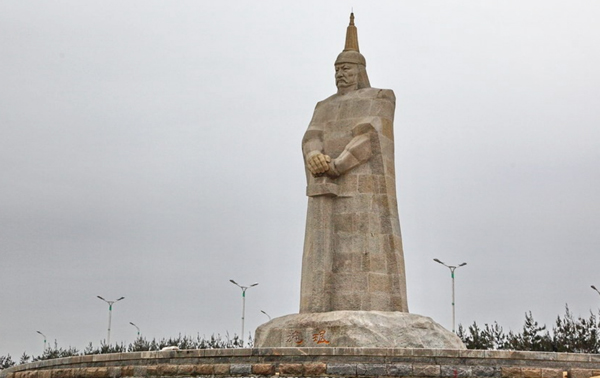
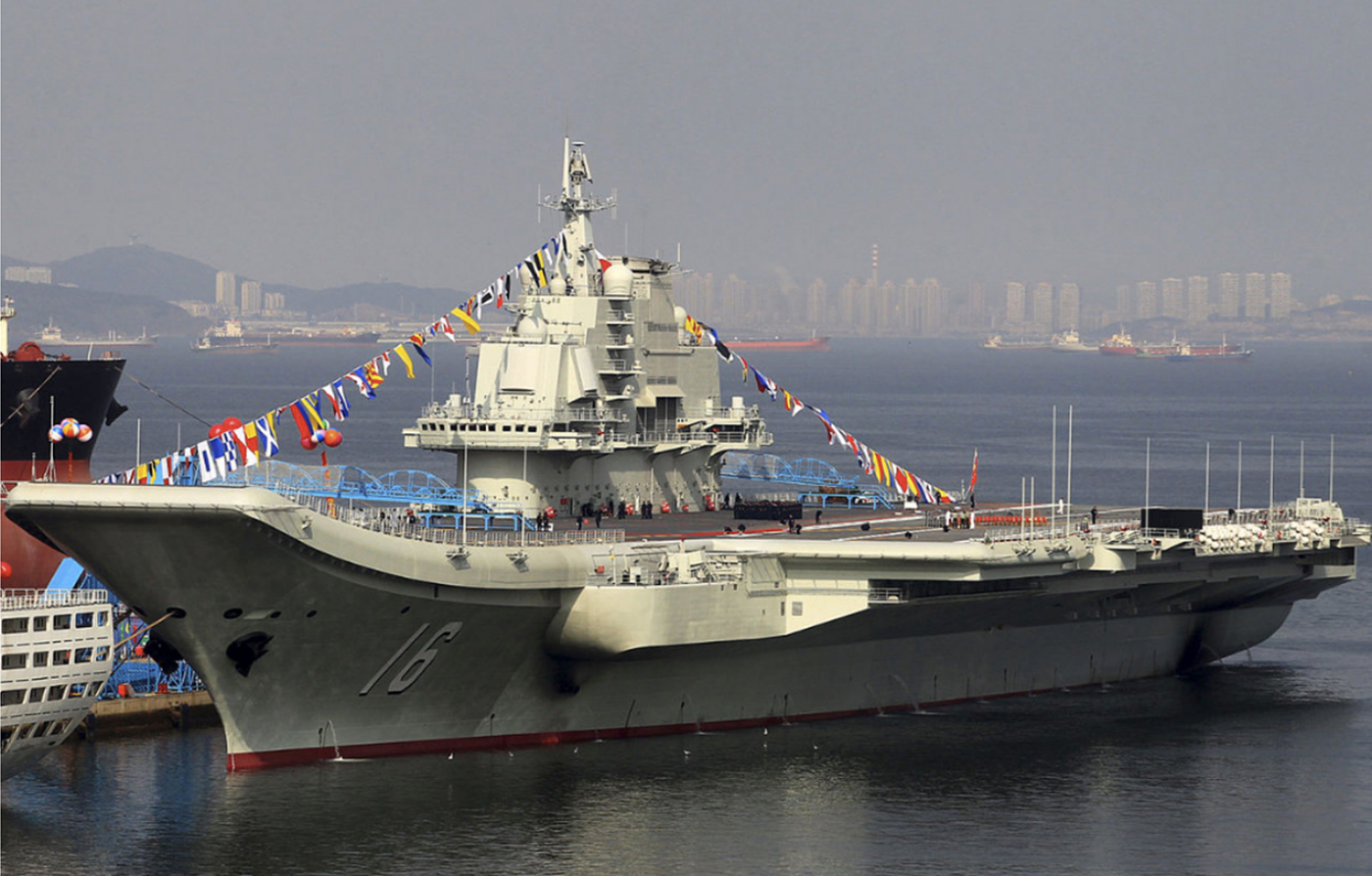
The Shi Lang fever quickly gained the central government's support. In late 2006, the Chinese Communist Party pronounced a historically deterministic standardized narrative that depicted the history of Taiwan's incorporation into the Qing state. In this account, Shi Lang is officially praised for returning Taiwan to mainland control.Footnote 56 Understandably, his contribution was effectively and markedly elevated. In commemorating the 337th anniversary of the Qing conquest of Taiwan, the Social Science Academy in Xiamen founded a research association entitled ‘Shi Lang yanjiuhui’.Footnote 57 This Association publishes a journal that contains new research findings and analyses, commentaries, and books related to Shi Lang and the Kangxi emperor. In collaboration with members of the ‘Shi clan’ in Quanzhou, the association even constructed a giant statue depicting Shi Lang facing seaward from his native coastal village in Jinjiang and holding a sword that is pointing toward the ground (see Figure 1). Building on the Communist framework, the popular boom in the topic of Shi Lang is notable and its underlying message is readily obvious. As Su Shuangbi, the editor of the Communist Party's journal, Seeking the Truth (Qiushi), has alluded: ‘Shi Lang maintained a principled insistence that Taiwan always belonged to China and refused to tolerate any foreign interference in its affairs …. Due to his determination to preserve the country's territorial integrity, Shi Lang deserves the exalted title of national hero.’Footnote 58 The editor even went on to predict the future of Taiwan, saying that ‘the island cannot reverse its eventual absorption at the hands of the mainland government, just like the Ming could not resist the Qing in the seventeenth century’.Footnote 59 And in order to ‘absorb’ Taiwan, the PRC, like the Qing, required a strong navy to sail across the strait. Perhaps this would help explain why, from the outset, one of the PRC's aircraft carriers (see Figure 2), which was launched in 2011, was named Shi Lang.
Statue of Shi Lang in Jinjiang

The PRC's aircraft carrier, Shi Lang

The counter narrative in the PRC
Since 2003, the PRC government has assumed a proactive role in promoting a positive, celebrated image of Shi Lang and in popularizing this image as its official line. Nonetheless, intellectual circles and online social networks in China do not always concur with the government's aspirations for its reappraisal of this striking historical figure. Backlashes to the Shi Lang fever have occurred at both academic and popular levels. Within academia, some scholars, who were assessing whether Shi Lang was the ‘architect of unification between the Qing and Taiwan’, skilfully countered that the admiral also made statements about Taiwan being a remote frontier that lay ‘beyond the orbit’ and outside the Qing. For instance, Deng Kongzhao, director of the Taiwan Research Institute of Xiamen University, stressed the need for a more in-depth analysis of Shi Lang before rushing to deify him as a ‘national hero’. He pointed out that, even after the naval victory of 1683, Shi Lang attempted to sell the island of Taiwan to the Dutch.Footnote 60 ‘After all,’ Deng continued, ‘the Qing Empire was a land-bounded empire with a continental mindset, and the official court was unable to fully comprehend the geopolitical value of its maritime frontier and the island of Taiwan.’Footnote 61 Zhu Shuangyi and Zheng Congming and other scholars in China urge their readers to not pay too much attention to Shi Lang or to not overlook the contribution of the Zheng family in bringing Taiwan back to China.Footnote 62 In other words, they believe it is time for the overheated Shi Lang boom to cool down.
The renewed Shi Lang fever also caused much discontent at the popular level. After the release of The Great General Shi Lang on CCTV, producer Chen Ming was attacked in a barrage of criticisms that were posted on several internet forums. He was labelled as disloyal, unrighteous, and a ‘fake Confucian’. The forums harshly criticized Chen for having abandoned his objective judgement by wilfully and unreservedly promoting Shi Lang in an attempt to feed the Communist Party's political hunger. Added to this, the descendants of Zheng's family, who still reside in the Minnan region of Fujian, could not be satisfied with the Shi Lang fever. As pointed out by Xing Hang, after conducting his field trip in Southern Fujian, the pro-Shi Lang narrative
added fuel to the ongoing enmity between the Zhengs and the Shis, [which was] already strained to the point that members of the two clans still refuse to inter-marry …. As Zheng Guangnan [a descendant of the Zhengs] writes to me, he sticks up his nose at the very idea that an opportunist and turncoat like Shi Lang could match the moral fibre and patriotic spirit of his illustrious ancestors.Footnote 63
These voices undoubtedly present a challenge to a more unified narrative that aims at conformity and stability. Here, we see a distinctly cultural sphere of Southern Fujian (Minnan) that is far removed from Beijing's hegemonic initiatives. As mentioned previously, this is a topic that is worth exploring further.
The formation of a distinct Minnanese regional narrative on Shi Lang found itself distinctly at odds with Beijing's pronouncements on the topic of Shi Lang and his role in Chinese history, particularly as it relates to Taiwan. The Minnan region is often referred to as the southern part of coastal Fujian province. When William Skinner mapped out the four principal geographically defined economic systems of the Southeast Chinese coast, the Minnan region was labelled as the ‘Zhang-Quan’ economic zone.Footnote 64 The geography of the Minnan region, similar to the rest of Fujian province, is largely made up of mountains and isolated valleys that preserve a great diversity of local subcultures that range in indigenous dialects, theatrical traditions, architecture, food, and musical traditions.Footnote 65 Since the Tang dynasty, if not earlier, the Minnan culture has remained especial and distinct among the surrounding provinces. However, not all governing regimes appreciate the beauty of such a unique pattern of development. For example, in Mao's era, the Minnan region was considered to represent one of ‘separatism’, or an attempt to split from the country and its feudal remnants.Footnote 66 Despite the tension between the central government in Beijing and the Minnan region, it is challenging to entirely suppress or mould a regional culture, especially when the region's spatial and temporal aspects as they relate to its culture have been deeply entrenched over several centuries. These differing spatial and temporal factors may have contributed to the inconsistent evaluation of Shi Lang within the PRC, but these factors are not the only explanation. The negative assessments of Shi Lang, founded in Minnan, are also intertwined with the legacy of Zheng Chenggong. Unlike Shi Lang, Zheng Chenggong was not born and raised in Minnan, but rather in Nagasaki, Japan, and only moved to Southern Fujian (Quanzhou) when he was eight years old. Yet, the connection between Zheng Chenggong and Minnan is no less profound than that between Shi Lang and the region.
During the 1650s, Zheng's headquarters were located in Xiamen—a key port city in Minnan. From there, he intended, first, to resist the Qing empire and, then, to mobilize his troops to recapture Taiwan. When the Republicans proclaimed Zheng Chenggong a national hero in the struggle for a stronger China, Minnan elevated his stature to one of glory and valour. As a consequence, Minnan academia has long been focused on the history and achievements of Zheng. For example, in the Republican period, Fu Yiling founded the Association of Zheng Chenggong (Zheng Chenggong yanjiu xuehui) in order to popularize a positive image of him. Evidence obtained from this association's work helps our understanding of Fu Yiling's sentiments toward Zheng and why he devalued the importance of Shi Lang, as demonstrated earlier. Later, in the 1970s, Xiamen University established a research unit on Zheng, naming it ‘Xiamen daxue Zheng Chenggong lishi diaocha yanjiuzu’. Some may wonder why Fu Yiling, and a majority of the Minnanese community, could not celebrate the legacies of both Shi Lang and Zheng Chenggong, especially during a time at which the PRC government acknowledged both historical figures.Footnote 67 Naturally, it is possible for a single province to have several national heroes. However, some local communities in Minnan find it inexpedient to acknowledge both historical subjects. This is especially so in communities where native Zheng family members still enjoy great respect and prestige, particularly in light of the fact that Shi Lang betrayed Zheng Chenggong. Hence, every time the Beijing authority promotes the importance of Shi Lang, the response of the pro-Zheng Chenggong community is a consciousness that runs counter to the state's attitude. Among the counter narratives that exist in Minnan, one can discern how the formation of a passionate regional circle could generate a challenge to a more centralized, official narrative that aims to achieve a particular sentiment or understanding on a wider national level.
The counter narrative in Taiwan
Not surprisingly, the counter narrative was strongest on the other side of the Taiwan Strait, where Shi Lang has not received respect since the Kuomintang era. As Taiwanese scholar Cai Xianghui commented, in 2002: ‘Shi Lang pretended to foster Qing-Taiwan integration in the late seventeenth century; in fact he selfishly took every opportunity to maximize his profits in Taiwan by expropriating farmland and villages.’Footnote 68 Lu Jianrong also accused Shi Lang of having encroached on the property of native Taiwanese. He also questioned Shi Lang's loyalty, noting that
a person could rate himself highly if he is being faithful and loyal to his master or monarch. As such, Shi Lang was making himself a mouse because he betrayed the Zheng kingdom. For centuries he has held the mark of a defector, which has significantly lowered his reputation and status. All in all, no one will admire a deceitful figure.Footnote 69
In Taiwan, during the first decade of the twenty-first century, criticism against Shi Lang grew. Yang Qinhua and Xu Xiaowang, to name two, accused Shi Lang of feigning loyalty to the Zhengs, betraying the Ming court, and sponging off the Taiwanese people. Similar to the counter narratives of the Minnanese, this negativity aligned with the positive rhetoric that had been accorded to Zheng Chenggong, wherein his opposition to the Qing had been deemed righteous and patriotic. However, not all intellectuals in Taiwan have unreservedly attacked Shi Lang. Wang Rongzu, a Taiwanese historian who taught for many years in the United States of America, was probably the first scholar to reassess Shi Lang in a positive light. In his ‘Security and Warfare on the China Coast’, published in 1983, Wang had this to say about Shi Lang:
(Shi Lang) proved himself not only a brilliant commander but also a perceptive strategist and able administrator. He was truly indispensable for the Taiwan campaign, no matter how we minimize the importance of an individual in the larger historical event … he was a persistent advocate of the Taiwan campaign. His knowledge and confidence in the matter were essential for the campaign to materialize. His strong interest in it was not simply to seek personal revenge, even though Cheng Ch'eng-kung (Zheng Chenggong) had brutally executed his father and brother for his defection to the Manchu authorities. He had a stellar understanding of the strategic importance of Taiwan to the security of the mainland coast, largely due to his familiarity with the island.Footnote 70
Early in the 1990s, Taiwanese historian Zhou Xueyu also called for a more objective assessment of Admiral Shi. In a similar vain to Wang, Zhou argued that, despite the fact that Shi had defected from the Zhengs to the Qing, compared to his contemporaries, he possessed a more developed political vision for keeping Taiwan in Qing hands.Footnote 71 By thus interpreting Shi's motives, these Taiwanese scholars are able to view him as a proficient military general, if not a maritime hero, and thereby offer a relatively unprejudiced historical perspective on him.
This counter narrative is also included in reappraisals of Shi Lang at the local level. For instance, members of Shi's clan in Taizhong (Taizhong Shixing zongqinhui) continue to promote his legacy on their association website and in their advertising materials. This association maintains a Shi Lang memorial hall in Taizhong, which preserves many primary materials related to him. It also venerates their ancestor through workshops and memorial events.Footnote 72 Also, Shi Zhongxiang, a clan association member in Tainan, sponsored the establishment of the ‘General Shi Lang Memorial Museum’ (Shi Lang Jiangjun jinian guan), which is located in the ‘General District’ (jiangjun qu).Footnote 73 Elegantly decorated and designed (see Figure 3), this museum humanizes and extols Shi as the primary agent of Qing–Taiwan integration and also of development in Taiwan; nowhere does it castigate him as a traitor. Here, one should be able to see an intriguing connection between the Shi clans from both Taiwan and mainland China. Even though the two sides are politically separate, political actors have been unable to disconnect the Shi Lang familial ties from the link that continues to bridge the cross-strait divide and the association between the ‘two Chinas’.
The General Shi Lang Memorial Museum (Shi Lang Jiangjun jinian guan)

In 2014, Zhang Tianjian, a committee member of the Fudeye miao (Temple of the Lord of the Soil and the Ground), proposed the construction of a shrine, in Tainan, dedicated to Shi Lang (Shi Lang miao). In a press interview, Zhang indicated that Shi Lang should be worshipped because ‘without his “Taiwan proposal” (Gongchen Taiwan qiliu shu) to conserve Taiwan, the Kangxi Emperor would have abandoned the island and overlooked this piece of precious territory’.Footnote 74 Despite the common stereotype of Shi as an unfaithful officer, Zhang notes that the admiral never relinquished his interest in Taiwan. It is perhaps even more noteworthy that the proposed site of the Shi Lang temple is just 200 feet away from the Zheng Chenggong temple (Yanping junwang miao). Zhang Tianjian has not commented on the reason for locating the Shi Lang shrine so close to the Koxinga joss house, but his choice of location may reflect how the reappraisals of Shi Lang have fostered renewed interest in the historical significance of both of these memorable Qing figures. In a sense, Zhang represents a group of people who not only recognize Shi Lang's achievement in ‘keeping’ Taiwan within China, but also are passionate about discovering his role in shaping Taiwan's local and indigenous identity. According to Zhang Tianjian, Shi Lang was not only an admiral who represented the Qing in the annexation of Taiwan, but he was also a heroic figure who recognized the importance of Taiwan. Shi Lang's ‘Taiwan Proposal’, followed by his policies on ruling the island, imbued him with a Taiwanese identity. In a nutshell, Shi's renewed status should not be seen as the result of the officially sponsored narrative coming out of Beijing or the PRC; instead, it is based on a local (Taiwanese) identity that is the consequence of the emergence of an alternative community, a clear and more localized domain of culture, and a symbolic framework of identification that recognizes Shi Lang's contributions from a disparate point of view.
Conclusion
For more than two centuries, some of China's most prominent officials and literary figures, from among its numerous intellectuals, have paid special attention to the legacy of Shi Lang. Compared to many other historical figures, Shi Lang remains essential to our understanding of the troubled past and murky future outlook of the East Asian region's cross-strait tensions and geopolitics. Although the image of Shi Lang has meant different things to different people, to some degree, his historical meaning for one particular community has also communicated itself to other communities. Consequently, when we look at the various appraisals of Shi Lang's story, we can see the construction of these historical narratives as ‘a continually shifting and mutually reinforcing process’.Footnote 75 The story of Shi Lang has been used in different ways in the Qing, in Republican China, and in the China (PRC) and Taiwan (ROC) of today; its interpretation was shaped to accord with the societal trends of the time. For instance, in the early years of the Communist period, Shi Lang came under suspicion as an embodiment of a benighted barbarian Qing. However, when the PRC sought to reclaim its lost territory, Shi Lang was recast as a national and maritime hero who later unified Taiwan with mainland China. Before retreating to Taiwan, the Kuomintang government had, likewise, not paid much attention to Shi Lang. This government only used him allegorically to point to the illegitimacy of the PRC's bids to retake the island and also to stand as a reminder of Shi's treason to the Zheng empire, which was Ming China's legitimate representative.
All of this suggests that Shi Lang's legacy was used as a nationalist narrative. Unlike most other well-known cultural historical figures, the story of Shi Lang carries a profound political message that points to the complications that endure in the cross-strait expanse. But his legacy is much more than this. Shi was a complex, eventful, and controversial figure. His legacy encompasses a range of meanings that scholars and the general public have cultivated in order to serve the particular circumstances at hand. Shi Lang is clearly one of China's most complicated historical figures. As such, ongoing endeavours to reinterpret his legacy are not confined to the production of national narratives that are shaped to accord with a particular political and/or nationalist agenda. That is, vast numbers of people also share in this legacy through their engagement in the broader process of cultural production in terms of how they have interpreted Shi Lang.
Yet, at most stages of the process, state-sponsored perspectives have shaped both the academic and public discourses on this important historical figure. Nonetheless, as mentioned at the beginning of this article, the central authorities have not always maintained the upper hand. Rather, sometimes they are openly defied by opposing voices, which range from academic scholars to internet bloggers. Admittedly, the diversity of opinions has substantially grown over the past few decades as the social and political environment has become more open. However, there is no way of knowing how Shi Lang will be treated in the future in response to political circumstances, as these can rapidly change at any time. It is possible that, as long as the PRC government remains bent on transforming the political and economic landscape of the Taiwan Strait, Shi's legacy will continue to be discussed in terms of his influence in the region. Only when the territorial disputes between China and Taiwan are ultimately resolved will the Shi Lang question become less significant in the nationalist narrative of party leaders and government administrators.