


Introduction
Metacognition can be defined as “stable knowledge or beliefs about one's own cognitive system, and knowledge about factors that affect the functioning of the system; the regulation and awareness of the current state of cognition, and appraisal of the significance of thought and memories” (p. 302; Wells, Reference Wells1995). A number of theorists (e.g. Flavell, Reference Flavell1979; Moses and Baird, Reference Moses, Baird, Wilson and Keil1999; Wells, Reference Wells2000) have distinguished between two broad dimensions of metacognition: (1) knowledge about cognition – that which is knowable and reportable; and (2) the regulation of cognition – the planning, evaluating, monitoring and regulation of activities that affect cognitive processes.
Knowledge about cognition (or metacognitions) has become a central construct in cognitive theories of psychopathology (Wells and Matthews, Reference Wells and Matthews1994, Reference Wells and Matthews1996), with several studies showing cross-sectional and directional relationships between metacognitions and a wide range of psychological disturbances (e.g. Bouman and Meijer, Reference Bouman and Meijer1999; Morrison, Wells and Nothard, Reference Morrison, Wells and Nothard2000; Myers and Wells, Reference Myers and Wells2005; Papageorgiou and Wells, Reference Papageorgiou and Wells2003; Roussis and Wells, Reference Roussis and Wells2005; Spada, Hiou and Nikčević, Reference Spada, Hiou and Nikčević2006; Spada, Nikčević, Moneta and Ireson, Reference Spada, Nikčević, Moneta and Ireson2006; Spada, Nikčević, Moneta and Wells, Reference Spada, Nikčević, Moneta and Wells2008; Wells and Papageorgiou, Reference Wells and Papageorgiou1998)
Early exploratory work by Spada and colleagues (Spada, Moneta and Wells, Reference Spada, Moneta and Wells2007; Spada and Wells, Reference Spada and Wells2005, Reference Spada, Hiou and Nikčević2006, Reference Spada, Nikčević, Moneta and Wells2008; Spada, Zandvoort and Wells, Reference Spada, Zandvoort and Wells2007) has also suggested that metacognitions may play a key role in problem drinking. To date only one study (Spada, Nikčević, Moneta and Wells, Reference Spada, Nikčević, Moneta and Wells2007) has investigated the possible links between metacognitions and smoking dependence. In this preliminary investigation it was found that three dimensions of metacognition partly mediated the relationship between negative emotion (anxiety and depression) and smoking dependence. The three dimensions are: Positive Beliefs about Worry (e.g. “Worrying helps me cope”), Cognitive Confidence (e.g. “My memory can mislead me at times”), and Beliefs about the Need to Control Thoughts (e.g. “I should be in control of my thoughts all the time”). Spada and colleagues (Spada et al., Reference Spada, Moneta and Wells2007) postulated that the first two belief domains may reflect diminished confidence in coping, through the need to anticipate problems and perceived low levels of cognitive esteem. These beliefs may contribute to smoking dependence because smoking enhances (in the short-term) subjective cognitive confidence as it can lead to improvements in vigilance, rapid information processing and verbal recall (Hatsukami, Fletcher, Morgan, Keenan and Amble, Reference Hatsukami, Fletcher, Morgan, Keenan and Amble1989; Warburton and Wesnes, Reference Warburton and Wesnes1984). Therefore the increased use of cigarettes should reduce metacognitive discomfort. The authors also hypothesized that Beliefs about the Need to Control Thoughts may contribute to the choice of smoking as a means of achieving desired levels of mental state (e.g. a temporary reduction in negative affect).
One of the key limitations of the study by Spada and colleagues (Spada et al., Reference Spada, Moneta and Wells2007) was the moderate level of smoking dependence presented by the participants (an average score of 3.4 on the Fagerström Test of Nicotine Dependence; FTND; Heatherton, Kozlowski, Frecker and Fagerström, Reference Heatherton, Kozlowski, Frecker and Fagerström1991) thus restricting the generalizability of the findings only to this sub-group. Another limitation was the lack of analysis of metacognitions in smoking dependent participants compared to non-smoking controls. A further limitation was that the sample employed consisted of college students.
The primary aim of the current study was to investigate the presence of metacognitions in high-dependency smokers, low-dependency smokers and non-smokers controlling for negative emotion (anxiety and depression). Negative emotion was included as a covariate because research has demonstrated that emotion regulation is a key motive for smoking (Breslau, Novak and Kessler, Reference Breslau, Novak and Kessler2004; Khantzian, Reference Khantzian1997; Wills and Shiffman, Reference Wills, Shiffman, Shiffman and Wills1985) and smoking abstinence leads to transient increases in negative affect (Gilbert, Reference Gilbert1995; Hughes and Hatsukami, Reference Hughes and Hatsukami1986; Ward, Swan and Jack, Reference Ward, Swan and Jack2001). It was thus necessary to confirm in this study whether metacognitions contribute to smoking dependence independently of negative emotion. Non-smokers were included in the study to establish if there are differences in metacognitions between this group and the dependency groups.
Method
Participants
Convenience sampling was used for selecting participants, who consisted of professionals employed in a variety of occupations (e.g. finance, education, health). For purposes of inclusion in this study participants were required to: (1) be 18 years of age or above; (2) consent to participate the study; and (3) understand spoken and written English. The sample was 72% Caucasian, 16% Asian, 10% Black, and 2% other. Participants were divided into three groups: high-dependency smokers, low-dependency smokers, and non-smokers. The criterion for inclusion in either of the smoking dependency groups was a score on the Fagerström Test of Nicotine Dependence (FTND; Heatherton et al., Reference Heatherton, Kozlowski, Frecker and Fagerström1991). Participants who were smokers and scored above 5 on this measure were classified as highly dependent; a score of 4 or below was considered low dependence.
Twenty-seven participants (10 females; M age = 36.4; SD = 13.8) reported high levels of smoking dependence (FTND ≥ 5, M score = 7.2; SD = 1.4). Mean scores on cigarettes smoked per day and number of years smoking were respectively 25.6 (SD = 7.8) and 19.6 (SD = 12.1). Three participants had received treatment for smoking dependence in the past.
Thirty-three participants (13 females; M age = 29.1; SD = 9.0) reported low levels of smoking dependence (FTND ≤ 4, M score = 1.4; SD = 1.3). Mean scores on cigarettes smoked per day and number of years smoking were respectively 8.1 (SD = 4.6) and 11.7 (SD = 9.9). Two participants had received treatment for smoking dependence in the past.
Forty-three participants (24 females; M age = 32.7; SD = 9.5) comprised the non-smoking group.
Measures
Hospital Anxiety and Depression Scale ( HADS; Zigmond and Snaith, Reference Zigmond and Snaith1983)
This scale consists of 14 items, 7 assessing anxiety and 7 assessing depression. The anxiety sub-scale includes items such as: “I get a sort of frightened feeling as if something horrible is about to happen”. The depression sub-scale includes items such as: “I feel as if I am slowed down”. Higher scores represent higher levels of anxiety and depression. Overall, the scale possesses good validity and reliability (Mykletun, Stordal and Dahl, Reference Mykletun, Stordal and Dahl2001; Zigmond and Snaith, Reference Zigmond and Snaith1983).
Meta-Cognitions Questionnaire 30 ( MCQ-30; Wells and Cartwright-Hatton, Reference Wells and Cartwright-Hatton2004)
This measure assesses individual differences in metacognitive beliefs, judgments and monitoring tendencies. It consists of 5 replicable sub-scales assessed by 30 items in total. The 5 sub-scales measure the following dimensions of metacognition: (1) Positive Beliefs about Worry (e.g. “Worrying helps me cope”); (2) Negative Beliefs about Worry (e.g. “When I start worrying I cannot stop”); (3) Cognitive Confidence (e.g. “My memory can mislead me at times”); (4) Beliefs about the Need to Control Thoughts (e.g. “I should be in control of my thoughts all the time”); and (5) Cognitive Self-Consciousness (e.g. “I pay close attention to the way my mind works”). The MCQ-30 possesses good internal consistency and convergent validity, as well as acceptable test-retest reliability (Wells and Cartwright-Hatton, Reference Wells and Cartwright-Hatton2004).
Fagerström Test of Nicotine Dependence ( FTND; Heatherton et al., Reference Heatherton, Kozlowski, Frecker and Fagerström1991)
The FTND is a brief 6-item measure to assess nicotine/smoking dependence with scores ranging from 0 to 10. Higher scores denote higher levels of nicotine dependence, with cut-off points of 3 and 5–6 respectively, indicating moderate to high nicotine dependence. The FTND has been widely used to report smoking status in smoking populations, and possesses good reliability and validity (Pomerleau, Carton, Lutzke, Flessland and Pomerleau, Reference Pomerleau, Carton, Lutzke, Flessland and Pomerleau1994).
Procedure
Participants were recruited through advertisements and fliers posted at places of work. After giving informed consent they were asked to provide demographic details and complete the questionnaires. All participants were debriefed following the completion of the study.
Results
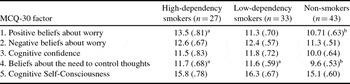
A chi-square analysis of the differences in terms of gender ratios between the three groups showed no significant differences. In order to establish if there was an overall effect from the combination of MCQ-30 subscales, a multivariate analysis of covariance was conducted with the participant group as a fixed factor, anxiety and depression as covariates, and all the MCQ-30 subscales as the dependent variables. This analysis revealed a significant effect [Roy's Largest Root = .15, F(2,98) = 2.92, p = .02]. In order to establish group differences on MCQ-30 subscales, a series of one-way analyses of covariance with follow-up Bonferroni pairwise comparisons were conducted with the participant group as a fixed factor, anxiety and depression as covariates, and individual MCQ-30 subscales as the dependent variables (see Table 1). These analyses revealed that high-dependency smokers scored significantly higher than non-smokers on Positive Beliefs about Worry [F(2,98) = 3.59, p = .03]. Furthermore on Beliefs about the Need to Control Thoughts high and low-dependency smokers scored significantly higher than non-smokers [F(2,98) = 4.31, p = .02]. In relation to the effects of anxiety and depression, the only significant effect of these covariates was identified for anxiety in relation to Beliefs about Uncontrollability and Danger [F(1,98) = 20.80, p < .001].
Adjusted means, standard errors (in brackets) and analyses of covariance for effects of group on MCQ-30 subscales

a,bPairs significantly different from each other (p ≤ .05).
Next we analysed the data using binary logistic regression analysis, which is used to find the odds of being in one category or another. In the current study the category was dependent smoker or non-smoker. Negative emotion (anxiety and depression) and all five dimensions of metacognition were entered individually as a block. The results were as follows: χ 2 = 21.9, df = 7, p = .03, with 67.0% of cases correctly classified. Inspection of the final equation shows that only Beliefs about the Need to Control Thoughts were a significant predictor of classification as a dependent smoker.
Discussion
The goal of this study was to establish whether metacognitions differ across the continuum of smoking dependence. The findings that both high and low-dependency smokers scored higher than non-smokers on Beliefs about the Need to Control Thoughts, and that high-dependency smokers scored higher than non-smokers on Positive Beliefs about Worry, suggest that these beliefs may play a role in smoking behaviour that is independent of negative emotion. The finding that Beliefs about the Need to Control Thoughts were the only predictor of category membership as a dependent smoker adds to the argument that smoking may be conceptualized as a strategy for controlling negative affect that is influenced by metacognitions (Spada et al., Reference Spada, Moneta and Wells2007). That is, the beliefs that some thoughts must be controlled may contribute to the choice of smoking as a means of achieving desired levels of mental state (e.g. a temporary reduction in negative emotion).
These results, taken together, are in line with Spada and colleagues' preliminary findings (Spada et al., Reference Spada, Moneta and Wells2007) confirming that specific metacognitions play a role in smoking dependence. They extend these findings by highlighting the importance of metacognitions in both low and high-dependency smokers, differentiating dependent smokers from non-smokers, and utilizing a non-student sample.
This study has several limitations that will have to be addressed by future research. First, it relies solely on self-report data (this is unavoidable as there are no objective or interview measures of metacognitions). Second, a cross-sectional design was adopted and this does not allow causal inferences. Third, the presence of concurrent psychological disorder (which could account for the observed differences in metacognitions) was not assessed. However, controlling for anxiety and depression does provide a degree of confidence in the specificity of the results. Finally, the sample was relatively small in size and some participants had received smoking cessation treatment that may have exposed them to the identification and exploration of cognitive constructs. However, standard smoking cessation treatment does not typically include the examination of metacognitions assessed here. Thus the experience of treatment may not be particularly significant in explaining the current findings. Directions for future research include ascertaining the role of metacognitions in the predisposition towards, and maintenance of, smoking behaviour, as well as considering the influence of smoking behaviour on metacognitions. It would also be interesting to examine whether changes in metacognitions occur during the process of smoking cessation treatment and, if so, if they are associated with smoking discontinuation.



Comments
No Comments have been published for this article.