Emerging during the first year of life, anger is one of the fundamental emotions (Deater-Deckard & Wang, Reference Deater-Deckard, Wang, Zentner and Shiner2012; Izard & Malatesta, Reference Izard, Malatesta and Osofsky1987). Individual differences in anger proneness are already visible and measurable in infancy, typically as distress to limits, irritability, and a negative response to frustration (Braungart-Rieker, Hill-Soderlund, & Karrass, Reference Braungart-Rieker, Hill-Soderlund and Karrass2010; Deater-Deckard & Wang, Reference Deater-Deckard, Wang, Zentner and Shiner2012; Dodge, Coie, & Lynam, Reference Dodge, Coie, Lynam, Damon and Eisenberg2006; Izard & Malatesta, Reference Izard, Malatesta and Osofsky1987; Kochanska, Coy, Tjebkes, & Husarek, Reference Kochanska, Coy, Tjebkes and Husarek1998; Putnam, Rothbart, & Gartstein, Reference Putnam, Rothbart and Gartstein2008; Rothbart, Reference Rothbart1981; Rothbart & Bates, Reference Rothbart, Bates, Damon, Lerner and Eisenberg2006; Rothbart, Derryberry, & Hershey, Reference Rothbart, Derryberry, Hershey, Molfese and Molfese2000). Interest in those early individual differences is on the upswing among researchers studying origins of disruptive behavior problems. High early anger proneness, often conceptualized as a core dimension of “difficult temperament,” is widely seen as a risk factor for a broad range of escalating developmental maladaptive outcomes. At preschool age, those outcomes typically involve defiance and negativity expressed toward the parent following the onset of parental discipline and control. Subsequently, the outcomes broaden to include a range of various externalizing behavior problems at home and in other ecologies (peer groups and school). Those later outcomes encompass oppositionality, hostility and aggression, disregard for rules, and conduct problems (Bates, Bennett Freeland, & Lounsbury, Reference Bates, Bennett Freeland and Lounsbury1979; Biedzio & Wakschlag, Reference Biedzio, Wakschlag and Zeenahin press; Campbell, Shaw, & Gilliom, Reference Campbell, Shaw and Gilliom2000; Caspi & Shiner, Reference Caspi, Shiner, Damon, Lerner and Eisenberg2006; Frick & Morris, Reference Frick and Morris2004; Gartstein, Putnam, & Rothbart, Reference Gartstein, Putnam and Rothbart2012; Hay, Reference Hay2017; Kerr & Schneider, Reference Kerr and Schneider2008; Lahey et al., Reference Lahey, Van Hulle, Keenan, Rathouz, D'Onofrio, Rodgers and Kovacs2005; Lipscomb et al., Reference Lipscomb, Leve, Harold, Neiderhiser, Shaw, Ge and Reiss2011; Putnam et al., Reference Putnam, Rothbart and Gartstein2008; Rothbart & Bates, Reference Rothbart, Bates, Damon, Lerner and Eisenberg2006; Stifter, Spinrad, & Braungart-Rieker, Reference Stifter, Spinrad and Braungart-Rieker1999; Stringaris, Reference Stringaris2011; Wakschlag et al., Reference Wakschlag, Estabrook, Petitclerc, Henry, Burns, Perlman and Briggs-Gowan2015, Reference Wakschlag, Perlman, Blair, Leibenluft, Briggs-Gowan and Pine2018).
Consistent with the principle of multifinality in developmental psychopathology, not all highly anger-prone infants embark on maladaptive developmental paths. Consequently, it is critical to identify factors that determine divergent unfolding trajectories from early anger to future outcomes. Research has identified multiple factors, at several levels, that interact with early anger proneness to predict future development, including aspects of the parent–child relationship, early stress, family dynamics, and many contextual and ecological factors (Brooker et al., Reference Brooker, Buss, Lemery-Chalfant, Aksan, Davidson and Goldsmith2014; Campbell et al., Reference Campbell, Shaw and Gilliom2000; Lengua & Kovacs, Reference Lengua and Kovacs2005; McElwain, Holland, Engle, & Wong, Reference McElwain, Holland, Engle and Wong2012; Rhoades et al., Reference Rhoades, Leve, Harold, Neiderhiser, Shaw and Reiss2011; Shaw, Bell, & Gilliom, Reference Shaw, Bell and Gilliom2000).
The quality of attachment organization that emerges between the child and the caregiver may be a particularly important factor that moderates future paths for infants varying in their anger proneness. Recently, researchers have increasingly acknowledged that early attachment may be a source of subtle, indirect, and complex effects rather than, or in addition to, direct effects. For example, Sroufe and colleagues (Reference Sroufe2005, Reference Sroufe, Cassidy and Shaver2016; Sroufe, Carlson, Levy, & Egeland, Reference Sroufe, Carlson, Levy and Egeland1999) have argued that although early attachment is an organizing core in development, always integrated with later experience and never lost, it relates to developmental outcomes probabilistically and in the context of complex developmental processes. In that view, attachment may serve an important conditional or probabilistic role. That is, attachment might initiate and/or alter future developmental cascades, and thus exert a significant impact even if its direct effects may no longer be detected. For example, by promoting the child's early adaptive emotion regulation, attachment may contribute to the child's resilience later on in development. Others have also emphasized the need to study such “hidden” or complex effects of early attachment (Cox, Mills-Koonce, Propper, & Gariépy, Reference Cox, Mills-Koonce, Propper and Gariépy2010; DeKlyen & Greenberg, Reference DeKlyen, Greenberg, Cassidy and Shaver2016; Fearon & Belsky, Reference Fearon and Belsky2011; Kuczynski & De Mol, Reference Kuczynski, De Mol, Overton and Molenaar2015; Masten & Cicchetti, Reference Masten and Cicchetti2010; Thompson, Reference Thompson, Cassidy and Shaver2008, Reference Thompson, Lerner, Lamb and Lerner2015), often in the context of early difficult temperament and its sequelae (Shaw et al., Reference Shaw, Bell and Gilliom2000).
Research in our laboratory has elucidated aspects of early attachment's complex effects. We have studied a common path to behavior problems, insightfully described and well supported by social learning researchers (Dishion & Patterson, Reference Dishion, Patterson, Cicchetti and Cohen2006; Pardini, Reference Pardini2008; Rothbart & Bates, Reference Rothbart, Bates, Damon, Lerner and Eisenberg2006; Scaramella & Leve, Reference Scaramella and Leve2004; Shaw & Bell, Reference Shaw and Bell1993). Starting with the child's difficult temperament, that path typically leads to parental power assertion and future cascading adversarial and mutually resentful parent–child interactions. However, our research has indicated that such a portrayal, whereas certainly accurate, is incomplete. Across several longitudinal studies, we have consistently found that early insecurity sets the tone, or creates a context that is conducive to future maladaptive, adversarial transactions unfolding within the parent–child dyad. We have found that toddlers with difficult temperaments elicited more power-assertive discipline, and that discipline, in turn, was detrimental to multiple child outcomes, such as self-regulation or regard for rules of behavior. However, we have found that such dynamics unfolded only in those parent–child dyads in which children had been insecure as infants (Kim, Kochanska, Boldt, Koenig Nordling, & O'Bleness, Reference Kim, Kochanska, Boldt, Koenig Nordling and O'Bleness2014; Kochanska, Barry, Stellern, & O'Bleness, Reference Kochanska, Barry, Stellern and O'Bleness2009; Kochanska & Kim, Reference Kochanska and Kim2012). Several studies in other laboratories have reported similar interactions of early anger proneness and attachment security, such that anger-prone children embarked on a negative trajectory if they were in insecure or otherwise negative relationships, but not when they were in secure relationships (Edwards & Hans, Reference Edwards and Hans2015; Keller, Spieker, & Gilchrist, Reference Keller, Spieker and Gilchrist2005).
By contrast, such negative developmental sequelae were absent, or defused, in dyads with histories of security. In secure dyads, toddlers’ difficulty did not trigger parental power assertion, and power assertion did not seem to lead to detrimental outcomes. On the contrary, in secure dyads, we found that positive sequelae appeared enhanced, compared to insecure dyads (Kochanska et al., Reference Kochanska, Woodard, Kim, Koenig, Yoon and Barry2010). Summarizing those findings, we conclude that early attachment organization can serve as a moderator of future links between child difficult temperament and parental power assertion, and later maladaptive child outcomes.
In those studies, we have typically modeled early attachment as a moderator of future links between child difficult temperament at toddler age and future parental power assertion, and between power assertion and future outcomes. However, we have not yet examined whether attachment organization moderated associations between early anger proneness, assessed in infancy, prior to the coalescence of attachment, and children's disruptive, externalizing behavior, assessed at preschool and early school age. This is an important question, and one informed by a broader debate on temperament and attachment. That debate, in its early phase, focused on the issue of what the Strange Situation paradigm (SSP) measured, child temperament or the history of the parent–child relationship. Some scholars argued that highly negative, anger-prone, or fearful infants were likely to present as insecure in the SSP, whereas others disagreed (Goldsmith & Alansky, Reference Goldsmith and Alansky1987; Kagan, Reference Kagan1982; Sroufe, Reference Sroufe1985). Later, the debate shifted to a focus on more complex dynamic relations between temperament (particularly negative emotionality) and attachment, including conceptual and empirical overlaps and mediating and moderating effects (for a recent review, see Vaughn & Bost, Reference Vaughn, Bost, Cassidy and Shaver2016).
Given those complex relations, it is theoretically possible that temperamentally based factors that precede the coalescence of attachment may be responsible for both insecurity and the maladaptive future sequelae, often found in insecurely attached children. In the current study, we examined relations between children's measures of anger proneness obtained in infancy (at 7 months) and maladaptive outcomes assessed at preschool and early school age, as moderated by attachment security assessed at 15 months.
We examine anger proneness in infancy as a risk factor for negativity at preschool age, expressed as defiance and negative affect in the context of the child's diverse interactions with the parent, and oppositionality, hostility, and aggression at early school age, rated by the children's parents and teachers. Adopting the model of attachment as a moderator of developmental dynamics, consistent with past findings and with the principle of multifinality in developmental psychopathology (Cicchetti & Rogosh, Reference Cicchetti and Rogosch1996), we anticipated different paths from early anger to unfold in insecure and secure dyads. We expected that attachment organization at 15 months would moderate the link between infant anger and future negativity in interactions with the parent and the link between infant anger and future oppositionality. Specifically, we expected that in insecure dyads, highly anger-prone infants would remain on a trajectory to higher negativity and oppositionality at preschool and early school age. In contrast, in secure dyads, we did not expect to find similar trajectories from high anger proneness in infancy to future negativity and oppositionality. In those dyads, we anticipated the associations between early anger and future negativity and oppositionality to be defused. We collected multimethod assessments (observations in standard procedures and in naturalistic interactions, and reports from mothers, fathers, and teachers).
We assessed anger in infancy using both observations and established parent-report instruments. In our past work on attachment as a moderator of paths from difficult temperament to future outcomes, we have generally relied on observational measures of children's difficulty, and have not examined parents’ reports. As one exception, in one study, we did obtain both observed and reported measures of child difficulty, and examined the quality of maternal care as a moderator of links between child difficulty and future outcomes (Kochanska & Kim, Reference Kochanska and Kim2013). The findings were parallel for both types of measures of difficulty. However, the maternal care measure involved responsiveness, and not the quality of attachment. Lickenbrock et al. (Reference Lickenbrock, Braungart-Rieker, Ekas, Zentall, Oshio and Phanalp2013) found evidence of the moderating role of early attachment on the link between parent-reported child overall negative reactivity and toddlers’ compliance that were consistent, in part, with our model. Their findings, however, were complex, with child temperament assessed by mothers’ reports only, and compliance observed with both parents present. Consequently, our expectations for the parent-reported measures of infants’ anger were more tentative.
The relative dearth of data on father–child relationships, compared to those on mother–child relationships, has been broadly acknowledged as problematic in attachment research, temperament research, and generally, developmental psychopathology. Collecting complete data from both parents and children continues to be seen as critical (Bretherton, Reference Bretherton2010; Cabrera, Volling, & Barr, Reference Cabrera, Volling and Barr2018). Consequently, obtaining all data from mother–child and father–child relationships has been one of the key principles guiding our work. Our work to date on early attachment organization serving as a moderator of future developmental dynamics has generally shown similar patterns for mother–child and father–child relationships, in that negative dynamics unfolded in insecure dyads only (Boldt, Kochanska, & Jonas, Reference Boldt, Kochanska and Jonas2017; Kochanska et al., Reference Kochanska, Barry, Stellern and O'Bleness2009; Kochanska & Kim, Reference Kochanska and Kim2012). However, this has not always been the case, particularly when we examined positive rather than negative trajectories. The positive trajectories (which we have found in secure dyads) have been supported for mother–child, but not father–child, relationships (Kochanska et al., Reference Kochanska, Woodard, Kim, Koenig, Yoon and Barry2010). The emerging literature on antecedents and implications of attachment in the two relationships is replete with inconsistent findings, some showing converging and some distinct developmental dynamics. Consequently, we see the current article as another exploratory step in investigating the role of attachment in the two relationships.
Method
Participants
Two-parent community families of typically developing infants (almost all born in 2001) volunteered for the study. They responded to flyers, posters, and ads disseminated broadly in multiple venues (daycare centers, stores, pediatricians’ offices, libraries, bulletin boards, etc.) in a college town, a small city, and surrounding towns and communities in a Midwestern state. The families were demographically diverse. In terms of annual income, 8% of families earned less than $20,000, 17% earned $20,000–$40,000, 26% earned $40,000–$60,000, and 49% earned over $60,000. In terms of education, 25% of mothers and 30% of fathers had no more than a high school education, 54% of mothers and 51% of fathers had an associate or bachelor's degree, and 21% of mothers and 20% of fathers had postgraduate education. Regarding ethnicity, 90% of mothers and 84% of fathers were White, 3% of mothers and 8% of fathers were Hispanic, 2% of mothers and 3% of fathers were African American, 1% of mothers and 3% of fathers were Asian, 1% of mothers were Pacific Islander, and 3% of mothers and 2% of fathers were non-White other. In 20% of families, one or both parents were non-White. The families were compensated for their participation (approximately $25–$30 per hour of activity). All parents signed consent forms upon entry to the study.
Overview of design
This article reports data collected in infancy (7 months, N = 102), at 15 months (N = 101), at preschool age (38 months and 52 months, Ns 100 and 99), and early school age (67 months and 80 months, Ns 92 and 90). At each time, each child completed two 2.5- to 3-hr sessions, one with each parent. At 7 months, the sessions were at home, at 38 months, there was a home and a laboratory session, with each parent participating in half of each session, and at 52, 67, and 80 months all sessions were in the laboratory. Children's anger was assessed in infancy (observations and parents’ ratings). The child's attachment to each parent was assessed in the SSP at 15 months. At preschool age (38 and 52 months), we observed the child's negativity toward the parent in naturalistic interactions, and at early school age, we obtained ratings of child oppositionality (from parents at 67 and 80 months, and from teachers at 80 months). Multiple teams coded behavior from videotapes, using 15%–20% for reliability and following up with realignments to prevent coders’ drift.
Measures
Child anger measures, infancy (7 months)
Observed anger
Anger was observed in the Car Seat episode from the Laboratory Temperament Assessment Battery (Goldsmith & Rothbart, Reference Goldsmith and Rothbart1996). The child was buckled tightly in a car seat for 60 s (shortened if he or she became very upset). Coders rated discrete facial, vocal, and bodily anger expressions, using 5-s segments, latency to the first anger expression, and intensity. Intensity for facial anger ranged from 0 = none to 3 = strong, in all three facial regions; for vocal anger, from 0 = none to 5 = full intensity cry or scream; and for bodily anger, from 0 = none to 4 = high intensity, continuous struggle. Reliability for discrete anger expressions, κ, was 0.67, and average αs, for latency and intensity ratings were 0.85. To create the final score, the latencies were reversed, all codes were standardized, and then aggregated. Cronbach's α was 0.79.
Parent-rated anger
Both parents completed the well-established Infant Behavior Questionnaire (IBQ; Rothbart, Reference Rothbart1981). We focused on the anger proneness scale (distress to limitations). Parents rated the infants on 20 items, each ranging from 1 = never to 7 = always. Cronbach's α were 0.85 for mothers and 0.82 for fathers. For each parent, the anger score was the average of all items. Mothers’ and fathers’ scores correlated, r (100) = .62, p < .001, a typical finding. Observed and parent-rated anger modestly correlated. The correlations were, for mothers, r (102) = .25, p < .025, and for fathers, r (99) = .21, p < .05.
Child attachment security measure (15 months)
Those data have been published (e.g., Kochanska & Kim, Reference Kochanska and Kim2012), and thus the description is brief. The SSP (Ainsworth & Wittig, Reference Ainsworth, Wittig and Foss1969) was conducted as the first procedure in the laboratory session with each parent, and coded by professional coders at another university (one coder coded a given child with one parent only). Coding reliability, κ, were 0.78 for the four main attachment categories (avoidant, A; secure, B; resistant, C; and disorganized or unclassifiable, D⁄U), and 0.85 for the coding of secure versus insecure attachment. All cases coded with low confidence by one coder and all D⁄U cases were double-coded and adjudicated. With mothers, 56 children were secure (B), and 45 were insecure (12 A, 19 C, and 14 D⁄U). With fathers, 66 children were secure (B), and 34 were insecure (15 A, 6 C, and 13 D⁄U; parents of one child declined to participate in the father–child paradigm). Security versus insecurity with the mother was unrelated to that with the father, Pearson χ2 (1) = 1.67, ns. The order of the session (mother or father first) had no effect on security with either parent, both Pearson χ2 (1) values < 1. There were no significant differences between girls and boys with mothers, Pearson χ2 (1) = 2.22, ns, or fathers, Pearson χ2 (1) < 1.
Child negativity measures, preschool age (38 and 52 months)
Observed defiance
Children's defiance toward each parent was observed in discipline contexts (total observed time 117 min with each parent). Those included, with each parent, “Dos” (toy cleanups; 15 min at 38 months, 10 min at 52 months) and “Don'ts” (prohibition; 27 min at 38 months, 65 min at 52 months). In toy cleanups, the parent asked the child to pick up multiple toys, scattered after play. In prohibition contexts, the child and the parent were in the laboratory room, engaged in other activities (e.g., free time or snack). In the same room, there was a low shelf, easily accessible to the child, containing extremely attractive objects, designated as off-limits. At the outset of each session, the parent conveyed the prohibition to the child and enforced it throughout the session.
Defiance was defined as highly negative opposition accompanied by poorly controlled anger, tantrums, kicking, screaming, throwing toys, hitting the parent, and so on. It was coded for each 30-s segment in toy cleanups and for each 30-s segment within the earlier identified (by another coding team) episodes that occurred during the entire prohibition contexts. An episode started when the child oriented toward the off-limits objects, and ended when the child reoriented. Reliability, κs (for a broader set of child behaviors), across multiple coding teams, ranged from 0.65 to 0.80. At each age, we tallied all instances of defiance and divided by the number of coded segments (for each parent). Those scores were standardized, and averaged across toy cleanups and prohibition contexts into one defiance score for each parent–child dyad at each age.
Negative affect in parent–child interactions
Children's negative affect was observed in naturalistic, but standard parent–child interactions (e.g., snack, play, or parent busy) for the total of 142 min with each parent. The contexts encompassed 77 min at 38 months and 65 min at 52 months (with each parent). Child negative affect was coded for each 30-s segment, as neutral negative mood (subtle discomfort, fatigue, or negatively tinged expressions), discrete negative affect (distress, fussiness, whining, or anger), or intense negative affect (very strong expression or lasting more than 15 s). Reliability, κs (for a broader set of affect codes), across several teams, ranged from 0.74 to 0.88. To create composite scores, we weighed the tallied instances of the child's intense negative affect by 3, discrete negative affect by 2, and neutral negative mood by 1. These figures were added and divided by the number of coded segments to create a score of the child's negative affect with each parent and at each age. Those scores were standardized.
Negativity composite at preschool age
For each child and with each parent, we averaged the four standardized scores (defiance and negative affect in interactions, each at 38 and at 52 months). Cronbach's αs were 0.76 for both mother–child and father–child dyads.
Child oppositionality measures, early school age (67 and 80 months)
Parent-rated oppositionality
Each parent completed, at both ages, the Child Symptom Inventory–4 (CSI–4; Gadow & Sprafkin, Reference Gadow and Sprafkin2002), a well-established instrument designed to correspond to DSM–IV. Using symptom severity scoring, where each item is rated from 0 = never to 3 = very often, we computed the scores for oppositional defiant disorder (ODD) and conduct disorder (CD). Cronbach's αs were (mother first, father second): at 67 months, for ODD 0.88, 0.84; at 80 months, 0.83, 0.86, and for CD, at 67 months, 0.77, 0.69; at 80 months, 0.73, 0.69. Those scores were added, and the summary oppositional score standardized.
Each parent also completed, at both ages, the Macarthur Health Behavior Questionnaire (HBQ; Boyce et al., Reference Boyce, Essex, Woodward, Measelle, Ablow and Kupfer2002; Essex et al., Reference Essex, Boyce, Goldstein, Armstrong, Kraemer and Kupfer2002), which assesses multiple dimensions of children's problems and competence. We selected the scale of overt aggression. Cronbach's αs were (mother first, father second): at 67 months, 0.64, 0.55; at 80 months, 0.67, 0.60. We averaged across its four items, each rated from 1 = never to 3 = often. Those scores were standardized.
Parent-rated oppositionality composite
For each parent, we averaged the four standardized scores (CSI-4 summary score and HBQ overt aggression, each at 67 and at 80 months). Cronbach's αs were 0.88 for mothers and 0.79 for fathers.
Teacher-rated oppositionality
Children's teachers completed teacher versions of the CSI-4 and the HBQ (at 80 months only). Cronbach's αs were 0.89 for ODD and 0.77 for CD; and 0.63 for overt aggression. We created the summary score in the CSI-4 and the average score for overt aggression in the HBQ in the manner parallel to the parents’ scores. Those two scores correlated, r (86) = .83, and were averaged into teacher-rated oppositionality composite.
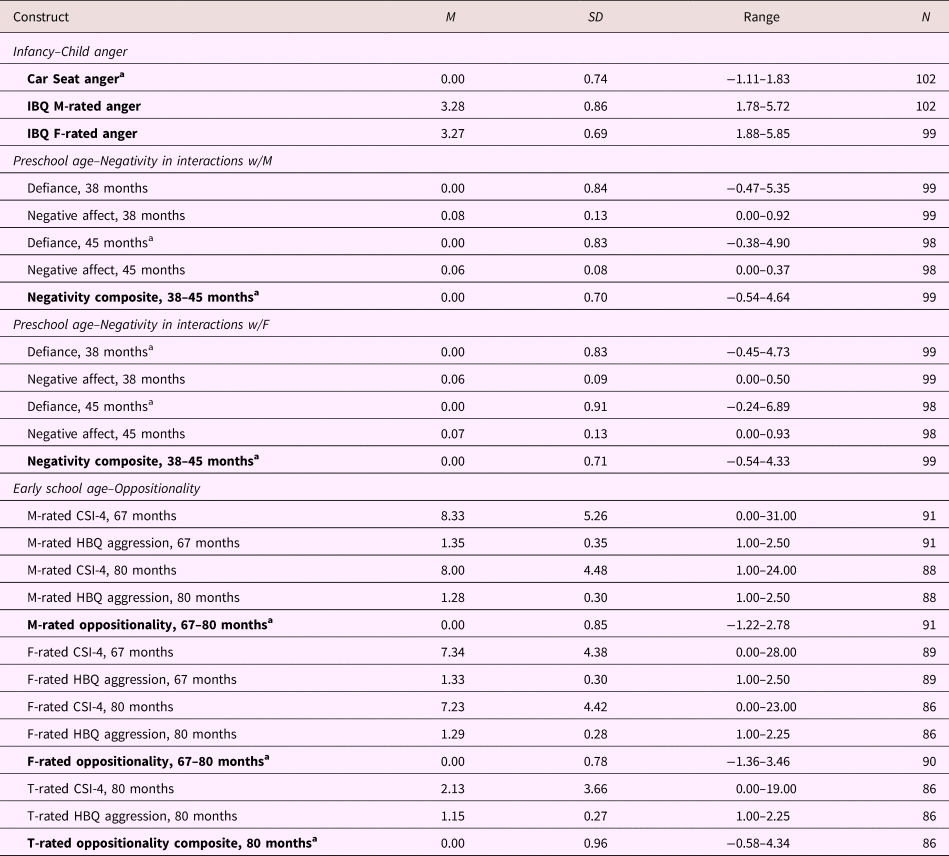
Teachers’ and parents’ oppositionality ratings modestly correlated, for mothers’, r (86) = .29, p < .01, and for fathers’ r (84) = .23, p < .05. All descriptive data are in Table 1. Univariate nonnormality was detected for child negativity displayed during interactions with mothers (skew = 3.38, kurtosis = 17.60) and fathers (skew = 3.38, kurtosis = 14.88) at preschool age (38–52 months).
Descriptive data for all constructs

Note: aA composite of standardized constituent variables. M, mother. F, father. T, teacher. IBQ, Infant Behavior Questionnaire. CSI-4, Child Symptom Inventory—4, HBQ, Health Behavior Questionnaire. Variables included in the moderation models are bolded.
Results
Overview of the analytic approach
In preliminary data analyses, we examined differences between insecure and secure children regarding the infancy measures, gender differences, and correlations among the studied variables, for insecure and secure mother–child and father–child dyads.
The key moderation models were tested using Mplus 8 (Muthén & Muthén, Reference Muthén and Muthén1998–2017). Missing data were present due to attrition across the repeated assessments and occasionally, a missing observed or reported measure, and covariance coverage ranged from 0.83 to 1.00. Consistent with contemporary theories of missing data (Enders, Reference Enders2010), we used full information maximum likelihood estimation, which is preferred over more traditional missing data treatments (e.g., pairwise deletion). We used bootstrapping, which provides an empirical approximation of sampling distributions of effects. Bootstrapping performs well in relatively small samples, maximizing power while maintaining control over the Type 1 error rate (Shrout & Bolger, Reference Shrout and Bolger2002). Further, bootstrapping can be used when the normality assumptions of parametric tests have been violated, as is the case in the present study, and is preferred over the use of conventional data transformations (Russell & Dean, Reference Russell and Dean2000). We performed a bias-corrected bootstrap with 5,000 resamples drawn to derive the 95% confidence intervals (CIs). Three moderation models were tested, as described below.
The first model. Child negativity in interactions with the parent at preschool age (38–52 months) was regressed on (a) the moderator, child attachment security with parent (15 months); (b) the two predictors at 7 months, child anger in the Car Seat and parent-rated anger in the IBQ; (c) interactions between attachment (moderator) and each of the predictors; and (d) the covariate, child gender.
The second model. Parent-rated child oppositionality at early school age (67–80 months) was regressed on (a) the moderator, child attachment security with parent (15 months); (b) three predictors, child anger in the Car Seat and parent-rated anger in the IBQ, both at 7 months, and child negativity in interactions with the parent at preschool age, 38–52 months; (c) interactions between attachment (moderator) and each of the predictors; and (d) the covariate, child gender. Note that child negativity at preschool age, which was the dependent variable in the first model, now served as one of the predictors.
The third model. This model was identical to the second model, but teacher-reported, rather than parent-rated oppositionality (80 months) was the dependent variable.
The three models were tested for both mother–child dyads and father–child dyads, for a total of six models. In the case of significant moderation, simple slopes were computed and graphed for the two levels of the moderator: insecure versus secure attachment (Aiken & West, Reference Aiken and West1991). Simple slopes were computed after omitting any nonsignificant interactions from the model.
Preliminary analyses
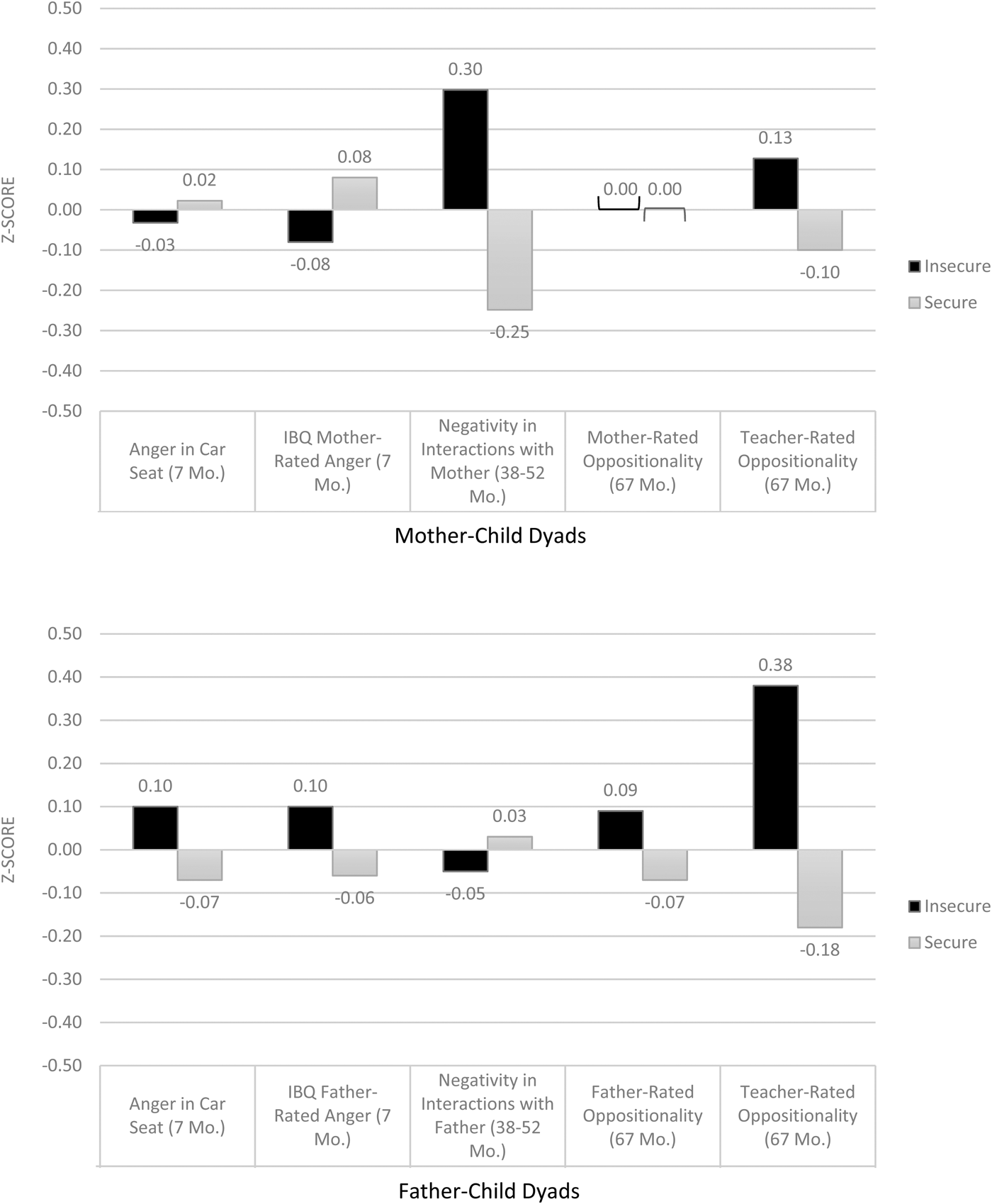
Figure 1 depicts observed (standardized) scores for insecure and secure dyads. Note that there were no differences between children classified as insecure or secure at 15 months in terms of their anger measures in infancy, for either mother–child or father–child dyads (all ts < 1). Children who had been insecure with their mothers showed more negativity at preschool age, t (97) = 2.80, p < .01, and those who had been insecure with fathers were rated as more oppositional by teachers at early school age, t (83) = 2.50, p < .05. Note that those differences were later qualified by interaction effects with infant anger, detected in the moderation analyses.
Observed standardized scores for study variables for insecure (black) versus secure (gray) parent–child dyads.

In terms of gender differences, mothers and teachers rated boys higher on oppositionality at early school age; for mothers’ ratings, boys, M = 0.20, SD = 0.98, girls, M = –0.21, SD = 0.62, t (89) = –2.36, p < .025, and for teachers’ ratings, boys, M = 0.28, SD = 1.15, girls, M = –0.31, SD = 0.54, t (84) = –2.99, p < .005. Consequently, child gender was covaried in the main analyses of the moderation effects.
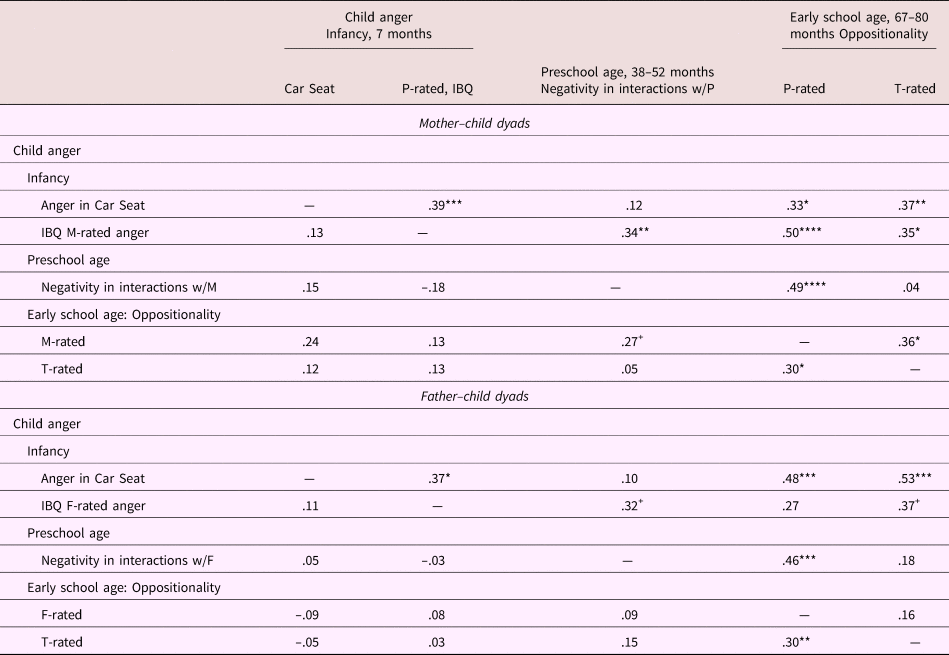
We then examined the correlations among the constructs in insecure and secure mother–child and father–child dyads. Those are presented in Table 2. In insecure mother–child dyads, mothers and teachers rated children who as infants had shown high anger in the Car Seat as highly oppositional at early school age. The infants rated by mothers as highly anger prone demonstrated high levels of negativity in interactions with mothers at preschool age and were rated as highly oppositional by mothers and teachers at early school age. Mothers also rated as highly oppositional those children who had been highly negative in interactions at preschool age. In secure mother–child dyads, none of the above correlations was significant.
Correlations among studied constructs for insecure and secure parent–child dyads

Note: IBQ, Infant Behavior Questionnaire. M, mother. F, father. P, respective parent. T, teacher. Correlations for insecure dyads are above the diagonal, and correlations for secure dyads are below the diagonal. Security classification based on Strange Situation at 15 months. +p < .10. *p < .05. **p < .025. ***p < .01. ****p < .001.
In insecure father–child dyads, fathers and teachers rated children who as infants had expressed high levels of anger in the Car Seat as highly oppositional when they reached early school age. Like mothers, fathers rated children who had been highly negative in interactions at preschool age as highly oppositional. In secure father–child dyads, none of those correlations was significant.
Main analyses of the moderated effects
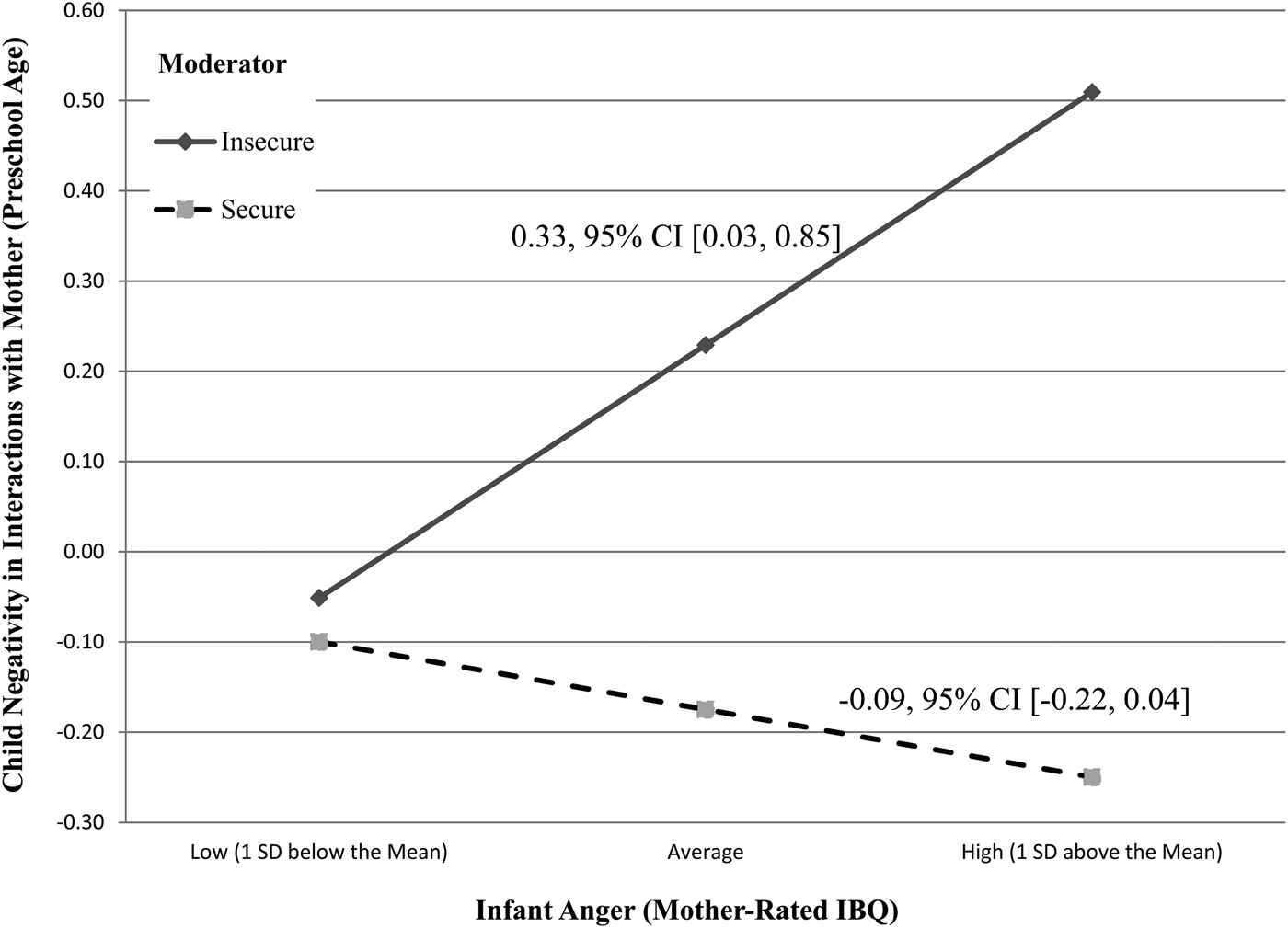
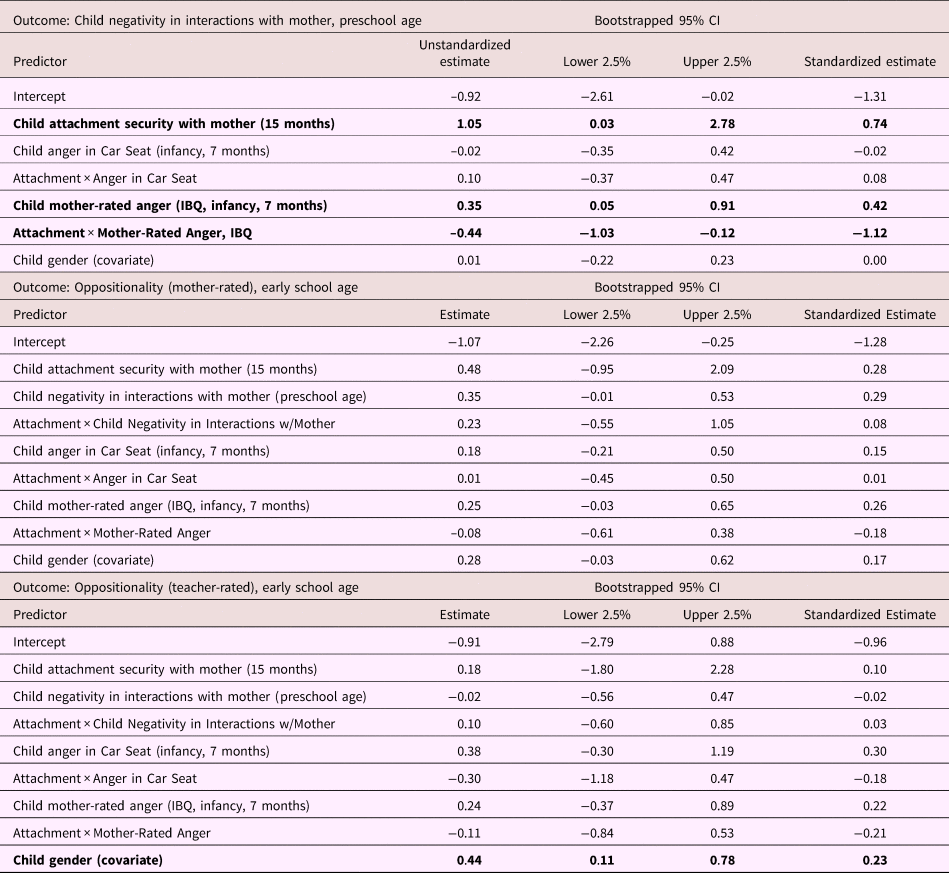
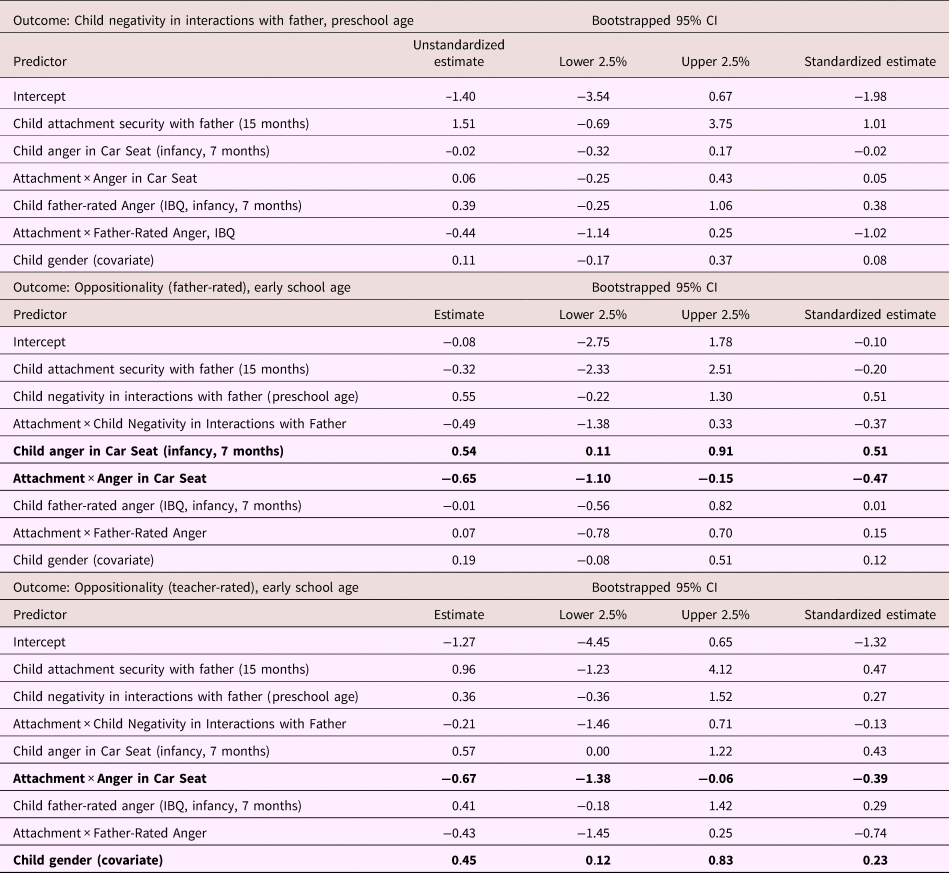
The results of the moderation analyses are reported in Table 3 (mother–child dyads) and Table 4 (father–child dyads). In mother–child relationships, attachment security moderated the effect of child anger, rated by mothers in infancy, on preschool age negativity, but it did not moderate the parallel effect of child anger observed in the Car Seat in infancy. Next, we graphed the significant interaction by computing simple slopes for mother-rated anger in infancy predicting child negativity during interactions with mother at preschool age. As depicted in Figure 2, the positive association between mother-rated anger and negativity was present for insecure dyads, 0.33, 95% CI [0.03, 0.85], but not secure dyads, –0.09, 95% CI [–0.22, 0.04].
Simple slopes and bias-corrected bootstrapped 95% confidence intervals for infant anger (mother-rated, IBQ, 7 months) predicting child negativity during interaction with mother (preschool age, 38–52 months) for insecure versus secure mother–child dyads. IBQ, Infant Behavior Questionnaire.

Results of moderation analyses: Mother–child models

Note: IBQ, Infant Behavior Questionnaire. Attachment Security (1 = secure, 0 = insecure). Significant effects as indicated by the bias-corrected bootstrapped confidence interval (CI) are bolded. The tested models accounted for 17% of the variance in child negativity, 28% of the variance in oppositionality (mother rated), and 18% of the variance in oppositionality (teacher rated).
Results of moderation analyses: Father–child models

Note: IBQ, Infant Behavior Questionnaire. Attachment Security (1 = secure, 0 = insecure). Significant effects as indicated by the bias-corrected bootstrapped confidence interval (CI) are bolded. The tested models accounted for 5% of the variance in child negativity, 26% of the variance in oppositionality (father rated), and 33% of the variance in oppositionality (teacher rated).
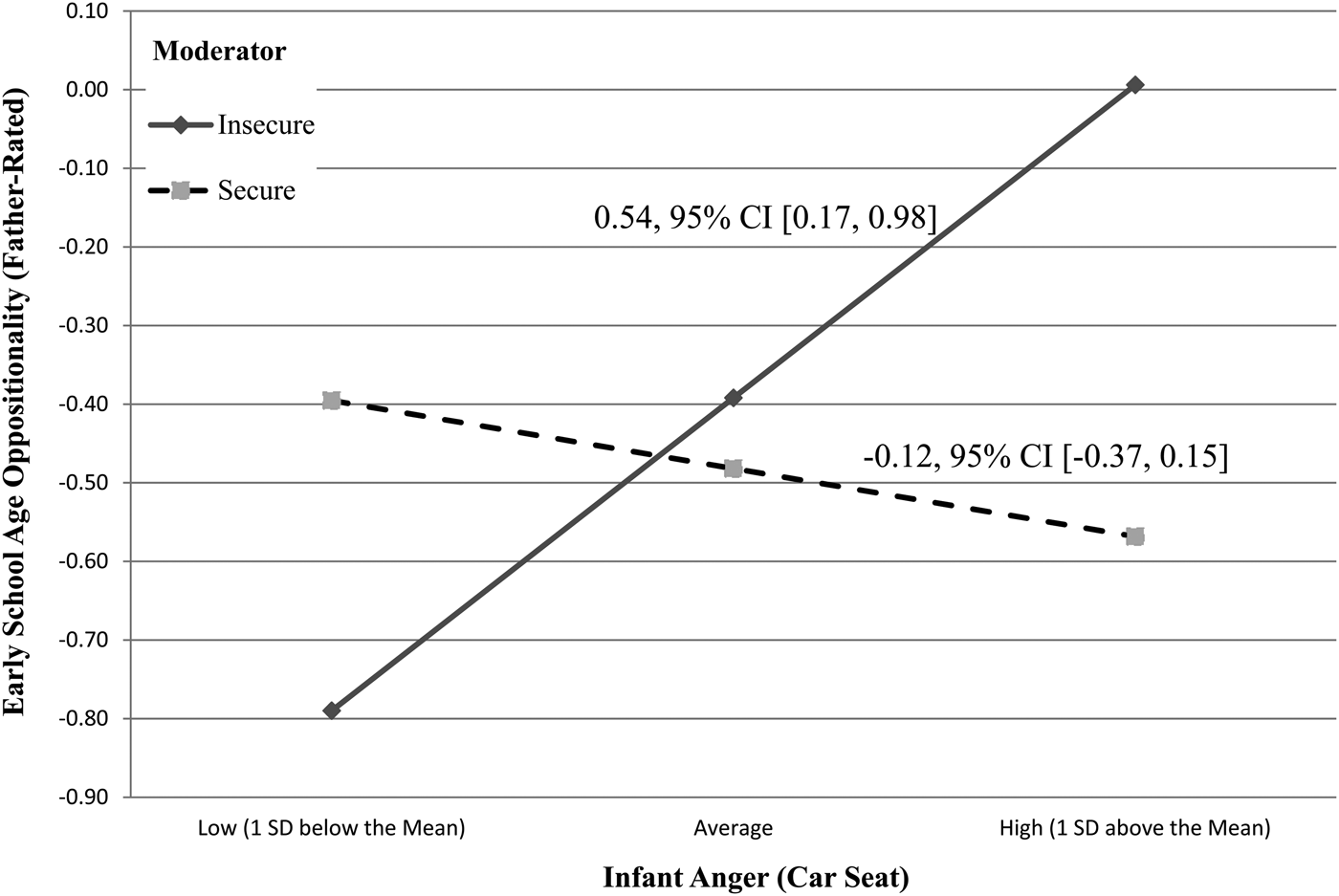
In father–child relationships, attachment security moderated the effect of child anger observed in the Car Seat in infancy on father-rated oppositionality at early school age, but it did not moderate the effect of child anger rated in the IBQ in infancy on oppositionality. The significant interaction was graphed in Figure 3. The positive association between child anger in the Car Seat and father-rated oppositionality was present for insecure father–child dyads, 0.54, 95% CI [0.17, 0.98], but not secure dyads, –0.12, 95% CI [–0.37, 0.15].
Simple slopes and bias-corrected bootstrapped 95% confidence intervals for infant anger (Car Seat, 7 months) predicting early school age oppositionality (father-rated, 67–80 months) for insecure versus secure father–child dyads.

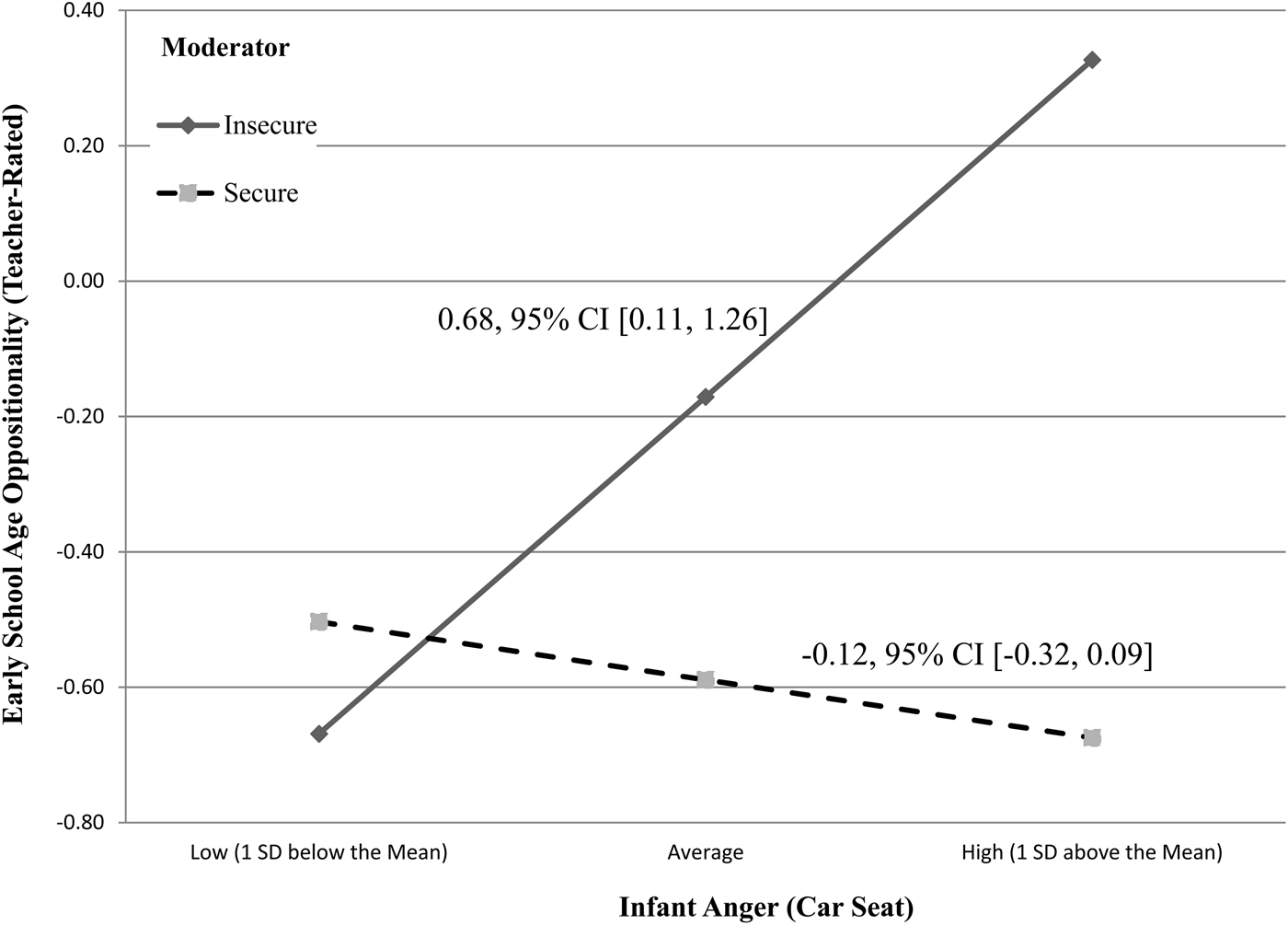
Attachment security also moderated the effect of child anger observed in the Car Seat on teacher-rated oppositionality at early school age. Attachment did not moderate the effect of child child anger rated in the IBQ on teacher-rated oppositionality. Figure 4, depicting the graphed significant interaction, illustrates the positive association between child anger in the Car Seat and teacher-rated oppositionality present for insecure father–child dyads, 0.68, 95% CI [0.11, 1.26], but absent in secure dyads, –0.12, 95% CI [–0.32, 0.09].
Simple slopes and bias-corrected bootstrapped 95% confidence intervals for infant anger (Car Seat, 7 months) predicting early school age oppositionality (teacher-rated, 80 months) for insecure versus secure father–child dyads.

Note that attachment security did not moderate associations between child negativity in interactions with either parent at preschool age and parent- or teacher-rated oppositionality at early school age.
Discussion
The findings of this longitudinal study of sequelae of early anger, unfolding from infancy to early school age, add to the growing evidence of subtle, yet powerful effects of early attachment organization on future cascades of emotional development. We examined children's anger in infancy, assessed prior to the coalescence of attachment organization with each parent, as a predictor of maladaptive outcomes: child negativity in lengthy interactions with the parent at preschool age and oppositionality at early school age. Of note, individual differences in anger proneness in infancy, either observed or reported, were not predictive of attachment organization, assessed 8 months later. However, subsequent paths from early anger diverged for insecure and secure children, illustrating the principle of multifinality in developmental psychopathology.
We expected that attachment organization, assessed at 15 months in the SSP, would moderate those links, such that early high anger proneness would be associated with future maladaptive outcomes in insecure, but not secure, parent–child dyads. Generally speaking, this expectation was confirmed.
For children in insecure relationships, variation in anger proneness in infancy was associated with future negativity expressed in the parent–child interactions at preschool age and oppositionality at early school age. Children who were highly anger prone as infants were also highly defiant and emotionally negative when interacting with their mothers and were rated as high in oppositionality (aggression and hostility) by fathers and teachers. In other words, although high anger proneness in infancy did not forecast insecurity in and off itself, it nevertheless posed a future developmental risk for those children who formed an insecure attachment with a parent at the beginning of the second year.
In contrast, for children in secure relationships, variation in anger proneness in infancy was unrelated to future outcomes. High anger proneness in infants who were secure at the beginning of the second year did not appear to confer risk. Of note, this overall picture is consistent with a large and rapidly growing body of research on interplay of temperament and relationships, although in that research, child temperament rather than the relationship context is generally modeled as the moderator (e.g., Belsky & Pluess, Reference Belsky and Pluess2009; Ellis, Boyce, Belsky, Bakermans-Kranenburg, & van IJzendoorn, Reference Ellis, Boyce, Belsky, Bakermans-Kranenburg and van IJzendoorn2011; Thomas & Chess, Reference Thomas and Chess1977).
What mechanisms may explain why and how early attachment can alter future developmental trajectories, in that risks of infant difficult temperament are amplified in insecure dyads? We have proposed that answers can be found, in part, at the level of the parent's and the child's internal representations, or internal working models (IWMs) of each other (Boldt et al., Reference Boldt, Kochanska and Jonas2017; Kochanska & Kim, Reference Kochanska and Kim2012). In secure dyads, parents likely have reflective, mind-minded, and positive IWMs of their children (Dykas & Cassidy, Reference Dykas and Cassidy2011; Meins, Fernyhough, Fradley, & Tuckey, Reference Meins, Fernyhough, Fradley and Tuckey2001; Slade, Reference Slade2005; van IJzendoorn, Reference van IJzendoorn1995). Consequently, they are likely to be thoughtful, patient, and reflective when faced with a difficult, anger-prone infant. In contrast, in insecure dyads, parents’ IWMs of their children are likely less reflective and more negative, and consequently, difficult infants engender frustration and resentment, and further reinforce the parent's negative IWM of the child, leading to increasingly hostile attributions and expectations (Smith, Dishion, Shaw, & Wilson, Reference Smith, Dishion, Shaw and Wilson2015).
A complementary process may develop on the child's side. In secure dyads, children come to see parents as available, warm, and well intentioned. In insecure dyads, they come to see the parent as unavailable, hostile, and capricious; consequently, anger-prone children likely react with defiance and negative emotions to parental control, and the adversarial cycle is set in motion. We are currently testing this conceptual model in our research program.
Although all significant findings of early anger being a risk factor were for insecure parent-child dyads, as expected, the more fine-grained picture of the findings was more complicated. In insecure mother–child relationships, mother-rated infant anger predicted the child's negativity, observed during interactions at preschool age. By early school age, infant anger no longer predicted maladaptive outcomes. In insecure father–child relationships, infant anger observed in a standard procedure predicted both father- and teacher-rated oppositionality at early school age (but not negativity at preschool age).
How to explain those differences? More research is certainly needed to clarify the distinct developmental windows when the outcomes of the moderated effects were measured and the differences in the infant anger measures that interacted with security. No one comprehensive, explanatory model appears to fit all the findings, but we can endeavor to offer partial interpretations.
One relatively simple possibility involves different amounts of time mothers and fathers spent engaged with their young children. At the assessment at 7 months, on average, mothers reported spending approximately 58 hr per week with the child, whereas fathers reported 30 hr. The difference remained substantial at 15 months: 51 hr and 32 hr. As well, compared to fathers, mothers may engage in more interactions that present emotional challenges (feeding, bathing, changing clothes, trimming nails, visiting the pediatrician, placing in car seats, etc.). Consequently, mothers’ reports may have more accurately reflected the difficulties their children posed during daily interactions. For insecure mother–child dyads, those difficulties may have continued into preschool age, to be observed as defiance and negative affect at preschool age. However, in secure dyads, benefits conferred by more optimal parenting may have defused the risk for highly anger-prone infants.
It is worth adding that this study informs the still-debated issue of measurement of temperament (Rothbart & Bates, Reference Rothbart, Bates, Damon, Lerner and Eisenberg2006). The findings suggest that both observational and parent-reported measures of infant temperament may each have unique value, and that reports from caregivers who engage in extensive interactions with the child may be particularly informative.
In insecure father–child dyads, early infant anger (although observed, and not rated) predicted child oppositionality at early school age, reported by fathers and teachers. Several studies have found links between attachment organization with fathers, and not mothers, and children's externalizing behavior problems (e.g., Bureau et al., Reference Bureau, Martin, Yurkowski, Schmiedel, Quan, Moss and Pallanca2017; Williams & Kelly, Reference Williams and Kelly2005). It is also possible that effects of father–child security are detected later in development than those of mother–child security, as we have found in this sample, using different assessments of attachment and outcomes (Boldt, Kochanska, Yoon, & Koenig Nordling, Reference Boldt, Kochanska, Yoon and Koenig Nordling2014).
As mentioned earlier, our previous analyses of the role of attachment as a moderator of links between children's difficulty, observed at toddler age, and future outcomes have often revealed similar processes in mother–child and father–child dyads. The current article shows that paths from anger, or difficulty, assessed prior to the formation of attachment may be different in the two relationships, although the patterns are quite complex. More research is definitely needed to replicate and explain those findings.
Although in this and other articles we have focused on the role of attachment organization as moderating future developmental cascades, sequelae of emotional development, and parent–child transactions, we certainly acknowledge that early attachment can exert direct influences on all those developmental domains. Rich literature on attachment and emotion regulation has demonstrated significant links between early security and insecurity and children's capacity to regulate emotions, particularly negative emotions. Security has been associated with more adaptive emotion regulation strategies, and insecurity, with less adaptive strategies (Calkins & Leerkes, Reference Calkins, Leerkes, Vohs and Baumeister2011; Cassidy, Reference Cassidy and Fox1994; Groh, Pasco Fearon, van IJzendoorn, Bakermans-Kranenburg, & Roisman, Reference Groh, Pasco Fearon, van IJzendoorn, Bakermans-Kranenburg and Roisman2017; Thompson, Reference Thompson, Cassidy and Shaver2016). In our own laboratory, in another longitudinal study, we found that attachment at 14 months predicted children's future expressions of negative and positive emotions in scripted episodes designed to elicit fear, anger, and joy (Kochanska, Reference Kochanska2001). Although secure and insecure children did not differ in their emotional responses at 9 months, prior to the assessment of attachment, differences in trajectories of emotion expression emerged in the second and third years. When examined longitudinally, secure children became significantly less angry. In contrast, insecure children's negative emotion expressions increased. Elucidating both the direct and the indirect influences of attachment organization on children's emotional development is an important goal for future research.
This study has limitations. In our community families, children were generally typically developing, their interactions with their parents largely positive, and their levels of oppositionality low. However, given that most of the research on children's anger proneness and irritability has purposely involved children who showed elevated levels of developmental risks of various kinds, data from a community sample may be a useful addition. Further, the ethnic diversity in the studied sample was limited (although in 20% of families, at least one parent was non-White). As well, the sample was relatively small, a common limitation in studies that deploy extensive observations and labor-intensive observational coding. Future research will benefit from the study of more diverse populations and larger samples to detect smaller effect sizes. Finally, an ideal design would include parent-reported and observed measures of anger, security, negativity, and oppositionality at multiple time points, to avoid a situation when age is confounded with context and measurement approach. This is, however, not easy to accomplish, given that not all measures are developmentally appropriate at all ages (as examples, defiance cannot be assessed prior to the onset of discipline, and the SSP is not appropriate at school age). Furthermore, in larger samples, mother–child and father–child processes would be analyzed in one model, deploying a full autoregressive design, to allow for the detection of complex interrelated dynamics within the family system (Cox & Paley, Reference Cox and Paley2003).
The findings support the continuing robust heuristic potential of attachment theory as a model that can inform our understanding of emotional development. Even when its direct effects are not found, early attachment can remain a powerful organizing core in human development, always integrated with later experience and never lost (Sroufe, Reference Sroufe2005, Reference Sroufe, Cassidy and Shaver2016; Sroufe, Egeland, Carlson, & Collins, Reference Sroufe, Egeland, Carlson and Collins2005). As well, the findings can potentially inform translational research and preventive interventions. Parents of highly anger-prone infants would be well advised to make strong efforts toward establishing a secure, positive, optimal relationship with their children as they move into the toddler age.
Financial support
This research was funded by NIMH Grants R01 MH6309 and K02 MH01446, NICHD Grants R01 HD069171 and R01 HD091047, and by a Stuit Professorship to Grazyna Kochanska.
Acknowledgments
We thank the many students and staff members for their help with data collection, coding, and file creation, including Lea Boldt and Sanghag Kim, and Bonnie Conley and Susan Paris for coding the Strange Situation paradigm. We also thank the participants in the Family Study for their commitment to this research.