INTRODUCTION
Culling is important in managing cow–calf production systems because cow longevity and the carcass yield have major effects on profitability. Productivity in a cow–calf production system is influenced by cow age (Rogers Reference Rogers1972); however, beef quality and prices diminish with advancing age (Van Arendonk Reference Van Arendonk1985). Therefore, profit may be lower if a cow is retained in the farm for too long.
The beef quality of a culled cow is evaluated in several countries using unique grading systems. In fact, returns from culled cows account for a significant part of the total returns of beef and dairy farms in Europe (Seegers et al. Reference Seegers, Bareille and Beaudeau1998; Garcia & Agabriel Reference Garcia and Agabriel2008) and sales of culled beef cows represent 0·10–0·20 of the gross revenue of cow–calf operations in the US (Sawyer et al. Reference Sawyer, Mathis and Davis2004). The strategies for culling cows may be affected by their beef quality traits (i.e. marbling). Hence, it is important to determine the effect of changes of beef quality in culled cows on the total production efficiency in different production systems.
Culling strategies in dairy cattle have been studied using numerous techniques including a representative dynamic programming model (Stewart et al. Reference Stewart, Burnside, Wilton and Pfeiffer1977; Van Arendonk Reference Van Arendonk1985), a dynamic programming model calculating the maximum average monthly return index (MaxAMR) (Kuipers Reference Kuipers1982; Congleton & King Reference Congleton and King1985), a hierarchic Markov process (Kristensen Reference Kristensen1987), a spreadsheet-based model (Meadows et al. Reference Meadows, Rajala-Schultz and Frazer2005) and decision support systems to evaluate cull cow finishing strategies (Minchin et al. Reference Minchin, O'Donovan, Buckley, Kenny and Shalloo2010). In beef cattle, Rogers (Reference Rogers1972) investigated the optimal culling age of cows by including four variables: proportion of calf crop weaned, weaning weights (WWs) of calves, sale value of cows and death loss of cows. Naazie et al. (Reference Naazie, Makarechian and Hudson1999) used a deterministic beef efficiency model to examine the effect of average culling age on overall life-cycle efficiency in the cow–calf production system. However, the effects of culling strategy on evaluation of total production by taking into account the change in beef quality and grading categories have been less widely studied.
Biological and economic evaluations have been conducted widely for several animal production systems. Biological evaluations were carried out by calculating the biological efficiency (BE), determined as total production over total energy input (Cartwright Reference Cartwright1979; Williams et al. Reference Williams, Bennett and Keele1995; Hirooka et al. Reference Hirooka, Groen and Hillers1998a) or vice versa; i.e. total energy input over total production (Tess et al. Reference Tess, Bennett and Dickerson1983). This measure, referred to as feed conversion ratio (Brody Reference Brody1945), is the most used index of production. The BE is stable because it is largely independent of changes in feed, calf and carcass prices resulting from economic fluctuations (Fowler et al. Reference Fowler, Bichard and Pease1976). However, the use of BE as a production indicator is limited because of lack of economic information (Dickerson Reference Dickerson1970; Harris & Newman Reference Harris and Newman1994; Hirooka et al. Reference Hirooka, Groen and Hillers1998b).
Economic evaluations have been done by calculating various economic values based on total revenue per unit of costs (Hirooka et al. Reference Hirooka, Groen and Hillers1998a), total cost per unit of product (Dickerson Reference Dickerson1970), gross margin (Miller et al. Reference Miller, Wilton and Pfeiffer1999; Veysset et al. Reference Veysset, Bebin and Lherm2005), the present value of profit per animal (Wolfová et al. Reference Wolfová, Wolf, Krupová and Kica2009), etc. Economic efficiency (EE) is the total revenue per unit of costs or total cost per unit of product and is useful for evaluating economic situations in different planning horizon of production. Economic values such as gross margin and net present value (NPV) are also widely used. They are simple and can be a production objective for producers, but they cannot be used for evaluation in different planning horizon of production. The annualized net revenue (AN) calculated from the NPV can solve the problem (Rogers et al. Reference Rogers, Van Arendonk and McDaniel1988). However, there are few studies that have investigated the effects of choice of method of biological and economic evaluations on culling strategies. The objective of the present study was to determine the optimal culling strategy in relation to BE, EE and AN in the Japanese Black cow–calf production system with special reference to the beef quality of culled cows.
MATERIALS AND METHODS
General
The model was developed to determine the optimal planned parity of culling of cows that maximizes the BE, EE and AN for a whole cycle in cow–calf production systems. The systems included birth, growth of calves in pre-weaning and post-weaning periods, selling male and non-replacement female calves at calf market, replacement of home-bred cows, repeated reproduction until the planned parity at culling, culling of cows after weaning of their calves and selling of culled cows’ carcasses. Production, reproduction and economic traits were incorporated into a herd composition model. Variables for nutrition and management were selected to represent specialized typical Japanese beef cow–calf production systems (NARO 2009). All simulations were conducted deterministically based on a one-day time step because production and reproduction traits in the standard are expressed on a daily basis. An explanation of the symbols and several fixed parameters used in the model are presented in Appendix 1.
Production traits
Daily mortality was considered for calves and cows. Body weight changes in each sex are estimated from growth curves. It was assumed that the growth curves were represented by a straight line from birth to weaning and by Brody's curve (Brody Reference Brody1945) from weaning to culling. The weaning age was assumed to be 150 days of age and is a fixed parameter. The WW of calves was assumed to vary according to the changes in parity of their dams and is expressed as a quadratic function as:

where n is the number of parities. The curving pattern of the change in WW in Eqn (1), expressed by the quadratic function in parentheses, was derived from the data of Renquist et al. (Reference Renquist, Oltjen, Sainz and Calvert2006). The function was multiplied by 180 in order to correct the expression to fit the situation in Japan (NARO 2009). Birth weight, WW and mature weight of steers were expressed as those of heifers multiplied by 1·2, 1·08 and 1·2, respectively. For pregnant cows, total weight of the conceptus was added to maternal weight for the last 2 months of pregnancy (AFRC 1993). Daily milk yields were estimated using Wood's lactation curve (Wood Reference Wood1967). The daily metabolizable energy (ME) requirement was estimated based on AFRC (1993) and Japanese feeding standard for beef cattle (NARO 2009). The ME requirement of calves was calculated using the ratio of dam's milk to dietary feed on a dry matter (DM) basis. Details about estimation of mortality, body weight change, milk yields and ME requirement are shown in Appendix 2.
Reproduction traits
The conception rate of cows (Cr(n)) in each parity is calculated using a quadratic function estimated from Rogers (Reference Rogers1972) as

where n indicates the number of parity. The Cr(n) peaks in the third parity and declines subsequently. The effect of differences in feeding level on the conception rate is not taken into account in the function, because the feed quantity is estimated from the ME requirement in the model and is assumed to be sufficient for mating. In the present study, two mating trial systems are assumed: a one-mating trial system (ONE) and Bailie's continuous-mating trials system (CON; Bailie Reference Bailie1982). The ONE assumes that heifers and cows are mated once in a breeding season and that heifers that fail to conceive are culled immediately and cows that fail to conceive are culled at weaning of their calves assuming a fixed calving interval of 357 days. In contrast, CON assumes that mating trial continues until all females theoretically conceive, in accordance with the procedure of Bailie (Reference Bailie1982). In that procedure, the average period from parturition to the next conception for all females at parity n (T do(n), days) is determined by Cr(n) assuming that the number of oestrous periods allowed for service is infinity. T do(n) is expressed as the sum of the anoestrus postpartum interval (t pp, days) and the average of mating trial period for all females at parity n. The number of females that fail to conceive after i oestrous cycles decrease by (1−Cr(n))i. If mating continues until all females in parity n theoretically conceive, T do(n) is calculated as

where t op (days) is the mean length of the oestrous cycle and for first mating, and t pp is equal to the sum of the weaning and post-weaning periods; i.e. the age at first mating (t mtfst, days). It is then assumed that all females in parity n conceive on the same day represented by T do(n) and that only cows with the planned parity at culling are culled at weaning of their calves. The average number of mating trial times (Mt(n), n) for all females in parity n in the herd is then calculated as

Finally, the calving interval T cl(n) (days) is defined as the period between parturitions and is the sum of T do(n) and the gestation length (t preg, days) as

In the present study, the conception rate was treated as the relative number of calves produced without considering prenatal calf mortality, to simplify the comparison between the two mating trial systems, and t op, t mtfst and t preg were treated as fixed parameters and were set to 21, 420 and 285 days, respectively.
Determination of cow carcass price and calf price
Carcass data for culled cows were obtained from farms consigned under the Agura Farm Enterprise, which is the largest cooperative farming company for Japanese Black cattle in Japan (Ibi et al. Reference Ibi, Hirooka, Kahi, Sasae and Sasaki2005). The data comprised 9759 records of culling date, carcass market, slaughter age (days), parity (n), fattening period (days), body weight (kg), carcass weight (kg), marbling score (n) and carcass price (¥/kg) of culled cows. The marbling score is measured according to the Beef Marbling Standard (BMS), with scores, also known as BMS number, of 1–12 where 12 is the best (JMGA 1988). Note that in Japan, carcass price is determined at auction and reflects the quality of carcasses from culled cows as well as feedlot animals.
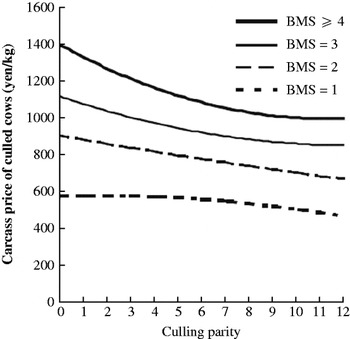
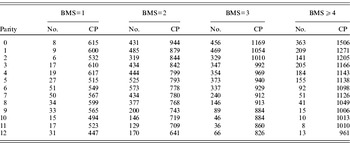
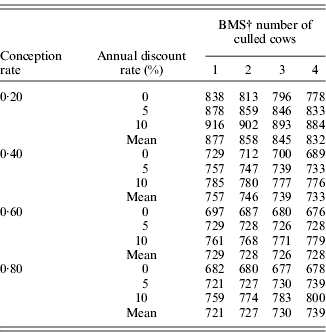
Table 1 shows the least square means of carcass prices (CP; ¥/kg carcass) by culling parity and BMS number, estimated by adjusting for the effects of slaughter year and month and carcass market using the PROC general linear model (GLM) of SAS (1999). The effect of fattening period was excluded from the adjusting procedure because its effect on carcass price was not significant. Culling age was also excluded from the procedure since age was strongly correlated with culling parity in the data. The quadratic regressions shown in Fig. 1 were obtained using PROC REG of SAS (1999) and the equations to estimate CP (¥/kg carcass) based on culling parity and BMS number are as follows:

where pa is parity of cows at culling. Dressing percentage for calculating carcass weight of culled cows was set to 61·35%, which is the average value of carcass weight per body weight in the carcass data.
Quadratic regressions to estimate carcass price of a culled cow by culling parity and Japanese BMS number of the carcass.


The default female calf price of ¥1250 per live weight kg was assumed based on average data for the last 10 years (MAFF 2008). Relative calf price rate of live male to live female was fixed and set to 1·1344.
Setting of cost parameters
For simplicity, only two categories of feeds are assumed in the present study: purchased roughage and concentrates. Seasonal changes in feed ingredients were not taken into account. Feed costs were calculated by multiplying feed prices for different animal classes using the feed requirement. For pre-weaning calves, fixed parameters of efficiency of ME utilization of milk and dietary feed were assumed to estimate total feed requirement. The ratio of concentrates to the dietary feed for pre-weaning calves was set as an age-related linear function derived from JLTA (2007). For post-weaning steers, heifers and cows, feed requirements from roughage and concentrates were estimated based on metabolizability as described by Hirooka et al. (Reference Hirooka, Groen and Hillers1998a). Details about calculation of feed amounts for each animal category are shown in Appendix 2. Prices of concentrates were assumed to be ¥30 and ¥38/kg DM for cows and pre-weaning calves, respectively. Price of roughage was assumed to be 1·30 times higher than of concentrates according to the situation in Japan. As for other production costs, most beef cows are artificially inseminated (AI) in Japan and the cost of AI per oestrous cycle was assumed to be ¥12000. The average cost of AI for all females at parity n were then calculated as the cost of AI per oestrous period multiplied by the average number of mating trials for all females at parity n (Mt(n)). The other costs, including managerial costs and machinery costs, were assumed to total ¥392 per day for producing a calf (MAFF 2009).
Herd composition dynamics
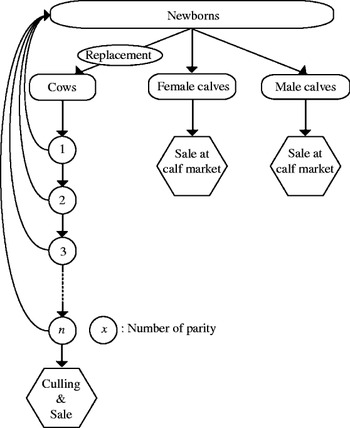
Figure 2 shows the outline of the herd composition dynamics. Three animal categories can be distinguished: male calves, non-replacement female calves and cows. Although the number of cows decreases between each reproduction because of the change in survival rate and the culling of non-pregnant cows in ONE, it is assumed that subsequent home-bred replacement heifers join the herd in each reproduction. It was assumed that all male calves and non-replacement female calves after weaning are sold at 285 days of age in calf markets after the post-weaning growing period. In the present study, optimal culling parity was simulated between parities 3–12. This was because the calculated result using the herd composition dynamics model (Fig. 2) indicated that the herd cannot maintain the initial number of cows with only homebred replacement heifers when reproduction is less than three times. There were no carcass data for culled cows with BMS⩾4 over 12th parity. Cows were culled when their calves born in the optimal culling parity were weaned. Fattening period of cows was not considered in the model because it did not significantly affect carcass price of cows in the GLM analysis described above. Total herd outputs were calculated as individual production traits multiplied by animal numbers in herd components derived from herd composition dynamics. Details of the herd composition dynamics are shown in Appendix 3.
Scheme of the herd composition for Japanese beef cow–calf production.

NPV and AN
The production objective in most enterprises is to maximize the NPV of the entire future stream of residual earnings from the productive process (Perrin Reference Perrin1972), and cull and replace cows when it is optimal to maximize this present value. The NPV of a series of future cash flows, so-called the discounted cash flow, is calculated as follows:

where NPV(pa) is the net present value associated with keeping cows from birth to culling when planned culling parity is set to pa, Day(pa) is the planning days of age of cows when planned culling parity is set to pa, CF(i) is the daily cash flow and dr is the daily discount rate. The daily cash flow is defined as the daily return (estimated only in cases where calves or beef from culled cows are sold) minus daily cost (including feed cost, AI cost and other fixed cost) for cows with i age in days and their calves. The daily discount rate is calculated from annual discount rate as:  , where ydr is the annual discount rate. Here, the discount rate includes three components: a risk-free rate for time preference, an inflation premium and a risk premium (Barry et al. Reference Barry, Ellinger, Hopkin and Baker1995).
However, NPV comparisons are strictly limited to the comparison of replaceable assets having equal lifespans (Meadows et al. Reference Meadows, Rajala-Schultz and Frazer2005). Cows kept for long periods should have a higher NPV as there is more production relative to the cows’ feeding cost. To eliminate this time problem, the NPV associated with each planned culling needs to be converted to an equivalent yearly annuity. This equivalent yearly annuity would be the constant amount of net revenue each year available to farmers (Rogers et al. Reference Rogers, Van Arendonk and McDaniel1988), and is expressed using the following formula:

where EDC(pa) is the equivalent daily cash flow associated with keeping cows from birth to culling when planned culling parity is set to pa, and AN(pa) is the AN (or the estimated equivalent annuity) using EDC(pa) (Meadows et al. Reference Meadows, Rajala-Schultz and Frazer2005). The planned parity at culling with the highest AN represents the optimal targeted herd life.
Evaluation of model outputs
The model developed in the present study evaluates AN and two other production indicators: BE and EE. The BE was defined as total sale live weights of a culled cow and her calves per unit of total ME intake of the herd from birth to culling. The EE was determined as returns over costs, including feed costs and other production costs from birth to culling.
The simulation was first performed under a base situation of Japanese cow–calf production in two mating trial systems. In the base situation, culling parity of cows, female calf price, Japanese BMS number and annual discount rate were assumed to be 6, ¥1250, 3 and 5%, respectively. Sensitivity of BE, EE and AN to changes in conception rate, WW, weaning age, calf market age in both mating trial system was performed. In addition, sensitivity of EE and AN to changes in female calf price and annual discount rate was also performed. For the sensitivity analysis, fixed WW (WW=180) and fixed conception rate (Cr=0.8) were used instead of the WW change function described in Eqn (1) and the conception rate change function described in Eqn (2). The relationships between optimal culling parity and the three indicators were investigated. In addition, difference between the effects of the two economic indicators on determination of optimal culling strategies was analysed.
RESULTS
Simulated outputs under the base situation
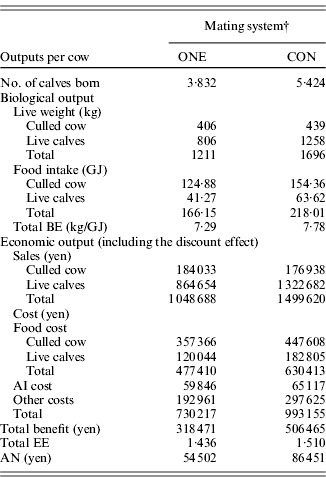
Table 2 shows the simulated outputs per cow under the base situation of Japanese cow–calf production in the two mating trial systems. The Japanese cow–calf production system has so far focused only on revenue from sale of calves. However, the sales of culled cows accounted for 0·18 in ONE and 0·12 in CON. Comparisons between the two mating trial systems showed that the number of newborn calves, BE, EE and AN were all higher in CON than in ONE.
Simulated outputs per cow under the base situation*
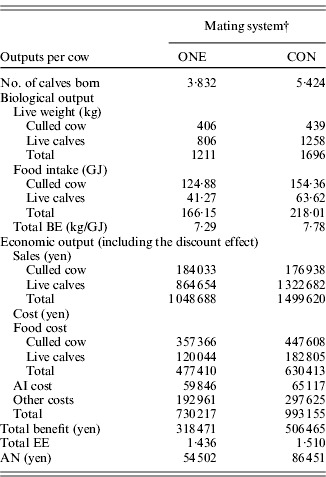
* Culling parity of cows, female calf price, BMS number and annual discount rate were set to 6, 1250, 3 and 5%, respectively.
† One mating trial system v. Bailie's continuous mating trials system.
Sensitivity of BE and EE and AN
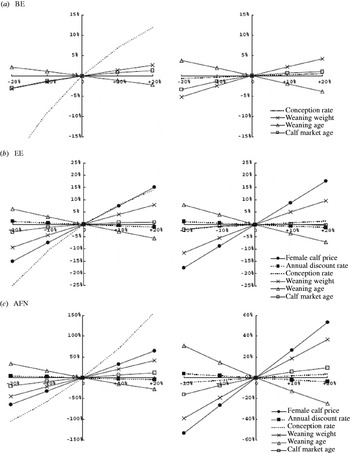
Figure 3 shows the sensitivity of BE, EE and AN to changes in conception rate, WW, weaning age, calf market age, female calf price and annual discount rate in the two mating trial systems. The three indicators were all sensitive to changes in parameters, but the level of sensitivity was different among them. The AN was the most and the BE the least sensitive to changes in the parameters. The three indicators were highly sensitive to changes in conception rate in ONE than in CON. The sensitivity of the indicators to changes in the other parameters was higher in CON than in ONE but the differences in the level of sensitivities between the two mating trial systems were small. The influence of female calf price on the two economic indicators was large but that of annual discount rate was small.
Sensitivity of (a) BE, (b) EE and (c) AN to changes in conception rate, WW, weaning age, calf market age, female calf price and annual discount rate in the one mating (left) and continuous mating (right) trial systems.

Effect of culling parity on BE
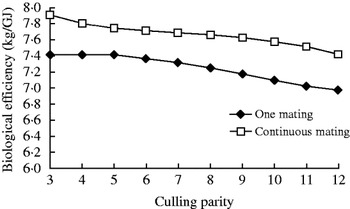
The effect of changes in culling parity of cows on BE in the two mating trial systems is presented in Fig. 4. An increase in culling parity led to a decrease in BE in both systems. When comparing the two mating trial systems, BE in CON was higher than in ONE in all parities of culling but the pattern of decrease was different between the two systems. In ONE, the pattern of the decrease mainly resulted from the changes in conception rate and WW of calves. In addition to the two parameters, the pattern of decrease in CON was greatly affected by the interaction between the reduction and improvement in BE that were caused by extension of mating trial period and constant production of calves having high efficiency of feed utilization.
Effect of change in culling parity of cows on the BE in the two mating trial systems.

Effect of culling parity, BMS number and female calf price on EE and AN
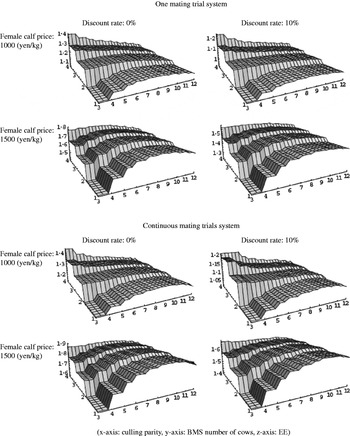
Figure 5 shows the effects of culling parity, BMS number, female calf price and annual discount rate on EE in the two mating trial systems. The optimal culling parity varied depending on levels of BMS number and the female calf price, but did not vary greatly with levels of annual discount rate. Annual discount rate only negatively affected the magnitude of the EE in both systems. When female calf price was ¥1000, optimal culling parity decreased with an increase in BMS number in both systems. However, optimal culling parity gradually increased until the ninth parity in all BMS number categories when the female calf price was raised to ¥1500. Decrease in EE in later parity of culling was a result of the decrease in conception rate and WW of calves. Values of EE were higher in CON than in ONE, especially when the female calf price was high and annual discount rate low.
Effect of changes in culling parity, Japanese BMS number and female calf price on the EE in the two mating trial systems.

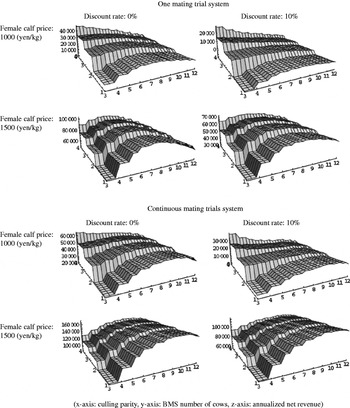
Figure 6 shows the effects of culling parity, BMS number, female calf price and annual discount rate on AN in the two mating trial systems. As was the case for EE, the optimal culling parity varied depending on levels of BMS number and the female calf price. The effect of the change in annual discount rate on AN was slightly larger than on EE. Levels of annual discount rate negatively affected values of AN in both systems, in a fashion similar to EE. When female calf price was ¥1500, AN decreased substantially in later parity of culling in ONE, whereas the rate of the decrease was very low in CON. The decrease in AN in ONE in later parities was associated with a decline in the conception rate because this strongly affected AN in ONE as shown in Fig. 3. Values of AN were higher in CON than in ONE; consistent with the findings for EE.
Effect of changes in culling parity, Japanese BMS number and female calf price on the AN in the two mating trial systems.

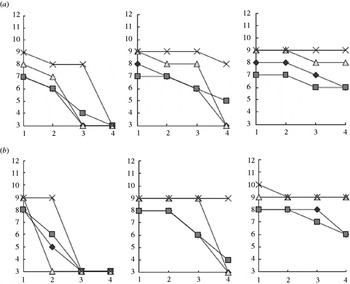
The differences in optimal culling parity between EE and AN with changes in BMS number, female calf price, annual discount rate and the mating trial system, are presented in Fig. 7. This clarifies the difference between EE and AN. When female calf price was set to ¥1000, both indicators in both mating trial systems derived same optimal solutions for BMS number 4 indicating that culling early is the best. For other price settings, however, the two indicators in the two systems did not show same optimal culling parities. An important finding was that EE and AN derived different optimal solutions even in the same mating trial systems. This difference was particularly prominent in the highest BMS numbers with female calf price of ¥1250 in CON. The optimal solutions of AN appear to be relatively stable especially when female calf price was equal to or higher than ¥1250.
Differences in optimal culling parity between EE and AN with changes in BMS number, female calf price, annual discount rate and the mating trial system. (a) Discount rate: 0% (female calf price (yen/kg) – left: 1000, centre: 1250, right: 1500). (b) Discount rate: 10% (female calf price (yen/kg) – left: 1000, centre: 1250, right: 1500).  Economic efficiency (one mating);
 annualized net revenue (one mating);
 economic efficiency (continuous mating);
 annualized net revenue (continuous mating). x-axis: BMS number of cows; y-axis: optimal culling parity.

Break-even values of female calf price
Table 3 shows the break-even values of female calf price when the AN in ONE exceeds the revenue in CON with culling in sixth parity. These values indicate that ONE should be selected when the calf price is lower than the break-even values. The break-even values clearly increase consistently with annual discount rate, and decrease with an increase in conception rate. The effect of the change in BMS number on the break-even value is negative when conception rate is ⩽0·40 and positive when conception rate ⩾0·80. The effect of the change in conception rate on the break-even value was the largest among the three parameters.
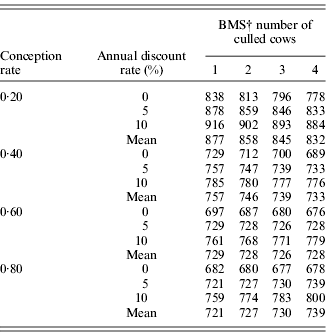
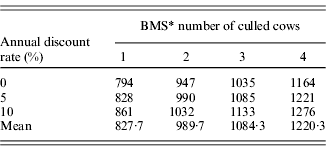
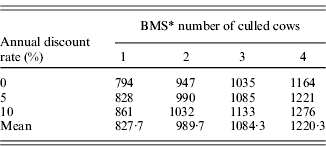
Table 4 shows the break-even values of female calf price when AN at culling in the ninth parity exceeds the revenue at culling in the third parity for CON. These were calculated to verify the effect of changes in calf price, BMS number and annual discount rate on selection of early culling (third parity) or late (ninth parity). Here, late culling was assumed to be in ninth parity, because the average value of optimal culling parity estimated by AN in CON (except when the optimal solutions indicated that the earliest culling was optimal) was equal to 9. The break-even values clearly increase with an increase in BMS number and annual discount rate. The change in annual discount rate was linear to the change in the break-even value. The effect of the change in BMS number on the break-even value was larger than in annual discount rate.
Break-even values of female calf price when the AN at culling in the ninth parity exceeds the revenue at culling in the third parity for the continuous mating trial system
* Japanese BMS number.
DISCUSSION
Evaluation of the base situation
Under the base situation in Japanese cow–calf production, the sales of culled cows accounted for >0·10 in both mating trial systems. This is consistent with the report of Sawyer et al. (Reference Sawyer, Mathis and Davis2004) in the US representing 0·10–0·20 of contribution of culled cows’ beef to the gross revenue. The present result indicated that culled cows are also important revenue sources in Japan. In addition, BE, EE and AN were all higher in CON than in ONE under the base situation. Although the mating cost increases with an increase in mating trial times and the sales of cow carcasses decrease with advancing age at culling, the result indicated that the benefit of calf production exceeded the cost and the loss in sales in the base situation.
Sensitivity of the three production indicators
In the sensitivity analyses, the AN was the most and the BE the least sensitive to changes in the parameters and the three indicators were highly sensitive to changes in conception rate in ONE than in CON. The difference in sensitivity indicates the high dependency of conception rate in ONE since failure to mate will directly affect the production outputs.
The negative influence of annual discount rate on the two economic indicators was smaller than expected. This may be due to the small changes in the rate in the present study. For example, a 20% change in the annual discount rate of 5% is equivalent to only a 1% change in the discount rate. On the other hand, the two economic indicators were highly sensitive to changes in female calf price. This result indicated the importance of considering fluctuations in calf price when estimating the economically optimal culling age of cows, consistent with the study of Clarke et al. (Reference Clarke, Gaskins, Hillers and Hohenboken1984a).
Relationships between culling parity and the three indicators
BE decreased consistently with increasing culling parity in both systems. Similar results have been reported elsewhere (Taylor et al. Reference Taylor, Moore, Thiessen and Bailey1985; Bourdon & Brinks Reference Bourdon and Brinks1987; Baptist Reference Baptist1992). Taylor et al. (Reference Taylor, Moore, Thiessen and Bailey1985) reported a decline in maximum overall efficiency of food utilization as the number of calving per dam increased. Baptist (Reference Baptist1992) also reported that an increase in culling age of cows resulted in a decrease in BE.
In contrast, optimal culling parity greatly varied with the changes in economic parameters when EE and AN were used as production indicators. When female calf price was ¥1000, the two economic indicators were maximized at the lowest culling parity for the highest BMS number and at later parity of culling for the lowest BMS number. Reduction in female calf price led to a low optimal culling parity, especially when BMS number was high. At low calf prices, revenue from sales of culled cows contributed greatly to the total sales because of low sales of its calves. This clarified the effect of differences in carcass quality of cows on the economic indicators.
Comparison of three production indicators
The patterns of change in BE and AN were similar when the female calf price was lower than the average price of culled cows for each BMS number. The decrease in BE in the present study appears to be due to the fact that the difference in prices between culled cows and their calves was not considered in calculating BE. The change in BE corresponds to the extreme case of no price difference between culled cows and sales of calves in AN. Hence, AN can express production efficiency just like BE according to the changes in the setting of production circumstances. Comparison between the use of EE and AN in determining optimal parity at culling in the present study indicates that choice of economic indicators is important for evaluating animal production systems. Sensitivity of biological and economic parameters on AN was higher than on EE. This suggests that AN is more effective in the evaluation of animal productions than EE. The AN directly implies production benefit and thereby it is easily understandable by decision makers. Therefore, the use of the AN is recommended as a measure of production efficiency.
Selections of ONE or CON and early or late culling
The results in Table 3 indicate that CON is better than ONE unless calf price is extremely low. Even though extension of calving period by a decrease in conception rate accumulates costs of mating and feeding and also decreases the quality of cow carcasses, increasing sales of calves by continuous mating can compensate for the negative effects of CON. Therefore, mating should continue as long as the breeding season continues. Clarke et al. (Reference Clarke, Gaskins, Hillers and Hohenboken1984b) simulated culling strategies for beef production and concluded that culling non-pregnant cows improved EE; however, the relative price of live calves to non-pregnant cows was low in that study. Hence, relatively higher calf price compared with culled cow carcass price should give high NPV for calf production.
The mean prices of the break-even values of female calf price in Table 4 were all higher than the average carcass prices of culled cows with corresponding BMS number calculated from Table 1 (BMS number 1: ¥556, 2: ¥787, 3: ¥950, 4: ¥1130). This result indicated that culling in early parity is the best choice when the female calf price is the same as carcass price of culled cows.
The mean prices in Tables 3 and 4 indicated that, in the actual Japanese Black cow–calf production, cows should be mated continuously to the extent possible and be culled in later parities, because the average price of live calves for the last 10 years in Japan has been ¥1250, which was higher than the mean values.
Effect of carcass price of culled cows
In general, culling of cows later in their lifetime may be caused by high sales price of calves compared to that of culled dams. For commercial beef cow–calf production in USA, Melton et al. (Reference Melton, Colette, Smith and Willham1994) developed a bio-economic simulation model and reported that an increase in culled cow price relative to the calf price results in cows being culled at an earlier age. Naazie et al. (Reference Naazie, Makarechian and Hudson1997) mentioned that the decline in overall efficiency with an increase in culling age of cows may be a result of high price of culled cows. Bourdon & Brinks (Reference Bourdon and Brinks1987) concluded that optimal age at culling of cows has a negative relationship with relative price of culled cow to her calves. The present studies are consistent with those results, indicating that calf prices lower than the break-even values (Table 4) resulted in the reduction in optimal culling parity.
The calf market situation in Japan is dynamic. The average calf price per kg body weight went below ¥1000 when cases of bovine spongiform encephalopathy (BSE) were reported in Japan (MAFF 2008). The present study shows that, when the price of live calves is low, the difference in BMS number of cows should be of great importance in determining the economically optimal culling parity of cows. This result stresses the importance of the difference in beef quality of culled cows in optimization of whole production, and thus it may be necessary to predict BMS number of cows before effecting culling decisions.
The differences in beef quality have raised concern when evaluating cattle production systems not only in Japan but also in Europe and the US. Bekman & Van Arendonk (Reference Bekman and Van Arendonk1993) introduced the EUROP classification into their model to estimate economic values for veal, beef and milk production traits and evaluate the difference in the quality of beef and veal. Liinamo & Van Arendonk (Reference Liinamo and Van Arendonk1999) also analysed the effect of changes in price difference between carcass categories of dairy cows on predicted total monetary response in alternative selection strategies. In the US, a relationship between carcass value and body condition of beef cows to optimize economic returns and USDA carcass grading information has been reported (Apple Reference Apple1999). Beef quality is evaluated primarily by physical characteristics that are associated with age (Yager et al. Reference Yager, Greer and Burt1980) or reproduction, as shown in the present study. Therefore, culling policy should be examined in the context of differences in beef grade of culled cows.
CONCLUSIONS
The present study showed the differences between BE, EE and AN in determining the optimal culling strategy. Comparisons between the three indicators showed that they all derived different optimal solutions even in the same mating trial systems, stressing the importance of choice of production indicators when determining the culling strategy and evaluating animal production. In addition, the study demonstrated the importance of culled cows’ beef quality when determining economically optimal culling parity of cows in the Japanese Black cow–calf production system. The changes in optimal culling parity and the price changes of culled cows’ beef as a result of the differences in beef grade play a significant role in the economic evaluation of beef production systems.
APPENDIX 1
EXPLANATION OF SYMBOLS AND SEVERAL FIXED PARAMETERS IN THE MODEL

APPENDIX 2
MORTALITY
Mortality of calves (dcmort) and cows (dmort) per day are calculated as

where cmort is proportional mortality before weaning, mort is annual proportional mortality of cows and t wean is days from birth to weaning.
DAILY BODY WEIGHT CHANGE AND DAILY MILK YIELD
The form of the growth curve is expressed using birth weight (BWx) and WW (WWx) as

where A x, Bx and K x are Brody's growth curve parameters. From the functions, daily gain is expressed as

Here, Brody's parameter A x is assumed to be mature weight (MWx). Since both functions of DGx(t) should be equal at weaning, parameter B x and K x can be calculated as

These growth curve functions are modified with the change in WW derived from the WW change function (Eqn (1)) described in the text.
The total weight of the conceptus added to maternal weight for the last 2 months of pregnancy is estimated as (AFRC 1993)

where t c is days from conception (222⩽t c⩽t preg).
Daily milk yields of cows were estimated using Wood's lactation curve (Wood Reference Wood1967) as

where t m is days after calving, a, b and c are Wood's parameters. In the model, parameters b, c and total milk yield in lactation period (TM, kg) are given as animal traits shown in Appendix 1. Using these parameters, the parameter a is calculated as

ME AND DMI REQUIREMENT
The series of mathematical expressions about ME (Mcal/d) and DMI (kg/d) requirement of Japanese Beef cow–calf production at an individual level was based on AFRC (1993) and NARO (2009). Briefly, expressions to calculate ME and DMI are separated in two categories: pre-weaning calves and post-weaning animals (steers, heifers and cows). ME calculations for pre-weaning calves accounts for the energy from the cow's milk and dietary feed (roughage and concentrates). The explanation of symbols is shown in Appendix 1.
[ME and DMI requirement for calves before weaning].
- Calculation of the ratio of dietary feed to total feed on a DM basis

- Calculation of ME requirement from milk and dietary feed

- Calculation of ME per kg DM of total feed using msrate(t)
- Calculation of DMI from dietary feed


[ME and DMI for steers, heifers and cows after weaning]
- ME requirement for maintenance and growth
- For steers and non-pregnant heifers
- For cows
- Calculation of DMI


FEEDING AMOUNTS OF ROUGHAGE AND CONCENTRATES
Quantity of roughage and concentrates for pre-weaning calves and post-weaning animals were calculated as the product of DMI and the proportion of roughage or concentrates in the total feed.
- For pre-weaning calves
The ratio of concentrates to dietary feed was estimated from the equation derived from JLTA (2007) as
where t⩽t wean. This ratio is variable with the age of calf (t).- For post-weaning animals
The ratio of concentrates to total feed was estimated from the equation derived from Hirooka et al. (Reference Hirooka, Groen and Hillers1998a) as
where MEc/ME is the proportion of concentrates, q c and q r are metabolizabilities of concentrates and roughage, and q is the overall metabolizability of feeds. This ratio is not variable when all parameters about metabolizability of feed are fixed.


APPENDIX 3
HERD COMPOSITION DYNAMICS
In the present study, the simulation was performed assuming that the number of replacement heifers at the start of simulation is 1·0. From this number, N(pa, n) matrix was calculated and indicates the number of cows at reproduction time n when the cows are kept until culling parity pa (n⩽pa). The N(pa, n) matrix is calculated with the mortality, and only in case of selecting one mating trial system described in the text, with the mortality and the conception as follows:
In ONE

where t cl is a fixed calving interval (357 days).
In CON

where T cl(n) is the calving interval function described in the text.
Using the matrix, total number of newborns (Tnb(pa)) and replacement of cows (rep(pa)) are expressed as

The denominator of the expression of rep(pa) theoretically represents the sum of female calves when the sex ratio is 0·5. Using N(pa, n) and rep(pa), the numbers of newborn male calves (Ncalfm(pa, n)) and non-replacement newborn female calves (Ncalff(pa, n)) born from cows at nth parity are: