


Introduction
Mental imagery is a phenomenon characterized by having a perceptual experience without an associated external sensory stimulus (Kosslyn et al., Reference Kosslyn, Thompson and Ganis2006). Mental imagery has been shown to be both a causal and maintaining factor in adult psychiatric disorders (Harvey et al., Reference Harvey, Clark, Ehlers and Rapee2000; Hirsch et al., Reference Hirsch, Clark, Mathews and Williams2003). Examination of mental imagery in adolescent psychopathology, compared with imagery in adult psychopathology, is insubstantial (Burnett Heyes et al., Reference Burnett Heyes, Lau and Holmes2013).
Qualitative and quantitative methods (de Silva, Reference de Silva1986; Harvey et al., Reference Harvey, Clark, Ehlers and Rapee2000; Pratt et al., Reference Pratt, Cooper and Hackmann2004) have been used in the adult literature to formulate cognitive models of anxiety disorders and associated interventions (e.g. Clark and Wells, Reference Clark and Wells1995; Ehlers and Clark, Reference Ehlers and Clark2000; Rapee and Heimberg, Reference Rapee and Heimberg1997). Imagery has a strong effect on behavioural and cognitive symptoms in agoraphobia (Day et al., Reference Day, Holmes and Hackmann2004), obsessive-compulsive disorder (OCD) (Speckens et al., Reference Speckens, Hackmann, Ehlers and Cuthbert2007), post-traumatic stress disorder (PTSD) (Grey and Holmes, Reference Grey and Holmes2008), social anxiety disorder (SAD) (Hirsch et al., Reference Hirsch, Clark, Mathews and Williams2003; Hirsch et al., Reference Hirsch, Clark and Mathews2006) and specific phobia (Pratt et al., Reference Pratt, Cooper and Hackmann2004).
Imagery in adolescent anxiety disorders has not, to our knowledge, been examined qualitatively. (Studies have examined intrusive imagery in children and adolescents outwith the class of anxiety disorders, including in those with PTSD (Eksi et al., Reference Eksi, Peykerli, Saydam, Toparla and Braun2008) and OCD (Farrell and Barrett, Reference Farrell and Barrett2006), but these are beyond our focus.) Almost all quantitative studies with children and adolescents have examined imagery in the context of SAD or social anxiety symptoms, and studies have typically investigated features of adult models of anxiety disorders. Hignett and Cartwright-Hatton (Reference Hignett and Cartwright-Hatton2008) conducted an observational study with a non-clinical sample of 12- to 18-year-olds to test the hypothesis that socially anxious individuals see images of themselves from an observer- (rather than a field-) perspective (Clark and Wells, Reference Clark and Wells1995; Rapee and Heimberg, Reference Rapee and Heimberg1997). They found a significant positive relationship between self-reported social anxiety and observer- (rather than field-) perspective. Schreiber and Steil (Reference Schreiber and Steil2013) conducted a cross-sectional study with adolescents with primary SAD or no psychiatric disorders. They found that negative self imagery (NSI) was more often from an observer- (than a field-) perspective in the index than control group, and that NSI was more frequent, vivid and distressing in the index than control group. Alfano and colleagues (Alfano et al., Reference Alfano, Beidel and Turner2008) used an experimental design with three groups of 12- to 16-year olds; an index group of 21 with social phobia and 42 without psychiatric disorders split into two control groups. All undertook two social stress tasks (reading aloud in front of a same-aged peer, and conducting role plays with a same-aged peer). NSI was no more common in the index group during the social stress tasks than the control groups. The results of these quantitative studies suggest similarities between adults and adolescents with SAD (e.g. increased frequency of observer- vs field-perspective in images) and differences (e.g. while NSI occurs during social stress tasks for adults with SAD (Hirsch et al., Reference Hirsch, Clark, Mathews and Williams2003) it did not for adolescents with SAD).
Ozsivadjian et al. (Reference Ozsivadjian, Hollocks, Southcott, Absoud and Holmes2016) reported the only study, to our knowledge, that has not limited its focus to social anxiety, and has sought to understand imagery in children and adolescents with high anxiety symptoms, but without comparing phenomena with the frameworks of adult models. They examined whether, and to what extent, spontaneous imagery was experienced by four groups of children aged 8–16 years: (i) autism spectrum disorder (ASD) with high parent-reported anxiety symptoms, (ii) ASD with low parent-reported anxiety symptoms, (iii) no ASD with high parent-reported anxiety symptoms and (iv) no ASD with low parent-reported anxiety symptoms. Spontaneous imagery was more common in (i), (ii) and (iii) than in (iv), and, irrespective of ASD status, high-anxiety children reported more frequent experiences of spontaneous imagery than low-anxious children. This gives us preliminary evidence of a quantitative relationship between imagery frequency and symptoms of anxiety in young people. We are unable, however, to draw conclusions about the nature of spontaneous imagery in adolescents with anxiety disorders for two reasons: first, the age range (8–16 years) spans many important features of development and maturation (e.g. Blakemore, Reference Blakemore2008) and second, the absence of diagnosed anxiety disorders.
The present study is the first qualitative examination of imagery in anxiety disordered adolescents. We conducted an exploratory qualitative study in which we interviewed adolescents with anxiety disorders. Our aim was to explore adolescents’ experiences of spontaneous imagery in the context of anxiety disorders.
Method
Participants
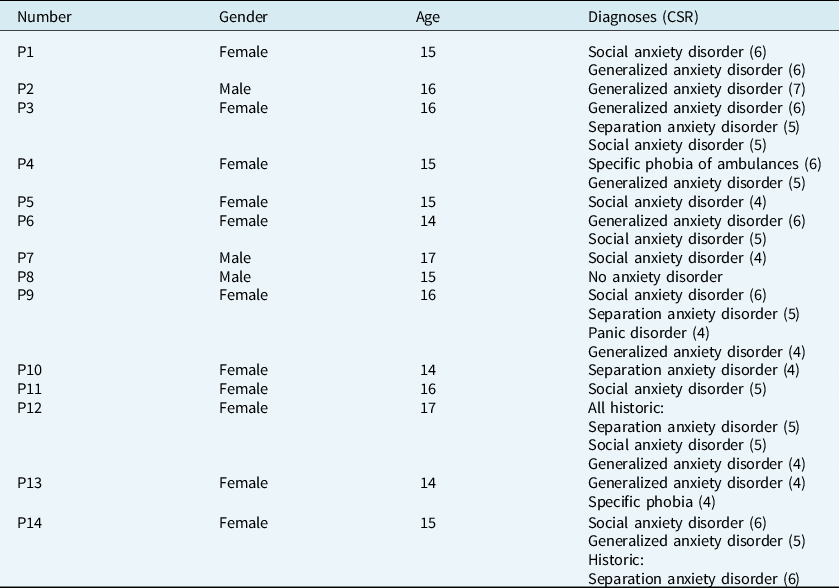
We recruited 32 participants (aged 13–17 years) from the community, using purposive sampling via two routes: one participant came from an ongoing natural history study of the intergenerational transmission of anxiety disorders (Murray et al., Reference Murray, Cooper, Creswell, Schofield and Sack2007), and all other participants were recruited via advertisements. To participate in the study, participants had to score above a clinical cut-off on a standardized measure of anxiety, meet DSM-5 diagnostic criteria for current or lifetime anxiety disorders (APA, 2013), and be able to describe their experiences fluently in English. See Table 1 for clinical details.
Participant characteristics

CSR, Clinician Severity Rating.
Procedure
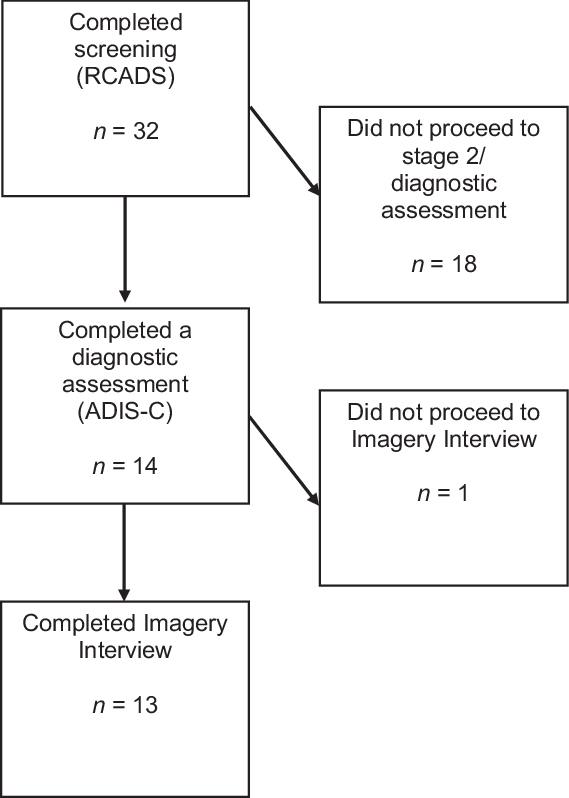
Participants were recruited in two stages: first screening (n = 32) and second, diagnostic assessment (n = 14) (see Fig. 1). We advertised our study via social media (Twitter and Facebook) and posted study fliers in schools in three counties in the south of England. In stage 1, potential participants were screened for anxiety using a standardized measure (see ‘Anxiety measures’ below). In stage 2, we gathered diagnostic information only from those who scored above the clinical cut-off for anxiety on this measure. All diagnostic assessments were conducted by one of two authors (P.L. or E.T.) face-to-face with adolescents either in university laboratories, or via Skype. All imagery interviews were conducted at participants’ homes, or in university laboratories, and audio recorded by one of two authors (A.G. or E.T.) and transcribed verbatim. Three were conducted face-to-face, 10 via Skype, and ranged from 20 to 40 minutes. Recruitment was completed once we had reached thematic saturation (Braun and Clarke, Reference Braun and Clarke2006) with 13 participants.
Recruitment through stages 1 and 2 to the Imagery Interview. ADIS-C, Anxiety Disorders Interview Schedule: Child Version; RCADS, Revised Child Anxiety and Depression Scale.

Anxiety measures
Screening
The Revised Child Anxiety and Depression Scale (RCADS) (Chorpita et al., Reference Chorpita, Yim, Moffitt, Umemoto and Francis2000) was used to screen participants for clinical anxiety, and its clinical cut-offs (7 for generalized anxiety; 12 for panic; 5 for separation anxiety; 10 for social anxiety) (Chorpita et al., Reference Chorpita, Moffitt and Gray2005) to inform our decisions regarding whether to conduct full diagnostic assessments.
Diagnostic assessment
We used the Anxiety Disorders Interview Schedule: Child Version (ADIS-C) (Silverman and Albano, Reference Silverman and Albano1996) to assess whether participants met criteria for a diagnosis of an anxiety disorder. Symptoms of the disorder must lead to significant impairment for a diagnosis to be assigned. Impairment is quantified using the Clinician Severity Rating (CSR), on a scale from 0 to 8. A CSR of 4 or higher is required for diagnostic criteria to be met. Two authors (A.G. and E.T.) were trained and reliable in conducting the ADIS-C. Thirteen of the 14 adolescents who undertook a diagnostic assessment met criteria for at least one anxiety disorder (of whom one had lifetime anxiety disorders only).
Semi-structured Imagery Interview
A.G. and E.T. (masters’ level students trained and experienced in conducting semi-structured interviews with adolescents attending a university-based research clinic for adolescents with affective disorders), conducted the Imagery Interviews. We used semi-structured interviews to conduct one-to-one in-depth exploration of participants’ experiences of spontaneous mental imagery. Out topic guide was developed from the ‘Imagery Interview’ used by Ozsivadjian and colleagues (Ozsivadjian et al., Reference Ozsivadjian, Hollocks, Southcott, Absoud and Holmes2016) [itself modified from Hackmann and colleagues’ interviews with adults with anxiety disorders (Day et al., Reference Day, Holmes and Hackmann2004; Hackmann et al., Reference Hackmann, Surawy and Clark1998; Pratt et al., Reference Pratt, Cooper and Hackmann2004)]. It differed from the Imagery Interview used in earlier studies in at least two key ways. First, while we began each interview by asking participants about their experiences of imagery in general (so, not necessarily related to anxiety), the main focus of our questions was on participants’ experiences of the intrusive imagery that occurred in the context of their anxiety. In contrast, Day et al. (Reference Day, Holmes and Hackmann2004) used a topic guide which specified particular scenarios for participants to imagine; for example, being alone in a large expanse of space with no one around to help should something go wrong. Second, we did not seek quantification of features of imagery, while other Imagery Interviews did (for example, ratings on a 0–10 scale of the intensity of particular pre-specified physical anxiety disorder symptoms such as heart palpitations, and the clarity of the image described to them). We included questions in later interviews relating to issues raised by participants in earlier interviews. For example, only once the earliest participants had described their emotions and thoughts about experiencing intrusive imagery, did we explicitly ask subsequent participants to tell us about their thoughts and feelings about experiencing intrusive imagery. Before asking questions about adolescents’ experiences of imagery, we explained what we meant by ‘imagery’: ‘pictures, sounds, tastes, anything that you have experienced in your mind’s eye’. We used participants’ own words, and verbal and non-verbal cues to encourage them to elaborate their responses.
Analysis
Thematic analysis is a systematic approach consisting of six stages: familiarization with the data; generating initial codes; searching for themes; reviewing themes; defining and naming themes; and producing the report (Braun and Clarke, Reference Braun and Clarke2006). We completed these to gain an understanding of adolescents’ experiences of mental imagery in the context of anxiety disorders. We used a hybrid approach of inductive and deductive analysis (Fereday and Muir-Cochrane, Reference Fereday and Muir-Cochrane2006) because we sought both to identify commonalities with existing adult literature, as well as to identify themes where there was no extant qualitative literature; that is, in adolescents with anxiety disorders.
Analysis was primarily conducted by two authors (A.G. and E.T.). Between interviews, two authors (A.G. and E.T.) transcribed their own imagery interviews and, having familiarized themselves with all transcripts (Lapadat and Lindsay, Reference Lapadat and Lindsay1999), independently conducted initial coding of these. While immersed in the data, two authors (A.G. and E.T.) independently generated candidate themes, and discussed these with the third author (P.L.). These discussions were iterative, in that candidate themes from early interviews were re-visited in light of data from later interviews. Where discrepancies were identified, data were revisited to resolve these. To enhance the quality of our research, we followed the criteria outlined by Lincoln and Guba (Reference Lincoln and Guba1985) to ensure trustworthiness (that is, by establishing credibility, transferability, dependability and confirmability). For example, the credibility of our analysis is supported by our use of triangulation of sources and analyst triangulation; and its confirmability by keeping a clear audit trail of our analyses and by an author (P.L.) keeping a reflexive log during analysis.
Results
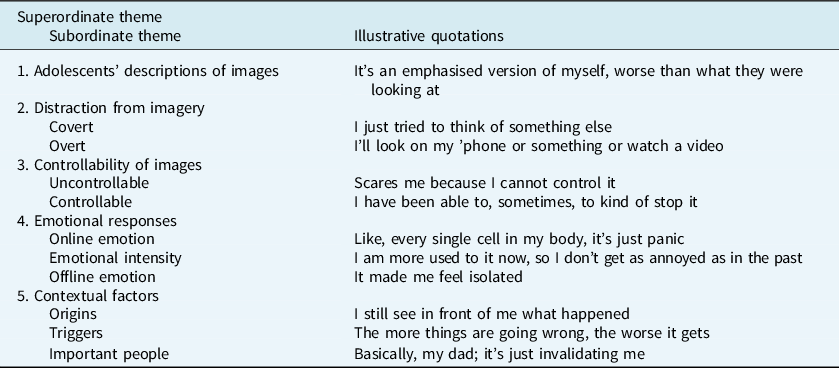
We identified five superordinate themes (see Table 2). We have included anonymized quotations from participants (references are made to participant numbers) to promote the transparency of our work. (Please see Supplementary material for more illustrative quotations.)
Superordinate and subordinate themes

Adolescents’ interpretations of images
In keeping with expected themes from an anxious sample, participants described images where events were imagined with catastrophic outcomes. For example, in describing a possible outcome of going cycling with friends, one participant reported: our lights might fail, that we’d be in the dark, that we’d be soaking wet and we wouldn’t know where we were or how to get out of where we were (P11).
Some participants spoke about features within an image that they enhanced. These could relate to how they appeared in an image: I can imagine myself looking, like a, well I suppose, logically, it’s an emphasized version of myself … worse than … what they were looking at (P7); as well as to exaggeration of features other than themselves:
Interviewer (I): In what way would it be more exaggerated do you think? How did you imagine that?
P13: A lot more impulsive and aggressive and them just shouting at me and getting really annoyed with me.
I: Okay, and why do you think that would be more exaggerated?
P13: Because I never really say much that they don’t like and, if I have in the past, then they’re much calmer people than I imagine them. And most of the time, no one really notices if I say something that I thought they wouldn’t like.
Some participants reported that their field of vision was limited, but that they had not tried to limit it: it feels quite real, but like, I see a lot less in it than I’d see in real life. Like, there’s a circle of stuff that I see, then, like, all around that is black. Like, I see the people either side of me; I see in front of me; but I don’t see above me or around me, I just see um, I just see, like, that (P10).
Interestingly, participants reported that the content of their images had an impact on their perception of reality:
P13: Then, if I feel really sad already, then the images just kind of go away and it’s just a black space.
Interviewer: Okay. Is it just your mind that’s black or is the room and everything else black?
P13: Mainly just my mind but then everything in reality seems a lot colder and darker.
Distraction from imagery
Covert distraction
When reflecting on the strategies they used to stop focusing on their images, participants reported using verbal distraction techniques which appeared to be either neutrally or positively valenced or to actively construct positive thoughts. Verbal strategies were often neutrally valenced: I’ll do the ABC’s backwards or something, anything to stop thinking about it (P10), and verbally reassuring: usually, like, I think, like, ‘no, it’s going to be ok, nothing will go wrong’; like, all the rehearsals has gone well, there is no reason to worry (P5). Participants also reported actively constructing positive thoughts: I can also try and think about the dress rehearsal … I also try and think about things that go well instead of things not going well (P5) and: I just tried to think of something else. Think about not being sick. I think about different things, like happy thoughts (P6).
Overt distraction
Participants also reported finding distraction from their images by engaging in observable behaviours. These require passive or active physical engagement in an observable activity to achieve distraction. An example of a passive distraction: um, maybe I’ll look on my phone or something or watch a video or something like that, take my mind off it (P3). Some participants described choosing an enjoyable task as a form of distraction: I found something that I really like to do so I really like playing video games, um, so now whenever I play video games I don’t see them [intrusive images] anymore (P14).
Other participants spoke about using more physical activities to distract themselves. When asked how he makes his images ‘go away’ one participant explained how he focuses on the physiological response of his body when he takes a deep breath: I just sort of took a deep breath and imagined how like that, I imagine the path that the air was taking and it came in and out and I just sort of focused on that (P10).
Controllability of images
Uncontrollable
When talking about trying to control his image, one participant explained that: it’s just making it worse. It’s like trying to tell someone to not think about a yellow car. That is basically, I cannot control it. The anxiety will spike, really (P2). When asked whether they could control their images, they found the idea humorous: No, not in the slightest (short laugh) that’s why it overwhelms me so much and scares me because I cannot control it (P2).
Controllable
Other participants reported that they were able to control their images. For example: [I] focus my mind on something else [so that the images] kind of fade into the background or just fade away. Or maybe just stop me hearing things or seeing it (P3). Some participants explained how the emotional valence of a controlled image is important to them: but like, I’d have to keep it positive … it can turn into a negative image, or situation quite quickly (P11). While some participants were able to articulate their strategy for controlling the image: I feel like if I clench my fists it will stop, it kind of brings me back to the sensation of that and I can’t see what’s in my mind anymore […] I have been able to, sometimes, to kind of stop it (P9); others referred to a sub-conscious strategy that: sort of works actually… I feel it might have some sort of unconscious effect, it’s, I dunno, I’ve been doing it for years. I feel like it works (P7).
Emotional responses
Online emotions
Common emotions participants reported experiencing while they had their images or directly after (that is, online) included feeling anxious: more like worried or anxious about the performance because I can see that it can go wrong and I am going to think that is going to happen because I have seen in my head (P5); scared: So I get really scared, I do not know how to deal with it and I feel quite frozen. I am very uncomfortable (P9), and panicked: It’s like I cannot control what I feel in that moment. It’s just panic. The only thing I feel in every part of my body. Like, every single cell in my body it’s just panic (P2).
Participant 12 reported a novel view – while acknowledging the distress she experienced during her imagery, talked about how the function of the image could be to make her feel more prepared and reassured: I mean, I feel, obviously it’s a bit distressing, but at the same time, kind of, if I know different, kind of ways it might be able to go, I feel a bit more like, planned and reassured…. if I know what different ways the situation could go, a bit like, like putting it out in my head, then I feel like a bit more prepared (P11).
Emotional intensity
Some participants reported that, although the emotions they experienced while they had their images were stable over time, the intensity of the emotions varied. Some spoke of experiencing emotions with less intensity than in the past, even though the image did not alter over time: I’m not as scared of it as I was, ‘cause I kind of understand it (P3); I think I am more used to it now, so I don’t get as annoyed as in the past when it was worse. The emotions were stronger back then (P6). One participant proposed why they now experienced less emotional intensity: the emotions that I got the first time were a lot more intense like, because I have never seen this image before, like it never happened…. But [now] I just know that I am going to see it and what I am going to see. Whereas before I didn’t know what to expect (P5). Participants also reported that they experienced emotions with greater intensity than in the past: Maybe in the beginning I wasn’t that irritated. Now I get more irritated (P1). One participant proposed that context was a possible modifier of emotional intensity: It’s always the same. Like the intensity changes depending if I had a particularly bad day. But it’s mainly just terror. It’s the same thing every time (P2).
Offline emotions
Participants spoke about the feelings they had about their experiences of mental imagery (that is, not during or directly after, but on reflection or ‘offline’). These emotions included anger: a lot of the time it makes me feel angry about myself, like you know, for having them. It makes me angry with other people that they don’t have to have them. And it makes me angry with myself for having them (P3), frustration: I’m frustrated… I don’t want to have them (P14), and loneliness: it made me feel isolated and having racing thoughts about moving school to a grammar school. I felt like I am alone, and nobody would help (P9). A more positive experience was reported in terms of acceptance: I have learnt that it’s part of me and I can’t really change it, or I don’t know how to change, if there is a way of changing it. So, I just I just gave up, if it happens it happens and I have to live with it (P4).
Contextual factors
This theme captures what participants told us about contextual factors, such as the origins and triggers of their intrusions, as well as their perception that important people, such as peers and teachers, could have an influence on their experiences of intrusive imagery.
Origins
In almost all cases, participants identified a particular event, often stressful, that coincided with their first recalled anxious image (i.e. a memory): It was in July this year. I still see in front of me what happened. Mainly what I see is a door smashing and glass going everywhere and, like, I am actually on the boat in the middle of the sea, I see the hails [sic] like it is happening in front of me (P7). I think it was about a couple of weeks into the term and I run across the road without looking. A car nearly hit me. Then somebody just came as the car swept by as I am crossing the road. And ever since I started to picture like, seeing that in my mind (P9).
Triggers
Participants reported that their images were commonly triggered by feeling stressed or fatigued: Just, like, how stressed I am. Like, I am feeling particularly manic that day. Just like the general things that would affect mental health. Like, how I have been eating, how was work. The more things going wrong, the worse it gets (P1). Similarity with the environment which led to the first intrusive episode was also identified as a common trigger. For example, when imagery was related to being bullied at school, the participant reported school environment as main trigger: It pops out of nowhere, but I think it comes frequently because school is a big part of my life and because I have a lot of anxiety and worry at school it can kind of come in with that (P7).
Important people
Participants perceived that other people could influence their images. Young people reported that their peers, family members and teachers could both influence, and be triggers of, their images.
When the participants reported their peer group as having an impact on their intrusive imagery episodes, it was generally negative. Young people expressed their concern with being misunderstood by their peers about their intrusive imagery experience: I get really scared when it happens […] My friends noticed that I’m really scared on the road but I don’t really tell them why because I just think they’ll think I’m not really, like, I’m quite weird, like it’s not really needed or that I’m putting it on or that I can control it. I won’t cross until there’s a green man but if I say to them ‘Oh no, it’s because I get this picture, cos I see something’ they will just think I am over-dramatic or just making it up (P9).
In some cases, participants identified links between their intrusive imagery and family. Parents were described as lacking understanding and invalidating the young person’s intrusive experience: Yeah, but basically my dad – it’s just invalidating me, which was delightful for a 13-year-old [Laughs]. It’s delightful to be told ‘You’re being stupid!’ like just ‘don’t think about it!’ and I am like ‘Oh brilliant, haven’t thought about this one, yet!’ (P2). One participant identified an early experience, related to her mother’s reaction in a particular situation, as the source for her later intrusive imagery episodes: The one crossing the road, I think it’s just like one time when I was little, I was in London and we were crossing the road. And I kind of stepped out without looking and mum grabbed me back screaming. She was like ‘You never cross the road without looking, you never do that!’ and she was really, like, really scared. But she really scared me because she was so scared. And I think that even from a young age that kind of set the fear in (P9).
Teachers’ influences on intrusive imagery experience were identified as having a negative impact. Some young people identified a teacher as an active factor in triggering intrusive images: Yeah, so the first time when I first started like seeing myself going wrong that was the time, like a couple of years ago when I had like the teacher for dancing was really, really, really stressed and she got like putting the stress that was going to her on us and she would get really panicky and shouty before the shows and that is probably what cause it, when it first started my anxiety about going wrong (P4).
Discussion
This is the first qualitative study to report adolescents’ experiences of imagery in the context of anxiety disorders. We interviewed 13 adolescents with anxiety disorders and identified five themes, elucidating anxiety disordered adolescents’ cognitive, behavioural and emotional experiences relating to intrusive imagery. Adolescents’ accounts of imagery were rich and yield a strong basis for considering imagery to play an important role in understanding anxiety disorders in adolescents.
We cannot discuss our findings with respect to other qualitative studies examining imagery in adolescents, whether with or without anxiety disorders, because, to our knowledge, none has been reported. Thus, we discuss our findings in the context of the quantitative literature regarding imagery in adolescents and adults.
Adolescents reported positive and negative emotional responses to spontaneous images. Consistent with quantitative literature (Hignett and Cartwright-Hatton, Reference Hignett and Cartwright-Hatton2008; Schreiber and Steil, Reference Schreiber and Steil2013) adolescents reported feeling anxious, panicked and scared while experiencing images. Interestingly, one adolescent described the function of a distressing image as helping her to feel reassured and prepared that she could deal with a stressful situation. While distressing images are commonly associated with negative feelings (Holmes et al., Reference Holmes, Arntz and Smucker2007), this example highlights the importance of assessing possible positive function and meaning of anxious adolescents’ images in clinical contexts (Wells, Reference Wells2000). Adolescents also described how they felt about experiencing anxious imagery, covering a spectrum of positive and negative emotions, from acceptance to anger and loneliness. This ‘offline’ impact of imagery on emotions is a novel feature which, to our knowledge, has not previously been reported in the adolescent or adult anxiety literature.
The majority of features of our themes had not been reported in the adolescent anxiety literature; but many features have been examined in the adult anxiety literature. Interestingly, adolescents reported taking an active role in constructing their images. This fits squarely with a fundamental tenet of cognitive models of anxiety disorders in adults (Clark, Reference Clark2004): that people’s interpretations of experiences, not experiences themselves, drive anxiety. In Beck’s conceptualizations of cognitive therapy (e.g. Beck, Reference Beck1976; Beck et al., Reference Beck, Rush, Shaw and Emery1979; Beck et al., Reference Beck, Emery and Greenberg2005) he described different information processing biases (or ‘cognitive distortions’) to help explain people’s thinking in the context of depression or anxiety. In our study, adolescents reported imagining events with extremely unlikely negative outcomes (consistent with ‘catastrophizing’), enhancement of particular distressing features in images (consistent with ‘magnification’) and editing their field of vision (consistent with ‘selective abstraction’) (Beck, Reference Beck1995).
Adolescents’ behavioural responses to anxious images have not been reported in the literature. In the adult literature, it is established that anxious adults will often try to shift their attention away from distressing images by distracting themselves (Borkovec and Inz, Reference Borkovec and Inz1990), and we found this to be the case with adolescents. What remains unclear from the adult literature, however, is the extent to which attention can be shifted from anxious distressing images via verbal distraction (Holmes et al., Reference Holmes, Brewin and Hennessy2004) or whether a task in a different modality is required (Bourne et al., Reference Bourne, Frasquilho, Roth and Holmes2010; Kemps and Tiggemann, Reference Kemps and Tiggemann2007). In our study, adolescents reported successful use of verbal strategies to distract themselves from distressing images. In anxious adolescents, this issue might be elucidated via experimental investigation of the effectiveness of distraction from distressing images in verbal and non-verbal tasks.
Contextual influences on imagery have not been reported in the adolescent literature. Yet, there were features in common with those reported in the literature regarding the origins of images in anxiety disorders in adults; namely that intrusive images are commonly an autobiographical memory of a particular event (Çili and Stopa, Reference Çili and Stopa2018; Conway and Holmes, Reference Conway and Holmes2005). Also, factors adolescents identified that trigger images, such as stress and fatigue, have been reported in the adult literature (Hackmann et al., Reference Hackmann, Bennett-Levy and Holmes2011). In contrast, the influence of important people, including peers, are novel in the anxiety literature. Given the importance in adolescent social development of the shift from spending the greatest amount of time with parents to peers becoming more important (Steinberg and Silk, Reference Steinberg and Silk2002), the role of peer influence in imagery in anxiety disorders in adolescents warrants further examination.
The strengths of this study are first, our sample consisted of adolescents who had undergone structured diagnostic assessment and second, our exploration of intrusive imagery was not limited by a framework imposed from the top-down, but explored novel issues via a bottom-up approach. While previous studies examining imagery in anxiety in adolescents have included clinical samples, they exclusively used a top-down approach (Alfano et al., Reference Alfano, Beidel and Turner2008; Schreiber and Steil, Reference Schreiber and Steil2013). Where a bottom-up approach has been used with anxious adolescents (Ozsivadjian et al., Reference Ozsivadjian, Hollocks, Southcott, Absoud and Holmes2016), no study has included a group of adolescents with diagnosed anxiety disorders. Thus, we have been able to identify not only similarities to the literature regarding imagery in adults with anxiety disorders, but also novel issues such as the positive value placed on intrusive images and contextual influences on intrusive images.
We must urge acknowledgment of the limitations of our study. First, our sample consisted of adolescents with heterogeneous anxiety histories. One participant reported only historical anxiety disorders, some reported only current anxiety disorders, and others both, so bias in recollection of their imagery experiences is likely to have influenced our results. Second, the anxiety disorders in our sample comprised five subtypes of primary anxiety disorders. Although in clinical samples co-morbidity of subtypes of anxiety disorders is more common than their occurrence in isolation (Brown et al., Reference Brown, Campbell, Lehman, Grisham and Mancill2001), differing primary disorders means that there might be subtype-specific features of imagery we were unable to identify. Third, we cannot specify the nature of treatment(s) participants have received, if any, to address their anxiety disorders. Thus, their reports of imagery might be informed by their experiences of treatment. For example, they might have received therapy which included targets such as the controllability of imagery, and the ability to distract from imagery; that is, themes we found in our data. Fourth, participants ranged from 13 to 17 years of age, meaning it is likely that they differed in their development of relevant cognitive processes. The typical developmental course of imagery has not yet been documented from childhood through adolescence to adulthood. Theoretically, it could be that features of imagery fluctuate during development, as does, for example, magical thinking (Bolton et al., Reference Bolton, Dearsley, Madronal-Luque and Baron-Cohen2002). Finally, as qualitative researchers, we unavoidably brought our own biases to our assessments, interviews and analyses. In meetings to develop codes and discuss emerging themes, our roles (assessor: P.L. and E.T.; interviewer: A.G. and E.T.) were directly addressed, and alternatives to our own initial conceptions carefully considered.
This is the first published account of anxiety disordered adolescents’ experiences of spontaneous imagery. We identified themes which indicate that spontaneous imagery is important in anxiety disorders in adolescents. Images are often difficult to control and are associated with negative emotions both during and after their occurrence. Images appear to be under the influence of contextual factors, and adolescents’ own cognitive processing styles.
Acknowledgements
We offer our thanks to Emily Holmes and Ella James for their assistance with obtaining the original version of the Imagery Interview; and Brynjar Halldorson, Lusia Stopa and Polly Waite for their incisive comments on the manuscript. We thank all adolescents and their families for giving us their time.
Funding
P.L. was supported by an NIHR Research Professorship to Professor Cathy Creswell (NIHR-RP 2014-04-018) while conducting this study. The views expressed are those of the authors and not necessarily those of the NHS, the NIHR, or the Department of Health. The NIHR had no involvement in any aspect of this paper. A.G. and E.T. were self-funding MSc students at the University of Reading, UK.
Conflicts of interest
All authors have no conflicts of interest with respect to this publication.
Ethical statements
Ethical approval for the study was received from the University of Reading Research Ethics Committee (UREC 16/18). All participants provided written informed consent or, if under 16 years of age, written informed assent with written informed parental consent.
Supplementary material
To view supplementary material for this article, please visit: https://doi.org/10.1017/S1352465820000934




Comments
No Comments have been published for this article.