




No CrossRef data available.
Getting Socialized to Build Bridges: Constructivism and Rationalism, Europe and the Nation-State
Published online by Cambridge University Press: 18 October 2005
Abstract
Building on the empirical findings of the preceding articles, we advance three arguments. First, while socialization research has typically been construed as constructivism's home turf, this volume's emphasis on mechanisms and scope conditions reveals that rational choice has much to contribute here as well. We develop this claim by undertaking a “double interpretation” of each essay, which allows us to advance more fine-grained arguments connecting the two social theories. Second, while there are good conceptual reasons for expecting a predominance of international socialization in Europe, the empirical cases instead suggest that its effects are often weak and secondary to dynamics at the national level. We make sense of this puzzle by reasoning more explicitly in longitudinal terms, by drawing on work on European identity, and by noting that students of European socialization—as well as integration—have much to gain by “bringing the domestic back in.” Finally, while our collaborators have demonstrated the empirical and theoretical benefits of combining a social ontology with a positivist epistemology, this comes at a cost, with normative perspectives neglected. This matters—and all the more so in a Europe marked by supranational constitution- and polity building. Socialization dynamics may well take us beyond the nation-state, but their legitimacy and governance implications bring us back—forcefully—to it.We are grateful to the project participants and contributors to this volume for valuable discussions on the themes addressed here. For detailed comments on earlier versions of this essay, we thank two anonymous reviewers, the IO editors, Peter Katzenstein, and Ron Mitchell.
Information
- Type
- Research Article
- Information
- Copyright
- © 2005 The IO Foundation and Cambridge University Press
As a scientific term, the concept of socialization originated more than 100 years ago—in the first issue of the American Journal of Sociology.1
It later became a central term in sociology through the work of Durkheim, who saw it as the process through which individuals develop from the stage of being driven by instinct to being a sociable human being.2 Socialization research in general has, since then, been marked by a definitional paradox. The closer the definition gets to the common-sense meaning of socialization—actors internalize norms and standards of behavior by acting in social structures—the more it runs into operational problems. The more operational the definition, the more detached socialization research becomes from its original sociological meaning, and the more it becomes the study of soft power.This volume revisits the concept and links it to international relations (IR) by focusing on international socialization. It links to debates in IR theory by adopting a definition that allows for both sociological and rationalist accounts of norm adoption: socialization is the process of inducting actors into the norms and rules of a given community.3
Checkel, this volume.
Bridge building has indeed become trendy. Panels are built around the theme at many national and international conferences. Courses may devote one or more weeks to its epistemological and practical implications. In publishing forums, one encounters a growing number of scholarly writings either wholeheartedly endorsing the idea, or strongly criticizing it.4
Compare Katzenstein, Keohane, and Krasner 1998; with Zehfuss 2002.
This volume is part of this trend. Contributors apply a form of positivist epistemology that advocates methodological pluralism. The articles adhere to an abductionist logic, which emphasizes the dialogue between theory and data.5
With abductionism, the meaning of given data is explored with the help of different theories and then extended to a generalization, which in turn can be tested again. See Pierce 1878; Josephson 2000; and Schneider 2003.
All these injunctions, for better or worse, push in the direction of bridge building. To give away our punch line, we think it is mostly for the better. At the same time, there is much to criticize. Like the other contributors, we organize our thoughts around this central bridge-building theme, but we expand its reach. In particular, while assessing it in the context of the rationalist-constructivist debate, we also use the concept as a springboard for addressing and reconciling two other tensions evident throughout the empirical studies—that between Europe and the nation-state, and that between substantive theorizing and normative assessment.
Having internalized the notion of bridge building, we advance three arguments, each of which follows a “both/and”—rather than an “either/or”—logic.6
See Beck 1993, 9–23, for a general defense of a “both/and” logic in times of the pluralization of borders and identities.
Contrast Hurrelmann 2002, 22; with Waltz 1979, 126–27.
Second, while there are good conceptual reasons for expecting a predominance of international socialization in Europe, the empirical cases instead suggest that effects of socialization are often weak and secondary to dynamics at the national level. We make sense of this puzzle by thinking more explicitly in longitudinal terms, by drawing on work on European identity, and by noting that students of European socialization—as well as integration—have much to gain by “bringing the domestic back in.” We call for studies that explore both the Europeanization of national identities and the importance of prior national socialization for European processes.
Third, while our collaborators have demonstrated the empirical and theoretical benefits of combining a social ontology with a positivist epistemology, this comes at a cost, with normative perspectives neglected. This matters—and all the more so in a Europe marked by supranational constitution- and polity building. Socialization dynamics may well take us beyond the nation-state, but their legitimacy and governance implications bring us back—forcefully—to it. The tendency to strictly separate empirical from normative discourse, and the other way around, seems to us outdated in times when the national foundations of both empirical and normative theories are challenged.
We proceed in the following manner. In the next section, we reflect on the contributors' use of causal mechanisms and scope conditions, both of which are central to the framework of this volume. Our main criticism concerns the somewhat inconsistent use of these concepts across the articles, which makes it hard to interpret the results of the different authors cumulatively. In addition, we build further on the empirical contributions to develop some conceptual issues linked to research on international socialization.
In the second section, we summarize the major findings of the volume and engage in a “double interpretation” of all the cases. More specifically, this means that we interpret each of the identified causal mechanisms and scope conditions from both a rationalist and constructivist perspective. On the basis of this exercise, it may be easier to find the right places for building bridges between the approaches, and thus lay the groundwork for more complex theorizing.
In the third section, we reflect on the volume's central dependent variable, the degree of international socialization in Europe. We speculate on why the amount of socialization appears less than expected, and use this “nonfinding” to build bridges of a different sort—between Europe and the nation-state, and between socialization research and domestic politics.
The final section turns from the empirical and substantive theoretical to the normative. In particular, the focus on individual decision makers in several of the essays brings the normative implications of socialization through international institutions into the open. While the process of inducting actors into the international community would appear to be highly desirable, it is, normatively speaking, more ambiguous than it first seems. What would it mean in terms of democratic legitimacy if agents were socialized through institutions that lie outside the jurisdiction of their principals? What, on the other hand, is the role of socialization in building a polity beyond the nation-state? How can bridges be built and connections be made between the “postnational” world that may be developing, and conceptions of governance and democracy grounded in national experiences?
On Causal Mechanisms and Scope Conditions
The idea of causal mechanisms has gained prominence in the past decade or so. Recent contributions in both the philosophy of science and applied science, especially in the literature on the effects of international regimes, have elaborated on it. A common motive for invoking “mechanisms” is to clarify what happens between a cause and its effect, that is, to analyze in detail how the former relates to the latter.8
Building on such insights, the introduction to this volume discusses socialization mechanisms, specifying two advantages to thinking in this way. For one, rather than relying on vague notions such as learning, this focus helps to theorize and empirically document specific socialization mechanisms. Moreover, the emphasis on mechanisms contributes to the much-needed development of middle-range socialization approaches.It is hardly surprising that there are different definitions of such causal mechanisms.9
See Hovi 2004 for an excellent discussion.
Stinchcombe 1991, 367. See also Elster 1998, 45–47; and Schelling 1978, 32–33.
See Bunge 1997, 414; and Mayntz 2003, 4–5, for example.
See Young and Levy 1999; and Stokke and Vidas 1996.
In this volume, the term causal mechanisms refers to the intermediate processes along which international institutions may lead actors toward accepting the norms, rules, and modes of behavior of a given community. Mechanisms connect things; they link specified initial conditions and a specific outcome.13
Checkel, this volume.
Accordingly, the empirical essays in this collection face two challenges: to establish how socialization happens (identify the socialization mechanism) and under what conditions (identify the scope conditions). The underlying assumption of this formulation is that certain features of international institutions trigger causal mechanisms, which in turn cause socialization. The general causal framework is summarized in Table 1.
The general framework

The framework has been adapted somewhat in the different essays. Indeed, the contributions suggest a number of different approaches for studying socialization (see Table 2)—a diversity that leads us to highlight four conceptual implications. The first addresses whether structures or agents trigger socialization. A second points to the need to move from an inventory to a typology of socialization mechanisms. The third concerns the appropriate target of socialization studies in international relations—individuals or states? The fourth concerns scope conditions.
The cases as presented in the articles

Socialization through Structures or through Actors
All contributions treat international institutions as the trigger or as the independent variable, the effect of which is socialization. Each essay thus examines international institutions and how their existence may induce socialization. In this sense, all contributions see international institutions as triggers of socialization mechanisms—in most cases implicitly, however. Furthermore, a closer look reveals two different notions of triggers. One is the notion of international institutions as social environments, the mere membership of which evokes the socialization of actors (see the essays by Beyers, Hooghe, and Lewis). Other contributors—Gheciu and Schimmelfennig—have another outlook. They focus on different activities that are carried out by international institutions vis-à-vis states that are not yet members, but may wish to become so.
This difference in outlook—international institutions as (part of) social environments that structure interaction and subsequently identities, as opposed to international institutions as actors—reveals a tension in the articles. Indeed, one may argue that, in a sociological reading, only the former conceptualization refers to socialization in its “truest sense,” while the latter is about the exertion of soft power or the eliciting of compliance by a given actor. The latter notion—international institutions as actors—overlooks that any specific socialization is frequently the unintended result of an interplay of “activities” by many different outside actors. In this common-sense understanding, it is those who become socialized who are the “actors,” not those who socialize (who are the structure). Sociologists sometimes use the term “self-socialization” to emphasize that socialization processes in modern times can no longer be adequately grasped by examining only the socializing structure.14
Framing the agent-structure relationship so that there is a focus on the socializing structure only, therefore, seems to be somewhat one-sided.In any case, this difference does not correspond with the difference between constructivist and rationalist approaches. Whereas Gheciu puts forward an argument in favor of constructivism that treats international institutions as actors, the analyses of Beyers and Hooghe—which are hard to categorize in terms of constructivism or rationalism—consider international institutions as environments. This rather seems to indicate that the agent-structure problem is familiar to both theoretical approaches.
The “culprit” here is positivism. Virtually all forms of IR rationalism, as well as the conventional constructivism invoked in this volume, embrace it as an epistemology. As a result, scholars are forced into an “either/or” resolution of the agent-structure problem. Either they choose structure (and look at its effects on agents) or agency as the starting point of their analyses. The simultaneous study of the mutual constitution of structure and agency barely seems possible. Within a positivist epistemology, it seems that one is forced to favor one or the other perspective. In fact, it is still possible to remain open-minded on the issue and acknowledge both relationships; however, this leads to a sequential approach as a solution to the structure-agent problem.15
Carlsnaes 1992. See also our elaboration of “dynamic” approaches to the study of European socialization in the third section.
From an Inventory to a Typology of Socialization Mechanisms
While the introduction to this volume puts forth three principal socialization mechanisms—strategic calculation, role playing, and normative suasion—a closer look at each essay reveals a quite disparate understanding of what constitutes one.16
This section has benefited greatly from discussions with Frank Schimmelfennig.
The processes that come closest to the concept of socialization mechanism as developed in the introduction are the ones identified by Gheciu, Lewis, and Schimmelfennig, who mainly refer to persuasion and teaching on the one hand, and incentives and strategic calculation, mostly in the form of conditionalities, on the other.17
See also Kelley 2004. Lewis, alone among the contributors, explicitly theorizes and documents the third, role-playing mechanism at work. See below.
See Elster 1992 and 1998; and Risse 2000.
See Saretzki 1996; and Zangl and Zürn 1996, 352.
Given this dichotomy, however, it is hard to fit in the third mechanism mentioned by Checkel, that is, cognitive role playing or—to use Johnston's terminology—mimicking. The relationship between arguing and bargaining, on the one hand, and role playing, on the other, remains somewhat unclear. This tension is evident in Lewis' carefully argued study on socialization in the European Union (EU)'s Committee of Permanent Representatives (COREPER).20
Lewis, this volume.
Further complicating matters, some of the authors use—at least implicitly—the concept of social influence. Social influence refers to a class of processes that elicit pro-norm behavior through the distribution of social rewards and punishments.21
Johnston 2001, 499.
Checkel, this volume, seems to imply this when he writes: “While incentives and rewards can be social (status, shaming) as well as material (financial assistance, trade opportunities), one might expect both to play some role in the socialization process.”
See also Schimmelfennig 2003.
There still remains another issue. If one sees internalization as the end point of socialization, then arguing seems to be the only process that leads directly to it. The other three mechanisms point to changes that clearly come to a halt before full internalization has taken place, which is a little odd.24
Indeed, the distinction made in the volume's introduction between Type I and Type II internalization directly hints at this tension. Checkel, this volume.
It may therefore be necessary to also look at secondary socialization mechanisms, or secondary links in the causal chain that are triggered by the primary link. The notion of causal mechanisms as such can surely include causal chains with more than one link connecting the trigger with the effect. A complete account of socialization mechanisms therefore requires the study of both primary and secondary mechanisms. Most contributions to this volume and the typology of mechanisms given in Table 3, however, focus on primary mechanisms only.
A typology of socialization mechanisms

What kind of secondary mechanisms might be conceivable? We point to just one possibility. According to cognitive dissonance theory, actors who—for ulterior reasons—act in a certain manner and need to justify these activities to themselves and others, begin to internalize the justification even if they were initially critical of it.25
For example, a government (and its agents) that subscribes to an international compromise which also requires arms reductions on its own side, will often defend it as good and necessary. As a result, a cognitive dissonance will arise between what is justified and argued for, and what is thought of in secret.26Zürn 1992, 144.
The theory of cognitive dissonance has similarities to, but is nevertheless different from, the “civilizing force of hypocrisy.” See Elster 1998.
This cognitive dissonance mechanism can potentially be part of two of the three mechanisms discussed by Checkel in his introduction. It can follow strategic adaptations of behavior because of given constraints (see the examples above) and it can follow a temporary role enactment. In sum, a complete typology of socialization mechanisms needs to distinguish different primary mechanisms (as suggested in Table 3), and, furthermore, requires a similar typology of secondary mechanisms, plus the relation between the two. To this end, it may be worthwhile to combine psychological theory and rational choice. This is another plea for the “both/and” logic. It also indicates that there is still some work to do.28
Johnston, this volume, provides further support for our argument here, with his similar call for more attention to psychological theory, in his case by constructivists.
Corporate and Personal Socialization
Socialization is the assumed effect in the framework here. Nevertheless, with respect to the dependent variable, there arises a division of the essays into two camps. While Schimmelfennig essentially focuses on behavioral changes in the direction of norm-compliance of states (that is, a corporate actor), Beyers and Hooghe inquire into individual allegiances and role conceptions.29
Gheciu and Lewis are partial exceptions to this categorization. See below.
There are, however, substantial problems with such an approach as well. Most importantly, a complete account of a socialization process in world politics ought to include an analysis of the effects of resocialized agents on decision making in national foreign policy. The decisive question is thus whether a changed allegiance and the supranational role conception of a participating individual do indeed necessarily translate into pro-norm behavioral changes in states.
The Gheciu and Lewis essays take up the latter challenge—and demonstrate the difficulties involved in pulling it off. Let us be clear. Although Gheciu and Lewis both provide studies that are superb examples of process tracing—documenting how individual allegiances (and, in Gheciu's case, identities) are transformed—the trick is to connect such micro-dynamics to the macro level of state politics and policy. In each case, this connection is largely made by establishing correlations. That is, changes in individual identity or allegiance are shown to precede later shifts in policy that are consistent with them. For sure, this is an important first step. However, it would need to be followed by additional process tracing to establish causality. Furthermore, the latter move, by reaching into the national arena, would need explicit grounding in some theory of domestic politics.30
See Lewis, this volume; and Gheciu, this volume. We return to, and amplify, the domestic-politics/socialization nexus in the third section.
Scope Conditions
We now turn to the scope conditions. The goal here is to identify the conditions under which international institutions trigger certain mechanisms that lead to socialization. The list of such conditions suggested in the case studies is impressive. They include institutional features such as the principle of specialization or isolation from domestic politics (Lewis), the strength of prior beliefs (Hooghe), the length of participation (Beyers, Hooghe), the intensity of contact (Beyers, Lewis, Gheciu), a teacher-student relationship (Gheciu), and the strength of the domestic opposition (Schimmelfennig).31
See also Kelley 2004.
- properties of the international institutions (be it as structure or
as actor) that trigger socialization;32
See also Johnston, this volume.
- properties of the political systems and agents that become socialized (for example, the strength of domestic opposition);
- properties of the issues or norms regarding which socialization takes place (for example, minority rights or democratic procedures); and
- properties of the interaction between socializing and socialized agents (such as intensity of contact, style of discourse, or a teacher-student role distribution).
Although the list of scope conditions can hardly be comprehensive, the ones identified here are interesting and telling, and the general approach seems convincing to us. Only two remarks are in order.
First, it is remarkable that we learn little about the properties of the actors and structures that trigger socialization. Whereas the properties of the actors who are, so to speak, undergoing socialization are obviously important (especially the role of domestic opposition), no properties of the actors encouraging socialization are systematically identified, with the exception of some more or less implicit references to power and credibility.
Second, with the exception of Hooghe's contribution, there is almost no mention of issue properties as conceivable scope conditions. While Hooghe argues that large or abstract values facilitate socialization, there are in fact good reasons to believe that socialization is easier with respect to superficial, as opposed to deeper, norms. Socialization, as used in common language and in the sociological literature, refers not only to abstract norms, but also to specific social expectations—for example, dress codes. With respect to the international sphere, it could be argued that the diplomatic code as behavioral standard gets socialized more easily than basic norms such as human rights or the rule of law. Further research is necessary to close this gap.
The Double Interpretation of Socialization and Future Directions in Research
In our reading of the cases (see Table 2), a number of promising findings are revealed. We highlight the most important ones here.
- All four socialization mechanisms we identified (see Table 3) do indeed play a role; that is, international institutions can—depending on their design and on scope conditions—trigger quite different socialization processes.
- Changes in individual allegiances are most likely to take place in highly issue-specific international institutions with a primary affiliation of all individual members and which are relatively isolated from domestic politics.
- For changes in individual allegiances, intensity of contact and career level are much more important than duration of contact.
- For individual actors in international relations, arguing seems to be the most important socialization mechanism.
- Socialization of individual actors in the direction of Europeanization can also take place at the national level. Indeed, dynamics at this level often seem to dominate those within European institutions.
- The socialization of states is most likely to take place where opposition to change is weak and the socialized state sees itself as a student in a teacher-student relationship.
- For states, arguing and bargaining seem to be the most important socialization mechanisms. They often coincide with attempts at social influence, and their individual effects are hard to distinguish.
How do these findings affect the debate between constructivists and rationalists? At first sight, one could assume that constructivists are winning on their home turf. Since socialization is a “constructivist theme,” it is hardly surprising that the majority of contributions favor constructivist (Lewis and Gheciu) or at least sociological institutionalist (Beyers and Hooghe) explanations of socialization. Only one article—by Schimmelfennig—sees bargaining as the decisive mechanism for a pro-norm change of behavior. However, this is not the whole story.
As Fearon and Wendt have pointed out, there are different ways of framing the constructivist-rationalist divide. There is an ontological reading, according to which rationalism and constructivism are different sets of assumptions about what social life in general comprises. For our purposes, there are good reasons for putting this interpretation aside. A second reading sees the divide in empirical terms, “as a disagreement about substantive issues in the world, like how often actors follow a logic of consequences or logic of appropriateness.”33
Fearon and Wendt 2002, 52–53.
We start with the third reading and establish to what extent each of the constructivist and rationalist interpretations in this volume can be complemented with an interpretation from the other side. We thus verify whether or not they are compatible with one or both theories. The strategy we intend to apply may be labeled “double interpretation,” meaning that empirical findings about causal mechanisms and scope conditions need to be interpreted once from the perspective of constructivism, and once from the perspective of rational choice. With the findings, we may be able to locate more precisely points at which bridge building between the theories is most promising.
At the same time, this exercise can contribute to the constructivist-rationalist debate in its second, empirical reading. Some philosophers defend the notion of the incommensurability of theories.34
Theoretical concepts and models only make sense of the empirical world. Theory thus comes before empirical evidence, and exactly for this reason validates the exercise of double interpretation. It follows that any attempt to decide the competition between theories on the basis of empirical evidence would be doomed to failure.While in philosophical terms this point of view is certainly on target, we should not read it as an argument in favor of an “anything goes” mentality. True, the judges of scientific truth are the disciplinary communities who ultimately decide on the basis of communicative action and not positivist notions of verification and falsification. However, the community discourse on rationalist and constructivist theories needs to be nourished with additional insights informed by positivist methodology.35
See also Jupille, Caporaso, and Checkel 2003, 19–24. On the connection between epistemology and bridge building, see Checkel 2004.
Beyers and Hooghe
These two essays focus on individual agents. The authors inquire into the conditions under which individual allegiances, role conceptions, and behavior change so that international institutions are no longer merely instrumental, but gain a value of their own. In this view, international institutions become “people-processing organizations”—to borrow a term from sociology that refers to formal organizations that socialize people.36
See also Barnett and Finnemore 2004.
We consider these analyses of the conditions under which individual actors get socialized to be interesting starting points. Yet a necessary next step would be the explicit identification of, and testing for, causal mechanisms—and especially cognitive dissonance in this case. To the extent that individuals are expected to behave as prescribed by the international institution (role enactment or mimicry), these agents have to adapt to such expectations and justify this adaptation to themselves, to peers, and possibly also to principals at home. As a result, they may later adapt their preferences to these justifications, in this way reducing cognitive dissonance.
This particular secondary socialization mechanism can indeed be doubly interpreted—both in line with constructivism and in line with thin rationalism. It is compatible with constructivism in that it emphasizes both the possibility of preference change as a result of interactions and the power of the logic of appropriateness. Acting in accordance with role expectations may lead to the internalization of these expectations.
It is also compatible with thin rationalism, or the intentional version of rationalist theory, which argues that agents act on the basis of beliefs and preferences, though these vary from actor to actor and from one issue to another and need to be assessed empirically. It follows from this two-step procedure that the development of preferences is not part of rational-choice theory, but indeed exogenous to it.37
See Elster 1985, 4; Zürn 1992, 123–36, and 1997; and Moravcsik 1993.
As our comments here suggest, we do not accept the oft-heard argument that the measurement of agent preferences—“getting inside heads,” as it were—is an impossible task. See Zürn 1997; Johnston 2001; and Checkel 2003, for further discussion.
The scope conditions identified by these studies can also be interpreted in various ways. As evidence supporting their view, constructivists may point to the finding that career level (seniority) and intensity (but not necessarily duration) of contacts promote the development of new allegiances. Especially when the intensity of contacts is examined in more detail, as done by Beyers, it may be seen as a proxy for arguing. Thin rationalists, on the other hand, may see the importance of prior beliefs and domestic experiences—as emphasized by Hooghe—as support for their view. If one really has strong beliefs about national interests, then colleagues at the international level can talk until they are exhausted and still not carry any weight. Changes take place only if beliefs and preferences are indifferent and the attitude toward domestic politics is negative, or if there is already a positive disposition toward European institutions acquired on the national level.
Yet these are loose connections. Thin rationalists may respond to constructivists by pointing to oral presentations as a proxy for intensity of contacts. Oral presentations, it could be asserted, may reduce cognitive dissonance. If one makes arguments publicly, the likelihood that one internalizes and finally believes these arguments will increase. Constructivists, in turn, may respond that the intensity of beliefs and preferences indeed varies, and a strong belief is harder to change then a weak one. This, so the argument could go, in no way questions the power of arguing and persuasion. On the contrary, differences in the strength and nature of beliefs are what constructivism is all about.
In conclusion, it seems fair to say that the findings in the essays by Beyers and Hooghe are compatible with both constructivism and rationalism, and the double interpretation of these findings is quite easy to carry out. The question then arises of whether their findings suggest directions for further studies that may facilitate a clearer empirical judgment between constructivist and rationalist accounts. We see three possibilities.
First, Beyers and Hooghe assess changes in allegiances basically by asking the individual agents directly. This approach does have its drawbacks, but also has its advantages. In any case, it may be helpful to go a step further and ask the agents more about their perception of the process of change. One could ask to what extent arguments, the quality of decision making, the value of the institution itself, concern to defend the institution at home, routine, or the pleasures of Brussels caused the change in allegiances. To be sure, asking agents directly would distort the result in favor of constructivist logic—in general most people prefer to say that they are guided by good arguments and dislike saying that they have been bribed—yet a good interview technique could help to shed additional light on this process of change.39
See also Checkel 2003, 213–14, which offers an empirical operationalization of this process-oriented interview technique.
Second, the counterintuitive finding that the length of time spent within the institution does not correlate significantly with changed allegiances—a central finding for both Beyers and Hooghe—is important. Hooghe even shows that prior national experiences are much more important than length of service in the European Commission. Why are those who have worked in an institution for a long time sometimes even more skeptical toward it, and why do they believe that their allegiances have not changed?
Is the change of allegiances a short-term phenomenon ensuing from the euphoria of having made it to the international scene? Do old-timers know how decision making really happens and therefore reject the idea of arguing taking place? Or is their internalization so thorough that they do not even notice it anymore? Studies into questions such as these may add important insights to the constructivist-rationalist debate.
Third, the strength of prior beliefs and different evaluations of the national political system are obviously important determinants for a change of allegiances. This raises the question of who is chosen for these positions. Hooghe points to the possibility that there is a tendency to choose (nationally socialized) Europeanists over stubborn nationalists. But why should selfish states do so? When do they choose whom? Answering these kinds of questions could provide an important link between micro-processes at the agent level and macro-processes at the level of the national political systems.40
More generally, and as we argue in the next section, such dynamics highlight the central importance of explicitly linking the domestic and international in socialization studies.
Lewis and Gheciu
It is hardly surprising that Beyers and Hooghe can be double-interpreted fairly easily, as neither takes the constructivist-rationalist divide as a direct starting point. In contrast, the articles by Lewis and Gheciu both offer accounts of socialization that explicitly seek to build on constructivist theory. Is a double interpretation in such cases still possible? Lewis shows convincingly that within COREPER, a decision style has developed that goes beyond strategic adaptation. He points to the isolation of COREPER from domestic politics and its informal style as scope conditions for this process. Gheciu demonstrates persuasively that over time and as a result of teaching, decision makers in the Czech Republic and in Romania have adopted liberal military norms, indicating a new identity.
How would rationalists account for these findings? In the case of COREPER, one could argue that what one sees is an institution that has been rationally designed to engineer compromises. Ultimately, control remains with the states, which make final decisions in the Council of Ministers. This mechanism could be described as Odysseus reversed. Instead of tying oneself up to increase the credibility of threats and avoiding the call of the sirens,41
See Schelling 1960; and Elster 1979, respectively.
Lewis, this volume.
In Gheciu's study, the argument is that the North Atlantic Treaty Organization (NATO) educated and persuaded elites in the Czech Republic and Romania to adopt liberal military norms. Because NATO membership was, according to her account, ambiguous in terms of instrumental benefits, guaranteed membership as an incentive cannot reasonably explain these changes. Rather, she argues, it is necessary to adopt a constructivist approach, “conceptualizing socialization as a process in which the socializer (NATO) has targeted—and sometimes affected—changes in the definitions of identity and interest held by the socializees.”43
Gheciu, this volume.
Rationalists are certainly forced onto the defensive by this excellent and carefully executed study. From their point of view, however, it is quite telling to learn that “proliberal elites tended to represent both countries in interactions with NATO. Those elites identified with the Western community and, hence, recognized it as a source of expertise on—and key forum for recognition of—those new identities.”44
Ibid.
Gheciu, this volume. More generally on instrumental—or what is sometimes called simple—learning, see the excellent discussion in Levy 1994.
To summarize this rationalist account: Gheciu demonstrates convincingly that learning took place. She also correctly points to the scope condition of a teacher-student relationship. However, the prior role conceptions are suggestive of preexisting identities, which rendered any learning that took place instrumental. Moreover, because student-teacher relations (the scope condition) are seldom seen in international relations, even this kind of instrumental learning is likely quite rare.46
For this reason, it is certainly useful to inquire into possible empirical extensions beyond Europe, as Johnston does in this volume.
So, even these two excellent studies, with their clear-cut constructivist arguments, can be confronted with plausible rationalist explanations. The double interpretation works here as well. Given this state of affairs, we see four directions for future research. First, most constructivist studies lack a clear and operational definition of identity change. Both Gheciu and Lewis use proxies for it that are so far removed from the essence of the concept that there remains room for rationalist explanations of the findings. The competitive aspect of the constructivist-rationalist debate would thus benefit from attention to this issue.47
Here, IR constructivists could benefit from recent methodological advances in empirical research on European identity. See, especially, Herrmann, Risse, and Brewer 2004.
Second, thin rationalists who do not work on the assumption of perfect information can often characterize a given change in preferences over outcomes as attributable to belief change, while desires (deeper values) remain constant. To the extent that rationalists can develop operational definitions that clearly distinguish changes in beliefs from changes in desires, the competitive aspect of the constructivist-rationalist debate again would gain.48
For one move in this direction, see Moravcsik's attempt to empirically operationalize insights from Bayesian updating theory, as applied to the rationalist/constructivist debate over European integration. Checkel and Moravcsik 2001.
Third, the teacher-student constellation so accurately described by Gheciu is worth further attention. On the one hand, it would be useful to have an inventory of such teacher-student constellations, because they amount to a form of role playing that is highly atypical for any conception of international relations. Although one's initial reaction may be to consider such constellations as highly unusual (thus strongly restricting the generalizability of Gheciu's findings), a closer look might reveal that they occur more often and therefore require further analysis. Has anarchy been overcome in such situations? Can a strong divergence of interests be expected in teacher-student relationships? Should cooperation and institution building not be extremely easy in such an environment?
On the other hand, and especially from a contructivist point of view, it would be highly interesting to study the development of a teacher-student relationship. How did it come about? How stable is it? While rationalists can explain preference change in a given teacher-student relationship with instrumental learning, they would probably have a hard time explaining the emergence and acceptance of this distribution of roles as such.
Finally, Lewis' story of decision making in COREPER, in which representatives of nation-states at times give a lower priority to injunctions from their governments for the sake of a cooperative effort to solve problems at the supranational level, raises questions about the relation between task assignment through principals and decision-making style in international institutions. Thinking more systematically about this relation could also help to clarify the debate between constructivists and rationalists. Do democratic states create institutions that are allowed to ignore the short-term interests of the principals in order to foster longer-term gains? How does that affect the decision-making style of these institutions and the allegiances of the agents involved in decision making? Are these delegations functionally similar to national constitutions, which also withdraw some decisions from the regular, democratic process of decision making and place them in the realm of law or technical expertise?
Schimmelfennig
Analyzing the process through which Western international institutions affect Eastern European countries striving for membership, Schimmelfennig is the rationalist counterpart to Gheciu and Lewis. In particular, he demonstrates that the use of incentives by international institutions such as the EU, the Organization for Security and Cooperation in Europe (OSCE), and the Council of Europe has been successful in changing human rights and democracy norms in Central and Eastern Europe. While these institutions also used persuasive means to move the target countries to pro-norm behavior, these efforts were much less successful when applied without incentives, especially if domestic opposition to the change was strong.49
On the role of domestic opposition, see also Kelley 2004.
Lewis and Gheciu—in keeping with constructivist proclivities—rely solely on qualitative techniques.
A constructivist reinterpretation would begin with two observations. First, persuasion is at times successful. For example, Schimmelfennig acknowledges the presence of socialization attempts by means other than rewards, yet points to restrictive scope conditions for their effectiveness.51
Schimmelfennig, this volume.
Mueller 2004, 397–401, which builds on and summarizes an earlier debate in the German IR journal Zeitschrift fuer Internationale Beziehungen.
Second, and in our view more importantly, the incentives used here are essentially membership incentives. Indeed, Schimmelfennig speaks about “political rewards.” The question therefore arises of why membership is sometimes considered an incentive on the part of the socialization targets, for after all, there is considerable variation among elites in Eastern (and Western) Europe on its desirability. In other words, before membership can be used as an incentive, the decisive change has already taken place. The targets of socialization must be convinced that membership is beneficial to them. Moreover, the effectiveness of these rewards seems to depend, in turn, on the strength of liberal parties in the target countries. It could therefore be argued that liberal policies are adopted if the new elites of a formerly authoritarian regime wish to become liberal and therefore seek membership in liberal international institutions. The role of ideas in this interpretation is obvious.
In sum, while Schimmelfennig shows the importance of incentives as a socialization mechanism, their success is dependent on the construction of a certain relationship between those involved in the process and the diffusion of ideas that leads to valuing membership. Incentives are constructed as well.53
Our critique here could be applied to Kelley's recent work as well. See Kelley 2004.
The double interpretation thus works in both directions. Even the most rigorous, well-written studies on socialization mechanisms are open to alternative theoretical interpretation. It is therefore not easy to establish real competition between the two schools. Although Schimmelfennig's study has already gone some way in carefully testing competing hypotheses, the constructivist rebuttal suggests two directions for further research.
First, thin rationalism is open to nonmaterial preferences. In this strand of rationalist theory, any kind of motivation and desire—be it material or nonmaterial, egoistic or altruistic—can determine preferences. Through this conceptual move, many seemingly well-grounded criticisms of rationalism can be rejected. However, to remain a complete theory, thin rationalism should be able to explain the formation of such value-driven preferences without reference to processes of arguing and deliberation and without reference to the normative structure of the social environment. Failing this, thin rationalism would be forced to accept that it can only serve as an explanatory tool if preferences are given, and that rationalism and constructivism are necessarily complementary.54
See also the discussion of “strategic social construction” in Finnemore and Sikkink 1998.
Second, for Schimmelfennig, the norms directed at his target countries are clearly compatible with the identity for which they strive. While he does his utmost to demonstrate that incentives have been decisive for pro-norm behavioral change, it would be most challenging to identify constellations in which the socializing institutions reward behavior that is incompatible with the identities that the new elites strive to attain. In such situations, rationalist and constructivist theory would indeed come up with competing hypotheses. The fact that it is hard to think of such situations indicates that identities and interests often go together, suggesting a large degree of compatibility between thin rationalist and moderate constructivist theorizing.
Summary
All of our double interpretations point to the same conclusion. Given the current state of the art in socialization research, we are not really able to judge whether constructivists or rationalists are right. In this sense, it is more telling and adds more to our understanding when both constructivist and rationalist lenses are used. Moreover, the double interpretation seems a necessary step to identify issues and dimensions on which rationalism and constructivism come to clearly competing predictions. These need to be identified so that we can discriminate more sharply between different theoretical accounts. Still, we believe that the “both/and” logic could apply even then, to the extent that the two theoretical perspectives complemented each other: the constructivist perspective would then focus mainly on the explanation of preferences, and the rationalist perspective on the explanation of behavior with given preferences.55
In bridge-building parlance, this is an argument about “temporal sequencing.” See Jupille, Caporaso, and Checkel 2003, 22–23.
The National/Supranational/Socialization Nexus
There are good historical and theoretical reasons for expecting a predominance of international socialization in Europe. Historically, and compared to Asia, a distinct, more intense form of regionalism has developed in postwar Europe. This has facilitated the creation of a community, with common norms and rules, without which socialization would be impossible.56
Theoretically, the IR literature on transnationalism and the sociological literature on organizations both suggest that value and preference change—by some measures, the hallmarks of socialization—are more likely in institutionally thick environments.57See Weber 1994; Risse-Kappen 1995, chap. 1; and Barnett and Finnemore 2004.
So, Europe is a most likely case for socialization dynamics. Some of the preceding empirical essays, through carefully argued studies, do indeed demonstrate a strong and unambiguous role for socialization spurred by European regional organizations. However, given the volume's most-likely-case design, equally if not more important are the “nonfindings” reported, with several authors documenting cases of minimal socialization, in which its effects are clearly secondary to dynamics at the national level. To make sense of this somewhat unexpected pattern of results, we draw on three insights and literatures—time scale, European identity, and domestic politics.
Time Scales
Recall that the endpoint of socialization is internalization, which in turn can be subdivided into Type I (adoption of new roles) and Type II (adoption of new interests or possibly identities). Internalization—of either type—is not something that occurs overnight. Yet most contributors to this volume work with empirical materials that cover at most a three- to four-year period. It thus may simply be too early to detect measurable signs of internalization.
If we stop here, the news for the volume's dependent variable is good. That is, if we wait long enough, stronger evidence of socialization is likely to appear.58
Indeed, this is the motivating idea behind the so-called contact hypothesis. See, for discussion, Beyers, this volume; and Checkel, this volume.
See Hooghe, this volume, figs. 1–3; and Johnston, this volume.
European Identity
Social identities refer to shared representations of a collective self. They depend on collective beliefs that the definition of the group and its membership is shared by all those in the group. With weak social identities, the welfare of the collective is part of individual preferences. Strong social identities are said to exist when individual interests are subordinated to the collective; there is a willingness to make sacrifices for its well-being.60
See Zürn 2000, 192; and Herrmann and Brewer 2004, 5–6. Needless to say, socialization could be a primary mechanism through which individuals come to hold such “shared representations.”
Given these definitions, it is easy to see why postwar Europe, and especially the EU, have fascinated students of social identity change. As Hooghe reminds us in her contribution to this volume, the EU Commission has what is virtually a constitutional mandate to promote the collective European interest.61
See Hooghe, this volume.
See Jupille and Caporaso 1999, 440.
Despite such promising raw material, work on European identity—until recently—has made for a frustrating read. There was a surplus of normative analysis (the kind of identity Europe ought to have), much of it very good,63
Fossum 2003, for example.
Compare Wessels 1998; and Laffan 1998.
Recent years have seen a welcome change, however, with normative analyses increasingly complemented with rich, methodologically rigorous empirical studies. The conclusion of this work is unmistakable. It is simply too early to talk of an independent, robust, superordinate, and strong European social/collective identity. Instead, the central finding—all the more striking because it has been reproduced across various disciplines (political science, social psychology, anthropology, and sociology) using different methodologies—is that any putative European identity is still dominated by its national counterparts or, better said, coexists side by side with them. More specifically, the identity construction “game” is not zero sum, in which European identities grow at the expense of national ones, but positive sum, in which we may be witnessing an evolution to “national identity first, European identity second.”65
See Checkel 1999; Risse and Maier 2003; Hooghe and Marks 2004a, 416–17; and, especially, the essays in Herrmann, Risse, and Brewer 2004.
In at least two ways, this work on European identity relates to and reinforces the findings in this volume. In one way, if we speak specifically about the EU, it is clear that Brussels has only secondary effects on core attitudes and loyalties. For students of European identity, this leads to the positive-sum outcomes described above. For contributors here, it is reflected in the extraordinary strength of national-level socialization experiences. Be it Beyers on the European Council, Hooghe on the Commission, or Lewis on COREPER, national factors play a central role. Moreover, these scholars—just like their counterparts studying European identity—go to great lengths to theorize and document the nuanced interplay between the national and European levels. It is not “either/or,” but “both/and.”
Consider in more detail Lewis' findings on COREPER. The individuals making up COREPER are the permanent representatives of member states to EU institutions. As such, they are exemplars of state agents; they articulate and defend national interests across the spectrum of EU affairs. Yet Lewis uncovers far more than the straightforward bargaining one would expect if these diplomats viewed themselves only as defenders of state interests. Instead, the permanent representatives also internalize group-community standards, which then become part of an expanded conception of the self. However, this collective culture does not trigger shifts of loyalty or transfers of allegiance. To quote Lewis:
Thus the identity configuration of EU permreps appears, even at first glance, more subtle and complex than zero-sum notions of loyalty and allegiance. In COREPER, what one sees instead is the cognitive blurring of sharp definitional boundaries between the “national” and “European” frames, and a shared sense of responsibility to deliver both at home and collectively. … [T]he pattern of socialization found in COREPER does not lead to the creation of a new overarching supranational identity, but rather to a more complex configuration of identity than is typically acknowledged.66
Lewis, this volume.
This is a quintessential “both/and” argument. Members of COREPER do indeed never forget that they are permanent representatives of particular states. At the same time, their self-understanding of the “national” is partly redefined through their joining the COREPER community—that is, through their socialization. For these diplomats, it is not Europe or nation-state, but both.67
See also Laffan 2004.
Domestic Politics and European Integration/Socialization
The importance of domestic politics is a second way that the findings in this volume and work on European identity reinforce each other. In both cases, they play a key, if undertheorized, role. Depending on the author and his/her disciplinary and epistemological orientation, we see European identity or socialization experiences being shaped decisively by a wide array of domestic factors—deeply entrenched social discourses, previous bureaucratic experience, or the structure of national institutions, for example.68
Specifically on European identity, see the findings reported in Risse and Maier 2003.
This point leads directly to our main argument as to why the volume as a whole, given its most-likely-case design, did not “see as much socialization as expected.” Here, we broaden our critique to the larger literature on European integration, of which arguments about European socialization are but one part.69
Much of the early neofunctionalist and more recent supranationalist theorizing on integration, while using a different analytic language, was and is greatly preoccupied with the same “dependent variables” of value-identity-interest shifts as scholars of socialization. Haas 2001.
A brief review of the literature highlights the challenges. To start, consider those two integration “warhorses”—neofunctionalism and intergovernmentalism. Both focused overwhelmingly on the European level, seeking to explain supranational loyalty transfers or interstate bargaining, respectively. More recent approaches—supranationalism, policy networks, and institutional analysis—have continued the European-level focus, albeit with a broader range of dependent variables (from the emergence of European governance structures to the multilayered nature of European policymaking, say).70
Wiener and Diez 2004 provide a concise overview of the various integration theories.
In all of this work, systematic attention to, let alone explicit theorization of, domestic politics is notable mainly by its absence. For sure, the domestic is present in integration theory. As Haas argued many years ago, “nationally constituted groups”—largely in the form of political elites—play a central role in integration.71
Risse 2005, 293, quoting from Haas 1958.
Wiener and Diez 2004, chap. 1.
Work on Europeanization, liberal intergovernmentalism (LI), and arguments about multilevel governance are partial exceptions to the neglect of domestic politics in integration theory. Europeanization research shifts the focus to the national level, exploring the domestic impact of EU institutions and policies. LI starts the analysis with the specification of domestic interests. In neither case, however, do we get a theory of domestic politics, or of how they might be linked conceptually to the European level. Both schools also offer largely structural readings of the domestic setting—for example, the well-known goodness-of-fit argument by students of Europeanization,73
Cowles, Caporaso, and Risse 2001, chap. 1. See also Heritier, Knill, and Mingers 1996, chaps. 1 and 4.
Proponents of multilevel governance go a step further, arguing that the European and national levels are becoming so deeply interconnected that it makes little analytic sense to give pride of place to one level over the other. The domestic is interpenetrated by the supranational—and vice versa. In our bridge-building language, theirs is a “both/and” argument.75
See Kohler-Koch and Eising 1999, chaps. 1 and 2; Hooghe and Marks 2001, chap. 1; and Kohler-Koch 2003, chap. 2.
Unfortunately, a social-theoretic choice of an “either/or” type limits the impact of this important analytic move. Simply put, while taking the domestic level—and its integration with Europe—more seriously, scholars of multilevel governance build their arguments overwhelmingly on rational-choice foundations: theories of transaction costs and informational asymmetries, as well as principal-agent frameworks. The dominant institutional metaphor and empirical focus is European institutions as constraint; they induce actors to adopt certain strategies or shape their behavior.76
This is especially true of the work by Hooghe and Marks. See Checkel 2001 for details.
Developments in the international/European socialization literature have followed a similar trajectory, with initial neglect or bracketing of domestic politics being followed by greater attention to them.77
Compare Finnemore 1996; or Finnemore and Sikkink 1998; with Cortell and Davis 2000.
See, respectively, Gheciu; Schimmelfennig; Beyers; and Hooghe, all this volume.
Although we applaud such moves “to bring the domestic back in,” more needs to be done.79
Of course, such criticisms could easily be extended to the broader IR literature. Gourevitch 2002.
Cortell and Davis 2000, 83–84.
Zürn 2002, 248.
In making these connections to the domestic, we would urge students of European/international socialization to adopt a “both/and” perspective, in which factors across different levels of analysis—national and European, in this case—are dynamically integrated. Dynamic here means that one goes back and forth across levels, emphasizing the simultaneity of international and domestic developments. This stands in contrast to an additive or residual variance approach—for many years the norm among IR theorists—in which the researcher explores one level at a time, explaining as much as possible there, before considering factors at other levels.83
See Mueller and Risse-Kappen 1993; and Moravcsik 1993.
To see this difference, we return to Hooghe's contribution.84
Hooghe, this volume.
See also Risse 2005, 305.
We well appreciate that there are complicated methodological issues involved in any such move. After all, to argue and show that A is a cause of B requires that something be held constant. Yet on our reading, these are (resolvable) issues of operationalization and method, and not (insurmountable) questions of epistemology.86
See Martin and Simmons 1998, 749; and Katzenstein 2003, 737–39, for other recent analyses that resonate with our thinking.
Risse 2005, 296. See also Risse 2004, 251–52.
Such a dynamic approach would benefit research on European socialization in two ways. First, an emphasis on simultaneity and cross-cutting influences would keep the focus on process, where it should rightly be, given existing biases toward structural accounts in the literature. After all, socialization, in its formal, definitional sense—the induction of actors into the norms and rules of a given community—is nothing if not a process. By stressing the latter, scholars will also be pushed to better explicate the micro-mechanisms of socialization—a gap in the literature and one the essays in this volume have already begun to fill.
Second, a dynamic, cross-cutting approach might better alert scholars of socialization to an understudied element in their analyses—feedback effects. What happens to the socializing agents or structures themselves—the EU Commission and Council, NATO, COREPER, and the OSCE in this volume—when they attempt (and perhaps fail) to socialize a target group? There is a tendency—reproduced in the articles considered here—for the causal arrows to point mainly in one direction: from socializer to socializee. To take one example, it would be a fascinating follow-up study to Gheciu's exploration of NATO's socialization role to consider the effect on NATO if her “baby generals” talked back, thus reversing the causal arrows.88
See also Johnston, this volume, on “emergent property” effects.
Our arguments on continuing and taking further the turn to domestic politics in socialization research find support in three closely related literatures. Among IR constructivists, there is now a growing recognition that, as Hopf so nicely puts it, “constructivism [starts] at home,” which in more operational terms means that “domestic society … must be brought back into any constructivist account of world politics.”89
Hopf 2002, 1, 278. See also Checkel 2004.
Within the field of European studies, two similar trends are at work. Scholars of integration are coming to recognize that the EU—and theory about it—is to some extent becoming a victim of its own success. The deepening of integration during the past decade and the current process of constitutionalization have spawned increasing domestic political resistance to, and mobilization against, the European project. In turn, this has led prominent theorists of integration to add a strong domestic politics–politicization element to their arguments.90
Hooghe and Marks 2004b. See also Wiener and Diez 2004, 238–46.
Byrnes and Katzenstein forthcoming. The communities are the Catholic, Orthodox Christian, and Islamic.
Interestingly, in both cases, the addition of an explicit domestic element leads these analysts to evince more pessimism, be it about the future path of integration (“domestic support for European supranationalism is as weak as it has ever been”) or the likely degree of Europeanization (“religion, as a political force, appears more likely to hinder the further integration of the European continent than to advance it”).92
See Hooghe and Marks 2004b, 15; and Byrnes and Katzenstein forthcoming, chap. 11, respectively.
In sum, and to return to the central question motivating this section—why the volume did not see as much socialization as expected—we would argue that the problem is not poorly crafted designs or methodologically suspect research. Instead, like their integration and Europeanization counterparts, students of socialization would appear to be operating with an underspecified theoretical apparatus, especially at the domestic political level.
Effective and Legitimate Governance beyond the Nation-State
There remains one—important—issue that has largely been ignored in this collection. It is mainly a normative one that raises questions of accountability and legitimacy. Simply put, in terms of democratic legitimacy, socialization beyond the nation-state would appear to be both good and bad at the same time.
As long as the analysis of international cooperation was based on rationalist cooperation theory, it was relatively easy and convincing to maintain that cooperation was worth striving for and thus normatively unproblematic. The claim was neither that international cooperation is sufficient for a normatively acceptable world nor that each instance of international cooperation advances global goods. The claim was merely that the management of urgent global problems could not be successful without international cooperation. On these grounds, it was easy to defend such cooperation and regimes on grounds of legitimacy—in normative terms and in terms of social acceptance.93
Keohane 1984, 7, for example.
Things change decisively when it comes to more in-depth cooperation, the delegation of authority to more or less supranational agents and the socializing effects of these much more intrusive international institutions. In the case of the EU, supranational agents such as the European Court of Justice and the European Commission do have almost a monopoly in interpreting given norms and rules. To the extent that norm interpretation also involves an element of rule setting, European institutions have the power to decide against the will of a given state.
In this way, European institutions undermine the principle that external interventions can only take place with the consent of affected states. This dilemma becomes even more accentuated if the agents working in European institutions are socialized to support European norms at the expense of the norms of the national political system. These developments raise understandable doubts: Does the functioning of international institutions such as the EU, but also the World Trade Organization (WTO) and other organizations, still meet democratic standards?
In addition, democratic criteria seem to be violated when there are no identifiable decision makers who are directly answerable for false decisions about rule setting made at the international level. As opposed to rule interpretation, national actors still play a key role in European rule setting. However, supranational actors like the European Commission and the European Parliament play an important role in this decision-making system as well. The European Commission, however, is not accountable to national communities, and election campaigns for the European Parliament focus mostly on current national issues, but rarely on European questions. Moreover, the inscrutability of international decision-making processes gives the national executive decision makers an additional advantage over others in terms of information. By pointing to European norms that need to be implemented even if the government does not agree, national decision makers can exploit their linking role between the different levels.
The most sophisticated defense of the legitimacy of the EU is put forward by scholars such as Kahler and Moravcsik.94
See Kahler 2004; and Moravcsik 2002.
This line of democratic defense of international institutions weakens significantly, however, when the national representatives in international institutions—those who are supposed to exercise control—develop allegiances to them that are stronger than their national ones. This would mean that socialization effects blur the principal-agent distinction. The ironic description of the German representative at COREPER as ständiger Verräter (permanent traitor) instead of ständiger Vertreter (permanent representative) highlights this point as well.95
Lewis, this volume.
See, in general, Dahl 1994; and Scharpf 1997.
See Zürn and Neyer 2005.
Most analysts therefore agree that the democratic legitimacy of international institutions is clearly inadequate. However, those who demand the reform of international institutions to make them more democratically accountable are confronted with yet another objection. According to the so-called skeptics, the mere possibility of democratic processes beyond the nation-state is questioned because the EU and other international institutions cannot meet the social prerequisites for democracy. In this view, democratic legitimacy is only possible within the framework of a demos, that is, a political community with some sense of common identity. In the absence of such a community, the professional confrontation of incompatible interests prevails completely in international institutions, while the common search for a sound solution, which is a necessary democratic requirement, is lacking completely.
It is against the background of this objection that socialization through international institutions becomes interesting in democratic terms. Contrary to the objection of the skeptics, socialization harbors the potential for identity building and deliberation beyond the nation-state. Given that international institutions increasingly contain supranational elements and features such as socializing power—an identity-forming effect that usually only national political institutions possess—it indeed makes sense to inquire into the opportunities to democratize these institutions themselves.98
For example, see Held 1995; Zürn 1998; Keohane and Nye 2000; and Eriksen and Fossum 2000.
The findings in this volume show that the issue of democratic legitimacy should be taken into account. Whereas there is no strong socialization on the European level detached from the national level, double identities evolve and some arguing certainly takes place. The implications of these processes are twofold and, again, best captured by a “both/and” logic. They increase the problems that intrusive international institutions have in terms of democratic legitimacy. At the same time, they carry the potential to democratize these institutions. In any case, with the expansion of international institutions, their normative evaluation becomes much more complicated. While these issues have been neglected in the debate between constructivists and rationalists, they certainly deserve more attention.
Conclusion
This volume brought together Europeanists and IR scholars to study socialization, with a view toward contributing to the debate between rationalists and constructivists. On the whole, this endeavor has been successful. The studies are empirically rich and theoretically subtle, and all address innovatively and open-mindedly a number of decisive issues in the rationalist-constructivist debate. Although, as we argued in the first and second sections, the theoretical framework is not applied absolutely consistently, the case studies address each other in dialogue and together come up with a number of interesting findings.
The most important result is that different socialization mechanisms take place and are effective. Socialization can come about via different pathways—a complexity best explained by seeking complementarities and points of contact between rational choice and constructivism. However, the extent of the socializing effect depends on scope conditions: The socialization of states is most likely to take place when opposition to change is weak and the socialized state sees itself as the student in a teacher-student relationship. Moreover, institutional design and domestic politics play significant—if undertheorized—roles.
While the foregoing articles contribute to the rationalist-constructivist debate, they certainly do not resolve it. We have argued that all the stories told in this volume are open to double interpretation. There is a constructivist and a rationalist account for all the cases, which supports the notion of the constructivist-rationalist debate—in pragmatic terms—as one between different analytical tools or lenses for explaining social events, and weakens the notion of the debate as a theoretical battle that can be resolved through empirical research. At the same time, all the studies in this volume are extremely instructive and indicate directions for further fruitful work, some of which could help to distinguish more clearly the different empirical predictions of rationalism and constructivism.
For Europeanists and students of the EU, the volume's findings remind us that the development of European institutions—compared to their national counterparts—is a relatively new undertaking. National-level socialization at times competes with, and often dominates, European processes. Research on European/international socialization will thus go astray if it fails to theorize this complex interplay between the domestic and the international.99
Surveying the broader literature on international institutions, Martin and Simmons have recently come to exactly the same conclusion. Martin and Simmons 1998, 747–57.
Overall, then, our plea for “both/and” theorizing surely makes life harder—for IR scholars and Europeanists as well. The intellectual, data collection, and methodological challenges of linking constructivism and rationalism, Europe and the nation-state, normative and positivist theory, should not be underestimated—as our comments and criticisms above suggest. Yet, and especially after so many years of so many (unproductive) paradigm wars, the payoff—in terms of developing arguments that capture and explain the world as it really is—could be immense.
References
REFERENCES
Adler, Emanuel, and
Michael Barnett, eds.
1998.
Security Communities.
Cambridge:
Cambridge University Press.
Barnett, Michael, and
Martha Finnemore.
2004.
Rules for the World: International Organizations in Global
Politics.
Ithaca, N.Y.:
Cornell University Press.
Beck, Ulrich.
1993.
Die Erfindung des Politischen.
Frankfurt, Germany:
Suhrkamp.
Bunge, Mario.
1997.
Mechanism and Explanation.
Philosophy of the Social Sciences
27 (4):410–65.CrossRefGoogle Scholar
Byrnes, Timothy, and
Peter Katzenstein, eds.
Forthcoming.
Praying for Europe: Secular States and Transnational Religion in an
Expanding EU.
Cambridge:
Cambridge University Press.
Carlsnaes, Walter.
1992.
The Agency-Structure Problem in Foreign Policy Analysis.
International Studies Quarterly
36 (3):245–70.CrossRefGoogle Scholar
Checkel, Jeffrey T.
1999.
Norms, Institutions and National Identity in Contemporary
Europe.
International Studies Quarterly
43 (1):83–114.CrossRefGoogle Scholar
Checkel, Jeffrey T.
2001.
Constructing European Institutions. In
The Rules of Integration: Institutionalist Approaches to the Study
of Europe, edited by
Gerald Schneider and
Mark Aspinwall,
19–39.
Manchester, England:
Manchester University Press.
Checkel, Jeffrey T.
2003.
‘Going Native’ in Europe? Theorizing Social Interaction
in European Institutions.
Comparative Political Studies
36 (1–2):209–31.Google Scholar
Checkel, Jeffrey T.
2004.
Social Constructivisms in Global and European Politics: A Review
Essay.
Review of International Studies
30 (2):229–44.CrossRefGoogle Scholar
Checkel, Jeffrey T., and
Andrew Moravcsik.
2001.
A Constructivist Research Program in EU Studies? Forum
Debate.
European Union Politics
2 (2):219–49.CrossRefGoogle Scholar
Cortell, Andrew, and
James Davis.
2000.
Understanding the Domestic Impact of International Norms: A Research
Agenda.
International Studies Review
2 (1):65–90.CrossRefGoogle Scholar
Cowles, Maria Green,
James A. Caporaso, and
Thomas Risse, eds.
2001.
Transforming Europe: Europeanization and Domestic Change.
Ithaca, N.Y.:
Cornell University Press.
Dahl, Robert A.
1994.
A Democratic Dilemma: System Effectiveness versus Citizen
Participation.
Political Science Quarterly
109 (1):23–34.CrossRefGoogle Scholar
Durkheim, Emile.
1922.
Éducation et sociologie.
Paris:
Alcan.
Elster, Jon.
1979.
Ulysses and the Sirens: Studies in Rationality and
Irrationality.
Cambridge:
Cambridge University Press.
Elster, Jon.
1985.
Sour Grapes: Studies in the Subversion of Rationality.
Cambridge:
Cambridge University Press.
Elster, Jon.
1992.
Arguing and Bargaining in the Federal Convention and the
Assemblée Constituante. In
Rationality and Institutions: Essays in Honour of Knut
Midgaard, edited by
Raino Malnes and
Arild Underdal,
13–50.
Oslo, Norway:
Universitetsforlaget.
Elster, Jon.
1998.
A Plea for Mechanisms. In
Social Mechanisms: An Analytical Approach to Social Theory,
edited by
Peter Hedström and
Richard Swedberg,
45–73.
Cambridge:
Cambridge University Press.
Eriksen, Erik Oddvar, and
John Erik Fossum, eds.
2000.
Democracy in the European Union: Integration through
Deliberation?
London:
Routledge.
Fearon, James D., and
Alexander Wendt.
2002.
Rationalism versus Constructivism: A Skeptical View. In
Handbook of International Relations, edited by
Walter Carlsnaes,
Beth Simmons, and
Thomas Risse,
52–72.
London:
Sage Publications.
Festinger, Leon.
1957.
A Theory of Cognitive Dissonance.
Stanford, Calif.:
Stanford University Press.
Finnemore, Martha.
1996.
National Interests in International Society.
Ithaca, N.Y.:
Cornell University Press.
Finnemore, Martha, and
Kathryn Sikkink.
1998.
International Norm Dynamics and Political Change.
International Organization
52 (4):887–917.CrossRefGoogle Scholar
Fossum, John Erik.
2003.
The European Union: In Search of an Identity.
European Journal of Political Theory
2 (3):319–40.CrossRefGoogle Scholar
Gourevitch, Peter.
2002.
Domestic Politics and International Relations. In
Handbook of International Relations, edited by
Walter Carlsnaes,
Thomas Risse, and
Beth Simmons,
309–28.
London:
Sage Publications.
Haas, Ernst B.
1958.
The Uniting of Europe: Political, Social and Economic Forces,
1950–57.
Stanford, Calif.:
Stanford University Press.
Haas, Ernst B.
2001.
Does Constructivism Subsume Neo-Functionalism? In
The Social Construction of Europe, edited by
Thomas Christiansen,
Knud Erik Jorgensen, and
Antje Wiener,
22–31.
London:
Sage Publications.
Held, David.
1995.
Democracy and the Global Order: From the Modern State to
Cosmopolitan Governance.
Cambridge:
Polity Press.
Hemmer, Christopher, and
Peter Katzenstein.
2002.
Why Is There No NATO in Asia? Collective Identity, Regionalism and
the Origins of Multilateralism.
International Organization
56 (3):575–608.CrossRefGoogle Scholar
Heritier, Adrienne,
Christoph Knill, and
Susanne Mingers.
1996.
Ringing the Changes in Europe: Regulatory Competition and
Redefinition of the State. Britain, France, Germany.
Berlin:
Walter de Gruyter.
Herrmann, Richard, and
Marilynn Brewer.
2004.
Identities and Institutions: Becoming European in the EU.
In
Transnational Identities: Becoming European in the EU, edited
by
Richard Herrmann,
Thomas Risse, and
Marilynn Brewer,
1–24.
Boulder, Colo.:
Rowman & Littlefield.
Herrmann, Richard,
Thomas Risse, and
Marilynn Brewer, eds.
2004.
Transnational Identities: Becoming European in the EU.
Boulder, Colo.:
Rowman & Littlefield.
Hooghe, Liesbet, and
Gary Marks.
2001.
Multi-Level Governance and European Integration.
Lanham, Md.:
Rowman & Littlefield.
Hooghe, Liesbet, and
Gary Marks.
2004a.
Does Identity or Economic Rationality Drive Public Opinion on
European Integration?
PS: Political Science & Politics
37 (3):415–20.Google Scholar
Hooghe, Liesbet, and
Gary Marks.
2004b.
The Neofunctionalists Were (Almost) Right: Politicization and
European Integration.
Paper presented at the ARENA Research Seminar, October, ARENA
Centre for European Studies, Oslo.
Hopf, Ted.
2002.
Social Construction of International Politics: Identities and
Foreign Policies, Moscow, 1955 and 1999.
Ithaca, N.Y.:
Cornell University Press.
Hovi, Jon.
2004.
Causal Mechanisms and the Study of International Environmental
Regimes. In
Regime Consequences: Methodological Challenges and Research
Strategies, edited by
Arild Underdal and
Oran Young,
71–86.
Boston:
Kluwer Academic.
Hurrelmann, Klaus.
2002.
Einführung in die Sozialisationstheorie. 8th ed.
Weinheim/Basel:
Beltz.
Johnston, Alastair Iain.
2001.
Treating International Institutions as Social Environments.
International Studies Quarterly
45 (4):487–515.CrossRefGoogle Scholar
Josephson, John R.
2000.
Smart Inductive Generalizations are Abductions. In
Abduction and Induction: Essays on Their Relation and
Integration, edited by
Peter A. Flach and
Antonis Kakas,
31–44.
Dordrecht, Netherlands:
Kluwer.
Jupille, Joseph, and
James A. Caporaso.
1999.
Institutionalism and the European Union: Beyond International
Relations and Comparative Politics.
Annual Review of Political Science
2:429–44.CrossRefGoogle Scholar
Jupille, Joseph,
James A. Caporaso, and
Jeffrey T. Checkel.
2003.
Integrating Institutions: Rationalism, Constructivism, and the Study
of the European Union.
Comparative Political Studies
36 (1/2):7–40.CrossRefGoogle Scholar
Kahler, Miles.
2004.
Defining Accountability Up: The Global Economic
Multilaterals.
Government and Opposition
39 (2):132–58.CrossRefGoogle Scholar
Katzenstein, Peter.
2003.
Same War–Different Views: Germany, Japan and
Counterterrorism.
International Organization
57 (4):731–60.CrossRefGoogle Scholar
Katzenstein, Peter,
Robert Keohane, and
Stephen Krasner, eds.
1998.
International Organization at Fifty: Exploration and Contestation in
the Study of World Politics.
International Organization
52 (4):645–1061.Google Scholar
Kelley, Judith.
2004.
International Actors on the Domestic Scene: Membership
Conditionality and Socialization by International Institutions.
International Organization
58 (3):425–58.CrossRefGoogle Scholar
Keohane, Robert O.
1984.
After Hegemony: Cooperation and Discord in the World Political
Economy.
Princeton, N.J.:
Princeton University Press.
Keohane, Robert O., and
Joseph S. Nye.
2000.
Introduction. In
Governance in a Globalizing World, edited by
Joseph S. Nye and
John D. Donahue,
1–41.
Washington, D.C.:
Brookings Institution Press.
Kohler-Koch, Beate, ed.
2003.
Linking EU and National Governance.
Oxford:
Oxford University Press.
Kohler-Koch, Beate, and
Rainer Eising, eds.
1999.
The Transformation of Governance in the European Union.
London:
Routledge.
Kuhn, Thomas.
1962.
The Structure of Scientific Revolutions.
Chicago:
University of Chicago Press.
Laffan, Brigid.
1998.
The European Union: A Distinctive Model of
Internationalization.
Journal of European Public Policy
5 (2):235–53.CrossRefGoogle Scholar
Laffan, Brigid.
2004.
The European Union and Its Institutions as ‘Identity
Builders.’ In
Transnational Identities: Becoming European in the EU, edited
by
Richard Herrmann,
Thomas Risse, and
Marilynn Brewer,
75–96.
Boulder, Colo.:
Rowman & Littlefield.
Levy, Jack.
1994.
Learning and Foreign Policy: Sweeping a Conceptual Minefield. A
Review Essay.
International Organization
48 (2):279–312.CrossRefGoogle Scholar
Martin, Lisa, and
Beth Simmons.
1998.
Theories and Empirical Studies of International Institutions.
International Organization
52 (4):729–58.CrossRefGoogle Scholar
Mayntz, Renate.
2003.
Mechanisms in the Analysis of Macro-Social Phenomena.
MPIfG Working Paper 03/3.
Cologne, Germany:
Max Planck Institute for the Study of Societies.
Milner, Helen.
1992.
International Theories of Cooperation Among Nations: Strengths and
Weaknesses. A Review Essay.
World Politics
44 (3):466–96.CrossRefGoogle Scholar
Moravcsik, Andrew.
1993.
Integrating International and Domestic Theories of International
Bargaining. In
Double-edged Diplomacy: International Bargaining and Domestic
Politics, edited by
Peter B. Evans,
Harold Jacobson, and
Robert Putnam,
3–42.
Berkeley:
University of California Press.
Moravcsik, Andrew.
1998.
The Choice for Europe: Social Purpose and State Power from Messina
to Maastricht.
Ithaca, N.Y.:
Cornell University Press.
Moravcsik, Andrew.
2002.
In Defense of the ‘Democratic Deficit’: Reassessing
Legitimacy in the European Union.
Journal of Common Market Studies
40 (4):603–24.CrossRefGoogle Scholar
Mueller, Harald.
2004.
Arguing, Bargaining and All That: Communicative Action, Rationalist
Theory and the Logic of Appropriateness in International Relations.
European Journal of International Relations
10 (3):395–436.CrossRefGoogle Scholar
Mueller, Harald, and
Thomas Risse-Kappen.
1993.
From the Outside In and From the Inside Out: International
Relations, Domestic Politics and Foreign Policy. In
The Limits of State Autonomy: Societal Groups and Foreign Policy
Formulation, edited by
David Skidmore and
Valerie Hudson,
25–48.
Boulder, Colo.:
Westview.
Pierce, Charles S.
1878.
Deduction, Induction, and Hypothesis.
Popular Science Monthly
13 (8):470–82.Google Scholar
Risse, Thomas.
2000.
‘Let's Argue!’: Communicative Action in World
Politics.
International Organization
54 (1):1–39.CrossRefGoogle Scholar
Risse, Thomas.
2004.
European Institutions and Identity Change: What Have We
Learned? In
Transnational Identities: Becoming European in the EU, edited
by
Richard Herrmann,
Thomas Risse, and
Marilynn Brewer,
247–71.
Boulder, Colo.:
Rowman & Littlefield.
Risse, Thomas.
2005.
Neo-Functionalism, European Identity, and the Puzzles of European
Integration.
Journal of European Public Policy
12 (2):291–309.CrossRefGoogle Scholar
Risse, Thomas, and
Matthias Maier, eds.
2003.
Europeanization, Collective Identities and Public
Discourses—Draft Final Report submitted to the European
Commission.
Florence, Italy:
European University Institute and Robert Schuman Centre for Advanced
Studies.
Risse-Kappen, Thomas, ed.
1995.
Bringing Transnational Relations Back In: Non-State Actors, Domestic
Structures and International Institutions.
New York:
Cambridge University Press.
Ross, Edward A.
1896.
Social Control.
American Journal of Sociology
1 (5):513–35.CrossRefGoogle Scholar
Saretzki, Thomas.
1996.
Wie unterscheiden sich Argumentieren und Verhandeln?
Definitionsprobleme, funktionale Bezüge und strukturelle Differenzen
von zwei verschiedenen Kommunikationsmodi. In
Verhandeln und Argumentieren. Dialog, Interessen und Macht in der
Umweltpolitik, edited by
Volker Prittwitz,
19–39.
Opladen, Germany:
Leske & Budrich.
Scharpf, Fritz W.
1997.
Economic Integration, Democracy, and the Welfare State.
Journal of European Public Policy
4 (1):18–36.CrossRefGoogle Scholar
Schelling, Thomas C.
1960.
The Strategy of Conflict.
Cambridge, Mass.:
Harvard University Press.
Schelling, Thomas C.
1978.
Micromotives and Macrobehavior.
New York:
Norton.
Schimmelfennig, Frank.
2003.
Internationale Sozialisation: Von einem
“erschöpften” zu einem produktiven
Forschungsprogramm? In
Die Neuen Internationalen Beziehungen: Forschungsstand und
Perspektiven in Deutschland, edited by
Gunther Hellmann,
Klaus-Dieter Wolf, and
Michael Zürn,
401–28.
Baden-Baden, Germany:
Nomos.
Schneider, Volker.
2003.
Komplexität und Policy-Forschung: Über die Angemessenheit
von Erklärungsstrategien. In
Die Reformierbarkeit der Demokratie. Innovationen und
Blockaden, edited by
Renate Mayntz and
Wolfgang Streeck,
291–317.
Frankfurt/New York:
Campus.
Stinchcombe, Arthur L.
1991.
The Conditions of Fruitfulness of Theorizing About Mechanisms in
Social Science.
Philosophy of the Social Sciences
21 (3):367–88.CrossRefGoogle Scholar
Stokke, Olav Schram, and
Davor Vidas.
1996.
Effectiveness and Legitimacy of International Regimes. In
Governing the Antarctic: The Effectiveness and Legitimacy of the
Antarctic Treaty System, edited by
Olav Schram Stokke and
Davor Vidas,
13–31.
Cambridge:
Cambridge University Press.
Waltz, Kenneth N.
1979.
Theory of International Politics.
New York:
McGraw-Hill.
Weber, Steven.
1994.
Origins of the European Bank for Reconstruction and
Development.
International Organization
48 (1):1–38.CrossRefGoogle Scholar
Wessels, Wolfgang.
1998.
Comitology: Fusion in Action. Politico-Administrative Trends in the
EU System.
Journal of European Public Policy
5 (2):209–34.CrossRefGoogle Scholar
Wiener, Antje, and
Thomas Diez, eds.
2004.
European Integration Theory.
Oxford:
Oxford University Press.
Young, Oran R., and
Marc Levy.
1999.
The Effectiveness of International Environmental Regimes.
In
The Effectiveness of International Environmental Regimes: Causal
Connections and Behavioral Mechanisms, edited by
Oran Young,
1–32.
Cambridge, Mass.:
MIT Press.
Zangl, Bernhard, and
Michael Zürn.
1996.
Argumentatives Handeln bei internationalen Verhandlungen. Moderate
Anmerkungen zur post-realistischen Debatte.
Zeitschrift für Internationale Beziehungen
3 (2):341–66.Google Scholar
Zehfuss, Maja.
2002.
Constructivism in International Relations: The Politics of
Reality.
Cambridge:
Cambridge University Press.
Zinnecker, Jürgen.
2000.
Selbstsozialisation.
Zeitschrift für Soziologie der Erziehung und
Sozialisation
20 (3):272–90.Google Scholar
Zürn, Michael.
1992.
Interessen und Institutionen in der internationalen Politik.
Grundlegung und Anwendungen des situationsstrukturellen Ansatzes.
Opladen, Germany:
Leske & Budrich.
Zürn, Michael.
1997.
Assessing State Preferences and Explaining Institutional Choice: The
Case of Intra-German Trade.
International Studies Quarterly
41 (2):295–320.CrossRefGoogle Scholar
Zürn, Michael.
1998.
Regieren jenseits des Nationalstaates. Globalisierung und
Denationalisierung als Chance.
Frankfurt, Germany:
Suhrkamp.
Zürn, Michael.
2000.
Democratic Governance Beyond the Nation-State: The EU and Other
International Institutions.
European Journal of International Relations
6 (2):183–221.CrossRefGoogle Scholar
Zürn, Michael.
2002.
From Interdependence to Globalization. In
Handbook of International Relations, edited by
Walter Carlsnaes,
Beth Simmons, and
Thomas Risse,
235–54.
London:
Sage Publications.
Zürn, Michael, and
Juergen Neyer.
2005.
Conclusions—The Conditions of Compliance. In
Law and Governance in Postnational Europe: Compliance Beyond the
Nation-State, edited by
Michael Zürn and
Christian Joerges,
183–217.
Cambridge:
Cambridge University Press.

The general framework

The cases as presented in the articles
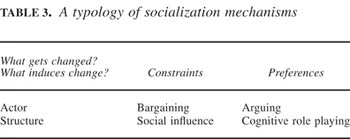
A typology of socialization mechanisms
 You have
Access
- 175
- Cited by