Aortic pseudoaneurysm is a rare, life-threatening complication that can occur after cardiac surgery, trauma, or infections. Reference Razzouk, Gundry and Wang1 Pseudoaneurysms are prone to rupture, thrombosis, distal embolisation, and mortality rates up to 61% have been reported if remains untreated. Although surgical repair is the first choice in the treatment of such cases, reoperation is associated with a very poor prognosis and high mortality that may reach up to 30%. Reference D’Attellies, Diemont, Julia, Cardon and Fabiani2 For this reason, as an alternative to surgical repair, transcatheter closure of pseudoaneurysms may be a reasonable option.
We would like to describe a case of a 9-year-old female who developed a pseudoaneurysm, 25 days after aortic reconstruction, that was successfully treated percutaneously using atrial septal occluder.
Case
A 9-year-old girl presented to the emergency department with complaints of weakness, paleness, and chest pain. It was learned from her history that the patient had undergone balloon aortic valvuloplasty and coarctation angioplasty at the age of 40 days due to aortic coarctation and aortic stenosis. Because of recoarctation, aortic reconstruction, aortic valve repair, and subaortic ridge resection had been performed 25 days ago.
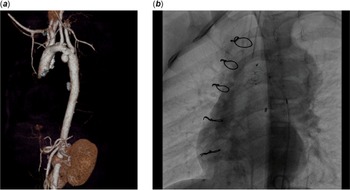
In the echocardiography, a round structure filled with a fistula was detected under the aorta. Contrast-enhanced computed tomography scan was performed and revealed a 34 mm pseudoaneurysm arising from the transverse aorta (Fig 1a). The neck of the entry at the aortic site was measured 3.8 mm on CT. The patient was discussed in the paediatric cardiology multidisciplinary meeting and was considered as of high risk for surgical revision; an endovascular approach was suggested as an alternative option. The procedure was performed under general anaesthesia. Written informed consent was obtained explaining the risks and benefits of the procedure, including the risk of potential pseudoaneurysm rupture during manipulation and potential embolic material migration in the cerebral circulation. A retrograde left femoral artery access was obtained and a 6 F sheath was inserted. Through a pigtail catheter, angiographic evaluation of the ascending aorta in anteroposterior and oblique views was performed in order to delineate the neck of the pseudoaneurysm. The neck of the pseudoaneurysm was calculated as 3 mm. A 0.035 in. standard hydrophilic guidewire was advanced into the pseudoaneurysm through a 6 F JR4 catheter. Then, a 6 F delivery sheath was introduced in the sac through the guidewire. A 6/6 mm Amplatzer atrial septal defect occluder (St. Jude Medical, St Paul, MN, USA) was advanced in the pseudoaneurysm neck and was successfully deployed (Fig 1b, Supplementary Video S1). The patient was followed in ICU for 2 days and discharged from the hospital without any complaints. Pseudoaneurysm repair was performed by elective surgery 2 weeks after the endovascular procedure.
(a) CT shows a 34 mm pseudoaneurysm arising from the transverse aorta. (b) control angiograms after a 6/6 mm amplatzer atrial septal defect occluder deployed.

Discussion
Very limited reports of successful transcatheter repair of aortic pseudoaneurysm related to surgery appear in the literature. Bashir et al. described the first case of an ascending aortic pseudoaneurysm treated percutaneously using an Amplatzer occluder device. Reference Bashir, Quaife and Carroll3 Very few similar cases have been published since then as reported by a recent review from Patel et al. Reference Patel, Gupta and Laffin4 However, most of the cases described before have been elderly patients. Up to our knowledge, this is the youngest patient who was treated by transcatheter approach for aortic pseudoaneurysm after aortic reconstruction.
Surgical repair of aortic pseudoaneurysm is the conventional treatment, but it is associated with very high morbidity and mortality especially in early post-operative period. Hence by applying this transcatheter technique in our patient, an early high-risk surgical intervention could be delayed. With the closure of the aneurysm, the systolic pressure within the aneurysm decreased and it became smaller. Time was allowed to heal fragile tissues in the early post-operative period and reoperation was performed without any complications.
There are several options such as stent grafts, coils, of-label devices, or injection of thrombin for closure of pseudoaneurysms. Reference Zhang, Chen and Gu5,Reference Nogueira, Fiarresga and de Sousa6 Device selection should be made according to the localisation, width, and neck shape of the pseudoaneurysm. In our case, there was a large aneurysm with a thin neck. Therefore, coil or thrombin injection was not used and the localisation of the aneurysm was not suitable for stent grafts. For this reason, the Amplatzer septal occluder, which is a flexible device with double discs, was preferred.
We would like to conclude that the use of an Amplatzer septal occluder has offered a valid minimal invasive solution in a complex patient with a challenging problem. More multi-centre data on long-term outcome of transcatheter closure procedures are needed to compare with standard surgery and to confirm safety and efficiency of the extended use of these techniques in high-risk patients, unsuitable for surgery.
Supplementary material
To view supplementary material for this article, please visit https://doi.org/10.1017/S1047951123000987.
Acknowledgements
None.
Financial support
This research received no specific grant from any funding agency, commercial, or not-for-profit sectors.
Conflicts of interest
None.
Ethical approval
All procedures performed in this case were in accordance with the ethical standards of the institutional and national research committee and with the 1975 Helsinki declaration and its later amendments or comparable ethical standards.
Informed consent
Informed consent was obtained from the patient’s parents.