





Introduction
The early season emergence of winter and summer annual weed species presents a significant challenge in designing an efficacious pre-plant herbicide management program. Cutleaf evening primrose, native to southeastern United States, is an herbaceous winter annual or biennial broadleaf weed (Uva et al. Reference Uva, Neal and DiTomaso1997). Cutleaf evening primrose exhibits substantial variability in growth habit and foliar morphology, which complicates its identification and management in cropping systems. Cutleaf evening primrose closely resembles common evening primrose (Oenothera biennis L.) in appearance, but the latter has smooth, untoothed leaf margins and a more upright growth habit. Cutleaf evening primrose belongs to the Onagraceae family and is found in agronomic and ornamental cropping systems, and in undisturbed habitats such as roadsides and no-till fields (Uva et al. Reference Uva, Neal and DiTomaso1997). A detailed account of the Onagraceae family was provided by Steckel et al. (Reference Steckel, Sosnoskie and Steckel2019).
The widespread adoption of herbicide-resistant crop cultivars has been the principal driver behind the expansion of conservation tillage practices (Dong et al. Reference Dong, Dodson, Nemec Boehm, Douglass, Ranville and Olver2024). Adoption of conservation tillage and discontinuation of fall and winter tillage have led to the spread of cool-season species such as cutleaf evening primrose (Clewis et al. Reference Clewis, Jordan, Spears and Wilcut2007; Culpepper et al. Reference Culpepper, Carlson and York2005). Cutleaf evening primrose presents a substantial economic and management challenge in reduced-tillage systems, driven by its extended seed viability and persistent contribution to the soil seedbank. More recently, cutleaf evening primrose has become an increasingly persistent and problematic weed across key row cropping systems of the Mississippi Delta, where its early emergence and tolerance to common herbicides complicate its effective control. Cutleaf evening primrose is generally challenging to manage, particularly at advanced growth stages, like bolting. The weed progresses through two main developmental phases: the basal rosette stage and the bolting stage. In plant development, recognizing key growth stages is essential for effective weed control. Both rosette and bolting stages play distinct roles in a plant’s life cycle and offer strategic windows for intervention. Rosette is an early vegetative stage when root development and energy storage occur, making it highly vulnerable to control measures. On the other hand, bolting marks the transition from vegetative growth to reproductive development and seed production (Daddario et al. Reference Daddario, Tucat, Fernandez and Bentivegna2021; Pouteau and Albertini Reference Pouteau and Albertini2009; Varanasi et al. Reference Varanasi, Bararpour, Mubvumba, Fletcher and Reddy2025).
Cutleaf evening primrose is a problematic weed that infests soybean [Glycine max (L.) Merr.], corn (Zea mays L.), cotton (Gossypium hirsutum L.), and small grain crops throughout the southern United States (Webster Reference Webster2004, Reference Webster2005). A density of 18 plants m−2 was reported for cutleaf evening primrose in the absence of a crop (Askew et al. Reference Askew, Cahoon, York, Flessner, Langston and Ferebee2021). Cutleaf evening primrose density varied from 1 to 8 plants m−2 in corn and soybean residues (Reynolds et al. Reference Reynolds, Jordan and Crawford2000). Currently, no studies have reported on yield losses caused by cutleaf evening primrose interference in agronomic cropping systems. However, under orchard conditions, the sequential emergence of newly planted cutleaf evening primrose followed by Palmer amaranth (Amaranthus palmeri S. Wats.) led to a maximum 79% reduction in pecan [Carya illinoinensis (Wangenh.) K. Koch] shoot growth over 3 yr (Wolf and Smith Reference Wolf and Smith1999). In a statewide crop survey conducted in Georgia, cutleaf evening primrose was ranked the 20th most troublesome weed out of 83 weed species in eight cropping systems (Webster and McDonald Reference Webster and MacDonald2001).
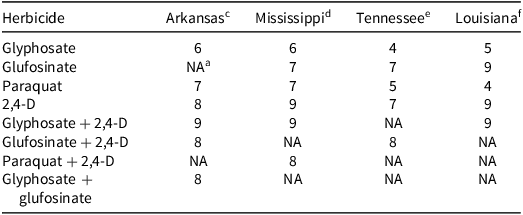
Several herbicides are currently available for controlling cutleaf evening primrose before planting season. Dicamba, fomesafen, glufosinate, glyphosate, oxyfluorfen, paraquat, 2,4-D, and others are some of the common herbicides labeled for burndown preplant use for managing cutleaf evening primrose (MSU 2026). Table 1 summarizes the efficacy of some herbicides commonly used to control cutleaf evening primrose in four southern states. However, the efficacy of these herbicides in controlling cutleaf evening primrose varies across its developmental stages. In general, weed size remains one of the key factors for controlling weed species in various cropping systems (Cahoon Reference Cahoon2016; Culpepper Reference Culpepper2009; DiTomaso et al. Reference DiTomaso, Kyser, Oneto, Wilson, Orloff, Anderson, Wright, Roncoroni, Miller, Prather, Ransom, Beck, Duncan, Wilson and Mann2013). To date, limited research has been conducted on the efficacy of the herbicides mentioned above for cutleaf evening primrose control, especially at different growth stages. Therefore, the objective of this study was to evaluate the activity of commonly used burndown herbicides to control cutleaf evening primrose at two growth stages, late rosette and bolting. This study focused on cutleaf evening primrose established throughout the Mississippi Delta region (Figure 1).
Weed response ratings for herbicides applied in burndown for cutleaf evening primrose control in four southern states. a,b

Table 1. Long description
The table presents the efficacy of several herbicides used for controlling cutleaf evening primrose in Arkansas, Mississippi, Tennessee, and Louisiana. It has 8 rows and 5 columns. The columns are labeled Herbicide, Arkansas, Mississippi, Tennessee, and Louisiana. The rows list different herbicides and their efficacy ratings in each state. Row 1: Glyphosate, Arkansas: 6, Mississippi: 6, Tennessee: 4, Louisiana: 5. Row 2: Glufosinate, Arkansas: NA, Mississippi: 7, Tennessee: 7, Louisiana: 9. Row 3: Paraquat, Arkansas: 7, Mississippi: 7, Tennessee: 5, Louisiana: 4. Row 4: 2,4-D, Arkansas: 8, Mississippi: 9, Tennessee: 7, Louisiana: 9. Row 5: Glyphosate + 2,4-D, Arkansas: 9, Mississippi: 9, Tennessee: NA, Louisiana: 9. Row 6: Glufosinate + 2,4-D, Arkansas: 8, Mississippi: NA, Tennessee: 8, Louisiana: NA. Row 7: Paraquat + 2,4-D, Arkansas: NA, Mississippi: 8, Tennessee: NA, Louisiana: NA. Row 8: Glyphosate + glufosinate, Arkansas: 8, Mississippi: NA, Tennessee: NA, Louisiana: NA.
Cutleaf evening primrose plants growing in a soybean field.

Materials and Methods
Plant Material and Experimental Setup
Greenhouse experiments were conducted during spring 2025 at the USDA-ARS Crop Production Systems Research Unit, Stoneville, MS. Cutleaf evening primrose seedlings at two growth stages were collected from a nearby soybean research plot (33.425°N, 90.952°W). The seedlings were brought to the greenhouse and transplanted into individual square pots (10 cm by 10 cm) prefilled with Berger BM7 custom growing mix (Hummert International, Earth City, MO). The pots were regularly watered and fertilized (N-P-K 24-8-16; Miracle Grow, Marysville, OH) during initial establishment until seedlings reached their respective targeted growth stages from transplanting: late rosette and bolting. Plants in the late rosette stage were 8 to 10 cm in diameter, whereas plants in the bolting stage were 12 to 14 cm in diameter and ranged from 13 to 15 cm tall (Figure 2). Greenhouse conditions were maintained at 28/22 ± 3 C day/night temperature with a 12-h photoperiod supplemented by metal halide lamps (560 µmol m−2 s−1).
Cutleaf evening primrose growth stages for herbicide treatments: Late rosette (A) and bolting (B). Plants were transplanted into 10-cm by 10-cm containers and grown until they reached the targeted growth stages for herbicide application.

A completely randomized block design experiment with six treatments and five replications was conducted separately for each growth stage. The treatments at recommended labeled rate (1×) consisted of glyphosate (1,260 g ae ha−1), glufosinate (672 g ai ha−1), 2,4-D (1,065 g ae ha−1), paraquat (840 g ai ha−1), glyphosate + 2,4-D (1,260 + 1,065 g ae ha−1), and a nontreated control. A nonionic surfactant (250 mL L−1) (Scanner; Loveland Products, Greeley, CO) was added to the paraquat treatment before spraying. Detailed information on herbicides used to control cutleaf evening primrose is shown in Table 2. Plants were treated with the 1× field-use rates of herbicides at two different growth stages: late rosette and bolting (Figure 2). All herbicide treatments were applied using a Generation 3 research track sprayer (DeVries Manufacturing, Hollandale, MN) with an 8002E nozzle (TeeJet Technologies, Glendale Heights, IL) calibrated to deliver 187 L ha−1 at 280 kPa. After spraying, plants were returned to the greenhouse and watered as needed. The experiment was repeated, over two runs under the same greenhouse conditions.
Herbicide treatments for control of cutleaf evening primrose at the late rosette and bolting stages in the 2025 greenhouse study.

Table 2. Long description
The table presents information on herbicide treatments for controlling cutleaf evening primrose. It includes columns for trade name, active ingredient, WSSA group, and application rate. The trade names listed are Makaze, Liberty, Enlist One, Gramoxone, and Makaze + Enlist One. The active ingredients include glyphosate, glufosinate, 2,4-D, paraquat, and a combination of glyphosate and 2,4-D. The application rates are given in grams per hectare.
a The Weed Science Society of America categorizes a herbicide according to its site of action in the plant. Group 4 herbicides are synthetic auxins; Group 9 herbicides inhibit 5-enolpyruvlshikimate-3-phosphate synthase; Group 10 herbicides inhibit glutamine synthetase, and those in Group 22 divert photosystem I electrons.
b A nonionic surfactant (250 mL L−1) (Scanner; Loveland Products, Greeley, CO) was included.
Manufacturer name and locations: Makaze, Loveland Products, Greeley, CO; Liberty, BASF Corporation, Research Triangle Park, NC; Enlist One, Corteva Agriscience LLC, Indianapolis, IN; Gramoxone, Syngenta Crop Protection, Greensboro, NC.
Data Collection and Analysis
Visible cutleaf evening primrose control was evaluated weekly up to 28 d after treatment (DAT). Evaluations were scored on a scale of 0 to 100%, where 0 represented no control and 100% represented complete control (Frans and Talbert Reference Frans and Talbert1986). After control ratings, aboveground shoot biomass of individual plants was harvested at 28 DAT and placed in a paper bag, dried at 65 C for 72 h, and weighed to obtain the shoot biomass for each treatment. Shoot biomass data were expressed as a percentage reduction relative to that of the nontreated check using the following equation:
 $Y = {{{DWc - DWt}}\over{{DWc}}} \times 100\;$
where Y represents the percentage shoot biomass reduction, DW c is the shoot biomass of the nontreated control, and DW t is the shoot biomass of treated plants at 28 DAT.
Weed control and biomass reductions were calculated relative to the untreated control and expressed as percentages for statistical analysis. The data analyses were conducted using the GLIMMIX procedure with SAS software (v. 9.4; SAS Institute Inc., Cary, NC) (SAS 2023), which fits generalized linear mixed models. The treatments glyphosate, glufosinate, paraquat, 2,4-D, 2,4-D + glyphosate, and days after treatment (7,14, 21, and 28) were considered fixed effects, while blocks were treated as random effects to account for variability across experimental units among replications. Mean separations were performed using a Tukey HSD test, which adjusts for multiple comparisons. Statistically significant differences among treatments were declared at a probability level of 0.05. Residuals were examined to confirm model assumptions of normality and homogeneity of variance.
Results and Discussion
The effectiveness of herbicides was strongly influenced by the growth stage of cutleaf evening primrose. In this study, herbicides applied at the late rosette stage resulted in maximum cutleaf evening primrose control compared with applications at the bolting stage (Figures 3 and 4). The effects of glyphosate and glufosinate were visually noticeable at 7 to 10 d after their initial application, whereas 2,4-D and paraquat effects were observed 1 to 2 DAT.
Cutleaf evening primrose control 28 d after treatment with herbicides sprayed at labeled rates. Herbicides were applied at the late rosette stage in a greenhouse study during the summer 2025 season. Herbicide labeled rates: glyphosate, 1,260 g ae ha−1; glufosinate, 672 g ai ha−1; 2,4-D, 1,065 g ae ha−1; paraquat, 840 g ai ha−1. A nonionic surfactant (250 mL L−1) (Scanner; Loveland Products, Greeley, CO) was added to the paraquat treatment before spraying.

Cutleaf evening primrose control 28 d after treatment with herbicides sprayed at labeled rates. Herbicides were applied at the bolting stage in a greenhouse study during the summer 2025 season. Herbicide labeled rates: glyphosate, 1,260 g ae ha−1; glufosinate, 672 g ai ha−1; 2,4-D, 1,065 g ae ha−1; paraquat, 840 g ai ha−1. A nonionic surfactant (250 mL L−1) (Scanner; Loveland Products, Greeley, CO) was added to the paraquat treatment before spraying.

Percent Cutleaf Evening Primrose Control and Biomass Reduction
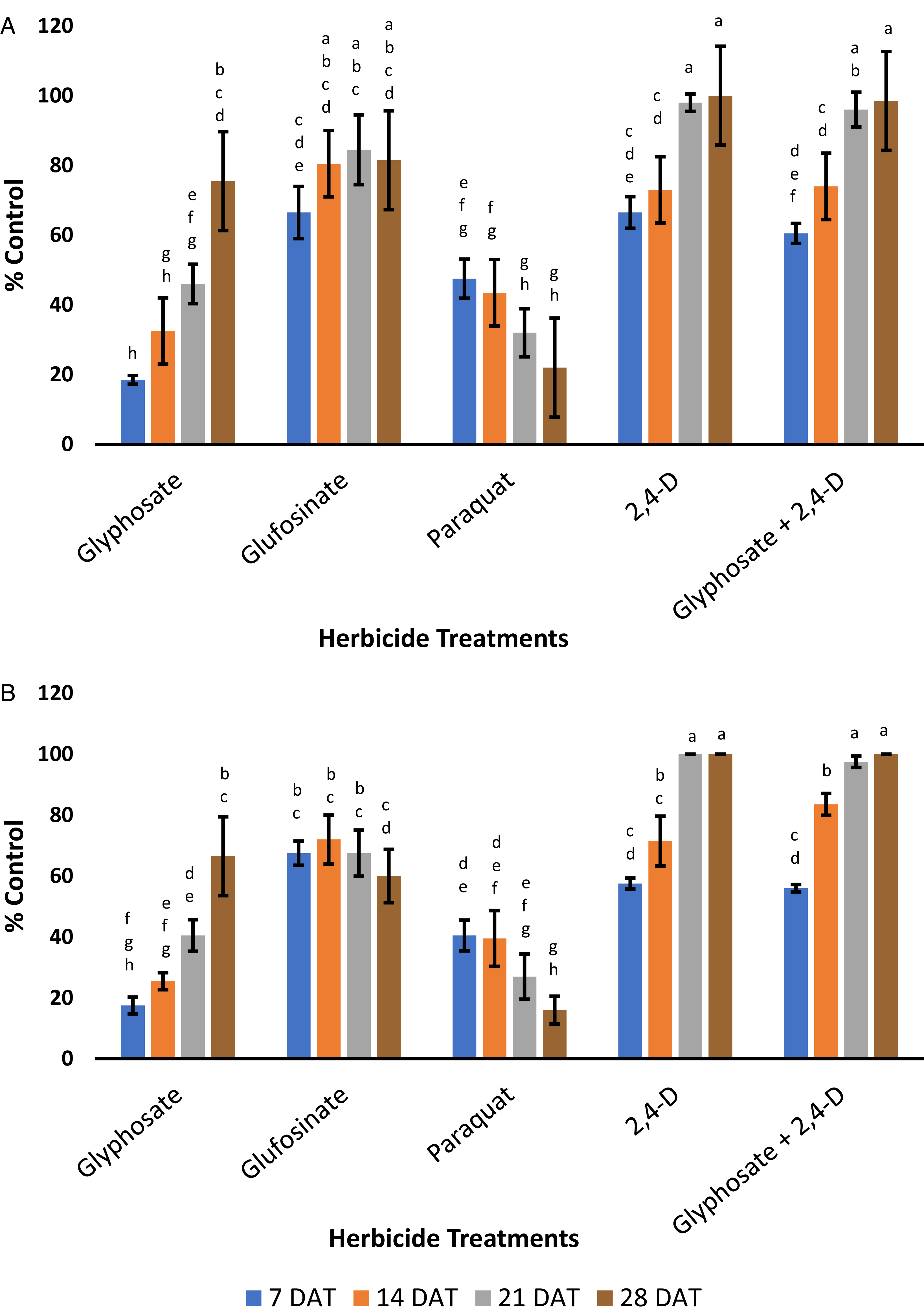
Of the five herbicides evaluated in this study (Table 2), 2,4-D alone and 2,4-D + glyphosate resulted in a maximum 95% to 100% cutleaf evening primrose control at both growth stages 28 DAT (Figures 3, 4, and 5). During the 4-wk evaluation period, control with 2,4-D ranged from 57% at 7 DAT to 100% by 28 DAT, respectively (Figure 5, A and B). Previously, Askew et al. (Reference Askew, Cahoon, York, Flessner, Langston and Ferebee2021) reported 74 to 85% cutleaf evening primrose control with 2,4-D. The herbicide 2,4-D has been recommended as an effective option for controlling cutleaf evening primrose, particularly where other herbicides have failed to provide adequate suppression control (Culpepper et al. Reference Culpepper, Carlson and York2005). Data on cutleaf evening primrose control with 2,4-D alone is limited compared with data when 2,4-D was tank-mixed with other herbicides that have different modes of action, such as glyphosate or paraquat. Reynolds et al. (Reference Reynolds, Jordan and Crawford2000) reported 80% to 100% cutleaf evening primrose control when 2,4-D was mixed with glyphosate or paraquat. Similarly, mixing 2,4-D with glyphosate or paraquat resulted in 86 to 94% cutleaf evening primrose control (Culpepper et al. Reference Culpepper, Carlson and York2005). We observed 98 to 100% control with 2,4-D + glyphosate treatment at both late rosette and bolting growth stages (Figures 3, 4, and 5). Prior studies have shown that cutleaf evening primrose is susceptible to 2,4-D (Johnson and Kendig Reference Johnson and Kendig1997; York and Culpepper Reference York and Culpepper1998). 2,4-D alone controlled cutleaf evening primrose at rates as low as 134 g ae ha−1(York and Culpepper Reference York and Culpepper2005). In our study, the combination of 2,4-D and glyphosate did not enhance efficacy compared with 2,4-D applied alone, regardless of growth stage (Figure 5). Research has shown that herbicide combinations that contain 2,4-D consistently provide effective cutleaf evening primrose control, with less variability in results compared to other herbicides.
Cutleaf evening primrose control relative to untreated check at 7, 14, 21, and 28 d after treatment (DAT) with glyphosate (1,260 g ae ha−1), glufosinate (672 g ai ha−1), paraquat (840 g ai ha−1), 2,4-D (1,065 g ae ha−1), and glyphosate + 2,4-D applied at late rosette (A) and bolting (B) stages in a greenhouse study during the 2025 season. Treatments associated with the same letter are not significantly different (P ≤ 0.05). Means separations were performed using a Tukey HSD test, which adjusts for multiple comparisons. Vertical bars represent ± standard error of the mean for each treatment and time assessment.

Studies in no-till cropping systems have reported that glyphosate provides poor control of cutleaf evening primrose (Clewis et al. Reference Clewis, Jordan, Spears and Wilcut2007; Culpepper et al. Reference Culpepper, Carlson and York2005; Steckel Reference Steckel2008; York and Collins Reference York and Collins2016). In the current greenhouse study, we observed 66 to 75% control when glyphosate was applied at the bolting and rosette stages (Figures 3 and 4). In a study conducted in cotton and soybean field residues, cutleaf evening primrose control when glyphosate was applied ranged from 42% to 60% (Reynolds et al. Reference Reynolds, Jordan and Crawford2000). About 60% cutleaf evening primrose control with glyphosate was reported by Culpepper et al. (Reference Culpepper, Carlson and York2005). In contrast, in some field experiments, glyphosate provided 83 and 84% control (Clewis et al. Reference Clewis, Jordan, Spears and Wilcut2007). In all these studies, the efficacy of control was attributed to the diameter (7 to 20 cm) and the number of leaves (6 to 12) of cutleaf evening primrose at the time of glyphosate applications, indicating that glyphosate efficacy is closely related to the growth stage of cutleaf evening primrose.
To our knowledge, data on using glufosinate for managing cutleaf evening primrose is limited. Greater than 80% control of cutleaf evening primrose was observed at 28 DAT when glufosinate was applied at the late rosette stage (Figure 5A). Cutleaf evening primrose control when glufosinate was applied at the bolting stage dropped to 60% and plants recovered from the initial herbicide injury by 28 DAT (Figures 4 and 5B). A 20% decrease in cutleaf evening primrose control at the bolting stage indicates that glufosinate is more effective when applied at the earlier actively growing rosette stage rather than at later growth stages. Tank-mixing glufosinate with 2,4-D is recommended for achieving effective control of cutleaf evening primrose at bolting or later stages.
Previously, inadequate cutleaf evening primrose control (32 to 56%) was reported with paraquat (Clewis et al. Reference Clewis, Jordan, Spears and Wilcut2007; Culpepper et al. Reference Culpepper, Carlson and York2005). Similarly, in this study, cutleaf evening primrose control with paraquat was low (<50%) compared to other herbicide treatments. The peak cutleaf evening primrose control of 40 to 47% was achieved 7 DAT with paraquat at the two growth stages (Figure 5, A and B). There was a significant decrease in paraquat efficacy in controlling cutleaf evening primrose (16 to 22%) by 28 DAT at both late rosette and bolting stages (Figures 3, 4, and 5A and B). By 28 DAT, plants had completely recovered from initial paraquat injury. Previous reports indicate that paraquat provides moderate control of cutleaf evening primrose, and its effectiveness declines over time due to plant regrowth (Kelly et al. Reference Kelly, Miller and Vidrine2002). York and Culpepper (Reference York and Culpepper2005) attributed post-treatment regrowth of cutleaf evening primrose to the presence of plants at the prebloom stage when paraquat was applied. However, greater than 90% cutleaf evening primrose control was achieved when paraquat was tank-mixed with 2,4-D (Culpepper et al. Reference Culpepper, Carlson and York2005).
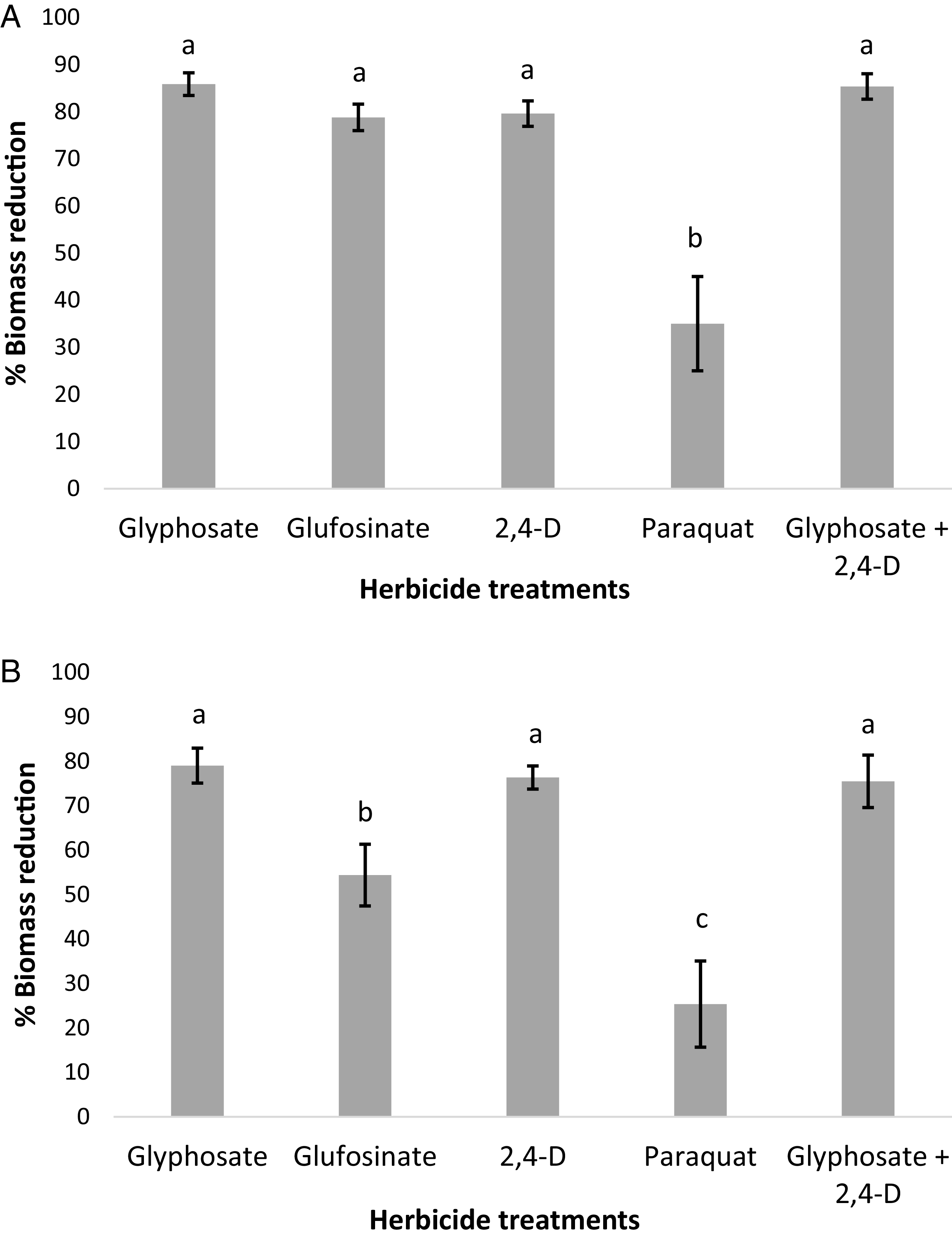
In general, aboveground dry biomass reduction was highest when herbicides were applied at the late rosette stage and lowest when applied at the bolting stage (Figure 6). However, biomass reduction did not differ significantly between the rosette and bolting stages among most treatments, except when glufosinate was applied, and when a 24% greater reduction occurred at the rosette stage than the bolting stage. The highest biomass reduction (85%) was observed when glyphosate and glyphosate + 2,4-D treatments were applied at the late rosette stage (Figure 6A). Paraquat treatment, on the other hand, resulted in the lowest biomass reduction of cutleaf evening primrose at both growth stages (Figure 6). The higher biomass reduction with 2,4-D when applied either alone or tank mixed with glyphosate corresponds to the maximum control observed with 2,4-D applications (Figures 3 through 6). At the late rosette stage, biomass reductions with glyphosate, 2,4-D, glyphosate + 2,4-D, and glufosinate treatments were 45% to 50% greater than those observed with paraquat treatment alone (Figure 6A). Plants exhibited rapid recovery from injury and increased regrowth following paraquat applications at rosette and bolting stages (Figures 3 and 4).
Percent biomass reduction relative to untreated control cutleaf evening primrose plants with different herbicide treatments applied at late rosette (A) and bolting (B) stages 28 d after treatment in a greenhouse during the 2025 season. Treatments associated with the same letter are not significantly different (P ≤ 0.05). Means separations were performed using a Tukey HSD test, which adjusts for multiple comparisons. Vertical bars represent ± standard error of the mean for each time assessment.

Greenhouse experiments offer valuable advantages, including tightly controlled conditions, reduced environmental variability, and precise manipulation of experimental parameters. However, these strengths also introduce certain limitations. Studies conducted under optimal conditions may not fully translate to field environments, where factors such as crop competition play a more prominent role. Greenhouse-grown plants typically display higher susceptibility relative to field-grown plants.
Practical Implications
Effective management of cutleaf evening primrose during spring and before planting is critical for minimizing yield losses and ensuring optimal crop production during the growing season. Timely and appropriate weed control measures, including early removal and the use of effective herbicides, can significantly improve crop yield and overall agricultural productivity. Cutleaf evening primrose is inadequately controlled with glyphosate, glufosinate, and paraquat applied individually. Integration of 2,4-D into a herbicide program is suggested to enhance the overall efficacy of control. Future research should focus on testing mixtures of 2,4-D with glufosinate, paraquat, and other burndown herbicides on cutleaf evening primrose control, especially at the early rosette stage. In this study, herbicides were applied to cutleaf evening primrose during the late rosette stage. However, for optimal efficacy, we recommend applying herbicides at the early rosette stage. These findings emphasize the importance of herbicide application timing and selecting appropriate herbicide combinations and prevent yield losses.
Acknowledgments
We thank Earl Gordon, Efron Ford, and Milton Gaston for collecting field samples and for their technical assistance in greenhouse tasks. Mention of trade names or commercial products in this article is solely for the purpose of providing specific information and does not imply recommendation or endorsement by the U.S. Department of Agriculture.
Funding
This research received no specific grant from any funding agency, commercial or not-for-profit sectors.
Competing Interests
The authors declare they have no competing interests.






 Open access

