





To put it bluntly—because the need is blunt as it gets—we must have our asses cleaned after we shit and pee. Or we have others’ fingers inserted into our rectum to assist shitting. Or we have tubes of plastic inserted inside us to assist peeing, or we have re-routed anuses and pissers so we do it all into bags attached to our bodies. These are blunt, crude realities. Our daily lives … We rarely talk about these things … Because let us face it: we have great shame about this need … If we are ever really home in the world and in ourselves, then we must say these things out loud. And we must say them with real language.Footnote 1
This quote foregrounds the crude and often blunt realities faced by persons with disabilities in their everyday lives. In one way, this paper may be read as an extension of this quote, in that it elaborates, through a range of examples, the forms of encounter, negotiation, and exclusion that persons with disabilities confront in their lived experiences. The conceptual language through which these examples are situated is that of care. Care, however, is not a singular or self-evident category. Especially in the context of persons with disabilities, care signifies different things to different actors and is often shaped by certain common-sense assumptions. Familiar instances of care include assisting a visually impaired person in crossing the road or offering a seat to a person with a disability on public transport, even when designated “handicapped” seating is already occupied.Footnote 2 Such public acts constitute the everyday, recognizable forms of “care,” while the continuous care provided within homes, primarily by women, and care within institutions remain unrecognized and invisibilized. This paper, however, asks what transpires when care is institutionalized. How do institutions conceptualize and administer care, and what specific modalities of care emerge within institutions explicitly designed for persons with disabilities?
Legal and policy definitions of care particularly tend to presume the family as the primary site of responsibility, implicitly positioning parents or kin as natural caregivers. Disability studies literature in India has similarly foregrounded familial care, often emphasizing parental labour, dependency, and domestic responsibility. However, from the early 2000s onwards, and largely through the intervention of non-governmental organizations, new support networks and institutional forms of care began to emerge.Footnote 3 These developments marked a gradual shift towards organized, institutionalized care infrastructures for persons with disabilities. Against this backdrop, this paper examines the specific discourses of care envisioned and promoted by such institutions, while also attending to the everyday realities through which care is enacted, negotiated, and at times contradicted at the institutional level.
The central concern of this paper, then, is to map out what it means to care, to interrogate notions of care at both the theoretical and institutional levels for persons with disabilities (PWDs) residing in Child Care Institutions (CCIs). In other words, what are the different processes and materialities involved in the act of caring within institutional settings? The act of caring can encompass simple relationships of affect as well as more complex situations in which caregivers and care receivers occupy contradictory positions shaped by institutional routines, administrative authority, and material constraints. Moving beyond a binary understanding of caring versus not caring, this paper argues that care is neither an inherent attribute of institutions nor merely an interpersonal ethical relation. In contrast, care is produced, negotiated, and constrained through the process of institutionalization itself. By foregrounding institutionalization as a primary analytical lens, the paper examines how the spatial organization of CCIs, disciplinary routines, bureaucratic practices, and state interventions reorganize the conditions under which care becomes possible, visible, and contested.
1. Interrogating care
The complex positions of care-giving and receiving have been much debated in the realm of feminist as well as disability studies. This section tries to introduce different notions of care and understand how they interact with the overall issues pertaining to disabled children living in Child Care Institutions (CCIs). The point of departure of disability studies from ethics of care is that human care is problematized in this discipline, as it often leads to objectification of disabled people under the guise of care. For example, a disabled person may well be positioned as lacking agency from an ethics of care perspective because they are unable to exert choice or control. On the other hand, the main focus of disability studies is the larger social structures as it seeks to empower the lives of disabled people by removing the structural (read; disabling) barriers in society. In this framework, the positionality is shifted from the individual to the social processes (attitudes, policies, culture, etc.) which fail to make interventions and services accessible for disabled people.
In this context, care service systems which perpetuate the discourse of medicalization can be questioned as they reinforce the notion that disabled people are needed to be cared for. An important question that arises in this context concerns how persons with disabilities, particularly children, who are dependent on others for care, safety, and security, are to be incorporated within this framework. Dependency in this context may be approached as a socially and institutionally produced condition. In child care institutions, care is necessarily mediated through caregivers, professionals, and institutional routines, which enable survival and shape the everyday lives of children with disabilities. This paper, therefore, treats dependency as a terrain through which agency, vulnerability, and control are negotiated. By foregrounding care as a relational practice embedded in institutional settings, the paper examines how care simultaneously operates as support, governance, and moral responsibility. In this context, Fine and Glendinning point to the fact that in order to recognize interdependence, one needs to acknowledge the relations of dependence and also the power dynamics in a carer-cared relationship.Footnote 4 Thomas also focuses on the power dynamics in a carer-cared relationship and argues that the social relationship between a disabled person and a care giver has a significant impact on the way a disabled person views their sense of self and self-esteem.Footnote 5 This point is significant in our study as the dynamics between a disabled person and a care giver often determines their life course and life chances. In this context, it may be pertinent to distinguish between impairment and impairment effects.Footnote 6
Thomas recognizes that people with disabilities may experience impairment effects along with impairments.Footnote 7 While the nature of an impairment or disability is physical, impairment effects have a direct and restrictive effect on the social life of an individual. Impairment effects are social in nature and often add to the restrictions and marginalization faced by a disabled individual. For example, if a disabled child is denied or has restricted access to education, due to lack of access to wheelchair, it can be an example of impairment effects along with disability. It is also important to recognize that the argument of impairment effects leads a context-specific investigation.
In case of Indian society, the lives of disabled children need to be examined in the context of multiple cultural discourses, where notions of ableism are normalized by invoking religious and dogmatic structures. In fact, shared understandings of language and cultural practices, which shape the lived experiences of disabled people, need to be contextualized in the light of social norms. There is the logic of inadequate rationality that is usually used against disabled subjects and the perceived lack of autonomy on account of their dependence on caregivers. Arguing from the alternate perspective, Eva Feder Kittay argues that the relationship between a caregiver and a disabled person has an intrinsic affective value.Footnote 8 Sara Ahmed tries to extend this frame by introducing the concept of affective economy.Footnote 9 In an affective economy, emotions do things and they align an individual within the broader social context. The concept of an affective economy binds the disabled subject in the realm of the social, which in turn binds them to the larger community. However, affective economies cannot be viewed in a metaphorical sense; it also needs to point out the material living contexts within which the relationship between a caregiver and a disabled person take place.
These perspectives are primarily oriented towards understanding disability and care from the perspective of interpersonal relationships. However, they do not investigate on how institutions themselves may reorganize the practice of care. In this context, the question of CCIs becomes pertinent, as caregiving in these institutions is inseparable from administrative authority, routines, and organizational management. Here, the notion of care escapes the binary of a caregiver and care receiver and becomes embedded within larger institutional structures.
Drawing upon Goffman’s notion of total institutions and Foucualt’s analyses of disciplinary power, institutions have been identified through the lens of organizational systems that regulate bodies, spaces, and the very categories which operate within the confines of institutions.Footnote 10 Institutional care becomes much more than just providing support or care, it reorients itself by governing people through infrastructures, routines, knowledge, and authority. In this context, care and technologies of regulation become inseparable.
One of the central mechanisms through which institutions facilitate the transformation of care to forms of regulation is the process of objectification. Within institutions, the practice of care shifts from individual attention towards population management. Daily life is organized in such a manner, so as to subordinate individual preferences, desires, and agency to organizational efficiency. Care becomes increasingly non-consensual as institutional imperatives require residents to conform to collective routines that do not necessarily accommodate individual differences.
The process of objectification is also facilitated by reshaping how institutional staff perceives those in need of care. Zimbardo argues that dehumanization enables institutional staff to process residents as manageable objects devoid of personhood.Footnote 11 The subjectivity of residents is progressively eroded by institutional classifications. Malacrida takes this point forward by arguing that this erosion of subjectivity is more pronounced within disability institutions as disabled residents have historically occupied socially devalued positions, making the suspension of dignity, autonomy, and bodily agency appear less publicly contestable than it would for other populations.Footnote 12 The transformation of subjects into institutional objects, therefore, becomes central to understanding how violence, neglect, and routine practices of degradation become normalized within caring institutions.
2. The setting
In India, a child has been legally defined variously in different documents, but primarily it refers to any individual who is below eighteen years of age. The National Policy for Children, 2013, reiterates India’s commitment towards such children in accordance with the Convention on the Rights of the Child and UN Standard Minimum Rules for the Administration of Juvenile Justice, 1985 (the Beijing rules) by stating that:
the State shall endeavour to secure the rights of children temporarily or permanently deprived of parental care, by ensuring family and community-based care arrangements including sponsorship, kinship, foster care and adoption, with institutionalization as a measure of last resort, with due regard to the best interests of the child and guaranteeing quality standards of care and protection. Footnote 13
There are legislations that guide the policy towards children, primary being the Juvenile Justice (Care and Protection of Children) Act, 2015. As the name suggests, and in consonance with UNCRC, a child in need of care and protection refers to a child found without family and means of subsistence, or in need of protection from people they are living with, or having a mental or physical disability. As per the law, restoration of and protection to a child is the prime objective of any Child Care Institution (CCI).
The CCIs, under the Juvenile Justice (Care and Protection of Children) Act 2000, are envisaged to play an important role in the holistic development of children and for making provisions for a child-friendly environment for children under state protection. These CCIs house all children under the guardianship of the state of India, who have been found without family and means of subsistence, or in need of protection from people they are living with, or having a mental or physical disability. As per the law, restoration of and protection to a child shall be the prime objective of the CCIs. Childcare Institutions include Children’s Home, Open Shelter, Observation Home, Special Home, Place of Safety, Specialized Adoption Agency, and a Fit Facility recognized under the Act for providing care and protection to children who need such services. Children in conflict with the law are provided residential care and protection in Observation Homes, Special Homes, and Places of Safety. While the Ministry of Women and Child Development aims to ensure that all children in this country grow and bloom to their full potential in a caring family, community, and society, homeless, abandoned, abused, and exploited children are accommodated within different Child Care Institutions (CCIs), which are designed to provide a safe space where a child can recover from trauma, regain trust, and gain skills to negotiate with the world outside the CCI. As per the JJ Act 2015 and JJ Model Rules, 2016, all CCIs, whether funded by Government or not, need to ensure safety, security, dignity, and well-being of the children in the best child friendly manner as per the prescribed standards of care.Footnote 14
In a Government of India report, it was found that CCIs very often fail at providing basic care and protection. The study found that 91 percent of the 9589 CCIs/Homes (registered/unregistered) across the country are run by non-government organizations. Thirty-two percent of CCI/Homes were registered under the JJ Act, whereas 33 percent did not have any legal status. The children residing in the CCIs/Homes include children who are orphaned, abandoned, homeless, sexually abused, victims of trafficking, children affected and infected by HIV/AIDS, children affected by disasters and conflict, and children with disabilities. While only 33.2 percent of CCIs/Homes have linkage to mental health services, 38.3 percent were linked to educational services, 27 percent had vocational training, and only 22.4 percent were linked to health services. The study found a considerable proportion of children with disabilities living in these institutions, primarily because of their poor social value, which means that disabled children are more likely to be abandoned and land up in different residential institutions, run either by the state or private agencies, where they have poor access to specific measures for their development.Footnote 15 This paper attempts to problematize the ways in which the CCIs facilitate the development of disabled children entrusted to their care.
3. Methodology
This paper is based on reflections and analysis of data that was collected for a study of 19 Child Care Institutions (CCIs) in West Bengal, run by both state and non-state actors, to uphold the rights of children in terms of development, care, and protection. The data were collected between June and October 2022, from these CCIs of which some are inclusive of all children and others exclusively for disabled children. While the project focused on the extent to which CCIs cater to the needs of children with disabilities, the reflections reveal state apathy towards disabled people and children, which impacts their overall development. Data were collected through visit to the organizations, structured observation of the spaces within the CCIs and their uses, and in-depth interviews with the caregivers, authorities, and children, along with study of secondary documents. This paper emerges out of the insights gained through the interactions during the data collection process, which reflects not only the state attitude towards care, protection, and children with disabilities but also the larger social attitudes within which the discourse is embedded.
The institutions included in the study were identified through the official list of registered CCIs provided by the Directorate of Child Rights and Trafficking. Prior to each visit, the respective institutional authorities were informed of the research team’s visit, and permission for access was obtained from the management of each CCI. Fieldwork combined prolonged site visits, participant observation, informal conversations, semi-structured and in-depth interviews, and the examination of institutional records and secondary documents. Interviews were conducted with multiple institutional actors, including superintendents, administrators, caregivers, support staff, and, where appropriate and possible, children residing within the institutions. Particular attention was paid to everyday institutional routines, spatial organization, caregiving practices, interactions between staff and residents, and the material conditions through which institutional life was organized. While interviews provided valuable insights into how care was narrated and justified by different actors, the analytical core of this paper is grounded primarily in participant observation and ethnographic encounters, which enabled the researchers to observe the often-unspoken contradictions between institutional narratives of care and their everyday enactment.
The research team approached the institutions from a human rights and critical disability studies perspective. Comprising academics, researchers, and disability rights practitioners, the team entered the field as researchers attempting to understand the everyday realities of institutional care. This orientation shaped both field access and the nature of interactions with institutional actors. Efforts were made to cultivate a non-threatening and dialogic relationship with administrators, caregivers, and staff, thereby encouraging open discussions. At the same time, the researchers remained attuned as to how their own presence occasionally altered institutional practices. During several visits, caregiving activities appeared more coordinated, visible, or performative in the presence of the research team, suggesting that institutional care was, at times, consciously staged for observation. This paper understands such instances as “orchestrated care,” which are ethnographically significant in themselves, revealing the ways institutions seek to represent, justify, and perform care under conditions of external scrutiny. The analysis presented in this paper, therefore, draws from the silences, performances, negotiations, and contradictions encountered during fieldwork.
The study was conducted with institutional ethical approval granted by the Directorate of Child Rights and Trafficking, Government of West Bengal, which commissioned the research. Given that the study involved children under state protection, care was taken in order to minimize potential harm and distress during data collection. Participation in interviews and conversations were voluntary, and verbal consent was obtained from institutional authorities and participants prior to interviews and taking photographs. Researchers avoided intrusive or potentially distressing questions, particularly when interacting with children, and conversations were adapted in terms of different contexts. Following emotionally difficult field encounters, members of the research team engaged in debriefing sessions to reflect on ethical dilemmas, emotional responses, and appropriate modes of representation. Permission for photographic documentation was obtained through institutional approval granted by the commissioning authority as well as verbal permission from the respective CCI authorities during field visits. Throughout the research and writing process, the identities of participants and institutions have been anonymized, and ethnographic materials have been presented with the aim of illuminating broader institutional processes.
4. Walking into a home: The embargo on care
Entering a Child Care Institution (CCI) was perhaps not just an act of crossing a physical threshold. Access unfolded through transitions of institutional negotiations, permissions, and space that progressively regulated what could be seen, whom one could meet, and what forms of care could be observed. We conceptualize this regimen through the notion of an embargo on care. The term embargo is employed to describe an institutional process through which access to people, spaces, and information is systematically regulated, thereby rendering care partially visible while simultaneously shielding its everyday practices from scrutiny. This embargo reorganizes the very conditions under which care becomes knowable. By controlling movement, communication, and observation, institutional authorities shape how care is represented, justified, and evaluated.
This understanding draws upon Michel Foucault’s analysis of disciplinary institutions.Footnote 16 Foucault argues that the organization of institutional space is a political technology through which power is diffused by producing visibility, surveillance, and conduct. Modern institutions such as schools, hospitals, prisons, and residential facilities govern by organizing bodies within carefully regulated spaces where movement, behaviour, and interaction become observable, recordable, and therefore governable. Institutional architecture thus becomes an active participant in governance, transforming space into a medium through which authority is exercised.
The CCIs visited during fieldwork exhibited a comparable spatial logic. Although established as sites of care and protection, access to their everyday functioning was carefully mediated through institutional arrangements that determined what researchers could observe and when. The embargo on care operated through two interconnected layers.
The first layer of embargo was administrative. Before reaching the residential spaces occupied by children, visitors encountered a sequence of bureaucratic spaces comprising the offices of the superintendent, administrative staff, and management personnel. These offices functioned as more than administrative units; they were the institutional centres where decisions concerning children’s education, rehabilitation, discipline, medical care, and everyday routines were regulated. Entry into these spaces was conditional, and interactions were largely mediated by institutional authorities, who narrated the history of the organization, its achievements, legal obligations, policy challenges, and institutional constraints. In many instances, children were introduced through institutional classifications as exceptionally successful residents, as particularly “challenging” cases, or as examples of institutional achievement, thereby trying to direct the researcher’s gaze before independent observation could be possible. Access to institutional knowledge was, therefore, filtered through administrative narratives that framed how care ought to be understood. The first embargo thus operated by regulating the flow of knowledge and how institutional care was represented to outsiders.
Beyond these administrative spaces lay the second layer of embargo: the residential environments in which children lived their everyday lives. Access to dormitories, living quarters, recreational spaces, and intimate sites of everyday care was considerably more restricted and often delayed until administrative interactions had concluded. The physical separation between administrative buildings and residential facilities was itself significant. While the first embargo regulated institutional narratives, the second regulated access to the material realities through which care was experienced by children.
In the second layer of embargo, institutional atmosphere shifted markedly. The gap between administrative order and lived experience became immediately apparent. The residential spaces revealed the material conditions through which children inhabited the institution, conditions that were very different from the carefully ordered narratives encountered earlier. The first impression upon entering these residential spaces was their striking resemblance to a deteriorating school. It emerged through memories of other disciplinary institutions like schools, hostels, boarding facilities, and similar enclosed environments, where movement, routine, attendance, and authority are carefully organized. Long corridors, rows of benches, uniforms, attendance registers, neglected infrastructure, and regimented daily schedules recalled familiar institutional forms through which subjects are trained, evaluated, and normalized.
Memory in this instance becomes an analytic entry point, shaping how care is recognized, anticipated, and questioned within the CCI. Such remembering renders visible how care is organized through routines, hierarchies, and evaluative mechanisms. In Foucauldian terms, the school form normalizes subjects by “taking over” their lives by enacting a particular form of arrangement in CCIs. When the CCI is remembered and experienced through this institutional memory, it raises a political question about whether care is being enacted as support or as discipline, whether the child is positioned as a subject of care or as a site of correction. This institutional space is conceptualized through this metaphor and analogy, depicting CCIs as decadent and deteriorating facilities marked by infrastructural neglect and decay (Figure 1).
A metaphorical and analogical depiction of CCIs as decadent and deteriorating institutional spaces, emphasizing infrastructural decay, neglect, and the erosion of care environments. The figure shows how institutional decline becomes normalized within everyday administrative practices. Source: Author’s fieldwork.

5. Care as a complex process: Orchestrated care and non-care
Recent scholarship in disability studies suggests that care is more than just a “stable” relationship between a caregiver and care receiver. Contemporary scholars have emphasized the relational, political, and institutional dimensions, showing of care and how it is shaped by infrastructures, organizational arrangements, professional knowledge, and unequal relations of power. Within institutional settings, therefore, must be understood as a contingent process that is continually negotiated through material conditions, administrative routines, and institutional processes.Footnote 17
The institutional organization of CCIs generates forms of care that emerge beyond the binary of a care giver and care receiver. It is rather mediated through the interaction between disability as a socially governed category, institutional infrastructures, administrative authority, and the material organization of everyday life within the institution. We conceptualize two institutional effects of this process: orchestrated care and non-care. These describe distinct institutional configurations through which care is performed, transformed, or rendered impossible.
The first configuration is orchestrated care. As discussed in the previous section, the first level of embargo regulates the relationship between the institution and outsiders by carefully managing what may be seen and how institutional life is presented. Orchestrated care emerges precisely within this space of managed visibility. Unlike everyday caregiving practices, orchestrated care is activated by the presence of an external observer, a researcher, government official, or visitor, whose gaze temporarily reorganizes institutional behaviour. The arrival of an outsider introduces a third position into the binary between caregiver and care receiver. Care is no longer directed towards the child, but it is simultaneously oriented towards the audience before whom the institution must demonstrate its competence and legitimacy. In this sense, the primary function of orchestrated care is representational.
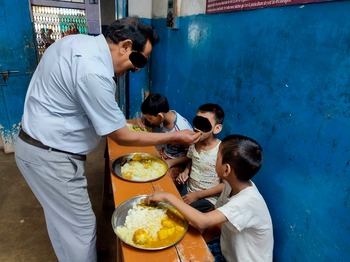
One encounter during fieldwork illustrates this dynamic. During a visit to one CCI, the research team observed the administrative head feeding a child diagnosed with cerebral palsy (Figure 2). The child required specialized assistance during meals owing to their particular physical needs. However, following a suggestion from members of the research team that the child required support while eating, the administrator immediately began force feeding the child by repeatedly placing food into the child’s mouth without an apparent understanding of the child’s disability-specific requirements. The act appeared motivated by an immediate desire to demonstrate that the institution cared for children with disabilities. What rendered itself visible was, therefore, a transformation of care into institutional performance. The presence of the team thus reorganized caregiving practices, producing more of a public demonstration of care than the child’s actual needs. In this way, orchestrated care reveals an important contradiction, that is, the institutional imperative to appear caring may itself generate practices that fail to respond to the embodied realities of disability.
An administrative head feeding a child with cerebral palsy in a Child Care Institution. The child required specialized support while eating. During the interaction, the administrative head, following a suggestion from the research team, attempted to assist the child without adequate understanding of the child’s specific needs. The image highlights everyday misrecognition of disability-specific care within institutional settings. Source: Author’s fieldwork.

Figure 2. Long description
A man in a light-colored checkered shirt and grey trousers stands on the left, leaning over a long wooden bench. He holds a small amount of food toward the mouth of a young boy sitting at the bench. The boy has his eyes obscured by a black oval for privacy and appears to have physical support needs. Two other children sit further down the bench, eating from metal plates containing rice and yellow curry. The setting is an institutional room with blue-painted walls that show signs of wear and scuffing. In the background, a blue door is visible on the far left, and a red informational sign is mounted high on the wall to the right. The man’s posture is slightly awkward as he reaches across the table to feed the child, illustrating the interaction described in the caption regarding disability-specific care.
The second institutional configuration is what we conceptualize as non-care. We use this term deliberately to distinguish it from neglect. Neglect generally denotes the omission or failure to provide appropriate care, often implying individual indifference or inadequate attention. Non-care, by contrast, refers to an institutional condition in which organizational arrangements systematically produce practices that fall short of care despite caregivers frequently acting with the intention of fulfilling their responsibilities. Non-care emerges when institutional routines, material constraints, inadequate training, staffing shortages, administrative priorities, and the spatial organization of care render meaningful care increasingly difficult to sustain. It is conceptualized as an institutional effect rather than merely an individual moral failure.
This distinction also aligns with recent work on institutional violence, which argues that harm cannot be understood solely as the outcome of either impersonal structures or the actions of a few “bad apples.” Instead, scholars such as Carina Heckert show how institutional environments shape the everyday decisions of otherwise ordinary individuals, making certain forms of violence possible and even routine.Footnote 18 Philip Zimbardo’s situational analysis makes a similar point by demonstrating that people’s actions are profoundly influenced by the settings in which they operate, often in ways that cannot be reduced to individual character or intention.Footnote 19 The analytical focus, therefore, shifts away from identifying a few culpable actors and towards understanding how institutional arrangements normalize, routinize, and morally legitimize harmful practices.
The second level of embargo, discussed earlier, provides the organizational context within which non-care emerges. Residential spaces remain relatively insulated from sustained public scrutiny, while a small number of caregivers are often responsible for a disproportionately large number of children. Across many institutions visited during fieldwork, approximately two caregivers were responsible for caring for nearly 50 children. Within such conditions, caregiving increasingly becomes organized around maintaining order, managing risk, and ensuring institutional continuity rather than responding to the individualized needs of residents.
Two ethnographic observations illustrate this dynamic. In one child care institution, a resident living with epilepsy was tied to a bed (Figure 3). Staff members explained that the restraint was intended to prevent injury during seizures, particularly because they lacked the personnel and medical supervision needed to monitor the resident continuously. In another institution, an elderly resident with severe mobility limitations was found sleeping on the floor in visibly neglected surroundings (Figure 4). Caregivers attributed this situation to chronic staff shortages, inadequate infrastructure, and the practical challenges of providing sustained care. In both cases, those responsible for the institutions framed their actions as unavoidable responses to constrained circumstances, invoking the language of safety, necessity, and limited resources. These explanations are analytically important because they show how practices that produce harm are not necessarily perceived as neglect by those who carry them out. Rather, they become embedded within the everyday logic of institutional care, where resource constraints and organizational routines come to justify actions that would otherwise appear unacceptable.
A resident diagnosed with epilepsy restrained to a bed within a Child Care Institution. The image documents the continued use of physical restraint as a routine response to medical conditions, raising questions about care, autonomy, and institutional management practices. Source: Author’s fieldwork.

An older resident lying on the floor inside a Child Care Institution, illustrating the material conditions under which aging residents live and the erosion of dignity within institutional care environments. The figure foregrounds neglect as an ordinary feature of everyday life in the home. Source: Author’s fieldwork.

Understanding these practices solely as neglect would obscure this institutional logic. The concept of non-care instead draws attention to the ways institutional environments reorganize caregiving itself. It highlights how care may gradually become subordinated to administrative survival, risk management, and organizational efficiency without requiring caregivers to consciously abandon their commitment to children. The question, therefore, is how institutional conditions reshape the extent to which caring becomes possible.
Taken together, orchestrated care and non-care demonstrate that institutional care cannot be understood through simple binaries care giver and care receivers. They are institutional effects produced through the interaction of disability, organizational routines, spatial arrangements, administrative authority, and material constraints. Care, in this sense, emerges as a contested institutional process whose form changes according to the conditions under which it is organized.
6. From flesh to personhood: Institutionalizing disabled bodies
The previous sections argued that CCIs regulate care through successive forms of embargo that shape what may be seen, known, and questioned. Yet, once these institutional thresholds are crossed, another question emerges: what kind of subject does the institution produce? More specifically, how are disabled children understood and acted upon within institutional life? To address this question, we turn towards Hortense Spillers’ distinction between flesh and body. Footnote 20 Spillers’ distinction provides an analytical framework for examining moments in which institutional power acts upon human beings even before they are recognized as a subject.
For Spillers, flesh denotes the condition in which the human subject is stripped of personhood and reduced to a material entity upon which power may operate.Footnote 21 Flesh, thus, refers to a prior condition in which the body becomes available for classification, regulation, management, and intervention. This transition also invokes our previous analysis of how institutions turn subjects into objects. It occurs when institutions cease to encounter individuals as subjects with histories, aspirations, and agency and instead engage them primarily as administratively governed bodies. Institutional life, therefore, produces a persistent tension between recognizing children as persons and managing them as institutional objects. Flesh, in this context, allows us to examine those moments where the administrative logic begin to eclipse personhood.
The analytical importance of flesh also extends beyond individual interactions. Recent scholarship on institutional violence argues that harm within institutions cannot be explained solely through individual cruelty or through broad structural inequalities. Instead, institutional arrangements themselves condition the possibilities of care and violence. As Carina Heckert argues, explanations that rely exclusively on either structural critique or individual moral failure overlook the organizational conditions through which violence becomes normalized.Footnote 22 Similarly, Albert Bandura’s work on moral disengagement demonstrates how institutional settings enable ordinary individuals to suspend moral responsibility by redefining harmful practices as necessary, routine, or professionally justified.Footnote 23 Institutional violence, therefore, emerges as these environments reorganize how residents are perceived and caregiving itself is understood.
Within disability institutions, one of the most powerful mechanisms enabling this reorganization is the gradual transformation of disabled children from social subjects into institutional objects. Admission itself marks an important shift. Children become residents, inmates, beneficiaries, or cases requiring management. Their everyday bodily routines of sleeping, eating, bathing, movement, medication, education, and recreation become organized through institutional schedules rather than personal choice. Such regulation is not inherently violent; indeed, many forms of support necessarily require organized routines. The analytical question, however, concerns the point at which organizational control begins to substitute for recognition of individual personhood. Flesh, therefore, serves as a way of examining how institutional practices may progressively displace agency, dignity, and individuality without necessarily abandoning the language of care.
This dynamic became apparent during our first visit to CCI 1. CCI 1 was the first home visit in the CCI study. Having little experience of visiting CCI’s before this study, there was a feeling of scepticism and apprehension before the first visit. During the visit, we could not help but feel a sense of dread, helplessness, and despair for us (the resource persons) and also the residents (commonly referred to as inmates). The space invoked feelings of visiting a prison and school all at the same time. In fact, the architecture (modes of organization and physical structures) was carefully ordered to ensure the residents cannot escape the facility, which was the only priority of the administration. The residents transformed into inmates and accomplished their position as prisoners through a complex mechanism of administrative apparatus, modes of surveillance, policies, and lack of interventions. The everyday infrastructure of care, particularly sanitation facilities, becomes a site where disability is invoked to naturalize neglect and foreclose possibilities of intervention (Figure 5). To add a brief context, we were asked by the superintendent to see the condition of toilets in the home. More specifically, we were shown an exhaust in a deteriorating condition. The superintendent specifically diverted our attention towards this exhaust while discussing issues of managing “mentally retarded” (read: intellectually disabled) inmates and dealing with the upkeep and maintenance of the institution. He told us that the staff were unable to maintain the upkeep of toilets and other facilities of the institute due to the “mischievous” behaviour of the “mentally retarded” inmates. The conversation took a grotesque turn as he pointed towards the exhaust and told us that the inmates would regularly jam the exhaust by throwing their faeces on it, some of which would also clutter the floor of toilets. The general attitude towards this event left us unsettled. He felt that process of intervention or course correction (like toilet training) was redundant since most of the residents were well past the age of 18. Seemingly, this was a “natural” consequence of having so many “mentally retarded” people in one home. This example points to one way in which flesh as a metaphor can be useful in understanding care within CCIs.
Condition of sanitation facilities in a Child Care Institution (CCI 1). The image shows a deteriorating toilet exhaust system that was highlighted by the superintendent while discussing institutional upkeep. In explaining infrastructural neglect, responsibility was attributed to residents with intellectual disabilities, framing maintenance failures as inevitable rather than as sites for care-based intervention. The figure illustrates how disability is discursively mobilized to normalize neglect within institutional care. Source: Author’s fieldwork.

The significance of this encounter lies in the institutional reasoning through which it was interpreted. Disability became the explanation that rendered neglect intelligible and intervention unnecessary. Rather than asking how institutional arrangements, staffing, training, or support might respond to these situations, bodily deterioration was naturalized as an expected characteristic of intellectually disabled residents. The residents’ bodies appeared as evidence confirming institutional assumptions regarding incapacity. In this moment, disability ceased to be understood as a relationship requiring support and instead became an administrative justification for abandoning the possibility of meaningful intervention.
However, the foregoing discussion should not be read as suggesting that flesh is the definitive condition through which disabled children experience institutional life. If Spillers’ distinction allows us to identify moments in which institutional arrangements suspend personhood, the ethnography also reveals moments in which institutions create conditions through which personhood is sustained, cultivated, and expanded. Institutionalization, therefore, may not be understood as a uniformly dehumanizing process. Rather, it is marked by profound contradictions in which the same institutional structures that regulate and objectify bodies may also generate opportunities for education, social participation, and developmental continuity that remain unavailable elsewhere.
The case of Rohini illustrates this contradiction. Rohini, a child with special needs, was residing in CCI 2 while attending mainstream school and was studying in Class VIII. According to caregivers and institutional staff, she had gradually adjusted to the educational environment and was making steady academic progress. Her participation in formal education, together with the routines and support available within the institution, had created conditions that enabled her developmental trajectory to unfold with relative continuity. During a scheduled vacation, Rohini returned to her parental home. While she was away, however, state authorities instructed the institution to reduce the number of children residing within the CCI. The institution was consequently directed either to restore Rohini permanently to her parental home or to require her parents to surrender all legal rights over the child, effectively transferring complete guardianship to the institution. Faced with this impossible choice, the family accepted Rohini’s permanent restoration.
Several months later, Rohini’s parents contacted the institution requesting that she be readmitted. They explained that they were unable to meet the everyday demands associated with her disability and that the institutional environment had previously provided forms of educational and social support that were unavailable within the household. Although caregivers expressed a willingness to assist, the institution was unable to intervene because the earlier administrative decision remained in force. As a result, Rohini’s educational continuity was interrupted and the developmental progress that had been carefully built over time was significantly disrupted.
This ethnographic episode compels us to reconsider our previous analytical distinction between flesh and personhood. Earlier examples demonstrated how institutional practices may reduce disabled children to administratively managed bodies through surveillance, categorization, and diminished expectations. Rohini’s experience opens up a different institutional possibility. Within the CCI, she was more than just a body requiring management. She was simultaneously a student, a learner, a peer, and a child whose future remained open to educational aspiration. The institution, despite its disciplinary character, had become a material infrastructure through which social personhood could be enacted. Her removal from the institution marked the interruption of an entire network of relationships, educational opportunities, and developmental supports that had enabled her participation in social life.
The analytical significance of Rohini’s case demonstrates that institutionalization cannot be reduced either to confinement or to care. The capacities of institutions emerge through the specific material arrangements, professional practices, educational resources, and administrative decisions that organize everyday life within them. Consequently, neither the institution nor the family can be treated as naturally superior sites of care. While the parental home is frequently imagined in policy discourse as the preferred location for disabled children, Rohini’s case demonstrates that care cannot be understood independently of the material capacities through which it is sustained. The moral value of both CCIs and home is, therefore, contingent rather than something which is self-evident.
The concept of flesh, therefore, should not be understood as a permanent identity imposed upon disabled children but as one possible institutional outcome. Institutional life continually oscillates between objectification and recognition, between administrative management and personhood. The same institutional apparatus that classifies, regulates, and disciplines bodies may, under different material conditions, also create opportunities for education, stability, friendship, and developmental growth. Conversely, spaces conventionally imagined as natural sites of care, such as the family home, may become environments where these possibilities cannot be realized because of insufficient resources, support systems, or institutional assistance.
This finding has broader implications for disability studies and institutional ethnography. Much of the existing literature has sought either to expose institutional neglect or to advocate for deinstitutionalization as an ethical and political imperative. While these interventions remain crucial, the present study suggests that the relationship between institutionalization and care is considerably more complex. Institutions may simultaneously function as spaces of discipline, surveillance, bureaucratic control, educational opportunity, protection, abandonment, and social inclusion. Their effects are neither singular nor static but emerge through the everyday interaction of material environments, institutional routines, policy decisions, and human relationships. A binary opposition between institutions and families, therefore, obscures the more fundamental question of how different care environments produce unequal possibilities for dignity, agency, education, and participation.
7. CCIs as Ambivalent Institutional Formations
This paper argues how the question of care within CCIs cannot be adequately addressed by only looking at either normative distinction between caring and uncaring institutions or through assumptions that institutional care is inferior to family-based care. We argue that institutionalization fundamentally reorganizes the conditions under which care becomes possible, visible, and contestable and care emerges as a socially and materially mediated institutional process shaped by spatial organization, administrative authority, resource constraints, disciplinary routines, and state intervention.
By foregrounding institutionalization as the central analytical framework, the paper contributes to scholarship on disability and care in three important ways. First, we argue that institutional care cannot be reduced to interpersonal relations between caregivers and care receivers, and it necessitates attention to the organizational environments within which care is enacted. Second, we develop the concepts of embargo, orchestrated care, and non-care as analytical tools for understanding institutional life. Taken together, these concepts move beyond moral evaluations of individual caregivers and instead locate care within the broader institutional conditions that shape the possibilities of care.
Third, we argue that the idea of institutionalization itself is contradictory. Drawing upon Spillers’ distinction between flesh and personhood, the ethnography reveals that institutions may reduce disabled children to administratively governed bodies through surveillance, classification, and diminished expectations. Yet, the same institutions may also create opportunities for education, stability, social participation, and developmental continuity that remain inaccessible elsewhere. Rohini’s experience captures this contradiction with particular clarity. Her forced restoration to the parental home illustrates that deinstitutionalization cannot automatically be equated with improved care. While contemporary disability policy rightly emphasizes community inclusion and family-based care, the ethnography demonstrates that these aspirations remain contingent upon the material capacities of families and communities to sustain disabled children’s everyday lives.
This contradiction takes us back to the central argument of the paper. CCIs cannot be understood as either spaces of protection nor dismissed simply as total institutions of confinement. Rather, they are contradictory or ambivalent institutional formations in which care, discipline, protection, neglect, and personhood are continually negotiated through material infrastructures, organizational routines, and state interventions. Interrogating these contradictions, therefore, requires us to move beyond normative assumptions about care and attending instead to the institutional conditions under which disabled children are alternately rendered as administratively governed bodies or recognized as persons capable of learning, belonging, and flourishing.
Author contribution
Conceptualization, Data curation, Formal analysis, Methodology, Project administration: N.G.
Conflict of interests
The authors declare no competing interests.



 Open access

