Implications
Sperm characteristics generally decrease from the start to the end of the breeding season in Iranian ram breeds; this could reduce fecundity. The primary objective was to determine the effects of fish oil supplementation on semen quality in rams. Feeding fish oil could attenuate seasonal decline in semen quality and increase fecundity.
Introduction
The lipid composition of semen is unique in its content of long chain polyunsaturated fatty acids (LC-PUFAs); they are essential components of all cell membranes and also give rise to many bioactive molecules, for example, eicosanoids (Sardesai, Reference Sardesai1992). In most mammals, sperm (similar to the brain and retina) have a considerable amount of n-3 LC-PUFAs, mainly docosahexaenoic acid (DHA; C22:6, n-3). These compounds have an essential role in the development and function (Neuringer et al., Reference Neuringer, Anderson and Connor1988), regulation of cellular movement, lipid metabolism and fusion capacity of sperm (Stubbs and Smith, Reference Stubbs and Smith1984). Differences among phospholipids in their PUFA composition may affect the flexibility and compressibility of cellular membranes (Neuringer et al., Reference Neuringer, Anderson and Connor1988). Furthermore, there is considerable evidence that the lipid composition of the sperm membrane is a major determinant of motility, cold sensitivity and overall viability (Hammerstedt, Reference Hammerstedt1993).
The n-3 and n-6 series of LC-PUFAs cannot be synthesized by vertebrates and therefore must be provided through the diet, either in the form of 18-carbon plant precursors (linolenic acid or linoleic acid) or long-chain derivatives found in animal tissues (20 to 22 carbons, with 4, 5 or 6 double bonds; Cook, Reference Cook1996). Fish oil is rich in n-3 poly-unsaturated fatty acids. Since a portion of the n-3 fatty acids of fish oil escaped biohydrogenation in the rumen (Ashes et al., Reference Ashes, Siebert, Gulati, Cuthbertson and Scott1992), dietary fish oil supplementation provided the required n-3 LC-PUFA in ruminants.
Feeding shark liver oil to boars increased the proportions of n-3 and n-6 PUFAs in sperm lipids, particularly DHA, compared to control (Mitre et al., Reference Mitre, Cheminade, Allaume, Legrand and Legrand2004). Feeding PUFAs increased sperm lipid content in several species (Mitre et al., Reference Mitre, Cheminade, Allaume, Legrand and Legrand2004; Zaniboni et al., Reference Zaniboni, Rizzi and Cerolini2006); fish oil as a source of n-3 fatty acids improved the semen quality in goats (Dolatpanah et al., Reference Dolatpanah, Towhidi, Farshad, Rashidi and Rezayazdi2008), boars (Rooke et al., Reference Rooke, Shao and Speake2001) and turkeys (Zaniboni et al., Reference Zaniboni, Rizzi and Cerolini2006). However, there are apparently no reports regarding the effects of fish oil supplementation on the semen characteristics and sperm lipid composition of rams. The objective of this study was to investigate the possibility of modifying the lipid composition and function of ram sperm with supplemental fish oil rich in n-3 fatty acids.
Material and methods
Rams
Eight sexually mature (3-year-old) Zandi rams were used. The rams were kept at the farm belonging to the Department of Animal Science, University of Tehran, in Karaj (35°48′N, 51°2′E). The rams were randomly assigned to two groups (n = 4), with a mean weight of 64 ± 1.5 kg (mean ± s.d.) in the control group and 62 ± 3.0 kg in the fish oil group. They were housed in individual pens throughout the experiment. The experiment was conducted for 13 weeks, from 23 September to 22 December (middle and end of the physiologic breeding season, respectively, in Iran).
Diets
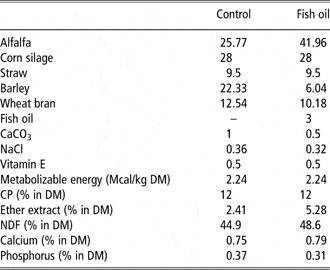
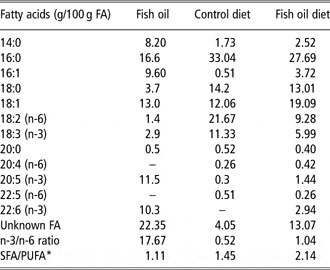
Diets were formulated according to the Agriculture and Food Research Council (AFRC, 1995) and fed at a maintenance level. Rams were randomly allocated to receive one of the following two diets: (i) control group fed a diet without fish oil and (ii) fish oil group (treatment group) fed a diet with 3% fish oil (Anchovy fish oil, Khazar Fish Powder Co., Kiyashahr, Iran) on a dry matter basis. Both diets were isocaloric and isonitrogenous (metabolizable energy was 2.24 Mcal/kg in dry matter and CP was 12% in dry matter). The ingredients and chemical composition of the diets (Table 1), and the fatty acid profiles of the diets and fish oil (Table 2) are shown. Diets were fed to the rams for 13 weeks. In addition, rams had ad libitum access to water. Live body weight (BW) was measured every 21 days in order to adjust the daily allowance; rams were fasted for 16 h before being weighed.
Ingredients and chemical composition of diets fed to rams (control diet and diet supplemented with fish oil)

DM = dry matter.
Fatty acid (FA) profile of fish oil and diets fed to rams (control diet and diet supplemented with fish oil)

*The ratio of saturated fatty acid (SFA) to polyunsaturated fatty acid (PUFA).
Semen collection
Semen was collected from each ram by artificial vagina, once per week for 13 weeks. Semen was maintained at 34°C and immediately transferred from the farm to the laboratory.
Semen evaluation
Semen volume was measured using conical graduated tubes and sperm concentration was determined using a hemocytometer, after dilution with 3% (wt/vol) NaCl solution (1 : 200). The total number of sperm per ejaculate was calculated.
To evaluate the indices of sperm motility including the percentage of motile sperm and progressive forward motility, semen was diluted with 0.9% NaCl w/v (1 : 100). An aliquot (10 μl) of diluted semen was placed on a prewarmed (37°C) microscope slide (76.2 × 24.5 mm; CN-Pearl Industry Co. Ltd, China) covered with a coverslip (24 × 24 mm; Menzel Gläser, Menzel GmbH & Co., KG, Germany) and 10 fields were examined (at ×200) with a phase contrast microscope (Nikon, Tokyo, Japan) equipped with a warm (37°C) stage (Bearden et al., Reference Bearden, Fuquay and Willard2004). The percentages of motile and progressively motile sperm were estimated in increments of 10%. Assessments of sperm motility were carried out without knowledge of the treatment group.
Lipid extraction and analysis
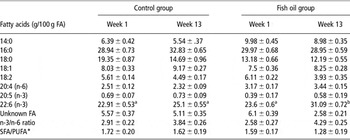
Sperm fatty acid compositions of all rams were measured at the beginning and the end of the experiment (Table 3), according to the following procedure.
Fatty acid composition (LSM ± s.e.m.) of sperm lipid from ram semen in the control and fish oil groups at the beginning and the end (weeks 1 and 13, respectively) of the experiment

a,bWithin a row, values without a common superscript are different (P ⩽ 0.05).
*The ratio of total saturated fatty acids (SFAs) to total polyunsaturated fatty acids (PUFAs).
Semen samples were washed twice following a 6-fold dilution of semen with 0.85% (wt/vol) NaCl, followed by centrifugation at 700 × g for 20 min (Surai et al., Reference Surai, Noble, Sparks and Speake2000). The total lipid was extracted from the sperm after homogenization in a suitable excess of chloroform–methanol (2 : 1, v/v; Folch et al., Reference Folch, Lees and Sloane-Stanley1957). The lipid was trans-methylated by refluxing for 30 min with a mixture of methanol : toluene : sulfuric acid (20 : 1 : 1, v : v : v) in the presence of pentadecanoic acid (Sigma Chemical Co., St. Louis, MO, USA; Hamilton et al., Reference Hamilton, Hamilton and Sewell1992). The resultant fatty acid methyl esters were analyzed by gas chromatography (HP6890 with FID detector and autosampler HP7683, Hewlett Packard, Wilmington, DE, USA) using a capillary column system Carbowax, 30 m × 0.25 mm in diameter, 0.25 μm film thickness (Alltech Ltd, Carnforth, Lancashire, UK). Integration of the peaks and subsequent data handling were performed using the HP Chemstation software (Hewlett Packard), enabling determination of the fatty acid composition (proportion of total fatty acids) by comparison of the total fatty acid peak areas to that of the pentadecanoic fatty acid standard. The identities of the peaks were verified by comparison with the retention times of standard fatty acid methyl esters. The fatty acid composition of total lipids extracted from the experimental feeds and fish oil was also measured.
Samples of the diet fed were collected in the 1st, 6th and 12th weeks of the experiment (in 10 replicates), and stored at 4°C. One mixed sample was analyzed to determine the fatty acid profile.
Statistical analysis
Response variables had a discrete nature with binomial distribution; therefore, all percentage data were subjected to arcsin transformation. Changes in sperm characteristics and BW were analyzed for the effects of treatment, time and treatment by time interaction using MIXED procedure in SAS (SAS Institute, Cary, NC, USA) with a repeated measures analysis. Effects of treatment on fatty acid composition of the sperm lipid were analyzed using the GLM procedure in SAS. LSM were compared between the two groups.
Results
Body weight
Live BW was not different (P > 0.05) between the two groups during the experiment.
Semen
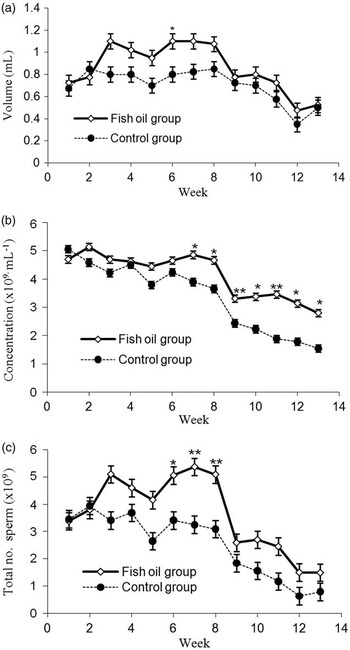
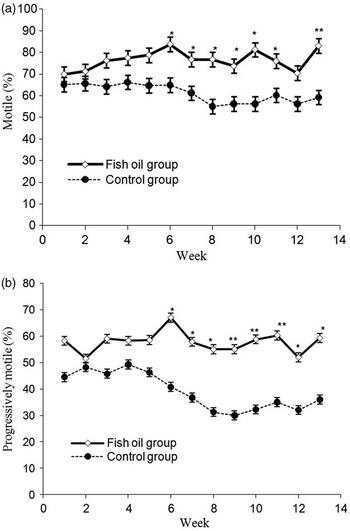
For semen volume, there was a significant effect of time, but the effect of treatment and the treatment by time interaction were not significantly different (Figure 1a). There were effects of treatment (P ⩽ 0.05), time (P ⩽ 0.01) and a treatment by time interaction (P ⩽ 0.01) on sperm concentration; they were significantly higher in the fish oil group versus the control group from week 7 to the end of the experiment (Figure 1b). For the total number of sperm, there were effects of treatment (P ⩽ 0.05) and time (P ⩽ 0.01), with significantly more sperm on weeks 6 to 8 in the group receiving fish oil (Figure 1c). Treatment affected motility (P ⩽ 0.05) and the percentage of progressively motile sperm (P ⩽ 0.01). There was no significant effect of time on sperm motility characteristics; however, motility and progressive motility in the control group were significantly lower than those in the fish oil group from week 6 to the end of the experiment (Figure 2a and b).
Mean semen volume for rams (a), mean sperm concentration (×109) per ml (b) and mean total number of sperm (×109) per ejaculate (c) in the control and fish oil groups during the experimental period. *, **Difference between groups (*P ⩽ 0.05, **P ⩽ 0.01).

Mean percentage of motile sperm (a) and mean percentage of progressive motility (b) in the control and fish oil groups during the experimental period. *, **Difference between groups (*P ⩽ 0.05, **P ⩽ 0.01).

Lipid composition of sperm
The fatty acid composition of sperm lipids is shown (Table 3). Although feeding fish oil did not significantly affect the ratio of total saturates to total PUFAs, it increased the proportion of DHA (P ⩽ 0.05).
Discussion
The objective of this study was to investigate the effects of dietary fish oil (as a source of n-3 fatty acids) on semen quality and sperm fatty acid composition in Iranian Zandi sheep during the physiologic breeding season (late summer to early winter). In this Iranian breed, it was previously reported that the semen quality decreased toward the end of the breeding season (Deldar-Tajangookeh et al., Reference Deldar-Tajangookeh, Zare-Shahne, Moradi-Shahrebabak and Shakeri2007). Similarly, in this study, the semen quality declined over time in both groups; we inferred that this was related to photoperiod. However, feeding fish oil (containing n-3 PUFAs and other compounds) attenuated the decreasing trend of semen quality during the last few weeks of the physiologic breeding season. Furthermore, fish oil supplementation also increased fatty acid 22:6 (n-3) in sperm lipid.
LC-PUFAs of sperm were significantly altered in a variety of livestock species including both mammals (bull, boar (Poulos et al., Reference Poulos, Sharp, Johnson, White and Fellenberg1986)) and birds (chickens, ducks, turkeys (Surai et al., Reference Surai, Blesbois, Grasseau, Chalah, Brillard, Wishart, Cerolini and Sparks1998)) by dietary supplementation. Increasing PUFA sources in the diet resulted in a concomitant increase in n-3 fatty acids of sperm lipid and semen quality in boars (Rooke et al., Reference Rooke, Shao and Speake2001; Mitre et al., Reference Mitre, Cheminade, Allaume, Legrand and Legrand2004) cockerels (Cerolini et al., Reference Cerolini, Zaniboni, Maldjian and Gliozzi2006) and stallions (Brinsko et al., Reference Brinsko, Varner, Love, Blanchard, Day and Wilson2005). Furthermore, we recently reported that dietary fish oil supplementation improved the total number and sperm concentration, motility and progressive motility of goat sperm during the non-breeding season (Dolatpanah et al., Reference Dolatpanah, Towhidi, Farshad, Rashidi and Rezayazdi2008). In contrast, other studies (Paulenz et al., Reference Paulenz, Taugbol, Kommisrud and Grevle1999; Blesbois et al., Reference Blesbois, Douard, Germain, Boniface and Pellet2004) reported no effect of dietary fish oil supplementation on sperm motility in various animal species. The apparently discordant results reported on the effect of feeding C22:6n-3 on sperm motility might be related to the different experimental techniques used.
These unsaturated fatty acids give the sperm plasma membrane the fluidity that it needs to participate in the membrane fusion occurrences associated with fertilization, whereas its deficiency resulted in a loss of sperm motility and an increased proportion of morphologically abnormal sperm (Conquer et al., Reference Conquer, Martin, Tummon, Watson and Tekpetey1999). In addition, alterations in membrane fluidity could impede the assembly and activation of signal transduction pathways critical to fertilization (Wathes et al., Reference Wathes, Abayasekara and Aitken2007).
Differences in the PUFA composition of sperm may influence the flexibility and compressibility of the sperm membrane (Neuringer et al., Reference Neuringer, Anderson and Connor1988). Such properties may affect the ability of the plasma membrane to accommodate the characteristic flagella motion of the sperm (Castellini et al., Reference Castellini, Lattaioli, Dal Bosco, Minelli and Mugnai2003). The function of PUFAs, particularly DHA in the testis, has been also related to their possible effects on the packing of membrane-bound receptors and activity of membrane-bounding enzymes as enzymes associated in spermatozoon-oocyte cross-talk, secondary messenger systems and membrane resistance in physical and chemical stress (Lenzi et al., Reference Lenzi, Picardo, Gandini and Dondero1996).
A secondary hypothesis regarding the favorable effect of dietary fish oil on sperm production is that it increased the concentration of eicosanoids. There is evidence that feeding PUFAs can influence biosynthetic pathways involved in both prostaglandin synthesis and steroidogenesis, which have multiple roles in the regulation of reproductive function. Eicosanoids might have relevance to the alterations in semen quality. Dietary fish oil supplementation was associated with changes in the eicosanoid precursors produced from (n-3) PUFAs. These precursors have different biological activities than those produced from (n-6) fatty acids. Perhaps the results in this study, after a high dietary intake of (n-3) fatty acids, were mediated through the change in the type of eicosanoids produced. Unfortunately, the eicosanoids were not characterized.
An important consideration is the potential interaction of PUFAs or their derived eicosanoids with the hypothalamic–pituitary axis and the hormonal control of spermatogenesis. Hence, the effects of dietary PUFAs on the secretion of GnRH, LH and FSH, and the responsiveness of these cells to these hormones, may be worthy of investigation (Surai et al., Reference Surai, Noble, Sparks and Speake2000).
Another mechanism by which dietary PUFA could promote spermatogenesis is through the regulation of gene expression. Moreover, fatty acids may alter the function of transcription factors controlling the gene expression and can thus affect cellular concentrations of enzymes regulating both the PG and synthetic pathways of steroidogenesis (Wathes et al., Reference Wathes, Abayasekara and Aitken2007).
In this study, after approximately 6 weeks of feeding fish oil, the positive effects of nutritional supplementation on sperm characteristics were apparent. In boars, changes in fatty acid proportions of sperm phospholipids and improvement in sperm quality appeared only after 5 weeks of feeding marine oil (Rooke et al., Reference Rooke, Shao and Speake2001). It was noteworthy that spermatogenesis and epididymal transport required 34 and 10 days, respectively, in boars, whereas in rams, the corresponding intervals were approximately 49 and 9 days (Bearden et al., Reference Bearden, Fuquay and Willard2004). Therefore, we inferred that dietary 22:6 (n-3) must be fed during the early stages of spermatogenesis for it to be incorporated into sperm lipids. Changes in sperm characteristics were detected both in relation to the diets fed and to the duration of the trial. That the supplementation of fish oil to the diet attenuated the decreasing trend of semen characteristics during the last few weeks of seasonal breeding was attributed to the transfer of n-3 fatty acids, especially DHA, from fish oil to sperm.
In this study, we found remarkable DHA content in the lipid component of sheep semen. Like in other mammals, but in contrast to the domestic avian species in which docosatetraenoic acid, 22:4 (n-6) predominates (Kelso et al., Reference Kelso, Cerolini, Noble, Sparks and Speake1996), both sperm and seminal plasma in bulls were characterized by the presence of very high concentrations of C20 and C22 polyunsaturates, particularly the n-3 series of PUFAs such as DHA (22:6, n-3; Parks and Lynch, Reference Parks and Lynch1992). Dott and Dingle (Reference Dott and Dingle1968) detected DHA in ram sperm, whereas Scott et al. (Reference Scott, Voglmayr and Setchel1967) did not report it as present in their extracts. Neill and Masters (Reference Neill and Masters1973) reported 65.1% DHA in total phospholipids of ovine sperm, consistent with the high proportion of DHA in ram sperm lipid in this study.
In conclusion, the composition of LC-PUFAs in sperm was changed by the dietary supplementation of an n-3 PUFA source. Supplementation significantly increased the concentration of DHA in sperm lipids and was accompanied by improved semen quality. We conclude that (i) n-3 LC-PUFAs of fish oil were effectively transferred to ovine sperm; and (ii) this attenuated decreased semen quality during the last weeks of the physiologic breeding season.
Acknowledgment
The authors thank Professor John Kastelic from the Lethbridge Research Centre Lethbridge, AB, Canada for kind scientific cooperation.