1 Introduction
In the study of groups, subgroups play a fundamental role in understanding the structure of a group. By examining the number, types and lattice diagrams of subgroups, important structural features such as solvability and simplicity can be studied. Many enumeration problems in algebra and combinatorics reduce to counting subgroups of certain related groups, either absolutely or up to some form of equivalence. A prime example is Galois theory: enumerating subgroups (or certain types of subgroups) of the symmetric group
 $S_n$
gives precise information on the number of intermediate fields in a field extension of degree n.
Let
 $s(G)$
denote the number of subgroups of the group G. Betz and Nash [Reference Betz and Nash4] classified all abelian groups G with
 $s(G)\leq 22$
and all nonabelian groups G with
 $s(G)\leq 19$
. Das and Mandal [Reference Das and Mandal5] established criteria for the solvability and nilpotency of a finite group based on its number of subgroups. Recently, Roney-Dougal and Tracey [Reference Roney-Dougal and Tracey16] obtained a result concerning the number of subgroups in symmetric groups.
To study the subgroups of a finite group, it is natural to consider their cyclic subgroup structure, as every element of the group generates a cyclic subgroup. In group representation theory, this helps in finding the Wedderburn decomposition of group algebras for an abelian group. We describe various results related to the counting of cyclic subgroups. Miller [Reference Miller13] was the first to give a result in this direction: if G is a finite group, then
 $$ \begin{align} |G|=\sum\limits_{m\,|\, |G|}c(m)\varphi (m), \end{align} $$
where
 $c(m)$
denotes the number of cyclic subgroups of order m in G. In [Reference Miller14], Miller proved that the number of cyclic subgroups of order
 $p^r, r>1$
, in a finite group is a multiple of p whenever the Sylow subgroups of the group are noncyclic. Richards [Reference Richards15] gave a remarkable lower bound on the number of cyclic subgroups: for a finite group G of order n, the number of cyclic subgroups
 $c(G)$
satisfies the inequality
 $c(G)\geq d(n)$
, where
 $d(n)$
denotes the number of positive divisors of n. Moreover, equality holds if and only if G is a cyclic group of order n. Meng and Lu [Reference Meng and Lu12] further refined this bound for finite noncyclic nilpotent groups. Tóth [Reference Tóth20] gave a formula to count the number of cyclic subgroups of finite abelian groups. Jafari and Madadi [Reference Jafari and Madadi9] also contributed to the counting of cyclic subgroups in finite groups.
Let G be a finite group, and let
 $s(G)$
and
 $c(G)$
denote the number of subgroups and the number of cyclic subgroups of G, respectively. A group G is n-cyclic if
 $c(G)=n$
. It is easy to see that
 $c(G)\leq |G|$
, and equality holds if and only if G is an elementary abelian
 $2$
-group. Tărnăuceanu [Reference Tărnăuceanu18] classified all finite groups G having
 $|G|-1$
cyclic subgroups. In the same paper, he posed a problem to classify the finite groups G satisfying
 $c(G)=|G|-r$
, where
 $2\leq r\leq |G|-1$
. Motivated by this problem, Belshoff et al. [Reference Belshoff, Dillstrom and Reid3] classified all finite groups having
 $|G|-r$
cyclic subgroups for
 $r=3,4$
and
 $5$
. They extended the classification to
 $1\le r\le 32$
in [Reference Belshoff, Dillstrom and Reid2]. Zhou [Reference Zhou21], Kalra [Reference Kalra10], and Ashrafi and Haghi [Reference Ashrafi and Haghi1] classified all n-cyclic groups for
 $3\leq n\leq 10$
. In our earlier paper [Reference Sharma and Reddy17], we classified all
 $11$
-cyclic groups.
Many authors have defined functions on the set of finite groups by using
 $c(G)$
and
 $s(G)$
, and studied these functions and their relationship with the structure of group G.
A new approach to group-theoretic problems is to study them statistically and derive probabilistic results, which help to understand the asymptotic behaviour. In this direction, the probability that a random subgroup of G is cyclic is introduced by Tărnăuceanu and Tóth [Reference Tărnăuceanu and Tóth19]. This is the cyclicity degree,
 $\textit {cdeg} (G)$
, of a finite group G, defined by
 $\textit {cdeg} (G)={c(G)}/{s(G)}$
. In [Reference Tărnăuceanu and Tóth19], the cyclicity degree of some classes of groups is determined and the following problem is posed.
Problem 1.1. For every
 $a\in [0, 1]$
, does there exist a sequence
 $(G_n)_{n\in {\mathbb {N}}}$
of finite groups such that
 $\lim _{n\to \infty } \textit {cdeg}(G_n)=a$
?
In this article, we classify all
 $12$
-cyclic groups. Additionally, we solve Problem 1.1 by proving that the image set of the function
 $\textit {cdeg}$
is dense in
 $[0,1]$
. In Section 2, we set up notation, recall the results of [Reference Sharma and Reddy17] and formulate lemmas on which our proofs are based. The classification of
 $12$
-cyclic groups and a solution of Problem 1.1 are given in Sections 3 and 4, respectively.
2 Notation and preliminaries
The notation
 ${\mathbb {Z}}_n$
,
 $D_{2n}$
,
 $Q_{2^n}$
,
 $M(p^a)$
,
 $F_5$
,
 $\text {SL}(2,3)$
and
 $\textit {Dic}_{n}$
denote the cyclic group of order n, dihedral group of order
 $2n$
, generalised quaternion group of order
 $2^n$
, modular group of order
 $p^a$
, Frobenius group of order
 $20$
, special linear group of order
 $24$
and dicyclic group of order
 $4n$
, respectively. The group
 ${\mathbb {Z}}_8.{\mathbb {Z}}_4=\,$
SmallGroup
 $(32,15)$
has the presentation
 $\langle a,b : a^8=1, b^4=a^4, bab^{-1}=a^{-1} \rangle $
. Here, SmallGroup
 $(n, i)$
denotes the ith group of order n in the Small Group Library of GAP [7].
Throughout,
 $p, q$
and r are distinct prime numbers, the Euler totient function is denoted by
 $\varphi $
, and
 $d(n), \omega (n)$
denote the number of positive divisors and the number of distinct prime divisors of n, respectively. We denote by
 ${\mathbb {N}}$
the set of natural numbers not including zero.
The number of Sylow p-subgroups of G is denoted by
 $n_p(G)$
. A group G is CLT if it has a subgroup corresponding to every divisor of
 $|G|$
. A group G is Dedekind if every subgroup of G is normal. A noncyclic group G is said to be minimal noncyclic if all its proper subgroups are cyclic.
Richards’ theorem [Reference Richards15] provides a lower bound on
 $c(G)$
: in particular,
 $c(G)\geq d(|G|)$
with equality if and only if G is cyclic. Suppose G is a
 $12$
-cyclic group of order n. An immediate consequence of Richards’ theorem is that
 $\omega (n)\le 3$
and n takes one of the forms
 $p^k, pq, p^2q, pqr, p^3q, p^4q, p^5q, p^2q^2, p^3q^2$
or
 $p^2qr$
, where
 $k\leq {11}$
.
Referring to (1.1), we define
 $$ \begin{align} T(G)=|G|-\sum\limits_{m\,|\,|G|}c(m)\varphi (m). \end{align} $$
One of our strategies for finding all
 $12$
-cyclic groups is to take different possibilities for
 $c(m)$
for all the divisors m of
 $|G|$
and then try to find all groups G, which satisfy
 $\sum _{m\,|\,|G|}c(m)=12$
and
 $T(G)=0$
. All the calculations for the groups of small orders are done by using GAP [7].
Lemma 2.1 [Reference Sharma and Reddy17, Lemma 2.2].
Let G be a nontrivial n-cyclic group of order
 $p^aq^b$
, where p and q are distinct prime numbers. If a Sylow p-subgroup P of G is Dedekind, then either P is normal in G or
 $q< {n-1}$
.
Lemma 2.2 [Reference Sharma and Reddy17, Proposition 2.4].
Let G be a noncyclic, n-cyclic group and let M be a maximal subgroup of G. Then,
 $c(M)<{n-1}$
.
Lemma 2.3 (Frobenius, [Reference Frobenius6]).
If p is a prime, p divides
 $|G|$
and
 $a_p$
denotes the number of subgroups of order p in G, then
 $a_p\equiv 1\pmod p$
.
Lemma 2.4 [Reference Lazorec11, Lemma 4.1].
Let
 $(x_n)_{n\geq 1}$
be a sequence of positive real numbers such that
 $\lim _{n\to \infty }x_n=0$
and the series
 $\sum _{i=1}^{\infty }x_i$
is divergent. Then, the set containing the sums of all finite subsequences of
 $(x_n)_{n\geq 1}$
is dense in
 $[0, \infty )$
.
3 Classification of 12-cyclic groups
Theorem 3.1. Let G be a finite group. Then,
 $c(G)=12$
if and only if G is isomorphic to an element of the set
 $$ \begin{align*} S & = \{{\mathbb{Z}}_{p^{11}}, {\mathbb{Z}}_{p^5q}, {\mathbb{Z}}_{p^3q^2}, {\mathbb{Z}}_{p^2qr}, {{\mathbb{Z}}_2}^2\times {\mathbb{Z}}_4, {{\mathbb{Z}}_2}^2\rtimes {\mathbb{Z}}_4, D_{16}, D_8\rtimes {\mathbb{Z}}_2, D_{18}, F_{5}, Dic_6, {\mathbb{Z}}_8.{\mathbb{Z}}_4, \\ &\quad \ \ {{\mathbb{Z}}_{2}}^2\rtimes {\mathbb{Z}}_9, M(64), {\mathbb{Z}}_2\times {\mathbb{Z}}_{32}, {\mathbb{Z}}_5\times {\mathbb{Z}}_{25}, {\mathbb{Z}}_{25}\rtimes {\mathbb{Z}}_5, {\mathbb{Z}}_2\times {\mathbb{Z}}_{2s^2}, {\mathbb{Z}}_{4s}\times {\mathbb{Z}}_2 \}, \end{align*} $$
where
 $p, q, r$
are prime numbers and s is an odd prime.
As noted above, if G is a
 $12$
-cyclic group,
 $$ \begin{align*}|G|\in \{p^k, pq, p^2q, pqr, p^3q, p^4q, p^5q, p^2q^2, p^3q^2, p^2qr\},\end{align*} $$
where
 $k\leq {11}$
. In addition, for the orders
 $p^{11}, p^5q, p^3q^2$
and
 $p^2qr$
, there is a unique
 $12$
-cyclic group that is also cyclic. The other possible orders of the
 $12$
-cyclic groups are divided among the following four lemmas.
Lemma 3.2. If G is a
 $12$
-cyclic p-group, then
 $$ \begin{align*}G\cong \begin{cases} {\mathbb{Z}}_{p^{11}}\hspace{-0.2pt},\; {{\mathbb{Z}}_{2}}^2\times {\mathbb{Z}}_{4},\; {\mathbb{Z}}_{2}\times {\mathbb{Z}}_{32}\; \mbox{or}\; {\mathbb{Z}}_{5}\times {\mathbb{Z}}_{25} & \mbox{if } G \mbox{ is abelian},\\ {{\mathbb{Z}}_{2}}^2\rtimes {\mathbb{Z}}_{4},\; D_8\rtimes {\mathbb{Z}}_2,\; D_{16},\; {\mathbb{Z}}_8.{\mathbb{Z}}_4,\; M(64)\; \mbox{or}\; {\mathbb{Z}}_{25}\rtimes {\mathbb{Z}}_5 & \mbox{otherwise.} \end{cases}\end{align*} $$
Proof. Let M be a maximal subgroup of G. Then, we have the following two cases.
Case 1: M is a cyclic subgroup of G. We first assume that G is abelian. Since
 $|M|=p^{a-1},$
either G is isomorphic to
 ${\mathbb {Z}}_{p^a}$
or
 ${\mathbb {Z}}_{p}\times {\mathbb {Z}}_{p^{a-1}}.$
If
 $G\cong {\mathbb {Z}}_{p^a}$
, then it is easy to see that
 $a=11$
. If
 $G\cong {\mathbb {Z}}_{p}\times {\mathbb {Z}}_{p^{a-1}}$
, then by [Reference Ashrafi and Haghi1, Theorem 1.1],
 $c(G)=(a-1)p+2$
. Consequently, either
 $p=5, a=3$
or
 $p=2, a=6$
and
 $|G|=125$
or
 $64.$
By a simple GAP program,
 $G\cong {\mathbb {Z}}_{5}\times {\mathbb {Z}}_{25}=$
SmallGroup
 $(125,2)$
or
 ${\mathbb {Z}}_{2}\times {\mathbb {Z}}_{32}=$
SmallGroup
 $(64,50)$
.
Now, let G be a nonabelian group. Depending on p, there are two situations. If p is odd, then
 $G\cong M(p^a)$
and by [Reference Ashrafi and Haghi1, Theorem 1.1],
 $c(G)=(a-1)p+2.$
This shows that
 $p=5, a=3$
and
 $G\cong {\mathbb {Z}}_{25}\rtimes {\mathbb {Z}}_5=$
SmallGroup
 $(125,4)$
by GAP. If
 $p=2$
, then by the classification theorem of finite nonabelian
 $2$
-groups containing a cyclic maximal subgroup,
 $G\cong D_{2^a}, Q_{2^a}, M(2^a)$
or
 $S_{2^a}.$
From [Reference Ashrafi and Haghi1, Theorem 1.1],
 $c(D_{2^a})=a+2^{a-1}$
,
 $c(Q_{2^a})=a+2^{a-2}$
,
 $c(M(2^a))=2a$
and
 $c(S_{2^a})=a+3.2^{a-3}.$
By a simple calculation, one can check that
 $G\cong M(64)$
or
 $D_{16}$
.
Case 2: M is a noncyclic subgroup of G. By Lemma 2.2,
 $c(M)\leq 10$
. By [Reference Ashrafi and Haghi1, Theorems 1.2 and 2.4], M is isomorphic to a member of the set
 $S=\{{\mathbb {Z}}_2\times {\mathbb {Z}}_2, {\mathbb {Z}}_3\hspace{0.1pt}\times\hspace{0.1pt} {\mathbb {Z}}_3, {\mathbb {Z}}_2\hspace{0.1pt}\times\hspace{0.1pt} {\mathbb {Z}}_4, {\mathbb {Z}}_5\hspace{0.1pt}\times\hspace{0.1pt} {\mathbb {Z}}_5, {\mathbb {Z}}_3\hspace{0.1pt}\times\hspace{0.1pt} {\mathbb {Z}}_9, {\mathbb {Z}}_2\hspace{0.1pt}\times\hspace{0.1pt} {\mathbb {Z}}_8$
,
 ${\mathbb {Z}}_2\hspace{0.1pt}\times\hspace{0.1pt} {\mathbb {Z}}_2\hspace{0.1pt} \times\hspace{0.1pt} {\mathbb {Z}}_2, {\mathbb {Z}}_7\hspace{0.1pt}\times\hspace{0.1pt} {\mathbb {Z}}_7, {\mathbb {Z}}_2\hspace{0.1pt}\times\hspace{0.1pt} {\mathbb {Z}}_{16}, {\mathbb {Z}}_4\hspace{0.1pt}\times\hspace{0.1pt} {\mathbb {Z}}_4, {\mathbb {Z}}_2\times Q_{8}, SD_{16}, {\mathbb {Z}}_{16}\rtimes {\mathbb {Z}}_2, {\mathbb {Z}}_4\rtimes {\mathbb {Z}}_4, Z_9\rtimes {\mathbb {Z}}_3$
,
 ${\mathbb {Z}}_8\rtimes {\mathbb {Z}}_2, Q_{16}, D_{8}, Q_8 \}$
. If
 $p=2$
, then
 $a=3,4,5$
or
 $6;$
if
 $p=3$
, then
 $a=3,4$
or
 $5$
; and if
 $p=5,7$
, then
 $a=3.$
This gives
 $|G|\in \{8, 16, 27, 32, 64, 81, 125, 243, 343\}.$
By a simple GAP program,
 $G\cong {{\mathbb {Z}}_2}^2\times {\mathbb {Z}}_4 =$
SmallGroup
 $(16,10)$
,
 ${{\mathbb {Z}}_2}^2\rtimes {\mathbb {Z}}_4= $
SmallGroup
 $(16,3)$
,
 $D_8\rtimes {\mathbb {Z}}_2=$
SmallGroup
 $(16,13)$
or
 ${\mathbb {Z}}_8.{\mathbb {Z}}_4=$
SmallGroup
 $(32,15)$
.
By Lemma 3.2 and Richards’ theorem, we conclude that a group G is cyclic and
 $12$
-cyclic if and only if
 $G\cong {\mathbb {Z}}_{p^{11}}, {\mathbb {Z}}_{p^5q}, {\mathbb {Z}}_{p^3q^2}, {\mathbb {Z}}_{p^2qr}$
. Again, by Lemma 3.2 and [Reference Tóth20, Theorem 1], it is easy to check that a group G is noncyclic abelian and
 $12$
-cyclic if and only if
 $G\cong {{\mathbb {Z}}_2}^2\times {\mathbb {Z}}_4, {\mathbb {Z}}_2\times {\mathbb {Z}}_{32}, {\mathbb {Z}}_5\times {\mathbb {Z}}_{25}, {\mathbb {Z}}_2\times {\mathbb {Z}}_{2q^2}, {\mathbb {Z}}_{4q}\times {\mathbb {Z}}_2$
, where q is an odd prime.
Therefore, from now onwards, the group
 $G$
is assumed to be nonabelian. The rest of the proof is organised as follows. In Lemma 3.3, we prove that if G is a nonabelian
 $12$
-cyclic group of order
 $p^2q$
or
 $p^2q^2$
, then G is isomorphic to
 $F_5, D_{18}$
or
 ${{\mathbb {Z}}_2}^2\rtimes {\mathbb {Z}}_9$
. In Lemma 3.4, we prove that if G is a nonabelian
 $12$
-cyclic group of order
 $p^3q$
, then G is isomorphic to
 $Dic_6$
. Finally, in Lemma 3.5, we prove that there is no
 $12$
-cyclic group of order
 $pq, pqr$
or
 $p^4q$
.
Lemma 3.3. Let G be a nonabelian
 $12$
-cyclic group.
-
(1) If
 $|G|=p^2q$
, then G is isomorphic to
$F_5$
or
$D_{18}$
.
-
(2) If
$|G|=p^2q^2$
, then
$G\cong {{\mathbb {Z}}_2}^2\rtimes {\mathbb {Z}}_9=$
SmallGroup
$(36,3)$
.


Proof. We consider the two cases separately.
Case 1:
 $|G|=p^2q$
. Then, there are two subcases.
-
(a) If
$p<q,$
then
$c(G)\in \{6, 2p+4, pq+4, q+4, 2q+2\}$
by [Reference Kalra10, Proposition 3.3]. Hence, G is
$12$
-cyclic only if
$p=2, 3$
and
$q=5.$
By [7], we have
$G\cong F_5=$
SmallGroup
$(20,3)$
. -
(b) If
$p>q$
, then
$c(G)\in \{6, 2p+4, p^2+3, p^2+p+2, 2p+3, 3p+2\}$
by [Reference Kalra10, Proposition 3.2]. Thus,
$c(G)=12$
is possible only if
$p=3$
and
$q=2.$
By GAP,
$G\cong D_{18}=$
SmallGroup
$(18,1)$
.


Case 2:
 $|G|=p^2q^2$
. Then, the Sylow p- and q-subgroups of G are Dedekind. We prove the result by examining three subcases.
-
(a)
${G}$
has unique subgroups of orders
${p}$
and
${q}$
. In this case, the Sylow p- and q-subgroups of G are cyclic. If
$n_p(G)=n_q(G)=1$
, then G is cyclic, which is a contradiction. Also, by Sylow’s theorems,
$n_p(G), n_q(G)>1$
is not possible. Assume that
$n_p(G)>1$
and
$n_q(G)=1$
. By Sylow’s theorems,
$n_p(G)\geq {1+p}$
and
$n_p(G)\in \{q,q^2\}$
. Moreover, G has a unique cyclic subgroup of orders
$1, p, q, pq$
and
$q^2$
. If
$n_p(G)=q$
, then
$p<q$
and
$c(G)\geq {q+5}$
. Hence,
$p\in \{2,3,5\}$
and
$q\in \{2,3,5,7\}$
; also
$|G|\in \{36,100,196,225,441,1225\}$
. If
$n_p(G)=q^2$
, then either
$|G|=36$
or
$c(G)>12$
. A simple calculation with GAP shows that there is no group of these orders which is
$12$
-cyclic. -
(b)
${G}$
has a unique subgroup of order
${q}$
and at least
${p+1}$
subgroups of order
${p}$
. Then, the Sylow q-subgroup of G is cyclic. Therefore,
$c(G)\geq p+4,$
which implies that
$p\in \{2,3,5,7\}.$
If one (and hence each) Sylow
${p}$
-subgroup of G is not normal, then by Lemma 2.1,
$q<11$
and
$|G|\in \{36, 100, 196, 225, 441, 1225 \}$
. Again, if the Sylow p-subgroups of G are normal (and hence there is only one Sylow
$p$
-subgroup), then the Sylow q-subgroup of G is not normal (since G is nonabelian), that is,
$n_q(G)\geq {1+q}$
. Since G has at least three subgroups of order p, we have
$c(G)\geq {6+q}$
and
$q\leq 6$
. Hence,
$|G|\in \{36, 100, 196, 225, 441, 1225\}$
. By using a simple GAP program, one can check that
$G\cong {{\mathbb {Z}}_2}^2\rtimes {\mathbb {Z}}_9=$
SmallGroup
$(36,3)$
. -
(c) Subgroups of orders
${p}$
and
${q}$
are not unique. By Lemma 2.3, G has at least
$p+1$
subgroups of order p and
$q+1$
subgroups of order q. Therefore,
$c(G)\geq p+q+3$
. Accordingly,
$p+q\in \{2,3,4,5,6,7,8,9\}$
and
$|G|\in \{36,100,196,225\}.$
After analysing all the groups of order
$36,100,196$
and
$225$
by GAP, it can be seen that none of them is
$12$
-cyclic.


Lemma 3.4. If G is a nonabelian
 $12$
-cyclic group of order
 $p^3q$
, then
 $G\cong Dic_6$
.
Proof. Let
 $|G|=p^3q$
. By the proof of [Reference Sharma and Reddy17, Theorem 1.1], we can check that G is a CLT group, so it has a subgroup M of order
 $p^2q$
. By Lemma 2.2,
 $c(M)\leq 10$
. Also by [Reference Ashrafi and Haghi1, Theorems 1.2 and 2.4],
 $M\in \{{\mathbb {Z}}_{p^2q}, {\mathbb {Z}}_3\rtimes {\mathbb {Z}}_{4}, {\mathbb {Z}}_2\times {\mathbb {Z}}_{2p}, A_4, {\mathbb {Z}}_5\rtimes {\mathbb {Z}}_4,D_{12},{\mathbb {Z}}_3\times {\mathbb {Z}}_{3q} \}$
. If
 $M\in \{A_4, {\mathbb {Z}}_3\rtimes {\mathbb {Z}}_{4},{\mathbb {Z}}_5\rtimes {\mathbb {Z}}_4, D_{12}\}$
, then
 $|G|\in \{24,40 \}.$
It is easy to verify using GAP that no such group of order
 $24$
or
 $40$
is
 $12$
-cyclic. We discuss the remaining possibilities for M separately.
Case 1:
 $M\cong {\mathbb {Z}}_{p^2q}$
. Then, G has at least six cyclic subgroups of orders
 $1, p, q, p^2, pq$
and
 $p^2q$
. We consider two sub-cases.
-
(a)
${G}$
has a unique subgroup of order
${p}$
. In this case, the Sylow p-subgroup of G is either cyclic or generalised quaternion. First, suppose that G has a unique cyclic Sylow p-subgroup. Then,
$n_q(G)\geq 1+q$
and
$n_q(G)\geq p$
. This shows that
$c(G)\geq 7+q$
and
$c(G)\geq 6+p$
. Thus,
$|G|\in \{24, 40, 54, 135, 250, 375\}$
. It is easy to verify using GAP that there is no
$12$
-cyclic group of these orders in which the Sylow p-subgroup is cyclic and normal. Therefore, if the Sylow p-subgroup of G is cyclic, then it is not normal, and
$n_p(G)=q$
. Moreover,
$c(G)\geq 6+q$
and
$q\in \{2, 3, 5\}$
. Again by using Sylow’s theorems,
$n_p(G)\geq {1+p}$
, which implies that
$c(G)\geq 7+p$
and
$p=2,3$
or
$5$
. Thus,
$|G|\in \{24, 40, 54, 135, 250, 375\}$
. After checking the number of cyclic subgroups of all the groups of these orders by GAP, we see that no such group is
$12$
-cyclic.If the Sylow p-subgroup of G is generalised quaternion, then Sylow p- and q-subgroups of G are Dedekind. First, assume that the Sylow q-subgroup of G is normal. If the Sylow p-subgroup of G is also normal, then
$G\cong Q_8\times {\mathbb {Z}}_q$
, and it is easy to see that
$c(G)=10$
, which is not possible. Therefore, the Sylow p-subgroups of G are not normal. By Lemma 2.1,
$q<11$
, which implies that
$|G|\in \{24, 40, 56 \}$
. A simple GAP program shows that no such group of these orders is
$12$
-cyclic. We are left with the case where the Sylow q-subgroups of G are not normal. Then, by Sylow’s theorems,
$n_q(G)=1+kq$
, where
$k\in {\mathbb {N}}$
and
$n_q(G)\geq 4$
. As a consequence, either
$|G|=24$
or
$c(G)>12$
. A simple GAP program shows that
$G\cong Dic_6=$
SmallGroup
$(24,4)$
. -
(b)
${G}$
has at least
${p+1}$
subgroups of order
${p}$
. Since
$c(M)=6$
, then
$c(G)\geq {6+p}$
and
$p\leq 6$
. We discuss the possibilities separately.If
$p=5$
, then G has exactly six subgroups of order
$5$
and there are two possibilities. If a Sylow
$5$
-subgroup of G is cyclic, then by Sylow’s theorems,
$c(G)>12$
. If a Sylow
$5$
-subgroup is not cyclic and contains an element of order
$25$
, then using GAP, we can check that it always contains more than two cyclic subgroups of order
$25$
, which implies that
$c(G)>12$
. Hence, this case is not possible. If
$p=3$
, then by Lemma 2.3, G has either four or seven subgroups of order
$3$
. If G has seven subgroups of order
$3$
, then by (2.1), the equation
$T(G)=0$
has no solution. Thus, from now onwards, assume that G has four subgroups of order
$3$
. By [Reference Kalra10, Table 1], a Sylow
$3$
-subgroup of G lies the set in
$\{{\mathbb {Z}}_{27}, {\mathbb {Z}}_{9}\times {\mathbb {Z}}_3, \langle a,b \mid {a^{9}=b^3=1}, ba=a^{4}b\rangle \}$
as G has an element of order
$9$
. If a Sylow
$3$
-subgroup P of G is isomorphic to
${\mathbb {Z}}_9\times {\mathbb {Z}}_3$
, then it is easy to see that
$c(P)=8$
. Additionally, G has at least one cyclic subgroup of orders
$q, 3q$
and
$9q$
, and either a Sylow
$3$
- or Sylow q-subgroup of G is not normal, which implies that
$c(G)>12$
. If P is isomorphic to
$\langle a,b \mid a^{9}=b^3=1, ba=a^{4}b\rangle $
, then by GAP,
$c(P)=8$
. This case is not possible, as with the previous case. Finally, if P is isomorphic to
${\mathbb {Z}}_{27}$
, then
$n_3(G)\geq 4$
and
$c(G)>12$
. Therefore, this case is not possible.If
$p=2$
, then by Lemma 2.3, G has either three, five or seven subgroups of order
$2$
. First, assume that the Sylow q-subgroups of G are not normal. Then,
$n_q(G)\geq {1+q}$
and
$q=3$
by the fact that
$c(G)=12$
. This shows that
$|G|=24$
, and we can verify by using GAP that no such group is
$12$
-cyclic. Therefore, from now onwards, the unique Sylow q subgroup of G is normal. By [Reference Kalra10, Table 1], Sylow
$2$
-subgroups of G lie in the set
$\{{\mathbb {Z}}_8, {\mathbb {Z}}_4\times {\mathbb {Z}}_2, Q_8, D_8\}$
as G has a subgroup of order
$4$
. There are two situations. First, assume that a Sylow
$2$
-subgroup of G is normal. Then,
$G\cong Q_8\times {\mathbb {Z}}_q$
or
$D_8\times {\mathbb {Z}}_q$
. With some easy calculation, it can be seen that neither of these groups is
$12$
-cyclic. Second, assume that no Sylow
$2$
-subgroup of G is normal. This gives two further possibilities. If a Sylow
$2$
-subgroup of G is Dedekind, then by Lemma 2.1,
$q<11$
. Thus,
$|G|\in \{24, 40, 56\}$
. With the help of a simple GAP program, we can check that no such group is
$12$
-cyclic. We are left with the case when no Sylow
$2$
-subgroup of G is Dedekind and so is isomorphic to
$D_8$
. By Sylow’s theorems, G has at least three Sylow
$2$
-subgroups. Let
$H\cong D_8$
and
$K\cong D_8$
be two Sylow
$2$
-subgroups of G. By using the fact that
$|H\cap K|\leq 4$
, we can see that G has at least seven subgroups of order
$2$
. By (2.1), the equation
$T(G)=0$
has no solutions. Hence, no such group is
$12$
-cyclic.


Case 2:
 $M\cong {\mathbb {Z}}_2\times {\mathbb {Z}}_{2q}$
. Then,
 $c(M)=8$
,
 $|G|=8q$
and G has no cyclic subgroup of order
 $8$
. By Sylow’s theorems,
 $n_2(G)\in \{1, q\}$
and
 $n_q(G)\in \{1,4,8\}$
. If
 $n_q(G)=8$
, then
 $c(G)>12$
. Also, if
 $n_q(G)=4$
, then
 $q=3$
and
 $|G|=24$
. By using GAP, no such group of order
 $24$
is
 $12$
-cyclic. Consequently, G has a normal Sylow q-subgroup. Moreover, a Sylow
 $2$
-subgroup is neither isomorphic to
 ${\mathbb {Z}}_8$
nor
 $Q_8$
as G has a subgroup isomorphic to
 ${\mathbb {Z}}_2\times {\mathbb {Z}}_2$
. Further, if a Sylow
 $2$
-subgroup of G is normal, then
 $G\cong D_8\times {\mathbb {Z}}_q$
, and it is easy to check that
 $c(G)=14$
. Hence, from now onwards, assume that no Sylow
 $2$
-subgroup is normal. This gives two possibilities. First, if a Sylow
 $2$
-subgroup is Dedekind, then by Lemma 2.1,
 $q<11$
and
 $|G|\in \{24, 40, 56 \}$
. With the help of a simple GAP program, we can check that no group of these orders satisfying the above conditions is
 $12$
-cyclic. Second, if no Sylow
 $2$
-subgroup is Dedekind, then all are isomorphic to
 $D_8$
. Also, G has at least three cyclic subgroups of order
 $2q$
and at least eight cyclic subgroups of order
 $1,2,4$
and
 $8$
. From (2.1), the equation
 $T(G)=0$
has no solutions. Hence, no such group is 12-cyclic.
Case 3:
 $M\cong {\mathbb {Z}}_3\times {\mathbb {Z}}_{3q}$
. Then,
 $c(M)=10$
and
 $|G|=27q$
. By Sylow’s theorems,
 $n_3(G)\in \{1,q\}$
and
 $n_q(G)\in \{1,3,9,27\}$
. If
 $n_q(G)\in \{3, 9, 27\}$
, then we can easily check that either
 $c(G)>12$
or G is not
 $12$
-cyclic by using (2.1). Therefore, G has a normal Sylow q-subgroup. Also, by [Reference Ashrafi and Haghi1, Theorem 1.2], a Sylow
 $3$
-subgroup, P, of G is either isomorphic to
 ${\mathbb {Z}}_9\times {\mathbb {Z}}_3$
or
 ${\mathbb {Z}}_9\rtimes {\mathbb {Z}}_3$
, and
 $c(P)=8$
. This implies that
 $c(G)>12$
, as
 $c(M)=10$
. Thus, no such group is
 $12$
-cyclic.
Lemma 3.5. If
 $|G|=pq, pqr$
or
 $p^4q$
, then G is not
 $12$
-cyclic.
Proof. The proof proceeds through three cases.
Case 1:
 $|G|=pq$
, where
 $p<q$
. By [Reference Kalra10, Lemma 3.1],
 $c(G)=4$
or
 $q+2$
. Hence, no group of order
 $pq$
is
 $12$
-cyclic.
Case 2:
 $|G|=pqr$
. Since every group of square-free order is solvable, G has Hall subgroups of orders
 $pq,pr$
and
 $qr$
. These Hall subgroups are either cyclic or they are isomorphic to
 $S_3, D_{14}, D_{10}$
or
 ${\mathbb {Z}}_7\rtimes {\mathbb {Z}}_3$
by [Reference Ashrafi and Haghi1, Theorems 1.2 and 2.4]. If all the Hall subgroups of G are cyclic, then G is a minimal noncyclic group, which is not possible by [Reference Jafari and Madadi9, Proposition 2.8]. Let M be a nonabelian, maximal Hall subgroup of G. Then, we have four sub-cases.
-
(a) If
$M\cong {\mathbb {Z}}_7\rtimes {\mathbb {Z}}_3$
, then
$|G|=21p$
, and G has a unique cyclic subgroup of orders
$1$
and
$7$
, and at least
$7$
cyclic subgroups of order
$3$
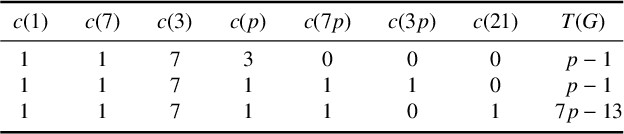
. Using Sylow’s theorems, Lemma 2.3 and
$c(G)=12$
, we can list all the possibilities for the number of cyclic subgroups of G along with the function
$T(G)$
using (2.1). The results are recorded in Table 1. It is easy to check that
$T(G)=0$
has no solution. Hence, no such group is
$12$
-cyclic. -
(b) If
$M\cong D_{14}$
, then
$|G|=14p$
and
$c(M)=9$
by [Reference Ashrafi and Haghi1, Theorem 2.4]. By Sylow’s theorems, there is a unique subgroup of orders
$7$
and p. Also, G has at least seven subgroups of order
$2$
and a unique cyclic subgroup of order
$7p$
. By using the fact
$c(G)=12$
, either G has a cyclic subgroup of order
$2p$
or order
$14$
. By (2.1), in both cases, the equation
$T(G)=0$
has no solution. Therefore, no such group is
$12$
-cyclic. -
(c) If
$M\cong S_3$
, then
$|G|=2\cdot 3\cdot p$
. By Sylow’s theorems,
$n_p(G)$
is either
$1$
or
$6$
. If
$n_r(G)=1$
, then M is not normal. In this case, either
$n_2(G)$
or
$n_3(G)$
is p. Therefore,
$p\leq 7$
and
$|G|=30$
or
$42$
. Also, if
$n_p(G)=6$
, then
$|G|=30$
. By GAP, no such group of order
$30$
or
$42$
is
$12$
-cyclic. -
(d) If
$M\cong D_{10}$
, then
$|G|=2\cdot 5\cdot p$
. By Sylow’s theorems,
$n_p(G)$
is either
$1$
or
$4$
. If
$n_p(G)=1$
, then M is not normal. This implies that either
$n_2(G)$
or
$n_5(G)$
is at least p. Therefore,
$p\leq 7$
and
$G=30$
or
$70$
. Also, if
$n_p(G)=4$
, then
$|G|=30$
. By using GAP, no such group of order
$30$
or
$70$
is
$12$
-cyclic.


Cyclic subgroups of G in Case 2(a) of Lemma 3.5.

Case 3:
 $|G|=p^4q$
. First, suppose that G is a CLT group. By Lemma 2.2, G has a subgroup M of order
 $p^3q$
such that
 $c(M)\leq 10$
. By [Reference Ashrafi and Haghi1, Theorems 1.2 and 2.4],
 $M\in \{{\mathbb {Z}}_{p^3q}, {\mathbb {Z}}_3\rtimes {\mathbb {Z}}_8, Q_8\times {\mathbb {Z}}_q, {\mathbb {Z}}_5\rtimes {\mathbb {Z}}_8 \}$
. If
 $M\cong {\mathbb {Z}}_3\rtimes {\mathbb {Z}}_8$
or
 ${\mathbb {Z}}_5\rtimes {\mathbb {Z}}_8$
, then
 $|G|=48$
or
 $80$
. By GAP, no group of these orders containing a maximal subgroup isomorphic to
 ${\mathbb {Z}}_3\rtimes {\mathbb {Z}}_8$
or
 ${\mathbb {Z}}_5\rtimes {\mathbb {Z}}_8$
is
 $12$
-cyclic. If
 $M\cong Q_8\times {\mathbb {Z}}_q$
, then
 $c(M)=10$
, and a Sylow
 $2$
-subgroup of G is nonabelian. By [Reference Kalra10, Table 2], we can check that
 $c(G)>12$
. We are left with the case when
 $M\cong {\mathbb {Z}}_{p^3q}$
and
 $c(M)=8$
for which we consider two sub-cases.
-
(a)
${G}$
has a unique subgroup of order
${p}$
. In this case, all Sylow p-subgroups of G are either cyclic or generalised quaternion. If G has a unique cyclic Sylow p-subgroup, then by Sylow’s theorems,
$n_q(G)\geq {1+q}$
and
$n_q(G)\geq p$
, otherwise G will be cyclic. Since
$c(M)=8$
and
$c(G)=12$
, we have
$p,q\in \{2, 3\}$
and
$|G|=48$
or
$162$
. By using a simple GAP program, we can check that no such group of these orders is
$12$
-cyclic. Therefore, if a Sylow p-subgroup of G is cyclic, then it is not normal, so that
$n_p(G)\geq {1+p}$
and
$n_p(G)=q$
. This implies that
$c(G)\geq {9+p}$
and
$p=2$
or
$3$
. Also,
$c(G)\geq {q+8}$
and
$q=2$
or
$3$
. Thus,
$|G|=48$
and
$162$
. This case is not possible by using GAP. If a Sylow p-subgroup of G is generalised quaternion
$(Q_{16})$
, then
$|G|=16q$
and
$c(Q_{16})=8$
. Also, G has a unique cyclic subgroup of orders
$q, 2q, 4q$
and
$8q$
. From (2.1), it is easy to see that
$T(G)=0$
has no solution. -
(b)
${G}$
has at least
${p+1}$
subgroups of order
${p}$
. In this case, by using the fact that
$c(G)=12$
, it is easy to see that
$p=2$
or
$3$
. If no Sylow q-subgroup is normal, then
$n_q(G)={1+kq}$
, where
$k\in {\mathbb {N}}$
. Therefore,
$c(G)\geq {10+q}$
as
$c(M)=8$
, which implies that
$q=2$
and
$|G|=162$
. By using GAP, no such group of order
$162$
is
$12$
-cyclic. We are left with the case when there is a normal Sylow q-subgroup (necessarily unique). In this case, from [Reference Kalra10, Tables 2 and 3], any Sylow p-subgroup, P, lies in
$\{{\mathbb {Z}}_{p^{4}}, {\mathbb {Z}}_8\times {\mathbb {Z}}_2, Q_{16}, M(16)\}$
as
$c(P)<{12}$
. If
$P \cong {\mathbb {Z}}_{p^{4}}$
, then
$n_p(G)\geq 3$
, which implies that
$c(G)>{12}$
. If
$P\cong Q_{16}$
, then G has at least five subgroups of order
$4$
. Moreover, G has at least three subgroups of order
$2$
and at least one cyclic subgroup of orders
$8, q, 2q, 4q$
and
$8q$
. Therefore,
$c(G)> 12$
. If
$p\cong {\mathbb {Z}}_8\times {\mathbb {Z}}_2$
or
$M(16)$
, then by (2.1),
$T(G)=0$
has no solution.


Hence, there is no CLT group of order
 $p^4q$
, which is
 $12$
-cyclic.
Let G be a non-CLT group of order
 $p^4q$
. By [Reference Kalra10, Tables 2 and 3], any Sylow p-subgroup P lies in
 $\{{\mathbb {Z}}_{p^{4}}, {\mathbb {Z}}_8\times {\mathbb {Z}}_2, {\mathbb {Z}}_4\times {\mathbb {Z}}_4, {\mathbb {Z}}_{27}\times {\mathbb {Z}}_3, G_7, G_{10}, G_{11}, G_{13}, G_{14}, G(vi)\}$
. We discuss these cases separately.
If
 $P \cong {\mathbb {Z}}_{27}\times {\mathbb {Z}}_3$
or
 $G(vi)\cong {\mathbb {Z}}_{27}\rtimes {\mathbb {Z}}_3$
, then by [Reference Kalra10, Tables 2 and 3],
 $c(G)=11$
. Also, G has a unique subgroup of order q. This implies that
 $|G|=80+q$
, which gives a contradiction.
If
 $P \cong {\mathbb {Z}}_4\times {\mathbb {Z}}_4, G_7, G_{10}, G_{13}$
,
 ${\mathbb {Z}}_8\times {\mathbb {Z}}_2, G_{14}\cong Q_{16}$
or
 $G_{11}\cong M(16)$
, then by [Reference Kalra10, Table 2],
 $c(P)=8$
or
 $10$
. In this case, if a Sylow q-subgroup is not normal, then by Sylow’s theorems,
 $n_q(G)\geq 4$
, which shows that
 $c(G)>12$
or
 $|G|=48$
. By using GAP, no such group of order
 $48$
is
 $12$
-cyclic. If all Sylow q-subgroups are G normal, we can easily check that G is a CLT group, so this case is not possible.
If
 $P\cong {\mathbb {Z}}_{p^4}$
, then
 $c(P)=5$
. In this case, G does not contain any normal Sylow subgroup, otherwise, G will be a CLT group. By Sylow’s theorems and the fact that
 $c(G)=12$
, we have
 $p, q\in \{2,3\}$
and
 $|G|= 48$
or
 $162$
. By a simple GAP program, we can check that no such group of these orders is
 $12$
-cyclic.
4 Solution to Problem 1.1
We denote the class of all finite groups by
 $\mathscr {F}$
. The cyclicity degree
 $\textit {cdeg}(G)={c(G)}/{s(G)}$
measures the probability that a random subgroup of G is cyclic. It satisfies
 $0<\textit {cdeg}(G)\leq 1$
, and equality holds if and only if G is cyclic. Also,
 $\textit {cdeg}$
is a function from
 $\mathscr {F}$
to
 $[0,1]$
with image set
 $S=\{\textit {cdeg}(G) \mid G\in \mathscr {F}\}\subseteq (0, 1]$
. We can therefore restate Problem 1.1 as the following theorem.
Theorem 4.1. The set
 $\{\textit {cdeg}(G) \mid G\in \mathscr {F}\}$
is dense in
 $[0, 1]$
, where
 $\mathscr {F}$
denotes the class of all finite groups.
Proof. Let
 $p_n$
denote the nth prime number, where n is a positive integer. Then,
 $$ \begin{align*}\textit{cdeg}({\mathbb{Z}}_{p_n}\times {\mathbb{Z}}_{p_n})=\frac{p_n+2}{p_n+3}.\end{align*} $$
Consider the sequence
 $(x_n)_{n\geq 1}\subset (0,\infty ),$
where
 $x_n=\ln {({(p_n+3)}/{(p_n+2)})}.$
We have
 $$ \begin{align*}\lim_{n\to\infty}\frac{x_n}{{p_n^{-1}}}=\lim_{n\to\infty}\frac{\ln{({(p_n+3)}/{(p_n+2)}})}{{p_n^{-1}}}=1.\end{align*} $$
The series
 $\sum _{n=1}^{\infty }{p_n^{-1}}$
is divergent, so by [Reference Hoang8, Theorem 1], the series
 $\sum _{n=1}^{\infty }x_n$
is also divergent. Also,
 $\lim _{n\to \infty }x_n=0$
so all the hypotheses of Lemma 2.4 are satisfied. Therefore,
 $$ \begin{align*} & \overline{\bigg\{\sum_{i\in I} \ln{\bigg(\frac{p_i+3}{p_i+2}\bigg)} \mid i\in {\mathbb{N}}, |I|<\infty \bigg\}}=[0,\infty) \\ &\quad \Longleftrightarrow \overline{\bigg\{\ln{\bigg(\prod_{i\in I}\frac{p_i+3}{p_i+2}\bigg)} \mid i\in {\mathbb{N}}, |I|<\infty \bigg\}}=[0,\infty). \end{align*} $$
Denote the interval
 $(0,\infty )$
by Y. Consider the topological spaces
 $({\mathbb {R}}, \tau _{{\mathbb {R}}})$
and
 $(Y,\tau _{Y})$
, where
 $\tau _{{\mathbb {R}}}$
is the usual topology of
 ${\mathbb {R}}$
and
 $\tau _{Y}$
is the subspace topology on Y. Since the function
 $$ \begin{align*}\exp:({\mathbb{R}}, \tau_{{\mathbb{R}}})\to ({\mathbb{R}}, \tau_{{\mathbb{R}}}), \quad \exp(x)=e^x \mbox{ for all } x\in {\mathbb{R}},\end{align*} $$
is continuous and
 $[1,\infty )$
is a closed set of
 ${\mathbb {R}}$
, it follows that
 $$ \begin{align*}\overline{\bigg\{\prod_{i\in I}\frac{p_i+3}{p_i+2} \mid i\subset {\mathbb{N}}, |I|<\infty \bigg\}}=[1,\infty).\end{align*} $$
Now,
 $$ \begin{align*} \overline{\bigg\{\prod_{i\in I}\frac{p_i+3}{p_i+2} \mid i\subset {\mathbb{N}}, |I|<\infty \bigg\}}_{\tau_Y} & = \overline{\bigg\{\prod_{i\in I}\frac{p_i+3}{p_i+2} \mid i\subset {\mathbb{N}}, |I|<\infty \bigg\}} \cap Y \\ & = [1,\infty)\cap Y=\overline{[1,\infty)}\cap Y=\overline{[1,\infty)}_{\tau_Y}. \end{align*} $$
Hence, if we consider the continuous function
 $$ \begin{align*}f:Y \to {\mathbb{R}}, \quad f(y)=\frac{1}{y} \mbox{ for all } y\in Y,\end{align*} $$
we deduce that
 $$ \begin{align*}\overline{\bigg\{\prod_{i\in I}\frac{p_i+2}{p_i+3} \mid i\subset {\mathbb{N}}, |I|<\infty \bigg\}}=\overline{(0,1]}=[0,1],\end{align*} $$
so that
 $$ \begin{align*}\overline{\bigg\{\prod_{i\in I}cdeg({\mathbb{Z}}_{p_i}\times {\mathbb{Z}}_{p_i}) \mid i\subset {\mathbb{N}}, |I|<\infty \bigg\}}=[0,1].\end{align*} $$
By [Reference Tărnăuceanu and Tóth19, Proposition 2.2], this set can be rewritten as

Since

by taking the closures of the these three sets, we deduce that the set S is dense in
 $[0,1]$
. This completes the proof.
Acknowledgement
The authors are grateful to the referee, who provided valuable suggestions.