Violence exposure during childhood and adolescence is a significant public health problem, associated with a wide range of negative effects on mental health and psychosocial adjustment (Hooven, Nurius, Logan-Greene, & Thompson, Reference Hooven, Nurius, Logan-Greene and Thompson2012). Studies using large nationally representative samples in the United States have found that approximately 60% of children and adolescents (<17 years) have been exposed to at least one violent act in the past year (Finkelhor, Turner, Ormrod, & Hamby, Reference Finkelhor, Turner, Ormrod and Hamby2009). Despite garnering significant research attention, our understanding of the impact of violence exposure has been limited by compartmentalization into separate bodies of research (Margolin et al., Reference Margolin, Vickerman, Ramos, Serrano, Gordis, Iturralde and Spies2009). For example, studies have investigated community violence exposure, exposure to domestic violence or marital aggression, peer victimization, and general violence exposure; rarely are these subtypes of violence exposure compared. Furthermore, there is a dearth of research investigating the impact of violence exposure type (witnessing vs. victimization) and location (home, school, neighborhood). Another major limitation is that many studies have been retrospective or cross-sectional in nature. Where longitudinal data have been utilized, studies have often focused on short-term mental health and adjustment outcomes in adolescence, ultimately neglecting adult outcomes.
Effects of violence exposure
Despite these limitations, ample research points to diverse negative consequences associated with violence exposure during childhood and adolescence. Violence exposure is often persistent across childhood and adolescence, and it can be diverse and unpredictable (Gorman-Smith, Henry, & Tolan, Reference Gorman-Smith, Henry and Tolan2004). These periods are times of significant change and transition; home, school, and neighborhood environments have substantial impacts on developmental trajectories. According to stress biology research and stress and coping theories (Lazarus & Folkman, Reference Lazarus and Folkman1984), violence exposure occurring at these times can have a significant impact on brain development, and negative coping can impact the interpretation of the self, others, and the surrounding world. Structural and functional changes in biology can manifest behaviorally in youth, including difficulties with self-regulation, memory and higher-order functioning; increased attention to threat cues; hyperarousal; and increases in reactivity (Blair, Reference Blair2010; Evans & Schamberg, Reference Evans and Schamberg2009; Goldsmith, Pollack, & Davidson, Reference Goldsmith, Pollack and Davidson2008; Valentino & Van Bockstaele, Reference Valentino and Van Bockstaele2008). These changes directly impact the ways that youth exposed to violence react to and process environmental stimuli (De Bellis, Reference De Bellis2005), which can result in disruptions to emotional and behavioral regulation (Cicchetti, Reference Cicchetti2016). Overall, various biological, psychological, and social–contextual factors may function as both determinants and compensatory mechanisms following adversity during childhood and adolescence (Cicchetti, Reference Cicchetti2016; Moffitt, Reference Moffitt2013), thus emphasizing the heterogeneity of outcomes associated with violence exposure.
Violence exposure and internalizing problems
A number of studies have found a significant effect of violence exposure during childhood and adolescence on internalizing problems, including depressive and anxious symptomatology (see Wilson & Rosenthal, Reference Wilson and Rosenthal2003, for a review). A short-term longitudinal study by Mrug, Loosier, and Windle (Reference Mrug, Loosier and Windle2008) investigated the effects of violence exposure using a sample of 603 children in Grade 5, and found that violence exposure (i.e., any exposure to 6 types of violent acts in the past 12 months) was associated with internalizing problems 17 months later. Some researchers have hypothesized that youth exposed to violence may come to learn that their world is dangerous and that they are unworthy of being kept safe (Margolin & Gordis, Reference Margolin and Gordis2004), thus increasing negative self-perceptions and a sense of hopelessness. Similarly, while anxiety is an adaptive reaction to a threat, youth exposed to violence may develop more generalized fears, such as fear for their personal safety and the safety of loved ones (Burgers & Drabick, Reference Burgers and Drabick2016). Burgers and Drabick note that the use of longitudinal designs in future research is necessary to disentangle the timing and relations among these variables.
Violence exposure and externalizing problems
Youth exposed to violence may also exhibit externalizing problems, including rule-breaking behavior, aggression, and violence perpetration (McCabe, Lucchini, Hough, Yeh, & Hazen, Reference McCabe, Lucchini, Hough, Yeh and Hazen2005). Mrug et al. (Reference Mrug, Loosier and Windle2008) found that violence exposure also predicted externalizing symptoms 17 months later. It has been hypothesized that rule-breaking and aggressive behaviors may arise through observation, modeling, and reinforcement, as youth come to learn that violence is a legitimate and acceptable way of behaving and interacting. Violence exposure can also reinforce aggression and weaken disinhibition toward acting aggressively (McCabe et al., Reference McCabe, Lucchini, Hough, Yeh and Hazen2005).
Violence exposure and attention problems
Other research has found a link between violence exposure and attention problems. Children who experience high rates of community violence victimization exhibit significantly greater difficulties in regulating attention compared to their peers (Gorman-Smith & Tolan, Reference Gorman-Smith and Tolan1998), and they display both immediate and long-term disruptions in a wide range of functions related to memory, learning, and attention (Becker-Blease, Freyd, & Pears, Reference Becker-Blease, Freyd and Pears2004). Using a large sample of Grade 5 students, Lewis et al. (Reference Lewis, Elliott, Toomey, Cuccaro, Emery, Schwebel and Schuster2015) found that youth who reported both witnessing violence and victimization had more parent-reported attention-deficit/hyperactivity disorder (ADHD) symptoms. DePrince, Weinzierl, and Combs (Reference DePrince, Weinzierl and Combs2009) hypothesized that chronic stress in the context of witnessing violence or being a victim of violence could impact brain regions responsible for attention, focus, and executive functioning. Virtually no research has investigated the association between childhood violence exposure and attention problems in adulthood.
Violence exposure and substance use
Violence exposure has also been associated with substance use problems (Finkelhor et al., Reference Finkelhor, Turner, Ormrod and Hamby2009). Wright, Fagan, and Pinchevsky (Reference Wright, Fagan and Pinchevsky2013) examined the effects of violence exposure at age 12 on youths’ subsequent alcohol and cannabis use at age 15. The authors found that violence exposure increased the frequency of substance use 3 years later. Although not directly investigated, researchers have hypothesized that substance use may be a means to relieve or cope with trauma-related symptoms associated with violence exposure (i.e., self-medication hypothesis; Khantzian, Reference Khantzian1997; Stewart, Reference Stewart1996).
Violence exposure and intimate partner violence
Researchers have also found that violence occurring in family relationships predicts teen dating violence and later intimate partner violence (IPV; Jouriles, Wolfe, Garrido, & McCarthy, Reference Jouriles, Wolfe, Garrido, McCarthy, Wolfe and Mash2006; Wolfe, Scott, & Crooks, Reference Wolfe, Scott, Crooks, Bell, Foster and Mash2005). The intergenerational transmission of violence suggests that youth who witness interparental aggression in the family are more likely to experience and engage in IPV in subsequent intimate relationships (Black, Sussman, & Unger, Reference Black, Sussman and Unger2010). Researchers have hypothesized that, compared to boys who are not exposed to intimate partner violence, boys exposed to IPV are more likely to approve of violence, to believe that violence bolsters one's reputation, and to justify the use of violence (e.g., Edleson, Reference Edleson1999; Roberts, Gilman, Fitzmaurice, Decker, & Koenen, Reference Roberts, Gilman, Fitzmaurice, Decker and Koenen2010). Using a retrospective design, Roberts et al. looked at data from 14,564 men aged 20 years or older and found a strong association between witnessing IPV in childhood with later adult perpetration. Less is known about whether other subtypes of violence exposure (i.e., victimization) across other locations (i.e., school, neighborhood) contribute to later IPV.
Effects of violence exposure on adult outcomes
Although many studies have investigated the negative effects of violence exposure occurring during youth, few have considered a life-course perspective and examined long-term adult outcomes (i.e., age 21 or older). Of the few studies that have examined longer-term outcomes of violence exposure (see Hooven et al., Reference Hooven, Nurius, Logan-Greene and Thompson2012; Olofsson, Lindqvist, Shaw, & Danielsson, Reference Olofsson, Lindqvist, Shaw and Danielsson2012; Stoddard, Heinze, Choe, & Zimmerman, Reference Stoddard, Heinze, Choe and Zimmerman2016; Turanovic, Reference Turanovic2019), some included retrospective designs, dichotomous and otherwise limited violence exposure measures, or did not investigate psychopathology outcomes. Violence exposure has been linked to internalizing, externalizing, and attention problems, substance use; and IPV. However, little is known about whether these emotional and behavioral problems persist into adulthood. Even less is known about how different subtypes of violence exposure differentially contribute to these various outcomes in adulthood.
Childhood adversity
Although there is a dearth of research examining the long-term effects of violence exposure during youth, it is important to note the extensive body of research examining the effects of child maltreatment, including longitudinal studies spanning many years. Child maltreatment includes physical, emotional, and/or sexual maltreatment as well as neglect of children, and is not restricted to family-related violence exposure or that which occurs in the home setting. Research in this area has found associations among child maltreatment and later negative adult outcomes including aggressive and violent behavior, nonviolent criminal behavior, substance use, self-injurious and suicidal behavior, emotional problems, interpersonal problems, and academic and vocational difficulties (Lansford et al., Reference Lansford, Miller-Johnson, Berlin, Dodge, Bates and Pettit2007; Widom, Reference Widom1999, Reference Widom, Korbin and Krugman2014, Reference Widom2017). Furthermore, extensive and ongoing research is examining adverse childhood experiences (ACEs), defined as traumatic exposures to maltreatment, household dysfunction, and other stressors that children younger than 18 years old experience (Anda, Butchart, Felitti, & Brown, Reference Anda, Butchart, Felitti and Brown2010; Centers for Disease Control and Prevention, 2019a,b). A large body of research has found that ACEs increase health risk behaviors, psychiatric problems, and chronic disease over the lifetime (Carr, Martins, Stingel, Lemgruber, & Juruena, Reference Carr, Martins, Stingel, Lemgruber and Juruena2013; Dube, Felitti, Dong, Giles, & Anda, Reference Dube, Felitti, Dong, Giles and Anda2003). A recent study aimed to identify ACEs profiles by examining community dysfunction (e.g., community violence) and associations among mental disorders in adulthood (Lee, Kim, & Terry, Reference Lee, Kim and Terry2020). Using a cross-sectional design of 10,686 adolescents, Lee et al. found that community violence was independently identified as one ACE profile and that this class was at higher risk for PTSD, but not depression or anxiety, in adulthood (ages 24–32). More extensive and longitudinal studies of this kind are required to examine the range of violence exposure experienced by children and adolescents, and the associations with negative emotional and behavioral outcomes in adulthood.
Witnessing versus victimization
Since violence exposure is associated with heterogeneous outcomes, researchers have explored the heterogeneous nature of violence exposure. Different subtypes of violence exposure may contribute differentially to negative developmental outcomes (Howard, Feigelman, Li, Cross, & Rachuba, Reference Howard, Feigelman, Li, Cross and Rachuba2002). Some research has shown that direct victimization is more strongly associated with internalizing problems than is witnessing violence (e.g., Fitzpatrick & Boldizar, Reference Fitzpatrick and Boldizar1993; Martinez & Richters, Reference Martinez and Richters1993), whereas witnessing violence is more strongly associated with externalizing problems than is direct victimization (Boxer et al., Reference Boxer, Morris, Terranova, Kithakye, Savoy and McFaul2008). A study using 753 participants from the Fast Track Project, the same sample as the current study, found that only witnessing violence, but not direct victimization, mediated the link between callous-unemotional traits and delinquency, indicating that indirect and direct forms of violence exposure may be associated with different developmental effects (Oberth, Zheng, & McMahon, Reference Oberth, Zheng and McMahon2017). Overall, meta-analytic findings indicate greater impact of victimization than witnessing violence on adolescent adjustment (Fowler, Tompsett, Braciszewski, Jacques-Tiura, & Baltes, Reference Fowler, Tompsett, Braciszewski, Jacques-Tiura and Baltes2009; Wilson, Stover, & Berkowitz, Reference Wilson, Stover and Berkowitz2009). The nature and severity of direct victimization may put youth at greater risk for developing emotional and behavioral dysregulation and associated problems.
Location of violence exposure
Negative emotional and behavioral outcomes also vary depending on the location of violence exposure: home, school, or neighborhood. Witnessing or experiencing violence in a particular context can interrupt a child's sense of security and safety in that specific setting, thereby disrupting secure relationships and developmentally appropriate behaviors (Cummings & Davies, Reference Cummings and Davies1996). Given the importance of different environmental contexts on child and adolescent development, it is essential that studies examining the effects of violence exposure consider where such exposure takes place. Mrug and Windle (Reference Mrug and Windle2010) found that home violence was related to anxiety, depression, and aggression; school violence predicted anxiety and depression; and neighborhood violence predicted delinquency. More specifically, witnessing violence at school and victimization at home were related to depression; witnessing violence in the neighborhood only predicted delinquency; and victimization in the neighborhood was not independently predictive of either internalizing or externalizing outcomes. Although these studies addressed location-specific violence exposure, the effects were only measured 17 months later. It is currently unclear whether location-specific effects of violence exposure in childhood and adolescence persist into adulthood.
Cumulative violence exposure
In addition to examining the comparative effects of different forms of violence exposure during youth, as a way to better understand its effects on adult outcomes, it is also important to consider the cumulative effects of such violence exposure. The term cumulative violence exposure has been used to address different types of co-occurring violence exposure (witnessing and victimization) across multiple locations (home, school, neighborhood). Researchers have noted the cumulative effects of violence exposure result in more frequent or severe negative outcomes (i.e., comorbidity of adverse outcomes) (e.g., Margolin, Vickerman, Oliver, & Gordis, Reference Margolin, Vickerman, Oliver and Gordis2010; Mrug et al., Reference Mrug, Loosier and Windle2008). Cumulative violence exposure may be especially detrimental because it means that youth have fewer “safe havens” and may be more likely to engage in maladaptive or negative coping mechanisms (Wright et al., Reference Wright, Fagan and Pinchevsky2013). The cumulative risk hypothesis suggests that the total number of adverse events may be a more important factor associated with negative outcomes than for each specific adverse event (Morales & Guerra, Reference Morales and Guerra2006; Sameroff, Reference Sameroff, Sameroff, Lewis and Miller2000). Additional research is required to address longer-term impacts of the accumulation of different types of violence exposure across a wider range of negative adult outcomes.
The current study
The current study aimed to address many of the limitations and empirical gaps in the existing research base examining the effects of youth violence exposure. Using a large and racially diverse community sample of male and female youth, the current study examined the comparative effects of violence exposure subtypes (witnessing vs. victimization) and location (home, school, neighborhood) during childhood and adolescence (lifetime through Grade 8) on long-term adult outcomes (at age 25) of internalizing, externalizing, and attention problems; substance use; and IPV perpetration. The study also investigated the cumulative effect of violence exposure across a composite indicator of these adult outcomes (i.e., comorbidity of adverse outcomes). Based on previous research, we hypothesized that: (a) victimization would be associated with a broader range of negative adult outcomes, compared to witnessing violence; (b) home violence exposure would be associated with a greater number of negative adult outcomes, compared to school and neighborhood exposure; and (c) witnessing violence in the home would predict IPV perpetration in adulthood. Because prior research has shown inconsistent findings with respect to violence exposure and negative outcomes, we had no further a priori directional hypotheses.
Method
Participants and procedures
Participants came from a community-based sample of youth from the Fast Track Project, a longitudinal multisite investigation of the development and prevention of child conduct problems (Conduct Problems Prevention Research Group [CPPRG], 2019). Participants were identified in schools within four sites (Durham, NC; Nashville, TN; Seattle, WA; and rural Pennsylvania), and classified as high-risk based on crime and poverty statistics of the neighborhoods that they served. In 1991–1993, 9,594 kindergarteners across three cohorts were screened for classroom conduct problems by teachers using the Teacher Observation of Classroom Adaptation-Revised (TOCA-R; Werthamer-Larsson, Kellam, & Wheeler, Reference Werthamer-Larsson, Kellam and Wheeler1991), and a subset of these participants were then screened for home behavior problems by parents using a 22-item instrument based on the Child Behavior Checklist (CBCL; Achenbach, Reference Achenbach1991). After the multiple-gating screening procedure, children were selected for the high-risk sample (control = 446 and intervention = 445) and the normative sample (n = 387). The current study used data from the high-risk control group and the normative sample. With 79 of those recruited for the high-risk control group included as part of the normative sample, the final sample included 754 participants (58% male; 46% Black; 50% White; 4% other race). Informed consent was obtained from all participants and/or legal guardian(s). Parent(s) were compensated with $75 for completing each of the summer interviews, while teachers were compensated $10/child each year for completing all classroom measures. At the age-25 follow-up, participants were solicited for interview. Participants were paid $100 for the interview, which was conducted by condition-blinded adults who were trained to interview participants in person (with telephone backup).
Measures
Covariates
The covariates included sex (male = 58%), race (Black = 46%), socioeconomic status (SES; Hollingshead, Reference Hollingshead1975) (M = 25.65, SD = 12.90) measured in the summer following kindergarten, and severity-of-risk score (M = 1.01, SD = 1.64) summed from standardized teacher and parent screening scores during kindergarten, reflecting classroom conduct problems and home behavior problems. The teacher report came from the TOCA-R and the parent report came from a 22-item instrument based on the CBCL. Further, internalizing, externalizing, and attention problems (measured in Grade 4), and substance use (measured in Grade 7) were also included as covariates. IPV perpetration was not included as a covariate, as this was not measured in childhood.
Internalizing, externalizing, and attention problems were measured using the caregiver-report CBCL (Achenbach, Reference Achenbach1991). Substance use was measured using the Tobacco, Alcohol, and Drugs (TAD) survey, which is a 57-item open-ended and forced-choice instrument based on measures from the National Longitudinal Study of Adolescent Health (Bureau of Labor Statistics, 2002). A substance use composite was used, calculated by summing the dichotomous scores for cigarette use, alcohol misuse (i.e., number of days being drunk or binge drinking), and cannabis use (range 0–3).
Violence exposure
In Grade 8, My Exposure to Violence (Buka, Selner-O'Hagan, Kindlon, & Earls, Reference Buka, Selner-O'Hagan, Kindlon and Earls1996) was used to collect information about participants’ lifetime exposure to five types of violent events: (a) beating, (b) attack with a weapon, (c) gun shot, (d) accident or other event resulting in death or serious injury, and (e) threat by another person with serious injury. For each type of event, the individual was asked five questions: whether it happened (yes = 1 or no = 0); whether the event occurred more than once (once = 1 or more than once = 2); and whether the event occurred at home, at school, or in the neighborhood (yes = 1 or no = 0 for each location).
The measure has three scales including witnessing violence, victimization, and cumulative violence exposure. For the witnessing and victimization subscales, the content of the questions was the same (e.g., “Have you ever seen others be beaten?” vs. “Have you ever been beaten?”). The potential score range for witnessing and victimization subscales (each with five occurrence questions and five frequency questions) was 0–15. For violence exposure in the home, school, and neighborhood, the scores ranged from 0 to 5, indicating the number of types of violent incidents that had been encountered in the given location. The cumulative violence exposure scale sums the number of violent events and the location(s) of such events. This scale range was 0–60 (10 occurrence questions, 10 frequency questions, and 30 location occurrence questions). A second cumulative violence measure was created, whereby each type of violence (witnessing or victimization) and each location (home, school, location) was dichotomized (yes = 1 or no = 0). This composite score ranged from 0 to 6. If a participant witnessed violence in all three locations and was a victim in all three locations, then they would receive a score of 6. Additional information about the measure is available on the Fast Track Project website (see Corrigan, Reference Corrigan2003). The Cronbach's alphas for the witnessing and victimization subscales, and cumulative violence exposure were .87, .82, and .90, respectively.
Age 25 outcomes
Internalizing problems
The Young Adult Self-Report (Achenbach, Reference Achenbach1997) was used to collect information about multiple behaviors, with 10 scales in total. The internalizing problems broad-band scale (39 items) comprises responses from three narrow-band scales: (a) withdrawn/depressed (18 items), (b) anxious/depressed (nine items), and (c) somatic complaints (12 items). The anxious/depressed narrow-band scale asks questions about loneliness, worries/fears, feelings of worthlessness, guilt, and sadness. The withdrawn narrow-band scale asks questions about enjoying little, lack of friendships, being secretive, and not getting along with others. The somatic complaints narrow-band scale taps into physical symptoms often associated with distress, including body aches, nausea, eye and skin problems, numbness, and sleep problems. Raw scores were used for the analyses. The Cronbach's alpha for the internalizing problems scale was .91.
Externalizing problems
The externalizing problems broad-band scale is drawn from the Young Adult Self-Report (Achenbach, Reference Achenbach1997). The externalizing broad-band scale (35 items) comprises responses from the aggressive behavior (15 items), rule-breaking behavior (14 items), and intrusive (six items) narrow-band scales. The aggressive behavior narrow-band scale asks questions about temper, arguing, screaming, fighting/attacking, and threatening behavior. The rule-breaking behavior narrow-band scale asks questions about breaking rules, lack of guilt, lying/cheating, irresponsibility, and stealing. Lastly, the intrusive narrow-band scale asks questions about being loud, showing off, talking too much, and bragging. Note that the rule-breaking behavior subscale included two questions tapping into substance use (“I use drugs other than alcohol and nicotine for non-medical purposes” and “I drink too much alcohol or get drunk too frequently”). To assess the impact of these two items, analyses were conducted twice: once with these two items as part of the externalizing scale and again with these two items removed from the scale. Results did not differ. For this reason, all primary analyses are reported with the original externalizing scale. Raw scores were used for the analyses. The Cronbach's alpha for the externalizing problems scale was .89.
Attention problems
The attention problems narrow-band scale is drawn from the Young Adult Self-Report (Achenbach, Reference Achenbach1997). It includes 15 items with questions tapping into forgetfulness, concentration, daydreaming, disorganization, poor attention to detail, and so on. Raw scores were used for the analyses. The Cronbach's alpha for the attention problems scale was .81.
Substance use
Substance use came from the TAD survey, assessing frequency and problem level for tobacco, alcohol, and illegal drug use. Three dichotomous indicators were created, including (a) binge drinking problem, defined as five or more drinks on one or more occasions in the last month and five or more drinks on 12 or more occasions in the last year; (b) heavy cannabis use, defined as 27 or more days of use in the past month; and (c) serious substance use, defined as use of cocaine, crack, inhalants, heroin, LSD, phencyclidine, ecstasy, mushrooms, speed, or other pills not prescribed by a physician in the past month. In addition, an alcohol and drug module, adapted from the National Institute of Mental Health Diagnostic Interview Schedule (Robins, Helzer, Croughan, & Ratcliff, Reference Robins, Helzer, Croughan and Ratcliff1981), was administered. Based on the Diagnostic and Statistical Manual of Mental Disorders, fourth edition (DSM-IV), diagnostic criteria for alcohol abuse were applied to create a diagnostic indicator. Because the subscales in the TAD were created differently (i.e., questions posed about the past 30 days and about the past year), a continuous variable was not possible; thus, an overall substance use problems indicator was created, scored 1 if any of the four substance use indicators were met, or 0 otherwise. This substance use indicator has been used previously in other Fast Track studies (see Dodge et al., Reference Dodge, Bierman, Coie, Greenberg, Lochman, McMahon and Pinderhughes2015). Furthermore, definitions of binge drinking, heavy cannabis use, and past-month illicit drug use are consistent with definitions laid out by the Centers for Disease Control and Prevention (CDC, 2020) and the Substance Abuse and Mental Health Services Administration (SAMHSA, 2019) and reflect important indicators of substance use and potential misuse.
Intimate partner violence
The 47-item General Violence Questionnaire (Holtzworth-Monroe, Rehman, & Herron, Reference Holtzworth-Monroe, Rehman and Herron2000) measured violence between the respondent and any of his/her romantic partners over the past 12 months. The frequency values are: never (1), once (2), twice (3), 3–5 times (4), and more than 5 times (5). The violent acts against romantic partners scale summed the number of times (1–5) the respondent did the following to any romantic partner: (a) yelled or screamed; (b) pushed, shoved, grabbed, slapped, or threw something; (c) punched, hit, kicked, bit, or slammed them against a wall; (d) beat them up or choked, strangled, burned, or scolded them; (e) threatened them with a knife or gun; and (f) used a knife or gun on them. Possible range of scores was 6–30. The Cronbach's alpha for the IPV scale was .72.
Analytic strategy
Descriptive statistics were conducted using SPSS version 24 (IBM, 2016); all other analyses were conducted using Mplus 7 (Muthén & Muthén, Reference Muthén and Muthén1998–2015) through structural equation modelling (SEM). A negative binomial regression with dispersion parameter was estimated for the IPV outcome, to account for the nature of the count outcome with inflated zeros. A binary logistical regression was estimated for the substance use outcome. Given the longitudinal design of the current study, it was expected that there would be a degree of missing data due to attrition. Missing data are as follows: violence exposure (Grade 8) = 18.0%; internalizing problems (age 25) = 17.6%; externalizing problems (age 25) = 17.6%; attention problems (age 25) = 17.6%; substance use (age 25) = 17.9%; and IPV (age 25) = 23.1%. Little's test of missing completely at random (MCAR) was not significant [χ2(174) = 171.51, p = .471], indicating the data were MCAR. With MCAR data, we were able to estimate all models using full-information likelihood (FIML) with robust standard errors, which provides estimates of the variance–covariance matrix for all available data, including those individuals who have incomplete data on some measures (Rubin & Little, Reference Rubin and Little2002). Due to missingness, for all analyses n = 578. A maximum likelihood estimator with robust standard error (MLR) was used in conjunction with Monte Carlo integration and logit link function (Atkins, Baldwin, Zheng, Gallop, & Neighbors, Reference Atkins, Baldwin, Zheng, Gallop and Neighbors2013). The former is a maximum likelihood parameter that estimates with standard errors and a chi-square test statistic (when applicable) that are robust to non-normality and non-independence of observations (Muthén & Muthén, Reference Muthén and Muthén1998-2015). Covariates (i.e., sex, race, severity-of-risk score, SES) were included in all analyses. Internalizing, externalizing, and attention problems assessed in Grade 4 and substance use assessed in Grade 7 were also included as covariates.
Comparative effects of violence exposure
Using SEM, a series of linear regression analyses was conducted to test the prediction of the five adult outcomes from violence exposure type and location. The first model included witnessing and victimization as predictors for the five outcome measures. It was important to include both in the model, to account for the fact that a number of participants may have been exposed to both forms of violence exposure. The second model included violence exposure in the home, school, and neighborhood as separate predictors for the five outcome measures. The third model included witnessing violence exposure in the three locations as separate predictors. Lastly, the fourth model used direct victimization in the three locations as separate predictors.
Cumulative effect of violence exposure
A fifth model used cumulative violence exposure as the predictor for a composite score of the five adult outcomes. This composite score was created using critical cut-off scores (i.e., T scores denoting the borderline range) for internalizing, externalizing, and attention problems. Responses were coded as 1 if the score reached or exceeded this cut-off point, and 0 if scores fell below this point. For the substance use indicator, the measure was dichotomous, with 1 indicating that any substance use indicator was endorsed and 0 meaning no substance use indicators were reported. For IPV perpetration, median split (+ 1 SD) was used, such that scores ≥1 SD above the median were coded as 1 and scores equivalent to or below the median were coded as 0. These scores were summed, with the overall composite score ranging from 0 to 5, with 5 indicating that a participant met the threshold for the five adult outcomes, which indicates comorbidity of adverse outcomes. This model was run twice, using both cumulative violence exposure scales.
Results
Descriptive statistics and bivariate correlations
Among participants, 89% reported any exposure to violence, 87% witnessed violence, and 51% were victimized. Of those who reported witnessing violence, 56% also experienced direct victimization. Examining different locations, 22% reported violence exposure in the home; 75% reported violence exposure at school; and 58% reported violence exposure in the neighborhood. Violence exposure across multiple locations was reported by 52% of youth. More specifically, witnessing violence across multiple locations was reported by 46% of youth, with 11% of the sample reporting witnessing violence in all three locations. Victimization across multiple locations was reported by 20% of youth, with 6% of the sample reporting being victimized in all three locations.
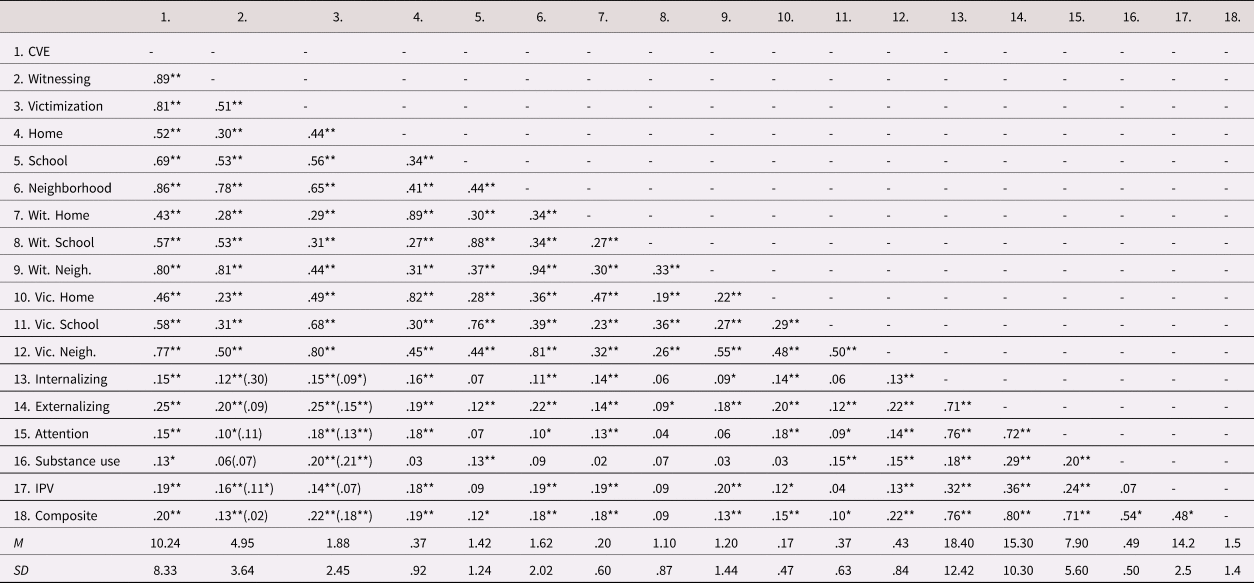
Means and standard deviations are reported in Table 1. Although the prevalence rates were quite high (i.e., 89% of participants reported any violence exposure), the mean levels of violence exposure (i.e., cumulative violence exposure: M = 10.24, range = 0–60) were generally low. Further, the mean scores for violence exposure type and location (e.g., witnessing at home) were very low; this was expected and consistent with previous research (Mrug & Windle, Reference Mrug and Windle2010).
Descriptive statistics and correlations among main study variables

Partial correlations among violence exposure and adult outcomes while controlling for the other exposure type provided in parentheses.
CVE = cumulative violence exposure; IPV = intimate partner violence; SES = socioeconomic status; Vic. = victimization; Wit. = witnessing
* p < .05. ** p < .01.
Correlations are shown in Table 1. Cumulative violence exposure was significantly positively correlated with age 25 outcomes of internalizing problems, externalizing problems, attention problems, substance use, IPV, and the composite score (rs = .13–25, ps < .05). Witnessing violence was significantly positively correlated with all age-25 outcome measures except for substance use (rs = .10–.20, ps < .05); victimization was significantly positively correlated with all age-25 outcome measures (rs = .14–.25, ps < .01). However, after controlling for the other violence exposure type (i.e., conducting partial correlations; see Table 1 in parentheses), only IPV was significantly positively correlated with witnessing violence (r = .11, p < .05). In contrast, when controlling for witnessing, victimization was still significantly positively correlated with internalizing problems, externalizing problems, attention problems, and substance use (rs = .09–.21, ps < .05), but not IPV.
In terms of location, violence exposure at home was significantly positively correlated with internalizing, externalizing, and attention problems; IPV; and the composite score (rs = .11–.19, ps < .05), but not substance use. School violence exposure was significantly positively correlated with externalizing problems, substance use, and the composite score (rs = .12–.13, ps < .05). Neighborhood violence exposure was significantly positively correlated with internalizing, externalizing, and attention problems; IPV; and the composite score (rs = .10–.22, ps < .05), but not substance use.
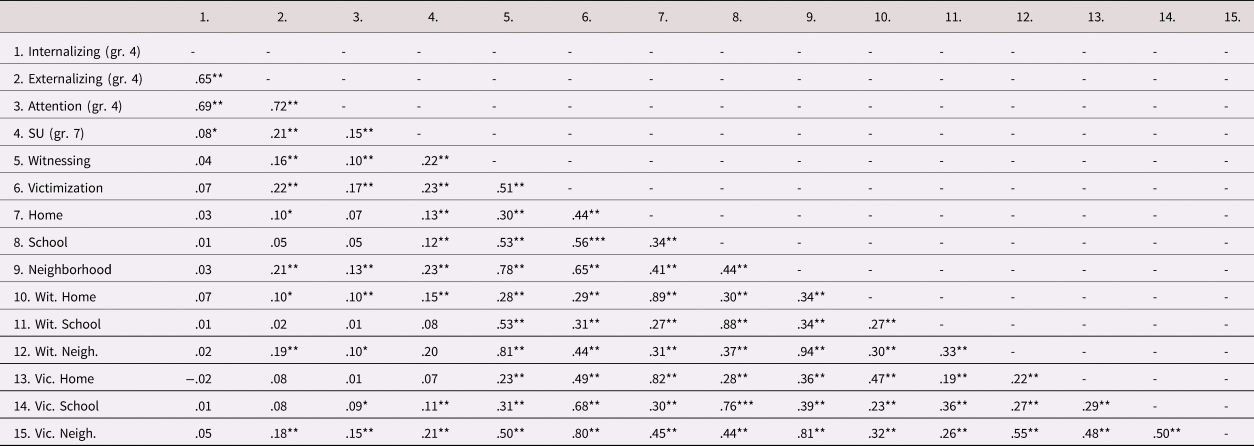
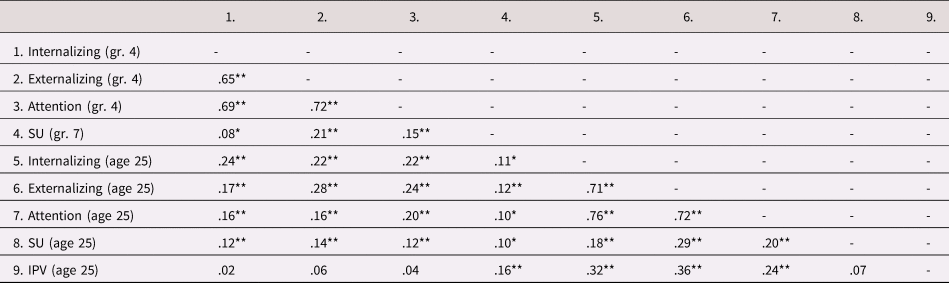
Correlations among baseline symptoms and main study variables are shown in Tables 2 and 3. Internalizing problems in Grade 4 were significantly positively correlated with internalizing, externalizing, and attention problems, and substance use at age 25 (rs = .12–.24, ps < .05). Externalizing problems in Grade 4 were significantly positively correlated with witnessing and victimization, witnessing at home, witnessing in the neighborhood, and victimization in the neighborhood (rs = .10–.22, p < .05), as well as internalizing, externalizing, and attention problems, and substance use at age 25 (rs = .14–.28, ps < .05). Attention problems in Grade 4 were significantly positively correlated with witnessing and victimization, witnessing at home, witnessing in the neighborhood, victimization at school, and victimization in the neighborhood (rs = .09–.17, p < .05). Lastly, substance use in Grade 7 was significantly positively correlated with witnessing and victimization, witnessing at home, victimization at school, and victimization in the neighborhood (r's = .12–.23, p < .05), as well as all five adult outcomes (rs = .10–.16, ps < .05).
Correlations among covariates (Grades 4 and 7) and violence exposure (lifetime through Grade 8)

SU = substance use.
* p < .05; **p < .01.
Correlations among covariates (Grades 4 and 7) and adult outcomes (age 25)

IPV = intimate partner violence; SU = substance use
* p < .05; **p < .01.
Path analyses
All path analyses were first fit without any covariates (unconditional) and then with all covariates included (conditional). In each conditional model, all predictors and outcomes were regressed onto all covariates. All models were “just identified” (meaning the number of observed parameters was equal to the number of estimated parameters with degrees of freedom = 0), and thus, model fit could not be assessed; this has previously been encountered in other reports and it does not interfere with the ability to interpret results (see Pasalich, Witkiewitz, McMahon, Pinderhughes, & Conduct Problems Prevention Research Group, Reference Pasalich, Witkiewitz, McMahon, Pinderhughes and Conduct Problems Prevention Research Group2016).
Covariates
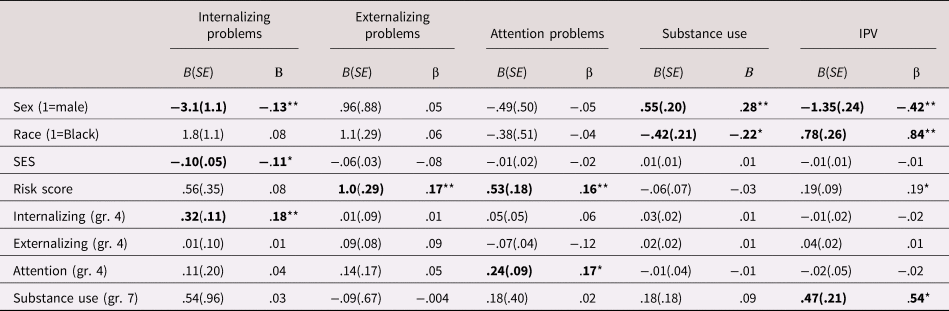
With regard to covariates (Table 4), male sex was associated with higher levels of witnessing violence [β = .08; B(SE) = .59(.29), p = .046]; being victimized [β = .16; B(SE) = .81(.21), p = .000]; neighborhood violence exposure [β = .13; B(SE) = .54(.16), p = .001]; and substance use at age 25 [β = .13; B(SE) = .13(.05), p = .007]. Female sex was associated with internalizing problems [β = −.26; B(SE) = −3.1(1.1), p = .003] and IPV perpetration [β = −.26; B(SE) = −1.3(.21), p = .000]. Lower family SES was associated with witnessing violence [β = −.12; B(SE) = −.03(.01), p = .007]; neighborhood violence exposure [β = −.18; B(SE) = −.03(.17), p = .000]; and internalizing problems at age 25 [β = −.11; B(SE) = −.10(.05), p = .030]. Greater externalizing symptoms and substance use measured in Grades 4 and 7, respectively, were associated with higher levels of both witnessing violence and victimization (βs = .17–.22; Bs = .05–.80, ps < .01). Black race was associated with higher levels of witnessing violence [β = .33; B(SE) = 2.41(.29), p = .000]; neighborhood violence exposure [β = .24; B(SE) = .94(.17), p = .000]; home violence exposure [β = .15; B(SE) = .27(.09), p = .002]; and age 25 IPV perpetration [β = .15; B(SE) = .78(.26), p = .003]. Non-Black race (i.e., identifying as a race other than Black) was associated with substance use [β = −.10; B(SE) = −.10(.05), p = .047]. Severity-of-risk score was associated with age-25 externalizing problems [β = .17; B(SE) = 1.0(.29), p = .000]; attention problems [β = .16; B(SE) = .53(.18), p = .003]; and IPV [β = .13; B(SE) = .20(.09), p = .032].
Estimates from multiple linear regression of covariates predicting internalizing, externalizing, and attention problems; substance use; and intimate partner violence

IPV = intimate partner violence; SES = socioeconomic status.
* p < .05; ** p < .01.
Witnessing versus victimization
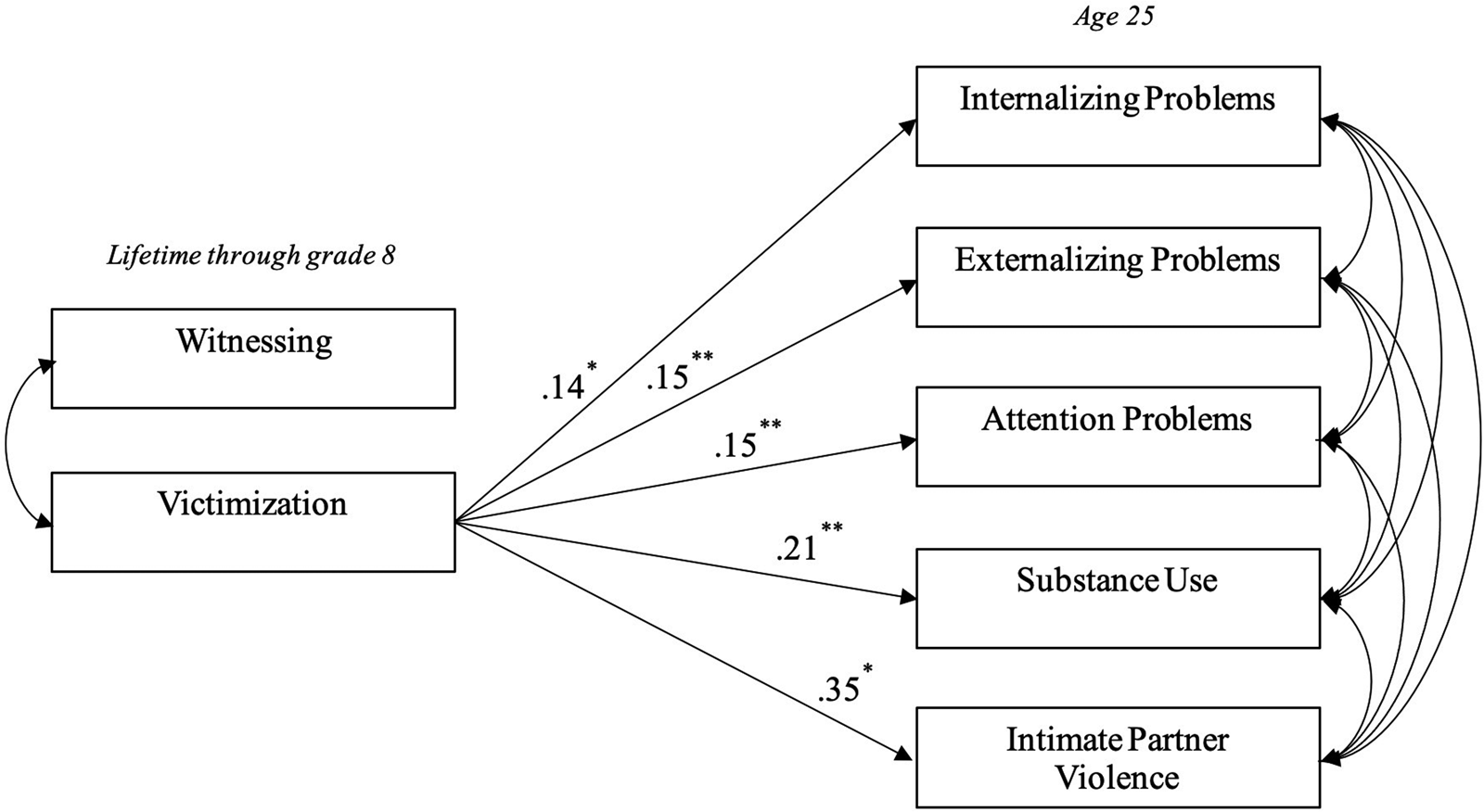
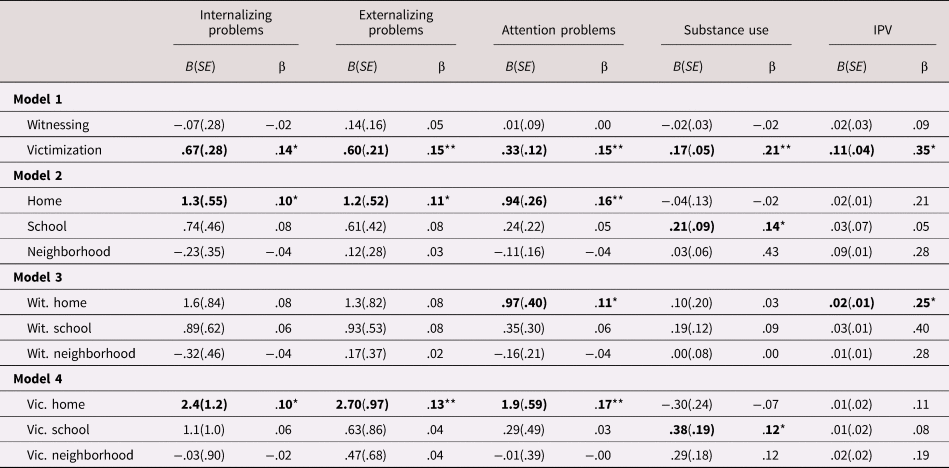
Table 5 and Figure 1 show the path model with witnessing and victimization predicting internalizing, externalizing, and attention problems; substance use; and IPV. Because both types of violence exposure were included in the same model, this accounted for the fact that of those participants who reported witnessing violence, 56% also experienced direct victimization. Higher levels of victimization were associated with greater internalizing problems [β = .14; B(SE) = .67(.28), p = .015]; externalizing problems [β = .15; B(SE) = .60(.21), p = .005]; attention problems [β = .15; B(SE) = .33(.12), p = .006]; substance use [β = .21; B(SE) = .17(.10), p = .001]; and IPV [β = .35; B(SE) = .11(.04), p = .027]. Witnessing violence did not independently predict any of the adult outcomes.
Path model of witnessing and victimization predicting internalizing, externalizing, and attention problems; substance use; and intimate partner violence. Covariates included in analyses but omitted from figure. *p < .05; **p < .01.

Estimates from linear regressions, negative binomial regression, and logistic regression of main study variables predicting internalizing, externalizing, and attention problems; substance use; and intimate partner violence

CVE = cumulative violence exposure; IPV = intimate partner violence; Vic. = victimization; Wit. = witnessing
* p < .05; ** p < .01
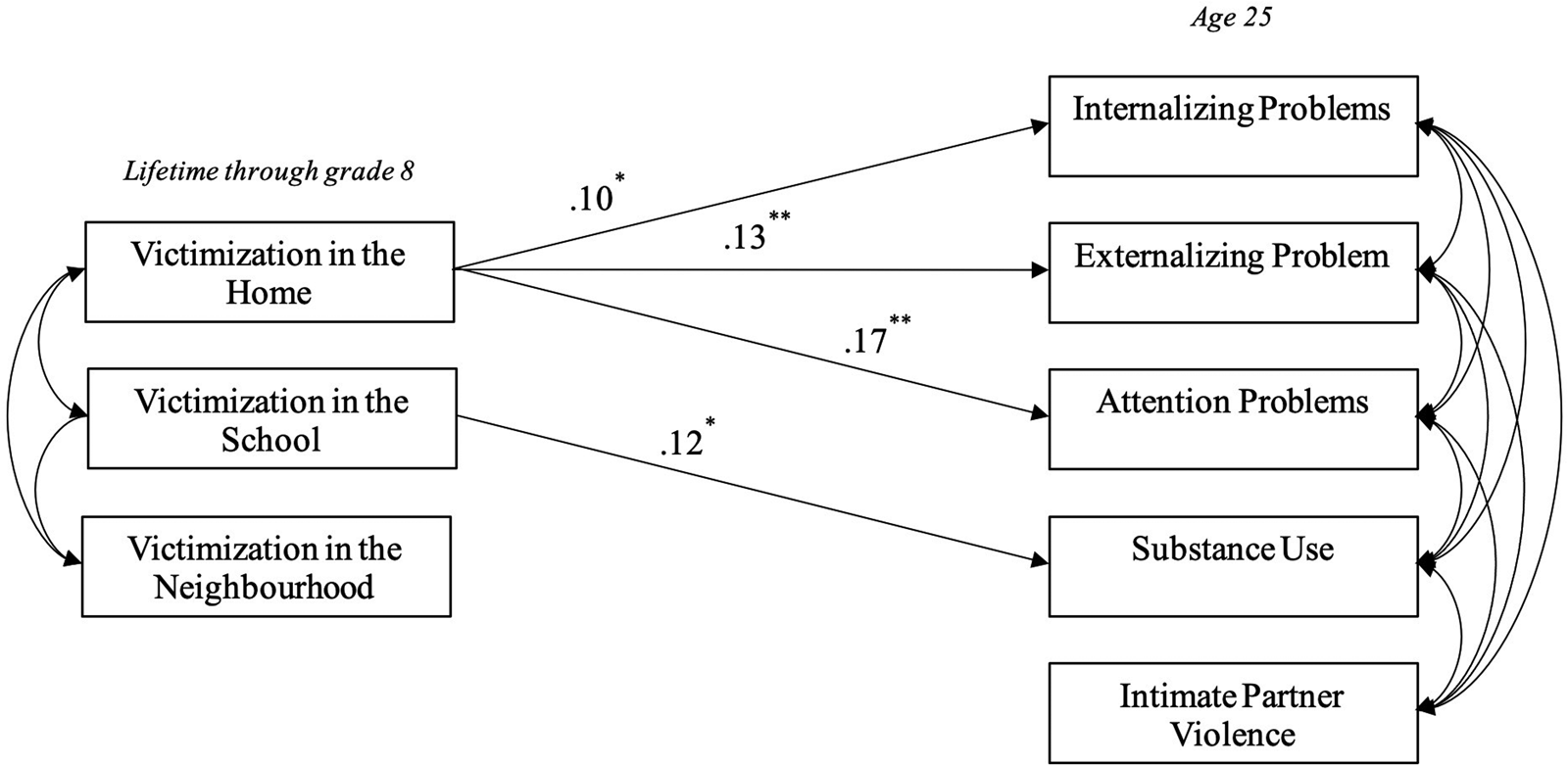
Home, school, neighborhood
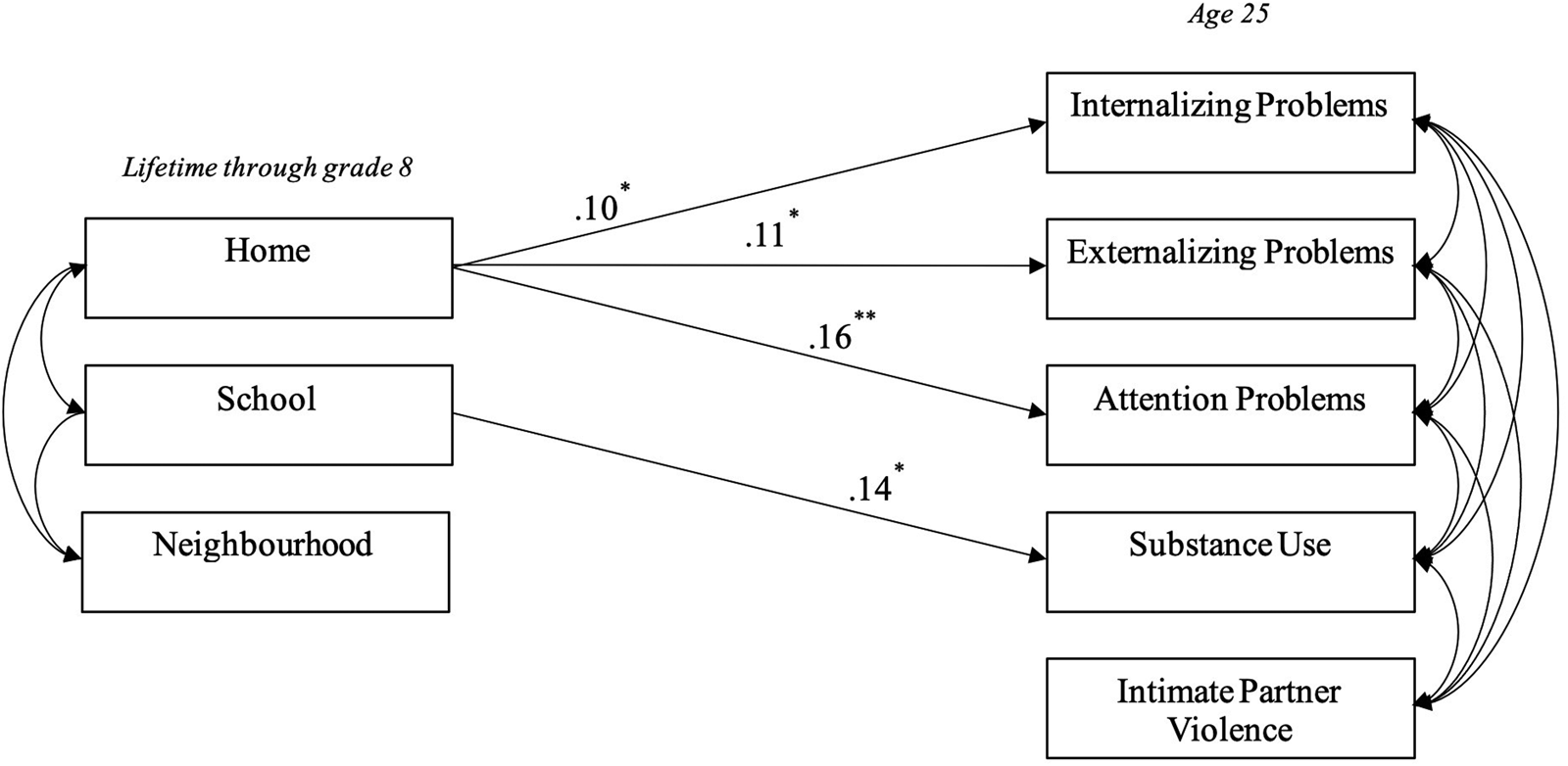
Table 5 and Figure 2 show the path model with violence exposure occurring in the home, school, and neighborhood predicting internalizing, externalizing, and attention problems; substance use; and IPV. Higher levels of home violence exposure were associated with greater internalizing problems [β = .10; B(SE) = 1.3(.55), p = .019]; externalizing problems [β = .11; B(SE) = 1.2(.52), p = .020]; and attention problems [β = .16; B(SE) = .94(.26), p = .000]. Higher levels of school violence exposure were associated with substance use [β = .14; B(SE) = .21(.10), p = .020].
Path model of violence exposure in the home, school, and neighborhood predicting internalizing, externalizing, and attention problems; substance use; and intimate partner violence. Covariates included in analyses but omitted from figure. *p < .05; **p < .01.

Witnessing violence across locations
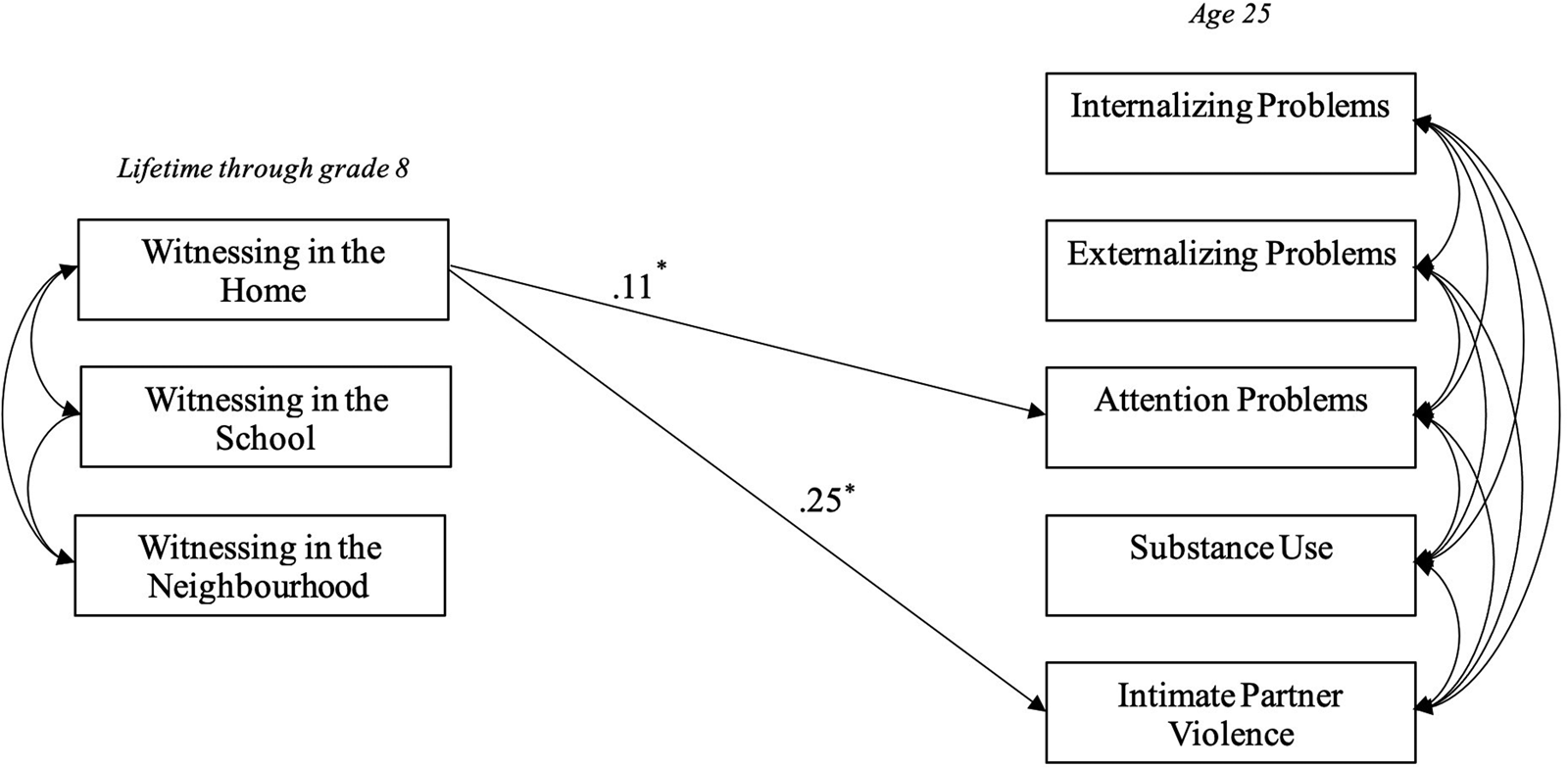
Table 5 and Figure 3 show the path model with witnessing violence in the home, school, and neighborhood predicting internalizing, externalizing, and attention problems; substance use; and IPV. Higher levels of witnessing violence at home were associated with greater attention problems [β = .11; B(SE) = .97(.40), p = .016] and IPV [β = .25; B(SE) = .27(.14), p = .045]. Witnessing violence in the school or neighborhood did not independently predict any adult outcomes.
Path model of witnessing violence in the home, school, and neighborhood predicting internalizing, externalizing, and attention problems; substance use; and intimate partner violence. Covariates included in analyses but omitted from figure. *p < .05; **p < .01.

Victimization across locations
Table 5 and Figure 4 show the path model with victimization in the home, school, and neighborhood predicting internalizing, externalizing, and attention problems; substance use; and IPV. Higher levels of victimization at home were associated with greater internalizing problems [β = .10; B(SE) = 2.4(1.2), p = .049]; externalizing problems [β = .13; B(SE) = 2.7(.97), p = .005]; and attention problems [β = .17; B(SE) = 1.9(.59), p = .001]. Further, higher levels of victimization at school were associated with substance use [β = .12; B(SE) = .38(.19), p = .043]. Victimization in the neighborhood did not independently predict any adult outcomes.
Path model of victimization in the home, school, and neighborhood predicting internalizing, externalizing, and attention problems; substance use; and intimate partner violence. Covariates included in analyses but omitted from figure. *p < .05; **p < .01.

Cumulative violence exposure
A fifth model was run indicating that greater levels of cumulative violence exposure were associated with comorbidity of adverse outcomes (composite score of adult outcomes) [β = .13; B(SE) = .02(.01), p = .026]. This same model was run again using the alternative cumulative violence exposure measure (composite score ranging from 0 to 6) and result did not differ [β = .17; B(SE) = .11(.04), p = .001].
Discussion
Violence exposure is heterogeneous in etiology, quality, quantity, and impact (Perry, Reference Perry and Osofsky1997). It is essential to examine if the type of violence exposure (witnessing vs. victimization) and where it takes place (home, school, neighborhood) differentially impact youth. It is also important to examine how different types of violence exposure occurring during childhood and adolescence continue to exert their effects as youth transition to adulthood. The present study examined the comparative and cumulative effects of violence exposure across multiple locations occurring during childhood and adolescence on long-term adult outcomes at age 25. Consistent with previous studies (Finkelhor et al., Reference Finkelhor, Turner, Ormrod and Hamby2009; Mrug & Windle, Reference Mrug and Windle2010), there were high rates of violence exposure during childhood and early adolescence: 89% of participants reported experiencing violence exposure before the end of Grade 8. In terms of location, 14% of participants reported witnessing violence in the home; 72% reported witnessing violence at school; and 54% reported witnessing violence in the neighborhood. Further, 52% of youth reported experiencing violence exposure across multiple locations; this overlap is consistent with prior research, indicating that youth exposed to violence in one domain are at an increased risk of experiencing violence in other domains (Finkelhor, Ormrod, & Turner, Reference Finkelhor, Ormrod and Turner2007).
Witnessing versus victimization
After controlling for prior symptom level, violence exposure made independent contributions in predicting negative adult outcomes. When comparing witnessing violence and direct victimization, only victimization during childhood and adolescence predicted all five adult outcomes: internalizing, externalizing, and attention problems; substance use; and IPV perpetration. Witnessing violence did not independently predict any of the five adult outcomes. There are a number of potential mechanisms and/or developmental pathways that may account for these findings. Meta-analytic findings indicate greater impact of victimization than witnessing violence on adolescent adjustment (Fowler et al., Reference Fowler, Tompsett, Braciszewski, Jacques-Tiura and Baltes2009; Wilson et al., Reference Wilson, Stover and Berkowitz2009). The nature and severity of direct victimization may put youth at greater risk for developing emotional and behavioral dysregulation and associated problems. Further, because other studies were short-term, perhaps the effects of witnessing violence become attenuated over time. This finding should not downplay the significant negative effects of witnessing violence; rather, it highlights the especially detrimental impact of being victimized during childhood and adolescence, and how this continues to be associated with a broad array of emotional and behavioral problems well into adulthood.
Violence exposure type and location
Consistent with Mrug and Windle (Reference Mrug and Windle2010), violence exposure at home and school were more robust predictors of negative adult outcomes than exposure to neighborhood violence. Violence exposure at home predicted internalizing, externalizing, and attention problems. Violence exposure at school only predicted substance use. Violence exposure in the neighborhood did not independently predict any adult outcomes. This finding does not rule out the significant impact of neighborhood or community violence exposure. Rather, because the violence exposure measure was lifetime through Grade 8, it may be that youth are not spending as much time outside in the neighborhood during childhood and early adolescence but are instead spending the majority of their time at school and in the home. The stronger effects of violence exposure in more proximal contexts (home and school) is consistent with previous research (Mrug et al., Reference Mrug, Loosier and Windle2008).
When examining both violence exposure type (witnessing vs. victimization) and location (home, school, neighborhood), victimization at home and school were again the most robust predictors of negative adult outcomes. Specifically, victimization in the home setting appears to have the most detrimental effects on later adult adjustment, predicting internalizing, externalizing, and attention problems. This is consistent with the larger body of research on the effects of domestic violence and child maltreatment more generally (Evans, Davies, & DiLillo, Reference Evans, Davies and DiLillo2008; Wolfe, Crooks, Lee, McIntyre-Smith, & Jaffe, Reference Wolfe, Crooks, Lee, McIntyre-Smith and Jaffe2003). As such, these findings emphasize the importance of a safe home environment for the emotional and behavioral development of youth. The present study extended this finding, by showing that earlier experiences in the home environment continue to impact youth as they transition into adulthood. As noted above, given that victimization is a more direct and severe form of violence exposure and the home setting functions as a developmentally important safe haven, it is not surprising that being victimized at home is associated with the widest range of negative outcomes in adulthood. The three adult outcomes of internalizing, externalizing, and attention problems all reflect common trauma symptoms caused by emotional, behavioral, and attentional dysregulation.
Victimization in the school setting predicted substance use at age 25. Previous studies have linked victimization due to school violence (e.g., physical and relational bullying) to substance use in later adolescence (Earnshaw et al., Reference Earnshaw, Elliot, Reisner, Mrug, Windle, Tortolero Emery and Schuster2017; Sullivan, Farrell, & Kliewer, Reference Sullivan, Farrell and Kliewer2006; Tharp-Taylor, Haviland, & D'Amico, Reference Tharp-Taylor, Haviland and D'Amico2009). These studies have specifically investigated school victimization; there is a surprising dearth of research examining witnessing violence at school, despite its prevalence. Some studies have identified deviant peer affiliation as a potential factor explaining the relationship between school victimization and substance use problems (Jiang, Yu, Zhang, Bao, & Zhu, Reference Jiang, Yu, Zhang, Bao and Zhu2016). Youth who are rejected or victimized by peers may develop deviant peer affiliations (Dishion, Ha, & Veronneau, Reference Dishion, Ha and Veronneau2012). These deviant peers then play a significant role in predicting initiation of alcohol, cigarette, and illicit drug use by way of social modeling, peer pressure, and reinforcement (Van Ryzin & Dishion, Reference Van Ryzin and Dishion2014). This study extended the link between peer victimization and substance use in adolescence, indicating that earlier school victimization is associated with alcohol, cannabis, and/or illicit drug use in adulthood.
Witnessing violence at home predicted both attention problems and IPV perpetration in adulthood. Attention problems are conceptualized as attentional dysregulation (i.e., stress-related symptoms associated with trauma). While an existing study found that youth who reported exposure to violence are at an elevated risk for ADHD symptoms (Lewis et al., Reference Lewis, Elliott, Toomey, Cuccaro, Emery, Schwebel and Schuster2015), our study expanded on this by showing that witnessing home violence exposure predicts attention problems and that this persists into adulthood. Consistent with previous research (Roberts et al., Reference Roberts, Gilman, Fitzmaurice, Decker and Koenen2010), the current study found that witnessing violence at home predicted later IPV perpetration.
Cumulative violence exposure
Our research also considered that youth often experience multiple forms of violence exposure across multiple domains, and that exposure to multiple forms of violence can have more serious effects than exposure to one type alone. As expected, cumulative violence exposure predicted a composite score (ranging from 0 to 5) of the five adult outcomes, which reflects comorbidity of adverse outcomes. This demonstrates that when youth experienced multiple types of violence across multiple locations, they experienced a broader and more diverse range of negative symptoms in adulthood. The accumulation of violence exposure is consistent with conceptualizations of complex trauma (Margolin et al., Reference Margolin, Vickerman, Oliver and Gordis2010) and comorbid negative outcomes may be an indication of functional impairment. These findings extend previous research (Margolin et al., Reference Margolin, Vickerman, Oliver and Gordis2010; Wright et al., Reference Wright, Fagan and Pinchevsky2013), and indicate that the accumulation of violence exposure during childhood and adolescence continues to contribute to a wide range of emotional and behavioral problems in adulthood.
Strengths and limitations
Using a large and racially diverse community sample, longitudinal design, and analytic approach, the study was able to compare how different types of violence exposure (witnessing vs. victimization) across different locations (home, school, neighborhood) during childhood and adolescence independently predicted five outcomes 11 years later at age 25. Understanding the diverse impact of violence exposure has been limited by the compartmentalization of different bodies of research (e.g., community violence, domestic violence, peer victimization), whereas the current study had the advantage of including different forms of violence exposure in one model to ascertain the comparative effects on long-term adult outcomes. Further, by including five outcome measures, the current study emphasized the wide range of negative effects of violence exposure during childhood and adolescence. The current study also demonstrated that cumulative violence continues to exert deleterious effects (i.e., comorbidity of adverse outcomes) well into adulthood.
Despite these strengths, some study limitations must be addressed. Although My Exposure to Violence (Buka et al., Reference Buka, Selner-O'Hagan, Kindlon and Earls1996) is a reliable and valid measure, previously used in other research, questions remain whether it accurately reflects an individual's exposure to violence. It includes only five types of violent events, all of which are scored the same despite a wide range in severity (e.g., witnessing someone being slapped vs. witnessing someone being killed). Further, it does not accurately take into account frequency. That is, an individual will score the same after exposure to violence on two occasions or 15 occasions. In addition, the measure did not include other forms of violence exposure (e.g., sexual violence). Furthermore, unlike the other four adult outcomes, substance use was a dichotomous variable due to the nature of the measure itself, thus information may have been lost (Altman & Royston, Reference Altman and Royston2006). The measure reflects potential alcohol, cannabis, and/or illicit drug misuse, and it includes different levels of severity for each substance (e.g., binge drinking problem vs. heavy cannabis use). Future research should separately examine type and severity of substance use in adulthood (e.g., alcohol, cannabis, illicit drug use) as outcomes associated with violence exposure during childhood and adolescence. It will be important to recognize that substance use is not homogenous, and violence exposure may differentially contribute to difference types of substance use. Finally, both predictor and outcome variables relied on self-report measures. Assessment approaches of this nature (i.e., self-report) have been widely accepted (see Selner-O'Hagan, Kindlon, Buka, Raudenbush, & Earls, Reference Selner-O'Hagan, Kindlon, Buka, Raudenbush and Earls1998); however, it would be valuable to include caregiver-report measures as well as alternative measures of violence exposure (i.e., police reports).
Future directions
Future research should be longitudinal and examine longer-term (i.e., middle age) outcomes, as a way to clarify life course outcomes associated with violence exposure during childhood and adolescence. More detailed measures should be employed to present a more complete record of the violence to which youth are exposed, including severity and information about the perpetrator(s) and victim(s) of witnessed violence. It would also be important to examine online victimization, which is an increasingly common experience for youth (White & Carmody, Reference White and Carmody2016). Lastly, the effects of violence exposure may function, in part, through the presence of other potentiating or compensatory factors; more research is needed to identify the mechanisms by which violence exposure exerts its effects, as well as relevant risk and protective factors for both youth and adults.
Implications
Taking a life-course perspective, these findings demonstrate that violence exposure has long-term negative effects evident well into adulthood. The study also provides further evidence of the heterogeneity of violence exposure, and the varied impact of different types of violence occurring in different locations. In addition, with the accumulation of violence exposure across contexts, youth are more likely to experience comorbid symptoms and diverse negative outcomes in adulthood. Based on these findings, preventing youth victimization, especially at home and the school, should be a top research, practice, and policy priority.
In terms of practice efforts, the heterogeneity of violence exposure dictates heterogeneity of intervention (Perry, Reference Perry and Osofsky1997). For youth or adults already exposed to violence, assessment and treatment efforts must consider the location in which this exposure took place, and employ a trauma-informed treatment that considers the relevant developmental disruption specific to each context. For example, for youth exposed to violence in the home, components including re-exposure interventions, education about violence and cognitive restructuring, processing of emotional cues, social problem-solving skills, and parenting interventions have all been empirically evaluated (Vickerman & Margolin, Reference Vickerman and Margolin2007). Overall, treatment must not solely focus on alleviating symptoms, but instead must consider how violence exposure functions as a precipitating factor, as well as how the accumulation of violence exposure across multiple locations continues to impact emotional and behavioral functioning in adulthood.
In terms of policy, the U.S. Department of Health and Human Services and the Centers for Disease Control and Prevention (CDC) call for creating safe, stable, nurturing relationships and environments for all children and families, as fundamental to the prevention of ACEs (CDC, 2019a,b). Some policies and strategies include promoting social norms aimed at decreasing violence and adversity (e.g., public education campaigns, bystander approaches to support healthy relationship behaviors); ensuring a strong start for children (e.g., early childhood home visitations, high-quality child care); and connecting youth to caring adults and activities (e.g., mentoring and after-school programs) (Merrick et al., Reference Merrick, Ford, Ports, Guinn, Chen, Klevens and Mercy2019). Such policy initiatives aimed at preventing ACEs, such as witnessing violence and direct victimization, may improve the mental, physical, and social well-being of youth over the life span (CDC, 2019a,b).
Acknowledgments
This work used data from the Fast Track Project (for additional information concerning Fast Track, see http://www.fasttrackproject.org). We are grateful to the members of the Conduct Problems Prevention Research Group (in alphabetical order, Karen L. Bierman, Pennsylvania State University; John D. Coie, Duke University; D. Max Crowley, Pennsylvania State University; Kenneth A. Dodge, Duke University; Mark T. Greenberg, Pennsylvania State University; John E. Lochman, University of Alabama; Robert J. McMahon, Simon Fraser University and B.C. Children's Hospital Research Institute; and Ellen E. Pinderhughes, Tufts University) for providing the data and for additional involvement.
We are grateful for the collaboration of the Durham Public Schools, the Metropolitan Nashville Public Schools, the Bellefonte Area Schools, the Tyrone Area Schools, the Mifflin County Schools, the Highline Public Schools, and the Seattle Public Schools. We appreciate the hard work and dedication of the many staff members who implemented the project, collected the evaluation data, and assisted with data management and analyses.
Funding Statement
The Fast Track Project has been supported by National Institute of Mental Health (NIMH) Grants R18MH48043, R18MH50951, R18MH50952, R18MH50953, R01MH062988, K05MH00797, and K05MH01027; National Institute on Drug Abuse (NIDA) Grants R01DA016903, K05DA15226, RC1DA028248, and P30DA023026; National Institute of Child Health and Human Development Grant R01HD093651; and Department of Education Grant S184U30002. The Center for Substance Abuse Prevention also provided support through a memorandum of agreement with the NIMH. Additional support for this study was provided by a B.C. Children's Hospital Research Institute Investigator Grant Award and a Canada Foundation for Innovation Award to Robert J. McMahon.
Ethical standards
All procedures performed in studies involving human participants were in accordance with the ethical standards of the institutional and/or national research committee and with the 1964 Helsinki declaration and its later amendments or comparable ethical standards.
Informed consent: Informed consent was obtained from all individual participants included in the study.
Conflicts of Interest
None.