INTRODUCTION
Recently there has been growing evidence in support of distinctive roles for consonants and vowels in language processing. Nespor, Peña, and Mehler (Reference Nespor, Peña and Mehler2003) proposed that consonants primarily give cues about lexical information, whereas vowels play a more important role at the syntactic and prosodic levels. This proposal is supported by an increasing body of research, originating with observations that the world's languages generally have more consonants than vowels (Maddieson, Reference Maddieson1984), making consonants more informative for lexical identification, with additional evidence from studies on written word perception (e.g., Acha & Perea, Reference Acha and Perea2010; New, Araùjo & Nazzi, Reference New, Araùjo and Nazzi2008; New & Nazzi, Reference New and Nazzi2012), speech perception (Bonatti, Peña, Nespor & Mehler, Reference Bonatti, Peña, Nespor and Mehler2005; Cutler, Sebastián-Gallés, Soler-Vilageliu & Van Ooijen, Reference Cutler, Sebastián-Gallés, Soler-Vilageliu and Van Ooijen2000; Delle Luche, Poltrock, Goslin, New, Floccia & Nazzi, unpublished observations; Toro, Nespor, Mehler & Bonatti, Reference Toro, Nespor, Mehler and Bonatti2008), neuropsychology (Caramazza, Chialant, Capasso & Miceli, Reference Caramazza, Chialant, Capasso and Miceli2000), and neuro-imaging (Carreiras & Price, Reference Carreiras and Price2008).
While there is extensive evidence for this division of labor in adults' language processing, its developmental origin is less clear. In particular, the role played by the linguistic input on its emergence is under debate (see Bonatti, Peña, Nespor & Mehler, Reference Bonatti, Peña, Nespor and Mehler2007; Keidel, Jenison, Kluender & Seidenberg, Reference Keidel, Jenison, Kluender and Seidenberg2007), and can be envisioned in at least three possible scenarios. The first one, the ‘initial bias hypothesis’, states that infants start processing consonants and vowels as distinctive linguistic categories from the onset of language acquisition, and therefore ascribes no fundamental role to the characteristics of the input (Bonatti et al., Reference Bonatti, Peña, Nespor and Mehler2007; Pons & Toro, Reference Pons and Toro2010). Alternatively, the ‘lexical hypothesis’ proposes that the functional asymmetry between vowels and consonants arises from differences in the distribution of consonants and vowels across languages and the degree to which they are informative to code the lexicon (Keidel et al., Reference Keidel, Jenison, Kluender and Seidenberg2007). This hypothesis gives an important weight to the lexical properties of the target language. A final scenario, that we shall name the ‘acoustic/phonological hypothesis’, is that the division of labor between consonants and vowels emerges from the acoustic differences between these segments, as consonants are usually shorter, less periodic, less steady, and tend to be perceived more categorically than vowels (e.g., Repp, Reference Repp and Lass1984). These acoustic differences should lead to the construction of two phonologically distinct categories in young children, henceforth creating a functional asymmetry in toddlers and adults. This last hypothesis can be seen as a compromise between the two former ones, as it attributes a role both to early perceptual biases and to the properties of the native language. Indeed, across languages the realization of vowels and consonants may vary as a function of the number of vowels and consonants, the presence of vocalic or consonant reduction, phonological short/long vowel contrasts, ambisyllabicity, etc., that could contribute to emphasize or attenuate the distinction between vowels and consonants.
Only developmental cross-linguistic evidence can provide an empirical test for the validity of these hypotheses. If this division of labor is universal, as stated by the initial bias hypothesis, then when children start building lexical representations they should display a similar difference in sensitivity to consonants over vowels irrespective of their native language and, a fortiori, irrespective of their acoustic/phonological or lexical characteristics. Support for the lexical or acoustic/phonological hypotheses would be provided by data showing that differential sensitivity to consonants versus vowels is modulated over the course of development by the lexical and/or acoustic/phonological properties of these phonemes in different languages. Finally, the lexical and the acoustic/phonological hypotheses could be further distinguished by data showing graded sensitivity to consonants over vowels as a function of the acoustic distance between them, which would be predicted by the acoustic/phonological hypothesis only. They could also be evaluated by the timing of emergence of the consonant bias: the lexical hypothesis would predict the bias to appear and grow alongside lexical development, whereas the acoustic/phonological hypothesis would predict the bias to emerge before infants have a sizeable lexicon.
To date, the main body of cross-linguistic comparisons in infancy comes from studies focusing on French, Italian, British English, and Danish. A straightforward test for the initial bias hypothesis would be the finding that infants display a similar bias for consonants over vowels in word processing in all these languages. In French, results appear to be clear-cut with the initial demonstration of a consonant bias with infants aged 1;8 in an interactive word learning task (Nazzi, Reference Nazzi2005), subsequently replicated using looking time measures with an eye tracker in older chidren and adults (Havy, Serres & Nazzi, in press). In this task, an experimenter introduces a pair of new objects each labeled with a different pseudo-word, e.g., /duk/ and /guk/, and asks the child to choose which one goes with a third object, whose label is either /duk/ or /guk/. French children are repeatedly better at learning consonant-contrasted pairs, such as /duk/ versus /guk/, than vowel-contrasted pairs, such as /duk/ versus /dɔk/. A lexical consonant bias has also been found with a familiar word recognition task using the Intermodal Preferential Looking paradigm (IPL; Zesiger & Jöhr, Reference Zesiger and Jöhr2011). In this task, the infant is presented with a picture of a ball (target) and one of a car (distracter) for 6 s. Halfway through the trial, the target picture is named (‘Look! Ball!’). Evidence for word recognition is acknowledged if the infant increases her looking at the target picture over the distracter picture between the pre- and the post-naming phases. With this method, Zesiger and Jöhr (Reference Zesiger and Jöhr2011) showed that French infants aged 1;2 would consider a vowel mispronunciation (/balε/) as a good label for the target object (/balõ/, ball) but not when a consonant was mispronounced (/bazõ/). In sum, this bias has been observed from age 1;2 to adulthood in different versions of the interactive word learning task (e.g., Havy, Bertoncini & Nazzi, Reference Havy, Bertoncini and Nazzi2011; Havy & Nazzi, Reference Havy and Nazzi2009; New et al., Reference New, Araùjo and Nazzi2008; Zesiger & Jöhr, Reference Zesiger and Jöhr2011), across different word structures or for different positions within a word (Havy et al., Reference Havy, Bertoncini and Nazzi2011, in press; Nazzi & Bertoncini Reference Nazzi and Bertoncini2009; Nazzi & Polka, unpublished observations; see also Nishibayashi & Nazzi, Reference Nishibayashi and Nazzi2011, with infants aged 0;8 showing a C bias in a word segmentation task).
Data from Italian (a language rhythmically and lexically very close to French) also provides support for an early consonant bias (Hochmann, Benavides-Varela, Nespor & Mehler, Reference Hochmann, Benavides-Varela, Nespor and Mehler2011). Presented with nonsense CVCV sequences, infants aged 1;0 were found to rely more on consonant information than vowel information to extract words.
In English the evidence is more debatable, with IPL studies repeatedly showing that children are as sensitive to consonant as to vowel mispronunciations in familiar words as early as 1;0 (Mani & Plunkett, Reference Mani and Plunkett2007, Reference Mani and Plunkett2010). The only exception is one experiment with infants aged 1;3 (Mani & Plunkett, Reference Mani and Plunkett2007), where they showed greater sensitivity to consonant changes although two older age groups tested (1;6 and 2;0) in that same study did not show the same bias. However, when using an interactive word learning task, another study found a consonant bias for word learning in English toddlers aged 2;6, comparable to that found in French-speaking children (Nazzi, Floccia, Moquet & Butler, Reference Nazzi, Floccia, Moquet and Butler2009). Another, albeit indirect, indication that English infants might also be more sensitive to consonants than vowels in lexical processing comes from a study by Vihman, Nakai, DePaolis, and Hallé (Reference Vihman, Nakai, DePaolis and Hallé2004), who used a head-turn paradigm to test preference for familiar over unfamiliar words. They found that infants aged 0;11 failed to recognize familiar words when one of the consonants was changed (e.g., vunny for bunny) whereas they succeeded when the stress pattern was reversed, a manipulation which usually results in a distortion of the vowels.
Because overall the results with English infants were obtained with different ages and methods than those in the French and Italian studies, one has to identify whether the lack of an early consonant bias is due to the status of the test words (new in the interactive learning, familiar with the IPL), age, or whether this reflects cross-linguistic developmental differences, that is, that the consonant bias emerges later for English than French children. Indeed, English and French do vary on a number of parameters that could potentially affect the emergence of the consonant bias. Not only do they differ regarding their ratio of consonant-to-vowel phonemes (17–15 in French, 24–12 in English), but the English vocalic system is more complex in terms of diphthongs and contrastive features than the French one. In theory this means that English consonants should be comparatively more informative than those in French, which should therefore lead to a larger consonantal bias in English. However, at this point the weight of developmental data provides repeated evidence of an early consonant bias in French-learning children, but not in English-learning children. Other factors, such as the phonological properties of the first lexicon or language-specific production constraints, could explain the smaller consonant bias found in English children; this will be addressed in the ‘General discussion’.
Finally, in Danish, a language with 19 consonants, 16 monophthong vowels plus a vowel length contrast, and two extra schwa vowels (Bleses, Basbøll & Vach, Reference Bleses, Basbøll and Vach2011), Højen and Nazzi (unpublished observations) have found the opposite of the results in French, that is, a vowel bias in an interactive word learning task with infants aged 1;8. This adds some credence to the lexical and/or acoustic/phonological hypotheses, which both assign a strong role to the language-specific contextual variables in the differentiation between consonants and vowels.
The present study aims at clarifying the English data by testing British-English-learning children aged 1;4 and 1;11 using interactive word learning tasks. If a consonant bias were to be found in this study it would indicate that it is task dependent, as no advantage was found using the IPL procedure (Mani & Plunkett, Reference Mani and Plunkett2007, Reference Mani and Plunkett2010), suggesting that it is more robust in word learning than familiar word recognition tasks. This would offer some support for the initial bias hypothesis, with a universal functional difference in the role played by consonants and vowels in lexical processing. Obviously, this explanation would need to be tempered in view of the Danish data (Højen & Nazzi, unpublished observations) which suggest, with the same task, a vocalic bias rather than a consonantal one.
On the other hand, the absence of an early consonant bias in English-learning toddlers would suggest that this absence is not due to the particular task being employed, and would therefore provide support for the lexical and/or acoustic/phonological hypotheses.
EXPERIMENT 1
METHOD
Nazzi et al. (Reference Nazzi, Floccia, Moquet and Butler2009) found evidence for a consonant bias in English children at 2;6 using an interactive word learning task. To evaluate whether consonants are processed better than vowels in younger English-learning children, we used an exact replication of this paradigm with two new age groups, 1;4 and 1;11.
In this procedure, two objects are placed successively on a table, for example one labeled /gɪb/ and the other /dεb/. A third, target object is then introduced, labeled /dɪb/, and placed in a cup between the two objects. The experimenter asks: ‘Can you give me the one that goes with this one?’ The three labels are chosen so that the name of the target object (i.e., /dɪb/) differs by one consonant from one object (/gɪb/), and by one vowel from the other (/dεb/). Given that all three labels are different, there is no right or wrong answer, but a choice based – partially – on sound similarity. If children give more weight to consonants, they should choose the object whose label shares the same consonant with the target (here, /dɪb/ and /dεb/) more often. If, on the other hand, they rely more on vowels, they should choose the object whose label shares the same vowel with the target (/dɪb/ and /gɪb/). This design was inspired by word reconstruction studies showing a consonant bias in adults (Cutler et al., Reference Cutler, Sebastián-Gallés, Soler-Vilageliu and Van Ooijen2000). In these experiments, adults were presented with spoken pseudo-words (e.g., kebra) that could be transformed back into words with one phoneme change (consonant change: zebra; vowel change: cobra), and they had to generate the closest possible word by changing a consonant or a vowel. Adults were more likely to name words that preserved the consonants (here, cobra) than the vowels (zebra).
To control for positional effects (and to provide an exact replication of Nazzi et al., Reference Nazzi, Floccia, Moquet and Butler2009), CVC stimuli were used where the first consonant (C1), the vowel, or the second consonant (C2) were manipulated. Although it has been argued that initial consonants are more important for word processing than final ones in early childhood (Swingley, Reference Swingley2009), in French the consonant bias has been replicated irrespective of word position (Nazzi, Reference Nazzi2005; Nazzi & Bertoncini Reference Nazzi and Bertoncini2009; Nazzi & Polka, unpublished observations).
Participants
In Experiment 1a, sixteen healthy infants aged 1;4 were successfully tested, including eleven girls (aged 1;3·15 to 1;5·21, M=1;4·9). The data of seven additional children were rejected for non-cooperation (1), side bias (1: the child systematically picked the object placed on her right-hand side), and non-completion of at least six trials (5). In Experiment 1b, sixteen infants aged 1;11 were successfully tested, including seven girls (aged 1;10·12 to 1;11·24, M=1;11·6). Ten additional children were tested but their data were rejected because of side bias (5), non-completion of at least six trials (2) and experimenter error (3).
Stimuli
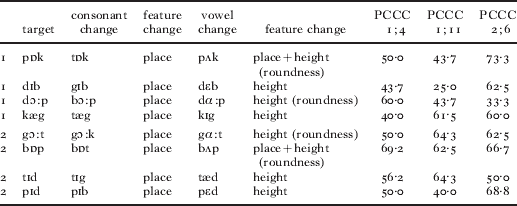
The labels and objects were identical to those from Nazzi et al. (Reference Nazzi, Floccia, Moquet and Butler2009), with eight triads of CVC pseudo-words (see Table 1), so that the target pseudo-word (e.g., /dɪb/) differed from one of the other pseudo-words by one consonantal feature (e.g., /gɪb/) and from the other pseudo-word by one vocalic feature (e.g., /dεb/). All consonant contrasts were made of a single place of articulation change. As described in Nazzi et al. (Reference Nazzi, Floccia, Moquet and Butler2009), four vocalic contrasts involved a height change and the other half a roundness change. Half of the consonant changes occurred on the initial consonant (C1) or the coda (C2). Out of the eight triplets, two contained a tense vowel (/gαːt/–/gɔːt/–/gɔːk/ and /bɔːp/–/dɔːp/–/dαːp/) and six had a lax vowel. This asymmetric number or lax and tense vowels was selected to be as close as possible to Nazzi et al. (Reference Nazzi, Floccia, Moquet and Butler2009). This contrast is of potential interest to test the acoustic/phonological hypothesis, as lax vowels tend to be perceived more categorically than tense vowels because of their shortness (Pisoni, Reference Pisoni1973), and therefore could be processed more like consonants than vowels. This factor will be analyzed here in a post-hoc test, but will be examined in further detail in ‘Experiment 2’.
List of stimuli used in Experiment 1
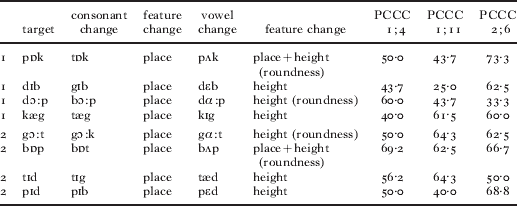
notes: a PCCC refers to the mean percentages of same consonant pairing choices given by children at 1;4, 1;11, and 2;6 (these former data being calculated from the data presented in Nazzi et al., Reference Nazzi, Floccia, Moquet and Butler2009).
b The four stimuli labeled ‘1’ in the first column refer to those involving a consonant change in C1, and the four others labeled ‘2’ refer to those with a consonant change in C2.
Procedure
Children were tested individually in a quiet room after informed consent was obtained from the parent/caregiver. The session was video-recorded for scoring purposes. All the objects used in the test trials came from a hardware store and had names that children would not know. The experimenter introduced a first object and labeled it five to seven times in sentences such as ‘Look at this /gɪb/! This is a beautiful /gɪb/!’ The object was then placed on the left-hand side of the child. A second object, perceptually different from the first one, was introduced similarly with another label (e.g., a /dεb/) and placed on the right-hand side of the child. A third object, perceptually different from the first two objects, was then presented briefly, using two repetitions of its label (‘Look, I have a /dɪb/! I put the /dɪb/ in my cup’). The experimenter then placed the third object in a cup that she would hold between the first two objects, and asked the child to pair this new object with one of the two preceding ones. When asking the test question, and waiting for a response, the experimenter would look at the cup or at the child's face. The experimenter was a British native speaker naive to the aims and hypotheses underlying the experiment, but trained in the task and word pronunciations.
Two training trials were used to ensure the child understood the task. In the first training trial, the objects were a cow and a pig, both labeled ‘animal’, and a car (the target object was one of the animals). In the second training trial, a dog toy was labeled ‘dog’, and the two other objects were unknown objects from the hardware store that were labeled /tɪk/ (the target object was one of the unknown objects).
The order of object triad presentation was counterbalanced (a particular triad of objects was presented for half of the children in the first trial, and for the other half, it was presented at trial five out of eight, etc.), as was the assignment of a particular object to a particular pseudo-word. The target name was always given to the object placed in the cup in the middle, whereas the side of the object receiving the name with the consonantal change was counterbalanced across trials. Thus, the same-consonant object was on the infant's right for half of the trials and on his or her left for the other half. The order of the eight test trials was counterbalanced across infants.
Children's receptive and productive vocabulary was assessed by parents filling in the Oxford CDI (Hamilton, Plunkett & Schafer, Reference Hamilton, Plunkett and Schafer2000) on the week preceding the testing. However, the parents of three infants aged 1;4 and three infants aged 1;11 failed to complete the CDI.
RESULTS
As in Nazzi et al. (Reference Nazzi, Floccia, Moquet and Butler2009), infants' responses were scored on whether they chose the object named with the pseudo-word sharing the same consonant with the target (/dɪb/ with /dεb/) or the object sharing the same vowel with the target (/dɪb/ with /gɪb/). Due to the possibility of missing trials these scores were transformed into the percentage of choices for the common consonant items (PCCC). For example, a PCCC of 75% means that a child presented with eight trials chose to pair the new label with the consonant-sharing one over the vowel-sharing one six times out of eight. Out of sixteen children aged 1;4, two completed six trials only, three completed seven trials, and eleven completed eight trials. Of the sixteen children ages 1;11, two completed six trials, four completed seven trials, and ten completed eight trials. Chance in this task was 50%, given that infants had a binary choice between two objects (whose pairing was counterbalanced).
In the following analyses we pooled data from these two age groups with additional data from the sixteen British-English-speaking children aged 2;6, tested using the same procedure and stimuli by Nazzi et al. (Reference Nazzi, Floccia, Moquet and Butler2009, Experiment 3). Table 1 provides the values of PCCC for each triplet and age group. Initially, PCCCs were analyzed using an ANOVA with Age (1;4, 1;11, and 2;6) as a between-participant factor, with Consonant Contrast Location (C1 or C2) and Vowel Contrast (front versus back) as within-participant factors. However, Vowel Contrast was not found to have an effect on the results, nor did it interact with any other factors, and thus will not be reported with the other results. Because of the unequal number of triplets with tense (2) versus lax vowels (6) leading to higher variance for tense vowels, the effect of Vowel Type (lax or tense) will be analyzed in post-hoc comparisons. Here and in the next two experiments, all ANOVAs were performed after having normalized the data through arcsine-root transformation (however, mean and standard deviation values given below and on the figures are the original ones).
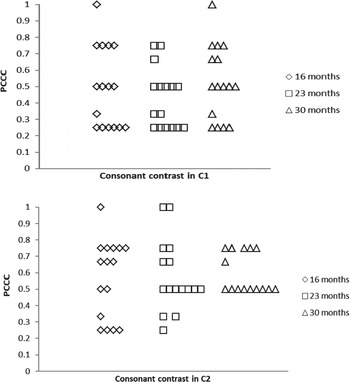
Overall, the average value of PCCC was 53·1% (SD=15·0%), which did not differ significantly from chance at 50% (t(47)=1·49, p=·14, d=0·21). There was no effect of Age (F(1, 45)<1, partial η2=·02), but a significant effect of Consonant Contrast Location (F(1, 45)=5·19, p=·028, partial η2=·10), which did not interact with Age (F(2, 45)<1, partial η2=·03). PCCC for C2 triplets (/bɒt/, /bʌp/, and test word /bɒp/) was significantly higher than chance (58·3%, t(47)=2·92, p=·005, d=0·42), whereas PCCC for C1 triplets (/gɪb/, /dεb/, and test word /dɪb/) was not (48·1%, t(47)<1, d=−0·03). The difference between the two PCCC scores (C1 versus C2) was significant (t(47)=2·29, p=·026, d=0·45). This can be interpreted as showing a consonant bias for C2 triplets, and no bias for C1 triplets (see Figure 1 for the distribution of PCCC for C1 and C2 triplets).
Experiment 1, distribution of children in each age group (1;4, 1;11, and 2;6) as a function of their percentage of choice for same consonant pairs (PCCC), depending on the position of the consonant contrast in the triplets, C1 (top panel) or C2 (bottom panel). For example, for C1 triplets, one child aged 1;4 had a PCCC at 100%, four had a PCCC at 75%, etc. Results from children aged 2;6 have been calculated from the data presented in Nazzi et al. (Reference Nazzi, Floccia, Moquet and Butler2009). Chance is at 50%.

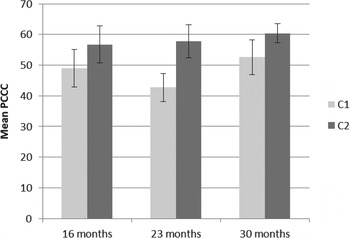
Even though there was no main effect of Age, we compared for each age group the mean PCCC to chance level, as the group with infants aged 2;6 was initially reported as a stand-alone experiment. As can be seen in Figure 2, in the three age groups, PCCC seems to be above chance level for C2 triplets, and around chance level for C1 triplets. However, in the 2;6 group only the average choice for consonant pairs was significantly above chance in C2 triplets (60·4%, t(15)=3·37, p=·004, d=0·84).
Experiment 1, mean percentage of choices for same consonant pairs (PCCC) for each age group (1:4, 1;11, and 2;6) as a function of the position of the consonant contrast in the triplets (C1 or C2). Results from children aged 2;6 have been calculated from the data presented in Nazzi et al. (Reference Nazzi, Floccia, Moquet and Butler2009). Chance is at 50% and error bars are standard errors.

Effect of vowel type
When Vowel Type (lax versus tense) was included in the analysis, a marginal main effect of Consonant Contrast Location was found (F(1, 45)=3·06, p=·087, partial η2=·06), but no effect of Age or Vowel Type (F(2, 45)<1, partial η2=·026; F(1, 45)=1·20, partial η2=·03, respectively). The triple interaction between Age, Vowel Type, and Consonant Contrast Location was marginally significant (F(2, 45)=3·16, p=·052, partial η2=·12).
Broken down into age groups, we found no main effect of Vowel Type or Consonant Contrast Location in infants aged 1;4 and 1;11, and no interaction between these factors. In infants aged 2;6, a significant interaction between Vowel Type and Consonant Contrast Location was found (F(1, 15)=5·63, p=·031, partial η2=·27). This was due to higher PCCC for lax vowel triplets (61·5%) over tense vowel triplets (26·7%) in C1 items (paired t(15)=3·15, p=·007, d=1·04), while no difference was observed between lax and tense vowel triplets in C2 items (57·3% and 68·8%, t(15)<1, d=0·41). Infants aged 2;6 chose the common consonant item more often than chance in every case apart from when a triplet contained tense vowels and had the consonant contrast in C1.
Effect of vocabulary size
The average OCDI production score was 25·4 words (SD 40·8, from 0 to 154, N=13) at 1;4, 152·7 words (SD 119, from 9 to 380, N=13) at 1;11, and 353·6 words (SD=62, from 204 to 416) at 2;6.
A hierarchical regression analysis with Age in days in the first block and OCDI production scores in the second block was conducted on each of the following variables: total PCCC, PCCC for triplets with consonant contrast on C1, PCCC for consonant contrast on C2, PCCC for triplets with a tense vowels, and PCCC for triplets with a lax vowels. Neither Age alone, nor Age plus OCDI score, correlated significantly with any of these variables. The same results were also obtained when analyzing receptive vocabulary scores. The lack of any reported link between the children's use of phonological information and the size of their vocabulary as estimated by the OCDI (or the age) will be addressed in the ‘General discussion’.
DISCUSSION
In this first experiment, English-learning infants aged 1;4 and 1;11 were tested in a word learning categorization task in which they had to choose between pairing a label (e.g., /dɪb/) with one that shared its consonants (/dεb/), or with another one that shared its vowel (/gɪb/). Neither of these age groups showed any difference in sensitivity between consonants and vowels, although the data collected by Nazzi et al. (Reference Nazzi, Floccia, Moquet and Butler2009) using an identical procedure with children aged 2;6 did show a significant consonant bias.
However, when items differed on their final consonant (as in /bɒt/, /bʌp/, and test word /bɒp/), children paired the two items that shared the consonant material (e.g., /bɒp/ and /bʌp/) more often than those that shared the vocalic material (/bɒp/ and /bɒt/), as if the coda consonant contrast was more salient than the vowel one. In contrast, when the consonant contrast was initial (as in /gɪb/, /dεb/, and test word /dɪb/), they showed no preference.
One account for this C1/C2 asymmetry is that it is due to a recency effect, with the last segment being processed better than its preceding one (see Hitch, Halliday, Schaafstal & Schraagen, Reference Hitch, Halliday, Schaafstal and Schraagen1988, in the visual modality). However, if this were applied systematically to the stimuli then children would also encode the vowel better than the first consonant. This latter prediction would lead to a ‘vowel’ bias in C1 triplets, which is not supported by our results. Another possibility is that this recency effect could be restricted to the very last segment, which was always a consonant in our CVC stimuli. However, all previous data suggest either an equal sensitivity to onset and coda segments in familiar word recognition (e.g., Swingley, Reference Swingley2009) and in interactive word learning (Nazzi & Bertoncini, Reference Nazzi and Bertoncini2009), or an advantage of onsets over codas in familiar word mispronunciation tasks (Swingley, Reference Swingley2005). These observations would appear to rule out an explanation based solely on a recency effect.
An alternative explanation relates to a possible interaction with rhyme sensitivity. In the case of C2 triplets such as /bɒt/, /bʌp/, and the test word /bɒp/, there is a different rhyme in each of the labels. On the other hand, with C1 triplets the target (e.g., /dɪb/) shares its rhyme with the vowel-sharing label (/gɪb/) but not with the consonant-sharing label (/dεb/). Children should pair /dɪb/ with /dεb/ if they process consonant information better than vocalic information. However, sensitivity to rhyme overlap (as seen in adult spoken word priming studies; Radeau, Morais & Segui, Reference Radeau, Morais and Segui1995; see also, in children, Treiman & Zukowski, Reference Treiman and Zukowski1996; but see Jusczyk, Goodman & Baumann, Reference Jusczyk, Goodman and Baumann1999) would lead them to pair /dɪb/ with rhyme and vowel sharing label /gɪb/. In this case it is possible that the opposite trends of rhyme and consonant bias would nullify any preference for vowel or consonant pairing.
A final explanation for the C1/C2 asymmetry is that English toddlers do pay more attention to consonants than to vowels in lexical processing, but only in word-final position. English-learning children's production of consonants in final position corroborates this possibility, as American English toddlers have been found to double their production of final consonants in prelinguistic vocalizations during the first two years of life, while at the same time, French children's production of coda consonants slightly drops (Vihman & de Boysson-Bardies, Reference Vihman and de Boysson-Bardies1994). As proposed by these authors (p. 163), the incidence of codas in maternal speech might explain these patterns, as 67% of English mothers' content words contained a coda consonant against 25% of French mothers' productions only. This could account for the C1/C2 advantage found in the current experiment with English-learning children, which was not found in French children in a similar design (Nazzi et al., Reference Nazzi, Floccia, Moquet and Butler2009). This hypothesis will be discussed in more detail should it be confirmed in the following experiments.
Experiment 2 was designed to examine the C1/C2 asymmetry in further detail, by establishing whether lack of consonant bias when contrasts are in word-initial position was due to the task encouraging rhyme processing over consonant encoding. Indeed, this task was very close to epilinguistic tasks usually presented to older children to evaluate phonological awareness, that is, tasks in which children must recognize shared sounds (see Goswami, Reference Goswami2002). In the literature on the development of phonological awareness in children, Goswami and colleagues have long argued in favor of the importance of the rhyme in early word processing (see Goswami, Reference Goswami2002). To determine whether the effect was task-specific, we used a simplified version of the present word learning task (as used in Havy & Nazzi, Reference Havy and Nazzi2009) in which only two labels are used instead of three. In this situation, the child is presented with two objects labeled with two pseudo-words (e.g., /sɪb/ and /sεb/), but in this experiment the third object shares the label of one of the two original objects, for example a /sɪb/. The test question is then: ‘Can you put the other /sɪb/ in the box for me please?’ A consonant bias would translate into a higher proportion of correct responses for pairs that differ by one consonant (e.g., /kεd/ and /gεd/) as compared to pairs that differ by one vowel (e.g., /sɪb/ and /sεb/). As in Experiment 1, half of the consonant trials had the to-be-processed contrast in C1, and the other half in C2.
This experiment has the advantage over the conflict task used in Experiment 1 as there are correct and incorrect responses, relying more on on-line processing than on decisions based upon task-based strategies. Indeed, in Experiment 1, the listener has to decide what constitutes a best match out of two stimuli mismatching the target by one phoneme, whereas in Experiment 2 there is always a perfect match. Importantly, children are not now choosing between labels that share the rhyme or the initial consonant, which potentially led to the null results in the C1 triplets of Experiment 1. If we do assume that the results of Experiment 1 were indeed due to the combination of a rhyme effect and a consonant bias, then we should find no difference in C1 and C2 contrasted pairs, with a consonant bias irrespective of whether they are at the onset or the coda of a word (as in Nazzi & Bertoncini, Reference Nazzi and Bertoncini2009; Swingley, Reference Swingley2009). Any further asymmetry in the processing of C1-contrasted and C2-contrasted pairs would suggest an interference with a task-independent rhyme effect. Indeed, if there are more correct responses for C1-contrasted pairs (e.g., /kεd/ vs. /gεd/) than C2-contrasted pairs (e.g., /kæg/ vs. /kæd/), it could suggest that the rhyme shared in C1-contrasted pairs (as in /kεd/ and /gεd/) contributes to emphasize the consonant difference in the onset. On the contrary, if C2-contrasted pairs are better discriminated than C1-contrasted pairs, as in Experiment 1, it would suggest that the rhyme overlap in C1-contrasted pairs masks the preceding consonant contrast.
EXPERIMENT 2
METHOD
In this second experiment, English-learning infants aged 1;4 were tested in an interactive word learning task similar to that introduced by Havy and Nazzi (Reference Havy and Nazzi2009). Pairs of CVC pseudo-words differing in the initial consonant, the vowel, or the final consonant, were presented to the children together with unfamiliar objects. A third object was then labeled with one of the preceding labels, and the child was asked to pick the object from the original pair that had the same name.
Participants
Twenty-four healthy infants aged 1;4 were successfully tested, including eleven girls (aged from 1;3·9 to 1;4·15, M=1;4·0). The data of five additional children were rejected for the following reasons: non-cooperation (2), side bias (1), refusal to participate after four trials (1), and distraction (1).
Stimuli
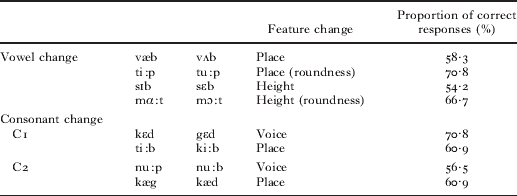
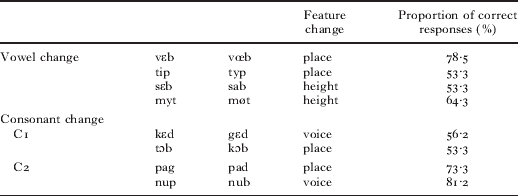
Eight pairs of monosyllabic CVC pseudo-words were created, differing on one consonant (4 pairs) or on one vowel (4 pairs). Single phonetic feature changes were used: place (2 consonant pairs and 2 vowel pairs), voice (2 consonant pairs), and height (2 vowel pairs). For the consonant pairs the first consonant was changed for half of the pairs (C1 pairs), and the coda was changed for the other half (C2 pairs). Within vowel contrasts, two pairs were made of tense (long) vowels and two pairs were made of lax (short) vowels. Details of the stimuli can be found in Table 2.
List of stimuli used in Experiment 2.
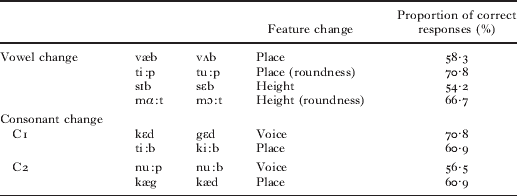
note: a For vowels, some change can also be described as a change in roundness rather than place or height.
Procedure
The procedure was identical to that used in Experiment 1, apart from the children being presented with two labels per trial instead of three. The third object being presented was named with one of the labels used to name the two first objects. For example, when the first object was named a /sɪb/, the second was named a /sεb/. The third object was introduced as follows: ‘Look, I have another /sɪb/! I put this other /sɪb/ in my cup.’ The experimenter then asked the following question: ‘Can you please put the other /sɪb/ in the cup for me?’ Contrary to Experiment 1, here there is one unique correct answer per trial (in this example, placing the first presented object in the cup).
The order of object triad presentation was counterbalanced, as was the assignment of a particular object to a particular pseudo-word. The side of presentation was also counterbalanced so that each child had four trials with the correct object on her right-hand side and on her left-hand side for the other four trials.
Children's receptive and productive vocabulary was assessed by parents filling in the Oxford CDI (Hamilton et al., Reference Hamilton, Plunkett and Schafer2000) on the week preceding their test.
RESULTS
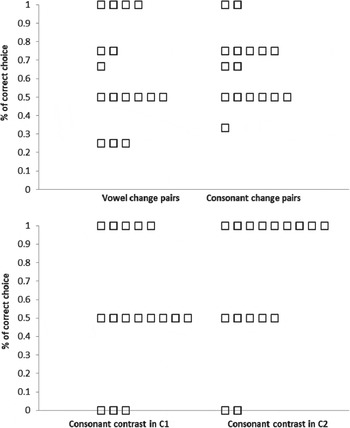
Out of all the 24 children tested 21 completed all eight trials, whilst the remaining three completed seven trials. The children were categorized as completing a trial if they picked up one of the objects from the table and placed it in the cup. For each child, a percentage of correct responses was calculated (and transformed using arcsine-root to normalize data). These percentages were analyzed with the following within-participant factors: Phoneme Type change (consonant versus vowel), Consonant Contrast Location (C1 versus C2), and Consonant Contrast (place versus voice) for the consonant change trials, Vowel Contrast (height versus roundness) and Vowel Quality (tense versus lax) for the vowel change trials. Overall, children performed above chance level (50%) at 62·3% (t(23)=3·54, p=·002, d=0·72). Performance for the consonant change trials was 62·2% (SD 25%) and 62·5% (SD 24%) for the vowel change trials, with no significant difference between these conditions (t(23)<1, d=0·011). Planned comparisons within the consonant change trials showed no effects of Consonant Contrast Location (C1 versus C2: 66·7% versus 58·3%, t(23)<1, d=0·23) nor Consonant Contrast (place versus voice: 60·4% versus 64·6%, t(23)<1, d=0·12). Likewise, no significant differences were seen between lax and tense vowels (lax versus tense: 56·2% versus 68·7%, t(23)=1·66, p=·11, d=0·40), or Vowel Contrast (place versus height: 64·6% versus 60·4%, t(23)<1, d=0·11).
Figure 3 provides the number of children according to their performance for consonant change trials versus vowel change trials (top panel), and for C1- versus C2-contrasted pairs (bottom panel).
Experiment 2, distribution of children as a function of the number of correct answers they provided for the vowel-contrasted pairs and the consonant-contrasted pairs only (top panel). For example, for the vowel-contrasted pairs, four children gave 100% correct responses and nine gave 75% correct responses. The bottom panel displays the distribution of children as a function of the number of correct answers they provided for the C1- and C2-contrasted pairs. For example, twelve children were 100% accurate for the C1 contrasted pairs and eight were 50% accurate (chance level).

The Oxford CDI production scores for the participants were 25·3 words on average (SD 19·9, from 2 to 72; N=23 children as OCDI data were missing for 1 child). There was no correlation between these scores and the overall success score in the task (r(23)=−0·29, p=·18), the score for the consonant trials (r(23)=−0·24, p=·28), or the score for the vowel trials (r(23)=−0·02, p=·92). Results were similar with the OCDI receptive vocabulary scores. There was no correlation either between the performance in the consonant trials and the vowel trials (r(24)=−0·10, p=·64). Like the French infants aged 1;4 in Havy and Nazzi (Reference Havy and Nazzi2009), word learning performance in this task did not depend on the children's vocabulary estimation as measured by a parental report.
DISCUSSION
This second experiment was designed to re-explore the proposed consonant bias in word learning, under the perspective of the asymmetry found in Experiment 1, where a bias was found in word-final consonants, but not those in word-initial position. Using a paradigm developed by Havy and Nazzi (Reference Havy and Nazzi2009), we found that there was no significant difference in the accuracy of learning new words with minimal differences in consonants or vowels. This contrasts with the findings by Havy and Nazzi (Reference Havy and Nazzi2009), who showed successful word learning in French-learning infants aged 1;4 in the consonant change condition (at 69·3%) but not in the vowel change condition (52·5%). Rather, our results closely resemble the performance observed with English-learning infants at 1;6 with the IPL (Mani & Plunkett, Reference Mani and Plunkett2007; see also Mani & Plunkett, Reference Mani and Plunkett2010, at 1;0), in which no evidence of a consonant bias was found. Also, no differences were observed between consonant contrasts that were word-initial or word-final, contrary to the results of Experiment 1. Whilst in the previous experiment the rhyme overlap had masked the initial consonant in C1 triplets (such as /dɪb/, /gɪb/, and /dεb/), no such confound existed in this experiment, suggesting that asymmetry in Experiment 1 was specific to the task, which focused attention on the final consonant or the rhyme.
In sum, the results of Experiment 1 and Experiment 2 indicate that before the age of 2;6 (Nazzi et al., Reference Nazzi, Floccia, Moquet and Butler2009) children do not show strong evidence of a consonant bias in word learning tasks. Whilst Experiment 1 did provide some evidence for better processing of the final consonant over that of the preceding vowel, this was not replicated in Experiment 2. Neither did we find evidence of a main consonant bias in this second experiment. It remains possible that the absence of a consonant bias in Experiment 2 is due to having measured performance for consonant change trials and vowel change trials independently, that is, by comparing vowel change trials with consonant change trials (although in a within-participant design). This was done to be as close as possible to the procedure used by Havy and Nazzi (Reference Havy and Nazzi2009) in French and to simplify the task. However, it is possible that a reliable consonant bias can only be found when directly pitting consonant and vowel against each other. Before discussing the possibilities of task demands and language-specific biases for consonant or vowel processing in the course of language development, a final experiment was conducted to explore the possibility that the consonant bias effect found repeatedly in French (e.g., Havy & Nazzi, Reference Havy and Nazzi2009) might be due to the specific stimuli that were used in those studies, and not to children's linguistic experience. Indeed, French phonology is characterized in part by clear syllabic boundaries (Mehler, Dommergues, Frauenfelder & Segui, Reference Mehler, Dommergues, Frauenfelder and Segui1981) and lack of ambisyllabicity (Goslin & Floccia, Reference Goslin and Floccia2007), which could provide young English listeners with more unambiguous phonemic cues and promote the observation of a consonant bias.
We tested a new group of British-English toddlers in a word learning interactive task similar to that of Experiment 2, but in this new experiment the stimuli were French. Bijeljac-Babic, Nassurally, Havy, and Nazzi (Reference Bijeljac-Babic, Nassurally, Havy and Nazzi2009) have reported successful word learning in French-learning infants aged 1;8 when taught in either French or English by a bilingual experimenter. In their study, highly contrasted pseudo-words were used (such as chook/dal). After training in French four trials were delivered in English, followed by four in French, to verify that the children could complete the task in their native language. Children were found to choose the correct object 60·4% of the time in English and 62·5% in French (see also Bijeljac-Babic, Nassurally & Nazzi, unpublished observations, for a replication with C-contrasted words). In Experiment 3 we used a similar design to test English-learning children aged 2;0 with the French language, and searched for a possible consonant bias (for both onset and coda position), as is found repeatedly in French children. The age of 2;0 was selected after pilot work showing that changing language was too distressing for younger children, who became distracted after a few trials in French. It must be noted that in contrast to Bijeljac-Babic et al. (Reference Bijeljac-Babic, Nassurally, Havy and Nazzi2009), who used very contrasted pairs of items, here we used minimally contrasted pairs that made discrimination and learning more difficult.
EXPERIMENT 3
METHOD
In this experiment we sought to ascertain whether the lexical consonant bias repeatedly found in French (e.g., Nazzi et al., Reference Nazzi, Floccia, Moquet and Butler2009) might be particular to the French linguistic input used in those tasks. British-English children aged 2;0 were tested in an interactive word learning task similar to that used in Experiment 2, but in this case the experimenter was a native French speaker who was fluent in English. After the completion of training done in English the eight test trials were delivered in French. As in Experiment 2, half of these test trials were made of pairs contrasted on a vowel, and the other half were contrasted on a consonant. Amongst the consonant change trials, half were contrasted on C1 and half on C2. If the French input contains some information that promotes the use of a consonant bias (e.g., clearer syllabic boundaries), then English children might show a general consonant bias when tested in French.
Participants
A total of forty children aged 2;0 were tested and the data of twenty-four of them were rejected for the following reasons: thirteen showed a systematic side bias in the French trials after a successful training in English, four were too agitated, four stopped halfway, and three took both objects more than twice. The sixteen children tested successfully were aged 2;0·5 on average (from 1;12·6 to 2;1·15), and included nine girls. They were selected on the same criteria as in the previous experiments, but we also ensured via parental questioning that they never had any significant contact with French.
Stimuli
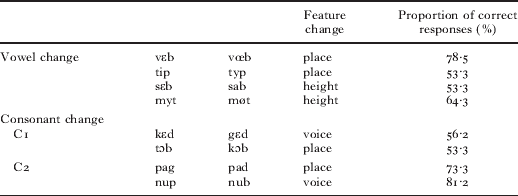
Stimuli were selected to be as similar as possible from those in Experiment 2, with eight pairs of monosyllabic CVC French pseudo-words differing on one consonant (4 pairs) or on one vowel (4 pairs). For the consonant pairs the first consonant was changed for half of the pairs (C1 pairs), and the coda was changed for the other half (C2 pairs). Details of the stimuli can be found in Table 3.
List of French stimuli used in Experiment 3
RESULTS AND DISCUSSION
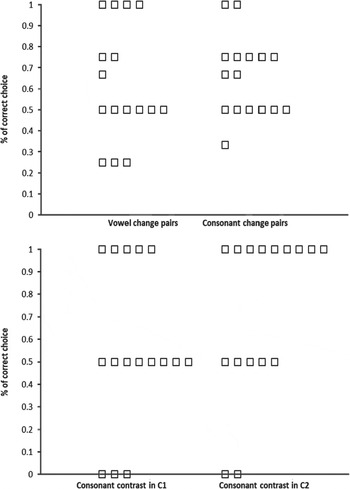
Of the 16 children successfully tested, 11 completed all eight trials correctly, 4 completed seven trials, and one child completed six trials. As in the previous experiment a completed trial was one in which one of the two objects was placed in the cup. The percentage of correct responses was analyzed in the same way as Experiment 2. Children performed above chance (50%) at 63·3% (t(15)=2·95, p=·010, d=0·74) across all trials. No significant difference between consonant change trials (65·1%, SD 18·8%) and vowel change trials (62·0%, SD 27·2%) was found (t(15)<1, d=0). Planned comparisons showed that within the consonant change trials, there was no effect of consonant position (C1 versus C2: 56·2% versus 71·9%, t(15)=1·05, p=·31, d=0·43) and no effect of consonant contrast (place versus voice: 62·5% versus 65·6%, t(15)<1, d=0·09). Further comparisons also showed that the effect of vowel contrast was not significant (place versus height: 65·6% versus 60·0%, t(15)<1, d=0·16).
Figure 4 shows the number of children according to their performance in the consonant change trials and the vowel change trials (top panel). It also displays their individual responses in consonant change trials when the contrast is on C1 or C2 (bottom panel).
Experiment 3, distribution of children as a function of the number of correct answers they provided for the consonant-contrasted pairs and the vowel-contrasted pairs (top panel). The bottom panel displays the distribution of children as a function of the number of correct answers they provided for the C1- and the C2-contrasted pairs (see Figure 3 for a similar representation).

The Oxford CDI production scores for the participants were 226 words on average (from 58 to 393; N=13 children as OCDI data for 3 children were missing). There was no correlation between these scores and the overall success score in the task (r(13)=0·12, p=·69), the score for the consonant trials (r(13)=0·21, p=·49), or the score for the vowel trials (r(13)=−0·14, p=·65). Receptive vocabulary scores provided similar results. There was no correlation either between the performance in the consonant and the vowel trials (r(16)=−0·05, p=·85).
These results are comparable to those found in Experiment 2, with responses for vowel-contrasted and consonant-contrasted pairs both higher than chance, and not significantly different from each other. This stands in contrast with the behavior of French toddlers when using both a similar task and similar stimuli (Havy & Nazzi, Reference Havy and Nazzi2009). This suggests the absence of a consonant bias in English-learning toddlers, at least before 2;6 (Nazzi et al., Reference Nazzi, Floccia, Moquet and Butler2009).
GENERAL DISCUSSION
The recent proposal that consonants are more important at the lexical level than vowels (Nespor et al., Reference Nespor, Peña and Mehler2003) has received strong empirical support in French. Children show a robust consonant bias in word learning tasks from age 1;4 (e.g., Havy & Nazzi, Reference Havy and Nazzi2009) and in the recognition of mispronounced familiar words in an IPL paradigm at 1;2 (Zesiger & Jöhr, Reference Zesiger and Jöhr2011). In contrast, only Nazzi et al. (Reference Nazzi, Floccia, Moquet and Butler2009) have found a consonant bias in English-learning children (at 2;6), whilst others largely report equal sensitivity to consonants and vowels (e.g., Mani & Plunkett, Reference Mani and Plunkett2007). However, differences between the studies suggest a range of possibilities that may account for this discrepancy, such as the task used, the familiarity of words used, the age of the children, and their linguistic exposure. In this study we have attempted to redress these inconsistencies by testing for vowel or consonant bias in English-speaking children aged 1;4 and 1;11/2;0 using interactive word learning tasks based upon the procedures used in Nazzi et al. (Reference Nazzi, Floccia, Moquet and Butler2009) in Experiment 1, and Havy and Nazzi (Reference Havy and Nazzi2009) in Experiments 2 and 3. In both tasks children were presented with CVC labels for two new objects, and had to match those labels to the label of a target object. In the former task the target object's label (e.g., /dɪb/) differed by one consonant from one of the two previously introduced labels (e.g., /gɪb/), and by one vowel from the other (/dεb/). A consonantal bias should result in more frequent matches between the target object and the previous object that shared the same consonant, rather than the one that shared the same vowel. In the latter task the two first objects were minimally different pairs, differing either in the first consonant, vowel, or third consonant of the CVC. In this task the target object was given the same label as one of the previously named pair of objects. A consonant bias would be revealed if matches were more accurate when the minimal pairs were differentiated by a consonant contrast, rather than by a vowel contrast.
Overall, the English-speaking children tested in our study did not show any stronger reliance on consonants than on vowels when learning new words, either in increased preference for shared consonant labels over shared vowels (Experiment 1), or higher accuracy with minimal pairs differentiated by a consonant or a vowel (Experiment 2 and Experiment 3). This stands in contrast to the increased preference for shared consonant labels shown by the English-speaking infants aged 2;6 tested by Nazzi et al. (Reference Nazzi, Floccia, Moquet and Butler2009; Experiment 3). It also contrasts with the accuracy of French children of similar ages when tested with minimal pairs differentiated by vowels or by consonants (Havy & Nazzi, Reference Havy and Nazzi2009). The lack of a general consonant bias was found even when the English children were presented with French stimuli in Experiment 3, suggesting that the consonant bias found in French toddlers is linked to their accumulated linguistic experience with this language more than to the sole properties of the French stimuli.
In our study, evidence for a consonant bias effect was limited to specific conditions, with the position of the consonant playing a role in the presence or absence of this effect. When the consonant contrast is on the coda position in the CVC pseudo-words of Experiment 1, a consonant bias is evidenced across the three tested ages (1;4, 1;11, and 2;6). At first glance, this finding suggests that the discrepancy between Mani and Plunkett's (Reference Mani and Plunkett2007, Reference Mani and Plunkett2010) studies and Nazzi et al.'s (Reference Nazzi, Floccia, Moquet and Butler2009) may not be due to the use of different tasks, or to the different status of the word, or to the age range. Rather, it could be due to the position of the consonant contrast, as Mani and Plunkett (Reference Mani and Plunkett2007, Reference Mani and Plunkett2010) only tested consonant mispronunciations in word onset position. Therefore, it could be said that English-learning children do exhibit a consonant bias at least from the age of 1;4, but that this is restricted to consonants in specific word position (here, the coda of CVC words). Again, this finding contrasts with French children, who have been shown to display a consonant bias in word learning and in mispronunciation detection in familiar words regardless of the location in the words (e.g., Havy et al., Reference Havy, Bertoncini and Nazzi2011; Nazzi & Bertoncini, Reference Nazzi and Bertoncini2009; Zesiger & Jöhr, Reference Zesiger and Jöhr2011).
However, this interpretation must be taken cautiously for at least two reasons. First, this effect was not replicated in Experiments 2 and 3, where children were found to succeed equally well whatever the consonant contrast location within the sequences. Second, this interpretation would suggest a greater importance of codas versus onsets in spoken word processing, contradicting most adult models of lexical access which state exactly the opposite, in the spirit of Cohort-like models of lexical selection (e.g., Content, Kearns & Frauenfelder, Reference Content, Kearns and Frauenfelder2001; Marslen-Wilson, Reference Marslen-Wilson1987). This would also challenge conclusions drawn from young children's data showing a greater role of onsets than codas in speech processing (see Swingley, Reference Swingley2009, for a review). In production too, children are generally less accurate in producing codas than onsets in their first words (e.g., Stoel-Gammon & Dunn, Reference Stoel-Gammon and Dunn1985). In addition, if children's acquisition of phonological details was based on the need to differentiate words from each other to constitute a lexicon, they would be less accurate in distinguishing codas than onsets, as monosyllabic words in English have neighbors which share their rhyme rather than their consonant components or their lead, that is, the onset consonant plus the vowel (de Cara & Goswami, Reference Goswami2002).
Therefore, as a position-dependent consonant bias was not found to be robust across experiments that used different tasks, it is possible that it is an artifact of task-specific constraints. In Experiment 1, children have to make a choice based on sound similarities, which might encourage them to focus on the rhyme or the most recent segment. Another possible explanation for this effect is that in situations where task difficulty slows participants, such as in the conflict task where they have to select which response is the ‘less bad’, a race-approach of lexical access encourages the emergence of rhyme processing later than an earlier, consonant bias stage. The idea that processing constraints affect performance with a different timecourse depending on the complexity or frequency of representations is quite common in language processing, as seen in syntax processing with constraint-based theories (e.g., MacDonald, Reference MacDonald1994) or in spoken word recognition in which abstract information is supposedly accessed before more concrete, less frequent information (e.g., McLennan & Luce, Reference McLennan and Luce2005; see also Floccia, Goslin, Kolinsky & Morais, Reference Floccia, Goslin, Kolinsky and Morais2012).
To sum up at this point, the key findings of the present study are that, overall, English-speaking toddlers do not show evidence for a robust consonant bias. We do not exclude the possibility that the requirement of a motor response in these kinds of task prevented the consonant bias from being revealed, as it is often found that on-line tasks can provide earlier indications of cognitive development than tasks involving a motor response (e.g., Baillargeon, Reference Baillargeon1987), and we are currently testing this possibility by using an eye-tracking version of the paradigm with no explicit response needed. However, this would not explain the cross-linguistic differences between English- and French-learning infants, as the French infants were able to express a consonant bias using the same object manipulation tasks. It further suggests that the lexical consonant bias emerges during language development, with a language-specific timing, leaving us to speculate about its origins.
Returning to the hypotheses that can account for the underpinnings of the functional consonant–vowel distinction found in adults across languages, it seems that the initial bias hypothesis, which assumes a universally higher sensitivity to consonants over vowels in lexical processing, cannot be supported. The unequal sensitivity to consonants and vowels in French and English toddlers (at the same ages) would instead lend support to the lexical and acoustic/phonological hypotheses, which both predict cross-linguistic differences in the developmental pattern of emergence related to the properties of the languages being learned. To differentiate between the latter two hypotheses we could turn to behavior with respect to vowels, with the acoustic/phonetic hypothesis predicting different behavior in toddlers or adults when processing lax or tense vowels. Indeed, lax vowels tend to be perceived more categorically than tense vowels because of their shortness (Pisoni, Reference Pisoni1973), and therefore they could be processed more like consonants than vowels. However, we failed to find any strong evidence of such a difference in Experiment 2, in which this factor was manipulated. But this alone should not be taken as firm evidence against this hypothesis, because the acoustic/phonological hypothesis cannot be reduced to the mere lax–tense difference. For example, the contrast between strong and weak syllables in English could progressively drive lexical processing towards a consonant bias: we have shown elsewhere (Floccia, Nazzi, Austin, Arreckx & Goslin, Reference Floccia, Nazzi, Austin, Arreckx and Goslin2011) that in a word learning task similar to that used in Experiment 2, English infants aged 1;8 to 1;11 only encode a syllable-initial consonant contrast when it is found at the onset of a stressed syllable, and not at the onset of an unstressed one. Therefore, the acoustic properties of stressed syllables might draw infants' attention towards them, and because stressed syllables are usually heavier in terms of consonant components (Kelly, Reference Kelly2004), that could result in an emerging consonant bias. If this were correct, one would also expect a strong consonant bias in the stressed syllable of disyllabic words but not in the unstressed ones. However, it must be noted that we would also expect a consonant bias in monosyllabic words, which are always made up of a stressed syllable (if they are nouns), which is inconsistent with both our data and that of Mani and Plunkett (Reference Mani and Plunkett2007, Reference Mani and Plunkett2010), at least before the age of 2;6.
In addition, while all hypotheses predict a consonant bias effect with adults across languages, the lexical hypothesis predicts a stronger effect in English than French during development (and possibly in adulthood), due to the increased weighting in favor of consonants in the former language. This is clearly inconsistent with both our and Mani and Plunkett's studies: English has a more unbalanced distribution of consonants and vowels as compared to French, yet a robust consonant bias is only observed in French children. It could be argued, however, that the Danish-learning toddlers' behavior (Højen & Nazzi, unpublished observations) adds some credence to the lexical hypothesis, as Danish has more vowels than consonants and Danish children do show a vocalic bias in an interactive word learning task. However, the acoustic/phonological hypothesis can account for these data as well, as Danish is characterized by extensive consonant lenition or reduction (Pharao, Reference Pharao, Lee and Zee2011), so that many obstruents become vocoids (non-lateral approximants) in coda position (see Basbøll, Reference Basbøll2005). This, together with frequent schwa reduction, translates into a sound structure ‘which is difficult to perceive, with long stretches of nonconsonantal sounds’ (Bleses et al., Reference Bleses, Basbøll and Vach2011: 1199). Therefore, the acoustic prominence of vowels as compared to consonants could also result in a lexical vowel bias in Danish children.
Another separation between lexical and acoustic/phonological hypotheses is demonstrated by the potential link between vocabulary size and consonant bias (see also the simulations by Mayor & Plunkett, Reference Mayor, Plunkett, Taatgen and van Rijn2009, for a link between emerging consonant bias and early lexicon size). Undeniably, age, and a fortiori, vocabulary size, relate to the emergence of a consonant bias as it is observed after, but not before, 2;6 in English. However, we found no statistical correlation between children's use of phonological information and their vocabulary size as measured by the OCDI. This is in itself not highly surprising, since such a failure to link vocabulary size and infants' use of phonological information in word learning tasks has been reported on many occasions with infants aged 1;5 and beyond (Floccia et al., Reference Floccia, Nazzi, Austin, Arreckx and Goslin2011; Havy & Nazzi, Reference Havy and Nazzi2009; Nazzi, Reference Nazzi2005; Nazzi & New, Reference Nazzi and New2007; Swingley, Reference Swingley2003; Werker, Fennell, Corcoran & Stager, Reference Werker, Fennell, Corcoran and Stager2002; see Swingley, Reference Swingley2009 for children aged 1;2 to 1;10; see also the lack of a correlation in a picture-fixation task at 1;6 in Swingley & Aslin, Reference Swingley and Aslin2007, and in a preferential looking task at 1;4–1;8 in Tan & Schafer, Reference Tan and Schafer2005). Havy and Nazzi (Reference Havy and Nazzi2009) commented that when such a correlation is found, it is reported for younger children (1;0 in Mani & Plunkett, Reference Mani and Plunkett2010; 1;2 in Werker et al., Reference Werker, Fennell, Corcoran and Stager2002), as if the effect of vocabulary size on the use of phonological information in lexical processing was temporary. Of course, it is also possible that our null results are Type II errors arising from small sample sizes and/or because parental evaluations of children's vocabulary through the OCDI are underestimated after a certain stage (Fenson et al., Reference Fenson, Dale, Reznick, Thal, Bates, Hartung, Pethick and Reilly1993).
At this point we are left to identify the factors underlying the emergence of a consonant bias at 2;6 and ultimately in English adults, and in French listeners from 1;4 (or a vowel bias as seen in Danish; Højen & Nazzi, unpublished observations). One possibility that favors the lexical hypothesis relates to the kinds of word that have been learned, rather than their number. For example, a simple count in the English OCDI (Hamilton et al., Reference Hamilton, Plunkett and Schafer2000) shows that out of the 364 content words (excluding 12 onomatopoeias and 41 function words), 222 are monosyllabic (61·2%). The French adaptation of the CDI (Kern, Reference Kern2007) provides 298 comparable content words, out of which only 38·6% are monosyllabic and 44·6% are disyllabic. Therefore an English-learning child's early nouns will mainly be monosyllabic words (e.g., ball, fish) and a French-learning child's multisyllabic (ballon, poisson). This means that there is less possible confusion between words in French than in English: the more phonemes in a word the less likely it can be confounded with another one. Out of the 298 content words selected from the French CDI, there are on average 4·48 phonemes per word (SD=1·65), whereas out of the 363 content words from the Oxford CDI, the average number of phonemes per word is 4·20 (SD=1·38). Perhaps this allows French children to concentrate on the most lexically informative phonemes, that is, the consonants, while English children cannot afford to pay less attention to the vowels.
Another factor that could explain the consonant bias emergence (or the vocalic bias in the case of Danish), compatible with both the lexical and the acoustic/phonological hypotheses, is the growing ability to process segmental information with language experience. Indeed, Tan and Schafer (Reference Tan and Schafer2005) reported a relationship between new word learning and segmental processing abilities (as suggested by Metsala & Walley, Reference Metsala, Walley, Metsala and Ehri1998), but no effect of vocabulary size. Similarly, it could be the increased experience with familiar words that leads to changes in the way these words (and new words) are represented and processed (Plunkett, Sinha, Møller & Strandsby, Reference Plunkett, Sinha, Møller and Strandsby1992). Indeed an infant aged 1;2 has had fewer opportunities to hear and produce the few words she knows than a child aged 1;8, and this increased experience could result in changes in word processing abilities, as revealed by changes in brain pattern activity, for example (Mills, Coffey-Corina & Neville, Reference Mills, Coffey-Corina and Neville1997). A similar view was adopted recently by DePaolis, Vihman, and Keren-Portnoy (Reference DePaolis, Vihman and Keren-Portnoy2011), who showed that infants aged 1;6 pay more attention to speech samples containing consonants that they are used to producing themselves. In other words, what would drive the changes in consonant versus vowel bias would be caused by increased experience with particular words more than by the acquisition of new words.
Overall, we have shown in this study that English toddlers between 1;4 and 2;0 do not pay more attention to consonants than to vowels in word learning tasks. This finding stands in contrast with French data, showing a consonant bias in every syllabic and word position from 1;4 onward (e.g., Havy et al., Reference Havy, Bertoncini and Nazzi2011; Nazzi & Bertoncini, Reference Nazzi and Bertoncini2009; Zesiger & Jöhr, Reference Zesiger and Jöhr2011), and with Danish data, showing a vowel over consonant bias at 1;8 (Højen & Nazzi, unpublished observations). These results are best accounted for by a mixed role of the lexical and acoustic/phonological properties of these languages, leading to a phonological distinction between consonants and vowels early in life, but at different rates of development. Further research will be needed to determine the timecourse of these influences and disentangle the role of lexical regularities from that of segmental information.