I. INTRODUCTION
Currently, photocatalysis technology, which is one of the most effective ways to resolve the issues of environmental pollution and energy shortage, receives more and more attention. Titanium dioxide (TiO2) and graphitic carbon nitride (g-C3N4), as two important representative photocatalysts, attract extensive attention and display great application potentials in the photocatalytic field due to their low-toxicity, and cheap and good chemical stability.Reference Wen, Li, Liu, Fang, Xie and Xu1,Reference Wen, Xie, Chen and Li2 Up to now, numerous studies have been carried out to enhance their photocatalytic abilities via modification. However, there still remain quite a number of issues to be tackled, such as poor efficiency in utilization of solar energy and low photogenerated charge separation. Therefore, it is still necessary to develop an effective photocatalytic material to realize the efficient utilization of solar energy.
As a novel class of photocatalysts, bismuth oxyhalides BiOX (X = F, Cl, Br, I) have drawn extensive attention recently due to their excellent performance in photocatalysis.Reference Ye, Su, Jin, Xie and Zhang3–Reference Chang, Huang, Tan, Wang, Ji, Deng and Yu7 Considering that the activity of a photocatalyst is closely related to the morphology and the microstructure, great efforts have been devoted to obtain various nanostructured bismuth oxyhalides via morphology control. In recent days, many relative studies on this field have been reported, and some contributive results have been achieved.Reference Zhao, Lv, Wang, Yang, Yang and Lu8–Reference Li, Yu and Jaroniec11 For example, Zhao et al. synthesized BiOCl nanosheet film, which showed excellent activity in degrading methyl orange.Reference Zhao, Lv, Wang, Yang, Yang and Lu8 Su et al. reported that the BiOF with steamed-rice-shaped morphology exhibited high photocatalytic performance for the removal of universal organic pollutants.Reference Su, Wang, Huang, Wang, Wu, Wang and Liu9 Sun et al. reviewed their work about the preparation of BiOCl with flower-like hierarchical structures. The synthesized flower-like BiOCl exhibited excellent photocatalytic activity in methyl orange degradation.Reference Sun, Li, Feng, He, Zhao, Wang, Li, Yin and Sato10 It is suggested that the morphology with hierarchical structures may not only promote the separation of carriers through quantum effect but also enhance the light absorption due to the light refraction in the hierarchical structure, which significantly improves the photocatalytic activity.Reference Sun, Li, Feng, He, Zhao, Wang, Li, Yin and Sato10,Reference Li, Yu and Jaroniec11 On the other hand, coupling two different semiconductors to construct a composite photocatalyst is an impressive strategy to achieve enhanced photocatalytic activity and has been extensively studied on various materials.Reference Feng, Zeng, Chen, Ma, Zhao, Jin, Lu, Wu and He12–Reference Yan, Xu, Chai, Wang, Wang and Ren15 For instance, Ye et al. synthesized a BiOBr–g-C3N4 composite, which showed much higher visible-light-driven photocatalytic activity than pristine BiOBr or g-C3N4.Reference Ye, Liu, Jiang, Peng and Zan16 Gopannagari et al. prepared a highly stable and efficient nanocomposite photocatalyst in hydrogen evolution via decoration of few-layered WS2 on CdS nanorods.Reference Gopannagari, Kumar, Reddy, Hong, Song and Kim17 Other similar studies are CdS/g-C3N4,Reference Dai, Xie, Meng, Fu and Chen18 AgI/BiOI,Reference Yang, Huang, Zhong, Chen, Li and Sun19 Gd2O3/TiO2,Reference Zhang, Wu, Yan, Chu, Zhao, Wang and Li20 Ni(OH)x/g-C3N4/WO3,Reference He, Xie, Luo, Wen, Ma, Li, Fang and Zhang21 BiOI/La(OH)3,Reference Sun, Xiao, Dong, Dong and Zhang22 β‐Bi2O3/BiOI,Reference Han, Li, Yang and Lin23 etc. Accordingly, it is deduced that an effective photocatalyst may be obtained via proper combination of the two aforementioned methods.
As one of the bismuth oxyhalides’ family, Bi5O7I, which has been reported over the past few years, is an effective photocatalyst and attracts much attention.Reference Sun, Wang, Zhang, Zhou, Yin and Shang24 The morphology control has been applied to optimize the photocatalytic property of Bi5O7I. Various morphologies of Bi5O7I including nanosheets,Reference Yang, Xu, Liu and Xie25 nanorods,Reference Zhao, Wang, Yang, Fang, Zhang, Zhu, Tang and Huang26–Reference Cao, Li, Lin, Xu, Luo and Chen28 and sphere-likeReference Zhang, Zhu, Gao, Zhu, Hojamberdiev, Wei and Liu29,Reference Chen, Yang, Yao, Wang, Sun, An, Yi, Wang, Zhou, Wang, Li, Wang and Zeng30 have been reported. However, to the best of our knowledge, the flower-like structure of Bi5O7I has not been announced. In this paper, flower-like Bi4O5I2 has first been fabricated as a precursor. A combination of deposition and post heat-treatment method was used to prepare the AgI/Bi5O7I composite photocatalyst. Scanning electron microscopy (SEM) analysis shows that the as-prepared sample possesses a flower-like morphology. Finally, the photocatalytic activity of the synthesized composite was evaluated by a group of rhodamine B (RhB) degradation experiments, which suggests that the AgI/Bi5O7I photocatalyst carries better photocatalytic capability than either individual AgI or Bi5O7I.
II. EXPERIMENTAL SECTION
A. Materials
The reagents used in this experiment are as follows: Bismuth(III) nitrate pentahydrate Bi(NO3)3·5H2O (≥99.0%), potassium iodide KI (≥99.0%), silver nitrate AgNO3 (≥99.8%), and ethylene glycol (≥99.0%). All reagents were purchased from Sinopharm Chemical Reagent Co. Ltd. (Shanghai, China) and used as received without further treatment.
B. Synthesis of Bi4O5I2, Bi5O7I, AgI, and AgI/Bi5O7I samples
Bi4O5I2 was prepared by a hydrothermal method.Reference Xiao, Xing, He, Zuo, Nan and Wang31 10 mmol Bi(NO3)3·5H2O and 10 mmol KI were added into 60 mL ethylene glycol and uniformly dispersed by using a magnetic stirrer under room temperature. The pH value of the solution was adjusted to 9.0 with 2 mol/L sodium hydroxide solution before being transferred into a hydrothermal reactor (100 mL). The hydrothermal reaction was run for 12 h at 150 °C. After that, a pale-yellow Bi4O5I2 sample was collected via centrifugation, alcohol and deionized water washing, and dried overnight. Pure Bi5O7I was prepared by direct heating of the as-prepared Bi4O5I2 powder at 500 °C for 2 h with a rate of 5 °C/min. Pure AgI was synthesized by using the chemical precipitation method: A certain amount of KI and AgNO3, in the same mole ratio of the Ag/I, were dispersed into 50 mL deionized water to get yellow AgI deposit. Thus, AgI powder can be obtained after drying overnight at 60 °C.
AgI/Bi5O7I composite photocatalysts were synthesized by the following process. A certain amount of Bi4O5I2 was well dispersed into 50 mL deionized water. After stirring for 30 min, equimolar KI with AgNO3 was added and further stirred for one hour. The precipitate was collected by high speed centrifugation, washed with deionized water and ethanol, and finally dried at 80 °C overnight. The obtained powders were put into the muffle furnace and heated at 500 °C for two hours to convert the AgI/Bi4O5I2 into AgI/Bi5O7I. The AgI/Bi5O7I composites with different AgI concentrations were obtained via varying the amount of AgNO3 and KI.
C. Photocatalytic test
The photocatalytic activity of the as-synthesized pholocatalysts was evaluated through degradation of RhB solution (10 ppm) with visible light irradiation (350 W Xe lamp, λ > 420 nm). In each degradation experiment, 100 mL as-prepared RhB solution and 0.1 g of photocatalysts were taken part in the chemical reaction, and the whole process was under constant magnetic stirring. The mixed solution was stirred for an hour to achieve an adsorption–desorption equilibrium before irradiation. Then, it was exposed to light irradiation. About 8 mL of the suspension was sampled at certain intervals and centrifuged to remove the solid for further analysis. Finally, the maximum absorbance of RhB solution was measured on a UV-vis spectrophotometer.
D. Characterization of catalysts
Brunner–Emmet–Teller (BET) surface area analysis was performed by N2 adsorption at 77 K on an Autosorb-1 apparatus (Quantachrome Instruments, Boynton Beach, Florida). X-ray powder diffraction (XRD) was recorded on a Philips PW3040/60 X-ray diffractometer (Philips, Amsterdam, the Netherlands) under the conditions of 40 kV, 30 mA, and Cu Kα radiation (λ = 0.15406 nm). The Raman spectra were carried out on a RM1000 spectrometer (Renishaw, Wotton-under-Edge, United Kingdom) with an Ar ion laser (514.5 nm) as the excitation source. X-ray photoelectron spectroscopy (XPS) measurements were performed to inspect the surface chemical composition of the samples by a Quantum 2000 Scanning ESCA Microprobe instrument (Physical Electronics, Eden Prairie, Minnesota). UV-vis diffuse reflectance spectra (DRS) were achieved using a UV-vis spectrophotometer (PerkinElmer Lambda900, PerkinElmer, Waltham, Massachusetts; BaSO4 as a reference). SEM was conducted to obtain the microstructure and morphology information of the as-prepared samples by field-emission scanning electron microscopy (SEM; Hitachi S-4800, Hitachi, Tokyo, Japan) equipped with energy-dispersive X-ray spectroscopy (EDS) for elemental analysis. The transmission electron microscopy (TEM) image was recorded with a JEM-2010F transmission electron microscope (JEOL USA Inc., Peabody, Massachusetts). A CHI 660E electrochemical workstation (Shanghai Chenhua Instrument Co., Ltd., Shanghai, China) with a standard three-electrode cell was used to record the transient photocurrent (PC) responses and electrochemical impedance spectroscopy (EIS) of the samples. The photocatalyst, Ag/AgCl (saturated KCl), and a Pt wire were used as the working electrode, the reference electrode, and the counter electrode, respectively. The working electrode was prepared based on the previous literature.Reference Liu, Jiang, Chen, Yu and He32
III. RESULTS AND DISCUSSION
A. Characterization of the AgI/Bi5O7I composite
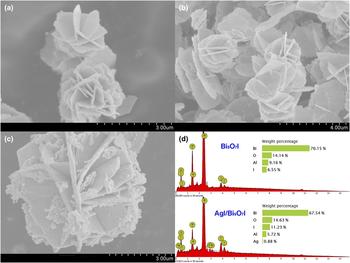
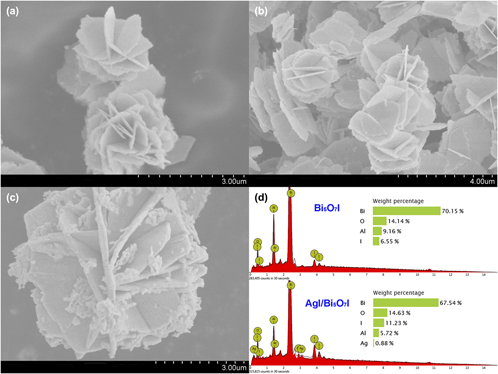
SEM was performed to reveal the morphology and microstructure of the as-prepared samples. Figure 1(a) shows the SEM image of Bi4O5I2. It displays a three-dimensional flower-like microsphere morphology with a diameter of about 2 um, which is assembled by a number of nanosheets. Pure Bi5O7I [Fig. 1(b)], prepared by direct heating of Bi4O5I2, shows a similar appearance to Bi4O5I2. However, compared with Bi4O5I2, the flower-like structure of Bi5O7I is slightly loose, as a portion of the sample displays more like layer-packed structure. This indicates that the thermal treatment at 500 °C may destroy a part of the microstructure. Anyway, the synthesized Bi5O7I still has the hierarchical flower-like microstructure, indicating that the sample exhibits good capability in absorbing the incident light. Figure 1(c) shows the SEM image of the AgI/Bi5O7I composite, which maintains a similar morphology as Bi5O7I except some nanoparticles adhered on the Bi5O7I nanosheets. These particles which are widely dispersed on the catalyst’s surface can be assigned to the formed AgI. EDS analysis [Fig. 1(d)] shows that AgI/Bi5O7I consists of Bi, O, Al, I, and Ag (where Al’s signal comes from the substrate), proving its hybrid structure.
SEM images of Bi4O5I2 (a), Bi5O7I (b), and AgI/Bi5O7I (c); the EDS result of Bi5O7I and 5% AgI/Bi5O7I (d).

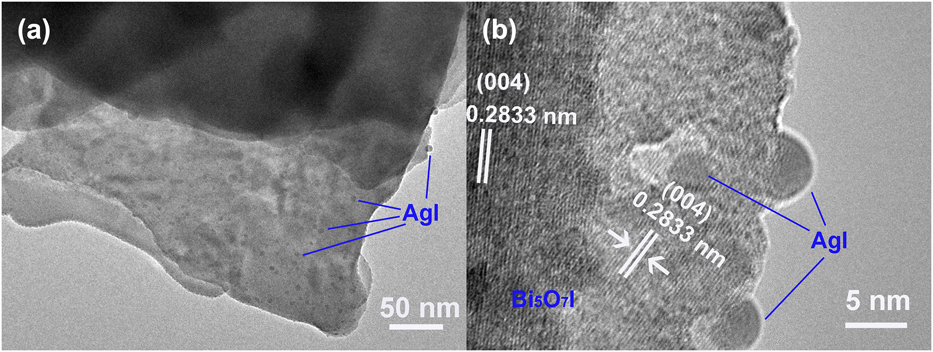
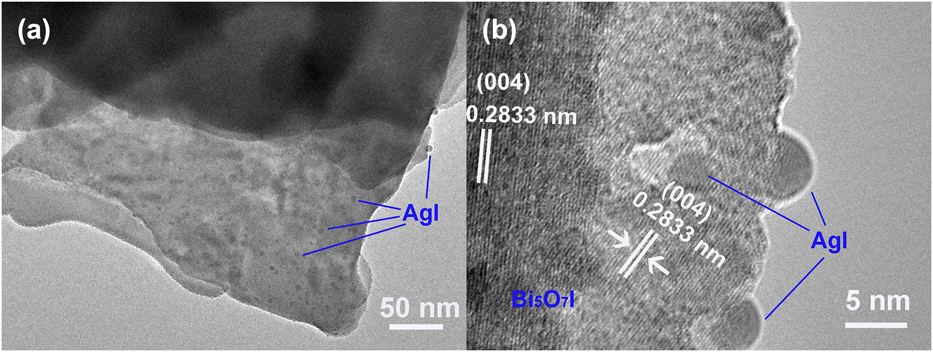
TEM and high-resolution (HR) TEM images of 5% AgI/Bi5O7I are shown in Fig. 2. The flower-like structure does not appear due to the fact that magnification of the TEM image is much larger than that of the SEM picture. However, the Bi5O7I nanosheet structure is still observed. Some black nanoparticles are adhered on the Bi5O7I nanosheet, which can be assigned to the loaded AgI [Fig. 2(a)]. The HR-TEM image of the sample further confirms the assignment [Fig. 2(b)]. The nanosheet shows a clear lattice fringe of 0.2833 nm, which can be ascribed to the (004) plane of Bi5O7I. The lattice fringe of these nanoparticles is not detected due to the light sensitivity of AgI. Actually, after the irradiation of the electron beam for a while, these AgI nanoparticles would be decomposed and disappear. Anyway, the TEM analysis indicates that the AgI is closely adhered on the Bi5O7I surface.
TEM (a) and HRTEM (b) images of the 5% AgI/Bi5O7I composite.
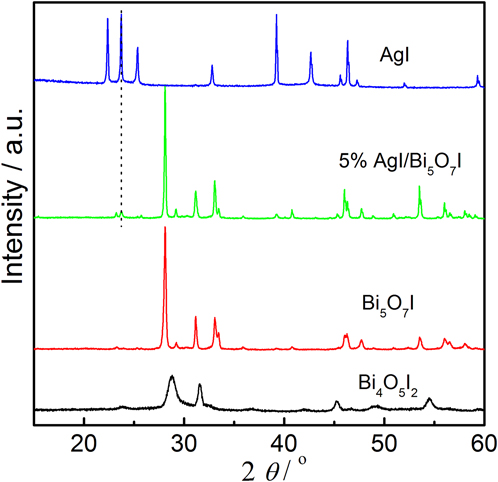
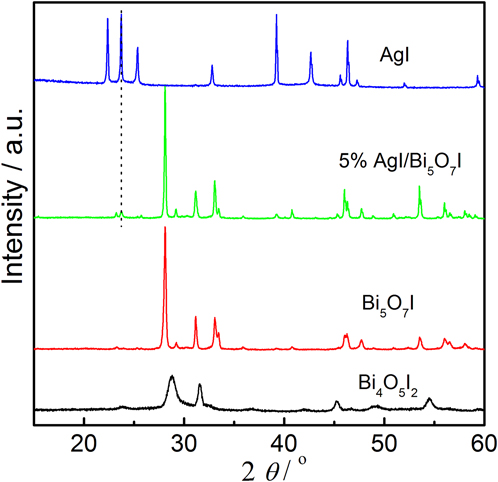
The crystal structures of Bi4O5I2, AgI, Bi5O7I, and AgI/Bi5O7I were characterized by XRD (shown in Fig. 3). Bi4O5I2 shows strong diffractions at 2θ = 28.8, 31.6, 45.2, and 54.5°, which is consistent with the previous literature.Reference Cui, Yu, Lin, Wu, Zhao and He33 After the thermal treatment at 500 °C, the XRD patterns change significantly. The original peaks disappear, while strong diffractions are observed at 2θ = 28.2, 29.2, 31.2, 33.1, 33.4, 46.0, 47.7, and 53.6°, which matches well with the standard orthorhombic structure of Bi5O7I (PDF#40-0548). For pure AgI, its diffraction peaks appear at 22.4, 23.8, 25.3, 32.8, 39.2, 42.6, and 46.3°, corresponding well to the standard card of PDF#09-0374. The XRD patterns of the AgI/Bi5O7I composite can be explained as a superposition of the AgI and Bi5O7I curves. Both the characteristic peaks of AgI and Bi5O7I are observed. However, for the AgI phase, only the peak at 23.8° is detected. This phenomenon can be ascribed to the low content of AgI in the AgI/Bi5O7I photocatalyst.
XRD patterns of Bi4O5I2, AgI, Bi5O7I, and 5% AgI/Bi5O7I.
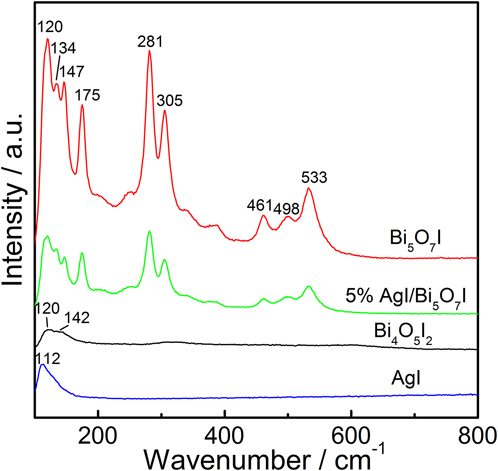
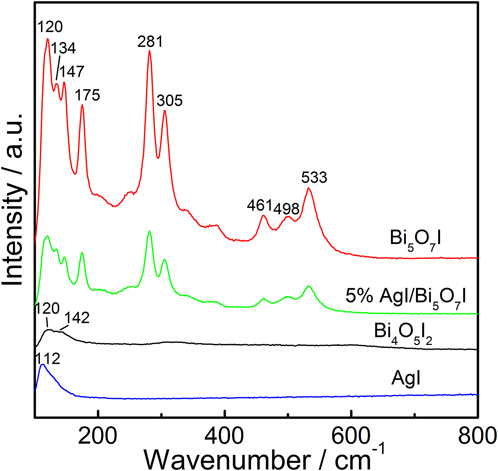
The Raman spectra of the as-synthesized composites are shown in Fig. 4. It can be seen that the Raman peaks of pure Bi5O7I appear at 120, 134, 147, 175, 281, 305, 461, 498, and 533 cm−1, which is in agreement with the previous report.Reference Cui, Yu, Lin, Wu, Zhao and He33 The Raman vibration peaks of Bi4O5I2 are markedly different from that of Bi5O7I. Only two weak peaks at about 120 and 142 cm−1 are observed, which indicates that the structure of the above two catalytic agents is different. Just like Bi4O5I2, the Raman signal of AgI is also very weak. One Raman peak appears at about 110 cm−1 as described in Ref. Reference Liang, Terabe, Tsuruoka, Osada, Hasegawa and Aono34, which is close to the characteristic peaks of Bi5O7I. Hence, it is no strange that only Bi5O7I is detected in the AgI/Bi5O7I composite. The Raman spectrum of AgI/Bi5O7I is nearly the same as that of pure Bi5O7I. However, the peak intensity is decreased which may be ascribed to the shielding effect of the loaded AgI particles.
Raman spectra of Bi4O5I2, AgI, Bi5O7I, and 5% AgI/Bi5O7I photocatalysts.
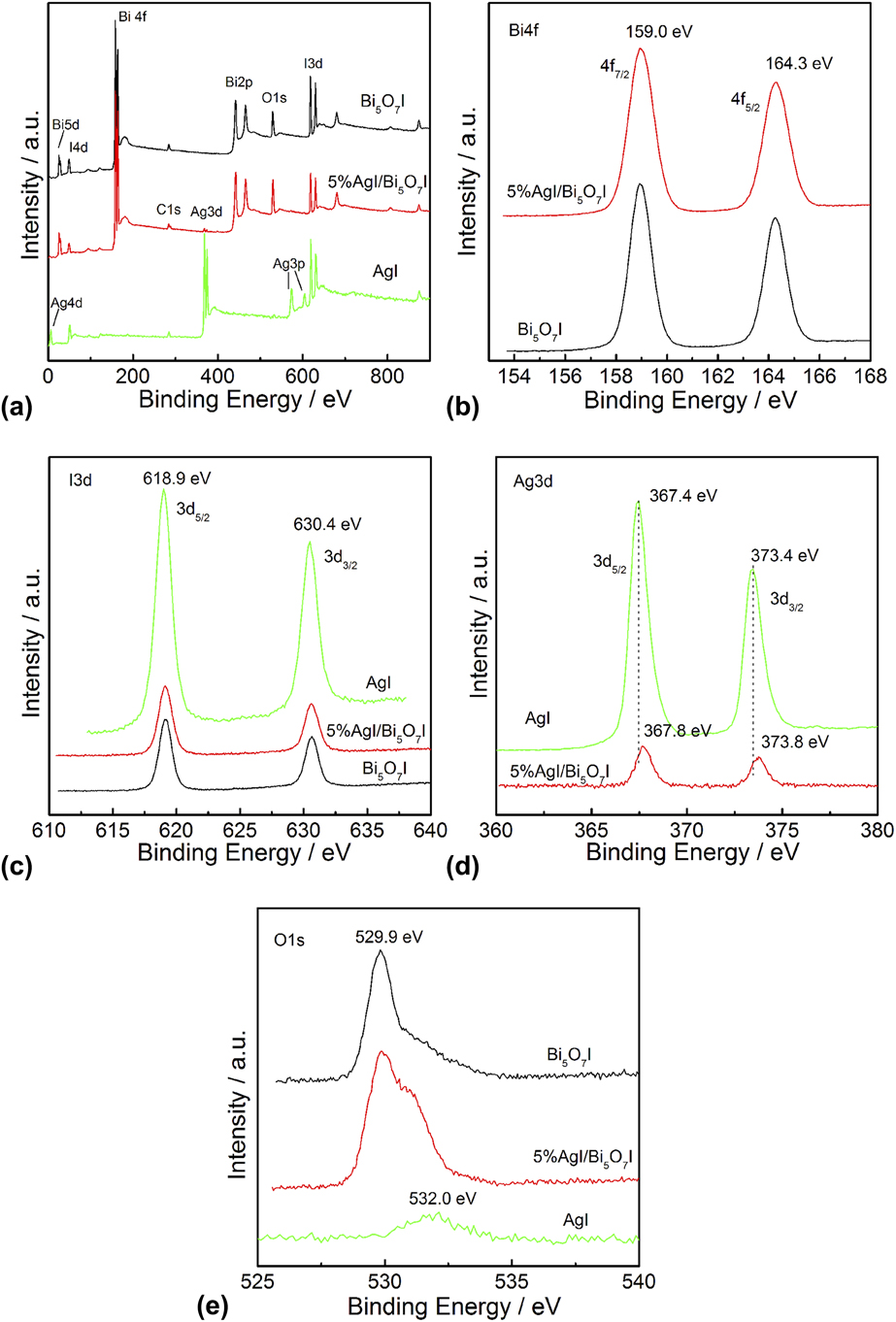
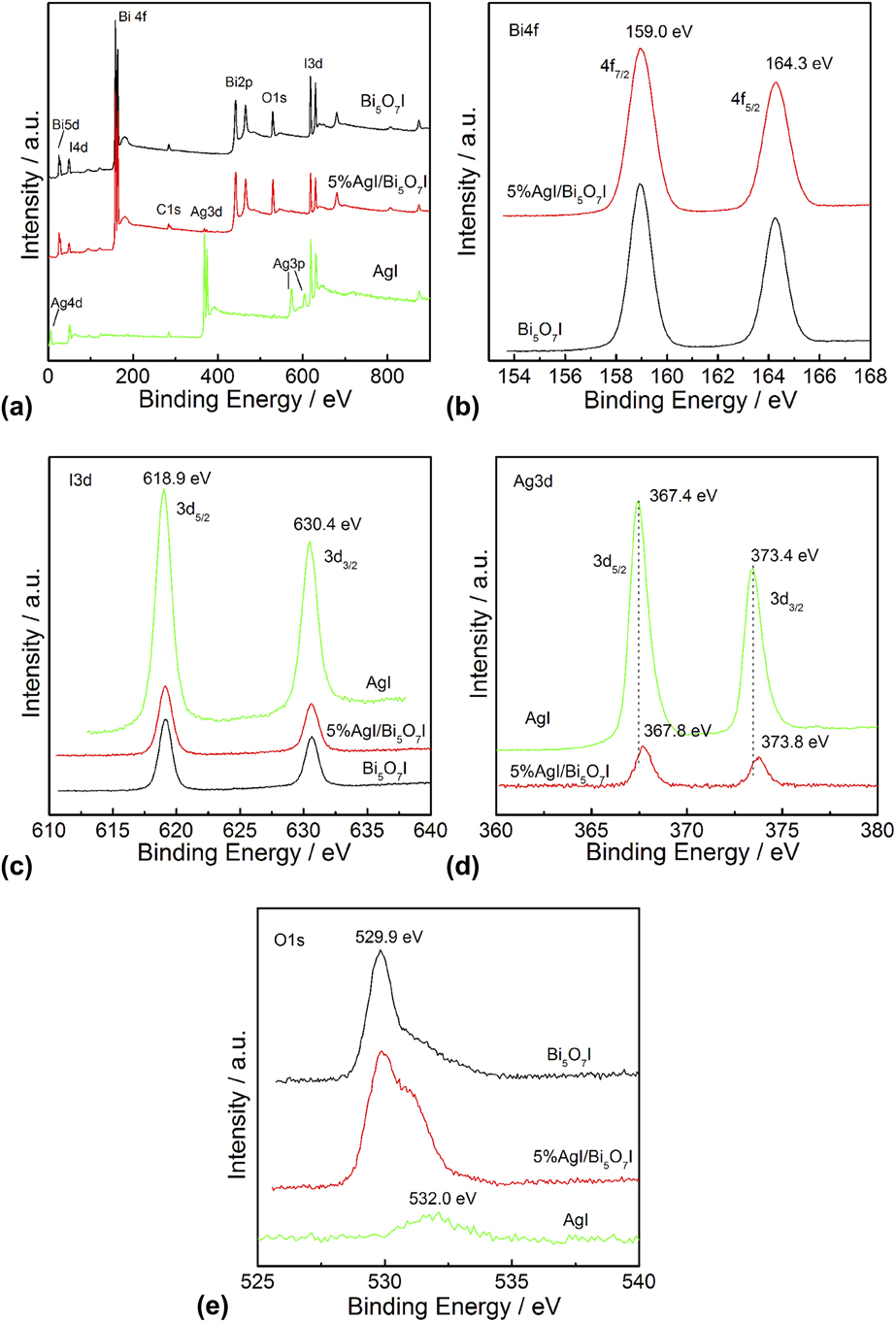
XPS was used to investigate the chemical composition and surface state of each atom of AgI/Bi5O7I. As shown in Fig. 5(a), the survey spectrum illustrates that the AgI/Bi5O7I composite consisted of C, Ag, Bi, O, and I elements, which is consistent with the chemical composition. Figure 5(b) shows the HR XPS spectra for Ag 3d of AgI and 5% AgI/Bi5O7I composites. For AgI, peaks can be observed at 367.4 and 373.4 eV that correspond to Ag 3d 5/2 and Ag 3d 3/2, as the essential characteristic of the Ag+ in the AgI material.Reference Liang, Terabe, Tsuruoka, Osada, Hasegawa and Aono34 By contrast, the Ag 3d peaks of the AgI/Bi5O7I sample are located at 367.8 and 373.8 eV, with a 0.4 eV shift toward higher binding energy (BE). In view of the fact that the instability of the AgI sample and the BE value of Ag 3d 5/2 of metallic Ag is located at 368.2 eV,Reference Xu, Huang, Ji, Jing, He, Xu, Zhang and Li35,Reference Potlog, Duca and Dobromir36 the phenomenon is probably caused by the deposition of Ag nanoparticles on the surface. Therefore, the AgI/Bi5O7I composite is actually the Ag–AgI–Bi5O7I ternary system. Figure 5(c) displays the HR XPS of Bi 4f. The peaks of Bi 4f 7/2 and Bi 4f 5/2 are located at 159.0 and 164.3 eV, respectively, which can be assigned to Bi3+ in the Bi5O7I sample.Reference Zhao, Wang, Yang, Fang, Zhang, Zhu, Tang and Huang26 Figure 5(d) shows the O 1s XPS spectra. For Bi5O7I, the main peak at 529.9 eV is attributed to the lattice oxygen.Reference Yan, Wu, Zhu, Hua and Shi37 The shoulder peak at about 532.0 eV is originated from the adsorbed –OH species on the catalyst’s surface.Reference Yu, Chen, Wang, Ma, Feng, Lin, Wu, Zhao and He38 No lattice oxygen exists in the AgI. Hence, only a weak signal appears at 532.0 eV on the O 1s spectra of AgI. The O 1s XPS spectra of AgI/Bi5O7I is similar to that of pure Bi5O7I except the increased absorbed OH species, which may be attributed to the effect of the added AgI. Figure 5(e) shows the HR XPS spectra for I 3d. It can be seen that all the samples present two peaks at 618.9 and 630.4 eV, which are attributable to I 3d 5/2 and I 3d 3/2, respectively, indicating the presence of I− in the materials.Reference Liang, Terabe, Tsuruoka, Osada, Hasegawa and Aono34
XPS spectra of AgI, Bi5O7I, and 5% AgI/Bi5O7I composites. (a) Survey spectra, (b) Ag 3d, (c) Bi 4f, (d) O 1s, and (e) I 3d.
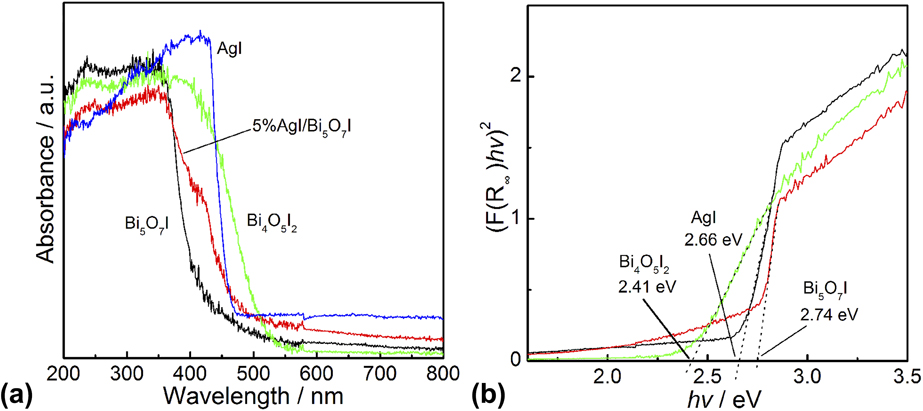
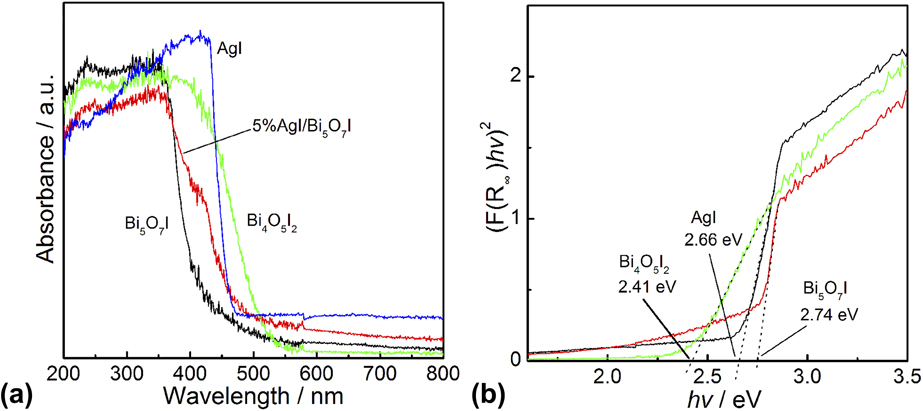
The optical absorption property of Bi4O5I2, AgI, Bi5O7I, and AgI/Bi5O7I compounds was detected by UV-Vis diffuse reflectance spectroscopy, as shown in Fig. 6. It shows that there are obvious absorption edges around 400, 450, and 500 nm for the pure Bi5O7I, AgI, and Bi4O5I2 samples, indicating that they all possess the ability in absorbing visible light. Based on the K–M equation,Reference Cheng, Huang, Dai, Qin and Zhang39 the band gaps of Bi4O5I2, AgI, and Bi5O7I are estimated to be 2.41, 2.66, and 2.74 eV, respectively [Fig. 6(b)]. The optical property of AgI/Bi5O7I lies between that of pure Bi5O7I and AgI, indicating that the decoration of AgI on Bi5O7I enhances the visible-light absorption property, which is beneficial to the photocatalytic reaction under visible-light illumination.
DRS spectra of Bi4O5I2, AgI, Bi5O7I, and AgI/Bi5O7I (a) and the estimated band gaps of Bi4O5I2, Bi5O7I, and AgI (b).
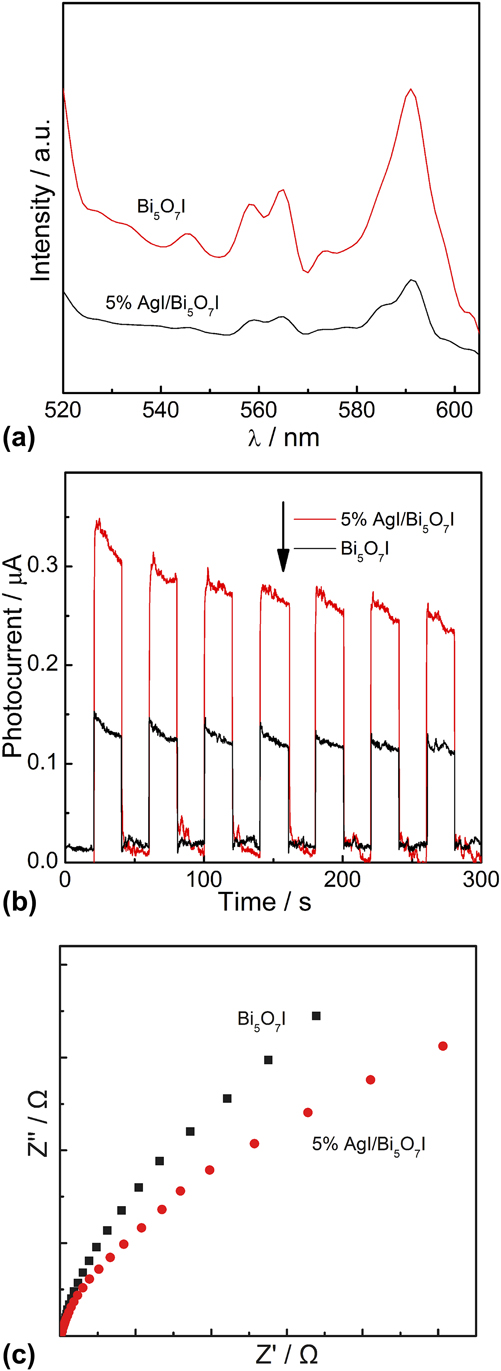
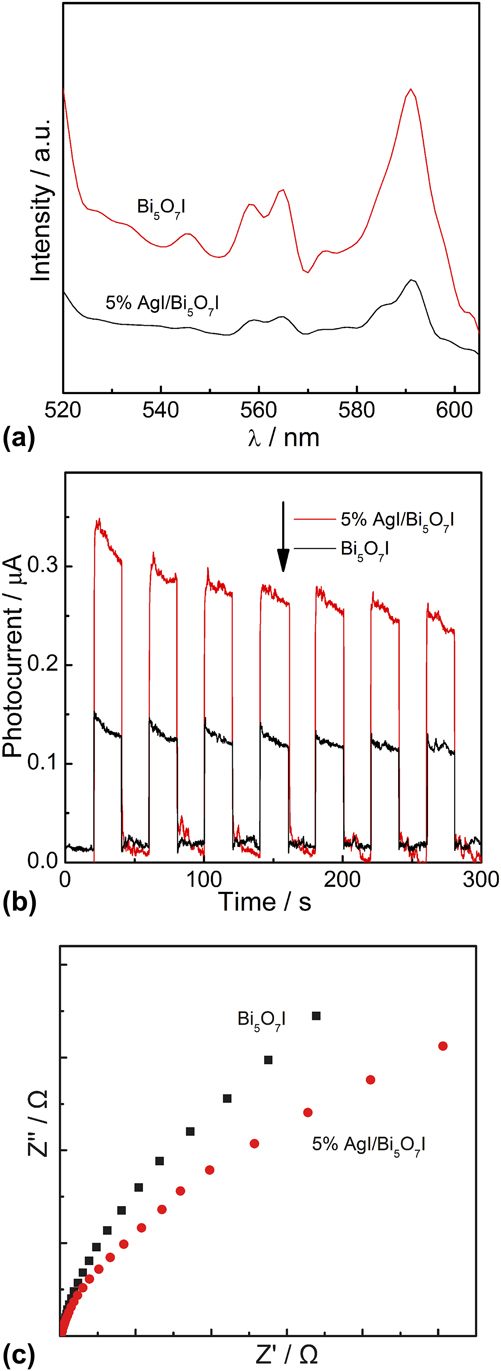
Separation and migration efficiency of photoinduced charge carriers are important targets to assess the photocatalytic performance of a semiconductor photocatalyst. To obtain this information, photoluminescence (PL) spectra, transient PC response, and EIS experiments were performed. Figure 7(a) shows the PL spectra of Bi5O7I and 5% AgI/Bi5O7I composites. Generally, the strong PL peak intensity means the high recombination efficiency of the electron–hole pairs.Reference He, Cai, Li, Wu, Lin, Zhao and Luo40,Reference Khoa, Kim, Thuan, Tien, Hur, Kim and Hahn41 As shown in the figure, the AgI/Bi5O7I composite displays a lower PL peak than the pure Bi5O7I sample, indicating that it holds better capability in charge separation, which will result in the enhanced photocatalytic activity under visible-light irradiation. Meanwhile, the intensity of the PC signal is also predominantly associated with the separation efficiency of photogenerated carriers. In contrast to the PL signal, the stronger PC response usually suggests the higher separation efficiency. As shown in Fig. 7(b), the AgI/Bi5O7I sample displays the stronger transient-PC response with a value of 0.3 μA, which is approximately 2.5 times higher than that of the pure Bi5O7I sample, verifying the enhancement of the charge transfer.Reference Vadivela, Nirmalesh Naveenb, Kamalakannana, Caoc and Balasubramaniana42,Reference Cui, Nong, Yu, Lin, Wu, Jiang, Liu and He43 Figure 7(c) shows the EIS spectra of Bi5O7I and AgI/Bi5O7I composites. It can be seen that the decoration of AgI decreases the arc size of Bi5O7I. In general, a small arc size represents better conductivity of the sample, which will subsequently lead to the improved separation efficiency of electron–hole pairs.Reference Jin, Fan, Tian, Cheng, Li and Zhang44,Reference Yu, Chen, Zeng, Ma, Feng, Wu, Lin, Zhao and He45 Hence, the data in Fig. 7(c) indicate that the AgI/Bi5O7I composite has better ability in retarding the recombination of charge carriers, which is consistent with the result of PL and PC.
PL spectra (a), transient PC responses (b), and EIS (c) of pure Bi5O7I and 5% AgI/Bi5O7I composites.
The BET surface area of the synthesized photocatalysts were obtained via N2 adsorption analysis. Bi4O5I2 presents the largest specific surface area of 13.6 m2/g, while AgI shows the lowest BET area of 1.1 m2/g. The BET value of Bi5O7I (12.5 m2/g) is slightly lower than that of Bi4O5I2. Since the two samples have similar morphology, the decreased surface area can be ascribed to the thermal treatment at 500 °C. The 5% AgI/Bi5O7I photocatalyst has a BET surface area of 7.1 m2/g, indicating that the loading of AgI further decrease the surface area. Anyway, except AgI, the specific surface area of these samples is in the same order of magnitude.
B. Photocatalytic performance of the AgI/Bi5O7I composite
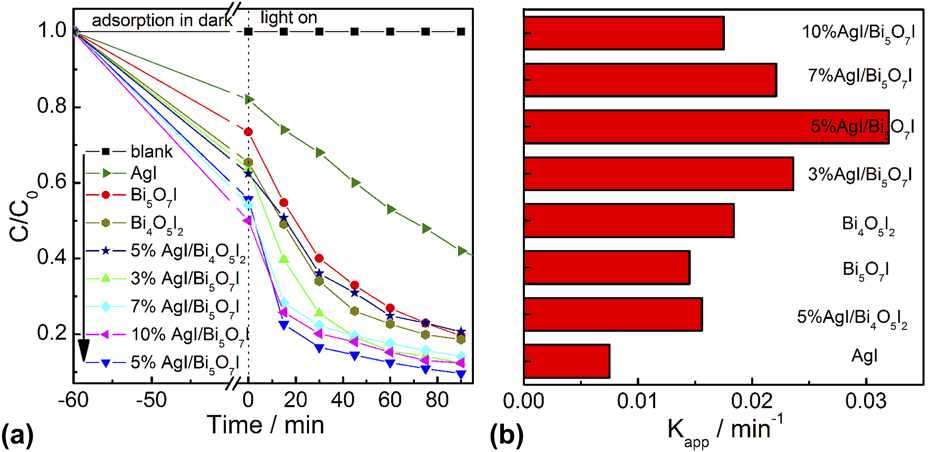
Figure 8 depicts the photocatalytic activities of the as-synthesized photocatalysts which are evaluated through degradation of RhB solution (10 ppm) under visible light irradiation (350 W Xe lamp, λ > 420 nm). The blank test indicates that pure RhB solution is stable during the whole photodegradation experiment. As mentioned before, the one-hour adsorption process is performed in the RhB solution before the photocatalytic reaction, and the adsorption process of RhB can be noticed in Fig. 8(a). From this figure, we can see that the RhB absorption on Bi4O5I2 and Bi5O7I is stronger than that of AgI, which may be attributed to their flower-like nanostructure and the higher surface area. The AgI/Bi5O7I composite displays better capability in RhB adsorption than pure Bi5O7I. Considering that the BET surface area of AgI/Bi5O7I is lower than that of pristine Bi5O7I, this phenomenon may be ascribed to that the added AgI nanoparticles promote the RhB adsorption, which has been observed in other AgI contained composite photocatalysts.Reference Cui, Yu, Lin, Wu, Zhao and He33,Reference Dong, He, Li, Cai, Hu, Wang, Lin, Luo, Yi, Zhao, Weng and Wan46 When the Xe lamp is on, the RhB dye concentration drops rapidly in the presence of photocatalysts. After 90 min irradiation, about 50% and 78% of RhB are degraded on AgI and Bi5O7I, respectively. For Bi4O5I2, the value is 82%. Clearly, Bi4O5I2 presents better activity than Bi5O7I, which is consistent with the reported literature.Reference Tu, Lu, Xiao, Zheng, Zhong, Zuo and Nan47 An interesting thing is that the loading of AgI on Bi4O5I2 does not improve the photocatalytic activity, which is different from that happened on Bi5O7I. A possible reason is the bad contact between the loaded AgI and Bi4O5I2 considering no further treatment (such as hydrothermal or calcination process) was performed. In other words, the AgI and Bi4O5I2 work individually during the photocatalytic reaction. For the AgI/Bi5O7I composite, the thermal treatment at 500 °C not only converts the Bi4O5I2 to Bi5O7I phase but also improves the phase contact between the consisting components. The close contact makes the AgI and Bi5O7I work as a complete system, which induces the enhanced separation efficiency of electron–hole pairs. Therefore, all the AgI/Bi5O7I composites show significantly improved activities than Bi5O7I. To further ascertain the RhB degrading rate, the changes of the concentration of RhB versus the irradiation time were fitted by the pseudo-first-order kinetic model, as expressed by ln(C 0/C) = kt, where C 0 and C are the initial and final dye concentration, respectively, and k is the pseudo-first order rate constant. As shown in Fig. 8(b), the rate constant of pure AgI is estimated to be 0.0075 min−1, while Bi5O7I is 0.0145 min−1. The k values of AgI/Bi5O7I with different contents of AgI (AgI = 3%, 5%, 7%, and 10%) are calculated to be 0.0236, 0.0320, 0.0221, and 0.0175 min−1, respectively. With the content of AgI increasing, the photocatalytic activity of the composites enhances gradually and then decreases. The 5% AgI/Bi5O7I sample presents the highest efficiency for RhB degradation with a k value of 0.0320 min−1 which is approximately 4.26 times and 2.20 times higher than that of pure AgI and Bi5O7I, respectively.
Photocatalytic activity of AgI, Bi5O7I, and AgI/Bi5O7I composites (a) and the estimated apparent rate constant (b).
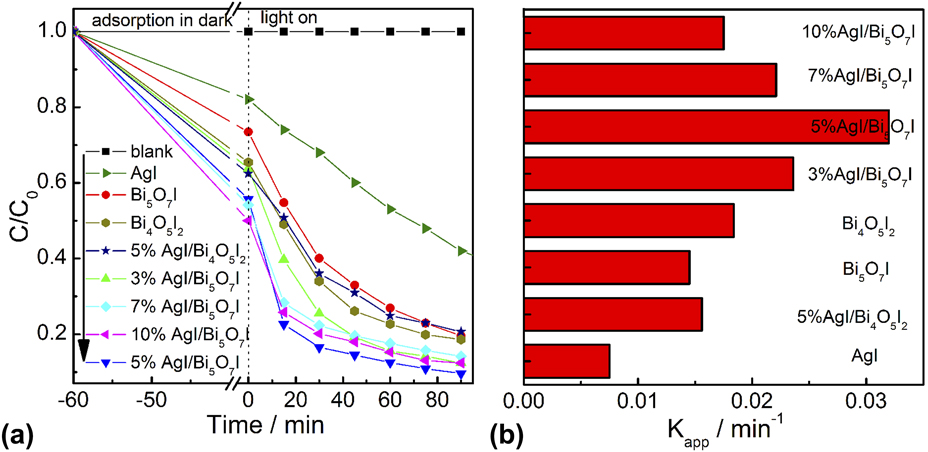
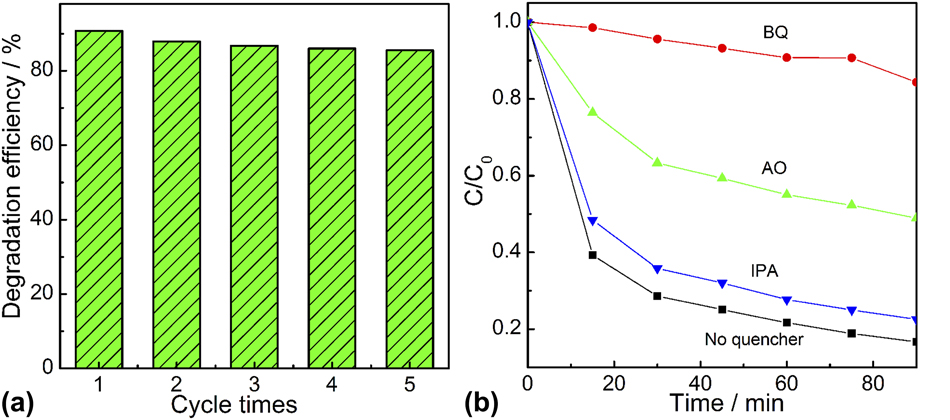
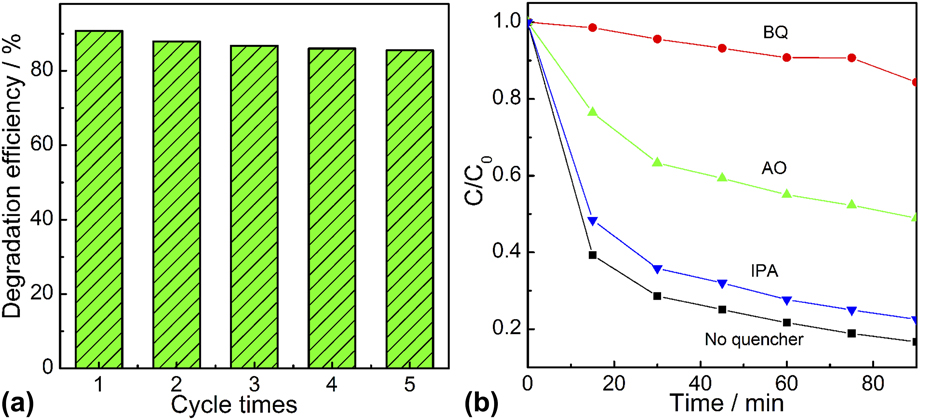
Figure 9(a) shows the cycling test of the optimal composite 5% AgI/Bi5O7I. After each cycling test, the photocatalyst was retrieved and reused. Although the catalyst loss during the recycling runs is inescapable, the AgI/Bi5O7I composite still preserves a similar RhB degradation rate during the five runs of experiments, indicating the good stability of the composite. The reactive species of the AgI/Bi5O7I composite during the photocatalytic reaction were investigated via the trapping experiment with benzoquinone (BQ, ˙O2− trapper), ammonium oxalate (AO, h+ trapper), and isoproponol (IPA, ˙OH trapper) as scavengers.Reference Li, Wong, Zhang, Hu, Yu, Chan and Wong48,Reference Zhao, Zhang, Lin, Nong, Cui, Wu and He49 The result is shown in Fig. 9(b). It can be seen that the addition of BQ or AO can significantly decrease the photocatalytic activity, while IPA shows a little effect on the photocatalytic process. This result indicates that h+ and ˙O2− are the main reactive species rather than ˙OH in the RhB photocatalytic process under visible-light irradiation.
Cycling test (a) and the reactive trapping experiment (b) of the 5% AgI/Bi5O7I composite.
C. Photodegradation mechanism
Generally, the reactant’s adsorption ability, the optical absorption property, the efficient separation, and transfer of photogenerated charge carriers are widely accepted as the primary factors that affect the photocatalytic activity of a semiconductor material. From this point of view, the improved photocatalytic activity of AgI/Bi5O7I composites can be supposed to be benefited from the well-crystallized flower-like structure. As can be seen in SEM pictures, AgI/Bi5O7I displays a three-dimensional hierarchical nanostructure composed of numerous nanoflakes. This morphology means that the composite would be good at adsorption of RhB, which has been confirmed by the adsorption experiments mentioned previous (see in Fig. 8). Furthermore, the special hierarchical structure also indicates that the composite can effectively absorb the incident light via the light refraction.Reference Sun, Li, Feng, He, Zhao, Wang, Li, Yin and Sato10,Reference Li, Yu and Jaroniec11 Both the two advantages are beneficial to the enhanced photocatalytic activity. It is noteworthy that the as-prepared Bi4O5I2 and Bi5O7I in this paper are also the flower-like morphology but display worse performances in the photocatalytic reaction than that of AgI/Bi5O7I. Hence, the special structure does not play a decisive role in the high photocatalytic activity of the AgI/Bi5O7I.
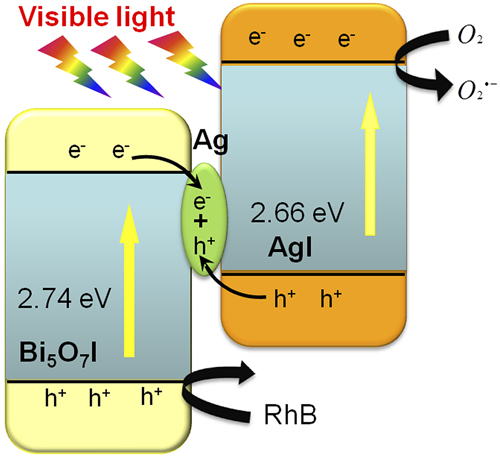
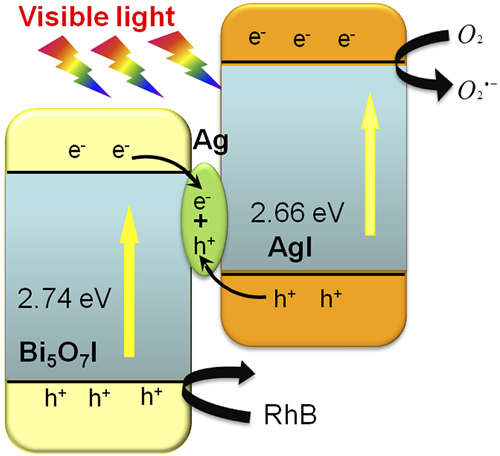
Just as supported by many reported literature studies,Reference He, Xie, Luo, Wen, Ma, Li, Fang and Zhang21–Reference Chen, Yang, Yao, Wang, Sun, An, Yi, Wang, Zhou, Wang, Li, Wang and Zeng30,Reference Fu, He, Wu, Wu and Wu50,Reference Yu, Chen, Chen, Wang, Lin, Hu, Zhao and He51 the enhanced separation efficiency of electron–hole pairs, which has been confirmed by the PL, PC, and EIS analyses, is mostly considered as the key factor for the high photocatalytic activity of the AgI/Bi5O7I. The charge separation is inextricably associated with the interaction between the two different semiconductors of a composite photocatalyst. The band structure of the semiconductors determines the way of the interaction. Hence, the valence band (VB) top and the conduction band (CB) bottom of Bi5O7I and AgI are calculated based on the reported equations (E VB = X − E c + 0.5E g and E CB = E VB − E g).Reference Fu, He, Wu, Wu and Wu50,Reference Wang, He, Li, Cai, Luo and Zhao52 The calculation result indicates that the VB and CB potentials of AgI are −0.37 eV and 2.31 eV, while those of Bi5O7I are estimated to be 0.36 eV and 3.10 eV, respectively. Clearly, the two semiconductors can fabricate a heterojunction structure and subsequently improve the charge separation. However, it should be noted that the photogenerated electron on the CB of Bi5O7I cannot reduce oxygen to ˙O2− species  $\left( {{E_{{{{{\rm{O}}_2}} / {{}^{\rm{ \bullet }}{{\rm{O}}_2}^ - }}}} = - 0.046\;{\rm{V}}} \right)$Reference Wang, Kako and Ye53 due to the low CB of Bi5O7I (E CB = 0.36 V). Considering that ˙O2− is the main reactive species in the AgI/Bi5O7I system, it can be deduced that the photogenerated electron would not accumulate on the Bi5O7I. Namely, the AgI/Bi5O7I composite would not follow the type-II mechanism. The Z-scheme mechanism is more reasonable for the composite. Just like many Ag compound contained composite photocatalysts, the Ag nanoparticles formed from the decomposition of the Ag complex usually act as the recombination center of electron and holes.Reference Chen, Yang, Yao, Wang, Sun, An, Yi, Wang, Zhou, Wang, Li, Wang and Zeng30 Under visible-light irradiation, the photoexcited electrons in the CB of Bi5O7I and the holes in the VB of AgI would migrate to the Ag nanoparticles and recombined, leaving the electrons and holes accumulated on the CB of AgI and the VB of Bi5O7I, respectively (Fig. 10). By this way, the electron–hole pairs in the AgI/Bi5O7I system are effectively separated, which subsequently enhance the high photocatalytic activity.
Suggested mechanism of the AgI/Bi5O7I photocatalyst.
IV. CONCLUSIONS
A flower-like AgI/Bi5O7I composite was prepared via a hydrothermal method combined with a postcalcination process. The obtained AgI/Bi5O7I shows high photoactivity in RhB degradation under visible-light irradiation, which can be ascribed to the enhanced charge separation efficiency via a Z-scheme mechanism. It should be noted that the flower-like AgI/Bi5O7I does not show better photoactivity than the previous rod-like AgI/Bi5O7I.Reference Yang, Xu, Liu and Xie25 Many reasons may cause the flower-like catalyst not to achieve the desired activity, such as the Bi5O7I sheet is not thin enough, the contact between Bi5O7I and AgI may be not good, and the hierarchical structure is not perfect. These shortcomings are what we need to overcome in the future. Anyway, the flower-like structure composite brings more possibility in photocatalysis and may provide some new insights for the design and preparation of novel and highly efficient photocatalysts.
ACKNOWLEDGMENTS
This work was financially supported by the Natural Science Foundation of Zhejiang Province in China (LY14B030002 and LY16B030002).