Migrant networks are usually thought of as being supportive and beneficial for their members and the households involved. Remittances in cash and kind supply additional income, enhance food security and offer access to viable resources. In short, migration and migrant networks reduce the risk of deprivation in the face of internal and external stressors and shocks. A growing body of literature recognizes the critical role of rural–urban networks and migration for poverty alleviation and food security (Lynch Reference Lynch2005; Satterthwaite and Tacoli Reference Satterthwaite, Tacoli, Rakodi and Lloyd-Jones2002; Schmidt-Kallert Reference Schmidt-Kallert2009). This fits neatly into the ‘new enthusiasm’ for migration, in which migrants and their networks are increasingly conceived of as agents of development of their home communities (Faist Reference Faist2008: 21). In this contribution I demonstrate that migrant networks are not solely supportive, but that they can also further socio-economic stratification and exclusionary practices. Based on ethnographic data from Namibia, I highlight the role of migration and rural–urban networks in reinforcing processes of socio-economic stratification. In doing so, I have focused on the impact these developments have had on the rural areas where modern urban forms of stratification, induced by education and income from wage labour, are on the increase; where township-style brick houses stand beside traditional clay hamlets, elaborate residences of rich migrants beside the wooden shacks of their workers.
While studies on migration have largely focused on the hybridization of identities (see for example Bank Reference Bank2001) and the role in enhancing livelihoods, the stratifying dynamics of migration processes have tended to be under-represented in the scholarly literature. In this literature, migration has been conceived of largely as permanent relocation in the attempt to overcome disparities in wealth existing between different regions, motivated by pull factors or individual cost–benefit calculations (for example, Harris and Todaro Reference Harris and Todaro1970; Lee Reference Lee1966). With regard to sub-Saharan Africa, this picture began to change in the 1980s, at least since Jamal and Weeks (Reference Jamal and Weeks1988) observed a ‘vanishing gap’ between rural and urban incomes. The earlier post-colonial pattern of development, based on a ‘fundamental division in privilege and wealth’ between rural and urban areas, was beginning to dissolve (ibid.: 271). Falling real wages, economic crisis, structural adjustment programmes and growing instability of urban labour markets throughout recent decades had caused a dramatic deterioration of urban conditions (Potts Reference Potts and Rakodi1997). These developments, however, did not lead to a more balanced overall income distribution. In contrast, income distribution shifted toward an increasing stratification between rich and poor within both urban and rural areas (Jamal and Weeks Reference Jamal and Weeks1988: 275). Yet, despite deteriorating urban conditions, the trend toward migration from countryside to town actually appeared to be on the increase (ibid.: 274). This observation stood in stark contrast to projections of major migration theories such as the Harris-Todaro Model (Reference Harris and Todaro1970).
More recent approaches have attempted to explain the paradox of persisting migration in the face of deteriorating urban incomes. Literature on livelihood diversification conceives of migration as a central strategy to diversify the sources of household income and access resources that are not locally available (Satterthwaite and Tacoli Reference Satterthwaite, Tacoli, Rakodi and Lloyd-Jones2002; Schmidt-Kallert Reference Schmidt-Kallert2009; Scoones Reference Scoones1998). The increasing importance of livelihood diversification in Africa's rural areas, via off-farm employment and migration, has been tellingly described as ‘depeasantization’ (Bryceson Reference Bryceson2002). While many scholars of livelihood diversification agree that these processes go along with increasing socio-economic stratification (de Haan Reference de Haan1999; Peters Reference Peters2004), the way in which the process of migration, as a key factor of diversification, actually contributes to this growing stratification has rarely been scrutinized in detail.
The most influential theoretical approach, known as the New Economics of Migration (Stark Reference Stark1991), conceives of migration as a household-based decision to diversify the means of income, and in doing so to spread risks. Cash income from urban-based family members thus doesn't need to be higher than income from agriculture to make migration worthwhile – the real incentive for the decision to migrate is that of adding an extra, new source of income to the household. The New Economics of Migration takes a rather optimistic stance regarding the economic effects of migration (Portes Reference Portes2007: 76). Migrant networks are seen as a bottom-up strategy to overcome market imperfections, such as the constraints inherent within, or even the complete lack of, insurance and credit markets. With regard to socio-economic stratification, the New Economics of Migration offers the concept of relative deprivation. This perspective suggests that wealth differences within communities, induced by migration, motivate poorer households to send more able members abroad and thus further migration dynamics. This, however, does not account for a growing stratification among households that rely on the same migration-cum-diversification strategy. Attempting to explain how such stratification occurs is precisely the purpose of this article. While some studies argue that the characteristic of the very poorest is that they are without migration contacts (see, for example, Gelderblom Reference Gelderblom2007; Reichert Reference Reichert1982; for a discussion see Jones Reference Jones1998), empirical evidence from Namibia suggests that both rich and poor families are involved in migration practices, albeit with different implications.
The remainder of this article will focus on the nexus between rural–urban migration and socio-economic stratification in north-western Namibia. After providing a short historical overview on socio-economic stratification in Namibia's African population and the research area, I briefly outline the concept of translocality that provides the framework for structuring my ethnographic data. The article closes with a discussion of the findings and an assessment of the usefulness of a translocal perspective for a general debate on migration and stratification in Africa.
THE NAMIBIAN CONTEXT
The population structure of rural north-western Namibia is thoroughly shaped by rural–urban migration, which could be classified most appropriately as circular (Adepọju Reference Adepọju, Kok, Gelderblom, Oucho and van Zyl2006: 28; Potts Reference Potts2000: 812).Footnote 1 In line with the theoretical approaches outlined above, these processes can be interpreted as part of the diversification strategy of the households involved. However, while ‘depeasantization’ in sub-Saharan Africa has been accelerated by structural adjustment and market liberalization in the last two decades (Bryceson Reference Bryceson2002), for Namibia's rural population this is by no means a recent process. The political economy of colonialism and apartheid forced rural populations to begin seeking employment outside their reserves and homelands as far back as the 1920s. These historical trajectories not only shape current patterns of migration (Melber Reference Melber, Bächler and Spillmann1996; Werner Reference Werner, Diener and Graefe2001; Winterfeldt Reference Winterfeldt, Winterfeldt, Fox and Mufune2002), but also bear on processes of socio-economic stratification within the African population (Melber Reference Melber and Melber2007; Werner Reference Werner, Tötemeyer, Kandetu and Werner1987).Footnote 2 Scholarly concern with these processes is rather new (Pankhurst Reference Pankhurst1996). This hardly comes as a surprise given the blatant racial inequalities in the country's history.
Prior to independence, class difference in Namibia was largely perceived as being directly related to skin colour. Paralleling South African dynamics, apartheid's ideological principles gave way to a ‘denial of class differences among Africans’ and led to a ‘monolithic notion of the oppressed’ (Marais Reference Marais1999: 216). However, the emergence of class stratification within African society probably has a longer and much more complex aetiology than has hitherto been documented, as this subject is still fairly under-researched.Footnote 3 This process accelerated in the 1970s, when the South African regime, in order to consolidate white supremacy in times of civil unrest and civil war, promoted the formation of a small African middle class by sharply increasing the wages in some professional groups such as nurses, teachers and miners (Moorsom Reference Moorsom, Mbumba, Pateman and Katjivena1988; Peltola Reference Peltola1995: 270ff.). The emerging ‘modernizing elite’ (Abrahams Reference Abrahams1982) comprised about 10 per cent of the African population by the end of the 1970s (ibid.).Footnote 4 Attempts to ‘win hearts and minds’ for a ‘neo-colonially independent Namibia’ (Simon Reference Simon1985: 506) also entailed a move away from the apartheid model. Influx control was suspended, as were many other regulations that previously restricted the migration and urbanization of the African population. These liberalizations, heralded in with the Turnhallenkonferenz (Turnhalle Conference) in 1975, also paved the way to better education facilities for Africans by opening some private and religious colleges to all races (Cohen Reference Cohen1994). It was above all the emerging ‘modernizing elite’ that could take advantage of these opportunities (Tapscott Reference Tapscott1993).
Since independence in 1990, the dynamics of social stratification are becoming more intense, and transcend previous racial boundaries (Tapscott Reference Tapscott1993: 30). Ethnographers have only recently begun to focus on these processes, providing insights into their dynamics. Some authors have addressed processes of impoverishment directly: for example, Kuper (Reference Kuper1995) on unemployment after the closing of a local tin mine; Iken (Reference Iken1999) on female-headed households; and Tvedten (Reference Tvedten2004) on urbanization and marginalization. Dobler (Reference Dobler2009: 116) shows how the recent transformation of Oshikango from a small village at the Angolan border into a ‘vibrant boom town’ provides an emerging bureaucratic elite with new business opportunities. Schnegg (Reference Schnegg, Greiner and Kokot2009: 245), investigating the income strategies of rural households in the Fransfontein region, concludes that ‘those who do not diversify beyond pastoralism are often the least successful’. Fumanti (Reference Fumanti2007), writing on elite formation in Rundu, Kavango, highlights the role of education in forging the career paths of the emerging elites in the 1970s. Pauli (Reference Pauli2010) focuses on marriage as a means of both distinction and reproduction of the local elite in the Fransfontein area, the same area where the ethnographic data for this contribution are based. There is a growing body of literature on migration and urbanization in Namibia (see for example Frayne Reference Frayne2007; Frayne and Pendleton Reference Frayne and Pendleton2001; Peyroux et al. Reference Peyroux, Graefe and Renaud1995; Tvedten and Mupotola Reference Tvedten and Mupotola1995). I have written about the culture of migration in Namibia (Greiner Reference Greiner2010), its general impact on livelihoods (Greiner Reference Greiner2008) and how it transgresses the rural–urban divide (Greiner Reference Greiner2009a). However, an attempt to link explicitly the ubiquitous phenomena of migration and the processes of stratification is still missing.
THE RESEARCH AREA
The Fransfontein communal area is located in north-western Namibia, nowadays known as Kunene Region. The area was designated as a native reserve in 1922. By the end of the 1960s it was integrated into ‘Damaraland’, a homeland established by the South African government while implementing apartheid policies in its erstwhile colony. Since independence, the area has been part of Kunene Region. My research focused on ten micro-settlements surrounding the village of Fransfontein, some of which are former cattle posts turned into permanent settlements. These settlements, which henceforth will be referred to as farms, rarely comprise more than fifteen homesteads grouped around a communal water point. The farms are inhabited by a multi-ethnic population shaped by multifaceted processes of out- and return-migration. Herero-, Ovambo- and Damara-speaking families dominate the local population on the farms, but there are also many families of other ethnic origins. Prevailing inter-ethnic marriages, cross-cutting family ties, and a widely acknowledged sharing of traditions have blurred distinctions between different ethnic groups. As a consequence of the region's prevailing arid climate, agro-ecological conditions are severely limited. Households usually rely on subsistence livestock husbandry of cattle, goat and sheep. Cash income, however, is highly diversified, with transfer incomes from remittances and social pensionsFootnote 5 playing a significant role within most budgets (Greiner Reference Greiner, Greiner and Kokot2009b; Schnegg Reference Schnegg, Greiner and Kokot2009).
MIGRATION, NETWORKS AND STRATIFICATION – A TRANSLOCAL FRAMEWORK
Like many other regions in Southern Africa, the Fransfontein region is characterized by an ongoing circulation of people and goods between rural and urban areas. This allows the households involved to combine different sources of income and to exploit distinct local opportunities, albeit with varying degrees of success. In attempting to gain a deeper understanding of these processes, it is of crucial importance to look at these dynamics from a perspective that embraces the emerging social spaces that connect the different localities. In referring to these dynamics I have used the term ‘translocality’. Borrowing from the insights of studies on transnationalism (Basch et al. Reference Basch, Schiller and Blanc1995), I define translocality as the emergence of multidirectional and overlapping networks created by migration that facilitate the circulation of resources, practices and ideas and thereby transform the particular localities they connect (Greiner Reference Greiner2010). Translocality thus refers to the dynamics, linkages and interdependencies of the multidimensional social space connecting migrants’ areas of origin and destination.
For analytical purposes, translocality can be split into three distinct fields. The first of these fields is concerned with the multi-local embedding of actors, households, communities or regions, by which I refer to what Guarnizo and Smith (Reference Guarnizo, Smith, Smith and Guarnizo1998: 13) have described as a ‘triadic connection’ that links migrants to their home and their host communities, albeit with the qualification that most rural households in the research area are connected to several towns and cities. The second field includes the various concrete linkages and networks connecting these units throughout the various localities, and the third is involved with investigating the interdependencies and local impacts.
These three fields can only be understood properly with reference to each other. As Steinbrink (Reference Steinbrink2009) points out, translocality is both structured by the actions of the people involved and at the same time provides a structure for these very actions. Through various feedback loops, the processes of socio-economic stratification are intimately connected to the translocal embedding of the actors: decisions, needs or remittances by migrants in urban areas have an impact on rural areas. Through network channels, these impacts feed back into the urban areas, bettering or worsening the translocal opportunities of the people involved. These interdependent dynamics necessarily remain poorly understood as long as migrant networks are presumed to be purely supportive in character.
The outline of my ethnographic data loosely follows the framework sketched above. Following the description of the research region's translocal structure, I first introduce two case studies. This portrayal is limited to that of a rich and a poor family network. In the next section the focus shifts to the network dynamics inherent in these translocal patterns. This in turn is followed by an account of the impact these translocal network dynamics have on very localized conditions. This third part also briefly highlights some social mechanisms that keep these networks separate and distinct.
PATTERNS OF TRANSLOCALITY IN THE FRANSFONTEIN AREA
Shaped by different processes of migration, the population originating from the research area is dispersed into various localities. Most able-bodied adults live in towns and cities, whereas the rural population predominantly consists of pre-school children and old-age pensioners. The prevalence of the very young in rural communities is due to the widespread practice of child fostering. Urban-based parents often send their children to grow up with their grandparents on the farm. This practice is common in many parts of central and southern Namibia (Gordon Reference Gordon1972: 42; Iken Reference Iken1999: 110). Children generally leave the farm by the age of six to attend school, as schools are too distant for daily commuting. Some eventually return after their school years to guard the homesteads of absent relatives, spend periods of unemployment in the rural households, or try to eke out a living through livestock husbandry. Most, however, stay in urban areas and only return to their farms after retirement from their jobs in the cities.
The significance of return migration is reflected in the number of old-aged residents on the farms: about 21 per cent of the population are aged sixty years and older; a figure almost three times the national average. There are clear-cut historical trajectories that shape these patterns. The political economy of apartheid largely rested on its exploitation of a cheaply reproducing African labour force in the homelands complemented by a legal framework inhibiting their permanent settlement in urban areas (Wolpe Reference Wolpe1972). In addition to this, several other factors contribute to shaping the persistence of this trend: for one, many returnees express their wish to return to the place where their ancestors are buried. The significantly cheaper living costs in the rural areas are also an important attractor. By the age of sixty, all Namibian citizens are entitled to a contribution-free old-age pension, which provides them with sufficient means to make a modest living in the countryside. Finally, most former urban dwellers claim to prefer the safety and calmness of the rural areas in their old age.
During their time as town dwellers, most migrants maintain very strong relations with their farms. This strong commitment to the rural area is not restricted to rural out-migrants. Many urban-born family members also foster strong ties with their parents in the rural areas (see Frayne Reference Frayne2005 for a similar observation in northern Namibia). This translocal organization of households and the emerging exchange relations are shaped by patterns of giving and receiving: many migrants based in urban areas send remittances to sustain their rural family. Survey data indicate that about one third of all urban-based children and grandchildren of rural household heads support the farm in cash or kind. Often only small amounts of money are transferred, but some wealthier migrants also send larger sums on a regular basis. In-kind remittances usually comprise groceries, household goods and items related to animal husbandry. These products are significantly cheaper and easier to access in urban areas.Footnote 6 The rural homes in return provide their urban-based kin with meat, which is expensive in urban areas, with dairy products, and in some cases also with money generated from livestock sales. They also provide important services such as child fostering, caring for sick family members and looking after livestock and other property owned by town dwellers.
These very general patterns indicate that translocality matters to livelihood systems not only in the rural, but also in the urban areas. It enables the households involved to exploit locally specific opportunities, such as cheap living costs in the countryside and easier access to wage labour in urban areas. This is achieved through the use of extensive networks that facilitate the circulation of people and resources between rural and urban households. Indeed, survey data show that transfers in both directions balanced out on a general scale in 2005/6. This was probably due to a series of rainy seasons with above-average precipitation. I assume that the overall balance shifts to one or the other side when the climatic, economic or other relevant conditions or factors change. However, as soon as we leave the aggregate level and look at individual family networks, this balancing pattern differentiates. The following vignettes are apt cases (Gluckman Reference Gluckman1961: 7) meant to illustrate these diverging dynamics with typical examples.Footnote 7
‘STRUGGLING’ TO SURVIVE OR ACCUMULATING – A BRIEF PORTRAIT OF TWO FAMILIES
Last month Margarita HambiraFootnote 8 (fifty years old) did not go to the farm to visit her relatives. She usually goes there once a month to visit her mother and her youngest son, who is staying there since he dropped out of school. Sometimes, however, there is simply no money left to buy any sugar or maize meal to take along. At such times she does not want to go there empty-handed. She knows that they expect her to bring something, and that they depend on her support. ‘Dis nie lekker nie’ (It's not nice), she tells me in our interview, ‘we struggle, there are problems … as a working person; if you earn money then you have to give away a lot … then the others wait for you. This is how we struggle.’ Together with three of her children, Margarita lives in Donkerhoek, the shanty town of Khorixas. She is working as a cleaner in a nearby tourist lodge; two of the children are still at school, and one is unemployed. Her eldest son is working in a fish factory in Walvis Bay, while one daughter lives in Windhoek, unemployed.
The rural household Margarita refers to is located on a small, remote cattle post on the Fransfontein commons, about 45 km from Khorixas by road. Margarita's mother's household looks much like many others in the area. It consists of some small houses built traditionally with local materials, a structure of Mopani wood covered with a mixture of cowdung and sand. The roofing is of corrugated iron sheets. Within earshot are the kraals where the household's livestock is kept at night. There is no telephone, no electricity, and donkey carts are the only available means of transportation. Drinking water has to be carried from the communal water point on one of the neighbouring farms, as the local water is brackish and unfit for human consumption. Six persons cohabit in the household: Margarita's mother Emma Hambira (aged 80), her eldest daughter Louise (57, Margarita's sister), two of Louise's children (34 and 21), a granddaughter (5) and Margarita's youngest son (15). The only stable cash income is Emma's old-age pension. Apart from this, they live off the milk, fat and occasional meat from a few goats and some thirty cattle, most of which belong to absent relatives. Remittances are a sparse but important contribution to their budget. They usually consist of groceries: maize meal, sugar and tea brought along by those few relatives who have found employment somewhere. Sometimes, the rural household also gives some sour milk, fat or meat to their urban kin. Margarita, however, when she gets supplies from the farm, has to share them with her unemployed brother who is living in Khorixas.
Unlike Emma Hambira, who stayed all her life on the Fransfontein commons, Johannes Nel (65) returned to his parental farm only five years ago upon retirement from his job as a driver. He grew up there but out-migrated as a young man to find work in Otjiwarongo, where he spent most of his life. His children grew up there. Most of them, however, moved on to Windhoek for job reasons. Johannes Nel's household is located on a larger and better-off farm close to the gravel road that connects Fransfontein with Khorixas. It consists of a big brick house with cemented floor and a spacious, roofed veranda. The house is connected to the telephone landline, and a tap in the garden supplies potable water, which is also used to feed small garden plots. In the back yard two wooden structures accommodate the workers, who care for the growing livestock and occasionally help out with household chores. The family owns a bakkie, a 4×4 pick-up truck, which is used to visit relatives and regularly to go to Khorixas or Outjo to stock up on supplies. Johannes Nel is living on the farm together with his wife (60), one of his four daughters (28) and both of her young children (6 and 4). She is the only child not married yet, and intends to stay on the farm until her children are old enough to go to school. Both Johannes and his wife draw an old-age pension. In addition to this their children send remittances in cash and kind, usually on their visits back to the farm. The youngest daughter, Christine (26), who works as an accountant for a big Windhoek-based company and is married to a professional operator in a mine, currently contributes the largest share. The couple can afford to send substantial amounts of money on a regular basis to both parental homesteads. The money they send is mainly used to pay the workers and to buy veterinary medicines and groceries. If relatives come to visit, Johannes Nel usually slaughters a goat or two for them to take back as carcasses to the urban areas, where meat is expensive, and if there is ever any need for larger amounts of cash, he can easily sell some of his cattle.
NETWORK DYNAMICS IN POOR AND RICH HOUSEHOLDS
These small vignettes demonstrate how the ostensible safety mechanisms of migrant networks become distorted. While almost all families in the research area are involved in translocal relationships, the outcomes and implications of individual cases diverge substantially. Rich families, such as that of Johannes Nel, can make constant use of translocal opportunities and accumulate capital, in both rural and urban contexts. There are also wealthy farmers who do not ask their children for remittances. This disburdens their urban offspring, as money that is not remitted can be invested, for example in better schooling. Additional income by remittances, however, can be invested in valuable rural assets, such as housing, shops and livestock. For these families, translocality provides a path to socio-economic upward mobility. Poor families, on the other hand, are often caught up in survivalist networks, where small incomes are immediately redistributed to satisfy the most basic needs. Here, translocal relations entail a socio-economic downward spiral. Unless they take the risk of being left alone (if they were to become unemployed) and cut their ties to their needy relatives, the few wage earners within these networks are unable to save or invest their earnings. This is not to deny that there are individuals who try to overcome the limitations of their social networks. Margarita Hambira is a case in point: her deliberate avoidance of the farm in the attempt to escape the expectations of her relatives suggests that she is such an individual. Another telling example is that of her eldest son, Jonas. Jonas lives in Walvis Bay where he found employment as a cleaner in a fish factory. He cut the support to his mother, claiming that his modest income does not allow this, but keeps investing in livestock on the grandparental farm, albeit on a small scale. In what follows, I describe the emergence and economic reproduction of rich-family migrant networks, and then turn to the use of translocal networks by poorer families.
The emergence of some of the rich families in the Fransfontein region can be traced way back to the 1930s and earlier (Miescher Reference Miescher2006). These more affluent families were in possession of many head of livestock, and some already had well-established rural–urban networks with family members working in urban jobs as native police officers and railway workers in Windhoek and Swakopmund.Footnote 9 Yet it was the erosion of apartheid laws in the 1970s that provided them with an essential boost. While overall economic conditions declined sharply for the majority of the African population at that time, wages in selected occupational groups, such as mining and public services, were adjusted to the level of the white workforce. This provided families with members in these high-paying jobs with the financial means to take advantage of the new opportunities that opened up when the interim governments started to repeal influx control, residential settlement and other discriminatory legislation in 1977 (Tapscott Reference Tapscott1993: 30).
Probably the most important consequence of this increased wealth was that those families were able to provide resources for better schooling for their children. Fuller (Reference Fuller1993), in one of the rare pre-independence ethnographies of ‘Damaraland’, describes this as a crossroads: ‘While opportunity lies outside the Reserve’, he notes (1993: 291), ‘simply leaving is not enough to guarantee success. Junior members who leave must do so with the skills necessary to successfully participate in the market economy’. These skills he identifies as being available through education, but good education is costly and many of the poorer families are not able to provide the means necessary to keep their offspring in school, and so enable them to succeed in the cities and towns (ibid.: 312). For those who were better off, however, education paved the way into the emerging de-racialized job market, to higher incomes and the opportunity to reinvest more money into family matters. Survey results among migrants in Windhoek and Walvis Bay clearly support this: migrants with better education have higher incomes and send more remittances (Greiner Reference Greiner2008: 231ff.).
Rising incomes enable those who earn them to invest in livestock. Remittances provide the essential means to reduce the off-take of animals for consumption. They also reduce the need for emergency sales below market value in case of urgent need of cash, as widely practised among poorer families. As a consequence, livestock ownership by rich families has grown steadily within the last decades, notwithstanding recurrent droughts. With most children in school and university education, and able-bodied family members in well-paid positions, since about the 1980s many rich families have begun to employ immigrant herders as a substitute labour force to care for the growing herds. In this way, animal husbandry is successively transformed from a subsistence strategy into a market-oriented activity. Revenues from livestock sales are again redistributed within these networks and most often invested in quality schooling, available only in urban areas and at high cost. Indeed, many children of richer families now enjoy university education. Paralleling these developments, migrants improve their rural living conditions by building stone houses equipped with urban amenities. Supplementary remittances enable the rural elders to care for foster children or sick family members without eating up their pensions. Some of the rich rural households even provide cash generated by livestock sales to cover the expenses of urban relatives. In short, translocality for these family networks provides abundant opportunities to redistribute surpluses between rural and urban areas. Indeed, observations from my multi-sited fieldwork suggest that families that are comparatively rich in urban areas are rich in the countryside too. The same can be observed for poor families, with little chance of upward mobility in either rural or urban areas. This is in line with what Jamal and Weeks (1988: 275) say about increasing income differences – not between rural and urban, but between rich and poor.
For poorer families, translocality is often a sheer struggle for survival. Sustaining rural and urban family members can be burdensome, and may even be erosive. High living costs in urban areas force many migrants with low-paid jobs to send their children to be fostered in rural areas. Some, however, cannot sustain them with remittances on a regular basis and the rural household is forced to eat up old-age pensions and even their livestock. Cash remittances are used to cover basic needs and are consumed immediately. There is hardly ever any money left to invest in livestock or home improvement, let alone better schooling.
Again, the cases of Johannes Nel and Emma Hambira can serve to illustrate these dynamics. While Emma's eldest son stayed back home on the farm to look after the animals, her first daughter, Louise Hambira, left the reserve for Windhoek in the late 1950s where she eventually started working as a maidservant for a white family. After almost four decades living in the capital on the low returns from her work, she recently returned to the farm to stay with her mother. Johannes Nel, some years older than Louise, left the Fransfontein area in the mid-1960s for Otjiwarongo, where he found work as a driver. It was not so much in this initial out-migration that the economic pathways of the families began to diverge; it rather started in the late 1970s, by which time Johannes Nel's two eldest children, born in the late 1950s, had jobs as teachers. Their augmented incomes were partly invested in the private schooling of their younger siblings, all of whom left school with a matriculation, the highest possible degree. They are now working in well-paid jobs in parastatal and private companies in Windhoek and Otjiwarongo. Compare this with the case of Emma Hambira, three of whose six surviving children live on the farm, to which most have returned after failing to get employment in urban areas. Two children live in nearby Khorixas, and only one daughter is living in Windhoek, where she works as a gardener. Of Louise's children, most are unemployed and, except for an elder son working as a teacher in rural Kaokoland, none has a higher schooling diploma.
LOCAL IMPACT: REMITTANCES, PART-TIME FARMERS AND AN EMERGING RURAL PROLETARIAT
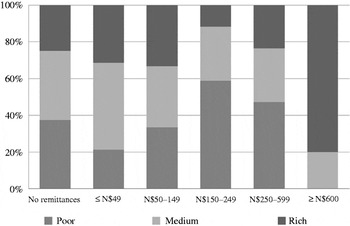
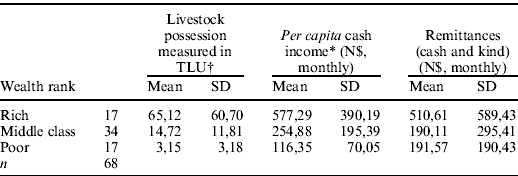
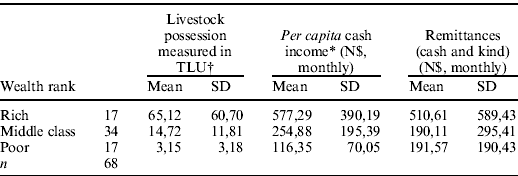
Housing is a ‘central focus for the spending of remittances’ (Pauli Reference Pauli2008: 173). The housing stock of a region may thus be a guide to its internal stratification. In the Fransfontein area, various stages of construction and decay clearly support this: the settlement's structures are fundamentally shaped by processes of socio-economic advancement and decline. Money earned in urban jobs is invested in upgrading rural family homes. Township-style brick houses stand beside traditional clay hamlets, elaborate residences of rich migrants beside the wooden shacks of their workers. Less obvious at first sight, yet highly significant, is the unequal income distribution. Table 1 provides insights into these marked differences.Footnote 10 The mean per capita monthly income in rich households is almost double that of the middle-income class, and about five times higher than that of poor households. While the more affluent households have managed to diversify their incomes successfully, poorer households often rely on few sources of income (Schnegg Reference Schnegg, Greiner and Kokot2009). They command few locally available resources, such as livestock or pensions, and many possibly could not survive without the remittances of their urban relatives, usually poor themselves. A comparison of the income and remittances figures in the table reveals that the proportion of remittances in the per capita cash income of poor households tends to be very high (N$192 remittances to N$116 income). This share is considerably lower in rich and middle-income households. The bar chart (Figure 1) shows yet another important tendency. More than half of poor households (53 per cent) draw on relatively high remittances (N$150–N$599), whereas the distribution in the medium-income households is roughly consistent throughout all brackets. In the category of rich households, however, a slightly bimodal tendency can be observed. About a third of the rich households (35 per cent) receive very high remittances. Remittances in the remaining rich households are comparatively small. They could perhaps be seen as gifts rather than as a support mechanism (Cliggett Reference Cliggett2003). From these figures, it can be concluded that remittances have a two-sided impact: on one hand they contribute to poverty alleviation by helping poor households to survive, while on the other they contribute to a growing socio-economic stratification.
Bar chart showing the classified distribution of remittances (cash and kind) according to the wealth rank of households (given as percentage of absolute households in each wealth class)

Measures for socio-economic stratification
* Including cash income from remittances.
† TLUs (Tropical livestock units) given in the table are calculated as follows: Cattle and horses: 1 TLU; donkeys: 0.5 TLU; sheep and goats: 0.125 TLU (Bollig Reference Bollig2006). The table shows livestock formally belonging to the household head only. Per capita cash income and monthly remittances (cash and kind) correlate significantly (Pearson's r=0.394). The correlation for TLU and remittances is weaker (Pearson's r=0.264).
Source: Own survey data.
Distribution of livestock roughly parallels income distribution, albeit with some age-based discrepancies. Households of older men, irrespective of their wealth status, tend to have more livestock than households with younger heads. However, out of the 74 households surveyed, nine own half of the total livestock counted on all farming settlements. Poorer and medium-income families usually have their livestock kraaled together with the animals of their migrant family members. Some of the migrant members of rich families, however, resort to what is called part-time farming (Schnegg et al. forthcoming). They set up their own herds, usually supervised by hired herders. Although rangeland dynamics in arid areas are not very well understood today (Gillson and Hofman Reference Gillson and Hofman2007), it can be surmised that the sheer number of animals owned by rich farmers causes ecological problems by putting additional stress on pastures and on the already scarce water resources (Klintenberg and Verlinden Reference Klintenberg and Verlinden2008). Yet while these dynamics increase the vulnerability of families owning less livestock, most rich farmers are well prepared to face the next drought. Cash income, particularly from remittances, as Scoones notes, ‘can be expected to be positively correlated with herd survival’ (1992: 299). Furthermore, many rich families have started to relocate parts of their livestock to more remote farms, to be looked after there by hired herders. Many of these plots are abandoned white settler farms, bought by the South African administration in the 1960s to integrate the land into the newly created Damaraland.Footnote 11 These practices diverge from what is known about other areas in Namibia, particularly in former Hereroland and Ovamboland, where illegal fencing has accelerated the ‘de facto privatization’ of communal rangelands since independence (Devereux Reference Devereux1996; Stahl Reference Stahl, Bollig and Gewald2000). In the sparsely settled hinterland of the Fransfontein commons, it is the ownership of a 4×4 vehicle that enables the wealthy to secure access to better pastures.
Johannes Nel had been a part-time farmer for a decade or so before he returned to the farm upon retirement. During this time, he had been investing continuously into his livestock. This enabled him to build up a substantial herd of cattle and goats that he could use as a starting basis upon settling down as bona-fide farmer. He has not relocated his animals, as there is abundant water on his farm and rainfall was good the last season. As in most other wealthy households, most farm work is done by hired herders. The majority of them are recent immigrants from northern parts of the country and adjacent war-torn southern Angolan territories. They are not kin to the families they work for, and often their contact with their employers is limited to working matters alone. Some of these workers bring their families along, but most are single young men in their twenties and thirties. Their share in the local population is substantial: almost one out of four residents on the farming settlements belongs to the group of workers and their dependants. While some of these workers keep up strong and enduring relations with their home communities, many others have broken these ties. They form a new, mobile rural proletariat, lacking networks, legal documents and skills that would enable them to migrate to industrial areas and cities. As strangers to the region, they often lack livestock, language skills and the means to settle down in the region and start a living as independent pastoralists.
Many other social processes reinforce the growing socio-economic stratification in the Fransfontein area and beyond. Some are rather drastic, such as the attempts of a few of the wealthier households to privatize access to communal water. Other dynamics pertain to more subtle changes, encoded in shifting cultural values such as the transformations in marriage patterns Pauli (Reference Pauli2010) describes. The sharply declining marriage rates in the Fransfontein region, which have caused a once almost universal social practice to become a ‘celebration of differences and distinctions’ (ibid.: 7), are an expression of the consolidation of a small local elite. Not only do married persons, often successful migrants, enjoy a higher social status than the non-married, but marriage itself is also a strategy for cementing new mechanisms of exclusion, particularly in the field of inheritance. In the recently codified neo-traditional inheritance laws, formulated by the local Traditional Authority, ‘marriage’ is defined as church marriage. Unmarried partners and out-of-wedlock children are explicitly excluded from any claims to inheritance. Amidst the growing number of out-of-wedlock births, Pauli (ibid.: 354) argues, marriage becomes a central strategy ‘to keep the group of potential heirs exclusive’. Dynamics in favour of legitimate children can also be observed in translocal support relations (Greiner Reference Greiner2008: 233ff.). About 49 per cent of sons and daughters out of formal marriages frequently send remittances to their parents on the farm (n=97), compared to 38 per cent of their ‘illegitimate’ peers (n=149). The monetary value of their remittances also compares favourably. In line with the New Economics of Migration (Stark Reference Stark1991: 221), I surmise that these investments can be ascribed partly to their prospects of inheriting rural assets. Offspring of formal marriages also receive more transfers from their rural homes in terms of money, meat and dairy products. The financial equivalent value of transfers received by them is about 44 per cent higher than that transferred to out-of-wedlock children.
DISCUSSION: TRANSLOCAL PERSPECTIVES ON MIGRATION AND STRATIFICATION
To better understand the nexus between migration and growing internal differentiation, I have argued for a translocal perspective. This approach conceives of livelihood systems as an organization of social spaces that embraces town and countryside as a single social field, facilitating the circulation of people, resources and ideas. These patterns are typical of many countries in sub-Saharan Africa (Adepọju Reference Adepọju, Kok, Gelderblom, Oucho and van Zyl2006; Geschiere and Gugler Reference Geschiere and Gugler1998) and recent case studies give evidence of their growing importance: Although net in-migration to towns has slowed down, circular patterns of migration and exchange are on the increase (Potts Reference Potts2009). In Namibia, the translocal organization is clearly reflected in the specific age distribution: while the old and the very young stay in the rural areas, the middle-aged population segment is overrepresented in urban areas (Tvedten Reference Tvedten2004: 404). In this respect the Fransfontein area is no exception to the general trend throughout Namibia. As sociologist Winterfeldt remarks: ‘urbanization [in Namibia] is a trend, fed by labour migration, but its subject, the migrant “personnel”, is in a constant state of change. One could say, it remains forever young’ (2002: 61). It follows that neither population dynamics nor the processes of socio-economic stratification in rural and urban areas can be understood adequately without reference to their translocal set-up.
Both rural and urban populations are linked by enduring transfer networks. These personal, family and community networks have gained increasing attention in migration research. Their crucial role as supporting mechanisms is established in social science literature and has been amply confirmed in many case studies. As such, the supportive character of migrant networks is often taken for granted. With respect to the migration–development nexus, however, Portes reminds us that networks operate as a ‘double-edged sword’ (2007: 77). Networks – and the social capital embedded within them (Lin Reference Lin2000) – can facilitate upward mobility, secure livelihoods and enhance prosperity. On the other hand they can also severely constrain economic mobility and freedom and put a levelling pressure on economically successful individuals (Portes and Sensenbrenner Reference Portes and Sensenbrenner1993). In this vein, they might also induce downward mobility in groups, resulting in erosive coping strategies ‘that are not sustainable and undermine their resilience in the long run’ (Drimmie and Casale Reference Drimmie and Casale2008: 30).
It therefore should be acknowledged that migrant networks are an outcome, as well as a precondition, of translocal practices (Steinbrink Reference Steinbrink2009): they both structure and are structured by the agency of the migrants, both producing and reproducing wealth differences. This suggests that members of poor families are often trapped in networks that provide them with poor chances. They have limited or no access to remunerative opportunities in the places connected by their networks (for a similar observation in South Africa see Gelderblom Reference Gelderblom2007). Richer families, in contrast, have access to resource-rich networks that provide them with attractive opportunities. This is not to deny that there are poor families that manage to create possibilities for advancement through migration, as is suggested by a wealth of recent literature (for example, Andersson Reference Andersson2006; Poeze Reference Poeze2010). This, however, is beyond the scope of this article, whose focus rests on the stratification processes triggered and sustained by these practices.
Many scholars of transnationalism emphasize that, no matter how ‘global’ migrant networks are, they always are grounded in specific, local places (Fog Olwig Reference Fog Olwig, Fog Olwig and Hastrup1997; Smith Reference Smith2001). These places, where particular global flows converge, are crucial for the reproduction of migrant networks (Levitt and Jaworsky Reference Levitt and Jaworsky2007: 146). I argue that the same applies for rural–urban migration. Migrant networks are shaped by historically specific and highly localized conditions. In turn, they simultaneously transform the very places in which they are grounded. This is how modern urban forms of stratification, induced by education and income from wage labour, reconfigure rural areas. In the Fransfontein area, this is expressed, among other ways, through stratified income, unequal livestock distribution, and different housing facilities, with remittances playing a key role in these distributions. As redistributed surpluses generated by rich urban family members, remittances contribute significantly to the economic advancement of rich households. In poor households, they alleviate poverty and enable survival. Poor households, however, may frequently experience stress caused by the need to meet demands from poor urban family members. When there is nothing left to share, these families may even resort to erosive strategies by eating up their assets. Remittances also affect livestock-related activities. This is where translocality has its most dramatic impact. Apart from the restructuring of local population by the influx of large numbers of in-migrating shepherds, the expanding numbers of livestock owned by rich families compete directly for pasture and water with the animals of poorer families. These dynamics bear close resemblance to what in East Africa has been described as ‘new pastoralism’ (Hogg Reference Hogg1986; Spencer Reference Spencer1997).
The social mechanisms driving the distinction and separation of networks in the Fransfontein region have been vividly described by Pauli (Reference Pauli2010). These dynamics resemble processes that Peters (Reference Peters2004: 302) describes as ‘a narrowing in the definition of belonging’. Another dynamic, more obviously linked to processes of migration, is the nexus between education and stratification. The spatial dispersion of schooling opportunities often links education in Africa inextricably to migration (Foster Reference Foster1980). In this regard, Namibia is paradigmatic (Shemeikka Reference Shemeikka, Fuller and Prommer2000): nearly all quality schooling is located in the bigger urban centres. As described above, however, it is not only the spatial distribution of the schools themselves that acts as a driver or attractor for migration, but also the ability of rich families to invest money from labour migration into their children's schooling. For Kenya, this has been summarized lucidly by Francis and Hoddinott: ‘labour migration has promoted long-term differentiation, not so much through its impact on agriculture, but rather through its funding of investment in the education of successive generations’ (1993: 116).
To sum up, these local impacts contribute to the growing socio-economic stratification. They are eroding local opportunity structures for poor families. This impacts negatively on their chances of exploiting opportunities successfully by going along with translocal strategies. Rich families, in contrast, clearly make use of these potentialities. They constantly both foster and improve their rural position and succeed in urban areas. At the outset of this article, I suggested the importance of adopting a translocal perspective when looking at rural and urban connections. I argue that this is a promising way to capture historical as well as recent processes: a translocal perspective emphasizes the networked space and the interdependent dynamics. It acknowledges the importance of the local while at the same time de-essentializing it.
ACKNOWLEDGEMENTS
The author would like to acknowledge Michael Bollig, Dag Henrichsen, Mario Krämer, Julia Pauli and Michael Schnegg, as well as David Pratten and two anonymous reviewers for valuable comments on draft versions of this article. The article is partly based on a presentation given at the biennial conference of the African Studies Association in Germany (VAD) 2010 in Mainz; this was a panel contribution on ‘New perspectives on rural Africa – 50 years after’. I thank the conveners Wolfram Laube and Achim von Oppen, as well as the participants on the panel for their comments. The data presented here are based on thirteen months of multi-sited ethnographic fieldwork in rural and urban Namibia in 2005/6. Fieldwork was carried out on ten farming settlements in the Fransfontein communal area (Kunene South) and in urban areas, particularly Windhoek and Walvis Bay. The research was part of the multidisciplinary collaborative research project ACACIA (Arid Climate, Adaptation and Cultural Innovation in Africa, SFB 389) at the University of Cologne, funded by the German Research Foundation (DFG). I am deeply grateful to Julia Pauli, the senior researcher of the subproject C10, and her husband Michael Schnegg for their friendly collaboration and helpful advice.