On February 26, 1964, the successor of John F. Kennedy, President Lyndon B. Johnson, signed into law what would be the largest income tax cut in U.S. tax history until 1981 ($11.5 billion). The Kennedy administration proposed two tax cuts, one in 1961 and the other in 1963. The latter, the so-called Kennedy–Johnson tax cut, provided huge cuts for individual and corporate income tax rates and a few structural reforms. In radio and television remarks, Johnson addressed the effects of the tax cut: in the short term, it would increase the income of citizens and businesses, stimulate their consumption and investment, and create new jobs; and in the long term, it would raise the level of the entire American economy.Footnote 1 In addition, he emphasized that the tax cut would result in a robust economy and preserve freedom so that no other country could be stronger than the United States. Then he stated that the federal government “will not have to do for the economy what the economy should do for itself.”Footnote 2
Many existing studies have argued that the tax cut of 1964 elevated the importance of the federal budget and effective fiscal policy as the key to achieving economic prosperity. By the late 1950s, leading economists, particularly presidential economic advisers before the Kennedy administration, increasingly viewed the balanced budget dogma as the main obstacle to rational economic policymaking. They believed that deliberately pursuing a precise level of aggregate taxing and spending would provide the most appropriate economic state. In this context, while restraining the increase in federal social expenditure, the Kennedy administration carried out two large tax cuts, one in 1962, and the other in 1964. After the latter tax cut was accomplished, the United States entered its most prosperous period after World War II. In the late 1960s, the deliberate creation of budget deficits through fiscal policy was no longer considered an evil for policymakers. As Herbert Stein once concluded, through “domesticated Keynesianism,” budget deficits became accepted national policy, and the “full-employment budget” concept—tax and expenditure policies should produce a balanced budget if the economy was operating at full employment—was established by 1964, when the Kennedy–Johnson tax cut was passed.Footnote 3 Walter W. Heller, who served the Kennedy administration as the chairman of the Council of Economic Advisers (CEA) from 1961 to 1965, called the tax cut a part of “the completion of the Keynesian revolution.”Footnote 4 Eugene Steuerle coined the term “the era of easy finance” to describe the period from the 1950s to the 1970s.Footnote 5
The story of domesticated Keynesianism was still far from completion when the tax cut of 1964 was enacted. By 1968, there was a breakdown in the consensus within the federal government that appeared to have been established by the 1964 tax cut for the concept of the “full-employment budget.” During the presidency of Richard Nixon, any idea of balanced budgets was no longer a force within the government, while in most instances almost all had become opposed to raising taxes. Instead, from the end of the 1960s, most policymakers were unwilling to subordinate their desires for specific tax and expenditure programs to any aggregate goal, including a balanced budget.Footnote 6 After the wave of tax revolts in the 1970s, political entrepreneurs—mostly in the Republican Party—seized on tax cuts as a populist issue they could use to define themselves and their party in the political market place. They led the charge for what would lay the basis for the largest income tax cut in U.S. tax history: the Economic Recovery Tax Act of 1981.Footnote 7 The administration of Ronald Reagan proposed and implemented this act on the basis of the same argument that “Keynesian” economists had used in devising the 1964 tax cut: lowering tax rates for businesses and individuals would stimulate the economy, increase tax revenues, and create jobs without inflation.Footnote 8 The memory of this campaign and tax cut encouraged George W. Bush to undertake tax cuts five times in the 2000s.Footnote 9 Bush made a large tax cut a top priority of his domestic program, using much of the budgetary surplus that had emerged from the 1990s to fund it. The first of his administration’s five tax cuts was implemented by invoking the model of the Kennedy–Johnson tax cut and the expansion of defense spending at the cost of direct social spending.Footnote 10 The Reagan and Bush administration favored tax-cutting measures both economically and politically by invoking the result of the Kennedy–Johnson tax cut.
One policy trend reinforced this change and helped fuel the shift: the expanding role of tax expenditures in the federal budget referred to as the “Hidden Welfare State.”Footnote 11 The administrations of Nixon, Gerald Ford, and Bill Clinton used tax expenditures to provide social benefits indirectly to the country.Footnote 12 The Bush tax cuts in the 2000s mainly benefited corporate entities and the wealthy, curtailed the capability of the federal government to finance its direct expenditure, and weakened the equity and progressiveness of the federal income tax system.Footnote 13 Steuerle pointed out that the expanding use of tax expenditures has narrowed the tax base since World War II.Footnote 14 The Congressional Budget Office demonstrated that it has favored higher-income classes unfairly relative to lower-income classes.Footnote 15 Suzanne Mettler renamed the “Hidden Welfare State” the “Submerged State,” pointing out that the state has consumed considerable amounts of the tax revenues available for government programs and has hidden how it provides benefits from people’s sight.Footnote 16 The result of the tax cut of 1964 justified subsequent tax policies in the United States that have produced not only a huge fiscal deficit in the federal budget but also an inequitable income tax system through frequent use of tax-cut measures.Footnote 17
This was definitely not the legacy that John Maynard Keynes and his American contemporaries, Alvin H. Hansen and Abba P. Lerner, actually intended. It is generally said that Keynes’s fiscal thoughts were spread through a letter he sent to Franklin Roosevelt in late 1933 as well as by The General Theory of Employment, Interest, and Money.Footnote 18 In both writings, he advocated a completely different tax policy from the 1964 tax cut, although the latter has been regarded generally as representing “Keynesian policy.”Footnote 19 To stimulate national purchasing power as a short-range measure to recover from the Great Depression, Keynes emphasized, in his letter to Roosevelt, the importance of transfers through taxation and existing income to finance government expenditure.Footnote 20 In General Theory, he argued that a low propensity to consume under highly developed capitalism would widen the gap between aggregate income and aggregate consumption, and this, in turn, would reduce the incentive for investment while increasing savings. As a deliberate instrument to close this gap, he suggested for the possibility of income tax reform aimed at redistributing income equally through the combination of capital levies such as capital gains taxation and estate and gift taxation to raise funds for government programs, and the reduction of taxes on income and consumption.Footnote 21
In How to Pay for the War, Keynes advocated a number of other interrelated goals: boosting vertical and horizontal equity, progressivity, countercyclical tax flexibility, and the financing ability of government through the income tax system.Footnote 22 He sought to prevent inflation and the exhaustion of resources, to raise funds for government expenditure to prevent deflation and unemployment in the first recession that might come after World War II, and to prevent the aggravation of unequal income and consumption among the working class, capitalists, and the wealthy.Footnote 23 To accomplish these goals, Keynes advocated boosting progressivity sharply by an increase in the exempt minimum and a tax increase mainly on middle- and high-income classes. In addition, to deal with the government’s difficulty in running the recovery program and retiring the debts accumulated during wartime, he argued for a general capital levy after the war and a tax structure that would enable the financing of expanding fiscal demands without increasing debt.Footnote 24
Following Keynes’s thoughts on taxation, Hansen and Lerner suggested the construction of a progressive federal income tax system.Footnote 25 The tax structure of the United States in the 1930s, based heavily on customs, excises, and property taxes, was heavily regressive and burdensome on low-income classes. Under such a tax structure, the increase in debt issues had expanded the income stream paid in the form of interest to wealthy holders of bonds, thereby worsening economic inequity among income classes. Under these conditions, the responsibility of the federal government to alleviate the fiscal difficulty of state and local governments through federal emergency expenditure had become significant. However, there was a possibility that inflationary pressure would worsen by carrying out deficit financing not through voluntary savings but through bank credit expansion. Then, Hansen recommended a federal tax system based on progressive taxation of individual incomes. He argued that such a tax system would redistribute assets and income fairly, create private savings to pay for deficit spending, and balance the budget when national income approached full employment.Footnote 26 Keynes, Hansen, and Lerner considered that “total demand can be increased by a redistribution of income from the rich to the poor” through a progressive income tax system.Footnote 27
Comparing the ideas of Keynes and his American contemporaries with the Kennedy–Johnson tax cut of 1964, it is quite obvious that the administrations of Kennedy and Johnson accomplished a “Keynesian policy” that was markedly different from the one that Keynes, Hansen, and Lerner actually suggested. Then, how and why did the administrations adopt the tax cut? How and why has the Kennedy–Johnson tax cut been evaluated as representative of “Keynesian tax policy?” This article attempts to examine these questions.
Although explanations for the Kennedy–Johnson tax cut have varied, all scholars have concluded that it marked a major departure in the use of tax policy as an economic stimulant incorporating Keynesian ideas.Footnote 28 I will argue that the tax cut of 1964 domesticated the idea of Keynes and his American contemporaries more than has been previously recognized. Following the same goals as Keynes and his American contemporaries emphasized, federal tax-reform programs after World War II focused on several defects of the federal income tax system: a narrow tax base, excessively high tax rates, inequity among income classes and types of income, and weak progressiveness. By 1961, in cooperation with the House Committee on Ways and Means (CWM), the Treasury Department’s staff and tax experts crafted a “one-package” comprehensive tax-reform program—a combination of base-broadening measures and rate reduction—that could eliminate these defects. However, when the federal tax-reform bill was proposed in 1963 as a tax cut, it adopted a “two-stage approach” that divided the “one-package” tax-reform plan into two parts: rate cuts first and reform measures later. When the tax-reform bill was enacted, becoming the largest tax cut in the U.S. tax history until 1981, most of the base-broadening reform measures were abolished. It was accomplished with the same kind of conflation of “domesticated Keynesian” and supply-side economics, “trickle-down” ideas, and the same powerful influence of business lobbies and the Congress, as in the Bush tax cuts. The “Keynesian revolution” was carried out without implementing the central aspect of Keynes’s idea: balancing the budget in the long term by raising revenues and establishing an equitable tax system.
Scholars analyzing the 1964 tax cut have focused on the role of the architects of the tax cut, who formed three distinct groups based on differing viewpoints: the economists associated with the CEA, experts inside and outside the Treasury, and the CWM, led by a southern Democrat from Arkansas, Representative Wilbur D. Mills. Previous studies have emphasized the role of the CEA economists in advocating for tax cuts to stimulate consumption demand in a “Keynesian” fashion. Meanwhile, these studies regarded the Treasury staff and Mills as stressing the importance of supply-side rational and fiscal conservatism.
This article shows that the ideas on taxation of Keynes, Hansen, and Lerner were more similar to those of the Treasury’s staff, led by a tax expert, Stanley S. Surrey, and Mills, than to those of members of the CEA. Surrey and the Treasury staff followed a strong tradition of support within the Treasury since the 1930s for base-broadening reforms. In the late 1950s, the Treasury Department and the CWM led by Mills cooperated in identifying the defects of the federal tax system and designing reforms to rectify them. Inside the Kennedy administration, by November 1961, an agreement was reached among policymakers to propose the “one-package” comprehensive tax reform along the lines of the discussion in the late 1950s. However, in terms of domestic economic conditions since the 1950s, the CEA viewed the federal tax system, with its strong revenue-raising capacity, as creating “fiscal drag.” CEA members argued that it should be eliminated by tax cuts or expenditure increases. Because conditions in the political economy were changing in 1962, the CEA appeared at the center of policymaking. It put forth a “two-package approach.” The Treasury and Mills compromised on the CEA plan to accomplish several base-broadening measures. As a result, however, so-called Keynesians, including the CEA members, defeated the efforts of comprehensive tax-reform proponents after the 1950s by ignoring the actual idea of Keynes and his contemporaries. This result set the stage for the kind of tax cuts that resumed in the early 1980s and obscured the role of the federal income tax system that had been a means to finance the federal government.
Several previous studies have focused on Mills as a key person in the legislative process of the tax cut of 1964. They proposed that Mills opened the door to a deliberate creation of budget deficit through a tax cut for the first time in history when the federal budget faced deficits.Footnote 29 I will argue instead that his action with respect to the legislative process of the Kennedy–Johnson tax cut should be viewed as much more inconsistent than has been described up to now. In the 1950s, Mills worked both inside and outside the CWM as a learned tax specialist. He aggressively supported the comprehensive tax-reform program on the policymaking and legislative stage. However, faced with the difficulty in passing the tax-reform bill through the Congress in 1963, he changed his attitude toward the tax bill. Until the 1964 passage of the Kennedy–Johnson tax cut, he had acted politically and abandoned the pursuit of ideal tax reform.
Federal Income Tax System and Federal Tax Reform, 1940s–1950s
Federal tax-reform programs crafted by the administration of Harry Truman and the Treasury after World War II were designed to ease the transition from wartime to peacetime conditions, while preserving the revenue stream at a level adequate to finance necessary government expenditures and to control inflationary pressures. On the one hand, the wartime federal income tax system adopted “mass-based taxation,” extracting revenue from middle-class wages and salaries with lower personal exemptions and a steep and high rate structure. On the other, it contained a narrow tax base that favored recipients of unearned income and relatively higher-income classes.Footnote 30 The Truman administration attempted to adjust tax liabilities created by this tax regime by reducing tax rates and increasing tax preferences for lower-income brackets.Footnote 31 The Revenue Act of 1945 and 1948 provided limited tax reductions by lowering the rates of individual and corporate income tax and increasing personal exemptions. In addition, the Revenue Act of 1948 provided income splitting for married couples, generous standard deductions, and medical expense deductions. Successively, in the early 1950s, the Truman administration cooperated with the Treasury, recommending reduction of excise taxes to the extent that revenue loss could be replaced by loophole-closing measures and revising the corporate income tax and estate and gift taxes.
However, the Korean War compelled a change in federal tax policy because rising government expenditures required more tax revenue. By the Revenue Act of 1950 and 1951, the Truman administration implemented several provisions for closing loopholes and increasing the rates of individual and corporate income tax.Footnote 32 But Congress did not accept their recommendations to close loopholes. In 1952, when Truman completed his two terms in office, his administration left unfinished the tasks of adjusting the federal tax system in the postwar period and broadening the tax base by closing loopholes. After the Korean War ended in July 1953, the administration of Dwight Eisenhower took up these tasks. In the federal tax reform of 1954, the administration introduced several measures to reduce tax liabilities. Most of them, however, took the form of expanding tax preferences, decreasing revenue from federal individual income taxes while failing to provide for equity among taxpayers.Footnote 33 Throughout the postwar period, federal tax-reform programs did not resolve defects in the federal income tax system: a narrow tax base with inequities and an excessively high rate structure.Footnote 34
Wilbur Mills’s Effort for the Accomplishment of Tax Reform, 1954–1960
In response to the defects in the federal income tax system, two organizations—the CWM and the Treasury—focused on constructing a federal income tax system that was equal, fair, and progressive and that would enable the federal government to avoid accumulating federal debts. A very senior and politically talented Representative, Wilbur D. Mills, significantly contributed to the discussion on comprehensive tax reform in the 1950s.
Mills was known as one of the top Democratic tax experts in the House. After finishing his education at Hendrix College in Arkansas and Harvard Law School, Mills returned to Kensett, Arkansas, to launch his political career. He was elected a county judge in 1934 and served for four years. In 1938, he successfully ran for Congress, becoming a member of the CWM in 1942. He enhanced his reputation for the plan he proposed in 1950 to speed up the collection of corporation income taxes—under which a corporation’s tax liability was paid semiannually in the following March and half in June. During his first thirteen years’ experience as a member of the CWM, he gained the confidence of members of both parties. In late 1954, Mills began chairing the Tax Policy Subcommittee of the Joint Committee on the Economic Report (JCER) and the Subcommittee of the Joint Committee on Internal Revenue Taxation of the CWM.Footnote 35 In both subcommittees, he was trusted and admired by both Republicans and Democrats, as one of the few members of Congress who did not have to rely on the advice of staff professionals to understand the working and effects of particular tax proposals. Mills charged that the Revenue Act of 1954 made changes that should not have been accepted, which increased loopholes that should have been closed and abolished. Then, he began leading studies over tax issues and economic and political functions of income taxation both inside and outside the CWM.Footnote 36
In 1955, Mills held hearings in the JCER on the economic implications of tax-break reform and the manipulation of tax rates. After the hearings, Mills concluded that the federal tax system should be based on the rule of ability to pay and progressive taxation, involving neutrality, equity, and countercyclical flexibility in its overall economic impact. He was of the view that an excessively high rate structure was the most serious problem in the individual income tax system. In the hearings, he found that the rate structure resulted not only from high government expenditures but also from a shrunken income tax base that departed from neutrality among particular types of income because of tax preferences. He found that low- and middle-income classes, primarily recipients of earned income, principally bore the tax burden because they could not avail themselves of preferential rates and tax differentials that were available to recipients of other types of income. Consequently, he believed that if the income tax base were to return to an ability to pay by simultaneously cutting tax preferences and eliminating advantages that the average person did not enjoy, tax rates could be reduced and the tax burden could be distributed more fairly without revenue losses, increases in public debt, aggravating inflation, and reducing government expenditures.Footnote 37 He expected that such comprehensive tax reform would provide a fairer, simpler, and more equitable income tax system that could raise more revenue, keep the federal budget roughly in balance, and create equal opportunity for steady economic growth and expansion.Footnote 38
After studying government expenditure in the JECR, Mills assumed the chairmanship of the CWM in 1958 and continued to work on a comprehensive tax-reform plan, which would become the hallmark of the federal tax-reform program without sacrificing the revenue required for responsible government financing.Footnote 39 In Mills’s view, the public needed to know as much as possible about federal tax policy through discussions in Congress. On behalf of the CWM, Mills organized a series of congressional studies and hearings on the possibilities of tax reform, utilizing his networks among economic experts, political parties, business leaders, and the Treasury. The CWM, cooperating with the Treasury, held hearings to discuss specific tax-reform proposals from November 16 to December 18 in 1959.Footnote 40 After the hearings, the CWM concluded that the income tax reform should reduce marginal rates, revise brackets and rates to create a more progressive structure, and split the lowest bracket and tax the lower part at lower rates. The tax reform would include base-broadening measures, such as eliminating unnecessary tax preferences and redefining capital gains taxation. As for corporate income taxation, the CWM recommended reducing corporate tax rates and tightening definitions of business expenses and net income.Footnote 41 On the last day of the panel discussion, Mills agreed with the Treasury that the plan to propose an inventory of suggestions for tax revisions should be put off until 1960, when the CWM and the Treasury completed consideration of broad proposals of tax revision based on these discussions.Footnote 42
Surrey’s Tax Thoughts
Although Mills played an important role in the discussion of the comprehensive tax-reform program, tax experts, including business, labor, and university economists, gave him and his committees great assistance. Among them, Stanley S. Surrey, Assistant Secretary of the Treasury for Tax Policy during the Kennedy presidency, significantly influenced the Treasury’s crafting of tax reform as early as the 1930s and continuing into the late 1950s. Surrey, a tax attorney who graduated from Columbia University Law School in 1932, joined the administration of Franklin Roosevelt the following year. Subsequently, he became a staff member of the Treasury’s Tax Legislative Counsel. After serving in the U.S. Navy, Surrey returned to the Treasury and in 1947 became a professor of law at the University of California, Berkeley. In 1949–50, Surrey joined the American Tax Mission to Japan under the chairmanship of Carl Shoup of Columbia University, and in 1951 he joined the Harvard Law School faculty as a law professor.Footnote 43 During the 1950s, Surrey actively convened several conferences of economists and tax attorneys to discuss issues of federal tax structure and tax administration.Footnote 44 In addition, while supporting Mills’s research, Surrey advised members of the CWM regarding tax-reform proposals throughout the late 1950s.Footnote 45
Surrey emphasized the necessity to improve the progressivity and equity of the tax system, and to smooth the rate structure without decreasing revenue.Footnote 46 At a hearing of the CWM on November 16, 1961, Surrey stated that preferential treatment for certain types of income had created an overly narrow tax base, excessively high marginal rates, low effective rates, and an inequitable tax burden among types of income. Then he argued that the combination of a rate reduction and the elimination of upper-bracket differentials would materially improve the federal income tax system without revenue loss. With respect to the significant differentials between the middle- and lower-brackets, he believed that their elimination would likewise be far easier in the context of a general revenue revision involving compensating rate cuts, a splitting of the first bracket, or an increase in exemptions. Furthermore, Surrey emphasized that any tax reform, whether tax reductions or increases, should be accompanied by structural improvement and elimination of as many differentials as possible to widen the income tax base rather than simply adjusting tax rates in order to treat any taxpayers fairly. Otherwise, he believed that the opportunity to improve the income tax system might never come.Footnote 47
Since the 1930s, there had been a strong tradition of support within the Treasury for base-broadening reforms.Footnote 48 When Surrey assumed the position of assistant secretary, Seymour Harris, professor of Economics of Harvard University, became a senior consultant to the Secretary of the Treasury.Footnote 49 His tax ideas resembled those of Surrey. In a report prepared in 1956, Harris argued that taxes were the price of civilization, but that a dreary process of erosion and evasion under the federal tax law had created a privileged class of taxpayers who paid less than their fair share of the cost of government. As a remedy, he proposed broadening the tax base to boost progressivity and horizontal equity.Footnote 50 The Office of Tax Analysis (OTA) in the Treasury, led by director, Harvey E. Brazer, mainly worked with Surrey to study structural tax issues and to devise a tax-reform bill.Footnote 51 As for their tax ideas, Surrey stated in retrospect, “In the Treasury in the late 1960s, I faced the task of articulating why the Treasury opposed the widespread use of the tax incentives.”Footnote 52 The Treasury and its staff under the Kennedy administration began their work toward the same goal as Surrey envisioned.
CEA’s Ideas on Tax Policy
Members of the CEA, namely, Walter Heller, James Tobin, and Kermit Gordon, viewed tax policy quite differently from both the Treasury and the CWM.Footnote 53 The CEA viewed the most important economic problem as the gap between actual output and full-employment output.Footnote 54 They estimated that the federal tax system could increase revenue by $7–8 billion per year during normal economic conditions. In a slack economy, however, this “fiscal drag,” as Heller called it, would kill the possibility for expansion. In response, the CEA utilized the concept of “full-employment budget surplus” to suggest that the “fiscal drag” be offset by “fiscal dividends” through tax cuts or increases in government expenditure.Footnote 55 The total budget deficit of general and trust funds of 1961 was about $2.3 billion. However, there was an estimated $10 billion surplus of the full-employment budget of 1961. The CEA argued that this full-employment budget surplus had to be eliminated by creating about $10 billion of fiscal dividends, even in the face of the actual budget deficit.Footnote 56
The CEA calculated that the federal tax system at that time prevented the creation of $12–13 billion of budget deficits that the CEA thought necessary for recovery. As part of an address Kennedy planned in April 1961, Heller urged Kennedy to emphasize that economic output was far below its potential output, that the consumption-stimulating deficit would be inadequate without a tax cut, that congressional reluctance and administrative slowness would restrain increases in government spending, and that an economy stimulated by tax cuts would increase federal revenues.Footnote 57 By the time the tax-reform bill was finally proposed in 1963, the CEA and several economists, including Paul Samuelson and Robert Solow, had persuaded Kennedy of the importance of deliberate deficit financing.Footnote 58
Drafting the Original Tax Reform Bill in 1961
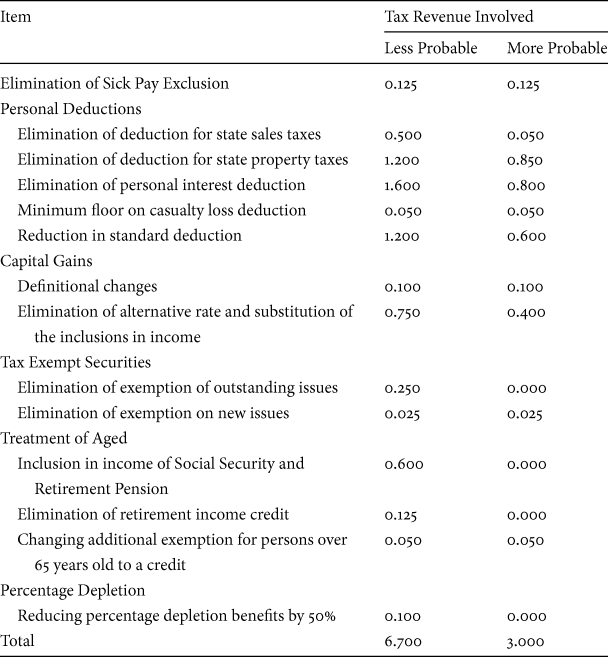
When the Treasury drafted the original tax-reform bill in 1961, its ideas along with those of Surrey and Mills prevailed in the Kennedy administration. In his first public address concerning the administration’s tax policy plan on April 20, 1961, Kennedy stated that the large number of tax preferences narrowed the tax base of the mass-based federal income tax system, distorted economic efficiency, provided preferential treatment to specific income groups, and made high rates necessary. He further stated that the administration intended to propose a “coherent package” tax-reform program to provide a broader and more uniform tax base with an appropriate rate structure for a higher rate of economic growth, more equitable tax structure, and simpler tax law without net revenue losses.Footnote 59 In a report circulated on April 22, 1961, Surrey recommended a more concrete set of tax-reform measures: reducing the top marginal rate from 91 percent to 65 percent; smoothing low- and middle-income tax rates;Footnote 60 reversing the normal corporate income tax rate (30 percent) and surtax rate (22 percent) to favor small corporations combined with a 2 percent rate reduction; and possible structural reform measures (see Table 1).Footnote 61
A Possible Tax Reform Program Reported on April 21, 1961 (In billions of dollar)

Source: Stanley S. Surrey, “Preliminary Statement of Tax Reform Program for 1962,” April 22, 1961, JFKL, WWHPP, Box 22, File: Tax Cut 4/61-11/61.
Several tax experts aided the work of the Treasury staff as part-time consultants. On April 22, 1961, a meeting was held in Surrey’s office.Footnote 62 Most of the consultants agreed on a reduction and simplification of itemized deductions and taxation of capital gains on assets less than five years with constructive realization at death or gift. Solow wrote to CEA members that the amount of revenue the reforms would presumably raise would determine the degree of revisions in the rate structure. The consultants generally agreed that some overall reduction in revenue, $3–4 billion at most, would be the price to pay for tax reform.Footnote 63 In a meeting on June 10, 1961, the consultants supported reform of individual income taxes, corporate income taxes, and estate and gift taxes with revenue losses involving $3 billion, $5 billion, and no losses, respectively. Furthermore, they supported floors on deductions for medical care, charitable contributions, casualty losses, and state and local taxes; tightened exclusions for sick pay, Social Security retirement benefits, and interest from state and local securities; the elimination of various tax credits; and splitting the first income bracket in order to reduce the maximum marginal rate.Footnote 64 In addition, the consultants urged taxation of unrealized capital gains left at death, raising the rates of capital gains taxation, liberalizing loss deductions, lengthening holding periods, and restricting the definition of allowable capital gains.Footnote 65 In a meeting on November 24, 1961, those in attendance agreed that a tax-reform bill would be proposed in 1962 or 1963 as a measure for improving equity, reforming tax structure, and promoting growth.Footnote 66
The Tax Reform Bill Arrives Onstage
While discussions of tax reform were continuing, the political and economic conditions surrounding the Kennedy administration significantly changed. Soon after his inauguration, Kennedy made a number of appointments to regulatory agencies, including the appointment of Luther Hodges as Secretary of Commerce in order to break up the cozy relationship between the Business Advisory Council and Commerce. However, these moves outraged businesspersons who had grown used to regarding the agencies as an adjunct of their own trade associations.Footnote 67 In addition, a serious conflict over rising steel prices occurred between the administration and steel industries in 1962. The Republican congressional leadership termed the actions of the administration “a display of naked political power never seen before in this nation.”Footnote 68 The economic growth rate that had increased consistently in 1961 began to decline in the first quarter of 1962.Footnote 69 In April 1962, stock prices fell sharply after rising from December 1961. The largest declines were suffered by growth stocks, which had been selling at high earnings multiples. On May 28, 1962, just after the steel fight ended, the stock market declined sharply again. Businesses, investors, and analysts worried that the recovery had ended and the disorder in the stock market was heralding a recession.Footnote 70
As Heller later wrote, adding expenditure programs faced great resistance during this period. The political situation required an approach to expansionary policy that would not be rejected on grounds that it would bloat the budget.Footnote 71 The CEA attempted to persuade Kennedy to advocate tax cuts in place of comprehensive tax reform. On June 5, 1962, to help head off a recession, the CEA suggested a temporary across-the-board 3 percent cut in individual income tax that would take effect on July 1 or September 1, 1962 (with associated revenue losses of $3.7 billion) and terminate on July 1, 1963, and a 3 percent cut in the corporate income tax that would take effect on January 1, 1963 (with associated revenue losses of $1.5 billion). The CEA expected that such tax cuts would appeal to both business and labor. In addition, the CEA argued that the temporary rate reduction “should be geared to the permanent cuts planned in the major tax reform.”Footnote 72 Meanwhile, the CEA recommended the division of the comprehensive tax-reform plan into two parts: first, the permanent rate cuts would take effect on January 1, 1963; second, “the bitter pills of base tightening would have [to wait] to be swallowed till January 1, 1964” in order to reduce the predictable opposition to the deliberate creation of a budget deficit (the two-stage approach).Footnote 73 Pursuant to their advice, Kennedy declared the administration’s intention to propose a comprehensive tax reform “as net tax reduction” on June 7, 1962.Footnote 74 In addition, in a speech at Yale University, Kennedy attempted to distinguish “the myth and reality” in the national economy and gave the strong impression that the administration would use fiscal and monetary policy in order to stimulate the economy without increasing inflation.Footnote 75
Several economists and businesses favored the CEA’s position. Richard Musgrave argued for the immediate reduction of individual income tax rates, mainly for those with lower-incomes in order to stimulate consumption, and of corporate tax rates in order to assuage political opposition. He believed that the proposed rate cuts would be a step toward a constructive tax reform that would later involve permanent rate reduction and a broadened revenue basis.Footnote 76 Samuelson and Solow recommended an immediate tax cut to Kennedy because they concluded: “The steam of the advance is already dissipating” based on their estimate that the production and order of vehicles and housing construction had decreased in July 1962.Footnote 77 Gerhard Colm of the National Planning Association also stressed the need for an immediate tax cut.Footnote 78 Heller met the members of the Conference of Business Economists (CBE) on July 12, 1962. The CBE estimated that the GNP would decline by $5–10 billion from the fourth quarter of 1962 or the first quarter of 1963 owing to the slow rate of retail sales, construction, and business fixed capital investment. The CBE argued that these indicators reflected uncertainty and loss of consumer confidence. The CBE recommended that the reduction in individual and corporate income taxes of $7–10 billion should last at least eighteen months to two years, effective October 1, 1962. In addition, the CBE recommended that any tax cut should not involve structural reforms at this time.Footnote 79 Other business organizations, such as the Chamber of Commerce, also supported an immediate reduction of individual and corporate income taxes.Footnote 80
A tax cut was appealing to the Kennedy administration because of the expected effect of restoring confidence in the administration, in addition to boosting the U.S. economy. On July 17, 1962, Kennedy’s personal aide, Arthur M. Schlesinger Jr., wrote to Kennedy that the last Gallup poll showed a troubling decline in the belief that the Democratic Party could handle economic difficulties. Schlesinger was concerned about the possibility that enactment of the tax cut in 1962, mainly consisting of investment credit and depreciation reform, might lead the public to think that the administration was abandoning the traditional Democratic faith in the support of consumer demand by trying to fight stagnation with trickle-down theory. Schlesinger also argued that the risk of appearing to let the economy slide into recession was even greater than the risk of losing a fight over tax reform in Congress. In response, he urged Kennedy to adopt a tax cut to restore the public’s belief in the Democratic Party “as the party which can be relied on to take action against recession.”Footnote 81 Meanwhile, Kennedy stated at a press conference on July 24, 1962: “Consumer purchasing power has held up. What has been particularly disappointing has been investment, and we have to consider whether a tax cut, and if so, what kind of tax cut, would stimulate investment.”Footnote 82 In summary, the Kennedy administration expected that a tax cut would be consistent with Democratic tradition while avoiding conflict with business.
Treasury’s Disagreement with the CEA’s View
The Treasury disagreed with the tax cut recommended by the CEA, economists, and businesses. On the one hand, the Treasury questioned the CEA’s expectation that the economy would continue to move forward until 1963. The economic trend had shown some improvement in July 1962 from the slowdown in the spring,Footnote 83 while a loss of revenue and a substantial budget deficit might have only increased foreign doubts about the course of the domestic economy and balance of payments.Footnote 84
On the other hand, Warren Smith, one of the consultants for the CEA, elaborately detailed for Heller the Treasury position with regard to the relationship of monetary and fiscal policy.Footnote 85 The Treasury posited the following accounting formula: “Personal Savings + Gross Business Savings = Gross Private Domestic Investment + Net Exports + Government Deficit.” As a consequence of this relationship, any increase in the government deficit had to be accompanied by an increase in personal or business savings, or a contraction in gross private domestic investment or net exports sufficient to release existing savings. However, the share of U.S. exports in exports of the entire world declined from 23.5 percent in 1948 to 17 percent in 1961.Footnote 86 Under the accounting formula, an increase in the deficit would be financed out of savings. In addition, a reduction of marginal tax rates would increase private savings. However, the Treasury was concerned that a separate enactment of rate reduction would result in much larger revenue losses than were necessary before the feedback effect of the tax cut. Meanwhile, the Federal Reserve would not increase supply reserves in the near future. Then, if tax cuts increased the budget deficits, bank purchases of Treasury securities would decrease bank acquisitions of private debt. Subsequently, the Federal Reserve would raise short- and long-term interest rates and increase the demand for money and credit to the extent that tax reduction would increase income, which would further raise interest rates. This operation of the Federal Reserve would result in increasing the cost of corporate finance while decreasing the availability of credit to private borrowers, reducing private demand for houses, automobiles, and plant and equipment, thereby diluting the expansive effect of the tax cut. As a result, the feedback effects of a tax cut on tax revenues would be reduced, so that the ultimate deficit resulting from the tax cut would be larger. Moreover, the rise in interest rates not only would increase the cost that the Treasury would have to pay on the new securities and outstanding debt as it matured and had to be refunded, but also would complicate the balance of payments problem.Footnote 87
The public and economic trends did not immediately support the proposed tax cuts. Financial interests, such as Connecticut General Life Insurance Company, contended that a tax cut should be enacted only when signs of an economic decline were stronger than at that time.Footnote 88 In a Gallup Poll that Heller sent to Kennedy on July 31, 1962, only 19 percent of Americans supported a tax reduction while 72 percent opposed it. Specifically, 15 percent of Republicans favored a tax cut, 18 percent of Democrats favored it, and 26 percent of Independents did so. Respondents, when asked whether they considered their income tax payments “about right” or “too high,” were split about evenly. However, only 31 percent of the group that considered their tax burden too large favored tax reductions.Footnote 89 In August 1962, the CWM concluded that no tax cut was needed at the time. They argued that an excessively bleak picture had been painted by business for self-serving reasons, and too much pressure for a tax cut had been generated by the administration figures. Mills was not convinced that a tax cut was desirable. He foresaw that the House would reject it.Footnote 90 Eventually, on August 13, in a thirty-minute television and radio address from his office, Kennedy stated that an immediate tax cut “could not now be either justified or enacted.”Footnote 91
Proposal of 1963 Tax Reform Bill
Despite the administration’s decision not to propose an immediate tax cut, the CEA and representatives of both labor and business continued to argue that the economy needed a tax cut and emphasized it over other reform measures. On August 9, 1962, Heller recommended that the administration should propose a tax-reform bill at the beginning of the next session and adopt the two-stage approach in recommending tax cuts.Footnote 92 On November 9, 1962, at a meeting of the CEA with business economists, 80 percent of the business economists agreed on substantial tax cuts even if they involved an expansion of budget deficits or federal expenditure. However, the economists generally opposed structural reform measures because they would impede the passage of tax cuts. In addition, the economists preferred the two-stage approach: making tax cuts first and tackling reform second.Footnote 93 Furthermore, in November 1962, representatives of the American Federation of Labor and Congress of Industrial Organization met Gardner Ackley and argued that a tax-reform bill would not be passed unless the tax cut and reform were separated.Footnote 94
However, Mills was unwilling to agree to separate the rate cuts from tax reform. At a meeting with Douglas Dillon, secretary of the Treasury, in November 1962, Mills argued that there was no evidence of a near-term recession as forecasts by various economists in the summer and current economic developments were favorable because of increases in capital expenditure, auto sales, and inventory accumulation. In addition, he regarded the existing tax-rate structure as a drag on economic growth and higher employment and favored a permanent reduction of individual and corporate rates. However, he argued that it should be accompanied by base-broadening measures and a commitment to hold down increases in nondefense expenditure to a minimum while the rate reductions took effect in order to avoid destroying confidence in the government’s fiscal responsibility and to maximize the possibility of enactment of the program.Footnote 95
The CEA, the Treasury and its staff, and Kennedy worked toward a compromise. On November 19, 1962, Robert Wallace, special assistant secretary of the Treasury, wrote that it was necessary for the Treasury to consider a compromise. Pressures continued for the two-stage approach on the one hand and congressional resistance to a large deficit persisted on the other. He believed that it might be especially appropriate in view of the continuing business improvement that would blunt the standard arguments of the economists. As a compromise, he suggested the two-stage approach. Consequently, the Treasury agreed with his suggestion. The Treasury decided to propose that the bulk of the tax cuts along with the simplest reforms be presented for early action. The rest of the cuts and the more controversial reforms could be considered later.Footnote 96 The Treasury’s staff did not intend to abandon the comprehensive tax reform they desired; nor was the administration’s initial portrayal of the tax-reform bill with the two-stage approach an attempt to justify the failure of the administration of the quick tax cut or to appease Mills. Those who actually did abandon their ideal bill were the Treasury and Mills. The Treasury staff simply believed the two-package approach would make the eventual adoption of tax reform much more likely.
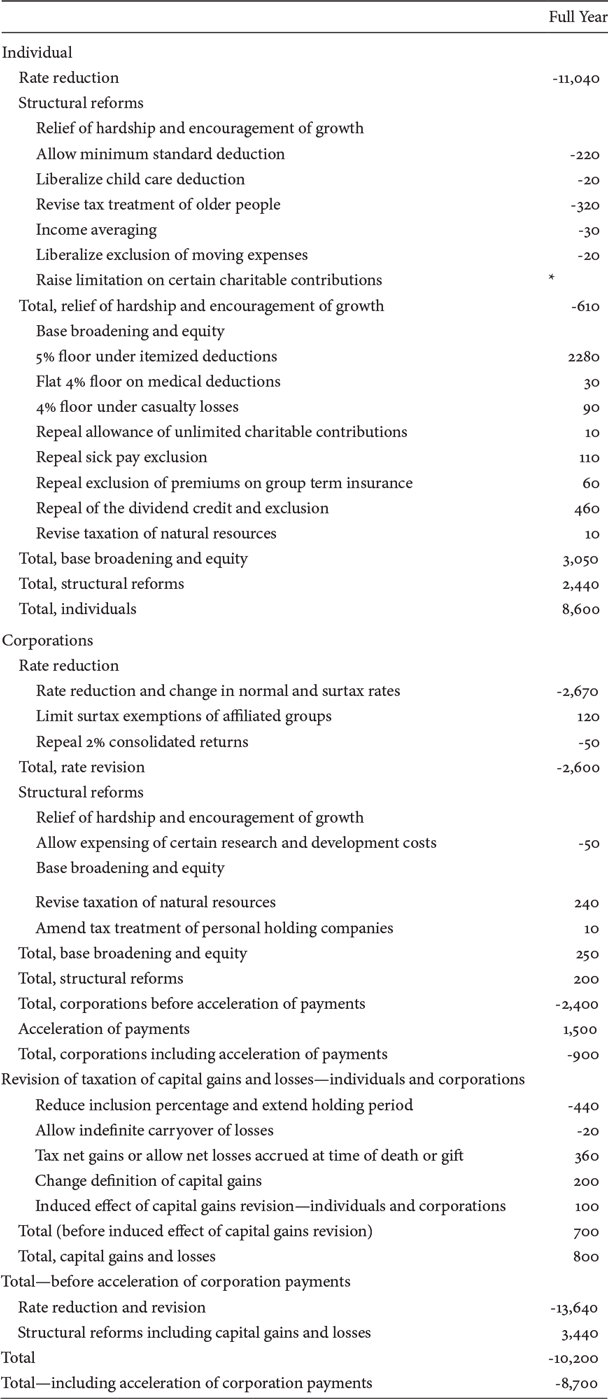
On January 24, 1963, the Kennedy administration finally proposed a tax-reform bill, taking the two-stage approach. The range of individual income tax rates was reduced from 20–91 percent to 14–65 percent over a three-year period.Footnote 97 Corporate rate cuts would take place in three stages.Footnote 98 These measures were aimed at relieving the barrier to full employment of manpower and resources and enhancing consumer demand and investment. Structural reforms, as displayed in Table 2, were proposed at the same time but did not take effect until January 1, 1964. Structural reform measures were aimed at avoiding an overly sharp drop in tax revenues for fiscal 1964–65, reducing inflationary pressures, decreasing the economic burden of the rate structure, and encouraging taxpayer cooperation and compliance by eliminating inequities and complexities. The measures to relieve “hardship” and encourage “growth” were aimed at providing relief to low-income taxpayers. The measures of “base broadening and equity” and “revision of capital gains taxation” were designed to eliminate or tighten preferential treatment of higher-income taxpayers and unearned income.Footnote 99 The reform of capital gains taxation was proposed as a step toward accomplishing estate and gift taxes reform.Footnote 100 Moreover, while the proposed bill would attempt to smooth differences in tax rates among each bracket, it would also increase the number of brackets from 24 to 25 by splitting the first $4,000 bracket.Footnote 101 The bill, when proposed, still intended not only to stimulate consumption and investment but also to boost progressiveness, fairness, simplicity, and equity.
Estimated Revenue Effect before Feedback,1 Full Year 1964 when all Proposals Are Fully Effective (In millions of dollars)

* Negligible
1. At levels of income estimated for the calender year 1963.
Source: The Treasury Department, “The Attached Tables Were Prepared to Accompany the President’s Tax Message and Must Be Held for Release at 12:00 Noon, Est Thursday, January 24, 1963,” January 23, 1963, JFKL, WWHPP, Box 21, File: Tax Cut 1/16/63-1/31/63.
Dispute over Passage of the Tax Reform Bill
Despite the compromise among the CEA, the Treasury, and Mills, the proposed structural reforms were attacked fervently, and the attacks impeded passage of the tax bill. They focused on key elements of the proposed structural reform, especially the repeal of dividend credit and exclusion, the 5 percent floor on itemized deductions, and the capital gains tax. The United Community Funds and Councils of America charged that the floor on itemized deduction for charitable contributions could invite dangerous changes that might do great damage to the country’s voluntary system of health, welfare, education, and religious and cultural organization.Footnote 102 The United States Trust Company of New York argued that the floor on itemized deductions and capital gains taxation were deliberate measures to squeeze people in the middle- and high-income classes who received capital income.Footnote 103 Keith Funston of the New York Stock Exchange maintained that the reform of capital gains taxation would hit not only shareholders but also small businesses and farmers, and that the repeal of dividend credit and exclusion would create full double taxation of dividends.Footnote 104 The U.S. Chamber of Commerce declared that the structural reforms would take away most of the benefits to be derived from the rate revision in middle- and high-income brackets.Footnote 105 Vincent P. Moravec, a citizen of New York, insisted in a letter to Kenneth O’Donnell, special assistant to Kennedy, that the reform measures, particularly the 5 percent floor on itemized deductions for charitable contributions and the $1,000 maximum standard deduction, would put pressure on homeowners and investors in middle- and high-income classes and dry up sources of contributions.Footnote 106 Belden L. Daniels of the Pennsylvania Bankers Association argued for the maintenance of dividend credit and the exclusion and withdrawal of taxation on capital gains at death and gift.Footnote 107
Many newspapers carried articles opposing the structural reforms. Business Week charged that loophole-closing reforms were not really “simple revenue raising,” but rather, “a barely concealed cancellation of a substantial part of the cut that the revision of rates appears to give.”Footnote 108 The St. Louis Post charged that “the inequity of the present tax system would be compounded by inequity in the ‘reform’. . . . It would simplify enforcement by reducing the number of returns to be audited. If this is accomplished at the cost of depriving taxpayers of deductions to which they are justifiably entitled, equity would suffer for the sake of the tax collector’s convenience.”Footnote 109 The Washington Post reported that the 5 percent floor had been misinterpreted variously as a deduction ceiling, a takeaway of all deductions, and a bar against specific deductions.Footnote 110
In the face of fervent opposition, Mills, who had been one of the imminent proponents of comprehensive tax reform, revised his role from a protector of comprehensive tax reform to a promoter of tax cuts. Neither Congress nor the nation favored the tax-cut bill immediately after it was proposed by the Kennedy administration.Footnote 111 In the House, structural reform faced strong opposition. In February 1963, Douglas Dillon, during the second day of his testimony before the CWM, drew a barrage of attacks by Republicans regarding the proposal for a 5 percent floor, a capital gains tax at death, and the repeal of dividend credit and exclusion. The Republican members of the CWM argued that those measures would severely pressure higher-income classes above $10,000 a year, investments, and homeowners who paid local estate tax.Footnote 112 Representative John W. Byrnes (R-Wisc.) charged that the Kennedy administration “seeks to favor the person who doesn’t own his own home, who doesn’t pay real estate taxes, who doesn’t support his church, who doesn’t give to the Community Chest.”Footnote 113 Then, on the House floor in 1963, Mills stated: “The route I prefer is the tax reduction road which gives us a higher level of economic activity and a bigger and more prosperous and more efficient economy with a larger and larger share of the enlarged activity initiating in the private sector of the economy.”Footnote 114 On the House floor, it was argued that the capital gains tax and the repeal of dividend credit and exclusion would damage capital markets and dilute the effect of rate reductions.Footnote 115 The bill passed the House (271–155) on September 25, 1963. However, most structural reform measures had been dropped, except for modified capital gains taxation, the first $100 exclusion of dividends, and a few other minor reforms. Mills, with his inconsistent attitude, could not protect the original bill.
Ultimately the administration abandoned the surviving reform provisions, especially capital gains tax reform, in exchange for quick passage of the bill. Soon after he assumed the presidency, Lyndon Johnson addressed the Congress saying, “No act of ours could more fittingly continue the work of President Kennedy than the early passage of the tax bill for which he fought all this long year,” adding that the legislation would increase national income and federal revenues while providing insurance against recession.Footnote 116 The OTA regarded the House bill as having various defects with respect to capital gains taxation. The House bill reduced the inclusion rate on long-term capital gains and the alternative tax rate, while determining not to tax capital gains at death, and adopting a much lower new tax rate schedule on realized gains than the administration originally proposed. These measures would reduce taxes on long-term capital gains, favor high-income earners, and maintain serious inequity among income classes. Furthermore, the OTA believed that the House bill would increase the complexity of the income tax system. For these reasons, the OTA concluded that the Treasury should abandon capital gains tax reforms until the law could be amended to deal with the problem of unrealized appreciation at death either by taxing the transfer at death or on a carryover basis.Footnote 117 Finally, the OTA decided to recommend that the Senate Finance Committee retain the existing tax treatment of capital gains.Footnote 118
The Senate passed the tax bill on February 7, 1964, and Johnson signed it on February 26. The range of individual income tax rates was reduced to 16–77 percent in 1964 and to 14–70 percent in 1965. The withholding rate of individual income tax and the normal rate and surtax rate of corporate income tax were also reduced.Footnote 119 With regard to structural reform, the new act increased the deduction for retirement income and the minimum standard deduction. Both these measures cut taxes and revenues. However, most base-broadening elements of the original administration proposal had disappeared. Consequently, the new legislation did not strengthen the progressivity and equity of the tax system, and was, in general, little more than a huge tax cut.Footnote 120 The original impetus for tax reform had vanished.
Concluding Remarks: The aftermath of the 1964 Tax Cut
The sharp acceleration in the economic growth rate seemingly convinced much of the nation that the Kennedy–Johnson tax cut represented one of the most important legacies of the Kennedy administration. When Johnson signed the tax cut into law in February 1964, for example, he applauded the legislation as “inspired and proposed by our late, beloved President John F. Kennedy.”Footnote 121 Kennedy’s economic advisers repeatedly referred to the tax reform as having contributed to this economic boost. For instance, Heller concluded: “Early returns—and circumstantial evidence—show the economy to be responding well to the tax cut.”Footnote 122 Accelerated economic activity, the resultant revenue increase, and economists’ arguments for the tax cut of 1964 eventually forced both the Democrats and the Republicans to consider tax cuts in their respective platforms in the face of budget deficits. During the 1964 presidential contest between Johnson and Barry M. Goldwater (R-Ariz.), Johnson recommended a consumption-tax reduction and another income tax cut, despite the accelerating economic recovery.Footnote 123 Meanwhile, Goldwater, despite his vote against the tax cut in 1964 on grounds that it would be fiscally irresponsible in the face of a budget deficit, proposed a far larger tax reduction (25 percent over a five-year period) through across-the-board rate cuts.Footnote 124
During the 1964 presidential election campaign, the Treasury staff did not adopt a new orthodoxy, but they had to endorse the result of the 1964 tax cut and their legislative effort because of the importance of the Kennedy–Johnson tax cut for the image of the Democratic administration. Surrey continued working on crafting tax reforms based on his fiscal beliefs until he returned to Harvard.Footnote 125 He nevertheless noted in a letter to a congressional representative that the Revenue Act 1964 “contains many revenue raising and revenue reducing provisions, primarily intended to provide more equity and uniformity and to reduce hardship.”Footnote 126 While denouncing Goldwater’s tax cut as fiscally irresponsible, Wallace told Myer Feldman, deputy special counsel to the president, “I think the best approach to the Goldwater proposal from a fiscal standpoint is ‘Welcome to the club! You have finally recognized your error in voting against the tax cut by proposing an even bigger one.’”Footnote 127 The theoretical stance on comprehensive tax reform taken by its proponents was more similar to the ideas of Keynes, Hansen, and Lerner than that of the “tax cut” proponents now referred to as “Keynesians.” However, the tax cut argument finally won. Then, ignoring what Keynes actually advocated, the victorious CEA and other economists promoted the popularity of the Kennedy–Johnson tax cut as a part of “the completion of the Keynesian revolution,” despite the fact that it did not involve the structural tax reforms suggested that Keynes and his American contemporaries suggested. This promotion by the CEA and other economists subsequently influenced the direction of many studies that have uncritically viewed the tax cut as “Keynesian tax policy,” a tax policy that simplistically emphasized the creation of a budget deficit to stimulate consumption as a response to a sluggish economy.
Remembering the legislative process and result of the Kennedy–Johnson tax cut, Mills thereafter required that every comprehensive tax-reform program include tax reductions.Footnote 128 When it turned out that the Treasury would very likely be defeated in 1964, the Treasury and its staff determined to develop and propose a new comprehensive tax-reform program.Footnote 129 Based on its research and discussion, the administration of Richard Nixon proposed a revenue-neutral comprehensive tax-reform program in 1969.Footnote 130 However, the CWM originated most of the changes encompassed in the bill.Footnote 131 Mills called for more rate reductions and increases in the low-income allowance and the standard deduction than Nixon originally proposed. The bill that the House finally approved added $2.4 billion in tax reductions to the Nixon proposal.Footnote 132 Thus, the legislation would lose more revenue than it produced, thereby threatening to increase deficits. In response to this concern, Mills drew on the logic of the 1964 tax cut to explain that in the long run, the economic improvements from the bill would generate higher revenue.Footnote 133 When the tax-reform bill was enacted in 1970, the number of loophole-closing provisions that could have raised revenues (+$3,320 million) was much less than that of income tax relief (–$9,134 million) over the long run.Footnote 134 The Treasury again failed to accomplish its desirable base-broadening revenue-neutral tax reform. Nevertheless, Mills justified the result not only by invoking the experience with the 1964 tax cut, despite the fact that it was far from success. He also argued that people from all income brackets would enjoy the benefits of tax preferences.Footnote 135
The victory of the 1964 tax cut and Mills’s action seemingly made tax expenditures and tax cuts popular among politicians and the public. In the early 1970s, because of the effects of “bracket creep,” tax policy took the enviable form of returning revenues to voters in the form of tax cuts while retaining some for government programs.Footnote 136 In the late 1970s, the Carter administration advocated the reduction of tax expenditures in light of Treasury investigations and attempted to roll back the surging wave of tax preferences from the early 1970s. However, Democratic and Republican leaders in Congress who were opposed to this approach favored tax preferences for the higher-income brackets, and their approach prevailed.Footnote 137 The Reagan administration, in turn, implemented the tax cut of 1981 and included indexing of income tax brackets on the basis of the results of the 1964 tax cut. However, in reality, it resulted in explosively larger federal deficits and weakened political taxing potential. Thereafter, the Reagan administration temporarily eased away from the path of tax cuts by implementing tax increases in 1982 and 1983, as well as a comprehensive tax reform through tax expenditure cuts in 1986. However, during the 1990s, the Clinton administration increased tax expenditures instead of direct social expenditure. Furthermore, in the early 2000s, the administration of George W. Bush weakened the capacity of the federal tax system to generate new revenues through a succession of five tax cuts. The memory of the 1964 tax cut held back the movement toward the kind of tax reform that might have helped solve subsequent fiscal problems, and it gave posterity to the impression that tax policy was more important as a tool to stimulate the economy rather than to raise revenue. Furthermore, the “tax-cutting culture” established by the 1964 tax cut meant that subsequent attempts by the government to seek new or higher revenue through legislated tax increases were a politically precarious task.