In September 2014, identification of the first case of a patient with Ebola virus disease (EVD) to present in the United States was delayed and infection of 2 healthcare workers (HCWs) occurred.Reference Liddell, Davey and Mehta 1 This experience exposed the difficulty that hospitals faced in adequately training dedicated staff to care for patients with EVD. Historically, institutional responses to highly infectious disease (HID) events have modified existing policies, procedures, and resources. However, this approach resulted in increased risks of HCW occupational exposure and delayed critical laboratory testing.Reference Smith, Anderson and Christopher 2 Consensus reports from the European Network of Infectious Diseases and state and federal agencies in the United States, as well as experts from the 3 initial biocontainment patient care units in the United States, have identified key elements in the design and operation of specialized facilities caring for patients with HIDs,Reference Smith, Anderson and Christopher 2 , Reference Bannister, Puro, Fusco, Heptonstall and Ippolito 3 including EVD. These units, defined by the European Network of Infectious Diseases as high-level isolation units, include recommendations for infection control, clinical competency, physical features, facility workflow, and worker safety protocols to prevent disease transmission to HCWs, other patients, and the general public.Reference Smith, Anderson and Christopher 2 , Reference Bannister, Puro, Fusco, Heptonstall and Ippolito 3
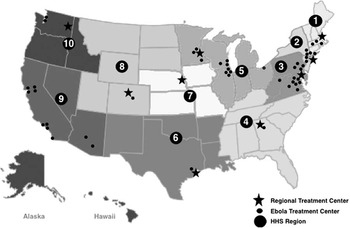
To maximize HCW safety and domestic EVD isolation capacity, the Centers for Disease Control and Prevention established an unprecedented multitiered network of hospitals with specialized capabilities for Ebola care, including frontline facilities, Ebola assessment hospitals, and Ebola treatment centers (ETCs). 4 ETCs have largely been designated in metropolitan areas that receive significant amounts of travelers from West Africa, leaving sparsely populated areas in further proximity from ETCs (Figure 1).
US Department of Health and Human Services (HHS) Regions with Centers for Disease Control and Prevention–designated Ebola Treatment Centers and Assistant Secretary for Preparedness and Response–designated Regional Ebola and Other Special Pathogen Treatment Centers.

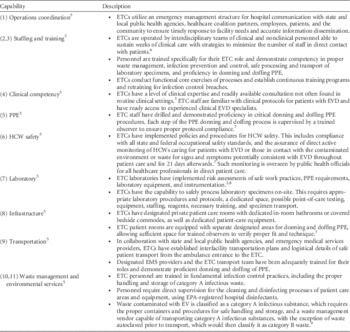
To ensure rapid readiness to provide Ebola care, local public health officials and the Centers for Disease Control and Prevention coordinated site visits to potential ETC hospitals, assessed facility readiness in 11 augmented capabilities, and provided technical assistance, as needed. As of August 2015, 55 US hospitals designated as ETCs have acquired the enhanced operational capabilities detailed in Table 1.
CDC Guidance on ETC Capabilities

NOTE. CDC, Centers for Disease Control and Prevention; EMS, emergency medical services; EPA, Environmental Protection Agency; ETC, Ebola treatment center; EV, Ebola virus; EVD, Ebola virus disease; HCW, healthcare worker; PPE, personal protective equipment.
To further geographic reach and strengthen capacity to care for patients with HIDs, in June 2015 the US Department of Health and Human Services selected 9 ETCs to serve as Regional Ebola and Other Special Pathogen Treatment Centers (RTCs) for patients with Ebola and other HIDs, in conjunction with their respective public health departments (Figure 1). The Assistant Secretary for Preparedness and Response funded the RTCs to expand their operational capabilities and capacity to sustain ongoing readiness throughout the United States. 10 Among other requirements, ETCs selected as RTCs must have the capacity to treat at least 2 Ebola patients at one time, have respiratory infectious disease isolation capacity or negative pressure rooms for at least 10 patients, accept patients within 8 hours of being notified, be able to treat both pediatric and adult patients, and conduct quarterly trainings and exercises for facility staff. 11
The extensive operational requirements and comprehensive treatment protocols required to care for an EVD patient limit an ETC’s capacity. The treatment of patients with EVD and other HIDs in ETCs with proper operational capabilities is critical to nationwide preparedness and the safety of the patient, HCWs, and the community. The recent Ebola epidemic was a grave example of the severity of HID threats, exacerbated owing to increasing global fluidity. This report describes current ETC locations, their infection control infrastructure, and their capacity to care for EVD patients.
METHODS
In April 2015, a 19-question electronic survey (with institutional review board exemption UNMC IRB #165-15-EX) was sent to all 55 ETCs, including the 9 RTCs. The survey was re-sent 2 weeks later to follow up with facilities that had not responded. The survey inventoried current capabilities and capacity as well as the cost of establishing the ETCs; the latter is the subject of another manuscript, currently under review. This survey, which consisted of discrete responses with the ability to provide qualitative feedback for every question, was adapted from existing assessment questions developed by the European Network of Infectious Diseases.Reference Fusco, Schilling and Puro 12 The survey included questions regarding isolation unit location within the facility, overall capacity for care, and infection control infrastructure. To assess capacity for care, the maximum number of EVD or HID isolation rooms and beds that can be used simultaneously as well as the total capacity for adult and/or pediatric patients were requested. The number of isolation beds per million of population was calculated using the most recent census estimates. 13 To assess the features of the infection control infrastructure, respondents were asked about separate air handling units, physical barriers separating isolation rooms within the same unit, negative pressure, high-efficiency particulate air (HEPA) filtration, details about entrances and exits to the isolation unit, and the processes used for sterilization of medical waste. Data were coded and analyzed using descriptive statistics with an electronic spreadsheet (Excel; Microsoft).
RESULTS
Forty-seven (85%) of the 55 ETCs, including 7 of the 9 RTCs, completed the survey. Thirty-eight ETCs are located in academic teaching institutions, 5 are in referral hospitals providing specialized tertiary care, and 2 designated themselves “other.” Nearly all (44 [94%]) of the high-level isolation units are located within the main hospital building. A portion of ETCs have separate wards (20 [43%]) or separate rooms within another ward (24 [51%]); 3 facilities (6%) are stand-alone. Of the 20 units located on isolated wards, 14 (70%) have separate air-handling systems. Of the 24 units located within other wards, 14 (58%) have independent air-handling systems and 23 (96%) have a physical barrier separating the isolation rooms from the rest of the ward.
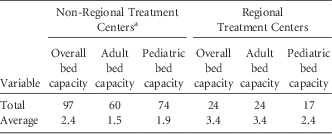
Of the 47 responding ETCs, there is a total of 84 adult beds, 35 pediatric beds in children’s hospitals, and 56 pediatric beds in hospitals treating both adults and pediatric patients (Table 2). Twenty-four hospitals accept both adult and pediatric patients; the children’s hospitals designated as ETCs have only pediatric beds available. The mean maximum number of beds that can be used simultaneously by individual ETCs is 2.6. The average capacity of the 7 RTCs that completed the study is shown in Table 3 and is higher than that of non-RTCs. On the basis of the current US census, 13 the number of staffed isolation beds available from the survey respondents is 0.38 beds per million population. Several centers provided additional feedback that capacity varies depending on the HID being treated and that staffing is insufficient for their current bed capacity.
High-Level Isolation Unit Capacity of the 47 Ebola Treatment Centers Participating in the Survey

a Some can be used simultaneously.
b Of the 47 facilities, 46 provided separate adult and pediatric bed capacity numbers.
c One facility listed only their maximum isolation bed capacity (2) but did not specify whether the beds could be used for pediatric patients.
Comparison of the Ebola Virus Disease Treatment Capacity of the 7 Regional Treatment Centers and 40 Non-Regional Treatment Centers Participating in the Survey

a One facility listed only their maximum isolation bed capacity (2) but did not specify whether the beds could be used for pediatric patients.
Anterooms and negative pressure (no. of air exchanges per hour: mean, 14.3; median, 12) are available for 45/47 (96%) of high-level isolation units. Consensus guidelines for high-level isolation recommend separate entrances and exits for units, which are available in 23 units surveyed (49%), whereas 24 (51%) use the same pathway for staff to enter and exit.Reference Smith, Anderson and Christopher 2 Thirty-one facilities (66%) use HEPA filtration in the units, of which 4 (13%) filter only intake air, 13 (42%) filter only exhausted air, and 13 (42%) have HEPA filtration for both intake and exhausted air. One facility did not specify the HEPA filtration direction.
Eleven ETCs (23%) have the capability to sterilize waste on site, of which 10 have an autoclave and 1 unit is equipped with an incinerator. However, this ETC noted they do not use the incinerator but use a separate certified facility for the disposal of category A infectious waste. Of the 11 ETCs equipped with on-site sterilization capability, 5 (45%) are located within the unit. Six ETCs noted that they were in the process of acquiring and installing an autoclave or intended to do so if they received the funds. All 36 facilities without the capability to sterilize waste on site have processes for category A waste disposal with certified facilities. Only 10 (21%) of the 47 ETCs have isolation units equipped with negative pressure, an anteroom, on-site sterilization of waste, and HEPA filtration. Forty-five ETCs indicated their willingness to participate in the US Highly Infectious Disease Consensus Network to establish control metrics, competencies, and peer review for high-level isolation units.
DISCUSSION
Before the establishment of ETCs, the great majority of hospitals were inadequately prepared to care for a patient with suspected or confirmed EVD.Reference Smith, Anderson and Christopher 2 , 5 Although the development of 55 ETCs has heightened nationwide preparedness levels, the treatment paradigm necessary for EVD care drastically limits patient capacity in these facilities. Furthermore, because no pediatric EVD patients have been treated in the United States, questions remain on the resources, staffing levels, and care required for pediatric patients. Responses show most ETCs distinguish adult bed capacity from pediatric beds and many ETCs do not plan to care for pediatric patients (Table 2), highlighting the need to distinguish between pediatric and adult bed capacity and capability.
Limitations to capacity include both beds available in high-level isolation units and the need for dedicated multidisciplinary staff. Expectations for staff include low turnover rates, regularly scheduled drill exercises for staff to maintain competency in infection control procedures, and a leadership system based on the incident command model.Reference Smith, Anderson and Christopher 2 , Reference Smith, Boulter and Hewlett 7 , Reference Hewlett, Varkey, Smith and Ribner 14 Despite efforts to designate specific team roles and minimize the number of staff in direct contact with the patient and/or infectious secretions, large numbers of staff are needed to care for an individual patient. Furthermore, owing to the intensity of treatment for EVD and the extended use of personal protective equipment, Nebraska Biocontainment Unit staff, for example, rotate after every 2–4 hours to prevent physical and mental fatigue.Reference Boulter, Link and Mehta 15 Because staff participation in ETCs is voluntary, scheduling and backfill issues may further complicate staffing.Reference Smith, Boulter and Hewlett 7 An additional challenge is how facilities will sustain a fully trained team when unoccupied.
Another unanticipated concern for ETCs has been the logistical capabilities and regulatory requirements associated with processing and disposing of EVD medical waste.Reference Jelden, Gibbs and Smith 16 , Reference Lowe, Olinger and Gibbs 17 The challenges of medical waste may be one of the factors that limit an ETC’s ability to manage more than one EVD patient at a time. Although autoclaves and incinerators, which cost approximately US $100,000 to install,Reference Boulter, Link and Mehta 15 can transform Ebola virus category A infectious waste to category B waste, only 11 facilities have on-site autoclaves or incinerators. The other 36 facilities must develop expensive procedures for safe handling and use a vendor capable of off-site transport and disposal of category A waste, which could cost millions of dollars. 5 , Reference Lowe, Gibbs, Schwedhelm, Nguyen and Smith 9 , Reference Boulter, Link and Mehta 15 ETCs without the ability to manage waste on site through autoclaves or incinerators heighten exposure risks during management, packaging, and transporting of contaminated materials.Reference Maltezou, Fusco and Schilling 18 Even with autoclaves and incinerators, the immense amount of waste generated by a single EVD-patient requires a temporary waste storage area/site and a nearly constant sterilization process.Reference Lowe, Gibbs, Schwedhelm, Nguyen and Smith 9
The establishment of the Centers for Disease Control and Prevention’s national Ebola network has heightened US preparedness for EVD, but questions on the use and efficacy of these isolation units in response to other diseases remain. Several ETCs noted that if patients are admitted into units located within the same ward as other hospital activities, surrounding rooms will be closed, likely resulting in lost revenue. Beyond the physical number of beds available, it is the negative pressure rooms, physical barriers, staffing capability, and other infection control capabilities that determine a facility’s capacity to treat a specific disease. HEPA filtration is not required for isolation of patients with EVD but has been recommended for high-level isolation units.Reference Smith, Anderson and Christopher 2 , Reference Bannister, Puro, Fusco, Heptonstall and Ippolito 3 Furthermore, having negative pressure rooms, on-site waste sterilization, and an anteroom reduces the risk of disease transmission to HCWs and has been attributed to successfully treating an EVD patient.Reference Jelden, Gibbs and Smith 16 , Reference Lowe, Olinger and Gibbs 17
Although EVD is a highly infectious viral hemorrhagic fever that can be spread to others via infected body fluids, it is not as contagious as some other HIDs spread via the airborne route, such as severe acute respiratory syndrome and Middle East respiratory syndrome coronaviruses, which can be spread through respiratory droplets and fomites.Reference Heymann 19 – 22 Furthermore, the number of travelers from affected nations arriving in the United States varies greatly. An average of 130 to 150 people travel from West Africa to the United States each day, 23 while between March 16 and April 3, 2003, more than 220,000 passengers traveled to the United States from severe acute respiratory syndrome–affected China, Vietnam, and Singapore. 24 Given the more than 121 simultaneous available beds nationwide, it is probable that the ability to control and treat a national outbreak of EVD (albeit unlikely) is adequate, whereas controlling and treating an airborne HID would be challenging.
This study has limitations. Data were self-reported by facility representatives and results were not validated. Many facilities noted their response was Ebola specific and would change with other diseases. Therefore, results cannot be generalized to the capacity for other HIDs. At the time of the survey distribution, RTCs had not yet been designated. The establishment of these centers included requirements on increased capacity. As such, the inclusion of any further capacity development by these facilities is not included here, and therefore the average capacity per RTC is likely greater than as indicated in Table 3. Lastly, these figures do not account for the 9 ETCs that did not respond to the survey, nor were non-ETCs that have made similar preparations but are not designated as ETCs counted; hence the complete number of beds available in the United States could not be tabulated.
The 2014-2015 Ebola epidemic was a reminder of the increasing global fluidity of HID threats. Multilevel, interprofessional collaboration to isolate HID cases and reduce disease transmission will be crucial to contain future outbreaks.Reference Smith, Boulter and Hewlett 7 , Reference Fusco, Puro and Baka 25 Although the current capacity of ETCs in the United States is adequate to manage and treat the few sporadic cases of EVD that occur or are treated domestically, future HID pandemics or larger domestic outbreaks warrant surge capacity owing to the low number of patients who can be treated simultaneously in the existing facilities. Finally, although ETCs have acquired specialized capabilities and infrastructure to successfully treat and manage EVD, whether or not these units can be adapted for other HIDs is unknown and should be explored.
ACKNOWLEDGMENTS
Financial support. None reported.
Potential conflicts of interest. All authors report no conflicts of interest relevant to this article.