Introduction
Genetically informed research has clearly supported a moderate role (31–42%) for genetic influences on major depressive disorder (MDD) (Sullivan et al. Reference Sullivan, Neale and Kendler2000), results that appear to hold across the lifespan (Burt, Reference Burt2009). For example, Burt (Reference Burt2009) meta-analysed 33 twin and adoption studies of child and adolescent MDD/depression. In adolescence, 39% of the variance in depression was accounted for by genetic influences. The environment also plays an important role, however, accounting for the remainder of the phenotypic variance. Indeed, there are several specific environmental risks that may contribute to the development of MDD. Among those most studied are stressful life events (SLEs). These include independent SLEs unrelated to the individual's behavior (e.g. the death of a loved one or a natural disaster) and dependent SLEs that could potentially be related to some behavior of the person (e.g. divorce/relationship stressors, unemployment), a distinction first made by Brown & Harris (Reference Brown and Harris1978). Both types of SLEs have been associated with the onset of depression in adolescents (Goodyer et al. Reference Goodyer, Herbert, Tamplin and Altham2000; Ge et al. Reference Ge, Conger and Elder2001), although the association is somewhat stronger for dependent SLEs (Kendler et al. Reference Kendler, Karkowski and Prescott1999). Research also suggests that the number of SLEs one experiences may be an important predictor of later depressive episodes (Kendler et al. Reference Kendler, Karkowski and Prescott1998). Indeed, it has been suggested that multiple exposures to such experiences could lower the threshold needed for an individual to enter a depressive state (Kendler et al. Reference Kendler, Thornton and Gardner2001).
In short, both genetic influences and SLEs are important predictors of MDD. However, their influences may not be additive. Instead, it may be the case that SLEs are linked to depression in part because they moderate the expression of genetic predilections towards depression, a phenomenon referred to as a gene–environment interaction (GxE). Eaves et al. (Reference Eaves, Silberg and Erkanli2003), for example, argued that genetic risk ‘for depression’ may actually be reflective of sensitivity to environmental stressors. Consistent with this idea, more recent work has indicated that, as genetic risk to developing depression increases, so does the depressogenic susceptibility to SLEs (Lau & Eley, Reference Lau and Eley2008). Similarly, Silberg et al. (Reference Silberg, Rutter, Neale and Eaves2001) found that genetic effects on depression were significantly greater in adolescents who had experienced SLEs compared with those who had not. Not all findings are consistent with the possibility of GxE, however. Hicks et al. (Reference Hicks, DiRago, Iacono and McGue2009) found that SLEs increased non-shared environmental influences on internalizing symptoms, but did not moderate genetic effects. These inconsistencies across studies indicate that additional GxE studies of SLEs and MDD are needed before any firm conclusions can be drawn.
Future studies should also seek to address the various limitations of prior GxE work. For example, GxE studies to date have relied exclusively on molecular genetic and/or twin methodologies (to our knowledge). Indeed, we know of no adoption studies that have sought to identify GxE in depression. Constructive replication using other sorts of genetically informative designs (like an adoption design) would thus constitute an important addition to prior work, as it would confirm that prior results are not confined to specific methodologies.
Another, arguably more important, limitation of examinations of GxE with SLEs is that dependent SLEs are unlikely to be genetically independent of depression (as discussed in Silberg et al. Reference Silberg, Rutter, Neale and Eaves2001), a phenomenon referred to as a gene–environment correlation (r GE). In particular, individuals may ‘have a stable tendency to select themselves into situations with a high probability of producing stressful life events’ (Kendler et al. Reference Kendler, Karkowski and Prescott1999, p. 838), and this tendency may reflect genetic risk for depression (Kendler & Karkowski-Shuman, Reference Kendler and Karkowski-Shuman1997; Kendler et al. Reference Kendler, Karkowski and Prescott1999; Silberg et al. Reference Silberg, Pickles, Rutter, Hewitt, Simonoff, Maes, Carbonneau, Murrelle, Foley and Eaves1999). For example, Williamson et al. (Reference Williamson, Birmaher, Anderson, Al-Shabbout and Ryan1995) found that, when comparing adolescents with depression to normal controls, the proportion of dependent SLEs (out of the total number of SLEs) experienced was greater, even though the total number of SLEs was comparable between groups. There was no significant difference in the number of independent SLEs. This suggests that, even when experiencing similar numbers of SLEs, depressed individuals may be more likely to select themselves into stressful circumstances as compared with their healthy peers. This effect has also been demonstrated by Rudolph & Hammen (Reference Rudolph and Hammen1999).
These sorts of r GEs (referred to specifically as active r GE) are particularly troublesome in GxE research (Moffitt et al. Reference Moffitt, Caspi and Rutter2005). In particular, if SLEs stem in part from genes common to MDD (or if genes for SLEs interact with genes for depression), then the potentiation of genetic influences at high levels of ‘environmental’ risk could be a reflection of r GE processes, rather than true GxE. Several prior studies have attempted to address this confound by modeling genetic overlap between depression and dependent SLEs (Eaves et al. Reference Eaves, Silberg and Erkanli2003; Lau & Eley, Reference Lau and Eley2008). However, another, more convincing approach is to circumvent active r GE via the examination of independent SLEs, which are, by definition, random ‘bad luck’ events unassociated with the individual's behavior (and thus his or her genetic risk; Bemmels et al. Reference Bemmels, Burt, Legrand, Iacono and McGue2008).
The present study sought to address these concerns, and thereby provide additional evidence of the presence or absence of GxE between SLEs and MDD symptoms. We specifically focused on the death(s) of family and/or close friends, examining the number of deaths experienced. This SLE represents a promising potential moderator, as it has a potent relationship with depression in adolescents (Harrison & Harrington, Reference Harrison and Harrington2001). Moreover, the deaths of friends/family are generally considered independent of the individual's behaviors, and thus etiological moderation by number of deaths experienced should be largely free of active r GE confounds. We also made use of a large sample of adoptive and biological siblings between the ages of 10 and 20 years, thereby clarifying whether previously reported evidence of GxE extends to other sorts of genetically informed designs. Positive evidence of GxE in the current study would thus serve to both constructively replicate and extend prior findings of GxE between SLEs and MDD symptoms.
Method
Participants
The sample examined here is composed of participants in the Sibling Interaction and Behavior Study (SIBS), a longitudinal population-based study of adoptive and biological adolescent siblings and their parents. Adoptive families living in the Twin Cities greater metropolitan area were contacted based on records for the three largest adoption agencies in Minnesota (averaging between 600 and 700 placements per year), and were selected to have: (1) an adopted adolescent placed as an infant and first assessed between the ages of 11 and 19 years, and (2) a second non-biologically related adolescent sibling falling within the same approximate age range. Adopted adolescents had a mean age of placement of 4.8 months (standard deviation=4.7 months). Non-adoptive families, which consisted of a pair of full-biological siblings and their biological parents, were randomly identified and recruited using public databases of Minnesota birth records. Although biological siblings were selected to have sex and age composition similar to that of the adopted siblings, biological and adoptive families were otherwise not matched so as to obtain representative samples of both family types (Stoolmiller, Reference Stoolmiller1998). Other eligibility requirements for all families included living within driving distance of our Minneapolis-based laboratory, participating siblings no more than 5 years apart in age, and the absence of cognitive or physical handicaps that would preclude completion of our day-long assessment.
Among eligible families, 63% of adoptive and 57% of biological families participated. There were no significant differences between participating and non-participating parents in terms of paternal education, paternal and maternal occupational status, or rate of divorce, although participating non-adoptive mothers were significantly more likely to have a college degree (44%) than non-participating non-adoptive mothers (29%). Among participating families, adoptive parents had a higher occupational status and were more likely to be college educated, but were less likely than non-adoptive parents to be diagnosed with lifetime drug abuse or dependence. However, there were no significant differences in the rates of MDD, nicotine dependence, antisocial personality disorder, or alcohol dependence (see McGue et al. Reference McGue, Keyes, Sharma, Elkins, Legrand, Johnson and Iacono2007).
The current sample consisted of 407 biologically unrelated and 208 biologically related families (n=1230 adolescent siblings). Of the adoptive families, some (n=123) also contained a non-adopted child, who was biologically related to his or her parents, but not to the target adoptee. Roughly 38% of the sample consisted of opposite-sex sibling pairs. Adolescent participants ranged in age from 10 to 20 years (average 14 years). A little over half of the sample was female (55%). The adoptive and non-adoptive parents (and therefore, the non-adoptive adolescents) were broadly representative of the ethnic composition of the Minnesota population; approximately 95% were Caucasian. However, due to predominantly international adoptions in Minnesota, the adopted adolescents were 67% Asian-American, 21% Caucasian, 2% African-American, 2% East Indian, 3% Hispanic/Latino, 1% South or Central American Indian, 4% mixed race, and 0.1% other ethnicities.
Measures
Adolescent MDD symptoms
We made use of a lifetime DSM-IV ‘symptom count’ variable corresponding to the sum of endorsed or partially endorsed criterion A symptoms of MDD (available on all 1230 adolescents) taken from the participant's worst episode. Symptom counts, rather than diagnoses, were used primarily to increase statistical power, as diagnostic prevalence rates in community-based samples are lower than in clinically referred samples (approximately 10% of the current sample met full criteria for a lifetime diagnosis of MDD; as reported in Tully et al. Reference Tully, Iacono and McGue2008). Symptoms judged to be definitely present (i.e. they were clinically significant in both severity and frequency) were counted as one full symptom. Symptoms judged to be probably present (i.e. they were clinically significant in either severity or frequency, but not both) were counted as half of a symptom.
Participants and their mothers were assessed in-person by trained bachelor- and masters-level interviewers for DSM-IV mental disorders using the Diagnostic Interview for Children and Adolescents-Revised (Welner et al. Reference Welner, Reich, Herjanic, Jung and Amado1987). Within a given family, each family member was interviewed by a separate interviewer. Supplementary probes and questions were added to ensure complete coverage of each symptom. Consistent with the DSM-IV, we made use of ‘gateway symptoms’ (i.e. depressed mood and anhedonia) in our administration of the MDD interview. Specifically, if the gateway symptoms were denied (i.e. symptoms were neither endorsed nor partially endorsed), the remaining seven symptoms were not assessed.
Following the interview, a clinical case conference was held in which the evidence for every symptom was discussed by at least two advanced clinical psychology doctoral students. As necessary, audiotapes from the interview were replayed or the participant was re-contacted for clarification. As actual diagnoses were not used in the current study, duration rules were excluded. After symptoms were assigned, computer algorithms were used to sum the number of assigned symptoms using a combined informant approach. A symptom was considered present if it was endorsed by either the mother or the adolescent. Symptoms endorsed by both the mother and the adolescent were counted as only one symptom. The use of this combined informant approach allowed for a more complete assessment of symptomatology than would the use of either informant alone, as previous studies have indicated that each type of informant contributes a considerable amount of valid information not contributed by other informants (Achenbach et al. Reference Achenbach, McConaughy and Howell1987). As actual diagnoses were not used, duration rules were excluded for both disorders. The reliability of the consensus process was good, with a κ of 0.82 for diagnoses of MDD.
Number of deaths
The number of deaths in the individual's lifetime was assessed via a life events interview (Billig et al. Reference Billig, Hershberger, Iacono and McGue1996). For the current study, adolescents were asked the following questions: ‘Has a close friend of yours died?’ and ‘Have any of your close relatives died?’ If they answered yes, they were asked how many times they had experienced this event. The number of deaths experienced was then summed across the two categories (i.e. number of deaths of friends and family, respectively). We thus examined the number of deaths experienced without regard to the identity of the deceased (i.e. the deaths of close friends and family members were equally weighted in our study). Of the deaths reported here, 88% of deaths were among family members (including grandparents, aunts, uncles, cousins and immediate relatives). Roughly a third of participants had experienced no deaths, another third had experienced one death, and the remaining third had experienced two or more deaths (n=401, 470 and 357, respectively). Information of number of deaths was missing for only two adolescents. When one sibling reported the death of a family member, the other did so as well 76% of the time. By contrast, of those siblings who had experienced the death of a close friend, only 24% of their siblings also reported experiencing the death of a close friend (not surprising, given that the siblings are likely to have different friends). As a result, 55% of the sibling pairs agreed on the number of deaths experienced.
Statistical analyses
The similarity of non-adopted youth (i.e. BIO) is a function of the 50% of additive genetic influences shared between them as well as any family-level environmental effects. By contrast, because adopted youth (i.e. ADOP) do not share genes with their adoptive siblings, sibling similarity functions as a ‘direct estimate’ of shared environmental mediation. Utilizing these differences, the variance within observed behaviors or characteristics (i.e. phenotypes) is partitioned into three components, additive genetic (a2), shared environment (c2) and non-shared environment plus measurement error (e2). The additive genetic component (a2) is the effect of individual genes summed over loci, and acts to increase sibling correlations relative to the proportion of genes shared. The shared environment (c2) is that part of the environment common to siblings that acts to make them similar to each other regardless of their genetic similarity. The non-shared environment (e2) encompasses environmental factors (and measurement error) differentiating siblings within a pair. More information on genetically informative studies is provided elsewhere (Plomin et al. Reference Plomin, DeFries, McClearn and McGruffin2008).
Etiological moderation models
We evaluated the impact of the number of deaths experienced on the etiology of MDD via a series of nested moderation models (Purcell, Reference Purcell2002). The first and least restrictive model allows for both linear and non-linear moderation of the genetic, shared and non-shared environmental contributions (i.e. a, c, e) to MDD. At each age, linear (i.e. A1, C1, E1) and non-linear (i.e. A2, C2, E2) moderators were added to genetic and environmental paths using the following equation:

We then fit a series of progressively restrictive models, in which the linear and nonlinear moderators were constrained to be zero.
Several steps of data preparation were necessary for these analyses. First, because severe skewness can artifactually suggest the presence of moderator effects (Purcell, Reference Purcell2002), we log-transformed MDD (+1) to better approximate normality (skew following transformation was 1.8). Because siblings often differed in their age and sex, we also statistically controlled sex and age effects via regression techniques (McGue & Bouchard, Reference McGue and Bouchard1984). Previous studies (Burt, Reference Burt2009) have strongly suggested that genetic and environmental influences on MDD do not vary across sex, and thus our correction for the main effects of sex is unlikely to influence our findings. We then standardized the log-transformed scale scores to facilitate interpretation of the unstandardized estimates derived from the model (the approach recommended by Purcell, Reference Purcell2002).
Because these interaction models effectively involve fitting a separate biometric model for each individual as a function of the number of deaths experienced (i.e. 0, 1, or 2+), they require the use of full-information maximum-likelihood raw data techniques. Mx, a structural-equation modeling program (Virginia Commonwealth University, USA; Neale et al. Reference Neale, Boker, Xie and Maes2003), was used to fit models to the transformed raw data. When fitting models to raw data, variances, covariances and means of those data are freely estimated by minimizing minus twice the log-likelihood (−2lnL). More restrictive models were compared with the least restrictive full nonlinear model by taking the difference in −2lnL between the non-linear and reduced models, which is χ2 distributed under the null hypothesis implied by the reduced model. Non-significant changes in χ2 indicate that the more restrictive model [i.e. that model with fewer parameters and thus more degrees of freedom (df)] provides a better fit to the data. Importantly, these models are quite flexible; siblings are not required to be concordant on the value of the moderator, and the moderator can be either categorical or continuous.
Results
Descriptives
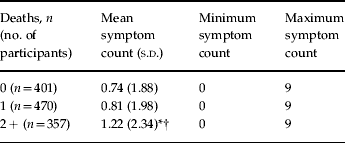
The number of MDD symptoms (prior to the log-transformation process) by the number of deaths experienced is presented in Table 1. As seen there, mean levels of MDD changed significantly with the number of deaths [analysis of variance: F(2, 1225)=5.87, p=0.003]. In particular, those who had experienced two or more deaths evidenced more symptoms of MDD than did those who had experienced one death or no deaths (Cohen's d effect sizes of 0.19 and 0.23, respectively, both p<0.01). Those who had experienced one death or no death did not evidence different levels of MDD symptoms. The overall BIO and ADOP correlations for MDD symptoms were 0.18 and 0.10, respectively, results which indicate modest genetic and shared environmental influences on MDD symptoms in general.
Mean MDD symptom count by number of deaths experiencedFootnote a

MDD, Major depressive disorder; s.d., standard deviation.
a MDD represents the lifetime extended symptom count of MDD.
* Mean value was significantly different from that of the group that experienced no deaths (p<0.05).
† Mean value was significantly different from that of the group that experienced one death (p<0.05).
Moderator models
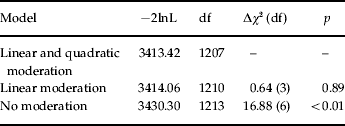
Test statistics for a series of nested moderator models are reported in Table 2. We compared the −2lnL obtained in the least restrictive full moderation model to the −2lnL found for each of the more restrictive models to yield a likelihood-ratio χ2 test of the constraints implied by the more restrictive model. Results reveal that although the three non-linear moderators could be fixed to zero without a decrease in fit, the linear moderators could not, suggesting that the etiology of MDD varies linearly across the number of deaths experienced.
Indices of fit for a series of nested ACE models examining the etiology of MDD by number of deaths experiencedFootnote a
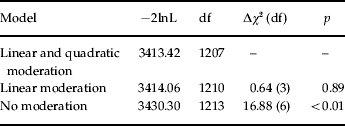
A, C and E, Genetic, shared environmental and non-shared environmental parameters; MDD, major depressive disorder; −2lnL, minus twice the log-likelihood; df, degrees of freedom.
a The fit of each model is compared with that of the least restrictive model (i.e. allows for linear and quadratic ACE moderation). Non-significant changes in χ2 indicate that the more restrictive model (i.e. that model with fewer estimated parameters and therefore more df) provides a better fit to the data. The best-fitting model was thus the linear moderation model.
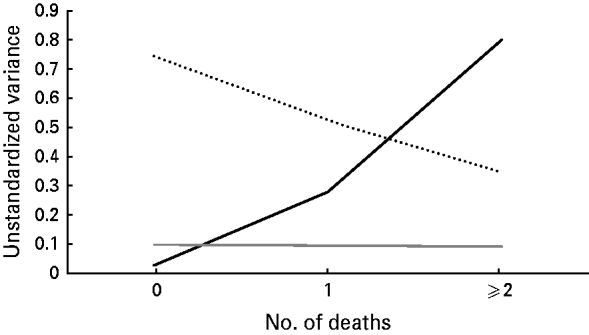
For the best-fitting model, we made use of the estimated paths and moderators (presented in Table 3) to calculate and plot (see Fig. 1) the unstandardized genetic and environmental variance components at each level of the moderator using the following equation:

Of note, because variance is a second-order statistic, the linearity in the best-fitting linear model is at the level of effect rather than the level of variance component (for more information, see Purcell, Reference Purcell2002); as a result, the variance components may appear to shift nonlinearly even though the model itself is linear. For those who had not experienced any deaths, MDD was largely non-shared environmental in origin. Indeed, genetic and shared environmental paths were not significantly greater than zero, as evidenced by confidence intervals that overlapped with zero (see Table 3). However, there was evidence of significant moderation of genetic influences by number of deaths experienced, such that genetic variation increased in magnitude with each death experienced, and was quite pronounced (i.e. accounting for roughly two-thirds of the unstandardized phenotypic variance) for those that had experienced two or more deaths. Non-shared environmental effects appeared to decrease with increasing death exposure, although this effect was not statistically significant. Shared environmental effects remained small and non-significant across all levels of the moderatorFootnote 1Footnote †.
Etiology of major depressive disorder (MDD) by no. of deaths experienced. A (––), C ( ) and E (. . . .) represent genetic, shared environmental and non-shared environmental variance components, respectively. These estimates index the absolute changes in genetic and environmental variance in MDD across the number of deaths (of close friends and family members) experienced.

Unstandardized path and moderator estimates in the best-fitting modelFootnote a

Values are given as estimate (95% confidence interval).
MDD, Major depressive disorder.
a Paths (i.e. a, c and e) and linear moderators (i.e. A1, C1 and E1) are presented. A, C and E (both upper and lower case) represent genetic, shared environmental and non-shared environmental parameters, respectively. Because these path estimates function as intercepts, the genetic and environmental variance components for those who have experienced no deaths can be obtained simply by squaring these estimates. For each subsequent death experience, linear moderators are added to these genetic and environmental paths using the following equation: unstandardized varianceTotal=[a+A1(no. of deaths)]2+[c+C1(no. of deaths)]2+[e+E1(no. of deaths)]2. The variance component estimates calculated in this way are presented in Fig. 1.
* Significant path and moderator estimates (p<0.05).
Discussion
The aim of the present study was to evaluate how exposure to the death(s) of close friends and/or family impacted the etiology of MDD symptoms. Analyses revealed that while shared and non-shared environmental influences on MDD symptoms were not meaningfully moderated with the number of deaths experienced, there were pronounced increases in the magnitude of genetic influences on MDD symptoms with the number of deaths experienced. In particular, genetic influences were estimated to be near-zero for those who had experienced no deaths but were quite large for those who had experienced two or more deaths (i.e. they accounted for roughly two-thirds of the phenotypic variance). Such results are consistent with the notion that exposure to the death of close friends and family may serve to activate genetic risk for depression.
Importantly, these results confirm and extend those of many prior studies indicating that exposure to negative life events moderates genetic risk for depressive symptoms (Silberg et al. Reference Silberg, Rutter, Neale and Eaves2001; Eaves et al. Reference Eaves, Silberg and Erkanli2003; Lau & Eley, Reference Lau and Eley2008). Moreover, some of the earlier studies examined dependent SLEs (i.e. negative life events related to the individual's behaviors or choices), and by doing so, were unable to unambiguously rule out active r GE as an alternate explanation for their results (although they did try to model these effects; see Eaves et al. Reference Eaves, Silberg and Erkanli2003 and Lau & Eley, Reference Lau and Eley2008). The current study, by contrast, examined an independent SLE (i.e. one that was almost fully independent of the individual's behaviors and choices), thus largely circumventing active r GE confounds. Moreover, the current study also suggested that prior indications of GxE between SLEs and MDD symptoms are not specific to twin designs, but appear to extend to adoption designs as well. In this way, the current study suggests that genetic moderation of MDD symptoms by SLEs is a robust effect.
There are several limitations to the current study. First, we examined the number of deaths experienced, without regard to the identity of the deceased (i.e. the deaths of close friends and family members were equally weighted in our study). It is thus possible that the effects were driven by the deaths of particular individuals (e.g. parents). Given the high level of statistical power needed for these GxE analyses, the current study did not have the power needed to explore this possibility; however, we hope that future research will do just this.
Second, we implicitly assumed that the depressive symptoms examined here were subsequent to the deaths of loved ones. However, this assumption was not empirically tested herein, primarily because our data were cross-sectional. Given this, it is theoretically possible that the depressive symptoms preceded the subsequent death(s) of others (e.g. if the death followed a prolonged illness, which brought on the adolescent's depressive symptoms), particularly as we did not assess the relative timing of our two variables, nor the cause of death. Future research should look to replicate these findings in a longitudinal design.
Next, although our examination of deaths as a moderator of genetic influences largely circumvented active r GE as an alternate explanation for our findings, we would not argue that we have fully eliminated this possibility. In particular, our moderator variable included the deaths of close friends, a potentially less-independent SLE (i.e. adolescents may select themselves into a high-risk group of friends where death is more likely to occur, such as joining a gang). Although this does represent a limitation, we would argue that it is important to include the death of close friends given that these experiences can be as traumatic as the deaths of family members (Harrison & Harrington, Reference Harrison and Harrington2001). Moreover, 88% of the deaths experienced in our sample were those of family members, in which active r GE is eliminated as a potential confound. Although this is an advantage, an exclusive focus on the death of family members is also complicated by the possibility of passive r GE confounds (i.e. families experiencing many deaths may be at increased genetic risk for depression, and thus genetic risk and increased death exposure would be correlated in any biological offspring). In sum, future research should seek to examine other independent SLEs that may relate to depression to confirm these results.
Finally, sex and age were regressed out of MDD symptoms prior to analysis, as biometric analyses meaningfully incorporating these demographic variables would be unwieldy and underpowered in the SIBS sample (e.g. sibling pairs evidence a broad range of age and sex compositions). Fortunately, prior studies (see meta-analysis by Burt, Reference Burt2009) have strongly suggested that the magnitude of genetic influences on MDD does not vary across sex. Effects of age and developmental level are less clear (Burt, Reference Burt2009). The latter point is particularly salient here, as late adolescents have a higher likelihood of experiencing a death (simply because they have been alive longer) as well as an increased likelihood of experiencing depressive symptoms (as the incidence of depression increases dramatically from childhood to adolescence across the population). We thus cannot be sure how age would have influenced our results. The age difference between siblings, however, did not appear to influence similarity for number of deaths (52% v. 57% for 0- to 2- and 3- to 5-year sibling age differences, respectively, p=0.21) or sibling similarity for depressive symptoms (correlations of 0.16 v. 0.09, respectively, p=0.39). Regardless, future work should seek to replicate these findings in a sample with the power to examine age.
Despite these limitations, the current study provides evidence for a GxE between exposure to the death of a loved one and the development of MDD symptoms. In particular, genetic influences on MDD symptom counts were estimated to be near-zero for those who had experienced no deaths but were quite large in those who had experienced two or more deaths (i.e. accounting for roughly two-thirds of the phenotypic variance). Such findings offer strong support for the findings of prior research on this topic (Kendler et al. Reference Kendler, Thornton and Gardner2001; Jacobs et al. Reference Jacobs, Kenis, Peeters, Derom, Vlietinck and van Os2006), indicating that prior evidence of genetic moderation of MDD by SLEs extends to other study designs. Furthermore, the current study examined the moderating effects of ‘independent’ life events (i.e. those events out of the individual's control), rather than ‘dependent’ life events (i.e. those events over which the individual exerts some control). Given this, our results largely circumvent active r GEs as an explanation for these results. Instead, the current results are consistent with the notion that exposure to the death of close friends and family may serve to activate genetic risk for depression.
We hope that findings such as these will facilitate future efforts to identify the specific genes involved. For example, Caspi et al. (Reference Caspi, Sugden, Moffitt, Taylor, Craig, Harrington, McClay, Mill, Martin, Braithwaite and Poulton2003) examined whether the number of SLEs (up to 14 events including employment, financial and relationships stressors) moderated the impact of the serotonin transporter gene (5-HTTLPR) on depressive outcomes. They found that those homozygous for the short 5-HTTLPR allele exhibited more depressive symptoms when confronted with SLEs as compared with those with one or two long alleles. Unfortunately, while some studies have supported these results (Kendler et al. Reference Kendler, Kuhn, Vittum, Prescott and Riley2005; Jacobs et al. Reference Jacobs, Kenis, Peeters, Derom, Vlietinck and van Os2006; Kim et al. Reference Kim, Stewart, Kim, Yang, Shin, Kim and Yoon2007), others (including a recent meta-analysis) were unable to replicate these findings (Gillespie et al. Reference Gillespie, Whitfield, Williams, Heath and Martin2005; Surtees et al. Reference Surtees, Wainwright, Willis-Owen, Luben, Day and Flint2006; Risch et al. Reference Risch, Herrell, Lehner, Liang, Eaves, Hoh, Griem, Kovacs, Ott and Merikangas2009). In short, it remains unclear whether 5-HTTLPR is one of genes involved in this GxE. The strength of the current results, however, attests to the presence of GxE, even if the specific genes involved are currently unknown. Future work should thus examine this and other genes to determine the specific polymorphisms whose effects are moderated by SLEs.
Acknowledgements
This research was funded in part by United States Public Health Service (USPHS) grants no. AA11886 and MH066140.
Declaration of Interest
None.