Introduction
The lichen genus Pertusaria (Pertusariaceae, Pertusariales, Lecanoromycetes, Ascomycota) was established by de Candolle (de Lamarck & de Candolle Reference de Lamarck and de Candolle1805). It is the largest genus in the Pertusariaceae and includes more than 500 species (Kirk et al. Reference Kirk, Cannon, Minter and Stalpers2008). The morphological characters of the genus are variable and the chemistry is complex. Only 20 corticolous species of Pertusaria, with disciform apothecia and 8-spored asci, are reported worldwide (Fink Reference Fink1935; Dibben Reference Dibben1980; Sipman Reference Sipman1993; Brodo et al. Reference Brodo, Sharnoff and Sharnoff2001; Galloway Reference Galloway2007; Ren et al. Reference Ren, Sun and Zhao2009; Smith et al. Reference Smith, Aptroot, Coppins, Fletcher, Gilbert, James and Wolseley2009; Spribille et al. Reference Spribille, Pérez-Ortega, Tonsberg and Schirokauer2010; Archer & Elix Reference Archer and Elix2011). An interesting and unusual Pertusaria species was found in south-western China and is described here as new to science.
Materials and Methods
The specimens studied were collected from Yunnan, China, and are preserved in SDNU (Lichen section of the Botanical Herbarium, Shandong Normal University). The morphological and anatomical characters of the specimens were examined under a stereomicroscope (COIC XTL7045B2) and a polarizing microscope (OLYMPUS CX41). The lichen substances were identified using standardized thin-layer chromatography techniques (TLC) with solvent system C (Orange et al. Reference Orange, James and White2010). Photographs of this species were taken under an OLYMPUS SZX16 stereomicroscope and BX61 compound microscope with DP72.
The New Species
Pertusaria yunnana G. L. Zhou & Lu L. Zhang sp. nov.
MycoBank No.: MB804508
Thallus crustose, off-white, isidia and soredia absent, corticolous. Apothecia disciform 0·8–3·0 mm diam., disc pruinose. Asci 8-spored. Ascospores 20·0–32·5× 10·0–17·5 µm, walls smooth, 2·5–3·0 µm thick. Thallus contains atranorin and fumarprotocetraric acid.
Type: China, Yunnan Province, Kunming, Mt. Jiaozixue, on bark, 3800 m alt., 27 October 2008, Z. J. Ren 20081952 (SDNU—holotype).
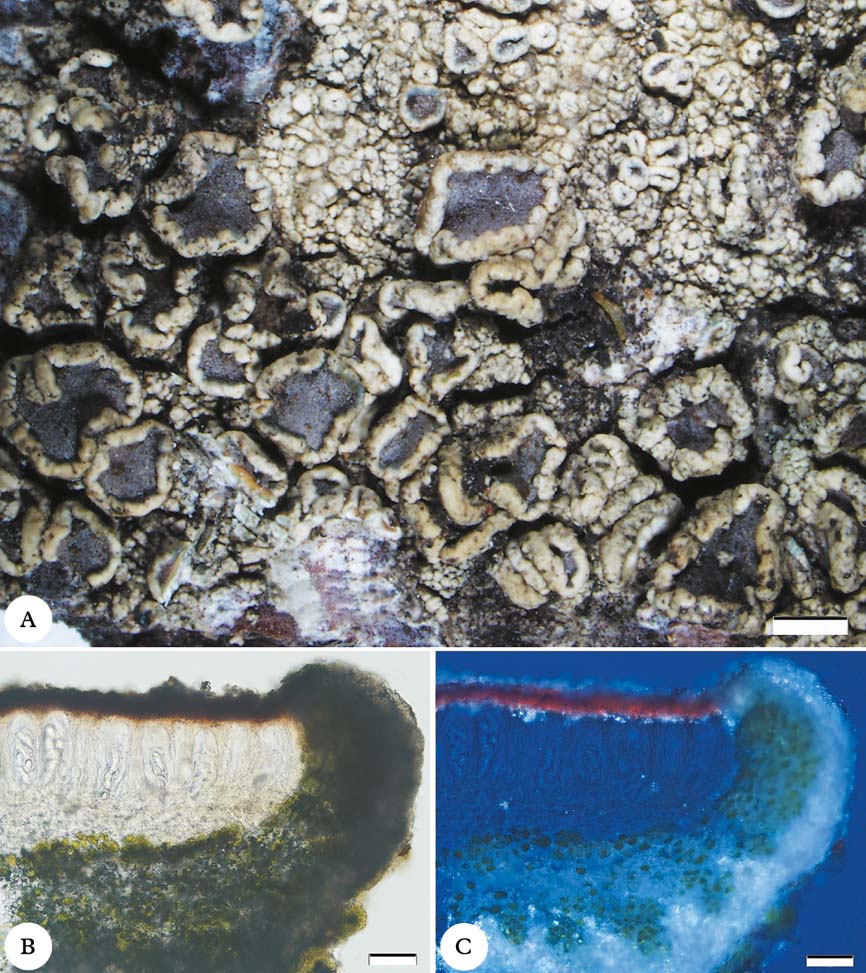
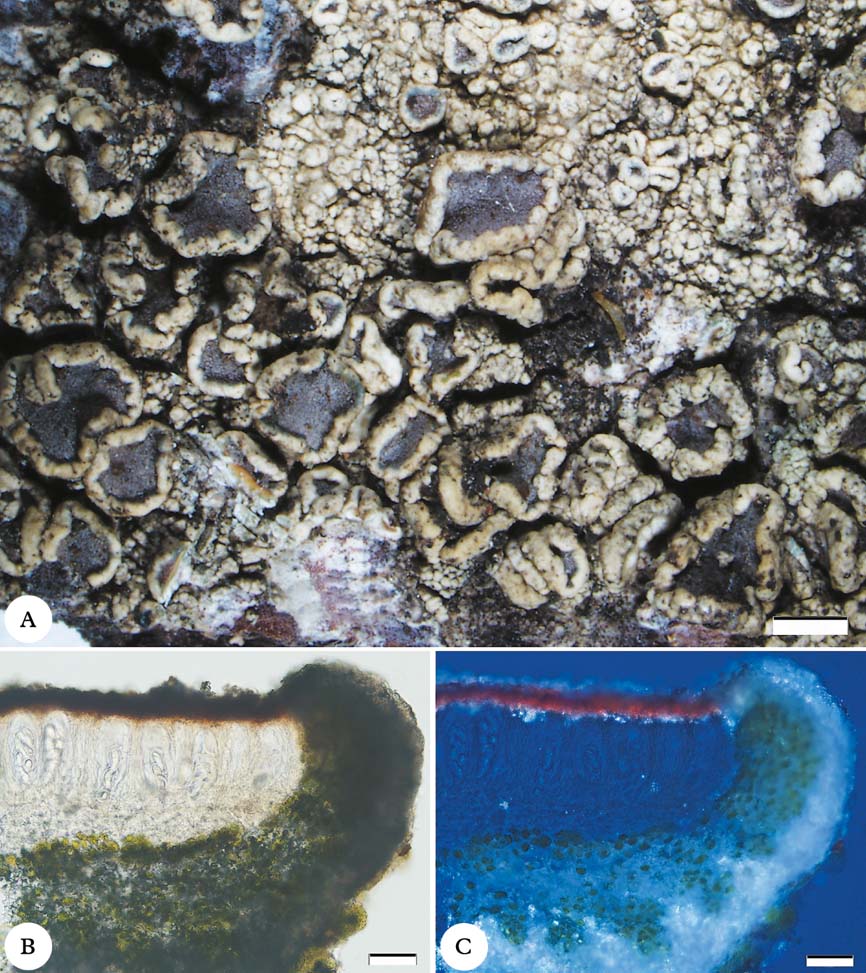
Pertusaria yunnana (20081952 SDNU). A, thallus with apothecia; B, apothecium section; C, crystals of apothecium section visualised with polarized light. Scales: A=1 mm; B & C=50 μm. In colour online.
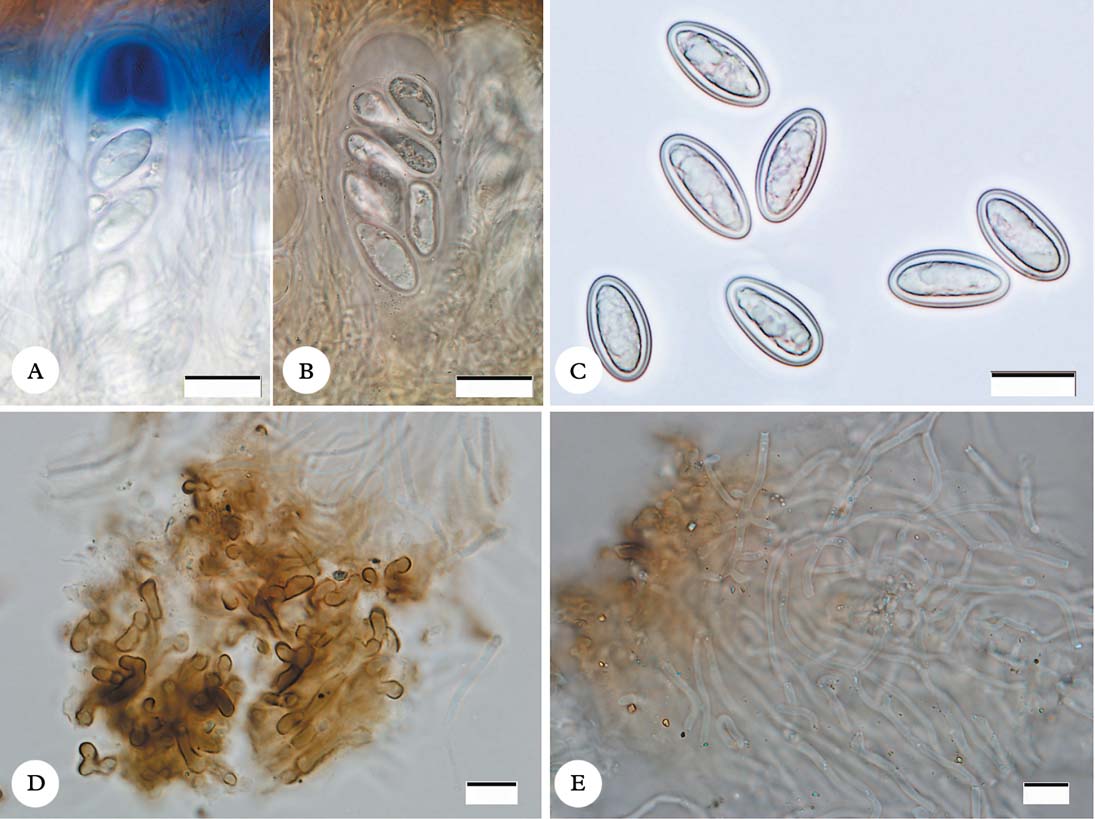
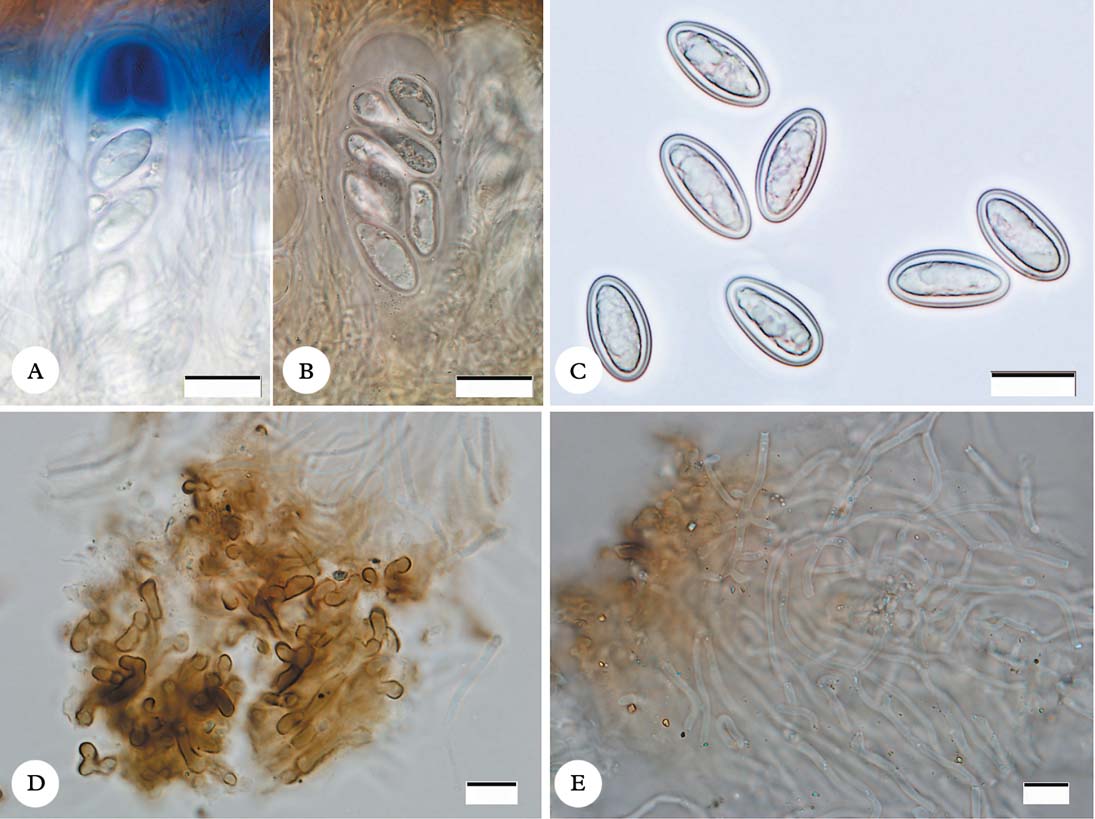
Pertusaria yunnanna (20081952 SDNU). A, ascus apex reaction; B, ascus; C, ascospores; D, tips of paraphyses; E, low part of paraphyses. Scales: A–C=20 μm; D & E=10 μm. In colour online.
Thallus crustose, off-white to pale grey, thick, verrucose, lacking isidia and soredia, corticolous; cortex 15–18 µm, algal layer thick, 160–180 µm; cortex and medulla with crystals dissolving in KOH solution. Prothallus absent.
Apothecia numerous, disciform with prominent margins, with strongly constricted base, 0·8–3·0 mm diam., 0·2–0·7 mm high; margins concolorous with thallus, prominent, flexuous in the mature apothecia; disc red-brown to dark brown, surface of disc mostly heavily white pruinose. Amphithecium with very thick algal layer and obvious small crystals dissolving in KOH solution, 113–170 µm thick. E pihymenium red-brown, K−, 13–25 µm high, with abundant red crystals dissolving in KOH solution. Hymenium hyaline, not inspersed with oil droplets, 87·8–125 µm high. Hypothecium hyaline, 50–88 µm high. Paraphyses branched to anastomosing in the lower parts, moniliform with 2–3 short, swollen brown-pigmented cells at tips. Asci clavate, 8-spored, tholus I+ blue, slightly paler in the centre around the ocular chamber. Ascospores biseriate, ellipsoid, smooth, 20–33 µm long, 10–178 µm wide, double-walled, 2·5–3·0 µm thick.
Pycnidia not observed.
Chemistry
Spot tests: thallus K+ yellow, C−, KC−, P+ orange to red. TLC showed the presence of atranorin and fumarprotocetraric acid.
Etymology
The specific epithet ‘yunnana’ refers to Yunnan Province, where this species was collected.
Distribution and ecology
Pertusaria yunnana occurs on the smooth bark of Pinus sp. at altitudes of 3800–4000 m at two localities in Yunnan, south-west China, where it occurs together with a corticolous species of Fuscidea V. Wirth & Vězda.
Notes. Pertusaria yunnana is characterized by the white pruinose disciform apothecia, asci with 8 ascospores, and its chemistry with atranorin and fumarprotocetraric acid. This new species has some aspects of the Lecanora subfusca group, having reddish brown apothecia and calcium oxalate crystals in the margins, and containing atranorin (Brodo Reference Brodo1984), but the new species has larger apothecia, thicker spore walls and the asci are of the Pertusaria-type. In the genus Pertusaria, P. borealis Erichs, P. pupillaris (Nyl.) Th. Fr., P. subambigens Dibben and P. suboculata Brodo & Dibben resemble this new species in having disciform apothecia, 8-spored asci and containing fumarprotocetraric acid. However, P. borealis has a sorediate thallus and smaller ascospores (18–20×10–14 µm) and contains protocetraric acid in addition to fumarprotocetraric acid. Pertusaria pupillaris has punctiform soralia, the epihymenium is olive-green, K+ violet and the ascospores are smaller (10–14×7–11 µm). Pertusaria subambigens has a pale yellowish, pink, greenish or black disc and the 8 ascospores in ascus are uniseriate. Pertusaria suboculata, with a K+ strongly violet epihymenium, contains gyrophoric acid as well as fumarprotocetraric acid. In addition to the four species above, P. bambusetorum also resembles this new species in having disciform apothecia with prominent, flexuous margins and white pruinose discs. However, P. bambusetorum has 2-spored asci, larger ascospores (50–55×20–22 µm) and different lichen substances (thallus and medulla K−, C−).
Additional specimens examined. China: Yunnan Prov.: Lijiang, Mt. Laojun, 4000 m alt., on bark, 2009, Q. Tian 20100370 (SDNU); Lijiang, Mt. Laojun, 3800 m alt., on bark, 2009, Q. Tian 20100367 (SDNU), 20100368 (SDNU).
Key to corticolous species of Pertusaria with disciform apothecia and 8-spored asci
-
1 Thallus with soredia ... 2
Thallus without soredia ... 3
-
2(1) Apothecia rare, disc pale pink, ascospores 18–20×10–14 µm ... P. borealis
Apothecia 1 per wart, disc red-black, ascospores 10–14×7–11 µm ... P. pupilaris
-
3(1) Lichen compounds absent ... 4
Lichen compounds present ... 5
-
4(3) Disc pale grey, epruinose; ascospores 33–41 µm long ... P. duppensis
Disc black, pruinose; ascospores 15–20 µm long ... P. sporellula
-
5(3) Fumarprotocetraric acid as major compound ... 6
Fumarprotocetraric acid not as major compound ... 8
-
6(5) Epithecium K− ... 7
Epithecium K+ violet ... P. suboculata
-
7(6) Ascospores predominantly uniseriate, 9–28 µm long ... P. subambigens
Ascospores predominantly biseriate, 20–32 µm long ... P. yunnana
-
8(5) Norstictic acid present ... 9
Norstictic acid absent ... 11
-
9(8) Lichexanthone present ... P. phlyctaenula
Lichexanthone absent ... 10
-
10(9) Ascospores 12–22 µm long ... P. ambigens
Ascospores 20–32 µm long ... P. elatior
-
11(8) Thamnolic acid present ... 12
Thamnolic acid absent ... 14
-
12(11) Ascospores globular, 20–25 µm diam. ... P. gongylospora
Ascospores ellipsoid ... 13
-
13(12) Ascospores biseriate, 30–50 µm long ... P. epitheciifera
Ascospores uniseriate, 22–32 µm long ... P. thamnolica
-
14(11) Lecanoric acid as major compound ... 15
Lecanoric acid not as major compound ... 17
-
15(14) Gyrophoric acid present ... P. glaucomela
Gyrophoric acid absent ... 16
-
16(15) Lichexanthone present ... P. pycnophora
Lichexanthone absent ... P. kaindiensis
-
17(14) 5-O-Methylhiascic acid present ... P. mccroryae
5-O-Methylhiascic acid absent ... 18
-
18(17) Disc pruinose ... 19
Disc epruinose ... 20
-
19(18) Disc pale orange-brown to grey, ascospores 16–27 µm long ... P. truncate
Disc pink or incarnadine, ascospores 27–40 µm long ... P. wulingensis
-
20(18) Disc pink or red, epithecium K− ... P. carneopallida
Disc dark brown to black, epithecium K+ violet ... P. hymenea
The present study was financially supported by the Programme for Scientific Research Innovation Team in Colleges and Universities of Shandong Province and the National Natural Science Foundation of China (31070010 & 31170187). We are grateful to Dr André Aptroot (ABL Herbarium, Soest, The Netherlands) and Professor Jack Elix (Australian National University) for assistance in specimen identification.