

INTRODUCTION
The illegal trade in wildlife resources is one of the key threats to global biodiversity loss (Butchart et al. Reference Butchart, Walpole, Collen, van Strien, Scharlemann, Almond and Baillie2010). Trade occurs from local to global scales, most of which is unregulated, unsustainable and has detrimental effects on ecosystems (Duckworth et al. Reference Duckworth, Batter, Belant, Bennett, Brunner, Burton and Challender2012). Due to its clandestine nature, there are several methodological difficulties in accurately monitoring the illegal wildlife trade, and the majority of previous work has been biased towards fauna over flora species (see Keane et al. Reference Keane, Jones, Edwards-Jones and Milner-Gulland2008; Nijman Reference Nijman2010; Phelps & Webb Reference Phelps and Webb2015).
Although data on the illegal wildlife trade are inherently incomplete (Rosen & Smith Reference Rosen and Smith2010), seizure records such as in the Convention on International Trade in Endangered Species of Wild Fauna and Flora (CITES) trade database are a main source of information on the trade of several wildlife and plant species (Ferriss Reference Ferriss2014; D'Cruze & Macdonald Reference D'Cruze and Macdonald2016; UNODC 2016). Data can also be acquired through national governments, regional enforcement offices, non-governmental organizations (NGOs; e.g. World Wide Fund for Nature (WWF), Environmental Investigation Agency (EIA) and TRAFFIC; Gomez et al. Reference Gomez, Leupen, Theng, Fernandez and Savage2016) or specific database systems for high-profile species (Rosen & Smith Reference Rosen and Smith2010; Underwood et al. Reference Underwood, Burn and Milliken2013; Challender et al. Reference Challender, Harrop and MacMillan2015). Using the CITES seizure data by itself can be relatively limiting, for reasons such as the periodic time lag between trade occurring and trade reporting (UNODC 2016), dependency on reporting rates for each country (Pistoni & Toledo, Reference Pistoni and Toledo2010; Milliken et al. Reference Milliken, Burn, Underwood and Sangalakula2012) and inaccuracy or absence of information on domestic trade (Blundel & Mascia Reference Blundell and Mascia2005; Giles et al. Reference Giles, Ky, Hoang and Vincent2006; Phelps et al. Reference Phelps, Webb, Bickford, Nijman and Sodhi2010), as well as the overlooking of trade in non-CITES species (Bruckner Reference Bruckner2001; Schlaepfer et al. Reference Schlaepfer, Hoover and Dodd2005; Rhyne et al. Reference Rhyne, Tlusty, Schofield, Kaufman, Morris and Bruckner2012). Alternative monitoring methods are therefore increasingly utilized to fill data gaps (Phelps & Webb Reference Phelps and Webb2015). One such example is the use of publicly available news articles to monitor the trade of pangolins (Nijman Reference Nijman2015; Cheng et al. Reference Cheng, Xing and Bonebrake2017).
Among plant species, timber is one of the most traded items (Brack Reference Brack2003), with illicit timber logging accounting for a substantial volume of activity (Sundström Reference Sundström2016). Several initiatives have been launched to promote the sustainable trade of various species (Li & Chen Reference Li and Chen2015). This includes domestic and regional legislative bans on illegal timber (Brack Reference Brack2010), forest certification systems to track the legality of forest products along the supply chain (Lawson & Macfaul Reference Lawson and MacFaul2010), legality verification (Li & Chen Reference Li and Chen2015) and global initiatives such as the Forest Law Enforcement Governance and Trade (FLEGT) action plan implemented to curb illegally sourced timber in markets by improving existing legislation in source countries whilst pushing consumer countries to heavily scrutinize imports (Cashore & Stone Reference Cashore and Stone2012). Furthermore, CITES, which is often seen to focus on animal species, has recently turned its attention to regulation of the commercial trade in many high-value endangered hardwood species (Schloenhardt Reference Schloenhardt2008; Phelps & Webb Reference Phelps and Webb2015).
A group of timber species currently under significant threat from unregulated trading is rosewood. A specific group of rosewood species are further classified as hongmu, which consists of 33 species in five key genera consisting of Dalbergia, Pterocarpus, Diospyros, Millitia and Cassia, distributed across Africa, Latin America and Asia (Treanor Reference Treanor2015). Hongmu possess a characteristic heartwood, with unique deep-red colouring, aromatic scent and distinctive durability (EIA 2014). Several hongmu species have previously been logged to produce high-value decorative timbers (e.g. musical instruments; Innes Reference Innes2010), but in the past decade have become popular in China among rapidly growing, wealthy, middle-class elites (Schuurman & Lowry Reference Schuurman and Lowry2009; Treanor Reference Treanor2015; CITES 2016a). This has led to highly unregulated trade and the commercial extinction of several species, including fragrant rosewood or huang hua li (Dalbergia odorifera) in China (EIA 2016) and Madagascar rosewood (Dalbergia baronii) (Schuurman & Lowry Reference Schuurman and Lowry2009; Innes Reference Innes2010).
Siamese rosewood (Dalbergia cochinchinensis) is one of the high-grade rosewoods found in Cambodia, Lao PDR, Thailand and Vietnam (Winfield et al. Reference Winfield, Scott and Grayson2016). The region of Southeast Asia serves as one of the hotspots for rosewood, particularly for Dalbergia and Pterocarpus species (Treanor Reference Treanor2015). Between 2000 and 2013, the Mekong region (Cambodia, Laos PDR, Myanmar, Vietnam and Thailand) exported over US$2.4 billion of rosewood to China, accounting for 70% of Chinese markets (EIA 2014). As a highly collectible and increasingly rare commodity, the market value of Siamese rosewood in 2012 was US$15 000 m−3, 15-times higher than in 2005 (Wenbin & Xiufang Reference Wenbin and Xiufang2013; EFI 2014). Domestically, Siamese rosewood has been legally protected in all its range states since 2008 (EIA 2014). Internationally, CITES included Siamese rosewood as an Appendix II species in 2013 (CITES 2016a) and in 2016 listed all Dalbergia species on Appendix II (CITES 2016b).
Despite increased efforts in regulation and enforcement, the illegal logging of Siamese rosewood remains rampant (EIA 2014; Singh Reference Singh2014). The demand for such a high-value commodity has led to increased militarization within forests, resulting in fatal clashes between enforcement officers and armed loggers backed by organized syndicates and enforcement officers in Laos (Dwyer et al. Reference Dwyer, Ingalls and Baird2016), Thailand (EIA 2014) and Cambodia (Phnom Penh Post 2017). This trade persists partly due to governmental commodification and lax import laws in China (Treanor Reference Treanor2015), but also due to corruption among governments, traders and local communities in source countries and the exploitation of legal loopholes in domestic and regional policies within the Asia-Pacific region (Schloenhardt Reference Schloenhardt2008; Singh Reference Singh2014; Sundström Reference Sundström2016). Most of the previous reports have highlighted the general global trade trends (e.g. UNODC 2016; Winfield et al. Reference Winfield, Scott and Grayson2016), with a specific focus on the corrupt networks operating within the region (e.g. EIA 2014, 2016).
There are many factors that drive the illegal wildlife trade, including poverty, resource management, legislation, market demand and awareness (TRAFFIC 2008). Economic indicators such as gross domestic product and gross provincial product (GPP) are proxies that reflect the economic status of a population (Douglas & Alie, Reference Douglas and Alie2014). Although there are detailed complexities to the definition of poverty (Duffy et al. Reference Duffy, St John, Büscher and Brockington2015), there is a strong relationship between poverty and illicit activity such as illegal wildlife hunting (Mackenzie et al. Reference Mackenzie, Chapman and Sengupta2011). It is also crucial to evaluate the resource management or availability (TRAFFIC 2008) – in this case of source countries – of the remaining distribution of Siamese rosewood trees. As there are no updated official records on the remaining populations of rosewood (Schloenhardt Reference Schloenhardt2008), forest cover per province is the only available proxy for remaining stocks (Patel Reference Patel2007).
Here, we investigate the trade of Siamese rosewood in Thailand by using seizure records reported in public media from January 2014 to April 2016. We attempt to explain the patterns of the trade (Table 1). First, we test for spatial and temporal patterns associated with the trade, then we consider economic and ecological factors to explain patterns of trade. We discuss the effectiveness of domestic and international regulations currently implemented for the protection of rosewood species and we evaluate the use of media-sourced seizure data to study the illegal trade.
Hypotheses and respective proxies used to quantify and explain the trade of Siamese rosewood trade in Thailand. CITES = Convention on International Trade in Endangered Species of Wild Fauna and Flora.

METHODS
Data collection
Public online news reports on Siamese rosewood seizures from January 2014 to April 2016 were searched in April to May 2016 in Thai language using the tags ‘rosewood’ (Thai:  , rosewood;
 , rosewood trade;
 rosewood arrests) News agencies included Manager (manager.co.th), Thairath (thairath.co.th), Daily News (dailynews.co.th), MCOT (tnamcot.com) and Banmuang (banmuang.co.th).
The five news agencies selected were the most popular daily online news sites in Thailand (4International Media & Newspapers 2016). The selection sufficiently covered the media coverage of Siamese rosewood seizures as represented in Thai online media; this is confirmed as the number of reports did not increase with the addition of more news sites. Details were collected for each article, where possible, on date, location (district and province), number and/or volume seized, intended destinations and respective government agencies conducting the arrest. Other details were also included, such as if suspects were apprehended, nationality of suspects, if cash was also found in-hand or if other prohibited timber was also found in the same seizure. Each report was classified according to type as ‘storage’ (timber stored or hidden in private properties, facilities or warehouses), ‘en route’ (timber seized during transport), ‘protected areas’ (cases seized within or bordering government-protected areas) or ‘on-the-spot logging’ (reports of rosewood trees being cut down in non-protected areas).
Each news article normally corroborates the news source, often the arresting government, which increases the validity to the news article. The respective news sites were reviewed twice to ensure all cases were included. Each report was treated as an independent case and extensively cross-checked for repetition and factual accuracy. In the case of duplications, the report with the most details was selected (cf. Nijman Reference Nijman2015).
Statistical analyses
Each seizure (regardless of number of logs seized) was treated as one unit of analysis. Where available, we also analysed the number of logs seized. In Thai language, ‘ton’ ( ) refers to log-shaped items, often referring to raw logs, debarked logs or even sawn logs of all sizes (branches, whole trunks and parts of trunks). Most records were of the number of ‘logs’ rather than volume of timber seized.
Data collected were separated into 4-month periods in order to analyse temporal trends and broken down to the provincial level for spatial analysis. To predict the provincial variation of the total number of logs and the number of seizures, we used the shortest overland distance to a land border, using the district with the largest number of seizures as the centre point, provincial human population size as of 2012 (NESBD 2014), GPP per capita for 2014 (in Thai baht) (NESBD 2014) and forest area (in km2) for each province (DNP 2014).
All data were log-transformed prior to analysis. Statistical analysis was conducted using R version 3.2.1 (R Core Team 2016), using the simple linear (lm) model in R, accepting significance as p < 0.05 in a two-tailed test.
Monetary values were invariably reported in Thai baht; these were converted to US$ (US$1 = 35.7 baht, June 2016; in the 2.5-year period, the range was 31.8–36.4 baht).
RESULTS
General trade patterns
From January 2014 to April 2016, a total of 929 seizures were recorded from 37 of 76 Thai provinces, of which 835 were unique individual seizures (see Supplementary Table S1, available online). Approximately 94% (788/835) of these referred exclusively to Siamese rosewood, whereas the remainder also involved other prohibited woods such as Burmese rosewood (Dalbergia oliveri), Burmese padauk (Pterocarpus macrocarpus) and teak (Tectona grandis).
Seizures ranged from single logs through to over 10 000 logs seized from a private property in Amnatcharoen province in January 2015. A total of 88% (735/835) of seizures contained information on the quantities of Siamese rosewood seized, totalling 80 433 logs, suggesting that the total amount of seized goods might be close to 100 000 logs. Most seizures were reported in terms of ‘logs’ (394 referred specifically to ‘logs’; 264 reported a mix of transformed logs); there were 85 seizures of sheets or sawn timber boards and 47 did not report details related to the form of the timber.
The average was 110 logs per seizure. The most frequent types of cases were seizures caught or en route (345/835), where seizures averaged 64 logs per seizure (Fig. 1). Logs found in storage seizures were larger, averaging 208 logs per seizure, and facilities used in storage-based seizures (278/835) ranged from individual private housing, cargo containers in shipping ports, abandoned warehouses, schools, temples and forest boundaries. Seventeen seizures from large-scale facilities and shipping port raids did not report exact volumes or numbers of logs seized. Seizures conducted within government areas, such as protected areas or wildlife sanctuaries (130/835), averaged 48 logs per seizure, with the highest rate of suspects caught, averaging three to four suspects per seizure. There was a significant decrease in the number of seizures over time (linear regression: F 1,5 = 18.32, p < 0.05), but there was no statistical difference in the number of logs seized per seizure over time (linear regression: F 1,5 = 0.08, p = 0.79) (Fig. 2).
Plot of seizure frequency against number of logs per seizure in the following categories: ‘on-the-spot logging’ (OTSL; rosewood trees cut down in non-protected areas); ‘protected areas’ (PA; cases seized within or bordering government-protected areas); ‘en route’ (ER; timber seized during transport); and ‘storage’ (ST; timber stored or hidden in private properties, facilities or warehouses).

Plot of mean number of seizures (circles) and mean number of logs seized (squares) per 4 months from January 2014 to April 2016.

In 45% (377/835) of seizures, suspects were apprehended at the scene. Where information was provided (301 seizures and 873 suspects), >81% of the suspects were Thai, and 85% (198/229) of Thai suspects originated or lived in the 20 provinces in the north-eastern region, where most of the seizures were made. Other suspects were found to be from bordering nations (145 from Cambodia, 16 from Laos and 2 from China). Vehicles were modified to maximize carry load, and in some cases front and/or back vehicles were present to scout for roadside checkpoints for the central vehicle and/or to serve as escape vehicles. Suspects were also found to carry cash-in-hand upon arrest. From the 109 reports that stated exact cash rewards, the amount of financial payment promised to the suspects averaged US$336 (range US$28–2801).
Legal protection of Siamese rosewood
Of the 835 reports, the Royal Thai Police were involved in 69% of all cases (579/835). Officers from the Department of National Parks, Wildlife and Plant conservation or the Royal Forestry Department were also present to verify the timber in 41% of cases (344/835). Thailand's military sector was involved in 45% of cases, with the navy patrolling heavily along the Mekong River. Other agencies involved included Thai Customs, the Immigration Bureau and the Department of Special Investigations. Most seizure reports refer to the legal penalties involving the possession of prohibited timbers in relation to the protection articles within the Thai constitution; however, in 929 reports, there was no mention of CITES regulations and/or penalties.
Spatial patterns of the Siamese rosewood trade
The rosewood trade in Thailand was concentrated in the north-eastern and eastern provinces, especially in provinces bordering Cambodia and Laos (Fig. 3). Provinces with the highest numbers of seizures reported are Ubonratchathani (201), Sisaket (96) and Mookdaharn (78). The Mekong River was used as the main crossing point for transport across the border, using motorized boats moored along the riverbanks. Many news articles indicated that the logs seized were being directed to China as a consumer country.
Distribution of rosewood seizures by province in Thailand from January 2014 to April 2016.
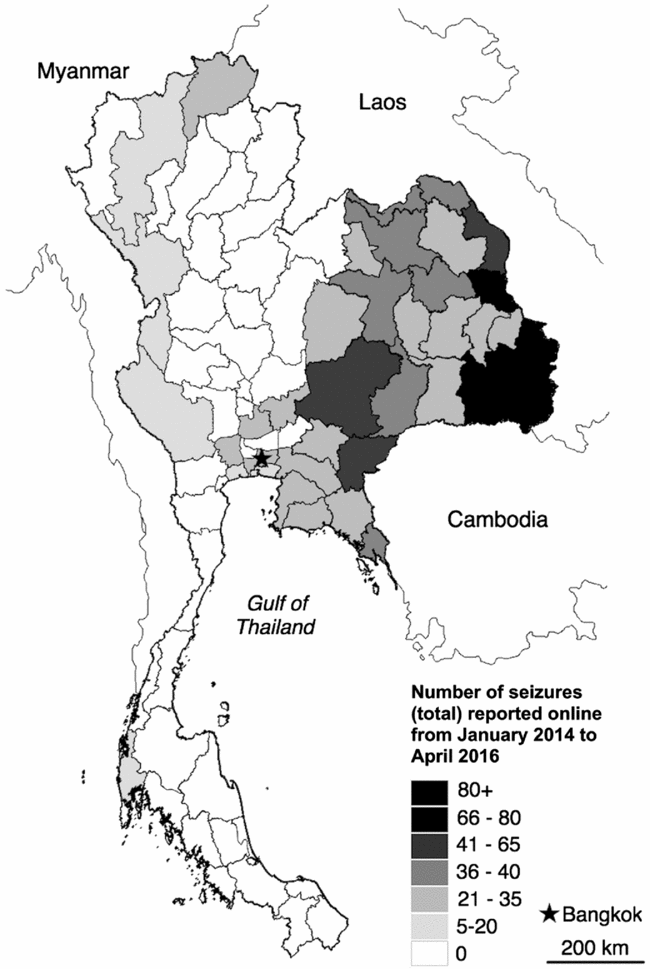
The numbers of seizures per province showed significant negative relationships with the distance to the nearest land border (linear regression: F 1,35 = 14.67, p < 0.0005) and with the GPP per capita (linear regression: F 1,35 = 7.17, p < 0.05). Population size and forest cover showed no significant relationships with seizure rates (linear regression: F 1,29 = 0.27, p = 0.61; F 1,27 = 0.11, p = 0.45, respectively).
DISCUSSION
Using online-sourced seizure data, we show that the Siamese rosewood trade network is dispersed throughout Thailand, with a concentration in the eastern and north-eastern regions. Overall, Thailand acts as a source and transport country. Seizure activity was greater along the border with Cambodia and Laos, indicating intention to move the logs over the border for international trade, as per NGO reports that highlighted the pathway to China (EIA 2014, 2016; Treanor Reference Treanor2015). The Mekong River bordering Thailand, Laos and Cambodia is porous and encourages open movement as a convenient escape route (cf. Phelps et al. Reference Phelps, Webb, Bickford, Nijman and Sodhi2010). Industrial shipping ports are also increasingly used (e.g. Lamchabang port in Chonburi province), as cargo containers hold large volumes of logs that are often misdeclared as other products. The various modes of transport emphasize the large-scale domestic and regional networks operating for this trade.
One of the drivers of the trade could be money, as provinces with lower incomes (GPP) had higher seizures rates. The high financial reward for storing or transporting timber, in combination with unreliable income from traditional sources such as agriculture or farming (Reuters 2016), may incentivize people to get involved in illicit activity. The relationship between poverty and illicit activity such as wildlife hunting has been highlighted in previous literature (Mackenzie et al. Reference Mackenzie, Chapman and Sengupta2011). Other factors in the present analysis did not show significant statistical correlation, but this could largely be due to misrepresentation. Although many cases of illegal rosewood logging occur within protected areas (Patel 2008; Schloenhardt Reference Schloenhardt2008), it is not limited to just national parks; Siamese rosewood is also found to be targeted towards public spaces and private properties. The use of percentage forest area as an environmental proxy is therefore not directly representative; however, there is no recent census of the remaining population of Siamese rosewood (EIA 2014). This highlights the data gap that is required in order to effectively evaluate and manage this species.
The findings here represent a fraction of the trade. As one of the main agencies involved, the Department of National Parks, Wildlife and Plant Conservation has revealed that Siamese rosewood is still significantly seized in high volumes (DNP 2016). Political instability, poor governance and ill-conceived environmental policies are key drivers of corruption and exploitation of natural resources in developing nations (Innes Reference Innes2010; Douglas & Alie Reference Douglas and Alie2014), and Thailand's political status has been relatively unstable since the military coup in 2014 (Freedom House 2016).
Utility of seizure data
Seizure reports are a viable source of data used to illustrate the presence and patterns of the Siamese rosewood trade in Thailand, as reported in previous studies of the illegal wildlife trade (Underwood et al. Reference Underwood, Burn and Milliken2013; Nijman Reference Nijman2015; D'Cruze & Macdonald Reference D'Cruze and Macdonald2016; Gomez et al. Reference Gomez, Leupen, Theng, Fernandez and Savage2016; UNODC 2016; Cheng et al. Reference Cheng, Xing and Bonebrake2017). Although news articles are dependent on reporting rates in the same way as official seizure data are (Rosen & Smith Reference Rosen and Smith2010), the different numbers of news outlets increases the chances of reporting. When multiple reporting agencies are used to gauge seizure data, this makes it possible to capture the magnitude of the trade; however, double and triple reporting inevitably becomes an issue. By including just the two largest online news agencies (out of the five) in our study, we retrieved 81.4% of all seizure reports; adding the third largest led to an increase of 8.1%, a fourth 7.6%, whereas adding the fifth agency only added 2.9%. This shows that including more agencies only leads to marginal increases in the number of new seizure reports.
Given cautious and systematic data collection, online media can be a highly useful sources of alternative seizure data, as there are degrees of flexibility in conducting research in different languages with minor geographic limitations (Nijman Reference Nijman2015). It is also a novel proxy that reflects real-time trends, independent of governments or monitoring agencies. This thereby addresses issues of the periodical delays in information being released by monitoring agencies such as CITES or UN Comtrade databases (Phelps et al. Reference Phelps, Webb, Bickford, Nijman and Sodhi2010). In Thailand, timber crime is not viewed as negatively as other illegal wildlife crime; therefore, authorities are more encouraged to report seizures.
The CITES trade database does not include the trade of other non-CITES listed species (Bruckner Reference Bruckner2001; Schlaepfer et al. Reference Schlaepfer, Hoover and Dodd2005; Rhyne et al. Reference Rhyne, Tlusty, Schofield, Kaufman, Morris and Bruckner2012), the poaching of species (UNODC 2016) or trade in domestic markets (Pistoni & Toledo Reference Pistoni and Toledo2010). Third-party monitoring sources can therefore be used to cross-check official government reports (Coston Reference Coston1998; Blundell & Mascia Reference Blundell and Mascia2005), and also to complement official trade statistics by providing valuable insight into the specific nuances of the trade and to reduce gaps in understanding. For example, in the CITES trade database, records on Siamese rosewood are relatively limited, only showing decreased export volume over time from key exporters such as Laos, Cambodia and Vietnam, and only one single report of confiscated Siamese rosewood from Germany to China (P. Siriwat & V. Nijman, unpublished data 2017). Therefore, these independent records of illegal trade activity, as used in this study, can be proactively used to monitor conservation efforts, help inform and reveal current gaps and ambiguities in the legal systems and lead to positive policy reforms extending beyond just monitoring and enforcement, which importantly corroborate and reflect current trade situations (Phelps et al. Reference Phelps, Shepherd, Reeve, Niissalo and Webb2014; Phelps & Webb Reference Phelps and Webb2015).
Rosewood legislation
Inadequate domestic and regional legislation is a fundamental issue that needs to be addressed, and suggestions to review legislation for the live reptile and amphibian trade (Nijman & Shepherd Reference Nijman and Shepherd2011) and the orchid trade (Phelps Reference Phelps2013) in Thailand have previously been highlighted. In this rosewood-specific case, English translated names of species used by the Thai government are inconsistent with the international literature (Department of Agriculture 2016; see Supplementary Table S2). Unclear taxonomic nomenclature can lead to inaccurate reporting of legal and illegal trade or even delayed prosecution, and thus it is important to update legislation in order to minimize trans-border inconsistencies and enable law enforcement agencies to be in agreement (Zhou et al. Reference Zhou, Newman, Buesching, Meng, Macdonald and Zhou2016).
Similarly, inconsistencies in export quotas within the Mekong region open channels for corruption and for illegally sourced rosewood to cross borders and become legal for export (Innes Reference Innes2010; EIA 2014). The Mekong River has been previously highlighted as a channel to move wildlife products such as wild orchids (Phelps et al. Reference Phelps, Webb, Bickford, Nijman and Sodhi2010) and other wildlife products (Shepherd et al. Reference Shepherd, Compton and Warne2007). Higher export quotas and allowances in neighbouring countries like Laos and Cambodia inevitably drive the movement of logs across the border (Treanor Reference Treanor2015). Furthermore, despite the clear intention of crossing international borders, we found a lack of acknowledgement of CITES penalties in all 929 news reports. This suggests that crimes related to the Siamese rosewood trade may not be considered an international issue and may represent the state's indifference towards this convention (Nijman & Shepherd Reference Nijman and Shepherd2011).
At the 17th meeting of the Conference of the Parties to CITES (CoP17) in Johannesburg in September 2016, CITES, as the key regulating body of wildlife trade (Amilien Reference Amilien1996; Challender et al. Reference Challender, Harrop and MacMillan2015), approved several listings for the protection of rosewood (CITES 2016a, 2016b). While acknowledging the progress made, protection conventions need to be more effective in reflecting markets in an updated and realistic manner (Challender et al. Reference Challender, Harrop and MacMillan2015). Siamese rosewood stocks will inevitably be entirely depleted, thus proactive listings need to be proposed, especially for clear cases like Burmese paduak (P. macrocarpus), an unlisted, but commercially recognized hongmu species. Gaps in protection such as these shifts the burden onto unprotected species, effectively undermining controls implemented to protect all rosewood species. Furthermore, the question arises as to whether or not CITES is adequate to regulate trade in certain flora species (Brack Reference Brack2003; Innes Reference Innes2010; Phelps & Webb Reference Phelps and Webb2015). High-value timber species simply do not grow fast enough to compensate high logging rates and commercial trading volumes (Winfield et al. Reference Winfield, Scott and Grayson2016). These problems are not new and have been highlighted in the regulations of Brazilian rosewood (Dalbergia nigra; Ferriss Reference Ferriss2014) and broad-leaf mahogany (Swietenia macrophylla; Innes Reference Innes2010).
Timber-specific trade regulations
Beyond CITES, there are several timber-specific trade initiatives directed at reducing the incentives for illegal logging and timber trade (Brown et al. Reference Brown, Schreckenberg, Bird, Cerutti, Del Gatto, Diaw and Fomété2008). Timber certification is one of the mechanisms aimed to promote sustainability (Cashore & Stone Reference Cashore and Stone2012), regulating the trade of rosewood species such as the north Indian rosewood (Dalbergia sissoo; Winfield et al. Reference Winfield, Scott and Grayson2016). Beyond that, legality verification is another tool that combines elements of timber certification with principles of good forest governance (FLEGT) (Brown et al. Reference Brown, Schreckenberg, Bird, Cerutti, Del Gatto, Diaw and Fomété2008) to give decision-making and regulating powers to sovereign governments (Cashore & Stone Reference Cashore and Stone2012). Therefore, it shifts focus onto technical and innovative solutions to remove the supply of illegally sourced wood from global forest products and to achieve traceability of timber sources (Li & Chen Reference Li and Chen2015). As a result, this approach is growing in popularity, with positive reviews in implementation projects in China (Li & Chen Reference Li and Chen2015) and Indonesia (Maryudi Reference Maryudi2015).
These policies provide some basic building blocks to help countries reach a level of legality assurance so as to effectively reduce the illegal timber trade (Cashore & Stone Reference Cashore and Stone2012). Of course, each policy has varying levels of acceptance and objection (Brown et al. Reference Brown, Schreckenberg, Bird, Cerutti, Del Gatto, Diaw and Fomété2008); however, the effectiveness of each mechanism will depend largely on the political commitment of actors, interpretation of the scope and robustness of domestic law and enforcement (Cashore & Stone Reference Cashore and Stone2012; Li & Chen Reference Li and Chen2015). It is especially important to choose and enforce action plans that specifically address trade patterns in respective regions or locales (Phelps Reference Phelps2013). Moreover, timber trade, like all wildlife trade, requires centralized monitoring mechanisms that respond quickly to changes in supply, demand and pricing (Challender et al. Reference Challender, Harrop and MacMillan2015). Without the framework to estimate the magnitude of illegal logging and trade, it will be a challenge to effectively evaluate any of the proposed initiatives (Pepke et al. Reference Pepke, Bowyer, Bratkovich, Fernholz, Frank, Groot and Howe2015). While it is positive to commit to larger conservation projects, it is imperative for governments to first re-evaluate priorities and focus on strengthening the backbone of domestic legislation and enforcement before extending beyond borders.
ACKNOWLEDGEMENTS
We thank A.W. Jones, E. Webb and one anonymous reviewer for their constructive comments and suggestions for improvement.
FINANCIAL SUPPORT
This research did not receive any specific grant from funding agencies in the public, commercial or not-for-profit sectors.
CONFLICT OF INTEREST
None.
ETHICAL STANDARDS
None.
Supplementary material
To view supplementary material for this article, please visit https://doi.org/10.1017/S037689291800005X



