1. Introduction
Amidst the vast areal coverage of the Gondwanan rocks preserved in India, the Early Permian Talchir Formation at Manendragarh is exposed over a short 2.5 km stretch and is the only site in India where marine fossils are found. The fauna, which includes cold water varieties in association with muddy conglomerates, is claimed to be linked to the Gondwana glaciation in the Southern Hemisphere (Shah & Shastry, Reference Shah, Shastry and Campbell1975; Dickins & Shah, Reference Dickins and Shah1979). Presently, the Indian government is developing the area as a geological museum to preserve this fossil suite, which is exceptional in an Indian context (Sinor, Reference Sinor1923; Reed, Reference Reed1928; Ghosh, Reference Ghosh1954; Bhatia & Saxena, Reference Bhatia and Saxena1957; Dutta, Reference Dutta1957; Tiwari, Reference Tiwari1958; Bhatia & Singh, Reference Bhatia and Singh1959; Bharti & Chakraborty, Reference Bharti and Chakraborty2014). Although the fossil assemblage includes equivalents of those found in glacial Gondwana deposits on other continents, conclusive glacial features have not been reported from this locality. Muddy conglomerates are present, but they could simply be nonglacial mass flow deposits (Dietrich et al. Reference Dietrich, Franchi, Setlhabi, Prevec and Bamford2019). Paradoxically, deposits of mudflows or debris flows often coexist with deposits enriched in glacial dropstones (Chiarle et al. Reference Chiarle, Iannotti, Mortara and Deline2007; Tiranti & Deangeli, Reference Tiranti and Deangeli2015; Vesely et al. Reference Vesely, Rodrigues, da Rosa, Amato, Trzaskos, Isbell and Fedorchuk2018; Le Heron et al. Reference Le Heron, Kettler, Wawra, Schöpfer and Grasemann2022). A convincing explanation for the presence of marine black shale directly overlying the granitic basement is still absent. This field-based work aims to account for the sudden and dramatic change in hydraulic conditions implied by this unusual stratigraphic relationship (marine black shale onlapping the granite basement) and to reconstruct the variation in palaeogeography of the basin in tandem with the palaeoenvironment and depositional dynamics. We distinguish between sedimentary features that are of direct glacial origin and those that are more likely formed due to density flows.
2. Late Palaeozoic glaciation in Gondwana
Late Palaeozoic glaciation was conceived traditionally as a single and massive ice sheet covering all of southern Gondwana for duration of 100 million years (cf. Veevers & Powell, Reference Veevers and Powell1987; Frakes & Francis, Reference Frakes and Francis1988; Frakes et al. Reference Frakes, Francis and Syktus1992; Ziegler et al. Reference Ziegler, Hulver, Rowley and Martini1997; Hyde et al. Reference Hyde, Crowley, Tarasov and Peltier1999; Blakey, Reference Blakey, Fielding, Frank and Isbell2008; Buggisch et al. Reference Buggisch, Wang, Alekseev and Joachimski2011). Glaciation started in western South America during the Visean (Caputo et al. Reference Caputo, Goncalves de Melo, Streel, Isbell, Fielding, Frank and Isbell2008; Pérez Loinaze et al., Reference Pérez Loinaze, Limarino and Cesari2010) and ended in eastern Australia during the Middle to earliest Late Permian (Fielding et al. Reference Fielding, Frank, Birgenheier, Rygel, Jones and Roberts2008a, Reference Fielding, Frank and Isbell2008b, Reference Fielding, Frank and Isbell2008c; Fielding et al. Reference Fielding, Frank and Birgenheir2022). However, recent geochemical, isotopic age and biostratigraphic analyses have confirmed that the Late Palaeozoic glaciation was not continuous; rather, multiple smaller ice centres were activated at different times and places across Gondwana (Isbell et al. Reference Isbell, Miller, Wolfe and Lenaker2003, Reference Isbell, Henry, Gulbranson, Limarino, Fraiser, Koch, Cicioli and Dineen2012; Fielding et al. Reference Fielding, Frank, Birgenheier, Rygel, Jones and Roberts2008a, Reference Fielding, Frank, Birgenheier, Rygel, Jones, Roberts, Fielding, Frank and Isbell2008d). A recent study also confirmed that, instead of a continuous 100 million-year span of glaciation, it was characterized by repeated short-lived glacial epochs (P1-P4, each spanning ∼1–8 million years) separated by several ice-free intervals of similar duration (Montañez & Poulson, Reference Montañez and Poulson2013 and references therein; Frank et al. Reference Frank, Shultis and Fielding2015 and references therein; Griffis et al. Reference Griffis, Montañez, Mundil, Heron, Dietrich, Kettler, Linol, Mottin, Vesely, Iannuzzi, Huyskens and Yin2021). Among these short-lived glacial phases, P1 (from Asselian to early Sakmarian) and P2 (from latest Sakmarian to early Artinskian) were the most intense, reaching their maxima and widespread distribution of ice sheets in Antarctica, eastern South America, Patagonia, Africa, the Arabian Peninsula, India, Australia, and some southern Asian crustal blocks (Isbell et al. Reference Isbell, Miller, Wolfe and Lenaker2003, Reference Isbell, Taboada, Koch, Limarino, Frasier, Pagani, Gulbranson, Ciccioli, Dineen, Hakansson and Trotter2011; Fielding et al. Reference Fielding, Frank, Birgenheier, Rygel, Jones and Roberts2008a; Wopfner & Jin, Reference Wopfner and Jin2009; Taboada, Reference Taboada2010; Frank et al. Reference Frank, Shultis and Fielding2015 and references therein). However, the P3-P4 glacial phases were less intense, with small ice centres restricted only to Australia (Fielding et al. Reference Fielding, Frank, Birgenheier, Rygel, Jones and Roberts2008a, Reference Fielding, Frank and Isbell2008c, Reference Fielding, Frank, Birgenheier, Rygel, Jones, Roberts, Fielding, Frank and Isbell2008d; Frank et al. Reference Frank, Shultis and Fielding2015 and references therein). A recent study by Griffis et al. (Reference Griffis, Montañez, Mundil, Heron, Dietrich, Kettler, Linol, Mottin, Vesely, Iannuzzi, Huyskens and Yin2021) proposed that the glacial maximum of the Late Palaeozoic Icehouse was reached during the Carboniferous, not in the Permian. The warmer ice-free periods between glacial phases vary by location within Gondwana, being estuarine at times but also fluvial, open-marine, fossiliferous shallow marine facies, or a variety of other environments (Rogala et al. Reference Rogala, James and Reid2007; Fielding et al. Reference Fielding, Frank and Isbell2008b; James et al. Reference James, Frank and Fielding2009; Fielding et al. Reference Fielding, Frank, Isbell, Henry and Domack2010). The extensive glaciomarine deposits of the latest Pennsylvanian to Early Permian age (Fielding et al. Reference Fielding, Frank, Birgenheier, Rygel, Jones, Roberts, Fielding, Frank and Isbell2008d) indicate that both glaciers and ice sheets in southern Gondwana reached sea level, requiring widespread cooling (Isbell et al. Reference Isbell, Henry, Gulbranson, Limarino, Fraiser, Koch, Cicioli and Dineen2012).
2.a. Records of Late Palaeozoic glaciation in India
In India, Talchir sedimentary rocks (Late Carboniferous to Early Permian) deposited within fault-controlled half-graben-type basins along palaeosuture lineaments such as the Damodar Valley, Son-Mahanadi Basin and Satpura Basin (Banerjee et al. Reference Banerjee, Ghosh, Nagendra, Bhattacharya, Desai and Srivastava2020) bear diagnostic glaciogenic signatures (e.g. dropstones, glacial till deposits, glacial pavement, repeated glacial advance-retreat cycles with shifts in the palaeoshorelines during the Talchir sedimentation) related to Late Palaeozoic glaciation (Smith, Reference Smith1963a, Reference Smith1963b; Casshyap & Qidwai, Reference Casshyap and Qidwai1974; Das & Sen, Reference Das and Sen1980; Casshyap & Tewari, Reference Casshyap and Tewari1982; Eyles & McCabe, Reference Eyles and McCabe1989; Bose et al. Reference Bose, Mukhopadhyay and Bhattacharyya1992; Mukhopadhyay & Bhattacharya, Reference Mukhopadhyay and Bhattacharya1994; Veevers & Tewari, Reference Veevers and Tewari1995; Bhattacharya et al. Reference Bhattacharya, Bhattacharya, Chakraborty and Chakraborty2004, Reference Bhattacharya, Chakraborty and Bhattacharya2005; Maejima et al. Reference Maejima, Das, Pandya and Hayashi2004; Bhattacharya & Bhattacharya, Reference Bhattacharya and Bhattacharya2006, Reference Bhattacharya and Bhattacharya2010, Reference Bhattacharya and Bhattacharya2012; Chakraborty & Ghosh, Reference Chakraborty and Ghosh2008 Varshney & Bhattacharya, Reference Varshney and Bhattacharya2023). A marine embayment within central India during the Early Permian was inferred based on the occurrence of marine invertebrates such as bivalves, brachiopods, gastropods, polyplacophora, crinoids, bryozoans, foraminifers, ostracods, among other invertebrates at Umaria and Manendragarh, and Dudhi Nala (Bhatia & Singh, Reference Bhatia and Singh1959; Ghosh, Reference Ghosh2003; Bharti & Chakraborty, Reference Bharti and Chakraborty2014). Till deposits relating to at least three phases of glacial advance and retreat during Talchir sedimentation are recorded in different sub-basins of the Damodar Valley (Smith, Reference Smith1963a, Reference Smith1963b; Sen, Reference Sen1977, Reference Sen1991). Trace fossil studies, cyclicity assessments and sequence stratigraphic architecture across different sub-basins of the Damodar Valley and the Satpura Basin revealed that storm-tide-influenced shallow marine deposition took place over these basal Talchir glaciogenic sediments due to alternating glacial advance-retreat phases (Bhattacharya, Reference Bhattacharya2013; Bhattacharya & Bhattacharya, Reference Bhattacharya and Bhattacharya2015) and are correlated with the climatic changes at the end of P1–P2 phases of Late Palaeozoic glaciation (Bhattacharya, Reference Bhattacharya2013; Bhattacharya & Bhattacharya, Reference Bhattacharya and Bhattacharya2015; Varshney & Bhattacharya, Reference Varshney and Bhattacharya2023). Based on the palaeontological evidence, the Manendragarh glacier was correlated to the late stage of the P1 phase of Late Palaeozoic glaciation by Shah and Shastry (Reference Shah, Shastry and Campbell1975) and Dickins and Shah (Reference Dickins and Shah1979). Our detailed sedimentary facies analysis in Manendragarh once again reflects such short-term climatic transitions at the end of the P1 phase of Late Palaeozoic glaciation.
2.b. Geological background of the study area
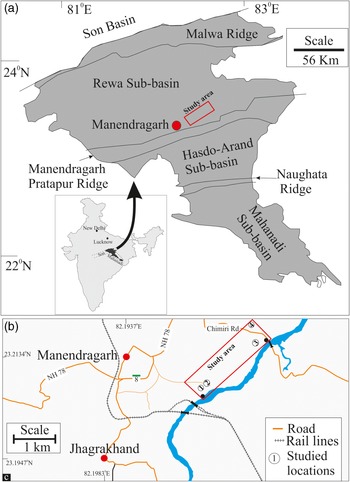
The dominantly siliciclastic Talchir Formation is exposed on the banks of the River Hasdeo in Manendragarh, Surguja district, Chhattisgarh, central India, and was deposited in the Rewa sub-basin of the NW-SE-oriented Son-Mahanadi Basin (Fig. 1a; Mukherjee et al. Reference Mukherjee, Ray, Chandra, Pal and Bandopadhyay2012; Ram-Awatar et al. Reference Ram-Awatar, Meherotra, Srivastava, Yadav and Gautam2013; Acharya, Reference Acharya2018). Similar to all other Gondwanan basins of Peninsular India, the Rewa Sub-basin is a fault-controlled half-graben-type basin along a NW-SE-oriented palaeosuture of the Son-Mahanadi Basin (Fig. 1a; Acharya, Reference Acharya2018; Banerjee et al. Reference Banerjee, Ghosh, Nagendra, Bhattacharya, Desai and Srivastava2020; Dasgupta, Reference Dasgupta, Banerjee and Sarkar2021). In the north, the Malwa Ridge separates the Rewa Sub-basin from the Son Basin (left side of the Malwa Ridge shown in Fig. 1a) and from the Mahanadi Graben in the south, bounded by two ridges, named the Manendragarh-Pratapur Ridge and the Naughata Ridge (Fig. 1a; Mukherjee et al. Reference Mukherjee, Ray, Chandra, Pal and Bandopadhyay2012; Dasgupta, Reference Dasgupta, Banerjee and Sarkar2021). There is substantial evidence in favour of glacially influenced sedimentation (e.g. dropstones, glacial till deposits, glacial pavement) throughout the Talchir Formation. (Pascoe, Reference Pascoe1968; Mukhopadhyay et al. Reference Mukhopadhyay, Mukhopadhyay, Roy Chowdhury and Parui2010; Varshney & Bhattacharya, Reference Varshney and Bhattacharya2023). Marine fossil assemblages have been recorded from several basins in Peninsular India where the Talchir Formation crops out, as well as along the Tethyan margin (Venkatachala & Tiwari, Reference Venkatachala and Tiwari1987; Ghosh, Reference Ghosh2003; Mukhopadhyay et al. Reference Mukhopadhyay, Mukhopadhyay, Roy Chowdhury and Parui2010; Bharti & Chakraborty, Reference Bharti and Chakraborty2014; Mondal et al. Reference Mondal, Mukherjee, Iangrai, Roy and Sinha2021). However, supposedly glacial sediments and Early Permian marine fossils together occur nowhere in India except in the study area near Manendragarh (Bose et al. Reference Bose, Mukhopadhyay and Bhattacharyya1992; Reference Bose, Mazumder and Sarkar1997; Chakraborty, Reference Chakrabarty1993; Mukhopadhyay & Bhattacharya, Reference Mukhopadhyay and Bhattacharya1994; Bhattacharya et al. Reference Bhattacharya, Bhattacharya, Chakraborty and Chakraborty2004; Bhattacharya & Bhattacharya, Reference Bhattacharya and Bhattacharya2015; Varshney & Bhattacharya, Reference Varshney and Bhattacharya2023). The faunal assemblage of Manendragarh includes Eurydesma, Deltopecten and Aviculopecten, in addition to bryozoans, crinoids and foraminifers (Frakes et al. Reference Frakes, Kemp and Crowell1975; Dickins & Shah, Reference Dickins and Shah1979; Venkatachala & Tiwari, Reference Venkatachala and Tiwari1987; Chandra, Reference Chandra and Guha1996). The fossil assemblages found in the studied locations have strong similarities with fossils found in other Gondwana basins in western Australia, Brazil, the Falkland Islands, Oman and South Africa (Table 1; Ghosh Reference Ghosh2003; Fielding et al. Reference Fielding, Bann, Maceachern, Tyes and Jones2006; Stephenson et al. Reference Stephenson, Angiolini, Leng, Williams, Haywood, Gregory and Schmidt2007; Taboada et al. Reference Taboada, Neves, Weinschutz, Pagani and Simoes2016; Horan et al. Reference Horan, Stone, Crowhurst, Le Heron, Hogan, Phillips, Huuse, Busfield and Graham2019; Simoes et al. Reference Simoes, Neves, Taboadac, Pagani, Varejaoe and Assine2020). Sahni and Dutt (Reference Sahni and Dutt1959) characterized its brachiopod assemblage by Trigonotreta hesdodoensis. A shallow marine origin of the Manendragarh fossils has been argued by many (e.g. Ghosh, Reference Ghosh2003; Ram-Awatar et al. Reference Ram-Awatar, Meherotra, Srivastava, Yadav and Gautam2013; Table 1). The above-mentioned fauna found in the studied region are of cold water origin (Shen et al. Reference Shen, Zhang, Shi, Li, Xie, Mu and Fan2013). Thus, the Manendragarh marine fossil-bearing beds of the Talchir deposits were correlated with the Late Carboniferous (Uralian) glaciation that continued up to the Early Permian (Artinskian) (Bhatia & Singh, Reference Bhatia and Singh1959; Varshney & Bhattacharya, Reference Varshney and Bhattacharya2023). However, based on the marine fossils found in this studied area Shah and Shastry (Reference Shah, Shastry and Campbell1975) and Ram-Awatar et al. (Reference Ram-Awatar, Meherotra, Srivastava, Yadav and Gautam2013) designated the marine fossil beds of the Talchir deposits as Early Permian age (280–240 Ma).
(a) Location of Manendragarh and the study area within the Rewa Sub-basin in the framework of related tectonic elements (map of India within inset). (b) Geographic location of the studied sections (1, 2, 3, 4) around Manendragarh.

Marine fossils of Manendragarh, India and their equivalents in other continents described by previous workers

The patch of fossiliferous conglomerate beds is observed to be persistent along a ∼2.5 km stretch of the NW bank of the Hasdeo River (Fig. 1b). The nonconformable contact of the Talchir deposits with the underlying Precambrian granite is characterized by basal Talchir strata deposited in graben structures developed in the granite (Acharya, Reference Acharya2018; Dasgupta, Reference Dasgupta, Banerjee and Sarkar2021). The Talchir Formation is overlain by the fluvial Barakar Formation (Casshyap & Tewari, Reference Casshyap, Tewari, Rahmani and Flores1984; Mukhopadhyay et al. Reference Mukhopadhyay, Mukhopadhyay, Roy Chowdhury and Parui2010; Ram-Awatar et al. Reference Ram-Awatar, Meherotra, Srivastava, Yadav and Gautam2013).
3. Palaeogeographic and palaeoenvironmental reconstruction
Palaeogeographic and palaeoenvironmental reconstruction is achieved through a comprehensive facies analysis. The Talchir Formation at Manendragarh is dominated by shale, the colour of which varies from black to grey. Conglomerates alternate with shale but are not ubiquitous. Sandstones are minor components, associated with grey shale and their geometry varies spatially. Fossils are localized, although their hosting black shale is preserved extensively throughout the study area. Granite fragments embedded within the black shale range in size from boulders to small pebbles and their roundness varies from sharply angular to well-rounded.
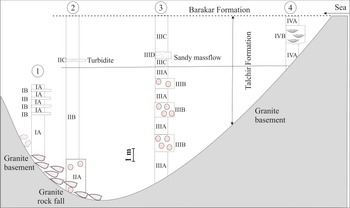
Four different facies associations have been recognized in four different sections placed in a NE-SW, 2.5 km long transect bounded by outcrops of basement granite at both ends (Figs. 1b, 2). Each section displays a single facies association. All these four facies associations correspond to the lateral transition of each other, and do not represent vertical stacking (Fig. 2). We focus on facies associations (described below) instead of individual facies to interpret the depositional environment and ultimately the palaeogeographic framework. The same lithology may be shared between the associations, the latter differing significantly in a combination of lithic and biotic components, and bed geometry, structure and texture. Also, more importantly, all four studied sections directly/nonconformably overlie the granitic basement (Fig. 2; Acharya, Reference Acharya2018; Dasgupta, Reference Dasgupta, Banerjee and Sarkar2021). It highlights that all four facies associations are likely to be the result of lateral facies variation due to change in sea level and decreasing effects of glaciogenic processes. The facies associations are described below separately before presenting a general interpretation.
Schematic distribution of facies across the depositional basin.

3.a. Facies Association I
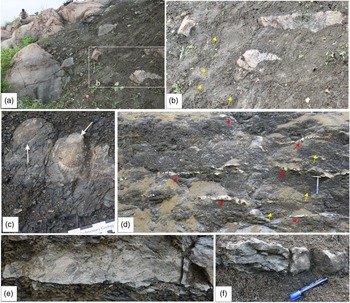
This facies association is at the southern end of the transect and directly overlies the granitic basement (Fig. 2). Lithologically, it consists of two sub-facies viz. the shale (facies IA) and the calcarenite (facies IB). Facies IA is black, finely laminated (Fig. 3a, b) and is confined to the basal 2 m of the measured succession and contains granite fragments (Fig. 3b), which are similar in composition to that of the basement. Around the granite blocks, however, the laminae of the facies IA are obliterated (Fig. 3a). Some of the granite fragments are very large (>80 cm), irregular in shape and sharply angular (Fig. 3a). Facies IA also incorporates intact fossils (Fig. 3c), which include brachiopods and pelecypods, many of which are benthic, intact and occur dominantly in live positions (Fig. 3c). Towards the upper part of the section, facies IA gradually becomes fossil-free. In contrast to facies 1A, facies IB is lighter than facies IA, appears approximately 1 m above the base of the section, and then alternates upwards with facies IA (Fig. 3d). Facies IB is cross-stratified, approximately 20 cm thick, tabular in geometry and rich in broken shell fragments. Facies IB has sharp erosional and dented bases that are studded with black mud clasts (Fig. 3d, e). Locally, straight-crested ripples mantle the upper surface of the calcarenite beds (Fig. 3f). The ripples have a wavelength and amplitude of approximately 7.5 and 2 cm respectively. The thickness of the shale encased by successive calcarenite beds varies from 50–60 cm.
Facies Association I - (a) Granite ridge flanking black shale facies (IA) with scattered granite blocks of very widely variable diameter, sharp angularity and devoid of any arrangement in distribution. (b) Fine laminations (yellow arrows) preserved within black shale facies (IA). (c) Fossils present in live positions (arrowed) within black shale (IA) and calcarenite (IB) beds. (d) Alternations between the black shale (IA) and calcarenite beds (IB; arrowed). (e) Sharp and erosional base of the calcarenite bed (IB); note the black shale clasts present within the facies IB. (f) Wave ripple laminations on top of a calcarenite bed (IB).

3.a.1 Interpretation
The black shale (facies IA) and its marine invertebrate fossil content (Fig. 3c) bear a clear signature of its marine origin. Being deposited directly on top of the granite basement, facies IA bears a clear indication of rapid marine invasion, and a rapid rise in sea level. Fine lamination within facies IA further points to a slow rate of deposition (Fig. 3a, b) and suggests that deposition took place in a stagnant basin where circulation was restricted (Posamentier & Walker, Reference Posamentier and Walker2006). The invertebrate fossil content is restricted to the base of the formation and the southern end of the studied transect. Even the calcarenite beds (facies IB), rich in fossil debris, are also confined to Facies Association I in the southernmost part of the studied transect. It implies that the organisms could not thrive along the entire studied transect of Fig. 2. This could indicate that sediment accumulated under restricted circulation behind a basement ridge within a horst-graben structure (Fig. 2; Acharya, Reference Acharya2018; Dasgupta, Reference Dasgupta, Banerjee and Sarkar2021). The deposition is thus assumed to have taken place in an interior sea that formed when the sea spilled over the ridge during transgression. The presence of isolated large, angular granite boulders in Facies Association I (Fig. 3a, b) suggests that the basement ridge had been steep and was generated at the basin margin only. Hence, the seaward boundary on the southern side can be assumed to be steep. Contrary to this concentration of marine fossils and unabraded granite boulders within Facies Association I at the southern boundary, the abraded granite pebbles increase in concentration rapidly from Facies Associations II to III, suggesting the existence of land northwards. This indicates that although there was input from both sides, the southern side provided large angular boulders from the steep basin margin whilst the northern side provided the conglomerates of cohesive/hyperconcentrated flow origin (discussed later).
The calcarenite facies (facies IB) is made of fragmented shells and is bound by facies IA below and above and appears to be a tempestite. Having a strongly erosional base and a wave-rippled top, these beds are interpreted as storm deposits, although the cross-strata within the beds could not be reconstructed clearly. The wave ripples on top of this likely tempestite record the waning phase of intermittent storms that eventually interrupted the usual calm depositional environment registered by the black shales above and below (Posamentier & Walker, 2006). The tempestite beds could have been emplaced by storm washovers spilling over the basement ridge. As the sheet-like geometry was determined only at the outcrop scale and these beds were not found in other sections, they may be lenticular on a larger scale. This also implies that sea spilled over from the southern side of the ridge. The biotic colonies associated with the preserved shell fragments thus seem to have grown only on the seaward/southern flank of the depositional basin. It is apparent that the organisms had only limited success in colonizing the niche created immediately after the transgression; they were probably merely opportunistic. The cold temperature enhanced oxygen dissolution in the water column and, had there been ice sheets, glacial debris may have provided additional nutrients (Christ & Wernil Sr., Reference Christ and Wernil2014). The presence of the calcarenite facies (facies IB) at the site of Facies Association I alone suggests that only the distal fringe of the storm sheets is preserved.
3.b. Facies Association II
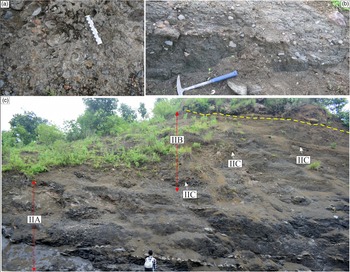
This facies association was found ∼200 m away from outcrops of Facies Association I along the chosen transect (Fig. 2). It has three sub-facies viz. black shale (facies IIA), grey shale (facies IIB) and thin, sparse sandstone beds (facies IIC). Facies IIA occurs in the basal ∼1 m and shares the same basal fossil assemblage (Fig. 4a) that is present within facies IA but the difference is that fossils are preserved as disarticulated valves in facies IIA (Fig. 4a). Unlike Facies Association I, the thickness of the fossiliferous zone of the facies IIA is reduced to 30 cm. Besides this, facies IIA also differs from the previously described facies IA in terms of the coexistence of scattered, well-rounded, small (approximately 16 cm in diameter) granite pebbles of the same composition (Fig. 4b). The thickness of this pebbly zone exceeds that of the fossiliferous zone, extending up to ∼50 cm from the base of the section. Facies IIA however continues up to 1 m from the base of the section. The calcarenite beds noted in Facies Association I are notably absent in Facies Association II. The upper part of the section, approximately 2.5 m thick, is composed of grey shale (facies IIB; Fig. 4c). The transition from facies IIA to facies IIB is gradational. Similar to facies IIA, facies IIB is also finely laminated and includes a few, sparse thin beds of khaki-coloured sandstone (facies IIC; Fig. 4c). These thin sandstone beds (facies IIC) are up to 7 cm thick, internally massive, have sharp bases and tabular in geometry. Their tops are planar, without any evidence of later reworking. Facies IIB is overlain by the coarse-grained siliciclastic Barakar Formation.
Facies Association II - (a) Marine fossil-bearing conglomerate bed (IIA); note that well-abraded granite pebbles are scattered along with the marine fossils. (b) Well-laminated fossil-free black shale (IIB). (c) Transition of facies IIB into grey shale facies (IIC) upwards, which is interspersed with thin sandstone sheets (white arrow); note that the top of the IIB facies is truncated by a sandstone body (demarcated by yellow dotted line).

3.b.1. Interpretation
The basal fossiliferous ∼50 cm of Facies Association II was presumably deposited in a palaeoenvironment similar to that of its counterpart at the base of Facies Association I. However, the absence of the isolated large unabraded granite boulders suggests a palaeogeographical position of Facies Association II relatively distant from the basement ridge which provided large, angular granite boulders. The occurrence of scattered and chaotic pebbles along with disarticulated fossil valves within facies IIA suggests that its origin was related to hyperconcentrated flows (Mulder & Alexander, Reference Mulder and Alexander2001). Fossils were probably disarticulated during their transportation. The upwards transition of the black shale (facies IIA) into the grey shale (facies IIB) in Facies Association II indicates some overall improvement in basin-floor oxygenation. However, the well-laminated nature of facies IIB attests to the continuation of the same slow rate of sedimentation in a low-energy depositional setting as before. The thin sheets of fine-grained sandstone (facies IIC) suggest periodic higher energy inputs into the basin. Internal massiveness, without any evidence of tractive currents or waves in the sandstone sheets, prompts their recognition as quasi-steady turbidites (Mulder & Alexander, Reference Mulder and Alexander2001).
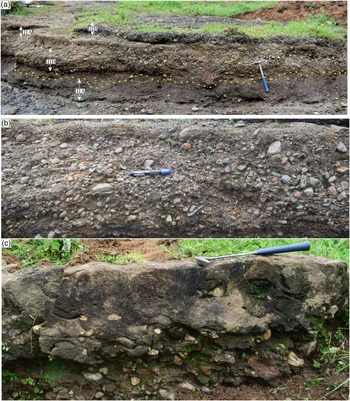
3.c. Facies Association III
This facies association, having four sub-facies viz. black shale (facies IIIA), conglomerate (facies IIIB), grey shale (facies IIIC) and tabular sandstone (facies IIID), is well exposed at a location approximately 1.2 km to the NE from outcrops of Facies Associations I and II described above (Fig. 2). Similar to Facies Association II, black shale and rounded pebbles are also present, although fossils are conspicuously absent. In addition, black shale and pebbles are present in different arrangements as they now occur as alternating beds. Facies IIIA (Fig. 5a) and facies IIIB (Fig. 5b) beds have mean thicknesses of approximately 28 and 45 cm, respectively. Facies IIIB contains pebbles of similar composition to the previous facies association, although they are less than 4.5 cm long and have a black mud matrix. Pebbles show reverse grading. The pebble beds are tabular and sharp, and the vertical distance between successive beds is approximately 50 cm. None of these beds bears any current structure. The shale-conglomerate alternation extends upwards approximately 3 m from the base of the section. Above, facies IIIA grades upwards into facies IIIC. The latter is similar to facies IIB and is also overlain by the Barakar Formation. It is sparingly interspersed with khaki-coloured sandstone bodies (facies IIID; Fig. 5c). The beds are tabular and massive, but thicker (∼50 cm) than facies IIC. A few pebbles, approximately 5 cm long, may be dispersed within them.
Facies Association III - (a) Repeated alternations between black shale (IIIA) and conglomerate (IIIB). Note that the lower contact between IIIA and IIIB is sharp compared to the upper contact. (b) Matrix-supported conglomerate of facies IIIB. (c) Massive pebble-bearing sandstone (III C) showing imbrication at the lower part of the bed.

3.c.1. Interpretation
In Facies Association III, the textural contrast in sediment is most remarkable. The black shale (facies IIIA) was deposited, as in other associations, in a calm and quiet basinal setting. The pebbles in the associated muddy conglomerates (facies IIIB) were likely delivered by melting icebergs and/or cohesive/hyperconcentrated flow or by both (comparison between these processes are discussed in Section 4). Neither a glacial nor density flow origin for the conglomerates necessitates any change in basin palaeogeography for the deposition of alternating shale and matrix-rich conglomerate beds. The grey shale (facies IIIC) at the top of Facies Association III may indicate relative improvement in water circulation during the deglaciation period within an otherwise restricted interior sea bottom. When the monotony of the grey shale (facies IIIC) lithology is interrupted by the appearance of the tabular sandstone facies (facies IIID), a sudden enhancement of depositional energy becomes imperative. There is no evidence for the action of tractive currents or waves in sand deposition. In contrast, the massiveness of the sandstone suggests instantaneous deposition, most likely from a sandy density flow.
3.d. Facies Association IV
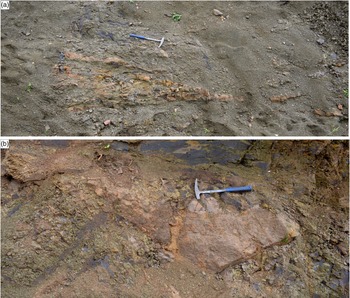
Moving further NNE, approximately 1 km from outcrops of Facies Association III described above, are outcrops exhibiting Facies Association IV, comprising two sub-facies viz. grey shale (facies IVA; Fig. 6a) and lenticular sandstone bodies (facies IVB; Fig. 6b) which rests directly on the granitic basement (Fig. 2). The sandstone lenses (facies IVB; Fig. 6b) are present as channel forms with concave-up bases and flat tops (Fig. 6b) within the grey shale (facies IVA). Their infillings are coarser-grained and distinctly more poorly sorted than the sandstone beds of the other associations. The channel fills are thoroughly cross-stratified, and their maximum width and depth are 70 and 55 cm, respectively.
Facies Association IV - (a) Grey shale (IVA) facies locally intervened by lenticular sandstone body (IVB). (b) Sandstone body (IVB) has a concave base and is internally characterized by cross-stratification.

3.d.1. Interpretation
The gradational vertical contact with the marine black shale in Facies Associations II and III also testifies to the marine origin of the grey shale. Facies IVA rests directly on the granitic basement at the northern/landward flank of the interior sea (Fig. 2), implying that sea also onlapped the landward flank. If the vertical colour change from black to grey in the shale of Facies Associations II and III reflects the enhancement of water circulation, it most likely relates to the deglaciation event that affected the depositional site. This contention is strongly supported by the fact that the grey shale, irrespective of facies association, hardly ever contains any pebbles that can be identified as a dropstone. Facies IVB, because of its lenticular body geometry, sandy lithology, very poor grain sorting and internal current structures, can readily be attributed to a river entering the interior sea (Walker & Mossa, Reference Walker and Mossa1982; Mėžinė et al. Reference Mėžinė, Ferrarin, Vaiciute, Idzelyt˙e, Zemlys and Umgiesser2019). Their channel-like geometry corroborates this contention.
4. Discussion
4.a. Glacial vs. density flow origin of the deposits
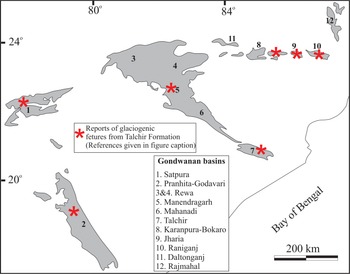
The map of the global distribution of ice sheets during the Late Palaeozoic glaciation by Montañez (Reference Montañez, Lucas, Schneider, Wang and Nikolaeva2022) includes the present study area. The most convincing glacial feature is striated/boulder pavement, which could not be identified within the outcrop limits at Manendragarh, but has been documented from the Giridih and Satpura basins close to the present study area (Fig. 7). Varshney and Bhattacharya (Reference Varshney and Bhattacharya2023) reported several signatures of deposition by melting glaciers near the ice grounding line at Manendragarh. In this section, pebbles belonging to conglomerates of different facies associations are considered to ascertain the mode/s of delivery of the pebbles to the depositional sites whether by glacier or by density flow. This account scrutinizes the general fabric in pebbly beds, the nature of their distribution and orientation of pebbles and the nature of bed contacts. The following are the features.
Map showing distribution of different Gondwanan basins of Peninsular India. Red coloured asterisks show the reports of glaciogenic deposits from Talchir Formation in and around the present study area by Smith (Reference Smith1963a); Sen (Reference Sen1991); Bose et al. (Reference Bose, Mukhopadhyay and Bhattacharyya1992); Dasgupta (Reference Dasgupta2006); Chakraborty and Ghosh (Reference Chakraborty and Ghosh2008); Bhattacharya and Bhattacharya (Reference Bhattacharya and Bhattacharya2015); Varshney and Bhattacharya (Reference Varshney and Bhattacharya2023).

4.a.1. Pebbles in hydrodynamic disequilibrium
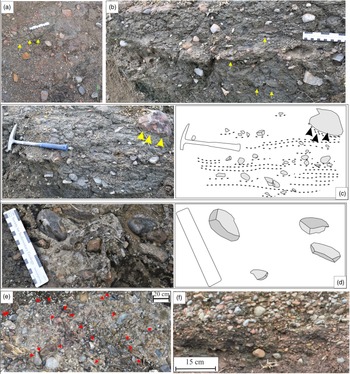
In the pebble-bearing black shale (facies IIA) at the base of the Facies Association II and in some of the conglomerate beds (facies IIIB) in Facies Association III, pebbles are found to be significantly larger in vertical dimension than the thickness of laminae within the shales that host them (Fig. 8a–c). The pebbles are up to 8.5 cm long, and some isolated pebbles are in an upright position, while the lamina-thickness around them is on the mm scale (Fig. 8a). The pebbles are also faceted (Fig. 8d). They can be deposited from a hyperconcentrated flow with muddy matrix generated from a melting glacier near the ice grounding line (Varshney & Bhattacharya, Reference Varshney and Bhattacharya2023). Such pebbles in finely laminated shale can alternatively be volcanic bombs dropped from the air. However, no contemporary volcanic event has thus far been reported from nearby areas. Dropping from a floating iceberg on the water surface appears to be the most reasonable option. It appears that these pebbles must have been subjected to prolonged abrasion and attrition after being picked up by a glacier.
(a) Oversized pebbles present in upright position within the shale (IA); finer laminations (yellow arrows) are preserved within the shale (IA). (b) Pebbles in hydrodynamically disequilibrium conditions with respect to shale (IA); note that fine laminations (yellow arrows) are preserved within shale. (c) Field photo and a hand sketch show laminae within the shale are downwarped around the bottoms of the granite block. (d) Ill-faceted basement pebbles within the conglomerate. (e) Bullet-shaped pebbles pointing towards glacial abrasion. (f) Reverse-graded and clast-supported conglomerate with a sharp base, suggesting deposition from mass flow with strong shear at its base.

4.a.2. Bottom wrapping
Under some similarly well-abraded and isolated pebbles in black shale (facies IIA) in Facies Association II, laminae wrap around their bottoms (Fig. 8c). Apparently, the laminae were deformed under the impact created by the pebbles falling from above, possibly from floating icebergs. Alternatively, as pointed out earlier, the pebbles could also be volcanic bombs, had there been evidence of proximal volcanic eruption.
4.a.3. Indistinct base of conglomerate beds
In Facies Association III, it was mentioned that the upwards transition from diamictite (facies IIIB) to shale (facies IIIA) is always sharp, despite minor irregularities at the contact. However, the reverse transition is often indistinct because of the occurrence of some detached pebbles beneath the base of the conglomerate beds (Fig. 5a, dashed line). These pebbles are in no way in hydrodynamic equilibrium with the shale around them. They are thus interpreted to have sunk into the underlying mud and are possibly dropstones.
4.a.4. Faceted and bullet pebbles
As a glacier moves, pebbles held tightly at its base are rubbed against the rocky surface and consequently, those surfaces become flattened, polished and striated (Atkins, Reference Atkins2003, Reference Atkins2004). In the process, ice thawing may turn the pebble on its other side. As soon as thawing occurs, the friction, however, disappears, and the ice immediately reforms, temporarily preventing further rotation of the pebble. A new face of the pebble starts to flatten. Therefore, facets, particularly multiple facets on pebbles, are considered diagnostic of their glacial origin (Fig. 7d) and have been recorded from the conglomerate beds (facies IIIB) at different levels within Facies Association III. Apart from faceted pebbles, bullet-shaped pebbles (Fig. 8e) are another indicator of glacier abrasion (Krüger, Reference Krüger1984). It is, however, possible that faceted pebbles generated on land due to glacial abrasion could have been redeposited within the interior sea.
4.a.5. Imbricated pebbles
The rare sandstone beds (facies IIID) in Facies Association III are sharp-based and generally appear massive. Locally, they contain some pebbles that tend to concentrate in the lower part of the beds, affecting coarse-tail grading (Fig. 4c; Nemec et al. Reference Nemec, Porębski and Steel1980; Schlunegger & Garefalakis, Reference Schlunegger and Garefalakis2018). In certain instances, the pebbles are elongated and imbricated along their long axes (Fig. 5c). The coarse-tail grading suggests the concentrated flow of sand and pebbles together, along with the entrapped fluid. The long-axis imbrication of the pebbles further suggests that the flows had been internally sheared (Bose & Sarkar, Reference Bose and Sarkar1991). Genetically, the massive fine-grained sandstone beds in Facies Association III are thus considered to be transitional between products of concentrated density flow and quasi-steady turbidity current (Mulder & Alexander, Reference Mulder and Alexander2001).
4.a.6. Sharp-based reverse-graded conglomerate
The hyperconcentrated/concentrated flow beds are always sharp-based, whether they are clast-supported or (unlaminated) matrix-supported. In glacier-imprinted formations, they are bound to create controversy regarding their origin. Grading, (whether normal or reverse) favours concentrated density flow interpretation. The reverse grading illustrated in Fig. 8f in a clast-supported conglomerate (facies IIIB) suggests deposition from a concentrated density flow with strong shear at its base. The vertical component of the dispersive pressure generated as a reaction to the basal shear presumably tended to push the clasts upwards; the larger clasts were pushed farther from the base. It can be conceived that a clast settled only when its settling velocity exceeded the dispersive pressure. The mechanism would suggest that the flow slowed from the top downwards.
4.b. Depositional conditions
An overall interpretation of the facies associations within the Talchir Formation in Manendragarh suggests its deposition within an interior sea. The spatial variation in the characteristics of the facies associations, notwithstanding the predominance of shale, indicates that the basin had its seaward margin on the south and the landward margin to the north. The basin formed when the sea transgressed over a basement ridge, and the large fragmented blocks recorded in the outcrops (Fig. 3a, b) may reflect the proximity and steepness of this ridge. Glacial dropstones accumulated in the interior of the basin, with faceted and bullet pebble deposits (Fig. 8c–e) and density flows (Figs. 5c, 8f), were induced by glacial meltwaters. Fielding et al. (Reference Fielding, Frank and Isbell2008b) viewed the Permian glaciation as a four-phase event. Shah and Shastry (Reference Shah, Shastry and Campbell1975) and Dickins and Shah (Reference Dickins and Shah1979), based on palaeontological evidence, correlated the Manendragarh glacier to the late stage of the first phase (P1). The initial transgression mentioned above could be the result of the first phase (P1) of deglaciation. The marine invertebrate fauna thrived in the lower part of Facies Associations I and II but failed to colonize the landward part of the interior sea (within Facies Association III and IV). It is possible that the marine organisms that invaded at the early stage of basin evolution were opportunistic and tried to colonize this newly created niche. Nonetheless, their colony remained confined to the vicinity of the seaward margin of the basin and only for a relatively short period. On the other hand, glacial dropstones as well as pebbly hyperconcentrated/concentrated flows and turbidites became important in the interior part of the basin. In the final phase of deglaciation, the shale turned grey and onlapped over the landward basin margin. Sandy turbidites (facies IIID) driven by glacial meltwater interrupted the grey shale (facies IIIC) sequence building periodically. The meltwater channel mouths interrupted the grey shale close to the land margin. The repeated alternation between shale and diamictite in Facies Association III, however, appears to be the product of shorter-scale glacial-interglacial transitions (Yang et al. Reference Yang, Shi, Lee and Luo2018). There is a consensus that the Gondwana glaciation was most intense during the first (P1) and second (P2) phases and had a low CO2 (1.0 X –1.5 X Present day Atmospheric Level) (Isbell et al. Reference Isbell, Miller, Wolfe and Lenaker2003; Montañez et al. Reference Montañez, Tabor, Niemeier, DiMichele, Frank, Fielding, Isbell, Birgenheier and Rygel2007). In such a setting, only a slight change in solar radiation could have caused the observed switchovers between glacial and interglacial regimes (Riechers et al. Reference Riechers, Mitsui, Boers and Ghil2022).
Through time, the black shale graded upwards to the grey shale, but a lack of preserved current structures points to the fact that the interior sea still remained a calm water basin. The postglacial grey shale, devoid of any dropstones, is interbedded with sandy turbidites that were triggered by glacial meltwater fluxes (Horan et al. Reference Horan, Stone, Crowhurst, Le Heron, Hogan, Phillips, Huuse, Busfield and Graham2019).
5. Conclusions
Marine fossil-bearing black shale resting directly on top of the granite basement indicates a rapid marine transgression in Manendragarh at the end of the P1 phase of Late Palaeozoic glaciation. The presence of isolated and sharply angular granite blocks within the black shale suggests deposition in an interior sea that was generated behind a steep basement ridge. The ice sheets did not extend beyond the deepest part of the interior sea, and the biotic colony could only invade the fringes of the interior sea, where it flourished for limited periods. Hence, during intermediate deglaciation phases, the seaward edge of the lagoon experienced the accumulation of thin calcarenite layers, while in central region of the interior sea, accumulation of black shale alternated with pebbly dropstones and hyperconcentrated flows. In the final deglaciation, grey shale deposition became dominant and was interrupted by rare sandy gravity flows and hyperconcentrated flows triggered by glacial meltwater fluxes. At the landward margin of the interior sea, feeder channels of these sandy gravity flows were locally incised and preserved. Dominance of sandy gravity flows and hyperconcentrated flows towards the upper part of the studied succession indicate decreasing influence of glaciogenic processes due to climatic changes during the Late Palaeozoic of northern Gondwana.
Acknowledgements
The authors acknowledge Emese Bordy (the Executive Editor), Pierre Dietrich, A.J. Tom Van Loon and the two anonymous reviewers whose comments helped to improve the manuscript. AC, SM and SKP acknowledge the Director of BSIP, Lucknow, for giving this opportunity for fieldwork in the studied area. AC and SM are indebted to Prof. Pradip K. Bose for advising all along and reviewing a previous version of the manuscript as well as suggesting its improvement. AC, SM and SKP acknowledge the Chattisgarh State Biodiversity Board and Forest Department for their hospitality and cooperation throughout the fieldwork and the Geological Survey of India, Raipur, for providing necessary help during the fieldwork. They also acknowledge BSIP, Lucknow, for the infrastructure (Publication No. 62/2021-22).
Competing interests
The authors declare no conflict of interest.