INTRODUCTION
In sub-Saharan Africa, increased agricultural productivity is widely viewed as a necessary condition for economic transformation and long-term economic development (Collier and Dercon, Reference Collier and Dercon2014; Sanchez et al., Reference Sanchez, Denning and Nziguheba2009). As a result, with the support of donors, many African governments have put tremendous resources and policy efforts into agricultural sectors to enhance contributions of the sector towards food security, economic development and poverty alleviation (Collier and Dercon, Reference Collier and Dercon2014; Jayne and Rashid, Reference Jayne and Rashid2013; Sanchez et al., Reference Sanchez, Denning and Nziguheba2009). However, challenges still remain regarding African agriculture and food systems to provide adequate nutritious food for the increasing population (Gómez et al., Reference Gómez, Barrett, Raney, Pinstrup-Andersen, Meerman, Croppenstedt, Carisma and Thompson2013; Pretty et al., Reference Pretty, Toulmin and Williams2011). Although net agricultural production growth has been observed, a strong population growth leading to a greater increase in food demand than in food production resulted in a low food self-sufficiency and frequent food crisis (Luan et al., Reference Luan, Cui and Ferrat2013; Pretty et al., Reference Pretty, Toulmin and Williams2011). Moreover, those policy efforts and associated programmes focused on increased production of cereals and other staple crops (Pretty and Bharucha, Reference Pretty and Bharucha2014), while fruit production has received less attention. As a consequence, the production of major staple crops increased while that of other crops such as fruits declined gradually and failed to keep pace with the rapid population growth (Gómez et al., Reference Gómez, Barrett, Raney, Pinstrup-Andersen, Meerman, Croppenstedt, Carisma and Thompson2013; Pretty and Bharucha, Reference Pretty and Bharucha2014). This narrow focus on calories and commercial staples has resulted in some nutritional gaps (Pretty and Bharucha, Reference Pretty and Bharucha2014).
Despite their potentials to address food and nutritional insecurity, fruits production and consumption are still low in Sub-Saharan Africa (Ganry, Reference Ganry2014; Tossou et al., Reference Tossou, Floquet and Sinsin2012). Moreover, with increasing urbanisation and population growth combined with nutrition transitions, increasing the availability and consumption of fruits will be a major challenge for African countries (Ganry, Reference Ganry2014). Addressing this challenge will require prior understanding of the current fruit production systems and bottlenecks so as to identify avenues and room for future policies initiatives and interventions to improve the production. Currently, the worldwide fruit production is dominated by citrus, which is the most cultivated fruit crop in the world (104 million tons with a cropping area exceeding 7.1 × 10⁶ ha in 2010) (Agustí et al., Reference Agustí, Mesejo, Reig, Martínez-Fuentes, Dixon and Aldous2014). In Benin, citrus is one of the most cultivated fruit crops and was identified as a priority crop for agro-industrial transformation (Gnimadi, Reference Gnimadi2008). However, the impact of citrus industry on the country's economy remains unknown since the ‘Société Nationale des Fruits et Légumes (SoNaFeL)’, the national company that contributed significantly to fruit production closed down in 1986, following the Word Bank and International Monetary Fund structural adjustment programmes (Gnimadi, Reference Gnimadi2008; Lokossou et al., Reference Lokossou, Tossou, Vernière and Ollitrault2009). Currently, there is a lack of statistics on citrus production to inform decision-making and the potential of the country in citrus production remains unexplored (Lokossou et al., Reference Lokossou, Tossou, Vernière and Ollitrault2009).
Citrus production for food and nutritional security was overlooked by the government as well as by researchers. Addressing these gaps necessitates prior understanding of citrus farm diversity and production constraints in order to explore possible development avenues. Since there is a rich diversity in smallholder farm systems based on biophysical and socioeconomic resources and system management practices, interventions and policy actions need to be tailored and context specific (Bongers et al., Reference Bongers, Fleskens, Van De Ven, Mukasa, Giller and Van Asten2015; Giller, Reference Giller2013; Pacini et al., Reference Pacini, Colucci, Baudron, Righi, Corbeels, Tittonell and Stefanini2014). In addition, given the heterogeneity existing among smallholder farm systems (Bongers et al., Reference Bongers, Fleskens, Van De Ven, Mukasa, Giller and Van Asten2015), production bottlenecks will likely vary among the various citrus farm systems. Analysis of farm typologies helps capture the heterogeneity in smallholder farm systems (Pacini et al., Reference Pacini, Colucci, Baudron, Righi, Corbeels, Tittonell and Stefanini2014). In this study, we explored citrus production systems in order to identify leverage points for sustainable intensification of production in smallholder farming systems in Benin. Specifically, we provided a typology of citrus farm systems based on biophysical and socioeconomic resources and system management practices, and assessed cultivation bottlenecks in citrus production in Benin. The following questions were addressed in this study: how is the current production system structured, what are the components and who are the stakeholders? How do cultivation bottlenecks relate to the farmer categories? What strategic activities/actions and research interventions can be applied to improve the production capacity in Benin?
MATERIALS AND METHODS
Study area
This study was carried out in two municipalities of the department of Zou (6°55′ to 7°40′ N and 1°39′ to 2°25′ E), namely Za-Kpota and Covè municipalities (Figure S1; available online at https://doi.org/10.1017/S001447971700028X). The department of Zou stretched on 5243 km2 and was identified as the most favourable area for citrus production in Benin (Praloran, Reference Praloran1972). Intensive citrus production started in this department by the Benino–Israeli cooperation and SoNaFeL, which promoted various citrus species cultivation from 1969 to 1985 (Lokossou et al., Reference Lokossou, Tossou, Vernière and Ollitrault2009). Nowadays, this department represents the most important and intensive citrus production area in Benin (Gnimadi, Reference Gnimadi2008; Lokossou et al., Reference Lokossou, Tossou, Vernière and Ollitrault2009). The study area belongs to the Soudano–Guinean transition ecological zone, i.e., between the Guinean zone in the south and the Sudanian zone in the north. The vegetation pattern is characterised by a mosaic of forest islands, gallery forests and savannas. The rainfall pattern has a tendency to unimodal distribution with an annual rainfall varying from 1100 to 1200 mm. Ferrallitic soils are the main soil types of the region. The department of Zou is composed of nine municipalities with an overall population of 851,580 habitants. About 37% of households practice agriculture and the staple crops include maize (Zea mays L.), cowpea (Vigna unguiculata (L.) (Walp.)) and cassava (Manihot exculenta Crantz), while the main cash crops are Citrus sp. and oil palm (Elaeïs guineensis Jacq.).
Data collection
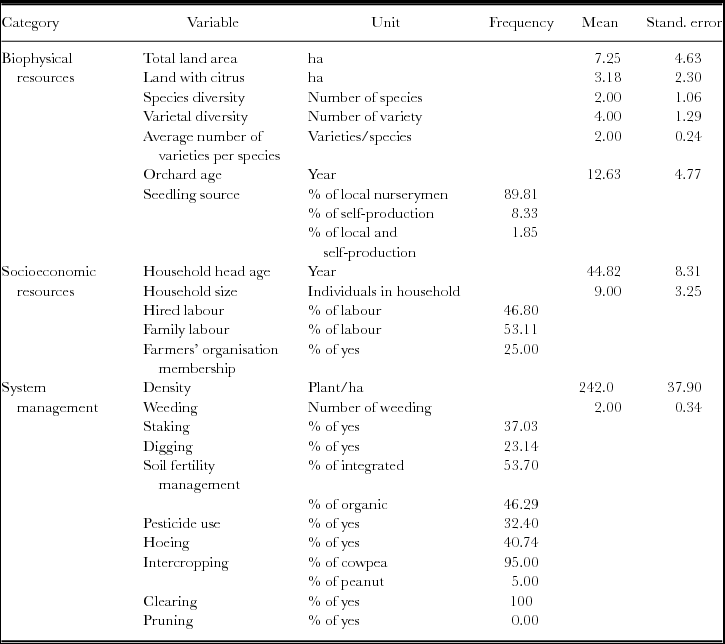
In each municipality, we obtained from local extension services the list of all citrus production villages with the total number of citrus farmers per village. We randomly selected 34 to 35% of the total number of these villages in each municipality. Za-Kpota holds 42 citrus production villages, whereas Covè holds 22. Afterwards, we randomly selected 15 to 17% of total number of citrus farmers in each village. We finally obtained a total number of 110 farmers from 21 villages in the two municipalities. Semi-structured interviews were carried out with farmers included in the sample using a questionnaire. We obtained permission from the chief of each village before conducting the survey. Participants were included in the survey after obtaining their verbal prior informed consent. The questionnaire included four parts related to socioeconomic resources, biophysical resources, system management and production constraints. Biophysical data included, for instance, the number of citrus species and varieties, and land tenure. Socioeconomic information was related to household head age, household size, labour source and farmers’ organisation membership. The system management part was related to farmer cultivation practices from land clearing to fruit harvesting (Table 1). During the individual interviews, each respondent was asked to list and score the main constraints hindering citrus cultivation on his farm. We also conducted a focus group discussion with citrus producers and interviews with key informants in each village to crosscheck constraints identified by individual famers and discuss on how production constraints interact to impact citrus production.
Description of biophysical, socioeconomic and system management variables.

Data analysis
We used descriptive statistics to account for farming practices patterns and socioeconomic characteristics of the respondents. To analyse the diversity in citrus farm systems in the municipalities, we constructed a farm typology using Factor Analysis of Mixed Data (FAMD) combined with Hierarchical Cluster Analysis (HCA) based on 17 variables (ten quantitative and seven qualitative) using the package FactoMineR (Lê et al., Reference Lê, Josse and Husson2008). FAMD was used to simultaneously quantify categorical and quantitative variables while reducing the dimensionality of the data. HCA was performed on the first six factors identified from FAMD to identify homogenous farm types. A dendrogram was generated using the complete linkage algorithm based on the Gower's dissimilarity coefficient (Gower, Reference Gower1971). To test the degree of separation between all pairs of farm categories, we performed Analysis of Similarities (ANOSIM) (Clarke, Reference Clarke1993). We used Chi-square test to test if production bottlenecks were farm-categories dependent. All statistical analyses were performed using R version 3.2.0 (R Core Team, 2015).
RESULTS
Citrus farming system in Benin
Citrus farmers interviewed in this study were, on average, 44.82 years old (ranging from 25 to 80 years). About 25% of them belong to a citrus farmers’ organisation. The average household size was nine members. For various activities, farmers combined family and hired labours, which were the two main sources of labour (Table 1). Labour was hired for farming practices such as land clearing, staking, holes digging, weeding, hoeing and harvesting. About 58% of farmers dedicated at least 50% of their land (on average 7.25 ha) to citrus farming. Average citrus orchard size is 3.18 ± 2.30 ha (Table 1). Local nurserymen were the main source of seedling (for 96% of the respondents). On average, each grower cultivated two species and four varieties on his farm. About 63% of citrus producers interviewed had less than two species, while 73% of them had less than four varieties. The most cultivated species was Citrus sinensis (L.) Osbeck with two varieties Pineapple and Valencia dominating. Moreover, in the orchards where more than two species were cultivated, C. sinensis represented about 80% of the total land allocated to citrus cultivation.
Citrus farming in the study area can be divided in two sets of practices: land preparation (before seedlings planting) and orchard management practices. Land preparation activities include land clearing, staking and digging. Land clearing was practiced by all farmers. However, only 37% of farmers did staking. Also, only 23.14% of farmers had respected digging before planting seedlings (Table 1). The orchard management includes practices such as pruning, hoeing, fertiliser applications, pests and diseases management and weeding. In the surveyed orchards, pruning operations were never practiced. About 40% of farmers practiced hoeing. Moreover, farmers (32.4% of the respondents) who managed pests and diseases exclusively relied on pesticide applications. The most used pesticide was Lambda-cyhalothrin. Regarding soil fertility management, about 54% of the respondents combined chemical and organic fertilisers (Table 1), while 46% of them relied exclusively on intercropping and crop residues as soil fertility management strategy. The main intercrops included cowpea and peanut (Arachis hypogea L.). Seedling source, land clearing, pruning and intercropping were similar among the respondents and were not included in the typology construction.
Typology of citrus farm systems
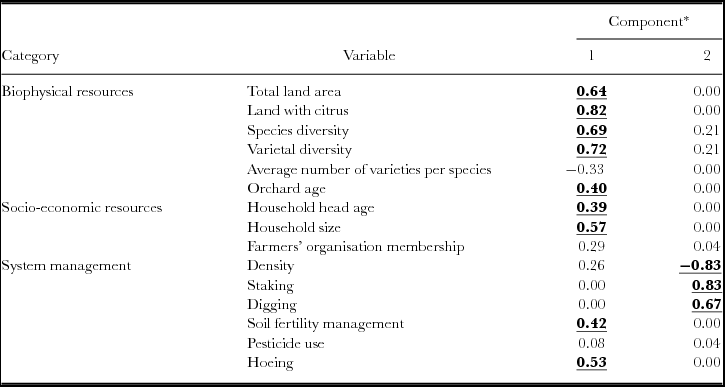
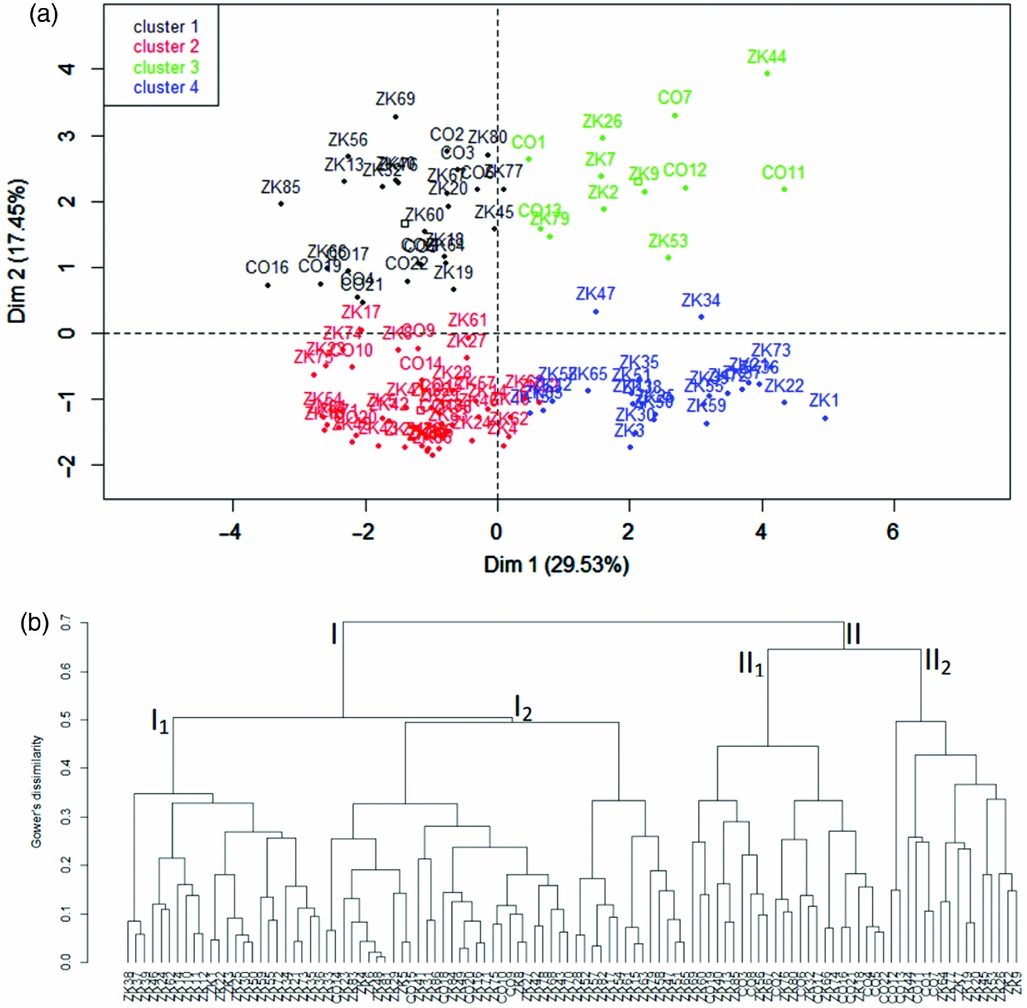
The FAMD analysis showed that the first two components explained 46.96% of the total variation among farmers. The first Principal Component (PC1) was correlated with variables related to biophysical resources, socioeconomic resources variables such as household head age and household size, and two management variables such as soil fertility management and hoeing (Table 2). The second Principal Component (PC2) was correlated with management variables related to orchard setting up practices such as plant density, staking and digging (Table 2). Given the low percentages of variations explained by the first two principal components, the HCA was performed using the first six principal components, which explained together about 79% of the total variation. The cluster analysis showed four citrus farm categories (Figure 1a) that were significantly distinct and homogeneously separated from each other (overall ANOSIM test R = 0.37, P < 0.01; Table S1). This was supported by the analysis of the dendrogram (Figure 1b) which revealed two groups (I and II), each one later was segregated into two clusters. Group I was made up of clusters 1 and 2 and group II of clusters 3 and 4. The main discriminant factors included orchard management practices (hoeing, soil fertility management and pesticide use), orchard setting up practices (staking, digging and density), biophysical resources (land owned, land with citrus, number of species, number of variety, orchard age) and farmers’ organisation membership. Furthermore, pairwise comparisons revealed significant differentiation between all pairs of farm categories (Table S1).
Contribution of the survey variables to the first two principal components.

*Values in the column are correlation coefficients; values underlined are significant (p < 0.001).
Clusters of citrus farms in Covè and Za-Kpota, Southern Benin (a) and dendrogram showing the grouping of citrus farms using the complete linkage algorithm based on the Gower's dissimilarity coefficient (b). I1 = cluster (1); I2 = cluster (2); II1 = cluster (3); II2 = cluster (4).
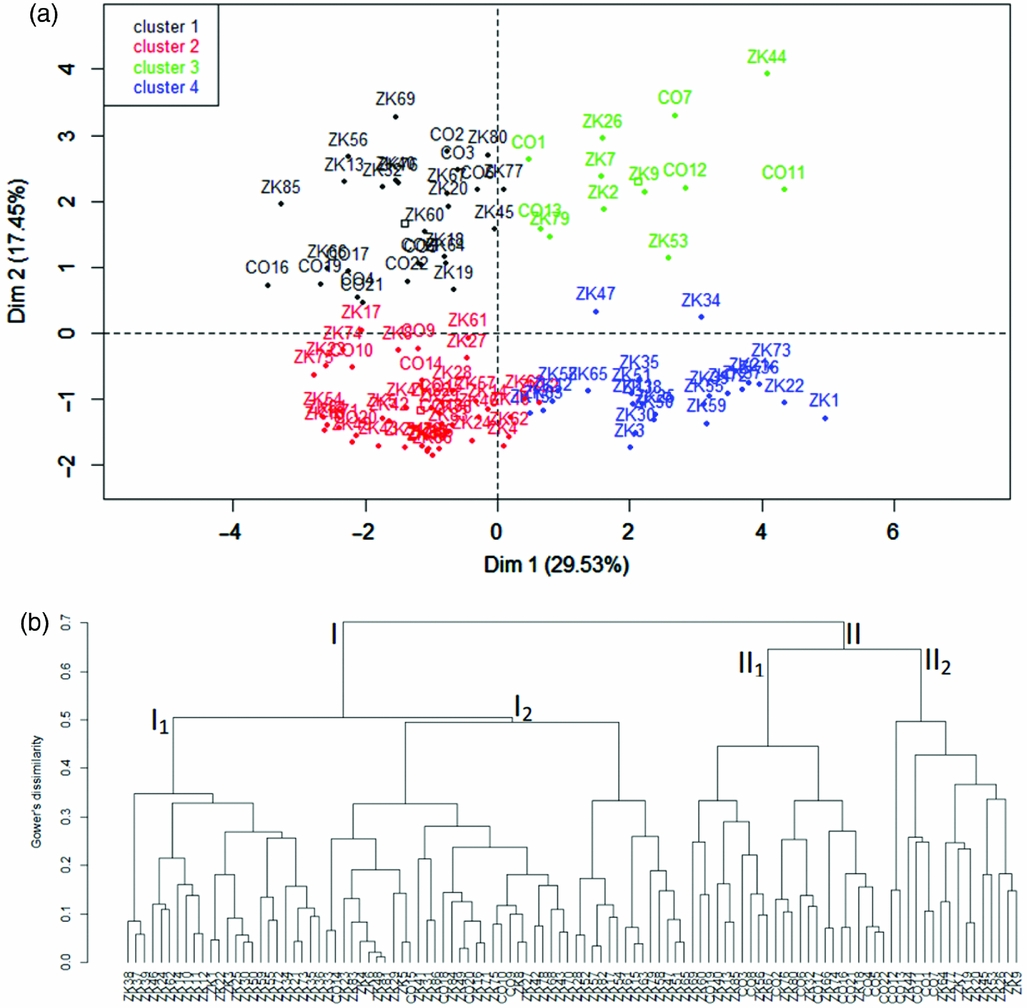
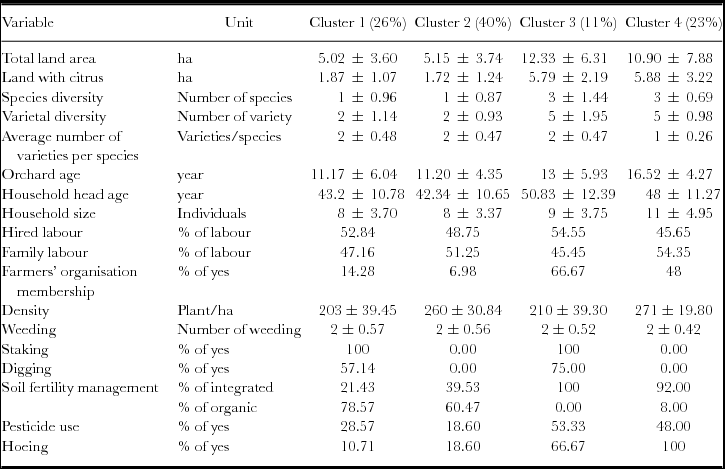
Cluster 1 (26% of the respondents) and 2 (40% of the respondents) were composed of small size orchards (1.87 ha for Cluster 1 and 1.72 ha for Cluster 2) (Table 3). Farmers of clusters 1 and 2 allocated, respectively, about 37 and 33% of their land to citrus crops. Both clusters were characterised by young orchards (11.17 years for cluster 1 and 11.20 years for cluster 2) but less diversified (on average, one species and two varieties for clusters 1 and 2). The most cultivated species was C. sinensis (with two varieties Pineaple and Valencia). Regarding management practices, farmers of these two categories relied mainly on organic fertilisers and crop residues for soil fertility management. Few of them controlled pests and diseases with pesticide application (28% for cluster 1 and about 19% for cluster 2). This was the only pest and disease management method used in the research area. The difference between clusters 1 and 2 was related to orchard setting up practices and planting density. Contrary to cluster 2, all farmers of cluster 1 performed staking operation and adopted low planting density. About 57% of farmers of cluster 1 performed digging, whereas this practice was absent among cluster 2 growers. Cluster 3 (11% of the respondents) and cluster 4 (23% of the respondents) were composed of farmers who have adopted integrated soil fertility management practices, pesticide application and hoeing (Table 3). In comparison to clusters 1 and 2, clusters 3 and 4 were composed of old farmers (on average 50.53 years for category 3 and 48 years for category 4) who owned large size orchards (on average 5.79 ha for cluster 3 and 5.88 ha for cluster 4). They allocated respectively 47 and 54% of their land to citrus cultivation. Most of farmers in these two clusters are members of farmers’ organisations (66.67% of farmers for cluster 3 and 48% of farmers for cluster 4). Their orchards were comparatively older (13 years for cluster 3 and 16.52 years for cluster 4) and more diversified with species such as C. reticulata Blanco, C. sinensis and hybrids Tangelo (C. reticulata × C. paradisi) and Tangor (C. reticulata × C. sinensis). The main varieties were Pineapple, Hamlin and Valencia for C. sinensis, Orlando for Tangelo, Ortanique for Tangor and Dancy for C. reticulata. The difference between clusters 3 and 4 was related to the type of labour, orchard setting up practices and planting density. In cluster 4, family labour was the main source of labour, contrary to farmers of cluster 3 who relied mainly on hired labour. In addition, farmers of cluster 3 performed staking (100% of farmers) and digging (75% of farmers) operations, contrary to those of cluster 4. Additionally, cluster 4 is made up of orchards with high density.
Description of the orchard categories.

Bottlenecks in citrus farming
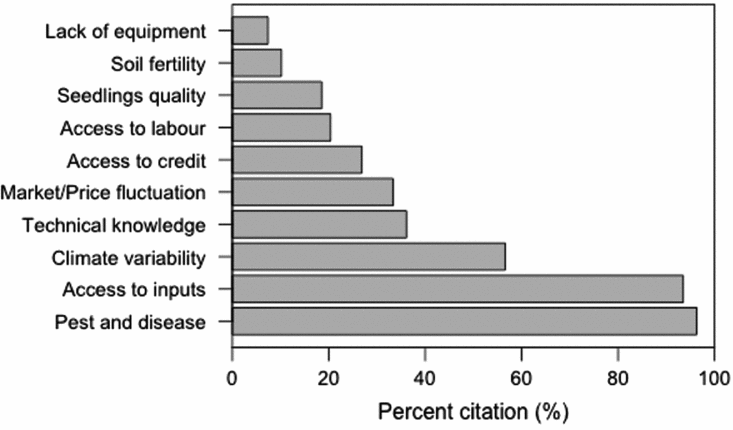
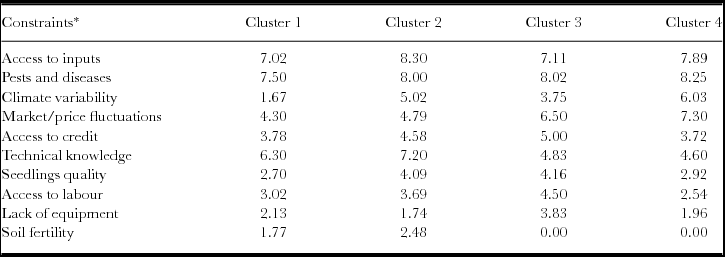
Our findings revealed various bottlenecks hindering citrus production in Benin as perceived by farmers (Figure 2). The five most cited constraints were related to pest and disease management challenges (96% of the respondents), access to fertilisers and pesticides (93% of the respondents), climate variability (57% of the respondents), lack of technical knowledge (36% of the respondents) and market/price fluctuation (33% of the respondents) (Figure 2). The other constraints include challenges related to access to credit, access to labour, seedlings quality, soil fertility and lack of equipment. The listed production bottlenecks were significantly orchard category-dependent (χ² = 45.63, P = 0.01). Lack of technical knowledge was highly listed by farmers of categories 1 and 2 while market/price fluctuation was more characteristic to categories 3 and 4 (Table 4). Furthermore, climate variability was an important production constraint mostly raised by farmers of categories 2 and 4. This constraint was perceived as drought spells that result in trees drying and premature fruit dropping.
Citrus production bottlenecks in Covè and Za-Kpota, Southern Benin.

Scoring of perceived constraints.

*1 = lowest score, 10 = highest score; values are mean scores for each cluster.
Production bottlenecks influenced farmers’ cultivation practices, tree drying, harvest dates and seedlings quality. These constraints lead to considerable fruit dropping and rotting, irregular tree flowering and subsequently low fruit production. Market/price fluctuation was a crucial problem during the first harvesting season in the research area. To cope with this challenge, farmers with large citrus areas (farmers of categories 3 and 4) conscientiously delay the harvesting period with the expectation to get the highest price. During this period, fruits lose their water content, drop from trees causing a low yield and low flowering the following season. According to farmers, access to inputs (e.g., pesticides, fertilisers) was limited due to difficulty of access to credit. This resulted in an absence of efficient pest and diseases management measures, which favoured pests and diseases abundance in orchards.
DISCUSSION
Our survey revealed four farm types (Figure 1; Table 3) based on biophysical resources (e.g., citrus species and varietal diversity), socioeconomic resources (e.g., land availability, farmer organisations membership) and system management practices. We observed that in Benin citrus farming is rain-fed only. No irrigation efforts have been made by farmers or any programmes to change the situation. However, lack of irrigation in addition to erratic rainfall patterns can affect yield and production (Dorji et al., Reference Dorji, Lakey, Chophel, Dorji and Tamang2016; Qin et al., Reference Qin, Assinck, Heinen and Oenema2016). In fact, water deficit in citrus production results in 10 to 12% yield decrease (García-Tejero et al., Reference García-Tejero, Romero-Vicente, Jiménez-Bocanegra, Martínez-García, Durán-Zuazo and Muriel-Fernández2010). Moreover, pruning practices were absent in all the surveyed villages. Consequently, orchards are composed of trees with abnormal shaping, small fruit size, low fruit quality and irregular fruit production (Agustí et al., Reference Agustí, Mesejo, Reig, Martínez-Fuentes, Dixon and Aldous2014; Lokossou et al., Reference Lokossou, Tossou, Vernière and Ollitrault2009).
In terms of farming practices, only farmers of category 3 (11% of the respondents) have respected good citrus management practices. In fact, most of farmers (91.66%) of this category were trained on citrus farming at SoNaFeL, where they had worked as employees. This shows the importance of training, which positively impact orchard management practices and yield (Dorji et al., Reference Dorji, Lakey, Chophel, Dorji and Tamang2016). Unfortunately, SoNaFeL was closed in 1986 and no other policies or interventions were put in place to train producers and sustain citrus production. In opposite to category 3, farmers of categories 1, 2 and 4 showed some inadequacies related to their orchard establishment and management practices (Table 3). Also in categories 2 and 4, the planting density was, respectively, 260 and 271 trees ha−1, which is greater than the recommended density of 235 trees ha−1 for C. sinensis. However, the high planting density combined with absence of pruning practices limits tree development, increases competition for sunlight and result in low yield with small size fruit (Agustí et al., Reference Agustí, Mesejo, Reig, Martínez-Fuentes, Dixon and Aldous2014; Lokossou et al., Reference Lokossou, Tossou, Vernière and Ollitrault2009). Although, all orchard categories were characterised by a mixed crop system with different species and varieties (Table 1), land availability and market demand and opportunities were the main considerations in the choice of species and varieties. Indeed, citrus is primarily a cash crop in the study area and only a residual share of fruits is reserved for household consumption (Tossou et al., Reference Tossou, Floquet and Sinsin2012). Therefore, farmers with small land preferred cultivating varieties with high market opportunity. No cultivar development system is in place to enhance production and consumption. Moreover, the harvest delay practices used by growers as marketing strategies can affect the quality of fruits. In fact, late harvest combined with non-removal of fallen fruits, as it is the case in the study area, can constitute pest reservoirs, especially fruit flies, for the re-infestation of other clean fruits (Umeh et al., Reference Umeh, Olaniyan, Ker and Andir2004).
Our results also revealed that production bottlenecks seemed to explain to some extent the observed heterogeneity in farming systems and the inadequacies of practices. In addition to pest and disease challenges and limited access to fertilisers and pesticides reported previously (Lokossou et al., Reference Lokossou, Tossou, Vernière and Ollitrault2009), climate variability, lack of technical knowledge and market/price fluctuation are also crucial bottlenecks affecting citrus production in Benin (Figure 2). Also, because of the phenomenon of young labour migration that occurred in the study area (Howard, Reference Howard2012), there was high labour shortage, especially family labour. Despite the incidence of pests and diseases in the orchards and associated economic damages and losses (Brentu et al., Reference Brentu, Oduro, Offei, Odamtten, Vicent, Peres and Timmer2012; Umeh et al., Reference Umeh, Olaniyan, Ker and Andir2004), farmers have not developed any effective strategy for pest and disease control. This may be due to the lack of technical knowledge of pest and disease control. For instance, one of the common pest and disease mismanagement practices was related to the fact that farmers leave in their orchards rotten fruits that contain insect larvae and hence increase pest population in the orchards (Umeh et al., Reference Umeh, Olaniyan, Ker and Andir2004; Reference Umeh, Garcia and De Meyer2008). This practice has also been reported in citrus production areas in Nigeria (Umeh et al., Reference Umeh, Garcia and De Meyer2008). Low or inadequate technical support from agricultural extension services may also be a driver of this mismanagement practices. Building citrus growers’ capacity could certainly bring about positive changes to improve citrus production.
Based on our results, it was clear that in most of surveyed farms, poor orchard management practices are applied (Lokossou et al., Reference Lokossou, Tossou, Vernière and Ollitrault2009), highlighting the need for training and capacity building on best orchards management practices. In these conditions, improving citrus production in Benin will require a number of policy and strategic decisions as well as research and development initiatives. We call for more effective and targeted extension systems combined with technical capacity building and training programme on both orchards establishment and management practices. This intervention should adopt participatory and stakeholder engagement approaches that create space and opportunities to foster innovations to address citrus production bottlenecks. To this end, farmer-to-farmer videos approach embedded in agricultural innovation platforms can be a promising approach. Innovation platforms provide the social space that enables knowledge exchange and learning and in which opportunities can be created, tested and transformed into changes in institutional regimes (Röling et al., Reference Röling, Jiggins, Hounkonnou and van Huis2014).
Farmer-to-farmer videos have great potentials to enhance sustainable agriculture by encouraging local innovations (Zossou et al., Reference Zossou, Van Mele, Vodouhe and Wanvoeke2009b). In addition, because videos can reach more farmers than conventional training, such as workshops, using videos can have more impact (Zossou et al., Reference Zossou, Van Mele, Vodouhe and Wanvoeke2009a). In this process, all the relevant stakeholders including farmers, technicians and agricultural advisers, along with the researchers, will be collectively in charge of defining the purposes and objectives for further improvement (Röling et al., Reference Röling, Jiggins, Hounkonnou and van Huis2014). As farmers of category 3 have been trained at SoNaFeL and are implementing some of the good citrus production practices, they will serve as examples or trainers to use for videos production.
Increasing citrus production in Benin also requires interventions to tackle pest and disease management challenges. Integrated Pest Management (IPM) approaches need to be developed for effective pests control while reducing pesticide use and health risks in citrus production agroecosystems. The first step towards IPM approach in citrus production systems will be the identification of major pests and diseases, infestation stages and damages caused, and the estimation of the economic damage for citrus varieties (Umeh et al., Reference Umeh, Olaniyan, Ker and Andir2004; Reference Umeh, Garcia and De Meyer2008; Vayssières et al., Reference Vayssières, Korie, Coulibaly, Van Melle, Temple and Arinloye2009). This preliminary step will give a better insight and knowledge on pest and disease dynamics and help set the optimal economic time of pest control treatment (Brentu et al., Reference Brentu, Oduro, Offei, Odamtten, Vicent, Peres and Timmer2012; Vayssières et al., Reference Vayssières, Korie, Coulibaly, Van Melle, Temple and Arinloye2009). Interventions to improve citrus production should also target the quality and health status of the planting materials used by the growers. We observed that almost all the citrus growers obtained their seedlings from local nurserymen (Table 1). However, the quality and health status of seedlings can be questionable as these local nurserymen have neither certification nor qualified training on nursery techniques. Poor seedling quality and health status can result in heterogeneity in flowering, fruit size and shape, harvest time, widespread transmission of diseases and can limit farm profitability as well as income generated. Therefore, improving and strengthening seedling certification systems is urgently recommended. This intervention should also promote training on nursery techniques directed to local nurserymen. Moreover, yield assessment of citrus cultivars will contribute in filling the gap of inadequate statistics on citrus production in Benin. We observed that cultivation of some varieties has declined due to lack of market opportunities since SoNaFeL closed down. According to farmers, there was a market demand and organised commercialisation channels for almost all the varieties during SoNaFeL era. Unfortunately, market demand and commercialisation channels have collapsed when SoNaFeL closed and neglected varieties may have some interesting traits such as tolerance to drought spells and resistance to diseases that could be useful in addressing some of the challenges hindering citrus production. Therefore, there is a need to define a sustainable conservation strategy in order to secure the citrus genetic resources for future uses (e.g., in breeding programme). We suggest a complete inventory of citrus genetic resources, morphological and genetic characterisation of these resources and a definition of a core collection in order to strengthen the conservation through use approach that prevails in citrus production system in Benin.
CONCLUSIONS
In this paper, we have provided a typology of smallholder citrus orchards based on biophysical resources, socioeconomic resources, system management practices and identified production bottlenecks hindering citrus production in Benin. We found a diversity of citrus orchards and production constraints were dependent on citrus farm types. Some of the production bottlenecks could be explained by the non-recommended farming practices used by citrus farmers. Interventions to increase citrus production and reduce poverty in Benin should be group specific and will require tailored training programmes on citrus orchard management practices, seedlings quality assessment, IPM strategies and conservation of citrus genetic resources.
Acknowledgements
This work was financially supported by New Alliance Trust. We are grateful to all the citrus farmers who participated in this work for their time and willingness to share their knowledge, and for their help during data collection.
SUPPLEMENTARY MATERIAL
To view supplementary material for this article, please visit https://doi.org/10.1017/S001447971700028X