Introduction
The biological ageing process is characterized by a progressive decline in functional capacity in all tissues and organs of the body, as well as by a decrease in the ability to respond and adjust to environmental changes (Adams & Whithe, Reference Adams and Whithe2004). Physiological changes that occur throughout the ageing process involve a remodelling in size, shape and body composition (Arking, Reference Arking1998). These body size variations are mainly due to a decrease in height (at 1 cm per decade; Nobre de Menezes & Nunes, Reference Nobre de Menezes and Nunes2005), intervertebral disc compression, loss of bone mass and loss of intersole curvature (Abrams, Reference Abrams2003). Changes in body composition are associated with functional decline, disability and morbidity (Atlantis et al., Reference Atlantis, Martin, Haren, Taylor and Wittert2008). Body composition is affected by a decrease in the metabolically active body lean mass caused by muscle mass loss (sarcopenia) (Rosenberg, Reference Rosenberg1997; Baumgartner, Reference Baumgartner2000), by the loss of cells from different tissues and organs, as well as by skeleton demineralization (Harper & Crews, Reference Harper, Crews, Stinson, Bogin, Huss-Ashmore and O'Rourke2000). This decrease in skeletal muscle and lean body mass results in a loss of strength and in greater fatigue, which can lead older people to abandon simple activities and to an increase in falls risk. These factors will not only negatively influence their life quality by increasing their dependence degree, but will also increase mortality and morbidity risk (Janssen et al., Reference Janssen, Baumgartner, Ross, Rosenberg and Roubenoff2004a). Besides, they also cause a lower metabolic basal expense, for which energy requirements are lower. Therefore, the consumption of foods and nutrients may be reduced, increasing the risk of malnutrition and reducing the effectiveness of the immune response (Arbonés et al., Reference Arbonés, Carbajal, Gonzalvo, González-Gross, Joyanes and Marques-Lopes2003).
The other body compartment – fat mass – increases in proportion. Abdominal obesity is associated with cardiovascular disease (CVD) and metabolic risk (Ross & Després, Reference Ross and Després2009; Arsenault et al., Reference Arsenault, Rana, Lemieux, Després, Kastelein, J. J. and Boekhold2010).
At an individual level, ageing is a process that does not have a precise beginning, which occurs throughout the life of the individual and depends on genetic, biological and psychological factors. There is great individual variation in the ageing process, observed through changes in physical, psychological and social variables among individuals sharing the same chronological age (Fernández-Ballesteros, Reference Fernández-Ballesteros2008). Most of these differences have their origins in the conditions in which early and later life occur. During the life course men and women are exposed to different risk factors that affect their health in later years (Lavery & Lee, Reference Lavery and Lee2009).
Several ways of ageing have been described (Rowe & Kahn, Reference Rowe and Kahn1997; WHO, 2002). Successful or healthy ageing has been considered a multidimensional concept, determined by a broad set of biological–psychological–social factors: low probability of disease and disability, high physical and mental functioning, high social involvement (Rowe & Khan, Reference Rowe and Khan1987; Schroots et al., Reference Schroots, J. J., Fernández-Ballesteros, Rudinger, Schroots, Fernández-Ballesteros and Rudinger1999), subjective appraisal and life satisfaction (Lher, Reference Lher1982) and social productivity (Siegrist et al., Reference Siegrist, Knesebeck and Pollack2004), as key elements of successful ageing (for a review, see Fernández-Ballesteros, Reference Fernández-Ballesteros2008).
There are no specific criteria or outcomes to define successful ageing. Some reviews have shown a high variability in the proportion of successful agers, depending on the domains considered to define this variable (Peel et al., Reference Peel, McClure and Bartlett2005; Depp & Jeste, Reference Depp and Jeste2006; Fernández-Ballesteros et al., Reference Fernández-Ballesteros, Zamarrón, López-Bravo, Molina, Díez-Nicolás, Montero and Schettini2010). The most common domains are: disability and physical functioning, cognitive functioning, life satisfaction and well-being, social/productive engagement, presence of illness, longevity, self-rated health, personality, environment and finances and self-rated successful ageing. In this article some of them are considered, so as to cover the biological–psychological–social dimension of successful ageing, and the concept of active ageing (WHO, 2002) is used embracing other terms referred to well ageing. The United Nations Research Agenda on Ageing for the 21st Century stated the need for research into the determinants of this type of positive ageing as a priority (Andrews et al., Reference Andrews, Sidorenko, Gutman, Gray, Anisimov and Bezrukov2006). Within this context of active ageing research, the objectives of the present study are: (1) to contribute to the development of a base of knowledge of active ageing that allows for an operational definition of this concept; (2) to establish which are some of the anthropometric, body composition, health and socio-cultural determinants associated with the presence or absence of active ageing; and (3) to incorporate a gender perspective into the analysis of active ageing determinants.
Methods
Participants
This is a cross-sectional study based on a sample of Spanish individuals. Baseline data were collected in 2006 in Madrid and Toledo (Spain) as part of the Active Ageing Longitudinal Study (‘Estudio Longitudinal sobre Envejecimiento Activo’ or ELEA). First, a sample was randomly chosen from the population citizen's (age range 54–75 years) census of Madrid. Then, an ELEA informative leaflet was sent to all individuals in the representative sample. After 2 weeks subjects were contacted by telephone, obtaining a response rate of 10% approximately. After that, participants from seniors centres from urban and rural areas of Madrid and Toledo were recruited in order to increase the sample size. Finally, interviews were conducted of the students of the Seniors' University Programme (‘Programa Universitario para Mayores’ or PUMA) of the Autonomous University of Madrid. Thus, the final sample was formed from three sub-samples. Finally, four hundred and fifty-six home-living individuals (169 men (37.1%) and 287 women (62.9%); age range 54–75 years) participated in this study.
Measurements
Individual interviews were performed in peoples' houses, and for older adults in community institutions; they included socioeconomic and demographic information, anthropometric measurements, health status information and cognitive tests. Interviews and tests were developed by researchers who participated in the ELEA and who were specifically trained for data collection. The study variables were the following:
Personal characteristics. These were: age, sex, marital status (single, separated or divorced, widowed and married), educational level (no formal education, completed primary education, high school and higher education) and education (years). For some statistical analysis age was re-coded into three groups (≤64 years, 65–70 years, ≥71 years) and marital status into two groups (married vs others).
Anthropometric variables. These were height (cm), weight (kg), hip circumference (cm) and arm circumference (cm).
Body composition and indicators of nutritional status. Fat mass percentage was measured by bipolar electrical bioimpedance. The Quetelet index (BMI), as an indicator of overweight and obesity, was classified according to the following values (WHO, 2006): underweight, BMI<18.50; normal weight, 18.50–24.99; overweight, 25.00–29.99; obesity type I, 30.00–34.99; obesity type II, 35.00–39.99; and morbid obesity, 40.00–44.99.
Health indicators. Waist circumference, as an indicator of abdominal obesity/metabolic risk (according to ATPIII) (Expert Panel on Detection, Evaluation, and Treatment of High Blood Cholesterol in Adults, 2001), was classified as: metabolic risk (men), waist circumference >102 cm; metabolic risk (women), waist circumference >88 cm. Self-reported number of physician-diagnosed diseases was recorded, considering both physical disabilities and/or chronic conditions. Self-perceived health was classified as: very poor health, poor, good or very good.
Active ageing. A dichotomous variable (yes/no) called ‘active ageing’ was created based on the major domains of active ageing (Depp & Jeste, Reference Depp and Jeste2006): disability/physical functioning, subjective health, cognitive functioning, satisfaction with life and productive activity performed. Those individuals who had all the following characteristics were grouped into the ‘yes’ category:
• Did not need any kind help to manage in everyday life.
• Were able to live by themselves.
• Rated their health as ‘good’ or ‘very good’.
• Had obtained a score ≥29 in the Mini Mental State Examination (MMSE) (Folstein et al., Reference Folstein, Folstein and Mchugh1975).
• Were ‘quite’ or ‘very’ satisfied with their lives.
• Were ‘equal’ or ‘more’ satisfied with their lives now than 5 years ago.
• Carried out more productive activities than their group average (care for children or older or sick people, do housework, do errands, etc.).
• Were ‘often’, ‘very frequently’ or ‘always’ liable to solve other people's problems.
Those participants who did not achieve any of these situations were characterized as individuals with no active ageing. Information on the above variables was obtained through reported individual interviews, including the MMSE test.
Statistical analysis
All statistical analyses were performed for the total population and stratified by gender. Bivariant analyses (χ2) were used to describe the distribution of personal characteristics between men and women and their association with type of ageing. Differences in anthropometric, body composition and health variables between men and women were analysed by t-test and Mann-Whitney U test. Anthropometric measurements by sex and groups of age were analysed by ANOVA.
The variable called ‘active ageing’ was considered the outcome measure when subsequent analyses, including logistic regression analyses, were performed. The variables included in logistic regression analyses were chosen in order to see the combined effect of anthropometric, body composition, health and socio-cultural variables on the presence of active ageing.
Statistical analysis was performed with SPSS 17.0. A non-parametric test was used for those variables with no homogeneity of variance assumed.
Results
Characteristics of the sample
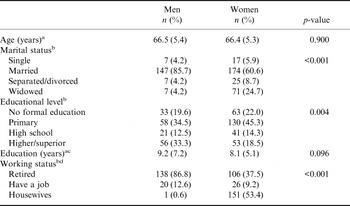
The mean age of the sample is 66.5 years (SD=5.0), with no statistically significant difference observed between women and men (Table 1). Regarding marital status, more than 85.7% of men are married compared with 60.6% of women. The percentage of female widows is significantly higher than that of male widows (p<0.001), and similar frequencies of single and separated/divorced are found for men and women. Regarding educational level, there is a high prevalence of participants with lower educational levels: more than 60% have primary education or less. A higher proportion of men than women have higher education. Women have a lower mean educational level (number of years) than men, but the difference is not statistically significant (p=0.096). Finally, regarding working status, most men are retired, while more than half of women are housewives (Table 1).
Age, marital status, educational level, education (years) and working status by gender

a Mean (SD);
b χ2;
c equal variances not assumed;
d the sum does not reach the total sample size in men and women due to missing values for this variable.
Prevalence of active ageing
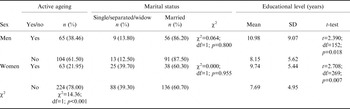
The frequency of active ageing is higher in men than in women (38.46% vs 21.95%) (Table 2), and no differences are observed in the prevalence of active ageing in relation to marital status in both men and women. However, significant differences exist in the type of ageing by educational level in both genders; individuals with active ageing have significantly more years of education than those with no active ageing (Table 2).
Relationship between type of ageing, gender, marital status and educational level

Gender differences in anthropomorphic, body composition and health variables
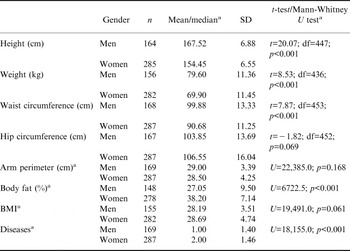
The mean waist circumference in women is higher than that given in the ATPIII (Table 3) (Arsenault et al., Reference Arsenault, Rana, Lemieux, Després, Kastelein, J. J. and Boekhold2010). Women have approximately 10% more fat than men, which is the usual difference observed between male and female adults. However, the percentage of fat mass in both sexes is higher than the recommended level (11–20% in men; 20–30% in adult women; Bray et al., Reference Bray, Bouchard, James, Bray, Bouchard and James1998). Women have significantly more diseases than men (Table 3). Mean values of BMI for men correspond to overweight, while those for women are close to those established for obesity (Table 3).
Anthropometric, body composition and health variables
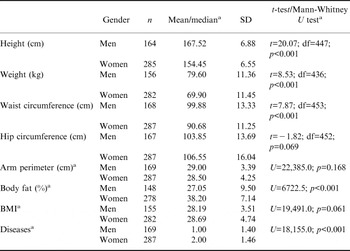
a No homogeneity of variance is assumed.
Also, women have worse self-perceived health than men (Table 4). More than 30% of men and women were obese (Table 4). It is also noteworthy that the prevalence of type II obesity (BMI>35) is twice as high in women than in men. None of the participants presented a BMI<18.5 (underweight), so this category was not included in Table 4.
Health indicators: perceived health, prevalence of overweight, obesity and metabolic risk

Although mean values of waist circumference are higher in men than in women (Table 3), a significant increased metabolic risk, according to the reference values, was only observed among women (Harper & Crews, Reference Harper, Crews, Stinson, Bogin, Huss-Ashmore and O'Rourke2000) (Table 4).
Anthropomorphic characteristics by age group and gender
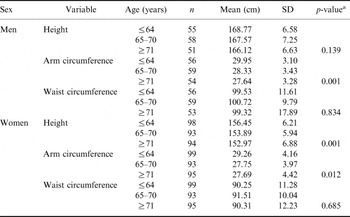
The lowest values of arm circumference by age are found in the higher age groups in both men and women. This was also observed for height, but only among women; moreover, there are no significant differences in waist circumference (Table 5).
Height and arm and waist circumference by gender and age group

a ANOVA
Predictive models of active ageing
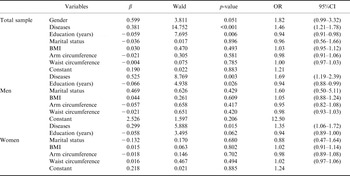
The combined effect of anthropometric, body composition, health and socio-cultural variables on the presence of active ageing has been analysed using logistic regression models (Table 6).
Predictive models of active ageing for the total sample and both men and women separately

Total χ2=45.519; df=7; p<0.001; −2 log likelihood=431.447.
Men χ2=20.107; df=6; p=0.003; −2 log likelihood=168.489.
Women χ2=15.522; df=6; p=0.017; −2 log likelihood=258.273.
Dependent variable: active ageing (yes/no).
In the first model the analysis is performed for the total sample. Because the measures are difficult to interpret when effects are protective, they are best calculated with non-protective effects (Mutsert et al., Reference Mutsert, Jager, Zoccali and Dekker2009); so, the lowest risk category (men) was selected as the joint reference, resulting in a positive risk difference for women. Logistic regression including ‘gender’ as a predictor variable showed that being a woman and number of diagnosed diseases were risk factors against active ageing. On the other hand, years of education are a protective factor against the absence of active ageing.
Different results are obtained when analyses are performed separately for men and women. In men, education level is positively associated with the presence of active ageing, while the average number of diagnosed diseases has a negative effect on it; among women, only diagnosed diseases can be consider as a risk factor against the presence of active ageing.
The other variables included in the analysis do not showed significant values. However, β coefficients suggest that arm circumference tends to be positively associated with the presence of active ageing, while BMI could negatively affect it. In addition, waist circumference could also have a negative effect on active ageing only among women. As mentioned above, this could be because although the mean values of waist circumference in women are lower than those of men, women showed a higher risk of metabolic syndrome (Table 4).
Discussion
Participants in this study were born between 1930 and 1950; at that time Spain was one of the poorest countries in Europe. Changes in the political system that occurred in 1930–36, the Spanish Civil War (1936–39) and finally the post-war period (1939–50, in coincidence with World War II) resulted in total isolation of Spain, food shortages and other negative events, with corresponding high mortality and morbidity. The elders from this generation can be considered as survivors, and their bio-physical and psychological conditions should be considered in this historical context. The socio-demographic characteristics of this sample are similar to those of the total population of the Province of Madrid (Instituto de Estadística de la Comunidad de Madrid [IECM], 2001). Differences in socio-demographic features between participants from Madrid and Toledo were not detected, except for the high number of individuals with higher education in Madrid, due to the inclusion of participants from the Seniors' University Programme. The unequal sample size between sexes is a product of the relatively higher participation of women than men in urban seniors centres in Madrid. There are more widows than widowers, due fundamentally to increased life expectancy in women compared with men. Men's educational level is higher as a result of historical differences between men and women regarding education access in this age group for the Spanish population. One interesting aspect of the study is that almost 60% of the individuals have primary/elementary school or lower educational level and near 20% never received any formal education. The high prevalence of individuals in lower social strata has strong implications since the results show that low education is predictive of the absence of active ageing.
The lower height values observed in the older age groups in men and women might be due to both secular changes in the height of the Spanish population in recent decades (Vercauteren, Reference Vercauteren, Blaha, Susanne and Rebato2005; Rebato, Reference Rebato, Blaha, Susanne and Rebato2007), and to the loss of bone mass associated with the ageing process. It might also be due to the potential impact of selective mortality (Teller et al., Reference Teller, Sibrian, Talavera, Bent, Del Canto and Saenz1979), not only for height but for other differences between sexes. The high prevalence of overweight and obesity observed (as well as the absence of underweight) could be explained in part by an overestimation of BMI values associated with height loss – especially among women, in which bone loss is greater (Skrzypczak et al., Reference Skrzypczak, Szwed, Pawlinska-Chmara, Skrzypulec, Bodzsar and Susanne2008). The use of the BMI in older people is controversial. A limitation of this study was not using other measures such as the demi-spam (distance from the sterna to the tip of the middle finger) or knee-height to estimate height values (Cereda et al., Reference Cereda, Bertoli, Vanotti and Battezzati2010). Several studies have shown an association between high BMI values and minimal mortality risk in men and women over 70 years of age (Bigaard et al., Reference Bigaard, Thomsen and Tjønneland2004; Janssen et al., Reference Janssen, Katzmarzyk and Ross2004b; López-Jimenez, Reference Lavery and Lee2009). In this study, no relationship was found between BMI and active ageing. Nevertheless, the prevalence of obesity in men and women is troubling, particularly taking into account the high values of waist circumference observed, which is an indicator of metabolic syndrome and cardiovascular risk (Perissinotto et al., Reference Perissinotto, Pisent and Sergi2002).
In general, both objective and perceived health deteriorates throughout life, but more clearly in women. A gender perspective becomes especially interesting in this approach because women have poorer health than men; WHO considers that gender is an influential factor that contributes to the occurrence of poor health during the ageing process (WHO, 2002). In the self-health survey of the Spanish population over 65 years of age (Instituto Nacional de Estadística [INE], 1999), four out of ten women classified their health as poor or very poor, while three out of ten men did so. Different health status and perception are linked to gender inequalities in the work place, in economic and personal autonomy and in entertainment. These results agree with those of the WHO and those observed in the Spanish population: women in the sample have twice the number of diseases than men, and 50% perceived their health as poor or very poor.
Education level is higher among active aged individuals for both genders. WHO's recommendations in this sense notes the importance of promoting education as a determinant factor to achieve an active ageing (WHO, 2002). However, the predictive models of active ageing in this study show that education is a determinant factor in achieving active ageing in men, but not in women. In the present study, the number of diseases remains as the most important factor against the presence of active ageing among women. Thus, greater attention is needed to lesser-known health conditions that may differ between men and women. The lower perceived and objective health status of women compared with men could be due to inequalities in the physical and psychological burden associated with the care of elders/disabled people or family members and must be considered differentially, since these activities are mainly conducted by women (Verbrugge, Reference Verbrugge1985). Differences observed in the prevalence of active ageing between men and women in relation to socio-cultural variables are surely determined by a gender effect across the life course. These results evidence that a deep knowledge of gender, health and ageing intersections is needed (De Angelis & Winker, Reference De Angelis and Winker2001). A gender perspective provides additional information regarding different policies and how they will affect the well-being of both men and women.
Acknowledgments
This study was supported by the IMSERSO (Institute of Elderly and Social Services of Spain) (Project: IMSERSO 15/050) and the Ministry of Science and Innovation of Spain (Project: I+D+I FEM2009-095560).