INTRODUCTION
Besides physical and psychosocial problems, the definition of palliative care by the World Health Organization also pays attention to spiritual issues (World Health Organization, 2012). It has been argued that spiritual care can be performed by all professionals working within palliative care (Frick et al., Reference Frick, Riedner and Fegg2005). However, the integration of chaplains (or any professionals specialized in spiritual care) can be an enormous contribution to multi-professional teams in palliative care and in health care in general (Puchalski & Ferrell, Reference Puchalski and Ferrell2010).
Health care chaplains are frequently involved and often consulted in ethically complex issues and treatment decisions (Carey & Cohen, Reference Carey and Cohen2008). Within a number of countries (e.g., Australia, UK, and USA) they are often included as members of hospital ethics committees (Carey, Reference Carey2012a). In Germany, the protestant churches were the first to demand ethics support services in hospitals (Deutscher Evangelischer Krankenhausverband, 1997). The guideline of the Federal Chamber of Physicians in Germany explicitly recommends the presence of chaplains in ethics committees (Stellungnahme zur Ethikberatung in der klinischen Medizin, 2006). One of the most common issues of clinical ethics consultation is treatment limitation at the end-of-life (Fletcher, Reference Fletcher1989; Vollmann, Burchardi & Weidtmann, Reference Vollmann, Burchardi and Weidtmann2004).
The involvement of chaplains in end-of-life decision making is, however, not unchallenged. On the one hand, their recommendations are highly valued and most chaplains welcome their involvement in these issues (Carey & Cohen, Reference Carey and Cohen2010). On the other hand, their presence is criticized due to their lack of ethical expertise, or respectively they play a less active role in ethics committees than the other professionals do (Kuhse & Singer, Reference Kuhse and Singer1985; McNeill, Berglund & Webster, Reference McNeill, Berglund and Webster1994). One of the great assets of chaplains, however seems to be their communication skills. They can frequently be involved in initiating communication to consider the patient's and/or the family's perspective with issues such as withdrawal of life support and not-for-resuscitation requests (McDaniel, Reference McDaniel1999; Carey & Newell, Reference Carey and Newell2007a; Reference Carey and Newell2007b).
However, it remains unclear how chaplains learn the specific ethical skills needed for end-of-life treatment decisions. Despite the fact that a basic understanding of ethics is part of theological studies, this is not a specific area within a chaplain's professional training. Clinical Pastoral Education in Germany does not include specific bioethical decision making as part of the training (Deutsche Gesellschaft für Pastoralpsychologie, 2006). International minimal educational standards for chaplains do not contain specific training in ethics/bioethics (Carey, Reference Carey, Cobb, Puchalski and Rumbold2012b).
There is almost no empirical data in Europe about chaplains' involvement in end-of-life treatment decisions.
This study aims to assess, in the German context, (1) how often chaplains are confronted with end-of-life treatment decisions, (2) how they judge their own confidence in this respect, (3) how they perceive their role within these decision making processes, and (4) how the integration within different teams influences these items.
METHODS
Design and Sample
To gain an overview of the practices and experiences of chaplains in Germany, we conducted a postal questionnaire survey. We addressed a convenience sample of chaplains working in German health care institutions. Potential participants were recruited from the working group “Spiritual Care” in the German Society for Palliative Medicine and from the relevant church authorities responsible for chaplaincy (Roman-Catholic and Protestant denominations). To mirror the heterogeneous confessional landscape in Germany we chose diverse, representative regions: Bavaria as overly Catholic region; Württemberg as mixed Catholic, Protestant and Muslim population, and Berlin and its surrounding areas as a secularized region (Evangelische Kirche im Rheinland, 2010).
Survey Instrument
The questionnaire was constructed on the basis of a previous study among physicians and nursing staff working in German intensive care units (Jox et al., Reference Jox, Krebs and Fegg2010).
The survey contained 27 items, consisting of both closed and open-ended questions, as well as demographic data. Demographic data included information on sex, age, and religious affiliation as well as data about professional training, duration of work experience, and specifications on one's working situation (e.g., assignment in palliative medicine or intensive care medicine, integration within multi-professional teams). Questions regarding professional practice were based on the chaplains' experience with end-of-life decision making. An explicit definition of limiting life-sustaining treatment (LST) based on German law, was given: “Limiting LST means that a certain life-sustaining medical treatment is no longer being enforced. In case LST has been previously induced it is no longer being continued.” It took approximately 10 to 15 minutes to complete the questionnaire.
Questionnaire Administration
The questionnaire was sent out by mail. A cover letter explained the background, aim, and anonymity of the survey. To ensure anonymity, all information concerning the respondent was immediately cleared as soon as the response was received. To increase the response rate, a reminder was sent out to all the chaplains after six weeks. The respondents could send back the questionnaire by mail, e-mail or fax.
The study design and questionnaire were a modification from a previous study implemented among doctors and nurses at the Munich University Hospital (Jox et al., Reference Jox, Krebs and Fegg2010). This study was approved by Munich University's hospital institutional review board. The distribution of the questionnaires took place after acceptance and approval of the questionnaire by the accordant church authorities and the head of the working group “Spiritual Care” in the German society for Palliative Medicine (meeting in Saarbrücken, Germany, September 9, 2011).
Quantitative Analysis
SPSS for Windows (SPSS Inc., Chicago, IL), version 19.0 was used for data collection and statistical analysis. The frequency of limiting LST, reported per week, month or year was recalculated in frequency per year. Questions on the level of confidence, the quality of professional training, and the level of satisfaction with the decision and communication process, which could be answered in a balanced forced-choice four-item scale (i.e., “very certain”, “rather certain”, “rather uncertain”, “very uncertain”), were dichotomized (e.g., “certain” and “uncertain”). To explore coherence between dichotomous variables, the Chi-square-test was calculated. In order to test coherence on scaled variables, a non-parametric test was applied: for two groups, the Mann-Whitney-U-test was implemented. Furthermore, the Kendall-Tau-b coefficient was calculated for ordinal variables, followed by a two-tailed test on significance. P ≤ 0.05 was set as the level of significance.
RESULTS
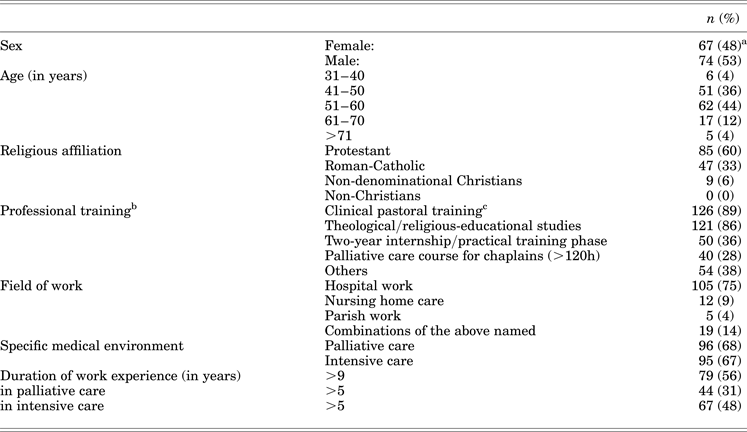
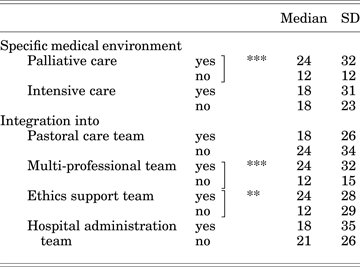
The survey was mailed to 256 chaplains. Of the 151 returned questionnaires (response rate: 59%), 141 (55%) were analyzable. In the remaining 10 questionnaires demographic data was missing. The respondents' demographic data is presented in Table 1. The participants were requested to specify the degree of integration in their team. Regular involvement in meetings, such as team rounds and supervision meetings served as the basis for defining the degree of integration. Most respondents were integrated in Pastoral care teams (n = 105, 75%), multi-professional treatment teams (n = 88, 62%), and ethics support teams (ethics committees, n = 73, 52%). Some were also part of the hospital administration (n = 36, 26%). The median number of confrontation with limiting LST was 18 times per year (mean = 28, SD = 28). Chaplains who were members of a multi-professional team, an ethics support team, or a palliative care team reported significantly higher rates of confrontation than the others (see Table 2).
Respondents' demographic data (n = 141)

aNumbers may not add to 100% due to rounding
bMultiple choices were possible
cCPT/CPE/comparable pastoral-psychological qualifications
Reported frequency of confrontation with limiting LST a per year
a LST = life-sustaining treatment
**P ≤ 0.01 (Mann-Whitney-U-Test)
***P ≤ 0.001 (Mann-Whitney-U-Test)
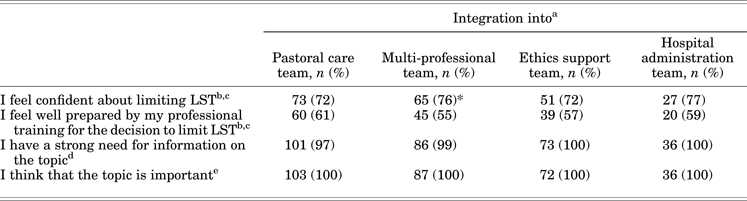
Two-thirds of the chaplains indicated that they feel confident discussing the limitation of life-sustaining treatment (n = 94, 67%). More than half of the respondents (n = 77, 55%) felt that they had been well-prepared for these situations in their respective professional training. Explanatory notes suggested a lack of practical training in academic studies. Practical experience and continuous education were appreciated for including end-of-life decisions. If the chaplains were members of multi-professional teams, they felt significantly more confident in such situations (see Table 3). Statements regarding the quality of their professional training correlated positively with the level of confidence in end-of-life decisions (r = 0.24, p ≤ 0.01). Furthermore, nearly all chaplains reported that the survey questions were highly relevant to them (n = 138, 98%) and stressed their strong desire for information (n = 135, 96%).
Reported levels of confidence, preparation and need for information (n = 141).
aIntegration within more than one team was possible.
bLST= life-sustaining treatment.
cSum of “very certain” and “rather certain.”
dSum of “very strong need” and “strong need.”
eSum of “very important” and “rather important.”
*p ≤ 0.05 (Chi-square-test).
Chi-square-test compares differences between being integrated and not being integrated in a special team.
The percentages are the result of the number of respondents who have explicitly answered the particular question.
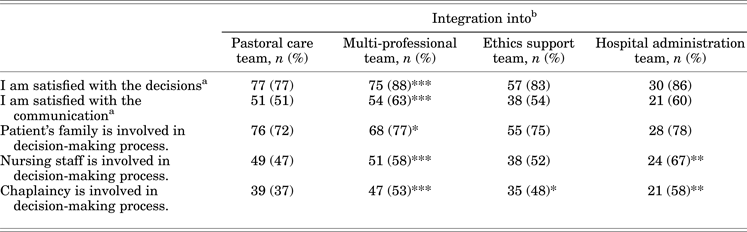
More than half of the respondents (n = 73, 52%) declared that end-of-life decisions were made cooperatively by the team of physicians; 42% (n = 59) reported that the attending physicians made unilateral decisions. With regard to the involvement of other professionals in these decision-making processes, the following results were found: patient's family: n = 99, 70%; nursing staff: n = 64, 45%; spiritual care: n = 54, 38%. Chaplains who consider themselves members of a multi-professional team declared significantly more often that a patient's family, nursing staff, or chaplains were actively involved in the decision-making process (see Table 4).
Reported experience with end-of-life decision making (n = 141)
aSum of “very satisfied” and “rather satisfied.”
bIntegration within more than one team was possible.
*p≤0.05 (Chi-square-test).
**p ≤ 0.01 (Chi-square-test).
***p ≤ 0.001 (Chi-square-test).
Chi-square-test compares differences between being integrated and not being integrated in a special team.
The percentages are the result of the number of respondents who have explicitly answered the particular question.
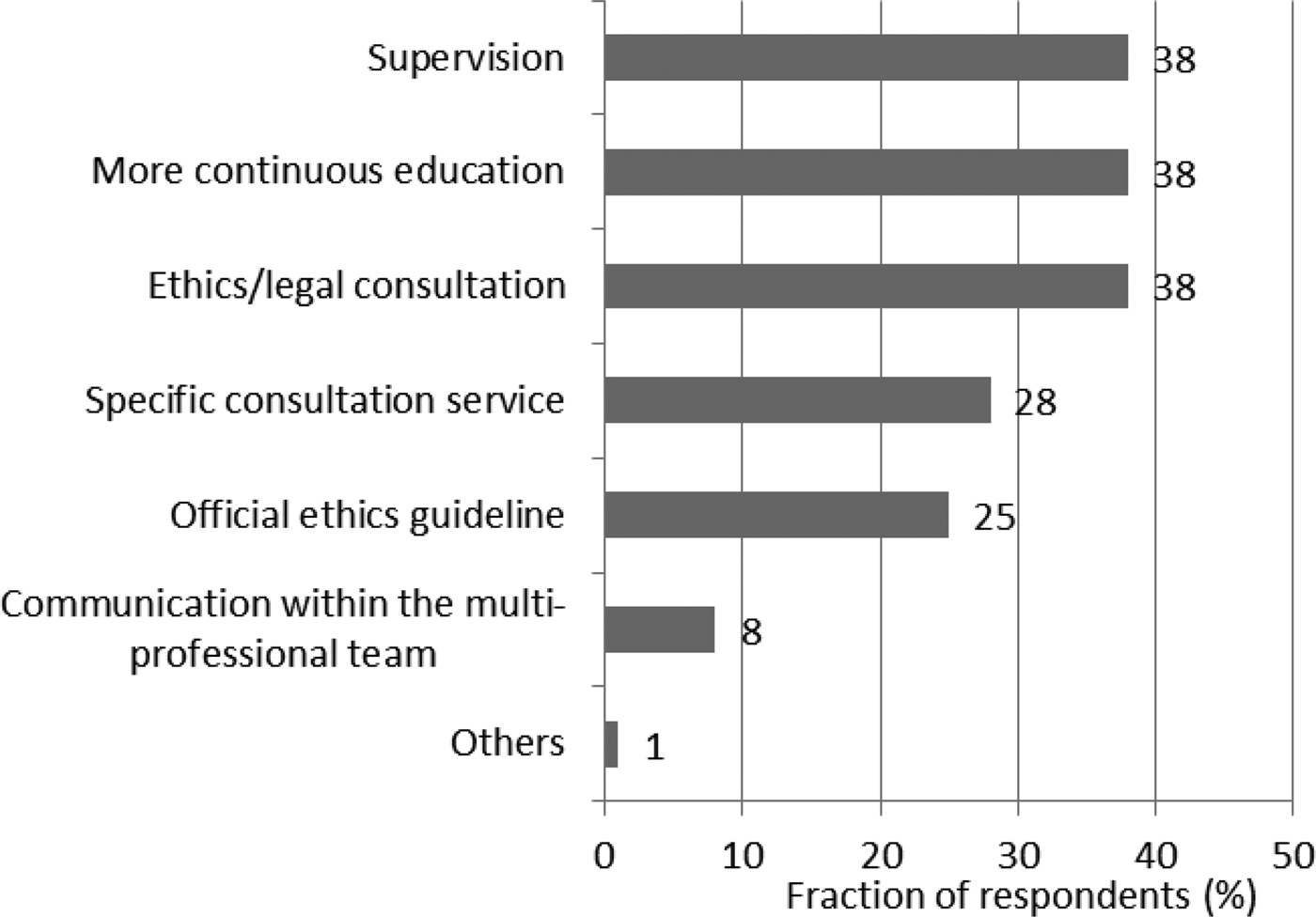
All in all, three-quarters of the respondents reported being satisfied with end-of-life decisions (n = 104, 74%). However, only half of the chaplains (n = 68, 48%) were satisfied with the communication process; these data were positively correlated (r = 0.61, p ≤ 0.01). Professional experience and satisfaction with end-of-life communication were significantly inversely correlated (r = −0.21, p ≤ 0.01). Due to the lack of satisfaction regarding communicative structures, there remains a strong desire for supportive measures (see Fig. 1).
Reported desire for supportive mesaures. Multiple choices were possible.
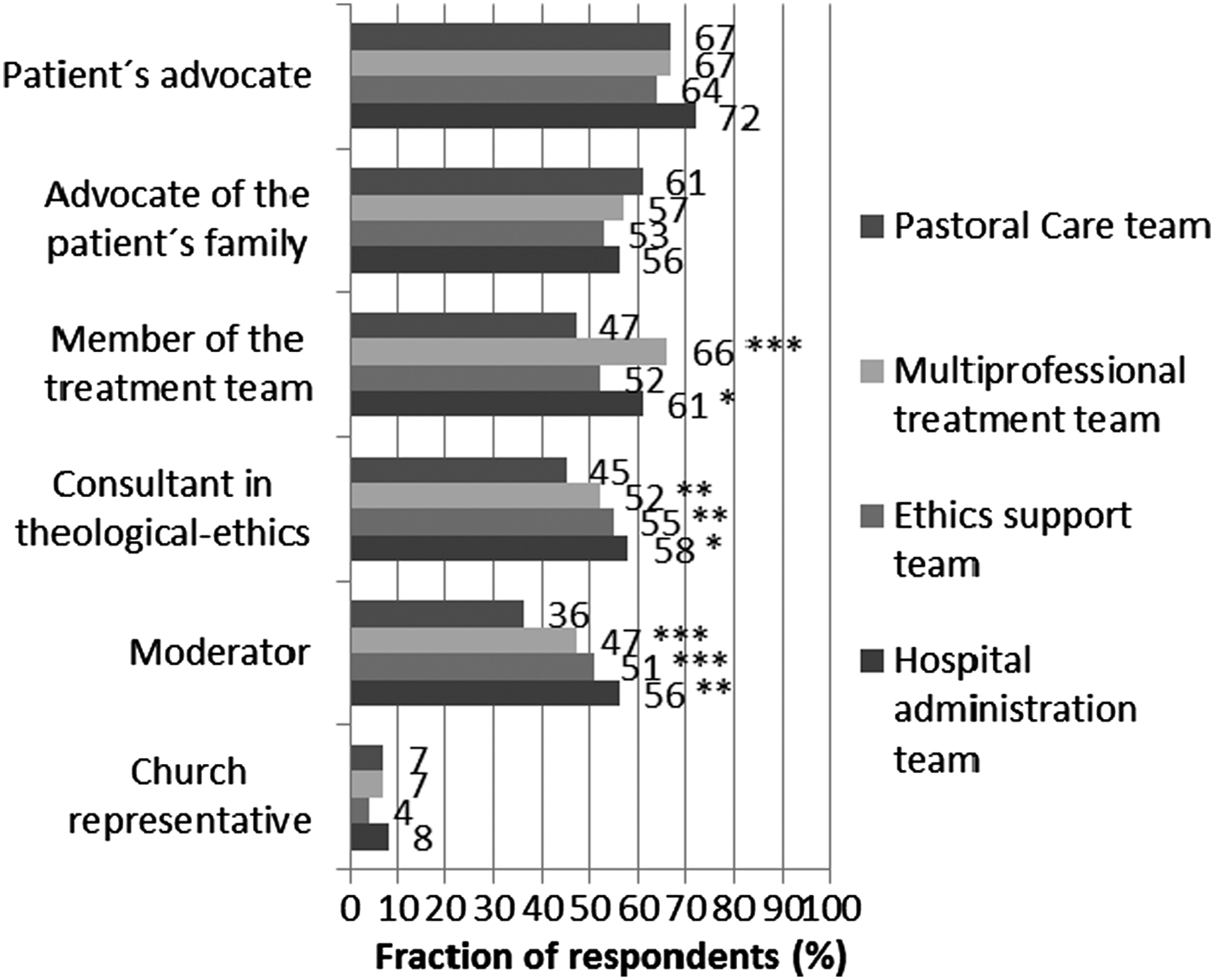
The role in which the chaplains see themselves in decision-making processes is most often as the patient's advocate (n = 91, 65%) and the advocate of the patient's family (n = 81, 57%). Less than half of the chaplains see themselves as members of the treatment team (n = 65, 46%), consultant in theological-ethics (n = 62, 44%), moderator (n = 50, 36%), or church representative (n = 9, 6%; Fig. 2).
The self-perceived role of chaplains within decisions concerning limiting of life-sustaining treatment. The histogram shows the answers of the respondents on their self-perceived role in dependence on their integration within different teams. Integration within more than one team was possible. The asterisks indicate significant differences between being integrated within a special team or not being integrated (*p ≤ 0.05, **p ≤ 0.01, ***p ≤ 0.001, Chi-square-test). The percentages are the result of the number of respondents who have explicitly answered the particular question (valid percentages).
DISCUSSION
The survey had a 59% response rate, and can thus be considered to be sufficiently representative within the chosen sample (Asch, Jedrziewski & Christakis, Reference Asch, Jedrziewski and Christakis1997). The chaplains explicitly expressed the fact that these topics are of great importance to them. This is a remarkable result, since end-of-life decisions and the corresponding ethical conflicts are not necessarily topics that pertain directly to spiritual care (Deutsche Gesellschaft für Pastoralpsychologie, 2006; Carey, Reference Carey, Cobb, Puchalski and Rumbold2012b).
The interest shown by the chaplains may be due to the fact that they are confronted with end-of-life decisions on a regular basis (median = 18 times per year). This data corresponds with data from Australian chaplains, where a large fraction (57% of the staff chaplains and 28% of the volunteer chaplains) indicated to be involved with end-of-life decisions with patients or their families; 37% of the staff chaplains and 16% of the volunteer chaplains had assisted the clinical staff within these decisions (Carey & Newell, Reference Carey and Newell2007b). Remarkably, chaplains appear to be confronted with these decisions almost as often as senior physicians and nurses in German intensive care units (Jox et al., Reference Jox, Krebs and Fegg2010). Chaplains who are a part of a palliative care team, an ethics support team, or a multi-professional treatment team, are confronted with these decisions significantly more often than chaplains who are not. This can be explained by the fact that in Germany chaplains are usually only regarded as members of the treatment teams in the context of palliative care. This is a result of the required multi-disciplinary approach in palliative medicine, as outlined by its WHO definition (World Health Organization, 2012). Caring for non-palliative patients mainly involves physicians and care nurses, whereas chaplains are usually only involved in these cases if there is a specific need for them or due to a patient's explicit demand.
Notably, 67% of chaplains indicated that they felt confident with regard to end-of-life decisions. Again, chaplains who were part of a multi-professional team were more confident than those who were not. This may be due to the fact that in multi-disciplinary teams sharing responsibility is a basic principle. It would be interesting to figure out whether the level of confidence of other professionals is inversely increased if chaplains are members of the treatment team. The percentage of chaplains that indicated confidence in their end-of-life treatment decisions was significantly higher than that of a survey of physicians and care personnel in German intensive care units (Jox et al., Reference Jox, Krebs and Fegg2010). Correspondingly, in the ETHICUS study, 81% of the respondent physicians in central Europe indicated that they did not have difficulties making end-of life treatment decisions (Sprung et al., Reference Sprung, Woodcock and Sjokvist2008). The above mentioned survey among German intensive care unit staff showed a clear connection between insecurity with regard to end-of-life decisions and the amount of work/medical experience. The ETHICUS study, as well as the present study, surveyed mainly experienced professionals.
Importantly, the percentage of chaplains who feel well prepared for end-of-life situations through their professional training is lower (55%). Indeed, end-of-life care and support and the corresponding ethical conflicts are not explicitly addressed within a chaplain's professional training curriculum in Germany (Deutsche Gesellschaft für Pastoralpsychologie, 2006). Many respondents reported to have absolved additional professional training in this area, which may contribute to the overall confidence concerning end-of-life decisions.
Despite the high degree of satisfaction among chaplains with end-of-life treatment decisions (74%), the level of satisfaction with communication processes is significantly lower (48%). Accordingly, supervision, which also serves the purpose of improving communicative competence, is one of the measures of support that was mentioned most frequently (Skinner et al., Reference Skinner, Roche and O'Connor2005). Official guidelines, which have a long tradition in the medical context, played a secondary role (Burns et al., Reference Burns, Edwards and Johnson2003). Overall, our data show that being part of a multi-professional team has a positive effect on the level of satisfaction with the communication processes as well as with end-of-life decisions. Members of these teams indicated significantly more frequently that professionals other than the treating physicians (e.g., nurses, chaplains), were involved in the decision process.
The chaplains' self-perceived role in the context of end-of-life decisions seems to be primarily that of the patient's advocate, a role that is gaining importance within health care institutions (Mallik, Reference Mallik1997). Interestingly, chaplains who are involved as members in multi-professional teams see themselves significantly more often as a facilitator (i.e., facilitators of the communication process).
Our study has several limitations. It is not an objective evaluation of current practice, rather a subjective investigation based on the self-perspective of chaplains working in health care facilities. The study only looked at a limited sample, which may be biased with regard to membership in the German Society for Palliative Medicine. In addition, as with all questionnaire surveys asking for subjective parameters such as satisfaction with one's own practice, social desirability bias is possible.
CONCLUSIONS
This study provides first indications concerning the frequency and type of involvement of chaplains in end-of-life treatment decisions within a German cultural context. This evaluation will have to be followed up by investigations of these aspects amongst other professional groups, as well as in patients and relatives, as has already been done in other cultural and medical contexts (VandeCreek, Reference VandeCreek2004). End-of-life treatment decisions are known to be highly dependent on the religious and denominational backgrounds of all those involved (Sprung et al., Reference Sprung, Cohen and Sjokvist2003; Seal, Reference Seal2010). Therefore, further studies of this topic in other cultural settings appear warranted.
ACKNOWLEDGMENTS
The authors are grateful for the participation of the respondents, for support of the church authorities responsible for chaplaincy and the working group ‘Spiritual care’ of the German Society of Palliative Medicine. Thanks are due to Dorothee Wagner von Hoff for language support. The authors are also grateful for creative ideas and critical appraisal of the study by all members of the Palliative Care research group Munich.