And so I am an anti-imperialist. I am opposed to having the eagle put its talons on any other land.
– Mark Twain, quoted in the New York Herald, Oct. 15, 1900Footnote 1Part of the impetus for the American intervention in the Philippines at the end of the nineteenth century came from, as President William McKinley himself said, a desire to “civilize and Christianize” the Filipinos.Footnote 2 Historians of American imperialism have therefore rightly highlighted the religious dimension of support and opposition to Gilded Age expansion, but there remains the need for a study of how American atheists and other freethinkers—those who rejected Christianity—responded to the question of U.S. involvement overseas.Footnote 3 Historians have charted the anti-imperialist movement in the United States, but they have typically neglected the irreligious motives that led some individuals to oppose expansion.Footnote 4 An examination of freethinkers’ views about imperialism would respond, in part, to the call of the historian Jeremy Rich, who writes, “[i]f one is to move beyond a hagiographic approach to the history of American religious scepticism, it will be necessary for scholars to find how freethinkers engaged with major issues in American cultural life.”Footnote 5 Certainly the debates surrounding American imperialism signaled an important moment in American cultural life, as Americans began to contemplate what, if any, their role should be on the global stage.
Mark Twain, the novelist and social commentator, seems an obvious starting point to this investigation. Twain was one of the most prominent critics of American intervention abroad and historians have identified how, at the turn of the century and toward the end of his life, Twain expressed vocal criticisms of Christianity and organized religion. Susan K. Harris's recent book, God's Arbiters: Americans and the Philippines, 1898–1902, considers Twain as “the man who embodies the conflicting assumptions held by most white Americans” about the American turn to empire.Footnote 6 Yet in Harris's reading, the dominant discourse at the turn of the century assumed the superiority of white American Protestants, who had a divine mission to uplift the backward races of the world. At the same time, however, many who believed in this American exceptionalism were confronted with the reality of an American foreign policy that seemed to shun the nation's republican ideals as it embarked on a campaign of conquest in the Philippines.
Harris is right to apply this framework to many Americans who were thinking about empire during the Philippine war. Twain, however, fits less easily into this framework since it considers him as part of a wider Protestant culture, in which, for example, imperialists and anti-imperialists alike shared “a desire to maintain the illusion that the United States was a white Christian nation” or “that the United States was a means toward a divine end, a country established to fulfill God's plan.”Footnote 7 For a work that centers so much on Twain and the supposed importance of the Protestant worldview, it is unfortunate that Harris entirely omits any discussion of freethinkers and of Twain's relationship to these figures. While Harris acknowledges that Twain did not have a simple relationship with Christianity, he nonetheless had “a profound desire for belief […].”Footnote 8 Twain's sharp criticism of the United States, she continues, “does not suggest that [he] rejected the idea that the United States had been founded on the principles of liberty, justice, and Protestant Christianity. On the contrary; the bitterness of his satire points to the fervency of his belief.”Footnote 9
Yet the irreligious nature of Mark Twain's anti-imperialist critique becomes clearer when seen in the context of a freethought tradition instead of the supposedly ubiquitous Protestant one. This article situates Mark Twain's anti-imperialism within the wider freethought responses to these debates about empire. This is not to argue for a clear line of influence in either direction—from Twain to other freethinkers, or from the freethinkers to Twain—but only to highlight the ways in which skepticism, if not outright hostility, toward organized religion might lead to similar views toward imperial conflicts and the nature of patriotism more generally. Freethinkers used an irreverent and even scoffing tone that attempted to expose and undercut the hypocrisies of Christianity and ideas of American superiority. These were not detailed political or economic analyses but were profoundly moral critiques that were distinctly rooted in the tradition of freethought. Twain, however, kept his most extreme views unpublished, even if he still published some strident criticisms of the war against the Philippines. Other freethinkers felt no such compulsion, expressing views that were often far outside the mainstream and that someone like Twain might otherwise have suppressed. Such an approach adds further depth to our understanding of Mark Twain's anti-imperialist views as well as illuminating his irreligious opinions. More broadly, this article seeks to question the idea that Americans’ views of imperialism can be understood entirely within the framework of the country's Protestant heritage and instead hopes to show that an approach informed by freethought led to new ways of conceiving of the emerging American empire.
In general, American freethinkers’ attitudes to imperial warfare shifted based on their nation's enemy. Initially, freethinkers, including Twain, cheered on the American war against Catholic Spain, in Cuba and the Philippines, beginning April 25, 1898. After the rapid defeat of the Spanish, the Treaty of Paris was signed on December 10, 1898. In this treaty, Spain relinquished control of Cuba and ceded Guam, Puerto Rico, and the Philippines to the United States. The Americans’ sights then turned to the Filipinos, who, having thrown off one colonial master, were not eager for another, and the two sides went to war on February 4, 1899. American freethinkers greeted this fight with less enthusiasm than the one against Spain, especially as the war took on a missionary character and reports of atrocities committed by American soldiers came to light. No longer was the United States the champion of oppressed peoples against the hated Catholic Spanish but had become an oppressor itself, no different from any other Christian power. The changing role of religion was thus critical to the way in which freethinkers responded to these conflicts.
The article will first begin with a discussion of Mark Twain's religious views and the context of nineteenth-century freethought. It will then move to discuss the ways in which a freethought perspective informed Twain's anti-imperialist critiques. The article will next consider the views of other freethinkers, with reference to the works of Robert Ingersoll and to several leading freethought periodicals, the Truth Seeker, the Free Thought Magazine, and the Blue-Grass Blade.
MARK TWAIN AND AMERICAN FREETHOUGHT
Recent scholarship on the religion of Mark Twain (1835–1910) has charted the complex trajectory of his religious journey.Footnote 10 Twain (Samuel Clemens) was born in Missouri and as a child attended a Presbyterian church with his mother, even though Twain's father was probably a freethinker. While a steamboat pilot on the Mississippi River in the 1850s, Twain read Thomas Paine's Age of Reason (1794–1795), one of the most influential freethought works of the era. Even as a young man, Twain harbored skepticism about the harsh Calvinist morality of his youth, but he devoted himself to Christianity in the 1860s during the courtship of his wife, Olivia, whose family was active in the Social Gospel scene in Elmira, New York. In 1871, Twain and his wife relocated to Hartford, Connecticut, another of the epicenters of the Social Gospel movement. While there, Twain developed one of the strongest friendships of his life with the Reverend Joseph Twichell. Twichell was the pastor at the Asylum Hill Congregational Church in Hartford, which Twain attended but never formally joined (although he and his wife remained members of the Congregationalist Church in Elmira). In the late 1870s, Twain appeared to confide to Twichell that he could no longer believe in orthodox Christianity. The two nonetheless remained close friends throughout the rest of their lives and Twain continued to attend the church even as he drifted further from Christianity.
Albert Bigelow Paine's early biography of Twain includes the text of a document Twain wrote sometime in the early 1880s, in which Twain wrote that while he believed in God, he did not believe that this god ever communicated to humans, meaning that the Bible was “imagined and written by man …” Twain also rejected special providence and the idea of eternal punishment. He left open the possibility of an afterlife yet expressed indifference to the question. These views, Paine suggested, did not deviate over his remaining years.Footnote 11 Indeed, following Twain and his wife's departure from Hartford in 1891, and into final years of his life, Twain expressed increasingly negative and pessimistic views about humanity and religion. In some ways, this pessimism reflected his personal circumstances, including his financial hardships during the 1890s as well as the deaths of his daughter Susy in 1896 and his wife in 1904. This period resulted in the collection of irreligious essays called Letters from the Earth, written in the first decade of the twentieth century but not published until 1962, several decades after his death.Footnote 12
While never orthodox, Twain's writings were often filled with biblical allusions and addressed a variety of religious motifs in an earnest way. This can perhaps best be seen in his admiring treatment of religious figures, particularly his 1896 work, Personal Recollections of Joan of Arc.Footnote 13 His close friendship with Twichell and his immersion in Christian society during most of his life meant that his views were unavoidably shaped in some ways by the Christian tradition. Twain grappled throughout his life with issues of the existence of God and the afterlife, the nature and purpose of humanity, and free will versus determinism. Harold K. Bush Jr. perhaps best captures Twain's views when he describes him as a “truth seeker.”Footnote 14 This echoes remarks made by David Nash, who, in the context of Victorian Britain, argues that historians should not construct a sharp dichotomy between believers and nonbelievers, but rather recognize “the religious and moral ‘seeking’ of a whole generation” that was characterized by “eclecticism” in religious matters, rather than adherence to particular dogma.Footnote 15 This “eclecticism” is important in understanding Twain, as his worldview inevitably drew much from his Protestant heritage, but was also profoundly influenced by the development of freethought during the nineteenth century. By the end of his life, Twain had strayed far from Christian orthodoxy, even if he never openly declared himself a freethinker and kept some of his most critical views of religion unpublished.
Susan Jacoby has described the second half of the nineteenth century as the “Golden Age of Freethought.”Footnote 16 This was a time when the authority of Christianity increasingly came under question: new insights from biology, geology, and archaeology challenged the traditional creation story found in the book of Genesis and biblical scholarship shed light on the authorship and composition of the Bible, undermining its claims to be divine revelation. A number of outspoken freethinkers in the era criticized religion and instead advocated for the principles of science, rationality, and secular government. The most important figure here was Robert Ingersoll (1833–1899), born in Dresden, New York.Footnote 17 Ingersoll's father was a Congregationalist preacher and abolitionist, who, because of his political views, had trouble retaining a stable congregation. This meant that the Ingersoll family moved frequently as result. Ingersoll eventually settled in Illinois, where he became a lawyer and unsuccessfully ran for Congress as a Democrat in 1860. He also served in the Civil War as a colonel (a title he would use throughout his life). It was during the first half of the 1860s that Ingersoll's irreligious views took shape, as he read some of the same freethought works as Twain, like the Age of Reason. Ingersoll's marriage to Eva Parker in 1862 might also have been influential in his movement away from Christianity since she came from a freethinking family. After the war, Ingersoll became active in the Republican Party and quickly developed a reputation as an impressive orator. In the decades following, Ingersoll lectured to audiences across the United States, often billed as the “Great Agnostic.” His lectures covered a range of topics, but the ones on freethought topics drew huge crowds and proved extremely popular, even among Christians. Sidney Warren estimates that over the course of Ingersoll's lecturing career, he probably reached hundreds of thousands of people.Footnote 18
This period also saw the formation of local and national secular organizations that advocated for a greater separation of church and state, including an end to churches’ exemption from taxation and the removal of religious teaching from schools. The National Liberal League was founded in 1876 and eventually was absorbed by the American Secular Union and Freethought Federation, founded in 1884 and continuing into the early twentieth century. At its height around the turn of the century, this group boasted between forty and fifty thousand members, though membership declined dramatically by the 1910s.Footnote 19 Related to the organizational presence was a thriving print culture. The Truth Seeker was the largest weekly freethought newspaper of the time, based in New York City. Begun in 1873 by D. M. Bennett, the newspaper advocated a range of views but was primarily aimed at criticism of Christianity and support for secular and rationalist principles. Following Bennett's death in 1882, the editorship passed to Eugene Macdonald (1855–1909), who continued in this position until 1909. Macdonald and his brother George, another freethinker and editor of the newspaper after Eugene's death, were born in Maine. Unlike so many other freethinkers, they were not raised as Christians but actually came from a freethinking family. In adulthood, the two moved to New York City and apprenticed with Bennett on the Truth Seeker until they took over.Footnote 20
Another important periodical was the weekly Blue-Grass Blade, founded in Lexington, Kentucky, by Charles Chilton Moore (1837–1907) in 1884. As a young man, Moore trained as a non-denominational preacher and was ordained at Bethany College, Virginia (now in West Virginia) but gradually gave up the faith, in part because of passages in the Bible that sanctioned slavery. Moore also spent several months in prison in 1899, convicted of sending obscene material through the mail, namely a discussion about free love in his paper.Footnote 21 The monthly Free Thought Magazine was founded and edited by Horace L. Green (1828–1903). Green, originally from a small town in New York, became active in freethought organizations in the 1850s and ‘60s and gave lectures on freethought across the Northeast, following a career as a schoolteacher and lawyer. He began the periodical in Buffalo, New York, in 1882, but later relocated it to Chicago. It ceased publication in 1903, following Green's death.Footnote 22 All of these periodicals had a national readership and often featured letters from people across the country. Larger periodicals like the Truth Seeker had a circulation into the thousands.Footnote 23 To take one instance, in 1880, the Truth Seeker, perpetually strapped for money, appealed to its readers to actually pay their subscriptions, complaining that over four thousand subscribers alone were in arrears!Footnote 24
Historians have identified Mark Twain's connections with these freethinkers, the most prominent being Ingersoll. Thomas D. Schwartz highlights the tremendous influence that Ingersoll had on Twain. The two had met in 1879 at a banquet for Civil War veterans and afterward Twain raved about Ingersoll's oratorical prowess. Twain engaged in sporadic correspondence with Ingersoll over the following years and read some of his works, including his lecture “Ghosts” and a debate with the clergyman Jeremiah Black published in the North American Review. Furthermore, in 1900, Twain received a copy of Ingersoll's Collected Works from a subscriber.Footnote 25 John Bird has gone further than Schwartz, contending that Twain was not just influenced by Ingersoll's irreligious writings, but that Twain actually plagiarized many of Ingersoll's ideas. This can be seen, Bird argues, especially in Twain's aforementioned Letters from Earth.Footnote 26 Even if one does not accept the charge of plagiarism in its entirety, it is clear that Twain owed much to Ingersoll. Twain never formally joined the freethought movement, but he was a subscriber to the Truth Seeker, according to George Macdonald.Footnote 27 Macdonald also confirmed, on Twain's death, that Twain was a fellow freethinker and that his views on religion were essentially the same as Ingersoll's, although it must be noted that Christians also claimed Twain as one of their own upon his death.Footnote 28
For those in the nineteenth century, to be a freethinker was about much more than belief in God. Perhaps even more important than the question of God's existence was a shared rejection of the divinity and historicity of the Bible, a commitment to rationality and independent inquiry, and a hostility toward the influence of organized religion and the clergy. It is on these grounds that Twain's views accord with other freethinkers, and it is not surprising therefore that Twain and other freethinkers’ views of imperialism contain many of the same themes.
MARK TWAIN'S ANTI-IMPERIALISM
There is a familiar pattern observable for Twain and other freethinkers with regard to the American turn to imperialism. This consisted of initial support for the war against the Spanish, which was conceived as a war on behalf of Cuba against an oppressive Catholic power, followed by an anti-imperialist turn when the fight against the Philippines began. At the time of the outbreak of the Spanish-American War, Twain was living in Europe. Nonetheless he wrote in June 1898 to Joseph Twichell about his support for the war: “I have never enjoyed a war … as I am enjoying this one.” This was because the United States seemed to be fighting for Cuban freedom: “It is a worthy thing to fight for one's freedom; it is another sight finer to fight for another man's.”Footnote 29
Twain returned to the United States in October 1900 after having spent several years abroad. It was during this period abroad that Twain wrote Following the Equator (1897), an account of his travels through the British colonies of Australia, New Zealand, India, and South Africa. In these writings, Twain was deeply critical of British imperial rule and expressed sympathy for the plight of the indigenous people. It was in this work that Twain made his quip: “There are many humorous things in the world; among them the white man's notion that he is less savage than the other savages.”Footnote 30 By the time of Twain's return, Spain had been defeated and the Treaty of Paris signed. Even if he was critical of other nations’ disastrous attempts at bringing civilization, he could not yet imagine his own country in this same critical light. In an interview soon after his return, Twain recollected that he used to be “a red-hot imperialist. I wanted the American eagle to go screaming into the Pacific … Why not spread its wings over the Philippines, I asked myself?” In Twain's view, the United States should liberate the Filipinos, who had been oppressed for three hundred years, just as the nation had liberated the Cubans. The United States should “put a miniature of the American constitution afloat in the Pacific, [and] start a brand new republic to take its place among the free nations of the world.”Footnote 31
But after “carefully” reading the Treaty of Paris, in which the United States purchased the Philippines from Spain for twenty million dollars, Twain's opinion changed: “… I have seen that we do not intend to free, but to subjugate the people of the Philippines. We have gone there to conquer, not to redeem.” More aggravating still was the provision ensuring the Americans would respect Spanish property rights, which meant that the country would “maintain and protect the abominable system established in the Philippines by the Friars.”Footnote 32 The Catholic friars, who had long helped govern the country over the three hundred years of Spanish rule, used their power to acquire large landholdings, marking them out as prime targets for Filipino nationalists like Emilio Aguinaldo and José Rizal, who denounced the friars’ corruption and undue influence.Footnote 33 Twain concluded by saying: “It should, it seems to me, be our pleasure and duty to make these people free, and let them deal with their own domestic questions in their own way. And so I am an anti-imperialist. I am opposed to having the eagle put its talons on any other land.”Footnote 34
Twain soon joined the Anti-Imperialist League, founded in 1898, and became a vice president, serving from 1901 to his death in 1910.Footnote 35 While the role was largely symbolic, Twain turned his pen in support of their cause. Among his published writings included “To the Person Sitting in Darkness” (1901), which imagined a satirical explanation about the necessity of imperialism to an uncivilized subject, the eponymous person in darkness,Footnote 36 and “A Defence of General Funston” (1902), which gave a tongue-in-cheek vindication of General Frederick Funston's underhanded capture of the Filipino resistance leader Emilio Aguinaldo by feigning illness and surrender. Twain suppressed some of his most scathing criticisms of American imperialism however, because he feared they were too controversial and, like some of his irreligious works, they were only published after his death. In this, Twain differed from the other freethinkers discussed here, who felt no need for self-censorship. Twain's position as a prominent literary figure undoubtedly made him more reluctant to put forth his most controversial views, but this was not a concern for other freethinkers.
Common to all Twain's anti-imperialist writings was a belief that the United States’ ideals were being betrayed by their actions in the Philippines. Furthermore, the cherished republican values of citizenship and freedom of speech were being eroded by a stifling patriotism that sought to crush all dissent in the name of supporting one's country regardless of the righteousness of its actions. While similar ideas were also put forth by other anti-imperialists, of particular relevance to my argument are the irreligious threads running through Twain's anti-imperialist writings. As we saw, Twain's initial disagreement with the Treaty of Paris was based partly on the issue of the Catholic friars in the Philippines, and this theme would reemerge in other works. In Twain's suppressed work, “The Stupendous Procession,” written in early 1901, Twain described a procession of symbolic figures representing various nations. The United States was represented by tarnished national symbols including a shackled woman in Grecian dress and a sullen-looking bald eagle. The American procession also included a “Fat Spanish Friar wrapped in the Treaty of Paris—labeled ‘This is Nuts for Us.’ Grouped about him, 16 recent children with wet-nurses. Banner, inscribed—‘Under the Treaty-protection we can start our population-factories again.’”Footnote 37 This is a reference to the common allegation that the friars fathered illegitimate children with Filipino women.Footnote 38 The friars also held other banners that expressed their desire to continue exercising control over the Philippines, with reference to Tammany Hall, the corrupt New York City political machine widely associated with Irish Catholics.Footnote 39 In “To The Person Sitting in Darkness,” Twain even likened the friars to diseases:
In buying these ghosts for twenty millions, we also contracted to take care of the friars and their accumulations. I think we also agreed to propagate leprosy and smallpox, but as to this there is doubt. But it is not important; persons afflicted with the friars do not mind other diseases.Footnote 40
While Protestant opponents of imperialism also shared this anti-Catholic sentiment, Twain's dislike of the friars was part of a larger resentment of all missionary activity, in which, he thought, arrogant and obnoxious Christians forced their religion upon helpless people. This is seen most clearly in the first section of “To the Person Sitting in Darkness,” which heavily criticized the Reverend William Ament for forcibly collecting compensation from the Chinese for Western missionary losses in the recent Boxer Rebellion—compensation that ultimately totalled over thirteen times the value of the actual property lost. Twain pulled no punches against Ament, whose acts of extortion condemned “pauper peasants … and their women and innocent children to inevitable starvation and lingering death, in order that the blood-money so acquired might be ‘used for the propagation of the Gospel’ …”Footnote 41 The work originally appeared in the North American Review but was subsequently reprinted by the Anti-Imperialist League. The League, however, omitted the first section on Ament. While part of this decision was based on a need to focus the subject matter of the essay and reduce printing costs, the need to avoid offending the religious classes was undoubtedly another motivation.Footnote 42
Twain's anti-imperialist writings also emphasized that Christians were the ones behind the violent atrocities committed in the Philippines. Another unpublished essay condemned the “Moro Massacre” of 1906, in which several hundred Filipino men, women, and children were killed by U.S. forces in what was ostensibly a battle but left nearly everyone on the Filipino side dead. Repeatedly, Twain highlighted that the soldiers were Christian. In one place, he called them “Christian butchers”; in another, he mockingly noted that, given the almost 100 percent fatality rate for the enemy, “[t]his is incomparably the greatest victory that was ever achieved by the Christian soldiers of the United States.”Footnote 43 In “The Stupendous Procession,” meanwhile, the “Head of the Spanish Inquisition” looked at the United States with envy: “We thought we were past-masters in inventing human miseries—these American Christians can teach us our trade.”Footnote 44
All of this meant to sever the common link between Christianity and morality. One might contend, as Susan Harris does, that Twain's writings were “jeremiads” in the Protestant tradition. “A jeremiad,” she explains, “accuses the community of having transgressed, then demands that the members repent and resume their mission to follow in the ways of God.”Footnote 45 This, however, seems unfair when applied to Twain. Freethinkers routinely pointed out Christians’ hypocrisy and their failure to live up to their own moral ideals. One popular freethought work in the nineteenth century, for example, was a collection of crimes committed by priests.Footnote 46 It would not be justified to therefore say that these freethinkers were operating from within the Protestant tradition.
There were, however, anti-imperialist Protestants who strongly denounced their own nation's conduct in the war against the Philippines as unchristian.Footnote 47 While Twain similarly highlighted Christian hypocrisy, he seemed pessimistic about the possibility for the religion ever reforming. One such work from 1905, unpublished during his lifetime, was “The War Prayer.”Footnote 48 The work described how “in the churches the pastors preached devotion to flag and country, and invoked the God of Battles, beseeching His aid in our good cause in outpourings of fervid eloquence which moved every listener.”Footnote 49 Religion, then, along with nationalism, could dull people's moral senses. Twain then described a scene in which a stranger—declaring himself God's messenger—entered the church and rebuked the preacher for praying for the victory of his own country. Such a prayer, the stranger said, had hidden consequences. The unspoken words of that prayer should say, for example: “… O Lord, our God, help us to tear their soldiers to bloody shreds with our shells; help us to cover their smiling fields with the pale forms of their patriot dead …”Footnote 50 Twain's conclusion to the story gives the impression that the speech was ultimately in vain and that patriotism was too great a foe to overcome: “It was believed afterwards, that the man was a lunatic, because there was no sense in what he said.”Footnote 51 Elsewhere, in “The Stupendous Procession,” Twain explicitly linked Christianity and violence. In the procession, he represented “CHRISTENDOM” with:
a majestic matron, in flowing robes drenched with blood. On her head, a golden crown of thorns; impaled on its spines, the bleeding heads of patriots who died for their countries—Boers, Boxers, Filipinos; in one hand a slung-shot, in the other a Bible, open at the text, “Do unto others,” etc. Protruding from pocket, bottle labeled “We bring you the Blessings of Civilization.”Footnote 52
Twain's anti-imperialist views certainly contained a belief, shared by many white Protestants, in the idea of American exceptionalism: that the United States was founded on valuable ideals, even if they were being betrayed by the imperialists. But it seems unfair to suggest, as Susan Harris does, that Twain counted Protestantism among the United States’ virtues. Rather, Christianity was a large part of the problem, fueling imperial conquest through its missionary impulse and its uncritical self-righteousness. As we will see, other freethinkers openly leveled similar criticisms, rather than keeping them private like Twain. Nonetheless, for all of them, religious issues played an important role in framing their attitudes to imperialism.
FREETHINKERS AND SUPPORT FOR CUBA
Around the turn of the century, a new form of “muscular Christianity” emerged, which jettisoned traditional ideas of Christianity as meek and passive in favor of “an assertive, sometimes aggressive religious outlook that did not compromise or retreat.”Footnote 53 It was this confident new outlook that helped rally the nation to support intervention in Cuba on moral and humanitarian grounds.Footnote 54 Freethinkers agreed with the need to intervene against the cruelty of the Spanish, but they went further than most of their Christian counterparts in making the liberty and independence of Cuba a key part of the rationale for intervention. As we saw, Twain was receptive to this line of argument, and so were many other freethinkers.
Robert Ingersoll was an early supporter of the war against Spain on behalf of the Cubans. While Ingersoll spent a great deal of time criticizing religion, he also championed the underdogs of society. For example, he criticized the Supreme Court's rollback of civil rights from black Americans in 1883 and condemned the inherent xenophobia in the movement for Chinese exclusion in the late nineteenth century.Footnote 55
Like Twain, Ingersoll was an initial supporter of American imperialism, even if he also had geopolitical interests in mind in addition to the need to spread American ideals. When asked in an 1899 interview whether he favored expansion, Ingersoll replied, “Yes, I have always wanted more—I love to see the Republic grow.”Footnote 56 It was for this reason that he supported the annexation of Hawaii and its eventual incorporation into the nation, with the proviso that it be done “of course by fair means.” Hawaii was closer to the United States than all other nations, Ingersoll reasoned, and the islands were strategically important for trading with Asian markets and in the event of war. Ingersoll similarly wanted to see the Caribbean islands annexed to the United States, since “[t]hey are our islands. They belong to this continent, and for any other nation to take them or claim them was, and is, a piece of impertinence and impudence.”Footnote 57 This sentiment, expressed earlier in the 1890s, became even stronger with regard to Cuba, as the United States and Spain grew closer to war. In an 1898 interview, he declared that “all my sympathies are with the Cubans.”Footnote 58
While Ingersoll was typically the champion of the underdog, he had a further motivation in supporting the Cuban struggle against the Spanish, namely that Spain was a Catholic country that “has always been exceedingly religious and exceedingly cruel.”Footnote 59 The country's superstitious beliefs better suited it to the Middle Ages, not the nineteenth century, Ingersoll suggested. Spain's cruelty could be seen in its actions in the New World. “When Columbus found Cuba,” Ingersoll explained, “the original inhabitants were the kindest and gentlest of people.” Yet Spain terrorized the native population and plundered the country's resources.Footnote 60 While such a picture undoubtedly contained more than a kernel of truth, it was also a riff on the “Black Legend,” a centuries-old tactic of portraying Spanish history as especially bloody to justify other states’—particularly Britain's—foreign policy toward the Catholic country.Footnote 61 Certainly Ingersoll had ulterior motives beyond just granting freedom to the Cubans, given that he hoped for permanent American influence in the Caribbean. Nonetheless, he expressed the view that Cuba should be free, regardless of whether it ultimately joined the United States.Footnote 62
Equally supportive of the aspirations of the Cubans was the Truth Seeker, even if the editor, Eugene Macdonald, had elsewhere expressed controversial views on racial issues, even lamenting in one editorial that granting suffrage to blacks had been a mistake.Footnote 63 But the paper was nonetheless strongly in favor of the Cubans, dating as far back as 1878, when an article encouraged U.S. support for the Cuban struggle for liberty.Footnote 64 Like Ingersoll, Macdonald found the Black Legend of Spanish cruelty useful in laying out the case for war. Spain's actions in the New World, to Macdonald, arose directly from religious teaching. Upon the European discovery of the New World, commentators debated the identity of its previously unknown inhabitants, about whom the Bible was silent. Macdonald wrote:
There could be no people of God here, since the Bible mentioned none. The natives of America could not belong to the human race, and in that view Spain proceeded to act toward them as though they were wild beasts. By apostolic authority the “heathen” were deprived of their lands and goods.Footnote 65
It was because of the alleged barbarity of Spain that Macdonald, like Ingersoll, portrayed the war as “a battle of the nineteenth century against the sixteenth.”Footnote 66
Like Twain and the others, the Free Thought Magazine supported intervention in Cuba on grounds of liberty and an opposition to the evil Catholic Spanish. One paragraph in the magazine, presumably written by the editor Horace L. Green, noted that although war was “a relic of barbarism,” it was nevertheless justified to expel “these Christian hyenas” from Cuba.Footnote 67 In August of 1898, in the midst of the war, the magazine reprinted a speech supporting Cuban independence given by the famed abolitionist Gerrit Smith in 1873.Footnote 68 Green supported Smith's sentiments and added that “[t]he Spanish are not only the most cruel but also the most ignorant and prayerful of European nations.”Footnote 69 After Spain's defeat, Green heralded it as “another victory for Liberty and Reason and another crushing blow to the Catholic church. … Now that a civilized nation has possession of these islands there is every reason to believe that the power of the priests is gone and they will all slink back to Spain.”Footnote 70
The anti-Catholic thread in arguments for intervention against the Spanish in Cuba was not unique to freethinkers. American Protestants, too, in their support for an imperial fight, often drew on themes that emphasized the cruelty and backwardness of the Spanish.Footnote 71 Protestants generally saw Spain as backward as a result of its Catholicism, in contrast to the United States’ own dynamic Protestant creed.Footnote 72 Such a view was modified in freethinkers’ writing, even though they mostly retained the idea of American exceptionalism. For these freethinkers, the United States represented secular Enlightenment ideals in contrast to the religious backwardness of Spain. Of course, in the freethought view, Protestants also followed an untrue faith, but Catholicism held pride of place as the worst of Christianity because of the long reach of papal power and the Church's history of stifling any dissent. On this, freethinkers and Protestants undoubtedly agreed.
THE WAR IN THE PHILIPPINES
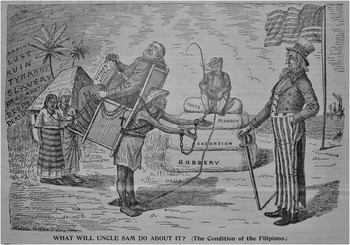
The initial fight against Spain in the Philippines was seen in much the same light as that in Cuba: a fight on behalf of an oppressed people against a cruel, Catholic nation. A cartoon by Watson Heston, the resident cartoonist of the Truth Seeker,Footnote 73 entitled “What Will Uncle Sam Do About It?,” encouraged American intervention in defense of the Philippines. The cartoon showed a primitive-looking Filipino, weighed down by a white Catholic friar strapped to his back, reaching out to Uncle Sam for help (Figure 1).Footnote 74 The implication was that the United States would play the role of liberator from an oppressive Catholic regime, as they had in Cuba. Freethinkers depicted the islands as wracked with religious persecution. One author writing in the Free Thought Magazine noted that non-Catholics faced harassment or worse, especially “atheists and agnostics” who “took their lives in their hands whenever they gave public expression to their convictions on religious questions.”Footnote 75 Such persecution was particularly galling to freethinkers, and they sought to link the Filipinos’ fight against Catholic Spanish rule as part of a wider fight against religion. Eugene Macdonald identified the genesis of the Filipino revolt against the Spanish to the Spanish persecution and eventual execution of the Filipino freethinker and nationalist José Rizal for criticisms of the Catholic Church and the Spanish administration.Footnote 76 Another article in the Truth Seeker again seemed to draw parallels between white freethinkers and Filipinos. The article quoted a zoologist who had recently visited the Philippines and noted that one of the native tribes appeared to have no forms of worship or other religious practices, nor a belief in an afterlife. These people, according to the article, had also successfully resisted missionary attempts to introduce Christianity.Footnote 77
Cartoon by Watson Heston, “What Will Uncle Sam Do About It?,” Truth Seeker, Oct. 15, 1898, 657.

Having purchased the Philippines in the Treaty of Paris of December 1898, the United States debated what was to be done with the islands. From then until the outbreak of war in February 1899 proved a time of uncertainty. Mark Twain, as we saw, did not begin seriously paying attention to these issues until the middle of 1900, but in this period when American policy was still unclear, other freethinkers were optimistic that the new territory might be transformed through the introduction of secular teaching. In this way, they mirrored Protestant missionaries, who similarly looked upon the Philippines as ripe ground for proselytizing.Footnote 78 One author in the Free Thought Magazine admitted that the fate of the islands was not yet clear, but
whether our government decides to hold permanently these islands as new territory, whether we form a colonial government, establish a protectorate or sell them to some civilized nation of Europe—one thing is certain: The rule of the clergy is at an end, and the commercial, intellectual and political power of the people will now begin to develop.Footnote 79
Herman Wettstein went even further in a letter to the Truth Seeker. He argued that American retention of the country was necessary for the emergence of secularism there. If the Philippines became independent, Wettstein argued, the possibility of freethought flourishing would be low and the people would be at the “mercies of priestly dominion and native misrule, which would, of course, mean suppression of all secular literature …”Footnote 80
After the American takeover of the Philippines, writers explained the need to support a system of secular government to stamp out the influence of the Catholic Church and the remnants of superstition. T. B. Wakeman, a prominent freethinker, called for secular schools that were independent of religion and open to everyone. This may be done “at first by martial law, until the people can become sufficiently able and willing to sustain the republic and secular education.” Wakeman also called for “the introduction of Liberal, scientific, and secular literature among those newly-awakened people as fast as they can learn to read.”Footnote 81 Another article echoed these remarks. While the Christians wanted to keep the islands to inculcate the people with religion, “Freethinkers” wished to retain “these half-civilized countries … for the purpose of liberating the inhabitants from all kinds of religious superstition, and in its place give them the benefit of free schools and scientific education.”Footnote 82
Robert Ingersoll too was eager to bring the benefits of secular civilization to the Filipinos, yet he was careful to point out that while he favored expansion, he did not support it without the consent of the subject people.Footnote 83 The Philippines might have great economic value to the United States, but, as Ingersoll said, this was ultimately unimportant: “We must do right. We must act nobly toward the Filipinos, whether we get the islands or not. I would like to see peace between us and the Filipinos; peace honorable to both; peace based on reason instead of force.”Footnote 84 In an undated article, likely soon after the Treaty of Paris, Ingersoll expressed hope that the American government would uplift the Filipinos: “I think that we should endeavor to civilize them, and to do this we should send teachers, not preachers. We should not endeavor to give them our superstition in place of Spanish superstition.”Footnote 85
While Ingersoll had supported the fight in the Philippines against Spain, he reacted angrily to the outbreak of war against the Filipinos. For Ingersoll, territorial acquisition had to be with the consent of the people, and this clearly failed his test. In an interview on February 20, 1899, two weeks after the start of the war, Ingersoll called it “a great mistake—a blunder—almost a crime.” Ingersoll insisted that “[w]e had no right to buy, because Spain had no right to sell the Philippines. We acquired no rights on those islands by whipping Spain.”Footnote 86 In a later interview, however, Ingersoll criticized what seemed to be the prevarication of the McKinley administration: “If it has been decided to conquer the Filipinos, then conquer them at once. Let the struggle not be drawn out and the drops of blood multiplied.”Footnote 87 In the Free Thought Magazine, George Macdonald quoted a letter sent from Ingersoll on July 20, 1899, to an Illinois newspaper: “It is true that I think the treatment of the Filipinos wrong—foolish. It is also true that I do not want the Filipinos if they do not want us. I believe in expansion—if it is honest.”Footnote 88
Ingersoll died a day later, before the fighting in the Philippines shifted from a conventional war to one based on guerrilla and counterinsurgency tactics later in the year. The subsequent years saw atrocities committed by American soldiers come to light. In particular, the use of scorched earth tactics, the indiscriminate killing of Filipino civilians, and the “water cure” method of torture, in which prisoners were forced to ingest large quantities of water, all became known among the American reading public.Footnote 89 Had Ingersoll lived longer, it seems likely he would have criticized these actions in a similar manner to Twain. Certainly Ingersoll was never one to shy away from criticism of his own country, when, for example, he compared the harsh restrictions on Chinese immigration to the Russian Czar's persecution of the Jews.Footnote 90 Given some of Ingersoll's earlier comments about the importance of respecting a subject people's wishes and his comments denouncing Spain's conduct in Cuba, it seems probable that Ingersoll would have publicly condemned the United States’ involvement in the Philippines as contrary to his principles for imperialist governance.
While Ingersoll died before the reality of the war was fully realized, other freethinkers took up criticism of the war after his death. If freethinkers were initially sanguine about the prospects of a (secular) civilizing mission, they soon came to realize—like Twain—that such a prospect was fraught with problems, not least because Christians would inevitably take the lead at reform. Some Americans patronizingly suggested that the nation had a duty to uplift the supposedly backward Filipinos, dubbed “our little brown brothers.”Footnote 91 Imperialists drew further succor from Rudyard Kipling's poem, the “White Man's Burden,” written on the onset of the war with the Philippines. Even if the poem was actually pessimistic about the possibilities for the civilizing mission—taking up the burden would, to Kipling, demonstrate that the United States had taken its place among the world leaders—many imperialists and anti-imperialists alike nonetheless interpreted the poem as calling for imperial intervention on behalf of the backward Filipinos.Footnote 92
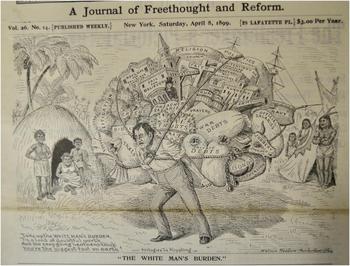
Freethinkers were highly critical of such sentiments and mocked the conceit of a white man's burden. Because freethinkers found so much to dislike about their own society, largely due to its Christian nature, they were skeptical of arguments about the innate superiority of the United States. Watson Heston, who as we saw above was initially desirous of American intervention in the Philippines, was quick to deploy his artistic talents against the idea of the white man's burden. In one cartoon, he depicted a white man in a foreign land, who was barely able to carry the various packages strapped to his back—the literal white man's burden, in this case—which were labeled, for example, “Preacher Salaries,” “Nunnery,” “Faith,” and “Religion.” The Filipinos in the scene meanwhile look unimpressed by the man's offerings (Figure 2).Footnote 93 Anti-imperialists published a number of satirical takes on Kipling's poem,Footnote 94 and freethinkers were no different. A lengthy poem by Charles G. Brown in the Free Thought Magazine was one such example. The poem described how “Uncle Sam, who felt the burden / Of the white man on his shoulders,” freed Cuba from the grip of the Spanish, “But the Cubans now are asking / Uncle Samuel, not the Spaniard / For the freedom they fought for, / For the freedom that was promised.”Footnote 95 The same situation occurred in the Philippines. The United States defeated Spain and purchased the islands, “But the wicked Filipinos / Would not ratify the bargain; / What they fought for was their freedom, / Not a formal change of masters.”Footnote 96
Cartoon by Watson Heston, “The White Man's Burden,” Truth Seeker, Apr. 8, 1899, 209.

This is not to say that Christians did not also speak out against imperialism. William Jennings Bryan, the outspoken Presbyterian Democratic politician, followed a similar trajectory to Twain and the others by first supporting intervention in Cuba before opposing the war in the Philippines. Indeed, Bryan was one of the fiercest critics of imperialism and ran for president in 1900 on an anti-imperialist platform.Footnote 97 One article, however, in the Blue-Grass Blade signaled agreement with Bryan's critique of the U.S. intervention in the Philippines but disapproved of his use of Bible passages in support of his argument. The humanitarian arguments against imperialism should be stated on their own merits, the author reasoned, without recourse to the Bible.Footnote 98
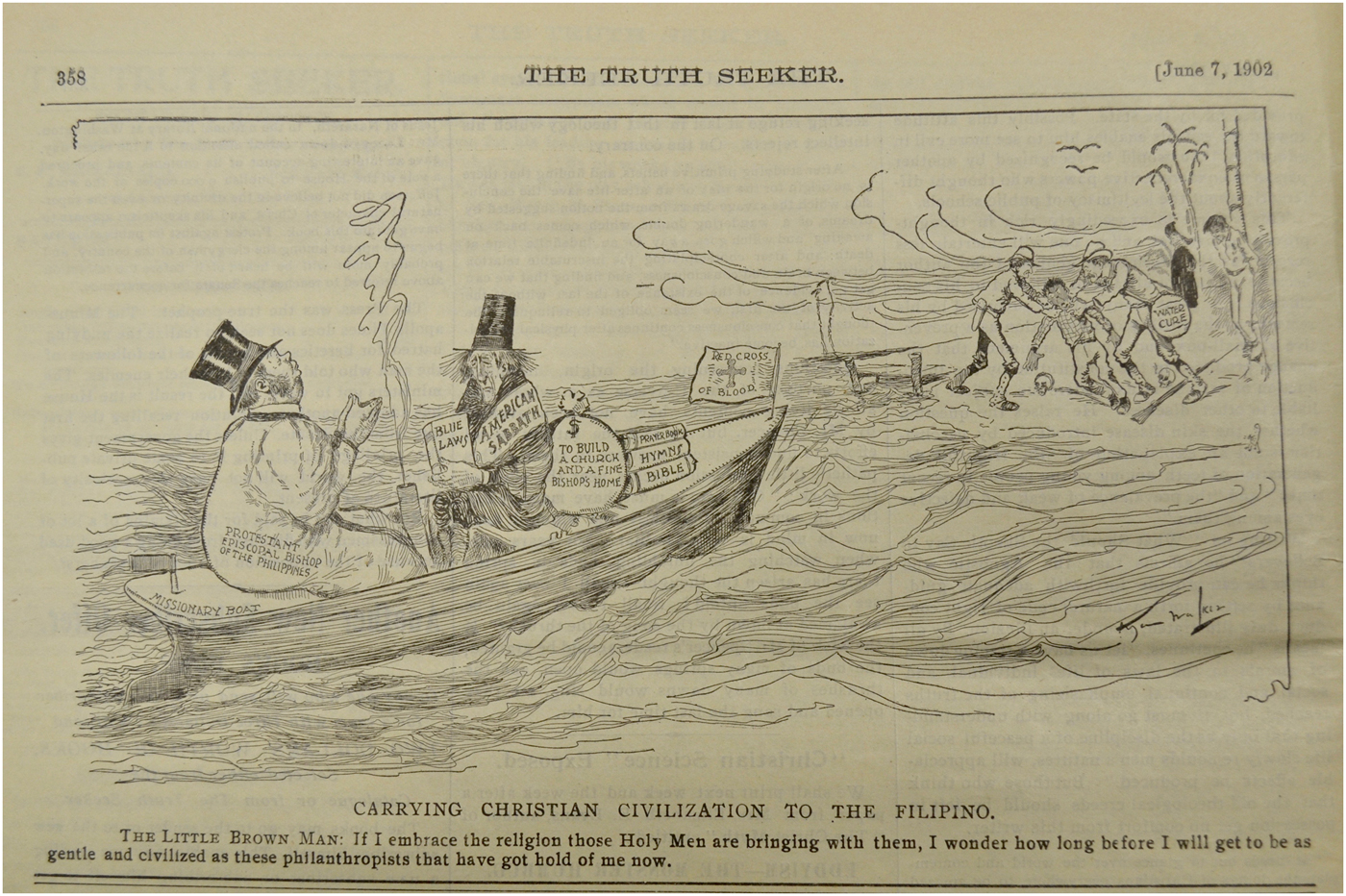
As the war against the Filipinos turned into a counterinsurgency operation, a host of atrocities followed. For freethinkers, these atrocities often went hand in hand with missionary evangelism. A cartoon by Ryan Walker, who briefly replaced Heston as the cartoonist for the Truth Seeker, showed a group of Christian missionaries arriving on an island by boat, while on the shore a Filipino man was forced down by two soldiers, with one wearing a sign that said, “water cure.” The caption below read: “The Little Brown Man: If I embrace the religion those Holy Men are bringing with them, I wonder how long before I will get to be as gentle and civilized as these philanthropists that have got hold of me now” (Figure 3).Footnote 99 One of the most scathing reports came from W. E. Johnson, who had stayed in the Philippines for two months. As we saw with Twain's writing, Johnson highlighted the Christian nature of the war: “William McKinley, the Methodist, is now conducting a war of ‘benevolent assimilation’ in the name of the Lord God and for the spread of ‘Christian civilization,’ etc.” Johnson drew parallels between the war against the Filipinos and “Moses’ celebrated campaign against the Midianites (also in the name of God) …”Footnote 100 Johnson also described in detail the atrocities committed by American soldiers, including the sexual assault of a Filipino woman. Local newspapers were filled with reports of “the most abominable outrages of this sort committed upon inoffensive natives by these ‘advance agents of Christian civilization.’”Footnote 101
Cartoon by Ryan Walker, “Carrying Christian Civilization to the Filipino,” Truth Seeker, June 7, 1902, 358.
The future of land owned by the Catholic Church in the country and the fate of Catholic friars were key questions in the aftermath of the war with the Spanish, and the United States negotiated with the papacy over these issues. But any negotiations with the papacy, freethinkers feared, would open the way to further influence into the American government by what they saw as the meddling of Pope Leo XIII.Footnote 102 Eugene Macdonald also worried about the prospects of sectarian conflict between Catholics and Protestants in the Philippines: “there seems no possible escape for the Filipinos from having one or other of these sectarianisms thrust upon them at the point of the bayonet. Poor little brown brothers! Poor devils!”Footnote 103
This was part of a wider disillusionment with the pretensions of Western civilization and the so-called Anglo-Saxon race, which Twain likewise railed against.Footnote 104 Elizabeth E. Evans criticized “the supposed ‘mission of the Anglo-Saxon race’ to dominate in every part of the world […].”Footnote 105 The war was, to Evans, motivated by the desire for speculators to increase their riches and a hypocritical goal of converting the people to “‘the right religion, which is ours’ (to quote Mark Twain's pithy condemnation of spiritual ignorance and bigotry).”Footnote 106 The war further emphasized, to Evans, how “the phrase ‘Christian civilization’ implies a scathing satire upon Christian conduct.”Footnote 107
A small minority of Catholics opposed the Spanish-American War upon similar lines, questioning the righteousness of the United States and the extent to which it could be labeled a Christian country by pointing out injustices committed by the nation and Protestant missionaries.Footnote 108 This might suggest that marginalized groups, even if differing in their religious outlook, had more reason than the dominant groups to question their own nation's superiority. But for most Catholics and other marginalized religious groups, like the Mormons, the wars offered the opportunity to demonstrate each groups’ loyalty to the nation and to thereby win greater social acceptance.Footnote 109 For freethinkers, however, this was not a motivation; their irreligious views already put them far outside the mainstream and they had no desire for assimilation. In this way, then, a freethought perspective allowed for greater freedom to criticize one's own country, since they could hardly become further marginalized. Twain undoubtedly felt this freedom less so than other freethinkers, as he regularly suppressed works he felt too controversial, like “The Stupendous Procession” or “The War Prayer,” even if many of his published works remained quite strident. By contrast, most other freethinkers had no such inclinations to self-censorship.
While arguments against the assumptions of racial or civilizational superiority were undoubtedly a common theme among freethinkers’ critiques of empire, another line of argument held that improving the Philippines was futile given the deficiencies of the inhabitants.Footnote 110 This was primarily the view of Eugene Macdonald who was reliably pessimistic about the potential for progress among non-white groups. As he grimly noted, “[a]bout the best we can do for depressed peoples is to set them a good example and invite them to study and imitate.”Footnote 111 In another case, Macdonald mockingly described “our new Americans” and emphasized the savage nature of the Filipinos. One group, according to Macdonald, “go nearly naked, in roving bands, subsisting on honey, wild fruits, and roots,” while another were “[s]ort of a cross between a monkey and a man.”Footnote 112 This meant to show the absurdity of imagining Filipinos as potential American citizens, on par with white Americans. Another author, a soldier who fought in the Philippines, wrote a letter to the Free Thought Magazine, in which he criticized the Filipinos as “generally a low and miserable class of people” who were untrustworthy.Footnote 113 But, he asked, “[w]hat can you expect of these poor, priest-ridden fools?”Footnote 114
This negative portrayal was not the norm, however. Twain and other freethinkers saw the Filipinos in a much more positive light and had no truck with arguments against imperialism on the grounds of the perceived racial inferiority of the inhabitants.Footnote 115 Josephine K. Henry wrote in the Blue-Grass Blade that her “sympathies [were] strongly in favor of the Filipinos. I have the greatest admiration for Aguinaldo and consider him in every way a born genius.”Footnote 116 Another article portrayed the Filipinos as freedom fighters. Those who wanted to help them were just like “La Fayette [who] helped us when we wanted our liberty […].”Footnote 117 What is more, the Twenty-Fourth Annual Congress of the American Secular Union and Free Thought Federation, held in Cincinnati, Ohio, from November 23–25, 1900, passed two resolutions that concerned the Philippines:
That we protest against the interference of our government with so-called heathen nations, forcing upon them the Christian religion, and using that method of extending our commerce and power.
That we protest especially against the use of the army and navy of the United States to continue the domination of the friars in the Philippines, believing that, except for this outrageous alliance of state and church, these islands would long since have been pacified.Footnote 118
These resolutions, which explicitly linked American military intervention and imperial oppression with the missionary impulse of Christianity and a failure to preserve a separation between church and state, would have undoubtedly found approval from Twain as well.
CONCLUSION
The article began with a discussion of how Twain was depicted in Susan K. Harris's work as representing white Protestant ambivalence to American imperial adventures, particularly in the Philippines. The case I have presented here, however, suggests that Twain's anti-imperialism becomes clearer when considered in the context of freethought. The freethought movement rejected Christianity and was hostile to organized religion. When Twain's anti-imperialist critiques are placed alongside those of other freethinkers, it becomes clear that irreligious threads were weaved throughout their writings. These include anti-Catholic rhetoric about the backwardness and cruelty of the Spanish, the dangers of a missionary spirit encouraging intervention, and the links between religion and nationalism. This helps to illuminate Twain's anti-imperialism and strengthens the case for the influence of freethought on his own worldview. The writings on imperialism by Twain and other freethinkers remind us that the United States was far from a monolithically Christian country and that irreligious viewpoints could offer alternative perspectives on social and political questions.
While this article has centered on Mark Twain, it has also examined the work of Robert Ingersoll and the freethought periodicals, the Truth Seeker, the Free Thought Magazine, and the Blue-Grass Blade. But it is worth quickly noting the activities of other freethinkers in the anti-imperialist movements. Felix Adler, the Columbia professor who began the nontheistic Ethical Culture movement in New York, was, like Twain, a vice president of the Anti-Imperialist League.Footnote 119 The agnostic thinker Clarence Darrow, perhaps best known for his role as the defense lawyer in the Scopes Monkey Trial in 1925, was at the time a lawyer in Chicago and became active in the Central Anti-Imperialist League in that city.Footnote 120 Finally, William A. Croffut, a leading freethinker in Washington, DC, was a vice president of the American Secular Union and Freethought Federation and played the key role in forming the Washington branch of the Anti-Imperialist League.Footnote 121 Further research might uncover other freethought connections with the anti-imperialist movement.
The article has suggested a general pattern to freethinkers’ reactions to American imperialism while allowing for individual differences. In the first instance, we saw that Twain, Ingersoll, and others were strongly supportive of American intervention on behalf of Cuba against Spain. This optimism extended to the early stages of the American intervention in the Philippines as well, when it seemed that secular, republican values might be introduced to that country, which would in turn stamp out the influence of the Catholic priests. Yet this optimism soon faded, as it became clear that this was mere fantasy. The Americans compromised and allowed the hated friars to retain some power. Furthermore, both American Catholic and Protestant groups began to wield influence. Worst of all, as the war shifted from a conventional fight to one of counterinsurgency, American soldiers—indeed, Christian soldiers—committed a range of atrocities. Freethought critiques of the war—Twain's included—reveal a profound ambivalence toward notions of American patriotism and superiority. This ambivalence was borne not out of a Protestant heritage but was rooted within the freethought tradition of skepticism to all orthodoxies. One misses a great deal of nuance in the reactions to imperialism if one accepts the notion that the United States was basically a Protestant country.
Twain and his fellow freethinkers were, of course, ultimately unsuccessful at unclasping the metaphorical eagle's talons from the Philippines. Their numbers were too small to have an influence at the ballot box and their iconoclastic arguments were too unpalatable for most Americans. Still, the importance of these anti-imperialist arguments lies in the fact that they pointed the way to a path not yet widely trekked: one that questioned the innate superiority of Christian American civilization and the resulting right to rule over other nations.