





Introduction
Schistosomiasis, or bilharzia, is a neglected tropical disease endemic in 78 countries, most of which are in sub-Saharan Africa (WHO, 2020). It is estimated to affect approximately 230 million people globally and result in between 11 000 to 24 000 deaths per year (WHO, 2020, 2023). In Africa, schistosomiasis is most commonly caused by the blood flukes Schistosoma haematobium or S. mansoni (WHO, 2023), whose complex life cycles depend both on aquatic intermediate snail hosts of the genus Bulinus and Biomphalaria, respectively, and definitive hosts which are mainly humans, but can include non-human primates or rodents in the case of S. mansoni (Wright, Reference Wright and Mostofi1967; Brown, Reference Brown1994; Gryseels et al. Reference Gryseels, Polman and Kestens2006; Richards et al. Reference Richards, Erko, Ponpetch, Ryan and Liang2019). Through water contamination with eggs in stool or urine, snails become infected and release cercariae that infect humans that come in contact with water (Humphries, Reference Humphries, Toledo and Fried2011; McManus et al. Reference McManus, Dunne, Sacko, Utzinger, Vennervald and Zhou2018). In endemic areas, such water contact is often unavoidable during tasks such as bathing, washing or farming, as people lack access to safe water or depend on irrigated areas for their livelihoods (Lund et al. Reference Lund, Sam, Sy, Sow, Sokolow and Leo2019). Rice farming is an example of an economic activity that can increase the risk of Schistosoma infections because irrigated rice fields and canals provide habitat to host snails (Barboza et al. Reference Barboza, Zhang, Santos, Matos, Silva, Virgínia, Rollemberg, Ramalho de Amorim, Tiduko Ueta, Moura de Melo, Pacheco de Almeida, De Lourdes Sierpe Jeraldo and Ribeiro de Jesus2012; Abao-Paylangco et al. Reference Abao-paylangco, Karla, Balamad, Paylangco, Japitana and Jumawan2019; Fokuo Ofori et al. Reference Fokuo Ofori, Opoku Peprah, Adukpo, Kakra Dickson, Anim-baidoo and Henry Asmah2020). As a result, areas of rice cultivation can show elevated prevalence and intensity of the disease (Yapi et al. Reference Yapi, Briët, Diabate, Vounatsou, Akodo, Tanner and Teuscher2005) and people practising rice farming may be at higher risk of infection (Bukenya et al. Reference Bukenya, Nsungwa, Makanga and S1994; Krumkamp et al. Reference Krumkamp, Remkes, Hainasoa, Rasamoelina, Razafindrakoto, Razafindralava, Hey, Winter, Fischer, Gunga, Martel, Jouanard, Andrianarinirina, Rausche, Kutz, Doumbia, Rakotozandrindrainy, May, Marchese, Rakatoarivelo, Consortium and Fusco2026).
In the Senegal River Basin, the prevalence of intestinal schistosomiasis is around 20–35%, while the prevalence of urogenital schistosomiasis reaches 80–90% and up to 100% in some communities (Léger et al. Reference Léger, Borlase, Fall, Diouf, Diop, Yasenev, Catalano, Thiam, Ndiaye, Emery, Morrell, Rabone, Ndao, Faye, Rollinson, Rudge, Sène and Webster2020; Jones et al. Reference Jones, Sokolow, Id, Id, Senghor, Jouanard, Bandagny, Id, Id, Id, Rohr, Remais, Lafferty, Kuris, Id and De Leo2021; Rohr et al. Reference Rohr, Sack, Bakhoum, Barrett, Lopez-carr, Chamberlin, Civitello, Diatta, Doruska, Leo, Haggerty, Jones, Jouanard, Lund, Seck, Senghor, Sokolow and Wolfe2023). Intermediate host snail species of S. haematobium are Bulinus umbilicatus, Bulinus truncatus, Bulinus globosus and Bulinus senegalensis (and potentially Bulinus forskalii), while S. mansoni is transmitted by Biomphalaria pfeifferi (Léger et al. Reference Léger, Borlase, Fall, Diouf, Diop, Yasenev, Catalano, Thiam, Ndiaye, Emery, Morrell, Rabone, Ndao, Faye, Rollinson, Rudge, Sène and Webster2020; Gaye et al. Reference Gaye, Doucouré, Sow, Sokhna and Ranque2023; Senghor et al. Reference Senghor, Webster, Pennance, Sène, Doucouré, Sow and Sokhna2023). The construction of the Diama dam in 1986 not only saw the spread of rice fields and irrigation infrastructure but also a sharp rise of schistosomiasis, as the dam created new habitat for Bulinus and Biomphalaria snails (Sack et al. Reference Sack, Selland, Bakhoum, Seck, Jouanard, Magblenou and Rohr2025). Indeed, snails shedding human schistosomes have been found in rice fields and irrigation canals in the region, indicating an infection risk to rice farmers (Sack et al. Reference Sack, Selland, Bakhoum, Seck, Jouanard, Magblenou and Rohr2025).
In Madagascar, schistosomiasis is endemic across the island, and schistosomiasis prevalence has been reported between 30% and 65% in many areas and even above 90% in some high-risk populations (Rasoamanamihaja et al. Reference Rasoamanamihaja, Rahetilahy, Ranjatoarivony, Dhanani, Andriamaro, Andrianarisoa and Jourdan2016; Spencer et al. Reference Spencer, St, Penney, Russell, Howe, Linder, Rakotomampianina, Nandimbiniaina, Squire, Stothard, Bustinduy and Rahetilahy2017; Gruninger et al. Reference Gruninger, Rasamoelina, Rakotoarivelo, Razafindrakoto, Rasolojaona, Rakotozafy, Soloniaina, Rakotozandrindrainy, Rausche, Doumbia, Jaeger, Zerbo, Von Thien, Klein, Van Dam, Tannich, Schwarz, Lorenz, May, Rakotozandrindrainy and Fusco2023). In Madagascar, S. haematobium is transmitted by Bulinus obtusispira, Bulinus liratus and Bulinus bavayi and S. mansoni by B. pfeifferi (Stothard et al. Reference Stothard, Brémond, Andriamaro, Sellin, Sellin and Rollinson2001; Charbonnel et al. Reference Charbonnel, Angers, Rasatovonjizay, Bremond, Debain and Jarne2002). Despite ongoing campaigns of Mass Drug Administration (MDA) by the National Programme for Schistosomiasis Control since 1999, infection rates remain above 50% in 40% of districts (Sokolow et al. Reference Sokolow, Wood, Jones, Swartz, Lopez, Hsieh, Lafferty, Kuris, Rickards and De Leo2016; Rasoamanamihaja et al. Reference Rasoamanamihaja, Rakotoarivelo, Edosoa, Rasamoelina, Montresor, Marchese and Fusco2023). Preventive chemotherapy through MDA with praziquantel is generally the most cost-effective measure to control schistosomiasis in endemic countries (Nogueira et al. Reference Nogueira, Lira, Licá, Frazão, Dos Santos, Filho, Rodrigues, Miranda, Carvalho and Nascimento2022; Gruninger et al. Reference Gruninger, Rasamoelina, Rakotoarivelo, Razafindrakoto, Rasolojaona, Rakotozafy, Soloniaina, Rakotozandrindrainy, Rausche, Doumbia, Jaeger, Zerbo, Von Thien, Klein, Van Dam, Tannich, Schwarz, Lorenz, May, Rakotozandrindrainy and Fusco2023). However, praziquantel does not prevent reinfection and because most MDA target schoolchildren, adult populations act as reservoirs of the disease and transmission continues (Gruninger et al. Reference Gruninger, Rasamoelina, Rakotoarivelo, Razafindrakoto, Rasolojaona, Rakotozafy, Soloniaina, Rakotozandrindrainy, Rausche, Doumbia, Jaeger, Zerbo, Von Thien, Klein, Van Dam, Tannich, Schwarz, Lorenz, May, Rakotozandrindrainy and Fusco2023). Schistosomiasis is mostly a chronic disease that, if left untreated, can lead to severe symptoms and even death (Verjee, Reference Verjee2019; Kutz et al. Reference Kutz, Rausche, Rasamoelina and Ratefiarisoa2023; Rakotozandrindrainy et al. Reference Rakotozandrindrainy, Rakotoarivelo, Kislaya, Marchese, Rasamoelina, Solonirina, Ratiaharison, Razafindrakoto, Razafindralava, Rakotozandrindrainy, Radomanana, Andrianarivelo, Klein, Lorenz, Jaeger, Hoekstra, Corstjens, Schwarz, Van Dam, May and Fusco2024).
Rice production is a food-security and economic cornerstone in Madagascar, with an estimated 70% of the population at least partly dependent on the sector for food or income (Bockel et al. Reference Bockel, Debrune and Toudert2016). B. pfeifferi has been documented in rice fields and irrigation canals in Madagascar (Pflüger, Reference Pflüger1976; Spencer et al. Reference Spencer, Linder, Penney, Russell, Hyde, Sheehy, Reid, Andriamasy, Raderalazasoa, Rakotomampianina, Nandimbiniaina, Ranaivoson, Andrianiaina, Cruickshank, Bustinduy, Stothard, Edosoa and Rahetilahy2021), indicating that rice-production systems are possible habitats of schistosome host snails and may present sites of infection risk here.
To meet the NTD roadmap 2030 target of elimination of schistosomiasis as a public health problem, the WHO released new guidelines in 2022 that stress the importance of snail control (WHO, 2022). Indeed, an evaluation of schistosomiasis control strategies in 83 countries over the past century showed that snail control was more effective than water engineering interventions or MDA (Sokolow et al. Reference Sokolow, Wood, Jones, Swartz, Lopez, Hsieh, Lafferty, Kuris, Rickards and De Leo2016). Importantly, understanding the spatial and temporal patterns of infection risk is necessary to effectively target snail control (Jones et al. Reference Jones, Sokolow, Id, Id, Senghor, Jouanard, Bandagny, Id, Id, Id, Rohr, Remais, Lafferty, Kuris, Id and De Leo2021).
This study presents case studies based on research in the department of Dagana, Senegal, and the district of Vatomandry, Madagascar, to investigate whether rice agro-ecosystems in schistosomiasis-endemic countries consistently support Schistosoma intermediate hosts. Rice farming is a prevalent agricultural activity in these regions, and schistosomiasis is endemic in both, with average prevalences of 69% in Dagana (in school age children) and 59% in Vatomandry (in the population age ≥5 years) (Krumkamp et al. Reference Krumkamp, Remkes, Hainasoa, Rasamoelina, Razafindrakoto, Razafindralava, Hey, Winter, Fischer, Gunga, Martel, Jouanard, Andrianarinirina, Rausche, Kutz, Doumbia, Rakotozandrindrainy, May, Marchese, Rakatoarivelo, Consortium and Fusco2026; Selland et al. Reference Selland, Jouanard, Guisse, Seck, Lund, López-carr, Sack, Magblenou, De Leo, Doruska, Barrett and Rohr2026). The initial hypothesis was that detectability and abundance of host snails would be similar in the 2 regions and could be determined using similar methodologies. Leveraging independently conducted field campaigns in Senegal (2024) and Madagascar (2022/2023), this study compares the ecosystem and environmental distribution of snails in rice-farming areas and illustrates how the presence and detectability of schistosome host snails can vary across regions even where human prevalence and land use are broadly similar.
Materials and methods
Study areas
In Senegal, sampling was conducted in rice-farming areas in the department of Dagana in the Saint-Louis region in the northwest of the country (Figure 1). The area has a hot desert climate with average air temperatures ranging between an average minimum of 15°C in December/January and maximum average values of 40°C in May. The rainy season lasts from June to October, with maximum precipitation of 116 mm in August (The World Bank Group, 2026). The sampling sites are in an agricultural area of the Senegal River Basin and were chosen based on accessibility and a prior relationship with the field owners. A total of 21 sites, which included 10 rice fields and 11 canals, were sampled between 2 November and 2 December, 2024.
Location of sites sampled in Senegal (A) and repeatedly sampled in Madagascar (B). Not all sites appear as an individual circle due to overlapping. Map created with Free and Open Source QGIS.

Figure 1 Long description
A) The map shows sampling sites in Senegal. An inset map highlights the location in Saint-Louis region, and a scale bar shows distances of 0, 3.5 and 7 kilometers. Black circles indicate sampling locations, concentrated along a river and road network. B) The map shows sampling sites in Madagascar. An inset map shows the location near Vatomandry, and a scale bar indicates distances of 0, 2.5 and 5 kilometers. Black circles mark sampling locations, distributed across the region. Both maps include a compass rose for orientation and a small map of Africa indicating the countries′ positions.
In Madagascar, samples were collected in the district of Vatomandry, on the East coast of Madagascar, located in the Atsinanana region (Figure 1). The area is characterized by a rainy, subequatorial climate driven by easterly trade winds. Average monthly temperatures range from a maximum of 29°C in February to a minimum of 15°C in July, and the rainy season lasts from December to March, with the highest precipitation of around 400 mm in January (The World Bank Group, 2021). The study area was selected because current data on schistosomiasis prevalence in the human population were available through surveys conducted at the time of our fieldwork (Krumkamp et al. Reference Krumkamp, Remkes, Hainasoa, Rasamoelina, Razafindrakoto, Razafindralava, Hey, Winter, Fischer, Gunga, Martel, Jouanard, Andrianarinirina, Rausche, Kutz, Doumbia, Rakotozandrindrainy, May, Marchese, Rakatoarivelo, Consortium and Fusco2026), and sites were chosen based on contact with the communities and individuals, accessibility during the rainy season and to include rice fields as well as natural water bodies. Data were collected during 4 sampling campaigns. During a first campaign from 26 October to 4 November 2022, a total of 51 sites were sampled: 25 rice fields, 14 canals and 12 natural streams. The sampling of streams was added to avoid missing host snail populations in this type of habitat, after the first days of sampling in fields and canals did not yield any Biomphalaria or Bulinus. Of these initial sites, 17 were chosen and 3 new sites were added for repeated sampling during campaigns from 06 to 11 February, 24 to 29 April and 11 to 15 September 2023. Of these 20 sampling sites, 9 were rice fields, 6 were canals and 5 were natural streams.
Sampling
Sampling was carried out via netting using a scoop net (a.k.a. a sweep net) with a 35 × 40 cm opening and 3-mm mesh size, supplemented by hand picking if larger pieces of vegetation or debris could not be collected in the net. Snails were then collected by hand from the net or any plant matter collected (Appleton et al. Reference Appleton, Appleton and Miranda2015). Gloves and waterproof boots or waders were worn during snail collection to avoid any water contact. One researcher (P.S.) participated in the sampling in both Senegal and Madagascar, ensuring reproducibility. At each site, the scoop net was deployed between 3 and 10 times, targeting substrates on which snails could be expected or sweeping across vegetation, the sediment or other surfaces to dislodge snails. In rice fields, the net was deployed at each of the sides of the field and at the inlet/outlet connecting the field to the canal. The nets were then emptied on a plastic sheet, and contents were carefully examined for attached snails. Snails were identified based on morphology to genus level and, if possible, to the level of species. In Senegal, Bulinus snails were identified to the level of 2 morphologically similar groups, i.e. B. truncatus/globosus and B. forskalii/senegalensis. In both countries, all Biomphalaria and Bulinus snails were transferred to containers filled with water and transported in the dark to the laboratory. They were placed individually in the wells of a 24-well plate filled with clean water and exposed to bright light for 2 h. The snails were then removed, a few drops of iodine solution were added to the well, and the well was examined for cercariae under a dissecting microscope.
Water depth was measured with a calibrated stick to the nearest cm each time a net was deployed. The location was recorded with a handheld GPS device in both countries (eTrex 10, GARMIN, USA). Physicochemical water parameters (temperature, pH, electrical conductivity and dissolved oxygen) were recorded using a YSI ProDSS Multiparameter meter (Xylem, USA) in Senegal and a HI9829 Multiparameter meter with logging probe (Hanna Instruments, USA) in Madagascar. Due to malfunctioning probes, measurements in Senegal are only complete for 7 sites (all fields) and pH and dissolved oxygen data are incomplete for the campaign in April in Madagascar.
Data analysis
The map of sampling sites was created using QGIS version 3.4 (QGIS.org, 2026). Data curation was performed in Microsoft Excel. Data processing, statistical analysis and visualization of graphs were produced in R (R CoreTeam, 2025). To account for differences in sampling effort, total snail counts per site were normalized by the number of sweeps deployed (dplyr package, in R).
To take regional differences in host snail compatibility into consideration, snails that were considered relevant hosts were B. umbilicatus, B. truncatus, B. globosus, B. senegalensis, B. forskalii and B. pfeifferi in Senegal and B. obtusispira, B. liratus, B. bavayi and B. pfeifferi in Madagascar (see Introduction section for supporting literature). Differences in host snail detection between countries were assessed using Fisher’s exact test based on contingency tables of country by presence/absence. Further statistical comparison of host snail presence or abundance between Senegal and Madagascar was not done due to complete separation, as no compatible host snails were detected in Madagascar. Consequently, statistical analysis of snail abundance was restricted to Senegal data only. Normalized snail abundance for each species group by habitat type was compared by Wilcoxon rank-sum test, as data on B. truncatus/globosus and B. forskalii/senegalensis abundance were not normally distributed (Shapiro–Wilk test p < 0.001) (rstatix package, in R).
Environmental variables (depth, temperature, pH, conductivity and dissolved oxygen) in rice fields were averaged per site. Since sampling in Senegal and Madagascar was performed during different months, the variables of country and month were grouped into 1 factor for pairwise comparison (emmeans package, in R) and tested for normality using the Shapiro–Wilk test within groups (rstatix package, in R). Although most groups did not show significant deviations from normality, sample sizes were small and uneven across groups (Table S1). Therefore, non-parametric Kruskal–Wallis tests were used to compare environmental variables.
Results
Snail abundance
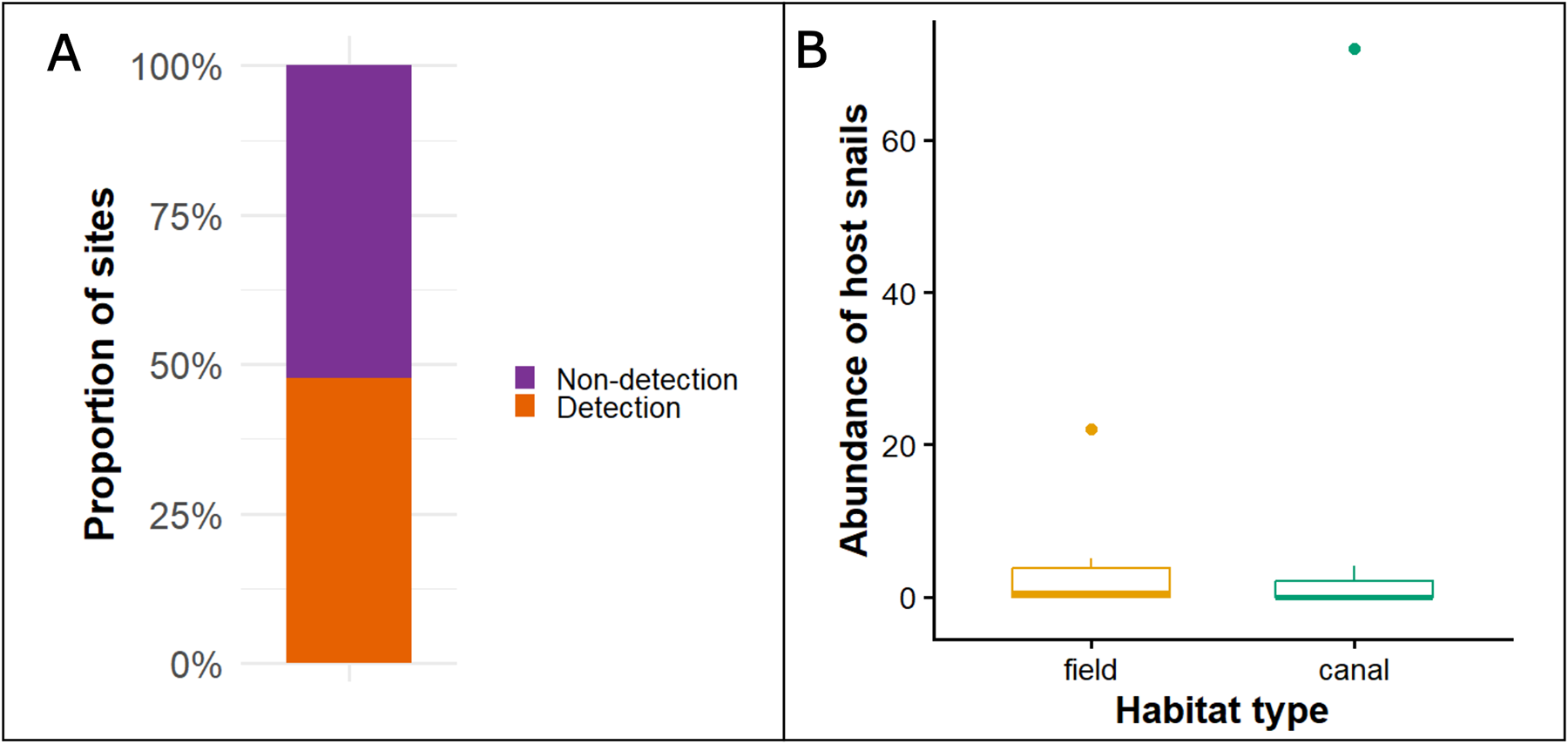
The snail surveys in Senegal resulted in a total of 91 Bulinus truncatus/globosus, 80 collected in canals and 11 collected in rice fields. A total of 25 Bulinus forskalii/senegalensis were collected, 1 in a canal and 24 in rice fields. In Madagascar, the only Bulinus specimen found was B. forskalii, with a total of 27 collected, all during September 2023: 1 in a rice field, 2 in a canal and 24 in a natural stream. No snails of the genus Biomphalaria were collected in Senegal or in Madagascar during this study. No compatible host snails for S. haematobium were collected in Madagascar, and host snail presence was therefore significantly associated with country (Fisher’s exact test p < 0.001, Figure 2). None of the Bulinus collected were found to be shedding cercariae. Other snail taxa collected were specimens of the genus Lymnaea in Senegal and of the genera Lymnaea, Melanoides, Madagasikara and unidentified species of the genus Planorbidae in Madagascar (Fig. S1).
Detection proportion (A) and abundance by habitat type sampled (B) of Schistosoma host snails in Senegal. The box represents the upper and lower quartiles and the median; the whiskers show variability; and outliers are depicted as individual points. No snails compatible with Schistosoma spp. were detected in Madagascar, resulting in zero abundance across all sites.

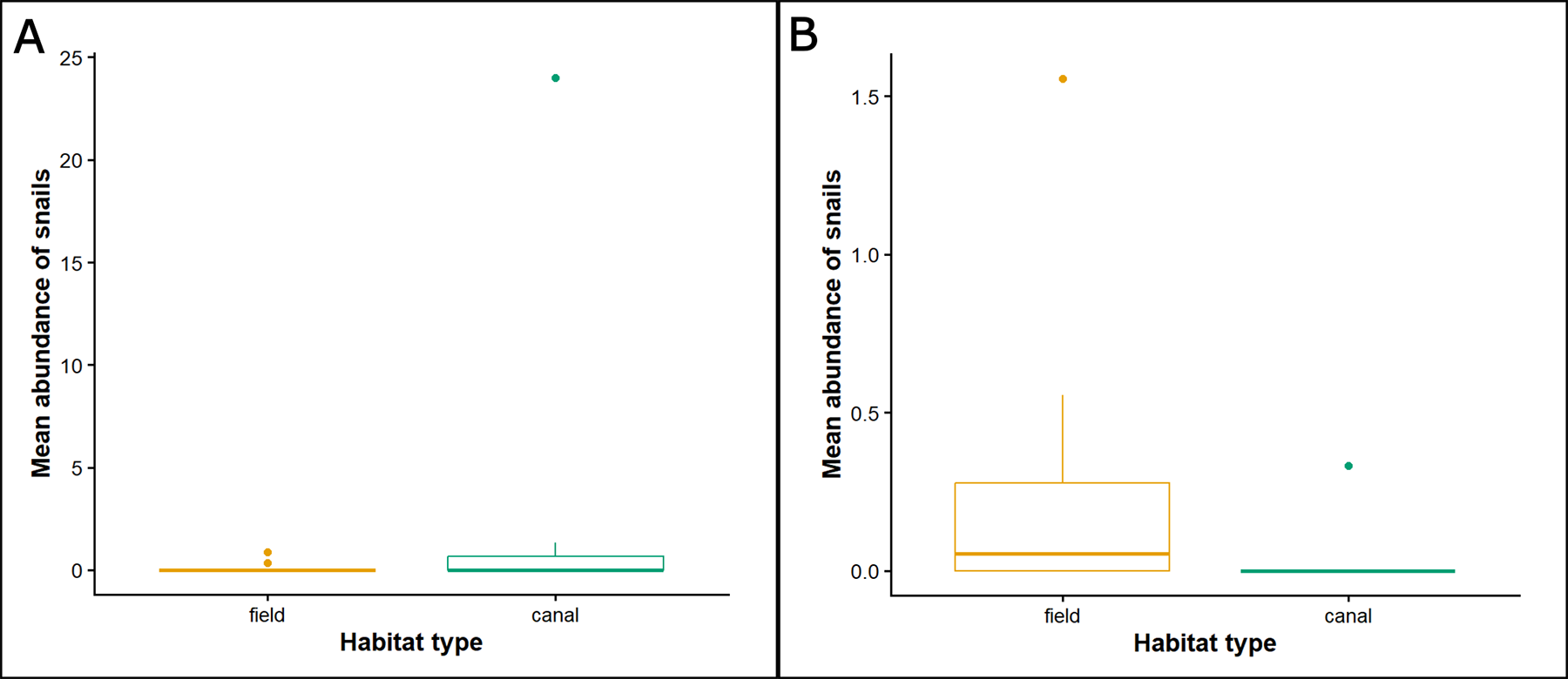
Normalized by sampling effort, in Senegal, 1 sweep contained 0.1 ± 0.3 (mean ± SD) B. truncatus/globosus and 0.3 ± 0.5 B. forskalii/senegalensis in rice fields (Table 1, Figure 3). In the canals in Senegal, 1 sweep collected an average of 2.4 ± 7.2 B. truncatus/globosus and 0.03 ± 0.1 B. forskalii/senegalensis. There was no significant difference in the abundance of B. truncatus/globosus (W = 66.5, p = 0.331) or B. forskalii/senegalensis (W = 32.5, p = 0.052) in rice fields or canals.
Mean number of Schistosoma host snails Bulinus truncatus/globosus (A) and Bulinus forskalii/senegalensis (B) collected per sweep in rice fields and irrigation canals in Senegal in November/December 2024. The box represents the upper and lower quartile and the median; the whiskers show variability; and outliers are depicted as individual points. Note the different y-axis scales.

Mean (±standard deviation) counts of Bulinus and other snail taxa collected in rice fields, irrigation canals and natural streams during the different sampling campaigns in Senegal and Madagascar

Table 1 Long description
Mean counts with standard deviations are reported for Senegal in Nov and Dec 2024 and for Madagascar in Oct and Nov 2022, Feb 2023, Apr 2023, and Sept 2023, split by habitat type field, canal, and stream. For Bulinus truncatus globosus, Senegal shows 1.1 plus or minus 2.6 in field and 7.3 plus or minus 21.5 in canal, with a second line of 0.1 plus or minus 0.3 in field and 2.4 plus or minus 7.2 in canal; all Madagascar habitats and months list 0 plus or minus 0. For Bulinus forskalii senegalensis, Senegal shows 2.4 plus or minus 4.4 in field and 0.09 plus or minus 0.3 in canal, with a second line of 0.3 plus or minus 0.5 in field and 0.03 plus or minus 0.1 in canal; Madagascar is 0 plus or minus 0 through Apr 2023, then in Sept 2023 shows 0.1 plus or minus 0.4 in field, 0.4 plus or minus 0.6 in canal, and 3 plus or minus 8.1 in stream, with a second line of 0.03 plus or minus 0.08 in field, 0.07 plus or minus 0.1 in canal, and 0.6 plus or minus 1.6 in stream. For Other species, Senegal lists 0 plus or minus 0 in field and 2.7 plus or minus 3.9 in canal, with a second line of 0 plus or minus 0 in field and 0.9 plus or minus 1.3 in canal. In Madagascar, Other species are 2.8 plus or minus 9.8 in field, 11.6 plus or minus 28.3 in canal, and 16.8 plus or minus 21.0 in stream for Oct and Nov 2022; 2 plus or minus 3.2 in field, 45.5 plus or minus 68.4 in canal, and 8.4 plus or minus 13.4 in stream for Feb 2023; 31.7 plus or minus 53.6 in field, 25.4 plus or minus 44.6 in canal, and 42 plus or minus 75.4 in stream for Apr 2023; and 23.7 plus or minus 45.2 in field, 17.6 plus or minus 22.3 in canal, and 13.9 plus or minus 20.4 in stream for Sept 2023. A second line for Madagascar Other species lists 0.6 plus or minus 2.0 in field, 0.9 plus or minus 1.73 in canal, and 2.7 plus or minus 3.9 in stream for Oct and Nov 2022; 0.4 plus or minus 0.6 in field, 9.1 plus or minus 13.7 in canal, and 1.6 plus or minus 2.7 in stream for Feb 2023; 6.3 plus or minus 10.7 in field, 5.0 plus or minus 8.9 in canal, and 5.6 plus or minus 7.5 in stream for Apr 2023; and 5.09 plus or minus 8.9 in field, 3.4 plus or minus 4.5 in canal, and 2.8 plus or minus 4.1 in stream for Sept 2023.
Notes: Values on grey background are mean total counts, and values in italics on white background are abundances averaged by the number of collection sweeps per site.
Environmental parameters
Among sampling contexts, all environmental parameters differed significantly, with the exception of water depth (Table 2). Significant differences were mostly due to changing environmental conditions between the different sampling campaigns in Madagascar (Figure 4). Dissolved oxygen concentrations were lowest in October/November and increased significantly by September (p = 0.046). By the end of the rainy season in February, both electrical conductivity and water pH had significantly decreased when compared to October/November (p = 0.018 and 0.038, respectively), and pH had subsequently increased significantly again by September (p = 0.030). Only water temperature differed between values measured in Senegal and Madagascar, where they were significantly higher during all sampling campaigns (p > 0.05).
Boxplots of the distribution of physicochemical water parameters across sampling sites and sampling campaigns in Senegal and Madagascar. Depth (in cm); DO, dissolved oxygen (in mg/L); EC, electrical conductivity (in µS/cm); Temp, temperature (in °C). Values for pH and dissolved oxygen are missing for the month of April in Madagascar due to a malfunctioning probe. Different letters indicate significant differences among Country–Month combinations based on pairwise comparison with Wilcoxon test. Groups sharing at least 1 letter are not significantly different, whereas groups with different letters differ significantly (p < 0.05).

Figure 4 Long description
Five boxplots comparing physicochemical water parameters across months in Senegal and Madagascar. Each boxplot represents a different parameter: Depth, DO (dissolved oxygen), EC (electrical conductivity), pH and Temp (temperature). The x-axis shows months: Nov/Dec, Oct/Nov, Feb, Apr and Sept. The y-axis varies for each parameter: Depth in centimeters, DO in milligrams per liter, EC in microsiemens per centimeter, pH and Temp in degrees Celsius. The legend indicates colors representing Madagascar and Senegal. Significant differences among Country to Month combinations are marked by letters a, b, c and d, indicating pairwise comparisons with the Wilcoxon test. For Depth, values do not differ significantly. DO is lower in Oct/Nov than in September in Madagascar. EC is higher in Senegal than in Madagascar, but not statistically significant, whereas it is significantly higher in Oct/Nov than in February in Madagascar. pH values are lowest in Feb for Madagascar. Temperature is significantly lower in Senegal than in all months in Madagascar. Within Madagascar, temperature peaks in Feb and is lowest in September.
Physicochemical water parameters (mean ± standard deviation) across sampling campaigns in rice fields in Senegal and Madagascar

Table 2 Long description
Physicochemical water parameters are reported as mean plus or minus standard deviation by country and sampling month, with columns for depth in centimeters, dissolved oxygen in milligrams per liter, electrical conductivity in microSiemens per centimeter, pH, and temperature in degrees Celsius. Senegal has one row for Nov and Dec: depth 20 plus or minus 9, dissolved oxygen 6.5 plus or minus 1.8, electrical conductivity 269.2 plus or minus 110.5, pH 6.5 plus or minus 1.2, and temperature 22.1 plus or minus 1.7. Madagascar has four rows: Oct and Nov depth 23 plus or minus 11, dissolved oxygen 5.8 plus or minus 0.6, electrical conductivity 46.5 plus or minus 11.1, pH 6.1 plus or minus 0.4, temperature 29.7 plus or minus 2.1; Feb depth 38 plus or minus 31, dissolved oxygen 5.6 plus or minus 0.7, electrical conductivity 17.9 plus or minus 6.3, pH 5.5 plus or minus 0.3, temperature 32.5 plus or minus 2.4; Apr depth 28 plus or minus 26, dissolved oxygen not reported, electrical conductivity 24.6 plus or minus 9.3, pH not reported, temperature 27.9 plus or minus 1.35; Sept depth 13 plus or minus 19, dissolved oxygen 7.2 plus or minus 0.8, electrical conductivity 35.1 plus or minus 7.8, pH 6.4 plus or minus 0.2, temperature 25.1 plus or minus 1.6. A final row labeled, Test statistics, lists chi squared, degrees of freedom, and p values for depth, dissolved oxygen, electrical conductivity, pH, and temperature, with p values shown as 0.091, 0.034, less than 0.001, 0.013, and less than 0.001, respectively.
Notes: EC, electrical conductivity; DO, dissolved oxygen.
Values for pH and dissolved oxygen are missing for the month of April in Madagascar due to a malfunctioning probe. Test statistics are based on Kruskal–Wallis rank-sum test.
General observations on rice fields
It was observed that, in general, rice fields in Senegal were much larger in surface area and irrigation canals were wider than the canals in Madagascar (Figure 5A, B, D, E). Rice fields, canals and natural streams in Madagascar had little submerged vegetation (Figure 5A–C). Independently of snail collection, Bulinus snails in rice fields in Senegal were often easy to locate, sitting on rice plants close to or right above the water surface (Figure 5F).
Example photos of sampling sites in Madagascar and Senegal: Rice field (A), canal (B) and stream (C) in Madagascar and rice field (D), canal (E) and Bulinus forskalii/senegalensis on rice plants (F) in Senegal.

Discussion
Host snail presence and abundance
To reduce the global burden of schistosomiasis, integrative approaches that combine snail control with chemotherapy are recommended by the WHO, but for snail control to be effective, it is imperative to know when and where to target snail populations (Jones et al. Reference Jones, Sokolow, Id, Id, Senghor, Jouanard, Bandagny, Id, Id, Id, Rohr, Remais, Lafferty, Kuris, Id and De Leo2021; WHO, 2022). Our surveys in Senegal and Madagascar provide an illustrative case study that highlights how the detectability of schistosome host snails can vary significantly across regions even where human prevalence is high (60–70%) and land use (rice farming) is broadly similar.
The snail survey in Senegal located Bulinus truncatus/globosus and Bulinus forskalii/senegalensis in both rice fields and irrigation canals, confirming previous findings of competent host snails in the same region, although overall abundance was lower than reported for different seasons (Sack et al. Reference Sack, Selland, Bakhoum, Seck, Jouanard, Magblenou and Rohr2025). While no Biomphalaria snails were collected during this survey, and the collected Bulinus specimen did not shed any cercariae, during summer months Biomphalaria pfeifferi were found in fields and/or canals and both Bulinus and Biomphalaria shed Schistosoma cercariae (Sack et al. Reference Sack, Selland, Bakhoum, Seck, Jouanard, Magblenou and Rohr2025). Urinary schistosomiasis is the more prevalent form of the disease in the area and Bulinus spp., the host of Schistosoma haematobium, is generally the more prolific host snail than B. pfeifferi (Jones et al. Reference Jones, Sokolow, Id, Id, Senghor, Jouanard, Bandagny, Id, Id, Id, Rohr, Remais, Lafferty, Kuris, Id and De Leo2021).
Applying the same sampling protocol as in Senegal over different seasons in Madagascar, no B. pfeifferi were detected, and all Bulinus specimens collected were B. forskalii, which is not endemic to Madagascar and is considered incompatible with S. haematobium there (Stothard et al. Reference Stothard, Brémond, Andriamaro, Sellin, Sellin and Rollinson2001). Intestinal schistosomiasis is more prevalent over the urinary form in the study area, and at the time of fieldwork, a high prevalence of 59% of schistosome infections was documented, which were almost exclusively caused by S. mansoni (Krumkamp et al. Reference Krumkamp, Remkes, Hainasoa, Rasamoelina, Razafindrakoto, Razafindralava, Hey, Winter, Fischer, Gunga, Martel, Jouanard, Andrianarinirina, Rausche, Kutz, Doumbia, Rakotozandrindrainy, May, Marchese, Rakatoarivelo, Consortium and Fusco2026, PCR results unpublished). Yet across multi-season campaigns, no B. pfeifferi, the known intermediate snail host of S. mansoni, were detected under survey conditions (Habib et al. Reference Habib, Lv, Rollinson and Zhou2021). Across different habitat types and seasons, the snail surveys thus did not detect any Schistosoma host snails in an area in Madagascar that has high prevalences of intestinal schistosomiasis.
Implication for snail detection in Madagascar
The high schistosomiasis prevalence around Vatomandry indicates that the results of the surveys presented should not be interpreted as the absence of host snails, but rather as imperfect detection in the spatial or temporal context (Rasoamanamihaja et al. Reference Rasoamanamihaja, Rakotoarivelo, Edosoa, Rasamoelina, Montresor, Marchese and Fusco2023; Krumkamp et al. Reference Krumkamp, Remkes, Hainasoa, Rasamoelina, Razafindrakoto, Razafindralava, Hey, Winter, Fischer, Gunga, Martel, Jouanard, Andrianarinirina, Rausche, Kutz, Doumbia, Rakotozandrindrainy, May, Marchese, Rakatoarivelo, Consortium and Fusco2026). Manual snail collection with nets or colanders, as was applied here, is a cheap and accessible method that has been used successfully for the study of schistosome infection sites in numerous regions, including the study area in Senegal (Moser et al. Reference Moser, Greter, Schindler, Allan, Ngandolo, Moto, Utzinger and Zinsstag2014; Appleton et al. Reference Appleton, Appleton and Miranda2015; Bakhoum et al. Reference Bakhoum, Haggerty, Jouanard, Riveau and Rohr2021). It may however not have been suitable for snail detection in Vatomandry. Hand picking may be more appropriate if surfaces are difficult to access with a net. A mixed-methods approach using both netting and hand picking may be a compromise, allowing to sample locations that are harder to reach, such as the interior of rice fields, as well as spatially constrained areas. Host snail populations in natural water bodies can be found in habitats that cannot be sampled by surveys on shorelines or may be limited to very specific sites (Jones et al. Reference Jones, Sokolow, Id, Id, Senghor, Jouanard, Bandagny, Id, Id, Id, Rohr, Remais, Lafferty, Kuris, Id and De Leo2021). While the study sites in Senegal were not preselected for known presence of host snails, the study area in general has a long history of research on schistosomiasis epidemiology and disease ecology, which may have inflated the detection probability. In Madagascar, no prior site-level information on snail populations was available, and it is possible that specific habitats or locations that harbour B. pfeifferi were missed. Although areas with available prevalence data on the district level were surveyed, higher spatial resolution (on the village or household level) may be necessary to identify infection sites.
Non-detection of B. pfeifferi may further be explained by seasonal changes in habitat, temperature and rainfall that affect snail abundance (Pflüger, Reference Pflüger1976; Hailegebriel et al. Reference Hailegebriel, Nibret and Munshea2022). Although our sampling campaigns included time points to represent the different seasons, it has been observed that snail populations increase rapidly within 2 months, and more frequent snail surveys may be necessary for successful detection (Pflüger, Reference Pflüger1976). If snails do indeed only appear during brief time periods, this would be pertinent information possibly allowing for targeted snail control or avoiding water contact to reduce infection risk.
Different methodologies may be needed to detect host snails and identify infection sites in Vatomandry. Citizen-science approaches involving local communities in snail collection and identification may provide higher spatiotemporal resolution in snail monitoring (Tumusiime et al. Reference Tumusiime, Kagoro-rugunda and Namirembe2021). Methodologies applying environmental DNA techniques may allow for detection of snails present at very low densities and the sampling of larger bodies of water (Sato et al. Reference Sato, Rafalimanantsoa, Ramarokoto, Rahetilahy, Ravoniarimbinina, Kawai, Minamoto, Sato, Kirinoki, Rasolofo, De Calan and Chigusa2018; Mulero et al. Reference Mulero, Toulza, Loisier, Zimmerman, Allienne, Foata, Quilichini, Pointier, Rey and Boissier2021; De Araújo et al. Reference De Araújo, Marques, Souza, Coelho, Kirinoki, Kawai, De Oliveira, Rosa, Sato and Otake2026).
Implication for snail control strategies in Madagascar
The observed disparities in snail abundance between Senegal and Madagascar, both highly endemic yet geographically distinct African nations, underscore the challenges in generalizing biocontrol measures across the continent’s vast and diverse ecological landscapes. Relying on strategies developed in disparate geographical, ecological or epidemiological contexts risks misleading public health initiatives and implementing ineffective interventions.
For the effective application of snail control strategies, it is crucial to first identify high-risk infection sites through the localization of infected snail populations (Sokolow et al. Reference Sokolow, Wood, Jones, Swartz, Lopez, Hsieh, Lafferty, Kuris, Rickards and De Leo2016). In Senegal, rice-fish aquaculture is being investigated as a strategy to mitigate schistosome host snail populations in rice fields, offering the joint benefits of vector control, crop diversification and increased rice yield (Sack et al. Reference Sack, Selland, Bakhoum, Seck, Jouanard, Magblenou and Rohr2025; Selland et al. Reference Selland, Jouanard, Guisse, Seck, Lund, López-carr, Sack, Magblenou, De Leo, Doruska, Barrett and Rohr2026). The distinct units of agricultural fields present opportune environments for the introduction of fish predators of snails. In Madagascar, where malnutrition and the imperative to increase rice production are often more critical concerns than reducing the burden of schistosomiasis, this approach has also garnered interest (Fusco, Reference Fusco2024). However, at this juncture, the results presented here do not provide direct evidence that biocontrol intervention in rice fields would effectively reduce human exposure risk. This is the first malacological survey on the central East coast of Madagascar, but a study by Pflüger (Reference Pflüger1976) in an S. mansoni endemic area on the central highlands found B. pfeifferi only in irrigation canals and not in rice fields, possibly due to differences in water temperatures. Significantly higher water temperatures were measured in Madagascar than in Senegal during this study, and it is possible that rice fields in Madagascar do not provide the ideal habitat for B. pfeifferi. However, rice farmers around Vatomandry were found to have an 18% increased risk of schistosomiasis compared to people who do not practise farming, pointing to activities in rice agro-ecosystems increasing contact with S. mansoni and suggesting that further investigations on this topic are warranted (Krumkamp et al. Reference Krumkamp, Remkes, Hainasoa, Rasamoelina, Razafindrakoto, Razafindralava, Hey, Winter, Fischer, Gunga, Martel, Jouanard, Andrianarinirina, Rausche, Kutz, Doumbia, Rakotozandrindrainy, May, Marchese, Rakatoarivelo, Consortium and Fusco2026).
Beyond rice fields, other biocontrol approaches can target snail populations in diverse environments. Waterfowl can reduce snail numbers, can be deployed into specific habitats and are a popular livestock in rural Madagascar (Teo, Reference Teo2001; Liang et al. Reference Liang, En, Fang, Zhao, Luo, Parajuli and Ouyang2013). Decreasing suitable snail habitat by harvesting aquatic plants decreased re-infection with schistosomes in Senegal, a strategy developed following the identification of submerged aquatic vegetation (Cerratophyllum spp.) as the primary substrate for Bulinus spp. (Rohr et al. Reference Rohr, Sack, Bakhoum, Barrett, Lopez-carr, Chamberlin, Civitello, Diatta, Doruska, Leo, Haggerty, Jones, Jouanard, Lund, Seck, Senghor, Sokolow and Wolfe2023). Developing similar strategies for Madagascar necessitates prior studies on the specific habitat favoured by host snails (Jones et al. Reference Jones, Sokolow, Id, Id, Senghor, Jouanard, Bandagny, Id, Id, Id, Rohr, Remais, Lafferty, Kuris, Id and De Leo2021). Reintroduction of natural snail predators has demonstrated potential in reducing snail abundance and infection events in the Senegal River (Sokolow et al. Reference Sokolow, Huttinger, Jouanard, Hsieh, Lafferty, Kuris, Riveau, Senghor, Thiam, N’diaye, Faye and De Leo2015; Proud et al. Reference Proud, Allan, Whiston, Kayanda, Kinung’hi, Angelo, Sylivester, Mrosso, Kashindye, Elison, Cox, Yang, Chamberlin, Boyd, Civitello, De Leo and Brierley2025). In Madagascar, the impact of the invasive Procambarus marginalis on B. pfeifferi populations is under investigation (Faiad et al. Reference Faiad, Williams, Goodman, Sokolow, Olden, Mitchell, Andriantsoa, Jones, Andriamaro, Ravoniarimbinina, Rasamy, Ravelomanana, Ravelotafita, Ravo, Rabinowitz, De Leo and Wood2023). In the Caribbean and Brazil, non-native freshwater snail species, such as Melanoides tuberculata have rapidly outcompeted Biomphalaria spp. (Pointier and McCullough, Reference Pointier and McCullough1989; Guimarães et al. Reference Guimarães, De Souza and De Soares2001). This could be investigated in the context of Madagascar, given that Melanoides sp. were also detected here. While strategies for snail biocontrol have been extensively tested in Senegal, where host snail populations are well-studied, a comparable level of knowledge regarding host snail ecology in Madagascar is essential for the successful implementation of biocontrol strategies.
The present study was not designed as a formal comparative analysis between the 2 study areas and countries. Protocols were harmonized at a high level but differed in timing and prior site knowledge. Data limitations did not allow to investigate the influence of environmental factors on host snail abundance. Further longitudinal and spatially balanced sampling would be required to confirm causality and disentangle possible diurnal, seasonal and geographic effects to investigate the similarities and differences between high-risk areas of schistosomiasis in Senegal and Madagascar and allow for stronger conclusions on factors that drive host snail populations.
Conclusion
Biological snail control must be tailored to local ecology. Across parallel surveys in rice landscapes, compatible Bulinus snails were readily detected in fields and canals in Senegal but snails that could be intermediate hosts for human schistosome parasites were not detected in Madagascar. These contrasts suggest that rice systems are not universal transmission sites and that local ecology strongly modulates exposure risk. Research on host snail ecology in Madagascar is needed for the development of appropriate biocontrol strategies.
Supplementary material
The supplementary material for this article can be found at https://doi.org/10.1017/S0031182026102777.
Acknowledgements
We would like to thank all the farmers in Senegal and Madagascar who made this research possible by providing access to their rice fields and irrigation canals. We would also like to thank the Vatomandry team of APDRA Pisciculture Paysanne and the staff of the Station d’Innovation Aquacole for facilitating fieldwork. We thank Aaron Remkes for assisting in site selection in Madagascar and Juljana Kraus for help creating the map of sampling sites. ChatGPT (OpenAI, GPT-5.3; accessed January–March 2026 via https://chat.openai.com/) was used to support the development and troubleshooting of R code for statistical analyses, data transformation, and visualization. All generated content was critically evaluated and modified by the authors, and no third-party copyrighted material or datasets were directly reproduced. For the purpose of Open Access, a CC-BY public copyright licence has been applied by the authors to the present document and will be applied to all subsequent versions up to the Author Accepted Manuscript arising from this submission.
Author contributions
P.S., A.S., D.F. and J.M.M. conceived and designed the study. P.S., A.S., N.A., N.M. and E.S. conducted data gathering. P.S. performed data processing and analysis. P.S., A.S., N.A., E.S., N.J., D.F. and J.M.M. wrote the article. P.S., A.S., D.F. and J.R. acquired funding.
Financial support
P.S. received funding from the French government, managed by the Agence Nationale de la Recherche (ANR) as part of the investment programme France 2030, reference ANR-21-EXES-0005; from the Occitanie Region; and from the ExposUM Institute of the University of Montpellier. D.F. received funding from the GLOHRA project O1KA21O91.
Competing interests
The authors declare that there are no conflicts of interest.
Ethical standards
Not applicable.



 Open access

