

Introduction
Meeting the societal challenge of sustainably providing high-quality food for a growing world population under conditions of climatic change requires scientists and stakeholders at all levels to work together. Mathematical modelling can predict the outcomes of complex processes, demonstrate the impacts of ‘invisible’ interactions and explore the impacts of proposed management strategies in a risk-free environment (van Paassen et al., Reference van Paassen, Roetter, Van Keulen and Hoanh2007; Kipling et al., Reference Kipling, Bannink, Bellocchi, Dalgaard, Fox, Hutchings, Kjeldsen, Lacetera, Sinabell, Topp, van Oijen, Virkajärvi and Scollan2016), making it an important tool for supporting such efforts.
The focus for understanding and improving the relationship between scientists and stakeholders has often been on stakeholder perceptions, motivations and barriers to engagement, with the scientist an objective mediator and provider of knowledge (Voinov and Bousquet, Reference Voinov and Bousquet2010). However, more recent approaches to stakeholder engagement emphasise mutual learning and reflection (Colvin et al., Reference Colvin, Blackmore, Chimbuya, Collins, Dent, Goss, Ison, Roggero and Seddaiu2014) with researchers becoming advocates and participants rather than neutral advisors (Rodela et al., Reference Rodela, Cundill and Wals2012). Stakeholder engagement exercises can be viewed as Arenas within which the different Social Worlds (Clarke, Reference Clarke1991) of modellers and stakeholders interact. These interactions and their outcomes are shaped by (and shape) the different discourses (perspectives and meanings constructed about the world) of each group (Vasconcelos et al., Reference Vasconcelos, Sen, Rosa and Ellis2012). In this context, understanding the viewpoint of researchers, as well as of stakeholders, is vital to improving the outcomes of communication processes. Here, the perceptions of agricultural modellers about the challenges of communicating their work to stakeholders are explored.
Material and methods
To gather the views of modellers in relation to communication with stakeholders, a questionnaire was distributed to partners of the Agriculture, Climate Change and Food Security Joint Programming Initiative knowledge hub Modelling European Agriculture with Climate Change for Food Security. The hub represents a large proportion of the agricultural modelling community in Europe, involving partners from 71 institutes in 18 countries. Recipients were asked ‘What challenges have you faced in communicating your modelling?’ as part of a wider questionnaire. The response space was numbered one to five, to encourage the reporting of challenges beyond the most important. Answers were analysed using framework analysis (Ritchie et al., Reference Ritchie, Lewis, McNaughton Nicholls and Ormston2014) involving categorising responses according to their content, and grouping these categories under themes informative for the subject of inquiry.
Results and discussion
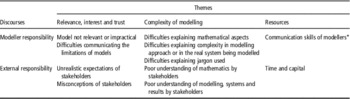
Analysis of the information provided by participants about the challenges they have encountered in communicating their modelling to stakeholders, revealed three themes made up of a number of components (Table 1).
Discourses of researchers relating to communicating modelling

* Implied category not explicitly stated by respondents (see text).
The components relating to each theme could be grouped as two different discourses within the modelling community. In one, communication challenges are perceived to be the responsibility of stakeholders and other external groups. In the other, communication challenges arise from limitations in the approaches and tools of modellers. In relation to the ‘relevance, interest and trust’, and ‘modelling complexity’ themes, the discourse of external responsibility focussed on the limitations of stakeholders, whereas in relation to the theme of resource constraints, institutional factors beyond the control of researchers, were seen to limit communication. Although none of the respondents explicitly mentioned challenges relating to their expertise in or experience of communicating modelling, this might be implied in the components of the other two themes within the ‘Modeller responsibility’ discourse, through the focus on the challenges of explaining complex models, systems, outcomes and jargon.
Individual modellers who made statements that could be grouped under ‘relevance, interest and trust’ often put forward challenges belonging to both the modeller and stakeholder responsibility discourses. However, those modellers who made statements that could be grouped as ‘complexity of modelling’ more exclusively expressed challenges in terms of one discourse or the other, focussing either on the understanding of stakeholders or on the difficulties of explaining their work. The language of explanation and understanding suggests the communication of objective facts to address uncontested aims. In contrast, framing challenges in terms of relevance and expectations is more aligned with the perspective that aims and knowledge are subjective issues for exploration. These views represent, respectively, ‘hard’ and ‘soft’ approaches to research and stakeholder engagement (van Paassen et al., Reference van Paassen, Roetter, Van Keulen and Hoanh2007). The observed patterns of response might therefore be associated with differing underlying beliefs about research processes and application, which cut across the identified ‘responsibility’ discourses.
Conclusions
Models are widely used in agriculture to support decision making at farm and policy level. In the context of global change, effectively communicating model outputs to stakeholders is vital. This study revealed two contrasting discourses held by modellers in relation to communication with stakeholders, in which challenges to modelling are perceived to be the responsibility of modellers or of stakeholders and other external groups. When seeking to drive more effective communication, both of these discourses must be recognised, as each is likely to be linked to different incentives and barriers to successful engagement. Further work is required to more fully define and explore the revealed discourses, how they are applied within the arenas of different types of stakeholder engagement exercise, and how they can inform efforts to support such exercises.
Acknowledgements
This paper was supported by the FACCE-JPI knowledge hub MACSUR, with additional support from the Norwegian Research Council, and BBSRC (UK).