Introduction
Altricial species have appropriate different physiological and behavioural mechanisms to offset their early postnatal limitations and to enhance reproductive success (Bosque & Bosque Reference Bosque and Bosque1995; Gilbert et al. Reference Gilbert, Blanc, Giroud, Trabalon, Maho, Perret and Ancel2007; Geiser et al. Reference Geiser, Wen, Sukhchuluun, Chi and Wang2019). That include both biological and selection of external habitats that protect fragile young from adverse climate and predation and ensure nutritional requirements for the development of motor coordination (Case Reference Case1978; Wolff & Peterson Reference Wolff and Peterson1998; Kinlaw Reference Kinlaw1999). Denning is a behavioural mechanism used by most carnivores (Caro Reference Caro1994), providing safe and ‘growth conducive’ refugia to relatively undeveloped young ones (Boydston et al. Reference Boydston, Kapheim and Holekamp2006; Paul et al. Reference Paul, Majumder and Bhadra2014). Interspecific competition is reported to cause high mortality of young in some species (Mills Reference Mills1993; Mills & Mills Reference Mills and Mills2014). Therefore, carnivores select dens in or close to their optimum habitat abundant in food resources, water bodies and relatively free from anthropogenic disturbances (Nurvianto et al. Reference Nurvianto, Imron and Herzog2015; Majumder et al. Reference Majumder, Paul, Sau and Bhadra2016; Moehlman Reference Moehlman and Gittleman2019). However, den site selection is predominantly determined by den availability and site-specific attributes like slope and vegetation cover that reduce detection probability of den.
Burrows and rocky refugia are the two major den forms known to be inhabited by carnivores (Caro Reference Caro1994; Alam Reference Alam2011). Animals occupy rocky regions of different forms like beneath outcropped rocks, under a large boulder/mound, in rock crevices, or caves. Though rock dens refugia are reported to be preferred by many animals (Akram & Ilyas Reference Akram and Ilyas2017), selection may depend on their availability, placement, season, animal ecology and intended use (Endres & Smith Reference Endres and Smith1993; Griesemer et al. Reference Griesemer, Fuller and Degraaf1998). Carnivores are either primary excavators or occupy rocky refugia (rock den) or burrows dug by other species. These refugia are not only footholds for young but also resting sites for adults (Prestrud Reference Prestrud1992; Chourasia et al. Reference Chourasia, Mondal, Sankar and Qureshi2020). Although significant differences in the micro-habitat conditions between natal and resting sites have been reported in many studies (Pruss Reference Pruss1999; Mukherjee et al. Reference Mukherjee, Kumara and Bhupathy2018; Chourasia et al. Reference Chourasia, Mondal, Sankar and Qureshi2020). Slope and vegetation cover either in the form of shrub, canopy or grass cover are key determinants in the placement of natal dens for most carnivore species. Multiple and narrow den openings are other characteristics observed in natal den to evade intra-guild predation (Frafjord Reference Frafjord2003).
The striped hyaena, Hyaena hyaena, is a carnivore and predominantly a scavenger by its feeding habit. The species has a wide distributional range which includes the Middle East, Caucasus region, Central Asia and the Indian subcontinent, with their southern and western limits in Africa (Mills & Hofer Reference Mills and Hofer1998; AbiSaid & Dloniak Reference AbiSaid and Dloniak2015; Bhandari & Chalise Reference Bhandari and Chalise2016; Bhandari et al. Reference Bhandari, Bhusal, Psaralexi and Sgardelis2021). Historically, the species was widely distributed in India but has experienced a steep population decline probably because of poisoning, competition from co-existing carnivores, reduction in livestock carcasses owing to the alteration in agro-pastoral practices and other reasons (Arumugam Reference Arumugam2012). The striped hyaena is considered to be a generalist species and feeds on wide varieties of food items, including mammals, birds, insects and vegetable (Kruuk Reference Kruuk1976; Bhandari et al. Reference Bhandari, Morley, Aryal and Shrestha2020). Wild and domestic mammalian prey species contribute a major portion of the dietary requirement of the species (Alam & Khan Reference Alam and Khan2015; Bhandari et al. Reference Bhandari, Morley, Aryal and Shrestha2020). Hyaenas inhabit a range of habitats but prefer those with sufficient food supply, water and adequate cover (Kruuk Reference Kruuk1976; Bhandari et al. Reference Bhandari, Bhusal, Psaralexi and Sgardelis2021). Analogously, in India, striped hyaena co-occurs with its sympatric carnivores like tiger (Panthera tigris), leopard (Panthera pardus) and dhole (Cuon alpinus) in most of its distribution ranges, thereby assuring frequent carcass availability for the former (Arivazhagan et al. Reference Arivazhagan, Arumugam and Thiyagesan2007; Alam et al. Reference Alam, Khan, Kushwaha, Agrawal, Pathak and Kumar2014; Singh et al. Reference Singh, Qureshi, Sankar, Krausman, Goyal and Nicholson2014; Jhala et al. Reference Jhala, Qureshi and Nayak2020). Such a shared landscape although provides more frequent scavenging opportunities than the anthropogenic refuse, it also increases fatal interspecific interactions because of competition over carcasses with other opportunistic species like leopard. The dietary niche of leopard and hyaena substantially overlap, and antagonistic interactions also have been evident in some of their distribution ranges (Heptner & Sludskii Reference Heptner and Sludskii1992; Prater Reference Prater1966; Arivazhagan et al. Reference Arivazhagan, Arumugam and Thiyagesan2007). Purportedly, this would be a reason for the interspecific killing of hyaena by leopard (Mandal et al. Reference Mandal, Chatterjee, Qureshi and Sankar2018) and spatial avoidance of large carnivore activity centres by hyaena, wherein they occupy buffer regions of protected areas (PAs) and even open scrub jungles outside PAs (Sankar et al. Reference Sankar, Qureshi, Mondal, Worah, Srivastava, Gupta and Basu2009; Jhala et al. Reference Jhala, Qureshi and Nayak2020; Srivathsa et al. Reference Srivathsa, Majgaonkar, Sharma, Punjabi, Singh, Chawla and Banerjee2020). To evade aversive interspecific interaction, hyaenas select optimum den site locations in their stronghold habitat that provides easy access to food and water. Determination of foothold den site by the species principally depends on the ruggedness of the terrain and later to its site-associated factors like canopy cover and scrub vegetation for both resting and breeding purposes (Singh et al. Reference Singh, Gopalaswamy and Karanth2010; Bopanna Reference Bopanna2013; Singh et al. Reference Singh, Qureshi, Sankar, Krausman, Goyal and Nicholson2014). Although there are several studies on striped hyaena ecology, there are relatively few on the denning behaviour of the species. Therefore, this study was intended to augment existing information and attempted to comprehend the factors that influence den site selection by a small and dwindling population of striped hyaena confined to approximately 314 km2 area of Mudumalai–Sathyamangalam landscape of Tamil Nadu in India. The landscape area possesses undulating terrain known as favourable den site location for the species, and therefore we predicted that striped hyaenas would select steeper areas with optimum vegetation cover to avoid aversive interspecific interaction with its competitors.
Materials and methods
Study area
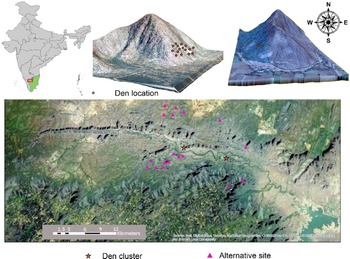
We identified an intensive study area (ISA) covering Mudumalai and Sathyamangalam Tiger Reserves based on the present distribution range of the species in the Western and Eastern Ghats of Tamil Nadu, India (WEGPTN; Figure 1). Initially, the broad study area was surveyed through sign evidence, interviews with locals with the conjunction of camera trapping and based on the recorded evidence on hyaena the ISA was delimited. The distribution of the source population of striped hyaena was highly confined to the two forest ranges namely Nilgiri Eastern Slope and Bhavanisagar Range of the Mudumalai and Sathyamangalam, respectively. Some sporadic records were also found outside these two ranges such as Masinagudi and Sigur, but the study was not intensified further in these ranges since there was no evidence of dens recorded. The ISA is dominated by dry thorn forest (Supplementary Information Fig. S13a) and often has a large number of cattle and goats which roam freely inside the forest. The study area is the stronghold of the last remaining population of striped hyaena in southern India and highly vulnerable to retaliatory killing and the ill effect of inbreeding depression. Chital (Axis axis), sambar (Rusa unicolor), Indian bison (Bos gaurus), blackbuck (Antilope cervicapra) and blacked-naped hare (Lepus nigricollis) are major prey species found in this landscape (Ramesh et al. Reference Ramesh, Kalle, Sankar and Qureshi2012; Jhala et al. Reference Jhala, Qureshi and Nayak2020). These prey species support healthy populations of tigers, leopards and dhole which provide scavenging opportunities in the landscape. Therefore, we expected the focal population of striped hyaena select optimum den site location in its stronghold habitat, ensuring easy availability of food, water and evasion of aversive interspecific interactions.
Cluster of dens of striped hyaena (Symbol: Start), alternative sites (Symbol: Triangle) and zoomed version of den locations on two mountains in the Moyar valley of Mudumalai–Sathyamangalam landscape, southern India.

Field data collection
The field sampling was conducted only during dry season of 2020 and 2021. To locate hyaena dens, potential denning sites like the slope or rift between two mountains, dry river beds or any natural refugia like modified Indian crested porcupine (Hystrix indica) dens were explored by foot (Supplementary Information Fig. S1b, c, & d). Long-term experiences of local people and forest department staff were also used to locate hyaena dens. Striped hyaena typically hoard bones at their den sites, so hoarded bones, hyaena tracks or scats were used as a key to confirm active dens (Supplementary Information Fig. S2c, d & e). In the case of any doubt, camera traps were deployed and ascertained if the dens were occupied by the species (Supplementary Information Fig. S1e). One motion sensor camera trap was installed at every doubtful den site locations for 15 nights. Camera traps were tied on nearest tree present at den sites and were position towards the major opening of den, if there were more than one den opening. After confirmation, comprehending den site selection with different species through available literature, relevant data on the den structure including number of den opening, position, topography and habitat characteristics of the site were collected to understand the denning site selection of the species. Patch-specific attributes of dens were collected from three concentric circular plots of 10 m, 5 m and 1 m radius laid considering den at the centre. In a 10-m circular plot, we numerated individual trees of major representing species and measured different parameters, including tree height, tree girth at breast height (GBH), mean canopy cover from four points and mean grass height from five places from the plot. From the 5-m radius plot, we recorded the percentage of shrub cover, and the percentage of rock and weed cover was estimated from the 1-m radius plot. To account for anthropogenic disturbances, we recorded different signs of human disturbances like wood cutting, lopping, human–livestock trails, people sighted and livestock sighted from 10-m circular plot. Furthermore, to understand those drivers through binomial models, we collected analogous site-specific data from other 18 alternative hillslopes located within the 10 km radius of den clusters considering the maximum hyaena movement recorded from our camera trap survey (Mandal Reference Mandal2018). The impact of prey–predator abundance on den site selection by hyaena was not assessed as the dens were clumped and confined to two mountains and lacked variability in prey–predator data.
Variable selection and analyses
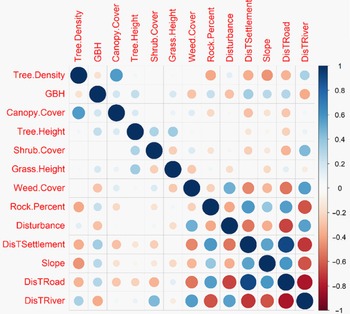
Based on available literature on den site selection by carnivores and species ecology, initially we selected 13 variables namely tree density, GBH, mean canopy cover, mean tree height, mean shrub cover, mean grass height, weed cover, rock percent, slope, distance to settlement, distance to road, disturbance and river for the binomial analysis. Canopy cover was measured at five random points ocularly within 10-m plot keeping the den site location at the centre, and finally we took average for the plot. The value for disturbance was calculated as a relative distribution index by dividing the number of the different five signs of anthropogenic disturbance recorded (woodcutting, lopping, human–livestock trails, people sighted and livestock sighted) in the plot by five (total type of human disturbances investigated). We calculated the slope from the STRM digital elevation downloaded from the Earth explorer data archive (Farr et al. Reference Farr, Rosen, Caro, Crippen, Duren, Hensley, Kobrick, Paller, Rodriguez, Roth and Seal2007). Distance from road and settlement were calculated using the Euclidean distance tool in ArcGIS (ESRI, USA) and keeping Google Earth as the background as base map. Then, we checked the normality in the distribution of the dataset and normalised the skewed variables with log10 transformation. We also checked the multicollinearity between the variables used by applying the Pearson correlation (Figure 2). In the correlation analyses, we found a high and negative correlation between variables distance to road and settlement (r 2 ≥ 70). We retained variable distance to settlement which was ecological sensible and discarded distance to road for further analyses and retained distance to settlement. Finally, to understand the factors influencing den site selection by the species, we used Bayesian generalised linear models with quasi-binomial family in program R (Zuur et al. Reference Zuur, Ieno, Walker, Saveliev, Smith, Zuur, Leno, Walker, Saveliev and Smith2009; R Development Core Team 2018) using arm package (Gelman & Su Reference Gelman and Su2018). The over-dispersion of the model was checked by dividing the residual deviance by the degrees of freedom. We constructed stepwise several models with different combinations of variables and checked model fit based on the maximum Kullback–Leibler-divergence-based R 2 value and Fisher score to select the best model (Zhou Reference Zhou2011).
Correlation matrix among predictor variables determining den site selection of hyaena.

Results
We found 18 striped hyaena dens in the study area belonging to two different den clusters. All dens were rock refugia such as caves, under outcropped rocks and mounts (Supplementary Information Fig. S1a–f; S2 a–f). The pattern elucidated the stark preference of hyaena towards hillslope which supports numerous rock structures preferred by the species. Dens were found on slopes of two different mountains situated in co-predators (tiger, leopard and dhole) and prey-rich habitat. We found 16 dens clumped on a mountain slope and the remaining 2 dens on another mountain situated approximately 8 km apart from each other. Out of 16 dens of the cluster, two were natal from where evidence of litters was recorded (Figure 3a) and were chambers excavated under two different big pieces of boulders (Figure 3b). At den sites, hyaenas were generally observed in a group of two to three individuals and found to exhibit communal denning behaviour. Communal dens were the cluster of dens located 5 m to 644 m from each other (Figure 3c). All dens were found to have a single den opening and oriented indifferently to aspect. Den openings faced the direction of slope, and since the two clusters of dens were recorded from the north- and south-facing slopes, both north and southward facing dens were observed. The mean height and width of dens were 1.38 m ± 1.3 (ranged from 0.35–9 m) and 1.47 m ± 0.9 (0.02–2 m), respectively. Wherein, the opening of both natal dens was considerably narrower than non-natal dens in the term of both height and width. Height of the opening of two natal dens was 0.35 m and 0.50 m, while width was recorded at 0.40 m and 0.45 m. In this study, we observed that hyaenas did not avoid areas with abundant co-predators; instead, they selected steep slopes of mountains which were less frequented by their competitors as a denning refugia.
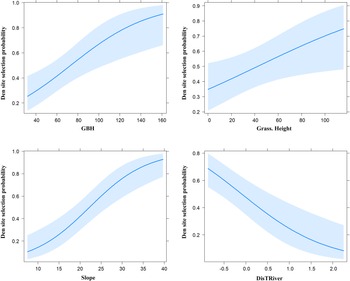
Variables tree girth at breast height (GBH) (in centimetre), slope (degree), grass height (in centimetre) and DisTRiver (distance to river in metre) from the best model explaining den site selection by hyaena.

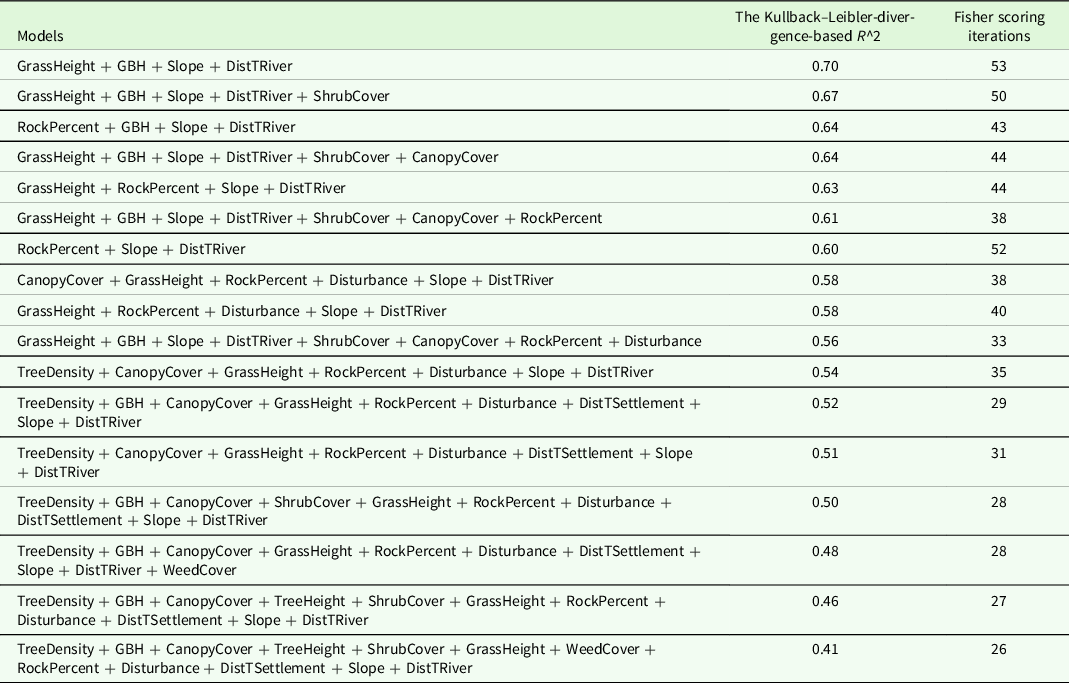
Among the different calibrated models, the combination of GBH, slope, grass height and distance to river achieved the best fit and were found to be robust in explaining den site selection by hyaena (P ≤ 0.05; Table 1). The R square value and Fisher score of the top model were found to be the highest with 0.81 and 53, respectively. The values of variable inflation factor of the explanatory variables of the top model ranged from 1.03 to 1.09, and therefore no variable was removed from the final model. In the top model, the beta coefficient value of GBH, grass height, slope and distance to river were found to be 0.026 ± 0.007, 0.015 ± 0.006, 0.145 ± 0.032 and −1.016 ± 0.249, respectively. Distance to river was discerned as the most important factor determining hyaena den site selection and exhibited a negative relationship, while the rest of the variables showed a positive correlation with the probability of den site selection (Figure 3). The model showed that the probability of den site selection decreased with an increase in distance from the river which affirmed the importance of the presence of a water source in the vicinity of the denning site. The slope was the second most influencing factor, and the probability of den site selection was observed to increase with the degree of slope. GBH and grass height also showed a positive relationship with the probability of den site selection. Although the variable rock cover did not appear in the top model, its importance cannot be utterly neglected. The mountain has a high proportion of rock in the forms of outcropped rocks and boulders that provide natural refugia to the species in the form of the cavity, rifts and chambers.
Candidate Bayesian generalised linear models with quasi-binomial family explaining den site selection by striped hyaena

Discussion
Dens are the focal locations in a home range of a species and the centre for crucial activities like feeding and breeding which are important for species survival (Eberhardt et al. Reference Eberhardt, Hanson, Bengtson, Garrott and Hanson1982; Doncaster & Woodroffe Reference Doncaster and Woodroffe1993; Fernández & Palomares Reference Fernández and Palomares2000). In our study, we identified two clusters of striped hyaena dens from Moyar valley. The valley also harbours a high abundance of other large carnivores like tiger leopard and dhole (Jhala et al. Reference Jhala, Qureshi and Nayak2020). In a study by Alam (Reference Alam2011), den sites of hyaenas were found to be overlap with the distribution range of sympatric obligate predators. This behaviour of hyaena probably helps in securing optimal scavenging opportunities for the species. In this study area with high abundance of large co-predators, hyaena were observed to select available rock refugia on steep slopes. This was similar to other studies where hyaenas were found to occupy big or small rocky caves, under rock outcrops on mountains (Mills and Hofer Reference Mills and Hofer1998; Kuhn Reference Kuhn2005; Singh Reference Singh2008; Mandal Reference Mandal2018). Female hyaenas are good excavators (Rieger Reference Rieger1979), able to excavate chambers under a rock mound, dig burrows and occupy burrows dug by other species like a porcupine (Mukherjee et al. Reference Mukherjee, Pilakandy, Kumara, Manchi and Bhupathy2017). However, we found no burrows occupied by hyaena in our study area. Out of 18 dens, we recorded 16 dens under outcrops of rocks and 2 natal dens which were excavated under two separate mounds. Rocky refugia are preferred by many species and are also argued to have advantages over burrows. Burrows are vulnerable to inundation and structural damage (Schwartz et al. Reference Schwartz, Miller and Franzmann1987), while rock refugia remain dry, intact and maintain a relatively constant microenvironment (Rabinowitz & Pelton Reference Rabinowitz and Pelton1986). Selection of den type (burrow or rock refugia) also varies regionally depending on local factors. For example, contrary to our observations, Alam (Reference Alam2011) found hyaena to used burrows over rock refugia. We recorded 28 den out which 5 were rock caves with natural opening while rest 23 were burrow dug in the sandy soil. Selection for the substrate can be influenced by its availability, and this could have added to observed differences between the studies. Furthermore, in Alam’s (Reference Alam2011) study, all hyaena dens were recorded from undulating terrain and most them from middle of hillslopes. Similarly, in our study, all dens were recorded from hillslopes varied from 16o to 27o. Our empirical model also suggested that there will be high probability of den site selection by striped hyaena on steep terrain. Similar associations between terrain and preference for den site selection have been evident from different distribution ranges of the species (Kruuk Reference Kruuk1976; Alam et al. Reference Alam, Khan, Kushwaha, Agrawal, Pathak and Kumar2014; Mandal Reference Mandal2018). In human-dominated landscapes, steep hilly terrain is known to have relatively less anthropogenic disturbance and potentially explains the preference of hyaena for undulating terrain. Camera traps around den sites recorded no movement of sympatric carnivores on steeper part of mountain slopes. During our field work, we recorded frequent indirect evidences of the compromised movement of co-occurring larger predators on inclined slopes which is another advantage of selecting undulating terrain which reduces the risk of encounters with competitor species (Jackson et al. Reference Jackson, Power, Groom, Masenga, Mjingo, Fyumagwa, Røskaft and Davies-Mostert2014; Nurvianto et al. Reference Nurvianto, Imron and Herzog2015; Davies et al. Reference Davies, Marneweck, Druce and Asner2016). Avoidance of animal movement through steep terrain could be a result of energy economics articulated with the movement ecology of a species. Slope is an ‘energy expensive terrain’ and movement through the terrain coast dearly under the gravity in comparison with flat terrain. Therefore, in response to the inclined surface, animals exhibit some cost-effective locomotory behaviour, including change in speed, direction and also avoidance of steeper terrains (Langman et al. Reference Langman, Roberts, Black, Maloiy, Heglund, Weber, Kram and Taylor1995; Shepard et al. Reference Shepard, Wilson, Quintana, Laich, Liebsch, Albareda, Halsey, Gleiss, Morgan, Myers and Newman2008; Dunford et al. Reference Dunford, Marks, Wilmers, Bryce, Nickel, Wolfe and Williams2020). In turn, this provides a relatively safer space for hyaena through long-term knowledge on space used by its competitors. Moreover, we lack ancillary studies on the parsimonious movement strategy of large carnivores from India, in response to slope. While, this is an indispensable aspect of denning ecology and will provide more overarching understanding on den site selection with respect to interspecific competition.
Previous studies on den site selection suggested the preference of hyaena towards orientation of den opening. In contrary to those observations, we found that all hyaena dens were oriented towards the direction of slope irrespective of aspect. We found that all dens will have a single entrance which contradicts the observations by Alam (Reference Alam2011). Although hyaenas are considered a solitary carnivore, we often observed two or three individuals together recorded in 2 den clusters comprising of 16 and 2 dens, respectively. Such clusters have been recorded from multiple studies conducted throughout the distribution range of the species, and they are known as communal dens (Alam Reference Alam2011; Bopanna Reference Bopanna2013; Mandal Reference Mandal2018).
Our top model explained that den site selection was as a function of grass height, slope, GBH and distance from river. Wherein, grass height, slope and GBH exhibited positive relation with the probability of den site selection. Grass cover was also appeared as an important factor in den site selection by species in a study by Alam (Reference Alam2011). Tall grass around dens might help to conceal the den from approaching predators and increases the survival fitness of hyaena (Mandal Reference Mandal2018). In our study, we did not find shrub cover important in determining the den site selection by species. Whereas, in a study by Bhopana (Reference Bopanna2013), shrub cover appeared as an important factor. The coefficient values of the model suggested that distance to the river had a negative relation which means that the chance of occupying the available rocky refuge decreases with an increase in distance to the river. This relation that unequivocally signifies the importance of water availability has corroborated the findings of other studies which stress the importance of water proximity for den site selection by the species (Kruuk Reference Kruuk1976; Bopanna Reference Bopanna2013; Khanal et al. Reference Khanal, Baniya and Acharye2017). Corroborating findings from previous studies in our model slope also appeared as an important factor (Alam Reference Alam2011; Singh Reference Singh2008; Nikunj et al. Reference Nikunj, Dave and Dharaiya2009). In field, we observed that almost all dens were situated under a tree and that was probably to keep the dens relatively cooler and to provide a structural support to the dens. Vroom et al. (Reference Vroom, Herrero and Ogilvie1980) also argued that vegetation roots provide auxiliary support and the structural rigidity of the soil can minimise den collapse
In our study, we observed the site-specific factors that influence den site selection by hyaena in a high carnivore density landscape. Our model suggested that hyaenas tend to select the rock refugia surround by trees and tall grasses, situated on a mountain slope proximate to a water body. Although our data reflect attributes only from two den clusters and results should be inferred cautiously, our compendium strengthens the importance of slope in the denning ecology and also rationalises its importance as a strategy to avoid co-predators. Here, we suggest that the movement ecology of competitor carnivores is an indispensable aspect in den site selection and should be considered if den site is presumed to be a function of aversive interspecific interaction. The studied hyaena population is confined to the narrow Moyar valley that lies between two mountain folds which is relatively less disturbed than its surrounding areas. This restricts the safe denning refugia for the species and has probably limited its population in the valley. Moreover, the argument needs further validation, but regular monitoring of identified dens and other potential den sites to check anthropogenic disturbance should be assured for conservation and range expansion of this confined population.
Acknowledgements
We are grateful to Director, SACON, for providing logistics support and the Chief Wildlife Warden, Tamil Nadu, for granting permission to work across forest divisions. The project was funded by the Science and Engineering Research Board, a statutory body of the Department of Science & Technology, Government of India, under the Core Research Grant (Grant No. EMR/2017/001849), and Ramanujan Fellowship scheme (Grant No. SB/S2/RJN049/2016) to the second author. We thank department staff and our research assistants for their help in the field.