1. INTRODUCTION
The wealth of the landed classes has been a well-trodden path for historians since the ground-breaking work of Sir John Habakkuk on ‘the rise of the great estates’.Footnote 1 Inheritance, the land market, intra-familial relations and estate settlement practices formed the main focus for Habakkuk and later scholars working in this area.Footnote 2 This research has greatly enriched our understanding of the legal–structural factors behind the continuity in status of early-modern landed elites and, indeed, of eighteenth-century society more generally. Yet this rather narrow focus has led to a relative dearth of work on the subject of expenditure, despite the importance of spending patterns for preserving the family patrimony. We know more about systems for the transmission of the estate and house and less about how the family wealth was put to use. Several scholars have considered patterns of spending on the household and on personal items, although these are generally scattered examples and focus on single generations within a family.Footnote 3 Social and architectural histories of the country house have explored spending on the building and furnishing of houses, and have given us a fairly reliable picture of the costs of building country houses and their broader significance in social and cultural terms.Footnote 4 However, since it is generally assumed that the status of landed elites was partly defined by their extravagant spending habits and lavish homes, the dominant approach in this literature, as well as the material on personal and household expenditure, has been to study the conspicuous consumption of the wealthier aristocracy.Footnote 5
As a result, we have very little knowledge about broader patterns of spending, on the mundane as well as the conspicuous, for the middling landowners that made up the majority of landed society. We are all too familiar with profligate and spendthrift individuals who ruined their family's patrimony or sank the estates into debt. A correspondent of The Gentleman's Magazine captured this in 1767, writing that his friend in the country had ‘beggared himself, and spent the fortunes of three or four children in what he called improvements, though it appeared to me that all the money had been thrown away, without either taste or common sense’.Footnote 6 However, the comprehensive research we do have has repeatedly shown that these were unrepresentative of the general behaviour of landowners who were either forced to, or trained to, restrict their spending.Footnote 7 Finally, most research has focused on the owners of estates rather than on absentee ownership due to demographic failure. Periods when houses and estates were managed by trustees while the inheritor was in his minority (usually up to the age of 21 years) are still largely shrouded in mystery in terms of spending and consumption.Footnote 8 This is despite the great frequency of such occurrences across a large swathe of landed society due to the high, although improving, mortality rates during the eighteenth century.Footnote 9 As Christopher Clay has noted, the survival of estates through the male line of succession was very unusual, with most lasting a mere three or four generations.Footnote 10
This article analyses changes and continuities during the eighteenth century in the level and character of expenditure amongst one family of the middling aristocracy that rose to be amongst the wealthiest landowners in Warwickshire through prudent management of their finances and demographic chance: the Leigh family of Stoneleigh Abbey. Through a variety of evidence, including family wills, receipted bills and account books, we aim to look beyond the analytical limitations imposed by the use of legal structures such as ‘the strict settlement’, the system of property transfer in which land was ‘settled to the father for life and after his death to his first and other sons or children in tail, with trustees to preserve the contingent remainders’.Footnote 11 By so doing, we hope to achieve a deeper understanding of gentry finances, inheritance, intra-familial relationships and dynastic change. Our data do not, unfortunately, include all spending by the Leigh family, but they reveal quite clearly the ebb and flow of expenditure. This allows us to examine how shifts in the spending patterns of successive owners of Stoneleigh Abbey related to inheritance events and to changes in family circumstances.
Building on the work of both Lloyd Bonfield and Peter Roebuck, which has emphasised the importance of spending habits over and above that of the strict settlement in the long-term survival of landed estates, our argument comprises three elements.Footnote 12 First, we note the important impact of demographic fortunes on family spending. Small numbers of children, the absence of costly annuities and a period of minority limited outgoings and provided opportunities for substantial retrenchment. Second, we argue that aristocratic spending was often more moderate and well managed than is usually portrayed. Cycles in spending by the Leighs show that they enjoyed surges of conspicuous consumption following inheritance, but that the general habit of all Leigh owners was to return to moderate and sedate spending regimes. This skilful restraint was, we argue, more important than the legal strictures governing spending. Finally, we demonstrate the important role played in the long-term nurturing of family finances by trustees, stewards and family friends. They helped to moderate spending and carefully managed estate finances during periods of minority, ensuring that the next generation could enjoy the full income from their estate.
2. THE LEIGH FAMILY AND THE STONELEIGH ESTATES: GROWTH THROUGH ACCIDENT AND DESIGN
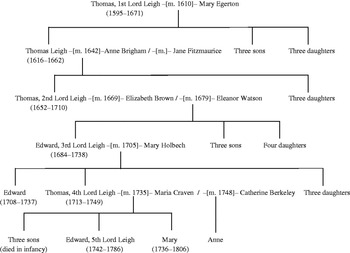
The Leigh family (see Figure 1; family tree) had been settled at Stoneleigh Abbey (a former Cistercian monastic abbey) since the purchase of the house and estate by Thomas Leigh, a London merchant, in 1561. His son, Thomas (d. 1626), was created a Baronet in 1611 and his grandson, also called Thomas (d. 1671), was created a Baron in 1643. The original estates were centred in Warwickshire and Gloucestershire, but through purchase and marriage they gradually expanded through the early sixteenth century, with the addition of new estates in Buckinghamshire and Staffordshire. Financial problems following the Civil Wars slowed this growth rate, although around 900 acres were brought to the family through the marriage, in 1669, of Thomas, the second Lord Leigh, to Elizabeth Brown, the daughter of Richard Brown of Kent. It was during the eighteenth century, however, that the Leigh estates acquired a new magnitude. The 1705 marriage of Edward, the third Lord Leigh, to Mary Holbech, the daughter and heiress of Thomas Holbech of Fillongley in Warwickshire, brought valuable real property and personal wealth to the family. When Edward's son, Thomas, the fourth Lord Leigh, died in 1749 he was receiving £6,975 per annum in rents. This grew considerably in 1755 when the death of Lady Barbara Leigh, the sister-in-law of Edward, the third Lord Leigh, brought not only her estate at Leighton Buzzard in Bedfordshire into the holdings of Stoneleigh Abbey but also the personal estate of her late husband Charles Leigh, Edward's younger brother, which, according to inventories of his three houses in Bedfordshire, Hertfordshire and London, amounted to more than £3,000.Footnote 13 The additional Leighton Buzzard estates brought the Leighs' annual income to almost £10,000 per annum, placing the owners of Stoneleigh Abbey into the highest bracket of Joseph Massie's 1756 typology.Footnote 14 After this the value of the estates grew steadily to £11,216 in 1774 and £13,643 in 1786. Wartime inflation and other factors meant that, by the end of our period in 1806, the Leighs were receiving rents of around £19,000 per annum. By this time their lands extended beyond Warwickshire to Bedfordshire, Cambridgeshire, Essex, Northamptonshire, Cheshire, Leicestershire, Staffordshire and Surrey.Footnote 15
Simplified family tree for the Leigh family of Stoneleigh Abbey, Warwickshire.

Similar to many other families during the eighteenth century, the Leighs had acquired a ‘great estate’ befitting their title.Footnote 16 The conscious strategies and safeguards involved in such processes are familiar enough. However, these expansions in the Leigh patrimony were set against the backdrop of a series of demographic failures, medical problems and deaths without issue, leading to a series of interruptions in the succession of owners to the estates. Such events were important in shaping the fortunes of many families, yet are often overlooked in analyses of rising wealth or estate aggrandisement.Footnote 17 The fourth Lord, Thomas, who had inherited in 1738, died in 1749 aged only 36 years. He and his first wife, Maria Craven, had suffered the death of their first three sons in infancy during the late 1730s, their eldest, Thomas, dying of smallpox in 1737. Their fourth son, Edward, was only 7 years old when his father died, the result being a 14-year period (1749–1763) of minority when the estate was managed by trustees. Thomas's will made provision for his surviving wife, Catherine Berkeley; his daughter by that marriage, Anne and his daughter by his first marriage, Mary.Footnote 18 Anne was to receive £100 per year, and Catherine got £300 over and above her jointure as detailed in their marriage settlement, which had provided an annuity of £500.Footnote 19 Mary received a very generous portion of £15,000, to be paid either when she reached the age of 21 years or when she married.Footnote 20 Such a portion was substantial in comparison with that provided for daughters by other families. For instance, Elizabeth Brownlow, daughter of the Hon. William Brownlow, received £6,000 in Exchequer Bills upon her marriage to the Earl of Darnley, in 1791.Footnote 21 It was also generous in proportion to the rental income of the Leigh estates in 1749, which stood at £6,975. Standard practice during this period was to provide one year's rental as a portion for a single younger child.Footnote 22 Mary also received maintenance in the meantime which, together with the care and upkeep of his son, Edward, was to be managed by the trustees of Thomas's estate: Charles Leigh (his brother), Elizabeth Verney, William Craven, the fifth Baron of Coombe Abbey, and Edward Fairfax, of Coventry. Two other executors were also named: Sir Charles Mordaunt and Sir Walter Wagstaffe Bagot. The trustees were the ‘guardians’ of Edward and Mary and could purchase land, ‘or otherwise apply or make use of any part of the said Trust estate for the intended use or benefit of my said children’.Footnote 23
Edward eventually came into his majority as the fifth Lord Leigh in 1763, two years after matriculating at Oriel College, Oxford. He showed great aptitude as a student and displayed a particular interest in science both during his university years and after he had inherited the estates. His reign was to be a brief one, however: he began to show signs of mental exhaustion and possible mental ill-health from the late 1760s. A bill for 18 June 1767 shows that the family had sought medical advice from Dr John Monro, a physician at the Bethlehem Hospital and a specialist in mental health.Footnote 24 Later accounts and papers show that Dr Monro, along with other specialists, continued to advise the family on Edward's deteriorating mental state and to provide periods of care for him.Footnote 25 The family eventually opted for the assistance of Dr Francis Willis from 1771 onwards, at a cost of £1,260 each year.Footnote 26 Three years later, Edward was diagnosed a lunatic by the Lunacy Commission, at which point the estate returned to the management of trustees in the form of a ‘Committee of Lord Leigh’, who were named as William Craven, the sixth Baron of Coombe Abbey (the fifth Baron's nephew) and Edward's sister, Mary Leigh. Perhaps as a result of his mental health problems from such a young age Edward had not married. He died childless in 1786, when the estate officially passed to his sister Mary as a life tenant, as the will of Thomas, the fourth Lord Leigh had instructed.Footnote 27 Mary herself was by this time 50 years old and, for reasons not entirely clear, had not married either; she remained in control of the estates until her death in 1806. With no remaining relatives in the direct family line, the estate was then passed to a collateral branch of the family, the Leighs of Adlestrop, Gloucestershire, and the Barony of Stoneleigh was extinguished.Footnote 28
A number of documents show that the Leigh estates were passed between generations by will from 1749 onwards – a practice which was quite common and which questions the overweening importance of the strict settlement.Footnote 29 There were marriage settlements, such as that between the fourth Lord, Thomas and his wife, Maria, but there does not appear to have been a ‘family settlement’ for the period of this study.Footnote 30 As Erickson has noted, contemporaries often distinguished between ‘family and marriage settlements’. Whilst both occurred on marriage, marriage settlements provided specifically for the ‘sole and separate’ use of the wife, ensuring her rights to property during the marriage. Family settlement more exactly corresponded to ‘strict settlement’ because it provided for all members of the family, not just the wife.Footnote 31
The trustees of the estate asked in 1749 to inspect the wills of the third and fourth Lords, and the final marriage settlement of the fourth Lord, Thomas, with his second wife, Lady Dowager Leigh (née Berkeley).Footnote 32 A later document includes a schedule of settlements gathered together for the trustees early in 1750.Footnote 33 This shows that there was a family settlement between the second and third Lords, at the time of the latter's marriage in 1706. This would have also have provided for the fourth Lord's tenure. However, the settlement was not rearranged for later generations, undoubtedly because Edward was seven years old at the time of his father's death and there would not have been time to arrange one since he had not reached his majority, or a marriageable age – a problem which, as Habakkuk argues, was quite common amongst the aristocracy.Footnote 34
The fact that the Leigh estates had been greatly aggrandised before passing to the Adlestrop branch of the family in 1806 owed something to judicious marriage and careful management, but part of the explanation for this financial success lay in factors beyond the control of the Leigh family and, indeed, contrary to their hopes and aims. Demographic failure, a small and declining number of children to be provided for in each generation, and a long period of minority were factors of this kind. Whilst the general trend was for family size to grow amongst the peerage during the eighteenth century, the Leighs were by no means exceptional in their experiences: their near neighbour, Sir Roger Newdigate died childless despite two long periods of marriage, as did Sir John Griffin Griffin of Audley End.Footnote 35 Having few children reduced the costs of education, establishing younger sons in professions and, most importantly, marriage portions for daughters. Since three of the fourth Lord's children had died at a young age, his bills show very few costs of this kind – just some small payments for dancing lessons and tutors' bills, most of which were for Mary.Footnote 36 We know little about the cost of Edward's education, other than the provision for his maintenance agreed by the trustees (see section 3). He attended Westminster School and Oxford University, the bills for which do not survive. Gordon Mingay estimates that the cost of private tutors, schooling and university education for the son of the ‘middling’ gentleman, Richard Grosvenor of Eaton in Cheshire, ran to about £200. Those of the son of the Duke of Chandos, who went to Balliol College, Oxford, with attendant servants and a large apartment in college, ran to over £400.Footnote 37 Edward's costs probably lay somewhere between the two. The education of a lady was much cheaper: the parents of Anne Ferrier, the daughter of a Pembrokeshire landowner, spent around 50 guineas a year to educate her in a fashionable school in Bath during the 1780s.Footnote 38 The bills for Mary Leigh during her seven-year education in the 1750s amounted to a mere £230. In addition to this, Mary was the only daughter for whom a marriage portion would have to be paid. Since neither she, nor her brother, Edward, married, the only encumbrances on the estate in terms of jointures and portions were for Mary, their stepmother and their stepsister, the second two of which were minimal.Footnote 39
To argue that a sound financial position was mainly a product of demographic chance would be both misleading and somewhat depressing in its negation of individual agency. Active consumption choices by the family also made a contribution. None embarked on a Grand Tour of Europe – often a burdensome expense for landed families – after the 1712–1713 tour made by Edward, the third Lord.Footnote 40 We do not know the exact cost of this tour, but comparative costs can provide some context. James Leigh, the eldest son of William Leigh of Adlestrop, toured Europe between 1747 and 1748, the receipted bills for which show that he, and his guardian General Wentworth, spent around £3,000 during this time, mainly on travel and accommodation expenses.Footnote 41 This appears broadly typical of an extensive tour, but families lower down the social scale often limited spending. Thus, Charles Hotham was provided with only £800 per annum for his three-year Tour.Footnote 42 The closest that the Leigh family came to a tour in our period was the brief visit to France made in 1767 by Edward, the fifth Lord, which cost just £200, a level of spending on a par with that of Charles Hotham.Footnote 43 It is difficult to know which of these examples were more in line with elite practice as there are no reliable figures for the proportion of the landed classes that embarked on these tours. It is quite clear, though, that many landowners of a more prudent persuasion rejected the full tour in favour of more modest excursions to France and the Low CountriesFootnote 44
Similarly, no major building projects were carried out on Stoneleigh after the construction of the west wing between 1720 and 1725, at a cost of just over £3,000.Footnote 45 This was a modest sum, such projects typically running to one year's rental from the estate, with the cost of furnishing and fitting often adding 50 per cent to the overall bill.Footnote 46 At Stoneleigh Abbey, the west wing was not fully furnished until the early 1760s, inflating the overall cost, but spreading this over four years or so. Neither did any of the family take political office during this period. The third Lord, Edward, had been a supporter of the Stuarts and he rarely took his seat in the House of Lords.Footnote 47 It has been argued that, throughout the eighteenth century, the family lived a reclusive life, shunning metropolitan life, politics and rural sociability ‘in eccentric seclusion … quite indifferent to the public affairs of a world where their fanciful hereditary gratitude could not hope for efficient exercise’.Footnote 48 The basis for this claim is unclear, since the bills show that they entertained at Stoneleigh, participated in fashionable county events, and visited Ranelagh Gardens, as well as London operas and theatres during the season.Footnote 49 We also know that Edward, the fifth Lord, took his seat in the House of Lords from 1764, paying his dues to the Doorkeeper between 1769 and 1772.Footnote 50 However, such costs were kept to a minimum and there is no evidence that the Leighs spent very great amounts on that other expensive taste of the landed classes: gambling. They restricted themselves to modest outlays at events such as horse racing at nearby Warwick.
Through both accident and design, the Leigh family were spared many of the expenses known to have burdened other wealthy landed families. The long period during which these expenses were in abeyance is quite unusual, but childlessness and, in particular, periods of minority were common amongst the landed classes. Of the 82 Yorkshire families studied by Roebuck, 73 experienced one or more minorities between 1646 and 1815 – a total of 122 minorities in all.Footnote 51 On the basis of four detailed case studies, he concluded that minorities were ‘… an important element in the history of a high proportion of this group’.Footnote 52 Despite these findings, such factors have often been overlooked in analyses that focus on conscious strategies of property accumulation or high-profile spending on house building, foreign travel and gambling. The Leighs' experiences typify the demographic ‘failure’ seen in many aristocratic families and the longer-term financial benefits that could accrue from this in terms of suppressed spending. Roebuck showed the positive impact that the minority of Charles Hotham had on the finances of the Hothams of Scorborough in Yorkshire between 1738 and 1755. Whilst his father's outgoings had often exceeded his income, the Trustees made sure that the balance of payments was positive for each year of the minority.Footnote 53 The key, according to Roebuck, was that during minorities no single individual was in control of the family finances. Similarly, Richard Wilson and Alan Mackley note that the lack of children facilitated spending on house improvements by Sir John Griffin Griffin.Footnote 54 What the Leighs also exemplify is the importance of measured expenditure in the survival and flourishing of the estate. It is to these aspects that we turn next.
3. LEIGH EXPENDITURE: THE MODERATION OF LUXURY
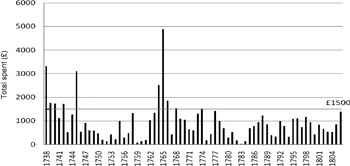
The archive of the Leigh Family contains valuable sources for tracing the consumption habits of the family across several generations. The most useful data series is contained in the receipted bills, which number 3,798 for the period 1738–1806, and cover a wide range of goods and services (see Figure 2).Footnote 55 However, they do not account for all spending across this period. Two household account books from 1774 and 1778Footnote 56 include some of the receipted bills from the longer series, to the combined value of £2,191, but they also contain extra spending to the value of £6,171 in the form of servants' wages, services and products relating to Stoneleigh Park, gardens and demesne lands, and expenses incurred by the house steward.Footnote 57 Auditor's accounts for the period 1763–1774 were entered each year by the family lawyer, Joseph Hill, and signed off by Edward and, after the diagnosis of his insanity, by his sister Mary.Footnote 58 About 30 per cent of the payments in the auditor's accounts (£5,395) can be traced through to the receipted bills – mainly for consumable items – but there are significant discrepancies between the two sources. The total spending shown in the receipted bills for this period was £18,757 whilst the auditor's accounts recorded a total spend of £60,466, a difference of £41,709. This sum comprised five main categories: £20,546 went on purchases of land and stocks, mainly South Sea shares;Footnote 59 £6,753 was spent on furnishings, furniture and silverware for Stoneleigh Abbey during the 1764–1767 refurbishment of the house; £820 went in a series of payments and advances of cash to Lord Edward Leigh; £2,970 was paid to Dr Willis for the care of Edward after he had been diagnosed a lunatic, and £4,200 was paid for undisclosed expenditure through Mr Graff, the estate steward. The remaining £6,000 or so was made up of wages and drafts of money for undisclosed items of expenditure.
Annual spending of the Leigh Family of Stoneleigh Abbey, 1738–1806. (Source: Shakespeare Birthplace Trust Record Office, DR 18/5, Receipted Bills and Vouchers, 1738–1806.)

There was undoubtedly other hidden expenditure not documented in the Leigh archive. It is also apparent that the inflation of prices is not reflected in the levels of spending found in the bills. Inflation levels showed a tendency to rise during the later eighteenth century, and particularly from the 1790s onwards. In 1799 and 1800, they reached between 20 and 30 per cent.Footnote 60 Michael Thompson has discussed the effect this had on the spending of the aristocracy and notes that changes in general price levels did not affect all luxury goods.Footnote 61 An examination of the bill series presents, as we would expect, a mixed picture in which some products (for example, wine) rose in price and others (for example, fine teas) were deflated. Overall it would appear that the main impact of inflated prices came at the end of our period and thus had little impact on the spending patterns of the Leigh family, except perhaps towards the end of Mary's period of ownership.
Despite these shortcomings and discrepancies, the receipted bills are a good guide to the ebb and flow of discretionary spending and variations in the uses to which the money was put. They certainly illustrate the importance of inheritance as discontinuities in these spending patterns. Across the entire period of this study the bills record a total spend of £64,943 – an average of £941 each year. For the majority of the period (i.e. in 43 of the 69 years) spending was restricted to less than £1,000 per annum, rising above £1,500 in only 9 years, as shown in Figure 2. There were three major surges in spending, in 1738, 1745 and 1765, when expenditure rose above £3,000 (Figure 2). All of these peaks can be related to changes of ownership and the associated settling of accounts and/or spending by the heir.
The literature is replete with examples of heirs spending lavishly, most prominently on extensive building projects. The first and second Dukes of Chandos, James and Henry, managed to accumulate huge debts through reckless spending and unwise investments during the eighteenth century, and the third Duke, another James, hardly fared any better. The penchant they showed for ‘a splendid style of life, whatever it cost’, and their ‘insouciant attitudes toward debt and an almost heroic financial laxity’ was very different from the more measured spending of the kind exemplified by the Leighs.Footnote 62 It is difficult to assess which aspect of this ‘Jekyll and Hyde’ character was more typical of aristocracy spending, but the Chandos's lifestyle was clearly unsustainable in the long run. Survival of the family fortune ultimately depended on bringing spending and income into line, although this could be done whilst still making a mark in society as individuals with varying priorities and tastes.
Thomas, fourth Lord Leigh, spent a total of £16,615 across his short reign, an average of £1,110 each year. When he inherited in 1738 he was faced with the expenses of his father's funeral which were compounded by those of his own brother and son, who died in 1737 and 1738, respectively. As a result, there were unusually high expenses of this kind, totalling £1,582 across his reign. There was also a substantial payment of £367 for legacies paid to servants following his father's death.Footnote 63 These expenses, combined with some building work and spending on the estate, largely account for the peak in spending in 1738. The peak later in Thomas's reign, in 1745, is a slightly more perplexing issue. This did not correspond directly with a change of ownership and, unfortunately, the majority of the bills in this year do not specify the product purchased. However, Mairi Macdonald has noted that Thomas Leigh's mother, Mary, continued to reside at Stoneleigh after the death of his father in 1738 and acted as a brake on his spending, particularly on alterations to the house.Footnote 64 This is supported by other evidence, including a 1740 estimate for building work, costing £79, which does not appear to have been followed up with the work itself, suggesting again that Mary had a tight hold on the family purse-strings, frustrating Thomas's plans for renovations. Elsewhere, as Amanda Vickery demonstrates, women also yielded a powerful influence, but they generally encouraged or commissioned work, rather than blocking it.Footnote 65 Other recent research has shown that such maternal influence on the spending habits of sons was very common and that mothers were crucial agents in the inculcation of habits of thrift amongst landed gentry men.Footnote 66 After Mary's death, in 1743, Thomas was able to continue work on the house, accounting for some of the unspecified bills for 1745, which were mostly paid through the house steward, Thomas Clarke. It is likely, then, that this surge in spending represents a ‘delayed inheritance event’.
Even taking into account this surge, the spending of the fourth Lord was well within the limits set by estate income of just under £7,000 each year, although Thomas was encumbered with debts and mortgages in a way that was less true for later owners. For this reason, it is possible to argue that this period was more representative of other landed estates than were later periods of greater liquidity. That said, the period of his son's minority following Thomas's death, and the financial benefits which were accrued from the period of trusteeship that ensued, were benefits shared by many other landowners, including the Coke family of Holkham Hall and the Hothams of Scorborough, in Yorkshire.Footnote 67
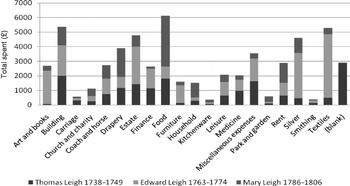
The three largest areas of Thomas's spending were building, food and drink, and miscellaneous expenses – mostly the funeral costs mentioned above (Figure 3). Much of the building work comprised small repairs and maintenance, with just £59 on painting, decorating and plastering in the house itself across the 12 years of his reign. Spending on food and drink included over £600 on wines, mostly Madeira and claret, sent up from London, and a growing range of groceries. Another significant area of spending was clothing and tailoring, over £1,000 being laid out in the course of 12 years. In contrast, Thomas spent just £96 on furniture and furnishings, nearly one-quarter of which was for a set of walnut chairs ordered in 1736 by his father, Edward. His largest purchases were a set of mahogany tables costing £17 and a carved and gilded chimney glass ordered by his wife.Footnote 68 An inventory at the start of Thomas's reign in 1738 did not list a library of any kind and it would appear that he did nothing to add to the very modest collection of books in the Abbey.
Amounts spent by members of the Leigh Family of Stoneleigh Abbey, 1738–1806, by type of goods bought. Note: ‘blank’ represents bills that were not assigned to any product. (Source: Shakespeare Birthplace Trust Record Office DR 18/5, Receipted Bills and Vouchers, 1738–1806.)

Thomas's son, Edward, who took control of the estate when he came of age in 1763, spent rather more grandly. If we focus on his discretionary spending in the bills and the account books, Edward spent a total of just under £25,000 in the 11 years before his diagnosis as a lunatic – an average of £2,272 per annum. This looks distinctly modest in comparison with the £5,643 per annum spent by Sir John Griffin Griffin in renovating and running Audley End.Footnote 69 However, as noted earlier, the diagnosis of his insanity was the end result of a long period of mental ill-health, first noticed in 1768,Footnote 70 and the bills and accounts show very little in the way of discretionary spending on the part of Edward after this date. In reality, his spending in the period 1763–1767 ran at about £5,000 per annum, but even this cannot be considered financially irresponsible given that rental incomes from the estate stood at £10,000 to £11,000 per annum. The 1765 peak amounted to around £14,500 if the spending recorded in the bills, auditor's accounts and household accounts are added together. It is likely that this caused the cash-flow problems alluded to by the house steward in a 1764 letter to Edward's former guardian, William Craven (see section 4).Footnote 71 There is no suggestion, however, that the bills could not be met, especially as expenditure quickly returned to ‘normal’ levels.
As can be seen in Figure 3, Edward's largest outlay was for furniture and furnishings as he set about refurbishing the principal rooms and fitting up many of the bedrooms in the west wing for the first time. Just under £5,000 was spent in total through William Gomme and Thomas Burnett, both of London, who supplied a wide range of mahogany furniture and undertook a large amount of upholstery work.Footnote 72 Edward also engaged in various projects to remodel the interior of the house, especially the great hall. He employed the architect Timothy Lightoler to plan these alterations, which included new chimney pieces and elaborate plasterwork.Footnote 73 Like his father, Edward bought silverware and had it engraved with his crest, but again his spending was at a much larger scale. A single bill from the silversmith, Thomas Gilpin, to the value of £755 provides a long list of items, including candlesticks, cutlery, snuffers, tea tongs, sauce boats and cruets, all engraved.Footnote 74
In many respects, such conspicuous and tasteful consumption accords with that of other middle-ranking aristocrats – especially those who had recently inherited a profitable estate. At Audley End, for example, Sir John Griffin Griffin made extensive improvements after he inherited the property in 1762, including a suite of eight rooms designed by Robert Adam.Footnote 75 However, certain aspects of Edward's spending can also be linked to his individual interests. He had distinguished himself at Oriel College, Oxford and, at the age of 25 years, shortly before his mental breakdown, he was made a High Steward of the University of Oxford and a Doctor of Civil Law. As befitted a learned gentleman, Edward spent large amounts of money assembling a fine library, comprising a large number of books, but also scientific equipment, including several globes, an ‘electrical machine’, a barometer, a hygrometer to measure humidity and an expensive thermometer. This was rather different from the fashionable collecting of the dilettanti and their like, which focused on artistic treasures bought on the Grand Tour.Footnote 76 It reflected more scholarly concerns of the kind exhibited by men such as Sir Roger Newdigate, his near neighbour and Sir William Hanbury of Kelmarsh Hall in Northamptonshire.Footnote 77 What made Edward stand out was the speed with which he acquired such a large number of outstanding books: £1,159 was spent in just three years, purchases ending abruptly with the onset of his mental health problems in 1767.
It seems likely that Edward's sister Mary took on some of the responsibility for the estate from this date – a position that was formalised after the diagnosis of his mental illness, in 1774. However, there are very few bills addressed to her personally during this period. By the time she inherited the estate in 1786, she had become a very wealthy woman, with a £20,000 jointure from her brother's will, as well as the income from her estates.Footnote 78 Despite this large capital and income, the pattern of Mary's spending exhibits a return to the more controlled behaviour of her father, Thomas, fourth Lord Leigh. Across her 20-year succession she spent, according to the bills, just under £17,000. To this average of around £800 each year should be added the sum of around £3,000 per annum in running costs for the Abbey noted in the household accounts. In the context of rental incomes of just over £13,643 per annum in 1786, this clearly left a large surplus each year, some of which was invested in stocks and bank annuities which subsequently passed on to her heirs, the Leighs of Adlestrop.Footnote 79 Indeed, given the growing gap between income and spending, which became particularly accentuated during Mary's succession, we suggest that much of the possible ‘hidden spending’ came in the form of investments that brought extra annual income to the family.
Mary Leigh appears to have been far more of a social creature than her predecessors, more engaged in polite sociability at home in Stoneleigh Abbey, at Bath or Cheltenham, or in London.Footnote 80 Indeed, she appears to have divided her time fairly evenly between Stoneleigh Abbey and her rental properties in London (originally Upper Grosvenor Street, and from 1788, Grove House, in Kensington), spending the summers in Warwickshire.Footnote 81 The bills show that Mary spent far larger sums on clothing and food than Edward had, and far less on building projects and interior decoration. Edward's extensive refurbishing of the house in the 1760s meant there was little immediate requirement for spending of this type. Whilst these items were undoubtedly becoming a little dated and even unfashionable, Mary focused her attention on rearranging the existing furniture to create new combinations that were presumably more to her liking, and making modest improvements to her Kensington property. In this, she was certainly far less active than many of the women described by Amanda Vickery, but her focus on the small details of domestic and public sociability was fairly typical and there is little evidence that she endured a lonely or unfulfilled life.Footnote 82
Even taking into account the upward adjustments in the spending of the Leigh family through the account books and higher possible levels of hidden spending, the bills data reveal that the spending of the Leigh family was kept within reasonable and thrifty limits – well below those determined by income. As elsewhere, new owners sought to imprint their own personality and individual taste on the house and estate. It was inheritance events that caused spending surges and led to temporary discontinuities, both in terms of levels of expenditure and the types of goods purchased. This point is underpinned by the fact that no such peak in spending occurred in 1749, after the death of Thomas, the fourth Lord. For short periods following inheritance, some of the new Leigh owners spent beyond the income from the estates, but our argument is that spending then returned to moderate levels, well within the levels of income.
Whilst we lack a wealth of comparable detailed analysis of long-term spending patterns, the few examples that we do have support the idea that surges in spending, generally associated with large building projects, were followed by periods of retrenchment. This was true of Sir John Griffin Griffin at Audley End and Sir Roger Newdigate at Arbury Hall, and it suggests that careful management of consumption as well as income was vital to the continued fortunes of the family.Footnote 83 This was certainly true of the Leighs, although another key factor in the survival and growth of their estate was the responsible and close management instituted by the board of trustees, between 1749 and 1763, and by the Committee of Lord Edward Leigh, between 1774 and 1786.
4. PERIODS OF TRUSTEESHIP: BALANCING THE BOOKS AND SPREADING THE RISK
The trustees and executors named in the will of Thomas, fourth Lord Leigh, all had long-standing connections with the Leighs of Stoneleigh. William Craven, fifth Baron Craven of Coombe Abbey in Warwickshire, was a cousin of Maria Craven, Thomas's first wife and the mother of Edward and Mary.Footnote 84 The association between these families stretched back to the seventeenth century, when Elizabeth Craven, the daughter of Sir William Craven of Worcestershire, had married a cousin of the Stoneleigh Leighs, Theophilus Leigh.Footnote 85 Elizabeth Verney, who became the guardian entrusted with the care of Mary Leigh, was the sister of Edward, third Lord Leigh.Footnote 86 Sir Charles Mordaunt was a prominent Warwickshire landowner and a Tory member of parliament for the county, and Sir Walter Wagstaffe Bagot was a landowner in Staffordshire, where the Leighs also held estates and with whom they also had historic connections.Footnote 87 The choice of these trustees for the long period of Edward's minority and the faith of Thomas in their honest management of the estates proved to be well placed. The surviving documents from this period provide evidence of their care and skills, so much so that the Chancellor of the Exchequer expressed his ‘approbation’ at their management of Edward's affairs after granting their request to increase his allowance in 1761.Footnote 88
Amongst the most urgent tasks facing the trustees after the death of Thomas in 1749 was to make an assessment of the finances of the deceased owner and the Stoneleigh estates. They immediately audited the accounts of the house steward, Thomas Clarke, and the auditor, Christopher Wright.Footnote 89 It is clear that the fourth Lord had been unhappy with the management of his accounts by Wright and the trustees set about placing a firmer grip on the estate.Footnote 90 At an early meeting, they made a wide range of decisions with regard to settling Lord Leigh's affairs and managing the estate during Edward's minority. They ordered a full inventory to be taken of the goods at Stoneleigh Abbey after which there were to be sales of livestock and, upon the death of the Dowager Lady Leigh, the furniture of the house.Footnote 91 It is unclear whether the latter occurred as planned since Lady Leigh did not die until 1753. However, a second inventory taken in 1750 shows that £906 of household goods had already been sold, including gold plate, drinking glasses and linen, and that Lady Leigh had taken plate to the value of £936 to her house at Guys Cliff.Footnote 92 As well as settling legacies to servants and organising the upkeep of the house, park and gardens, the trustees undertook an assessment of Lord Leigh's debts and implemented a process whereby the securities he had loaned out were to be called in to help settle the debts.Footnote 93 Their audit showed that the amount owed by Thomas in the form of mortgage payments, bonds, unpaid bills and legacies amounted to £21,666.Footnote 94 Taking into account mortgages lent to other landowners in the local area, rent arrears and the total value of the household goods and cash at Stoneleigh Abbey, Thomas's personal estate was valued at £11,947, leaving a deficit of £9,719.
Such debts were not unusual for landowners during this period. Agricultural prices had been depressed for much of the late seventeenth century and early eighteenth century, and suffered particularly between 1730 and 1750, the period of Thomas's reign.Footnote 95 The Leigh estates had been accumulating rent arrears of around £2,000 per annum during the reign of the third Lord Leigh (1710–1738).Footnote 96 The common solution to these problems was to turn to alternative investments, particularly pure finance, often in the form of mortgages and bonds.Footnote 97 Borrowing was fairly secure in the early eighteenth century due to low interest rates of around 4 per cent, and the payments of interest on Lord Leigh's borrowing confirm this rate.Footnote 98 The financial situation of the Stoneleigh estates and the behaviour of Thomas Leigh in attempting to solve these problems were therefore typical both of the behaviour of other landowners and the economic context of the period. Furthermore, the debt of £9,179 was manageable in comparison with an estate income which was around £7,000 per annum and set to grow.
This ratio compares favourably with examples of more substantially indebted estates. For example, by the early 1740s, the debts on the Myddleton estates, centred on Chirk Castle in Denbighshire, which had accrued through expenditure on elections and had been exacerbated through financial mismanagement, totalled almost £30,000. This was a more serious problem, given that the annual income from the estates at this time was a mere £5,000.Footnote 99 This dire situation in the Myddleton finances, although eased in 1761 by the prudential marriage of Richard Myddleton to the eldest daughter of Sir John Rushout, was exacerbated by the behaviour of the following generations who spent excessively on electioneering, consumables and the estate, leading to further and even more serious debts. Significantly for our argument here, the Myddletons decided in 1787 to place the estate under the management of a board of trustees.Footnote 100
The situation at Stoneleigh Abbey was very different. The trustees made some good progress in attempting to clear the debts left by Thomas over the following five years. A schedule of debts and bills paid by William Craven in 1754 shows that they had paid £1,758 of the £11,562 of mortgages and bonds owed on the estate of the fourth Lord.Footnote 101 All but the two largest debts of this kind (£4,500 owed to Sir William Jollife,Footnote 102 and £5,000 owed to Sir Dudley Ryder) had been settled in full and the trustees were servicing these larger debts with interest payments. Of the estimated £10,000 worth of unpaid bills and legacies, £6,790 had been paid in full, leaving gross debts on the estate of £13,188.Footnote 103 These were low interest and serviceable and, taking into account the value of the fourth Lord's estate after the house sale and the growth in the Leigh lands through the accession of the Leighton Buzzard estates, the net debt was only in the order or £4,000 or so.
The trustees had achieved this improvement in the estate finances through various means. The first was to recall some of the debts owed to the estate, £1,666 of the £3,000 in mortgages lent to other landowners being recovered by 1754.Footnote 104 Rent arrears were also starting to be recovered: a total of £536 had been repaid, leaving just £258 outstanding – a far better situation than the estate had stood in during the early eighteenth century. The trustees ordered regular accounts to be kept and delivered to them, and, it is very likely that the auditor's accounts that run the entire period of Lord Edward Leigh's active succession, from 1763 to 1774, were set in place by the trustees before he reached his majority.Footnote 105 Finally, they looked ahead to the growth of the estate and made investments on behalf of Edward. They bought into the national debt through South Sea Annuities, acquiring £13,349-worth by 1762;Footnote 106 however, they also expressed an inclination to acquire more land for the Stoneleigh estates, including those of the late Corbett Kynaston (d. 1740) in Shevlock, Shropshire, who had left large debts after his death.Footnote 107 Such investments mirrored those made by other landowners during this period.Footnote 108
The close management of the accounts and the clearance of many of the debts were accompanied by controls on spending on the estate and by the dependents. Since the house was unoccupied, there were natural economies on running costs, which, as J. D. Williams's analysis of Audley End confirms, could be considerable.Footnote 109 The trustees had ordered that a very small staff be kept at the house, park and gardens, including two housemaids, a gardener, a gamekeeper and a steward.Footnote 110 This was to cost no more than £300 a year with the proviso, noted in a later document, that the necessary cleaning and upkeep of the house be maintained, since the house was ‘a very large building & great part is very old being the remains of the old Abbey’.Footnote 111 Edward and Mary were living with their guardians or at school for the majority of this period and so were away from the house. Initially the trustees stipulated that both would receive £300 per annum each for their maintenance, but Edward's allowance was increased to £550 per annum in 1755 and in 1761, when he matriculated at Oxford, the trustees successfully petitioned the Lord Chancellor to increase this to £1,000.Footnote 112 The trustees also followed the orders set out in the fourth Lord's will, that £100 per annum be paid to his daughter, Anne, and that his widow receive her jointure of £500 each year.Footnote 113
Overall, the trustees maintained a tight grip on the spending of the Leigh patrimony during the 14 years of their governance. According to the bills across this period they spent a total of £7,932, an average of £528 each year – far below the overall average annual spending on the Leigh estate through our period. Importantly, their influence did not end in 1763 with the majority of Edward Leigh, but continued into his short succession. William Craven, in particular, played a key role in guiding the expenditure of his former ward. A 1764 letter written to Craven by the house steward, Samuel Butler, expressed concern at Edward's plans for refurbishing the house and the expense of the project.Footnote 114 He noted that he had advised Edward to get an estimate of the projected costs of the building plans from the architect Timothy Lightoler, since they seemed ‘quite expensive’. He also suggested that plans Lord Leigh had for the gardens would require ‘some ready money’. Butler added that he did not wish to ‘prescribe rules for his Lordship's conduct, intentions of that kind are far from me’, but he again emphasised that Edward should have ‘exact estimates’ for his plans ‘before they are put into execution’. Butler clearly saw Craven as someone who held some influence over Edward and looked to him for help in steering his master away from unguarded expenditure. More directly, we see Craven's name appearing several times in the auditor's books. In 1766, for instance, he was remunerated for the £17 he had spent on a pleasure boat for Edward.Footnote 115
When William Craven died in 1769, his nephew, also William Craven, succeeded him as the sixth Baron. The younger man was Edward's cousin and a friend from their years at Oxford. After the official diagnosis of his insanity in 1774, Craven served as a member of the Committee of Edward Leigh, along with Mary, Edward's sister. Thus began another period of retrenchment in expenditure comparable with the regime introduced earlier by the trustees. The bills show that the Committee spent an average of £586 each year (£7,027 in total), although this excludes many of the expenses incurred in providing care for Edward during his mental illness, which we know cost around £1,200 per year (including Edward's boarding costs), adding another £14,400 to the total spend.Footnote 116 However, in terms of discretionary spending, the majority of which was recorded in the bills, this was a period of great economy in comparison with Edward's lavish spending in the mid 1760s and even Mary's more thrifty regime that followed. Moreover, some of this spending was investment in the estate. Like many other landowners during this period, the Committee decided to enclose parts of the Leigh estates, at a minimum cost of just over £700.Footnote 117 This built on earlier more moderate spending on enclosure during the reign of Thomas, the fourth Lord, in 1742, on plans developed by Edward, the fifth Lord, and his solicitor, Joseph Hill, in 1767, and on enclosures taking place at Leighton Buzzard around the same period.Footnote 118 The Committee also took advantage of the developing canal network in the west Midlands, in 1776 selling land in Staffordshire and Cheshire to the Trent and Mersey Canal Company.Footnote 119 Beyond the fairly large outlay on enclosure most of the other bills for this period record a process whereby the Committee restricted itself mainly to small repairs on the house and running costs for the estate. There are no recorded bills for the staffing of the house, but the household accounts for 1774 and 1779 show that around £3,000 was spent on running costs each year, no doubt generated by the presence of Mary Leigh and the occasional residence of Edward until his death in 1786.Footnote 120
These two periods of trusteeship and the retrenchment they precipitated were representative of minorities amongst other families. Very similar patterns of restricted spending, wise investments and improving family fortunes can be seen during the period of Sir Charles Hotham's minority, between 1738 and 1755. Here the three guardians also audited the estates, cut spending and reduced levels of debt. Investments were the only substantial purchases made, in South Sea Annuities, land and improvements to the efficiency and management of the estates.Footnote 121 Spending on the household was kept to a minimum with small outlays on servants, maintenance and repairs and other incidental expenses.Footnote 122 ‘Family payments’ were also kept within reasonable bounds, the guardians setting aside £400 each year for the maintenance of Charles and his three sisters. As with the Leighs, then, the family patrimony of the Hothams benefitted greatly from a period of minority ownership.
5. CONCLUSION
In this paper, we have sought to demonstrate that maintaining healthy estate finances over the long term was not simply a matter of maximising income through investment, marriage or mortgages, or of ensuring safe transmission to future generations through legal instruments such as settlement. Careful management of outgoings was just as significant. In presenting this argument, we have built on the work of Bonfield and Roebuck to make a number of important interventions in the debate over aristocratic finances and spending.Footnote 123
First, we have confirmed the financial benefits that could accrue from demographic misfortune. Having few surviving children reduced outgoings significantly, whilst periods of minority suppressed spending beyond the essentials of maintaining the house and estate. The 14-year breathing space provided by the period of Edward's minority was unusually lengthy, but such breaks in succession were common enough and were undoubtedly a factor in the survival of other estates. More important, we would argue, was the careful management of spending. This did not mean the Leighs were parsimonious or neglected body, house or estate, but it did involve awareness of and regard for the amount of money being spent. Whether they were typical of the aristocracy in this respect is hard to assess, but ruinously lavish lifestyles were clearly unsustainable in the long run. The cyclical nature of the Leighs' spending was certainly repeated in other estates, with inheritance often marking a high point, followed by periods of retrenchment which in turn encouraged subsequent surges, sometimes driven by need rather than extravagance. These successive surges allowed each owner to mark their own preferences, either on the fabric of the house or the pages of account books, and we need to be alive to the ways in which personality could have an impact upon the pattern as well as volume of spending. Both, of course, could be constrained by the burden of debt, which is often seen as omnipresent – the inevitable result of aristocratic excess.Footnote 124 Yet only Thomas, the fourth Lord Leigh, appears to have been troubled by debts, which may have lain behind his mother's reluctance to sanction spending on alterations to the house. However, his debts were manageable and in this sense were perhaps more typical of the aristocracy as a whole than the high-profile and crippling debts of the aforementioned Myddletons or William Beckford.
This sense of moderation is central to our reading of spending by the Leighs during the eighteenth century. The third and final component of this came in terms of the restraining influence of friends, stewards and, above all, trustees. The control on spending and the proficient easing of debts during the period of trusteeship were central to the ongoing liquidity of the Stoneleigh estates, as they were in so many others.Footnote 125 That the trustees followed strategies similar to those of other landowners is hardly surprising, as they were part of the same landowning elite. Perhaps more surprising is the continued involvement of former trustees even after Edward, fifth Lord Leigh, came of age. Alongside the use of trustees, this might be seen as part of the family strategy, deployed to ensure the survival and prosperity of the estate.Footnote 126
As neither Edward nor his sister Mary married, the Stoneleigh estates passed out of the family to a collateral branch after Mary's death in 1806, and with this the Barony became extinct. This was, by any measure, a failure in the Leigh line, but one that was not uncommon amongst the landed classes during this period. Amongst the peerage life expectancy was rising and rates of spinsterhood falling, but the risks of losing an estate through demographic accident were very real: one in five women remained single and the same proportion of marriages remained childless even by 1800.Footnote 127 This, amongst other factors, was one of the causes of the many extinctions J. P. Cooper found: of the 946 Baronetcies created before 1701, 667 were extinct by 1798.Footnote 128 However, the Leighs experienced a failure of the family line, not the estate. From good fortune and careful management of spending against income, the Leighs of Adlestrop inherited a very wealthy estate. Indeed, it was clearly a prize worth fighting for, as they had to fend off and eventually buy off a rival claim.Footnote 129 Passing on intact a viable and increasingly valuable estate could be seen as the ultimate measure of successful financial management by the landowning elite.