Introduction
Across the developed world the prevalence of childhood overweight and obesity has seen dramatic increases over the last 20 years,Reference Ebbeling, Pawlak and Ludwig 1 , Reference Beyerlein, Toschke and Von Kries 2 bringing with it an increased risk of adult obesity and obesity-related morbidity and mortality. In Australia, the estimated prevalence of overweight and obesity among children aged 2–18 years rose from 10.2 to 23.7% in boys and 11.6 to 24.8% in girls from 1985 to 2008.Reference Olds, Tomkinson, Ferrar and Maher 3 In 2008, at least 32% of children and adolescents between 2 and 19 years of age were identified as being overweight or obese in the United States.Reference Ogden, Carroll, Curtin, Lamb and Flegal 4 While solutions to this problem will be multifactorial, understanding the mechanisms that may contribute towards increases in childhood BMI are of significant public health importance.
Cigarette smoking represents one of the most common, and yet avoidable, pregnancy insults. While estimates differ widely according to country and location, ~15–25% of women smoke during pregnancy,Reference Cnattingius 5 with prevalence of smoking highest amongst socially disadvantaged populations.Reference Hodyl, Stark, Scheil, Grzeskowiak and Clifton 6 Despite significant reductions in smoking as a result of immense public health campaigns, this reported prevalence is still too high given the reported associations between maternal smoking and perinatal morbidity and mortality.Reference Cnattingius 5 Maternal smoking is well demonstrated to be associated with increased risk of spontaneous abortion, small-for-gestational-age, preterm birth, stillbirth, neonatal mortality and a range of behavioural and psychiatric diseases in childhood.Reference Cnattingius 5 Coupled with these effects is the strong association between maternal smoking and increases in offspring BMI, including an increased risk of childhood overweightReference Toschke, Montgomery, Pfeiffer and Von Kries 7 – Reference Power and Jefferis 23 supported by a recent meta-analysis [aOR 1.52 (1.36–1.70)].Reference Oken, Levitan and Gillman 24 This association remains strong regardless of whether the comparison group consisted of women who were never smokers or women who were former smokers (i.e. women who quit smoking before the index pregnancy).Reference Oken, Levitan and Gillman 24 Furthermore, within all studies that obtained information on the amount of maternal smoking, a clear dose–response relationship was observed between the number of cigarettes smoked on average each day and increases in childhood BMI, strengthening arguments for a causal relationship.Reference Oken, Huh, Taveras, Rich-Edwards and Gillman 8 , Reference von Kries, Toschke, Koletzko and Slikker 13 , Reference Leary, Smith and Rogers 20 , Reference Wideroe, Vik, Jacobsen and Bakketeig 21 , Reference Power and Jefferis 23 , Reference Harris, Willett and Michels 25
What remains less clear is the relationship between timing of maternal smoking during pregnancy and childhood BMI, which has been investigated in few studies to date and with conflicting results.Reference Toschke, Montgomery, Pfeiffer and Von Kries 7 , Reference Toschke, Koletzko, Slikker, Hermann and von Kries 11 , Reference Chen, Pennell, Klebanoff, Rogan and Longnecker 22 , Reference Power and Jefferis 23 , Reference Harris, Willett and Michels 25 – Reference Durmuş, Kruithof and Gillman 27 Some studies have demonstrated that smoking throughout pregnancy is associated with a greater increase in childhood BMI,Reference Toschke, Koletzko, Slikker, Hermann and von Kries 11 , Reference Chen, Pennell, Klebanoff, Rogan and Longnecker 22 , Reference Power and Jefferis 23 , Reference Harris, Willett and Michels 25 while others have observed similar estimates for those only exposed in the first trimester.Reference Toschke, Montgomery, Pfeiffer and Von Kries 7 , Reference Leary, Smith and Rogers 20
In light of these findings, we aimed to investigate the association between early and late maternal smoking during pregnancy, in addition to the quantity of cigarette smoking, on offspring body mass index (BMI) at 4 to 5 years of age.
Method
This project was approved by the Human Research Ethics Committees of the Women’s and Children’s Health Network (WCHN), University of South Australia, and the University of Adelaide in South Australia.
This was a retrospective cohort study relating to all births in the WCHN in South Australia between January 2000 and December 2005 that occurred at the Women’s and Children’s Hospital (WCH), Adelaide. The WCH is a specialist metropolitan tertiary level teaching hospital and South Australia’s largest maternity and obstetric service provider, caring for over 4000 pregnancies each year. The study utilized linkable health administrative data within the WCHN, which included the WCH Perinatal Statistics Collection and the WCHN Child Health Record, to obtain follow-up data on child weight and height. Electronic records were first matched using each individual’s unique hospital identifier number, and where this was not possible, through an exact match on the following three variables; surname, sex and date of birth.
South Australia’s WCHN provides a range of health and social services and programmes for parents, children and young people across the state. As part of these services, child and family health nurses have performed health checks on 4- to 5-year-old children at all kindergartens and preschool centres since 1995. During these visits, a standard protocol is used to measure height with a fixed tape and weight of children. Data are recorded electronically and have been utilized in previous studies.Reference Grzeskowiak, Gilbert and Morrison 28 From 1997 through 2007, the average participation rate was 65% of South Australian children.
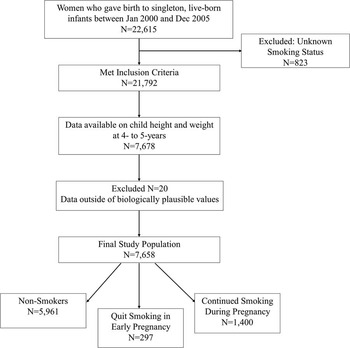
A total of 24,377 pregnancies occurred during the study period. Women who were eligible for the current analysis were those who gave birth to singleton, live-born infants (n=22,615). We excluded women where data on smoking status was missing (n=823), leaving a total eligible study cohort of 21,792 mother–child dyads. Data was available on the height and weight of 7678 children at 4- to 5-years of age, of whom 20 were considered outside of biologically plausible values based on predefined criteria. This left a final study cohort of 7658 mother–child dyads (Fig. 1).
Selection of study population.

Data on smoking status were obtained from the Perinatal Statistics Collection. These data are originally collected during the first antenatal booking visit and, based on maternal self-report, women were classified as either: non-smokers, quit smoking or smokers during pregnancy. Women who were smokers were asked to estimate how many cigarettes they smoked each day, on average in second half of pregnancy. These data were used to stratify smokers into three groups (1–9; 10–19; ⩾20).
The primary outcome measure was childhood BMI z-score at 4 to 5 years of age. BMI (BMI=weight (kg)/height (m)2) was calculated based on measured height and weight at the health check. We expressed BMI according to age- and sex-specific z-score utilising the US Centres for Disease Control (CDC) 2000 reference standards.Reference Kuczmarski, Ogden and Guo 29 The secondary outcome measure was childhood overweight, classified as a BMI for sex and age at or above the 85th percentile on CDC 2000 reference standards.Reference Kuczmarski, Ogden and Guo 29 For additional comparison and robustness, we also calculated BMI age- and sex-specific z-scores according to the British 1990Reference Wright, Booth and Buckler 30 and International Obesity Task Force,Reference Cole, Bellizzi, Flegal and Dietz 31 reference standards.
Information on maternal age, BMI, parity, race, socioeconomic status and breastfeeding at discharge from hospital was obtained from the Perinatal Statistics Collection. Data were collected on the pregnancy and outcome of every live birth and late foetal death occurring at the WCH according to the guidelines of the Pregnancy Outcome Unit of the South Australian Department of Health for the Supplementary Birth Records (SBRs) and in consultation with the senior clinicians at the hospital. Data were collected from the woman’s medical records following delivery by a specially trained research midwife through use of a structured coding sheet. It is important to note that included in the medical record is the South Australian Pregnancy Record, which is a hand-held antenatal record carried by each woman throughout her pregnancy and contains notes by all health providers consulted during the pregnancy. From the medical records, information is collected on maternal illnesses (e.g. diabetes, gestational diabetes, epilepsy, asthma and psychiatric illness), lifestyle factors (e.g. smoking), obstetric history, course of delivery, pregnancy complications and newborn characteristics (e.g. birthweight). All SBRs were checked manually for completeness and data discrepancies by a senior research midwife and then go through a series of automated validation procedures during data entry. The information in the Perinatal Statistics Collection has been previously validated and is reliable when compared with hospital case records.Reference McLean, Scott, Keane, Sage and Chan 32 These data have also been utilized in previous studies.Reference Grzeskowiak, Gilbert and Morrison 33
The estimated length of gestational age at delivery is based on the last menstrual period and ultrasound examination. Appropriateness of intrauterine growth was assessed using percentage of optimal birthweight (POBW).Reference Blair, Liu, De Klerk and Lawrence 34 POBW is the ratio of the observed to the ‘optimal’ birthweight, with the later calculated from a regression equation that takes account of major non-pathological determinants of intrauterine growth including gestational age, infant sex, maternal height and parity.Reference Blair, Liu, De Klerk and Lawrence 34 We used a POBW score less than the 10th percentile to define small-for-gestational-age (SGA) infants and a score greater than the 90th percentile to define large-for-gestational-age infants.
Parity was defined as no previous deliveries (nulliparous) or one or more previous deliveries. Maternal race was classified as Caucasian, Asian or Other. Socioeconomic status for each woman was determined using her residential postcode at the time of delivery. Women were then ranked according to their level of advantage or relative disadvantage, based on data from the Socio-Economic Indexes for Areas (SEIFA), calculated from the Australian Bureau of Statistics’ 5-yearly Census of Population and Housing. SEIFA scores were converted to quintiles, and these are widely used measures of relative socioeconomic status.Reference Pearlstein, Howard, Salisbury and Zlotnick 12
All data analysis was undertaken on de-identified data. We conducted univariate categorical analyses using the χ2 test or Fisher’s exact test where appropriate. Unpaired t-tests were used for two-group comparisons and one-way analysis of variance for three-group comparisons of normally distributed continuous variables. Bivariate and multivariate linear regression was used to investigate the relationship between maternal smoking status and offspring BMI z-score, expressed as a continuous variable. Potential confounding maternal and child covariates were categorized as shown in Table 1. All categorical variables were coded as a number of dummy variables equal to the number of categories minus 1. In the first adjusted model we included confounders and covariates chosen a priori, including maternal age, race, socioeconomic status, parity and pre-existing or gestational diabetes. In the second adjusted model we also included maternal BMI, data on which was available for ~70% of the cohort. Statistical analyses were performed using Stata IC 11.0 (Stata, College Station, TX, USA). Statistical significance was defined as a two-sided P value of <0.05.
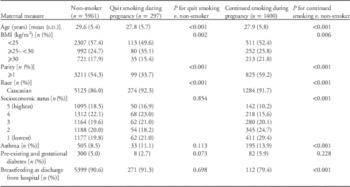
Demographic and clinical measures for women who were non-smokers, quit smoking during pregnancy or continued smoking during pregnancy

BMI, body mass index.
Percentages are calculated from non-missing data.
Inverse probability weighting was used to evaluate the potential for bias a result of loss to follow-up.Reference Hogan, Roy and Korkontzelou 9 This involved using a logistic regression analysis (complete data v. lost to follow-up as outcome) to determine weights for each individual using the inverse probability of response.Reference Hogan, Roy and Korkontzelou 9 Complete follow-up data was predicted based on maternal smoking status, maternal age, parity, neonatal birthweight, maternal BMI and socioeconomic status. The individual weighting factor for these covariates (their inverse probability) was used as a sample weighting adjustment in the multivariable linear and logistic regressions.
Results
Of the mother–child dyads who had follow-up data on weight and height (n=7658), 5961 did not report smoking during pregnancy (non-smokers), 297 reported stopping smoking during pregnancy (quit smoking) and 1400 reported continued smoking during pregnancy (smokers). Compared with mothers of children with follow-up data, mothers lost to follow-up were more likely to be younger, multiparous, smokers, non-Caucasian and from a higher socioeconomic status (Supplementary Table 1).
Women who were non-smokers were comparable to those who quit during pregnancy in terms of socioeconomic status, asthmatic prevalence and rates of breastfeeding at discharge, but were more likely to be older, have lower BMI, were primiparous and Caucasian (Table 1). However, women who were non-smokers differed substantially from those who continued smoking in pregnancy. Compared with smokers, non-smokers were more likely to be older, of lower BMI, primiparous, Caucasian, of higher socioeconomic status, non-asthmatic, and to be breastfeeding their infant at discharge from hospital (Table 1). Compared with smokers, those who quit smoking during pregnancy were more likely to be primiparous, of higher socioeconomic status and were more likely to have been breastfeeding their infant at discharge from hospital (Table 1). Underlying rates of pre-existing and gestational diabetes were the same in all three groups. The age of the children at follow-up was comparable between groups.
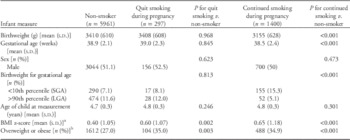
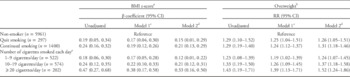
Birthweight was lowest in the group of women who continued smoking throughout pregnancy (3155±628 g), while being similar in the group of women who never smoked during pregnancy (3410±610 g) and quit smoking during early pregnancy (3408±608 g) (Table 2). Despite this birthweight disparity between continued smokers and those who quit during pregnancy, compared with non-smokers, both continued smoking (0.21, 95% CI 0.13–0.29) and quitting smoking during early pregnancy (0.15, 95% CI 0.01–0.29) were associated with statistically significant increases in BMI z-score at 4 to 5 years of age (Table 3). Similarly, both continued smoking (aRR 1.31; 95% CI 1.18–1.46) and quitting smoking during early pregnancy (aRR 1.26; 95% CI 1.05–1.51) were associated with an increased risk of childhood overweight. These findings were consistent across each of the different growth chart reference standards compared (data not shown).
Demographic and clinical measures for infants of women who were non-smokers, quit smoking during pregnancy or continued smoked during pregnancy

BMI, body mass index; SGA, small-for-gestational age; LGA, large-for-gestational age.
Percentages are calculated from non-missing data.
a According to Centres for Disease Control (CDC) BMI for sex and age reference standards.Reference Kuczmarski, Ogden and Guo 29
b Defined as BMI for sex and age at or above the 85th percentile according to CDC 2000 reference standards.Reference Kuczmarski, Ogden and Guo 29
Effect of quitting smoking and continued smoking during pregnancy on childhood BMI and risk of childhood overweight at age 4 to 5 years

BMI, body mass index; RR, relative risk; CI, confidence interval.
a According to Centres for Disease Control (CDC) BMI for sex and age reference standards.Reference Kuczmarski, Ogden and Guo 29
b Defined as BMI for sex and age at or above the 85th percentile according to CDC 2000 reference standards.Reference Kuczmarski, Ogden and Guo 29
c Adjusted for maternal age, socioeconomic status, race, parity and diabetes (pre-existing and gestational).
d Adjusted for covariates in Model 1 and maternal BMI.
e Test for trend statistically significant (P<0.001).
A significant dose–response relationship was also observed between the average number of cigarettes smoked per day and difference in BMI z-score and risk of childhood overweight at 4 to 5 years of age (P trend<0.001; Table 3).
Discussion
This study has demonstrated that any maternal smoking, even in early pregnancy, is associated with an increase in offspring BMI at 4 to 5 years of age. These findings add to a growing body of literature supporting an association between active maternal smoking, degree of smoking in pregnancy and increased childhood BMI.Reference Toschke, Montgomery, Pfeiffer and Von Kries 7 – Reference Power and Jefferis 23 Notably, the observed association between maternal smoking and childhood BMI was independent of birthweight, a finding consistent with a small number of previous studies.Reference Gravel, Potter and Dubois 16 – Reference Rückinger, Beyerlein, Jacobsen, von Kries and Vik 18
A number of potential mechanisms and pathways have been proposed to explain the association between maternal smoking and childhood BMI including: postnatal catch-up growth, the thrifty phenotype theory, neurotransmitter or endocrine imbalances and behavioural differences between smoking and non-smoking mothers.Reference Raum, Küpper-Nybelen and Lamerz 35 An initial proposed mechanism that is not supported by our findings, or those from other studies,Reference Gravel, Potter and Dubois 16 – Reference Rückinger, Beyerlein, Jacobsen, von Kries and Vik 18 is that maternal smoking results in reduced foetal growth and low birthweight but more rapid postnatal weight gain (catch-up growth), which itself has been associated with increases in BMI in later life.Reference Oken, Levitan and Gillman 24 Given that we did not see differences in birthweight between smokers and those who quit smoking during pregnancy, a more substantive explanation may lie in the thrifty phenotype theory. This theory posits that in situations of undernutrition, the foetus undergoes permanent metabolic adaptations to enhance its immediate survival chances.Reference Hales and Barker 36 Problems emerge when these adaptions made to suit the in utero environment do not accurately predict the ex utero environment.Reference Prentice 37 Maternal smoking in the first trimester may lead to a reduction in foetal nutrition supply due to a reduction in placental blood flow associated with the vasoconstrictive effect of nicotine.Reference Oken, Levitan and Gillman 24 Postnatally, however, where nutrition is readily available, the adaptations made in utero are no longer adaptive and the child develops a higher BMI. This explanation supports the current findings of increased childhood BMI where mothers smoked during first trimester of pregnancy, regardless of whether this continued past first trimester. Supporting this proposed mechanism are findings from the Dutch Famine Study, which demonstrated gestation-specific associations between exposure to famine and offspring health in later life.Reference Painter, Roseboom and Bleker 38 Offspring exposed to famine only during the first trimester were more likely to have a range of metabolic complications in later life, including obesity; this was not observed in offspring exposed during late gestation.Reference Painter, Roseboom and Bleker 38 Biological mechanisms underpinning these observations may involve programmed permanent alterations in hypothalamic regulation of food intake and energy expenditure.Reference Ino 39 It is also possible that nicotine has a direct effect on hypothalamic structures, resulting in impaired metabolic functioning in later life.Reference Toschke, Montgomery, Pfeiffer and Von Kries 7 The final proposed mechanism does not involve maternal smoking itself, but rather that increases in childhood BMI is a product of unfavourable living conditions or lifestyle habits (i.e. poor dietary intake and/or physical activity patterns) commonly associated with maternal and paternal smoking behaviours.Reference Florath, Kohler and Weck 40 Supporting this mechanism is research demonstrating that maternal and paternal smoking in the postnatal period is also associated with increases in childhood BMI,Reference Yang, Decker and Kramer 19 , Reference Leary, Smith and Rogers 20 , Reference Raum, Küpper-Nybelen and Lamerz 35 , Reference Florath, Kohler and Weck 40 suggesting either exposure to passive smoke or other unmeasured confounders associated with or that occur with smoking may play a role. Further evidence towards unmeasured confounding comes from one study which conducted sibling-based analyses, with smaller associations between maternal smoking and childhood overweight observed from within-family analyses then among the cohort as a whole, suggesting the presence of partial confounding by familial factors.Reference Iliadou, Koupil and Villamor 41 These findings for the presence of unmeasured confounding, however, have not been consistent, with Gilman et al. demonstrating that the increased risk of childhood overweight associated with maternal smoking that was observed among their full cohort remained following a conditional sibling fixed effects analysis that adjusted for familial factors.Reference Gilman, Gardener and Buka 42
A strength of our present study is that it compared outcomes in offspring of not only mothers who smoked throughout pregnancy, but also those who quit during early pregnancy. Few studies have examined the effect of maternal smoking in different periods of pregnancy, with inconsistent results.Reference Toschke, Montgomery, Pfeiffer and Von Kries 7 , Reference Toschke, Koletzko, Slikker, Hermann and von Kries 11 , Reference Chen, Pennell, Klebanoff, Rogan and Longnecker 22 , Reference Power and Jefferis 23 , Reference Harris, Willett and Michels 25 – Reference Durmuş, Kruithof and Gillman 27 Some studies have demonstrated no increased risk from first trimester exposureReference Harris, Willett and Michels 25 , Reference Durmuş, Kruithof and Gillman 27 or a greater risk associated with smoking throughout pregnancy,Reference Toschke, Koletzko, Slikker, Hermann and von Kries 11 , Reference Chen, Pennell, Klebanoff, Rogan and Longnecker 22 , Reference Power and Jefferis 23 while others, including our study, demonstrate an increased risk regardless of duration of exposure during pregnancy.Reference Toschke, Montgomery, Pfeiffer and Von Kries 7 , Reference Leary, Smith and Rogers 20 , Reference Mendez, Torrent, Ferrer, Ribas-Fitó and Sunyer 26 Supporting the argument that intrauterine exposure to maternal smoking may play an important role is evidence from studies that have failed to demonstrate associations between maternal smoking before and/or after, but not during, pregnancy.Reference Oken, Huh, Taveras, Rich-Edwards and Gillman 8 , Reference Toschke, Koletzko, Slikker, Hermann and von Kries 11 , Reference Mamun, O’Callaghan, Williams and Najman 43 Furthermore, a recent meta-analysis of 12 studies identified a higher effect estimate of maternal smoking during pregnancy on childhood overweight and obesity than the effect estimates of paternal smoking at any time.Reference Riedel, Schönberger and Yang 44 In addition, supporting evidence comes from a recent study investigating associations between prenatal exposure to maternal smoking and offspring DNA methylation.Reference Richmond, Simpkin and Woodward 45 In this study the major contributant towards altered offspring DNA methylation status, identified from longitudinal samples taken at birth, age 7 and 17 years, was intrauterine exposure to maternal smoking, rather than postnatal smoke exposure.Reference Richmond, Simpkin and Woodward 45
There are a number of limitations associated with this study. We relied on maternal self-report to ascertain smoking status during pregnancy, rather than biochemical measurements. Given the negative perception of smoking during pregnancy, some women may be reluctant to admit their smoking habits. This is demonstrated in a recent study where 16% of women identified as being an active smoker according to a cotinine concentration >14 ng/ml had actually reported that they did not smoke during pregnancy.Reference Florath, Kohler and Weck 40 As such, it is possible that some women who reported being non-smokers actually smoked during pregnancy, or that women who stated quitting in early pregnancy resumed smoking in later pregnancy. This is likely to underestimate any associations observed between maternal smoking in pregnancy and childhood BMI. Furthermore, we had no information on how many women smoked in the postnatal period or on paternal smoking behaviours. The lack of data on postnatal factors such as the child’s diet, energy intake and physical activity represents an additional study limitation. However, studies that have adjusted for a number of important postnatal factors have also demonstrated a strong association between maternal smoking in pregnancy and childhood BMI.Reference Toschke, Montgomery, Pfeiffer and Von Kries 7 , Reference Oken, Huh, Taveras, Rich-Edwards and Gillman 8 , Reference von Kries, Toschke, Koletzko and Slikker 13 , Reference Von Kries, Bolte, Baghi and Toschke 15 , Reference Harris, Willett and Michels 25 , Reference Raum, Küpper-Nybelen and Lamerz 35 , Reference Florath, Kohler and Weck 40 Other potentially important covariates that could not be adjusted for in this study include paternal BMI, pregnancy weight gain and duration of breastfeeding. With height and weight follow-up data only available for 40% of the original cohort eligible for this study, there is also the potential for selection bias. To assess the impact of this, we attached inverse probability weighting to subjects included in the analyses to restore the representation of those lost to follow-up. This aims to construct a pseudo-population of the same size as the original study population, but in which nobody is lost to follow-up.Reference Hogan, Roy and Korkontzelou 9 We found no difference between the weighted and non-weighted results (data not presented), which suggests that loss to follow-up is unlikely to have substantially biased our findings. Finally, given the cohort consisted of women who delivered at a specialist public metropolitan tertiary level teaching hospital and likely reflects a higher risk obstetric population, the findings may not be completely generalizable to all pregnancies across the state.
Notably, it is clear that maternal smoking during pregnancy represents just one of a myriad of important factors influencing childhood BMI.Reference Monasta, Batty and Cattaneo 46 It is extremely difficult to disentangle the complex web of associations between each of these risk factors, where factors may independently, cumulatively and interactively contribute to increases in childhood BMI.Reference Monasta, Batty and Cattaneo 46
Smoking during pregnancy remains a major public health issue due to its relationship with adverse perinatal outcomes. The results of this study suggest that any maternal smoking in pregnancy, even if mothers quit in the first trimester, is associated with significant increases in childhood BMI by 4 to 5 years of age and that this association is independent of intrauterine growth and subsequent birthweight. While the mechanism underpinning this association is not yet completely understood, these results strongly support encouraging women to quit smoking during their reproductive years to minimize the number of women who enter pregnancy as a current smoker. Quit smoking campaigns should be introduced pre-pregnancy and may serve as one solution to alleviating the current health burden of childhood obesity. It is feasible that health programmes introduced in adolescence may be a starting point. We acknowledge, however, that the pathways leading to childhood obesity post pregnancy are also major contributors to this outcome and will also need to be addressed. For women who enter pregnancy as a smoker, advising and supporting them to quit smoking will never represent a lost cause. We have clearly demonstrated that smoking cessation is associated with significant improvements in gestational age, birthweight and a reduced risk of SGA compared with smoking throughout pregnancy. Further, a lower quantity of cigarettes smoked during pregnancy is associated with a smaller increase in childhood BMI. Smoking cessation or reduction is also likely to positively improve a range of other perinatal and child health outcomes not measured within this study. In the absence of getting women to quit smoking before pregnancy, the antenatal period still represents an important opportunity to address both maternal and paternal smoking behaviours with the aim of maximizing child health outcomes.
Acknowledgements
The authors wish to acknowledge the midwives, nurses and other staff involved in data collection.
Financial Support
Salary support was provided through a Heart Foundation South Australian Cardiovascular Research Network Fellowship (ID CR10A4988 to J.L.M.), National Health and Medical Research Council Australia Biomedical (Training) Fellowship (ID 1016379 to N.A.H.) and a National Health and Medical Research Council Senior Fellowship (ID 510703 to V.L.C.). Authors’ contribution: L.E.G. and J.L.M. conceived the study, obtained the data and conducted initial data analyses. M.J.S., N.A.H. and V.L.C. were involved in reviewing study design and data interpretation. All authors were involved in writing the paper and had final approval of the submitted and published versions.
Conflicts of Interest
None.
Ethical Standards
The authors assert that all procedures contributing to this work comply with the ethical standards of the relevant national guidelines on human experimentation (NHMRC – National Statement on Ethical Conduct in Human Research (2007) – Updated May 2015) and with the Helsinki Declaration of 1975, as revised in 2008, and has been approved by the Human Research Ethics Committees of the Women’s and Children’s Health Network (WCHN), University of South Australia, and the University of Adelaide in South Australia.
Supplementary Material
To view supplementary material for this article, please visit http://dx.doi.org/10.1017/S2040174415007151