Introduction
Self-injurious behaviour comprises various phenomena, including non-suicidal self-injury (NSSI), suicidal ideation, suicide attempts and completed suicide (Nock, Reference Nock2010). Recently, several studies have found that psychotic experiences (PE) are associated with an increased risk of self-injurious behaviour (Saha et al. Reference Saha, Scott, Johnston, Slade, Varghese, Carter and McGrath2011; Kelleher et al. Reference Kelleher, Corcoran, Keeley, Wigman, Devlin, Ramsay, Wasserman, Carli, Sarchiapone, Hoven, Wasserman and Cannon2013b ; Jang et al. Reference Jang, Lee, Cho, Cho, Shin and Kim2014; Nishida et al. Reference Nishida, Shimodera, Sasaki, Richards, Hatch, Yamasaki, Usami, Ando, Asukai and Okazaki2014; DeVylder et al. Reference DeVylder, Lukens, Link and Lieberman2015a ; Martin et al. Reference Martin, Thomas, Andrews, Hasking and Scott2015).
PE represent delusional or hallucinatory experiences that fall below the threshold of a diagnosable psychotic disorder in absence of significant psychological distress or need for help (Kelleher et al. Reference Kelleher, Connor, Clarke, Devlin, Harley and Cannon2012a ; Linscott & van Os, Reference Linscott and van Os2013). Reliable PE estimates can best be obtained with clinical interviews containing sufficient PE items. Results from self-reports (including lay interviewers writing down self-reports) and interviews with fewer than 10 items are less reliable (Linscott & van Os, Reference Linscott and van Os2013). Significant variation across ethnicities in both PE endorsement and in self-reported attributions and understandings for these experiences has been reported, which may result from culturally sanctioned beliefs and idioms of distress (Earl et al. Reference Earl, Fortuna, Gao, Williams, Neighbors, Takeuchi and Alegria2015). Evidence suggests that PE are part of an extended psychosis phenotype ranging from PE in the general population to full-blown psychosis, sharing the same demographic, aetiological, familial and psychopathological correlates (van Os et al. Reference van Os, Linscott, Myin-Germeys, Delespaul and Krabbendam2009). The concept of a psychosis continuum is supported by the fact that the PE population prevalence (7.2%) (Linscott & van Os, Reference Linscott and van Os2013) is much higher than the population prevalence of broadly defined psychotic disorders (3.48%) (Peraala et al. Reference Peraala, Suvisaari, Saarni, Kuoppasalmi, Isometsa, Pirkola, Partonen, Tuulio-Henriksson, Hintikka, Kieseppa, Harkanen, Koskinen and Lonnqvist2007).
Population-based research indicates that the majority of individuals with PE either have a diagnosable mental disorder according to the fourth edition of the Diagnostic and Statistical Manual of Mental Disorders (DSM-IV) or significant mental health difficulties in the absence of a diagnosis (Van Os et al. Reference Van Os, Hanssen, Bijl and Ravelli2000; Kelleher et al. Reference Kelleher, Keeley, Corcoran, Lynch, Fitzpatrick, Devlin, Molloy, Roddy, Clarke, Harley, Arseneault, Wasserman, Carli, Sarchiapone, Hoven, Wasserman and Cannon2012b ; DeVylder et al. Reference DeVylder, Burnette and Yang2014; Jeppesen et al. Reference Jeppesen, Clemmensen, Munkholm, Rimvall, Rask, Jorgensen, Larsen, Petersen, van Os and Skovgaard2015). Prospective research indicates that PE are a risk factor for several mental health outcomes including psychotic disorder (Linscott & van Os, Reference Linscott and van Os2013) and other mental disorders (Kaymaz et al. Reference Kaymaz, Drukker, Lieb, Wittchen, Werbeloff, Weiser, Lataster and van Os2012; Kelleher et al. Reference Kelleher, Keeley, Corcoran, Lynch, Fitzpatrick, Devlin, Molloy, Roddy, Clarke, Harley, Arseneault, Wasserman, Carli, Sarchiapone, Hoven, Wasserman and Cannon2012b ) while the presence of PE in non-psychotic mental disorders has been identified as an indicator of illness severity and poor outcome (Perlis et al. Reference Perlis, Uher, Ostacher, Goldberg, Trivedi, Rush and Fava2011; Kelleher et al. Reference Kelleher, Keeley, Corcoran, Lynch, Fitzpatrick, Devlin, Molloy, Roddy, Clarke, Harley, Arseneault, Wasserman, Carli, Sarchiapone, Hoven, Wasserman and Cannon2012b ; Wigman et al. Reference Wigman, van Nierop, Vollebergh, Lieb, Beesdo-Baum, Wittchen and van Os2012, Reference Wigman, van Os, Abidi, Huibers, Roelofs, Arntz, Kelleher and Peeters2014; Guloksuz et al. Reference Guloksuz, van Nierop, Lieb, van Winkel, Wittchen and van Os2015).
With more than 800 000 completed suicides and more than 16 million suicide attempts each year worldwide, suicidality constitutes a major global health burden (World Health Organization, 2014). Suicidality has been conceptualized as a continuum developing from suicidal ideation (i.e. having thoughts about killing oneself) to suicide plans (i.e. considering a specific method through which one intends to die), to suicide attempts (i.e. engagement in potentially self-injurious behaviour in which there is some intent to die), and completed suicide (Nock, Reference Nock2010, Sveticic and De Leo, Reference Sveticic and De Leo2012). The construct of a continuum of suicidality is supported by epidemiological data showing a decreasing 12 months prevalence when moving from one end of the spectrum to the other, ranging from 3.3% for suicidal ideation to 0.01% for completed suicide (Kessler et al. Reference Kessler, Berglund, Borges, Nock and Wang2005).
Forms of self-injurious behaviour without suicidal intent also exist. An obstacle in the literature is the inconsistent use of definitions and terminology when referring to self-injurious behaviour without suicidal intent, including self-mutilation, deliberate self-harm and parasuicide (Nock, Reference Nock2010). In the fifth edition of the Diagnostic and Statistical Manual of Mental Disorders (DSM-5) NSSI has been proposed as a new diagnosis for self-injurious behaviour without suicidal intent (American Psychiatric Association, 2013). Since suicidal intent as a dimensional phenomenon may be difficult to assess, researchers often classify self-injurious behaviour as suicidal when suicidal intent cannot be excluded to prevent underestimation of the severity (Nock, Reference Nock2010). Although non-suicidal self-harm is an important risk factor for future suicidal behaviour (Hawton & van Heeringen, Reference Hawton and van Heeringen2009; Hawton et al. Reference Hawton, Saunders and O'Connor2012), it remains unclear whether non-suicidal self-harm and suicide are phenomena on the same continuum, as some authors suggest (Hamza et al. Reference Hamza, Stewart and Willoughby2012).
PE have been associated with self-injurious behaviour, but most studies were cross-sectional (Nishida et al. Reference Nishida, Sasaki, Nishimura, Tanii, Hara, Inoue, Yamada, Takami, Shimodera, Itokawa, Asukai and Okazaki2010; Saha et al. Reference Saha, Scott, Johnston, Slade, Varghese, Carter and McGrath2011; Temmingh et al. Reference Temmingh, Stein, Seedat and Williams2011; Kelleher et al. Reference Kelleher, Lynch, Harley, Molloy, Roddy, Fitzpatrick and Cannon2012c ; Jang et al. Reference Jang, Lee, Cho, Cho, Shin and Kim2014; Capra et al. Reference Capra, Kavanagh, Hides and Scott2015; DeVylder et al. Reference DeVylder, Lukens, Link and Lieberman2015a ). Five longitudinal studies with variable length of follow-up (Fisher et al. Reference Fisher, Caspi, Poulton, Meier, Houts, Harrington, Arseneault and Moffitt2013; Kelleher et al. Reference Kelleher, Corcoran, Keeley, Wigman, Devlin, Ramsay, Wasserman, Carli, Sarchiapone, Hoven, Wasserman and Cannon2013b ; Martin et al. Reference Martin, Thomas, Andrews, Hasking and Scott2015; Sharifi et al. Reference Sharifi, Eaton, Wu, Roth, Burchett and Mojtabai2015; Sullivan et al. Reference Sullivan, Lewis, Gunnell, Cannon, Mars and Zammit2015) showed contradictory results, ranging from absence of an association (Martin et al. Reference Martin, Thomas, Andrews, Hasking and Scott2015; Sharifi et al. Reference Sharifi, Eaton, Wu, Roth, Burchett and Mojtabai2015) to an odds ratio (OR) of 11.27 [95% confidence interval (CI) 4.44–28.62] (Kelleher et al. Reference Kelleher, Corcoran, Keeley, Wigman, Devlin, Ramsay, Wasserman, Carli, Sarchiapone, Hoven, Wasserman and Cannon2013b ). Martin et al. (Reference Martin, Thomas, Andrews, Hasking and Scott2015) conducted the only longitudinal study to date assessing PE in relation to NSSI and found no association in absence of psychological distress.
All phenomena of self-injurious behaviour are strongly associated with mental disorders. Of all adolescents engaging in NSSI, 87.6% met criteria for a DSM-IV diagnosis and 41.6% for a major depressive disorder (Nock et al. Reference Nock, Joiner, Gordon, Lloyd-Richardson and Prinstein2006). Furthermore, a mental disorder was present in 91% of the individuals that committed suicide; most common diagnoses were depressive disorders, substance abuse and schizophrenia (Cavanagh et al. Reference Cavanagh, Carson, Sharpe and Lawrie2003). This means that both depression and depressive symptoms are associated with self-injurious behaviour. PE are also prevalent across a range of mental disorders including depression. Therefore, any association between PE and self-injurious behaviour is probably confounded by the presence of depressive symptoms and other mental disorders. Various studies reported that the specific association between PE and self-injurious behaviour remained even after including depression in the regression model (Olfson et al. Reference Olfson, Lewis-Fernández, Weissman, Feder, Gameroff, Pilowsky and Fuentes2002; Lewis-Fernández et al. Reference Lewis-Fernández, Horvitz-Lennon, Blanco, Guarnaccia, Cao and Alegria2009; Polanczyk et al. Reference Polanczyk, Moffitt, Arseneault, Cannon, Ambler, Keefe, Houts, Odgers and Caspi2010; Saha et al. Reference Saha, Scott, Johnston, Slade, Varghese, Carter and McGrath2011; Calkins et al. Reference Calkins, Moore, Merikangas, Burstein, Satterthwaite, Bilker, Ruparel, Chiavacci, Wolf, Mentch, Qiu, Connolly, Sleiman, Hakonarson, Gur and Gur2014; Jang et al. Reference Jang, Lee, Cho, Cho, Shin and Kim2014; Nishida et al. Reference Nishida, Shimodera, Sasaki, Richards, Hatch, Yamasaki, Usami, Ando, Asukai and Okazaki2014; DeVylder et al. Reference DeVylder, Lukens, Link and Lieberman2015a ). However, controlling for a variable (i.e. depression) that is strongly associated with the outcome (i.e. self-injurious behaviour), although often carried out, is methodologically challenging in cross-sectional designs (Miller & Chapman, Reference Miller and Chapman2001). For example, if suicidality forms a fundamental part of the depression syndrome, it is conceptually impossible, and therefore methodologically questionable, to examine how suicidality varies in relation to PE whilst keeping depression constant. Longitudinal studies have more possibilities to examine the association between PE and self-injurious behaviour, whilst controlling for depression, although similar methodological challenges exist.
Other methodological issues may require attention. First, depression is best represented as a dimensional phenotype (Anderson et al. Reference Anderson, Huppert and Rose1993; Kendler & Gardner, Reference Kendler and Gardner1998) and correcting for a narrow dichotomous measure of depression at the level of the clinical phenotype, although often done, leaves more room for residual confounding than correcting for a broad dimensional measure of depression. Second, while correction for depression may be required, many more features of psychopathology may either confound or mediate the association between PE and suicidality. Furthermore, given that PE are an indicator of underlying severity of non-psychotic psychopathology (Perlis et al. Reference Perlis, Uher, Ostacher, Goldberg, Trivedi, Rush and Fava2011; Kelleher et al. Reference Kelleher, Keeley, Corcoran, Lynch, Fitzpatrick, Devlin, Molloy, Roddy, Clarke, Harley, Arseneault, Wasserman, Carli, Sarchiapone, Hoven, Wasserman and Cannon2012b ; Wigman et al. Reference Wigman, van Nierop, Vollebergh, Lieb, Beesdo-Baum, Wittchen and van Os2012, Reference Wigman, van Os, Abidi, Huibers, Roelofs, Arntz, Kelleher and Peeters2014; Guloksuz et al. Reference Guloksuz, van Nierop, Lieb, van Winkel, Wittchen and van Os2015), the association between PE and suicidality may simply reflect a greater likelihood of suicidality as a function of greater psychopathology severity.
Despite the wide variety of available studies in unselected general population samples, no systematic review or meta-analysis has been performed. A systematic review and meta-analysis of all previous studies is required, given the fact that reported effect sizes in both cross-sectional and longitudinal studies show marked variation and issues with confounding remain. The aim of the present meta-analysis was to integrate the available evidence on the association between PE in the general population and self-injurious behaviour from both cross-sectional and longitudinal studies. Moreover, it will assess to what degree this association can be considered confounded by depression and other measures of psychopathology.
Method
Definitions
Self-injurious behaviour was categorized in terms of presence or absence of suicidal intent, in agreement with previous work (online Supplementary Fig. S1) (Nock, Reference Nock2010). Self-injurious behaviour with suicidal intent was further divided into suicidal thoughts and suicidal behaviour. Suicidal thoughts included all cognitions about suicide, without engagement in self-harming behaviour including suicidal ideation, suicidal feelings and suicide plans. Suicidal behaviour included all outcomes in which an individual physically engaged in self-injurious behaviour with suicidal intent, including suicidal attempts and completed suicide. Self-injurious behaviour was only classified as NSSI if the absence of suicidal intent was specified.
Search strategy and selection criteria
The Meta-analysis of Observational Studies in Epidemiology (MOOSE) guidelines were followed. A literature search without restriction by publication date or any other filters was conducted in Pubmed, PsycINFO and Embase using the following terms: (Psychotic exp* OR subclinical psych* OR subthreshold psych* OR attenuated psych* OR psychotic-like OR psychotic sympt* OR delusion* OR hallucinat* OR schizotyp*) AND (suic* OR parasuic* OR self-harm OR selfharm OR self-injur* OR self injur*). This resulted in 4362 studies after removal of duplicates. The literature searches were handled using bibliographic citation management software (EndNote X7). Papers were first screened by reading the title and subsequently by reading abstracts and full texts. All steps of this process were done by two independent reviewers (S.H., R.G.). In the case of conference abstracts without available full articles, authors were contacted to retrieve preliminary data, and unpublished or submitted articles. The literature search was complemented by hand searching reference lists of obtained articles.
Papers were included in the meta-analysis if they: (a) reported the association between PE and self-injurious behaviour; (b) were conducted in a general population sample; (c) were written in the Dutch, English or German language. Studies were excluded if they: (a) were conducted in clinical or mental health populations (including ultra-high-risk populations); (b) did not contain quantitative data (i.e. qualitative studies).
Data extraction
The data extraction was performed by two independent reviewers (S.H., R.G.) using a standardized data extraction form. Relevant exposure variables, outcome variables, associated effect sizes and their 95% CIs or the standard errors of the effect sizes were recorded. If a study reported multiple effect sizes for the same exposure and outcome combination but with varying degrees of adjustment, all effect sizes were recorded together with information on the level of adjustment. If a study reported on multiple relevant outcomes, all outcomes and effect sizes were recorded. When the association between PE and self-injurious behaviour was not reported but could be derived from the available data, both reviewers calculated the ORs. In the case of disagreement after data extraction, consensus was reached between the two reviewers and when necessary a third, senior, reviewer was consulted (M.D.).
Statistical analysis
All analyses were performed using Stata 13 (StataCorp, 2013) using the METAN command to calculate meta-analytic ORs and 95% CIs. Since most studies reported ORs as effect sizes, these were used in the analyses. If instead of ORs, hazard ratios or relative risks were reported, we used these as substitutes for the OR since the prevalence of the outcome of interest is low. A main analysis was performed including all outcomes with regard to self-injurious behaviour. For this analysis, one effect size per study was selected. Thus, if studies reported effect sizes for multiple outcomes, the association with the most severe outcome variable was selected for the main analysis in the following order of severity: (a) completed suicide; (b) attempted suicide; (c) suicide plans; (d) suicidal ideation; (e) non-suicidal self-harm. When a study reported multiple effect sizes for identical exposures and outcomes, the most completely adjusted effect size was selected for the main analysis. Studies reporting ORs for continuous exposure and/or outcome measures were excluded from the main analysis and analysed separately.
Meta-analytic subanalyses were conducted for NSSI, suicidal thoughts (i.e. suicidal ideation or suicide plans) and suicidal behaviour (i.e. suicide attempts or suicide). Moreover, a separate subanalysis for studies reporting effect sizes for continuous exposure and/or outcome measures was carried out. For this purpose, the reported regression coefficients and standard errors were used. If studies reported ORs instead of regression coefficients, the ORs and their corresponding 95% CIs were converted to regression coefficients. The regression coefficients were standardized using the standard deviation of the exposure and outcome with the following formula: β = B × (s.d. exposure/s.d. outcome), in which B is the unstandardized regression coefficient and β is the standardized regression coefficient. If the association represented a continuous exposure variable and a dichotomous outcome variable, s.d. outcome was replaced by the standard deviation of the standard logistic distribution (π/√3) (Weiner et al. Reference Weiner, Schinka and Velicer2003; Menard, Reference Menard2004; Katz, Reference Katz2006).
To check the potential for bias arising from the method of selecting one result per study rather than any of the other reported results in that same study, a sensitivity analysis was conducted using permutations to test robustness of the analyses. One effect size per study was randomly selected from all available rows in the database and a meta-analysis was performed. This process was repeated 1000 times, thus generating 1000 meta-analytical results per analysis. Finally, these 1000 regression coefficients were averaged and converted into one overall OR and CI.
To assess whether the association between PE and self-injurious behaviour remained after controlling for depression, meta-analyses were performed using only studies that controlled for depression. To further assess the influence of adjustment for depression and other confounders on the reported effect sizes, meta-regression analysis was performed using the METAREG routine in Stata. Since the association between PE and self-injurious behaviour and the influence of adjustment for confounding can be estimated most accurately from longitudinal studies, separate analyses were done for the longitudinal studies before and after adjustment. Finally, in order to identify possible publication bias, funnel plots, Egger's tests and trim-and-fill procedures were applied.
Results
Characteristics of included studies
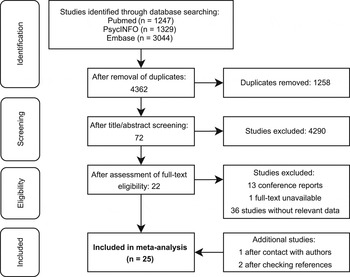
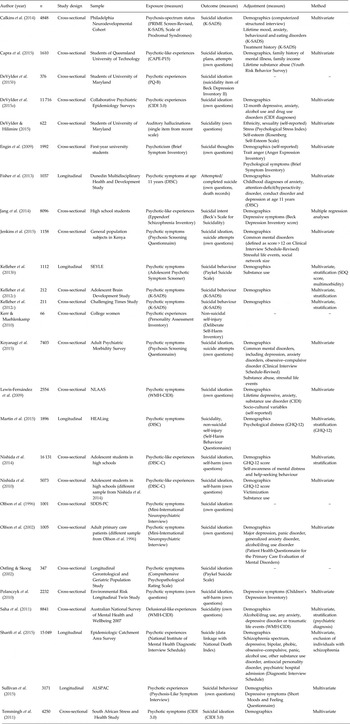
The systematic search strategy resulted in 25 studies (Fig. 1). Characteristics of these studies are shown in Table 1. Most of the included studies used a cross-sectional study design (n = 20); some used a longitudinal design (n = 5). A great variety of questionnaires and tests was used to examine PE and self-injurious behaviour. The level of adjustment varied among studies. Most studies controlled for demographic characteristics. Fewer studies adjusted their analyses for the presence of one or more mental disorders including depressive disorder. Only two studies (Polanczyk et al. Reference Polanczyk, Moffitt, Arseneault, Cannon, Ambler, Keefe, Houts, Odgers and Caspi2010; Jang et al. Reference Jang, Lee, Cho, Cho, Shin and Kim2014) controlled for broader measures of depressive symptoms.
Flowchart of literature search.

Characteristics of included studies

K-SADS, Kiddie Schedule for Schizophrenia and Affective Disorders; CAPE-P15, Community Assessment of Psychic Experiences-Positive; PQ-B, Prodromal Questionnaire-Brief; CIDI, Composite International Diagnostic Interview; DISC, Diagnostic Interview Schedule for Children; SEYLE, Saving and Empowering Young Lives in Europe; SDQ,Strengths and Difficulties Questionnaire; NLAAS, National Latino and Asian American Study; WMH-CIDI, World Mental Health Composite International Diagnostic Interview; HEALing, Help to Enhance Adolescent Living; GHQ-12, 12-item General Health Questionnaire; DISC-C, Diagnostic Interview Schedule for Children – Child Version; SDDS-PC, Symptom Driven Diagnostic System for Primary Care; ALSPAC, Avon Longitudinal Study of Parents and Children.
Self-injurious behaviour
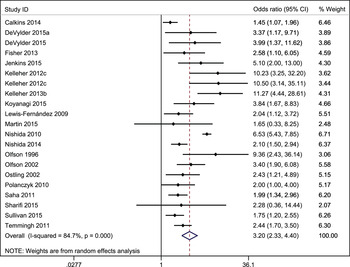
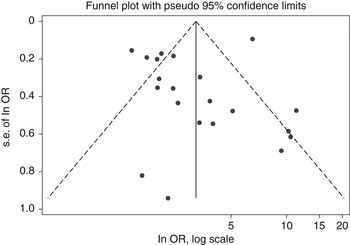
Of the included studies, 20 reported effect sizes for the association between PE and a form of self-injurious behaviour (Fig. 2). The pooled OR of this association was 3.20 (95% CI 2.33–4.40), indicating that experiencing PE is associated with significantly increased odds of self-injurious behaviour. The funnel plot (Fig. 3), Egger's test and the trim-and-fill procedure showed no evidence of publication bias.
Meta-analysis of studies reporting on association between psychotic experiences and self-injurious behaviour. CI, Confidence interval.

Funnel plot of meta-analysis on association between psychotic experiences and self-injurious behaviour. OR, Odds ratio; s.e., standard error.

Non-suicidal self-injurious behaviour
Two studies specifically examined the association between PE and NSSI (Kerr & Muehlenkamp, Reference Kerr and Muehlenkamp2010; Martin et al. Reference Martin, Thomas, Andrews, Hasking and Scott2015). Because one of these studies (Kerr & Muehlenkamp, Reference Kerr and Muehlenkamp2010) used a case–control design with a continuous measure for PE, meta-analysis could not be performed. Kerr & Muehlenkamp (Reference Kerr and Muehlenkamp2010) compared women with NSSI with women without NSSI and found that those with NSSI scored significantly higher on a scale measuring PE, although PE did not predict NSSI group membership in logistic regression analysis. Martin et al. (Reference Martin, Thomas, Andrews, Hasking and Scott2015) assessed the association between PE and NSSI using both cross-sectional and longitudinal analyses. The cross-sectional examination showed that experiencing PE increased the risk of NSSI, even after adjustment for age and gender (OR 2.88, 95% CI 1.51–5.49). When individuals reported psychological distress alongside PE, the association between PE and NSSI was stronger (OR 17.81, 95% CI 10.00–31.71). In a longitudinal design, experiencing PE without psychological distress was not associated with an increased risk of NSSI 1 year later. Exposure to both PE and psychological distress remained significantly associated with an increased NSSI risk in the longitudinal design (OR 11.45, 95% CI 5.70–23.00) (Martin et al. Reference Martin, Thomas, Andrews, Hasking and Scott2015).
Two other cross-sectional studies reported on the association between PE and self-harm, but did not specify whether there was suicidal intent or not. A meta-analysis including all three studies (Nishida et al. Reference Nishida, Sasaki, Nishimura, Tanii, Hara, Inoue, Yamada, Takami, Shimodera, Itokawa, Asukai and Okazaki2010, Reference Nishida, Shimodera, Sasaki, Richards, Hatch, Yamasaki, Usami, Ando, Asukai and Okazaki2014; Martin et al. Reference Martin, Thomas, Andrews, Hasking and Scott2015) resulted in a pooled OR of 2.36 (95% CI 1.13–4.95) (online Supplementary Fig. S2), indicating that experiencing PE is associated with significantly increased odds of self-harm. Removing an outlier from the study (Nishida et al. Reference Nishida, Sasaki, Nishimura, Tanii, Hara, Inoue, Yamada, Takami, Shimodera, Itokawa, Asukai and Okazaki2010) lowered the pooled OR to 1.61 (95% CI 0.95–2.73) and rendered it statistically non-significant. Egger's test and the trim-and-fill procedure showed no evidence of possible publication bias.
Suicidal self-injurious thoughts and behaviour
When suicidal thoughts (i.e. suicidal ideation or suicidal plans) were analysed separately, the pooled OR was 2.47 (95% CI 1.71–3.59) (online Supplementary Fig. S3). After removal of two outliers the pooled OR decreased to 2.06 (95% CI 1.69–2.52), but remained statistically significant. When the association between PE and suicidal behaviour (i.e. suicidal attempts or completed suicides) was analysed, the pooled OR was 3.03 (95% CI 2.08–4.41) (online Supplementary Fig. S4). Although Egger's test was statistically non-significant for both analyses, the trim-and-fill procedure decreased both pooled ORs, indicating possible publication bias. However, results remained statistically significant.
Three studies reported on the association between PE and suicidal behaviour using a continuous exposure measure (score on scale measuring PE) and a dichotomous outcome measure (presence/absence of suicidal self-injurious behaviour). The pooled OR was 1.34 (95% CI 1.24–1.45) (online Supplementary Fig. S5), indicating that an increase of 1 s.d. on a scale measuring PE is associated with a 34% increase in the odds of suicidal self-injurious behaviour.
Adjustment for depression
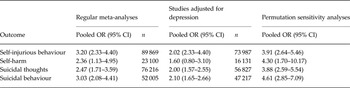
The pooled ORs for the association between PE and the various outcomes in studies controlling for depression were reduced as compared with non-adjusted meta-analytic estimates, but remained statistically significant for all outcomes except self-harm (Table 2). Only one study assessed the association between PE and self-harm while controlling for depression and found that PE in absence of self-awareness of mental distress and help-seeking behaviours were not associated with self-harm (Nishida et al. Reference Nishida, Shimodera, Sasaki, Richards, Hatch, Yamasaki, Usami, Ando, Asukai and Okazaki2014). The pooled OR for the adjusted association between PE and self-injurious behaviour was 2.02 (95% CI 1.71–2.39). Jang et al. (Reference Jang, Lee, Cho, Cho, Shin and Kim2014) assessed the association between PE and suicidal ideation using a continuous exposure (score on the Eppendorf Schizophrenia Inventory) and a continuous outcome measure (score on Beck's Scale for Suicidal Ideation) and found a statistically significant association (β = 0.44, p < 0.0001) that greatly decreased in magnitude, but remained statistically significant after controlling for depression (β = 0.13, p < 0.0001). Meta-regression analysis confirmed that effect sizes adjusted for depression were smaller than effect sizes unadjusted for depression (OR 0.51, 95% CI 0.38–0.69). The trim-and-fill procedure decreased the pooled ORs of the meta-analyses including studies controlling for depression for all outcomes, indicating possible publication bias, although the results remained statistically significant.
Results of main meta-analyses, adjustment for depression and permutation sensitivity analyses

OR, Odds ratio; CI, confidence interval.
Sensitivity analyses and adjustment
ORs in the permutation analyses were slightly larger than in original analyses (Table 2). Meta-regression analyses showed that reported adjusted effect sizes were smaller than unadjusted effect sizes (OR 0.59, 95% CI 0.44–0.78). Reported effect sizes from longitudinal studies were smaller than effect sizes from cross-sectional studies, but this difference was not statistically significant (OR 0.94, 95% CI 0.60–1.46). A separate meta-analysis of the effect sizes unadjusted for depression or other mental disorders from longitudinal studies showed a pooled OR of 4.39 (95% CI 2.14–9.00) for the association between PE and suicidal behaviour. The pooled OR decreased to 1.88 (95% CI 1.34–2.64) after only including longitudinal studies controlling for depression and other mental disorders, representing a reduction in excess risk of 74%.
Discussion
Summary of results
The present meta-analysis assessed the association between PE and self-injurious behaviour in general population samples using different outcome measures: (a) self-injurious behaviour (summary outcome measure); (b) NSSI; (c) suicidal thoughts; and (d) suicidal behaviour. The main result of the meta-analysis was that experiencing PE is associated with an increased risk of self-injurious behaviour (OR 3.20, 95% CI 2.33–4.40). This association was confirmed in both cross-sectional as well as longitudinal studies. The pooled ORs increased as the severity of the outcome measure increased, ranging from 2.36 (95% CI 1.13–4.95) for self-harm to 3.03 (95% CI 2.08–4.41) for suicidal behaviour. Results remained significant after adjusting for various confounders including depression, although adjustment significantly decreased the meta-analytical effect sizes for all outcome measures and the excess risk in longitudinal studies was reduced by 74%. This indicates significant confounding and possibility of residual confounding. Meta-analytical effect sizes from the permutation analyses showed slightly larger meta-analytical effect sizes, demonstrating that the method of selecting the most adjusted effect size for the analyses was conservative.
Interpretation of results
Even though our results confirmed that PE are strong correlates of self-injurious behaviour, the mechanism behind this association remains unclear. Several possible explanations have been suggested. Studies have identified shared risk factors for PE and self-injurious behaviour; individuals endorsing PE show a more emotion-oriented coping style (Lin et al. Reference Lin, Wigman, Nelson, Vollebergh, van Os, Baksheev, Ryan, Raaijmakers, Thompson and Yung2011), an increased emotional reactivity to stress (Lataster et al. Reference Lataster, Wichers, Jacobs, Mengelers, Derom, Thiery, Van Os and Myin-Germeys2009) and deficits in processing speed (Kelleher et al. Reference Kelleher, Clarke, Rawdon, Murphy and Cannon2013a ), which may also increase the risk of self-injurious behaviour (LeGris & van Reekum, Reference LeGris and van Reekum2006). Exposure to traumatic experiences and adverse life events is also associated with an increased risk of both PE and self-injurious behaviour (Iga et al. Reference Iga, Ueno, Yamauchi, Numata, Tayoshi-Shibuya, Kinouchi, Nakataki, Song, Hokoishi, Tanabe, Sano and Ohmori2007; Wilcox et al. Reference Wilcox, Arria, Caldeira, Vincent, Pinchevsky and O'Grady2012). Moreover, neuroimaging studies have identified alterations in brain regions that are associated with both PE and suicidality (Koolschijn et al. Reference Koolschijn, van Haren, Lensvelt-Mulders, Hulshoff Pol and Kahn2009; Jacobson et al. Reference Jacobson, Kelleher, Harley, Murtagh, Clarke, Blanchard, Connolly, O'Hanlon, Garavan and Cannon2010). It is possible, however, that shared risk factors increase the risk of psychopathology in general, making PE a risk marker between various mental disorders and self-injurious behaviour. The results of the present meta-analysis support this hypothesis.
The finding that adjusted effect sizes were significantly smaller than unadjusted effect sizes and the finding of substantial reduction of excess risk after adjustment in longitudinal studies indicates that the association between PE and self-injurious behaviour may be confounded. There is considerable scope for unaccounted residual confounding as examination of the adjustment method used in the individual studies showed several methodological limitations. Most of the included studies used a cross-sectional study design. Besides the fact that causality cannot be inferred from cross-sectional studies, it is difficult and conceptually challenging to control for depressive symptoms and other psychopathology using a cross-sectional design given strong fundamental associations between all psychopathology and increased risk of suicide or self-harm (Cavanagh et al. Reference Cavanagh, Carson, Sharpe and Lawrie2003; Nock et al. Reference Nock, Joiner, Gordon, Lloyd-Richardson and Prinstein2006). Moreover, several general population surveys have confirmed that approximately 50% of all individuals with PE have at least one diagnosis for a mental disorder (Van Os et al. Reference Van Os, Hanssen, Bijl and Ravelli2000; Kelleher et al. Reference Kelleher, Keeley, Corcoran, Lynch, Fitzpatrick, Devlin, Molloy, Roddy, Clarke, Harley, Arseneault, Wasserman, Carli, Sarchiapone, Hoven, Wasserman and Cannon2012b ; DeVylder et al. Reference DeVylder, Burnette and Yang2014; Jeppesen et al. Reference Jeppesen, Clemmensen, Munkholm, Rimvall, Rask, Jorgensen, Larsen, Petersen, van Os and Skovgaard2015), including depressive or anxiety disorders (van Nierop et al. Reference van Nierop, van Os, Gunther, Myin-Germeys, de Graaf, ten Have, van Dorsselaer, Bak and van Winkel2012; Wigman et al. Reference Wigman, van Nierop, Vollebergh, Lieb, Beesdo-Baum, Wittchen and van Os2012), eating disorder (Van Os et al. Reference Van Os, Hanssen, Bijl and Ravelli2000), substance abuse (Johns et al. Reference Johns, Cannon, Singleton, Murray, Farrell, Brugha, Bebbington, Jenkins and Meltzer2004), autistic traits (Bevan Jones et al. Reference Bevan Jones, Thapar, Lewis and Zammit2012) and post-traumatic stress disorder (Fisher et al. Reference Fisher, Caspi, Poulton, Meier, Houts, Harrington, Arseneault and Moffitt2013). Indeed, Calkins et al. (Reference Calkins, Moore, Merikangas, Burstein, Satterthwaite, Bilker, Ruparel, Chiavacci, Wolf, Mentch, Qiu, Connolly, Sleiman, Hakonarson, Gur and Gur2014) showed that experiencing PE is associated with increased odds of a wide variety of psychopathology. This means that any association between PE and self-injurious behaviour is likely to be confounded or mediated by other psychopathology. Controlling for this kind of confounding is methodologically challenging in cross-sectional designs, notwithstanding attempts to do so in several of the included cross-sectional studies as discussed above. However, others identified other psychopathology as a possible mediator (Kelleher et al. Reference Kelleher, Keeley, Corcoran, Lynch, Fitzpatrick, Devlin, Molloy, Roddy, Clarke, Harley, Arseneault, Wasserman, Carli, Sarchiapone, Hoven, Wasserman and Cannon2012b ; Linscott & van Os, Reference Linscott and van Os2013), while including mediators in a regression model as if they were confounders is not considered valid (Rothman et al. Reference Rothman, Greenland and Lash2008). In sum, because all associations between PE and any included outcome remained statistically significant, the conclusion that PE are associated with self-injurious behaviour including suicidality outcomes is warranted. However, because of suspected residual confounding, results should be interpreted tentatively.
Longitudinal study designs have more options to validly control for possible confounders, although it remains similarly difficult to examine how self-injurious behaviour varies in relation to PE whilst keeping other psychopathology constant, when suicidality is fundamentally associated with the psychopathology that is being adjusted for. In longitudinal studies, controlling for psychopathology using a dichotomous measure at the most severe level (i.e. presence or absence of disease) similarly leaves room for residual confounding. This kind of confounding can be reduced by using a dimensional, continuous measure of the psychopathology, while none of the longitudinal studies used such an approach. Separate analysis of the longitudinal studies showed that the pooled OR of effect sizes adjusted for psychopathology with a dichotomous measure decreased the magnitude of excess risk by 74%, suggesting confounded associations. Future research using broad dimensional measures of confounding by psychopathology is required.
Several authors suggested that PE should be considered a manifestation of general psychological distress (Saha et al. Reference Saha, Scott, Johnston, Slade, Varghese, Carter and McGrath2011; Capra et al. Reference Capra, Kavanagh, Hides and Scott2015; DeVylder et al. Reference DeVylder, Lukens, Link and Lieberman2015a ; Martin et al. Reference Martin, Thomas, Andrews, Hasking and Scott2015). In a cross-sectional study, PE without self-awareness of mental distress was still associated with an increased risk of suicidal ideation, but not of self-harm. However, a longitudinal study not adjusted for other psychopathology showed that PE in the absence of psychological distress were not associated with an increased risk of suicide or NSSI (Martin et al. Reference Martin, Thomas, Andrews, Hasking and Scott2015), while PE with psychological distress were associated with an increased risk of NSSI and suicide attempts. This suggests that the association between PE and self-injurious behaviour can be explained by psychological distress. However, the difference between PE with and without distress may also simply reflect differences in PE severity along a several dimensions, e.g. conviction, impact and frequency. Psychological distress without PE was also associated with an increased risk of NSSI and suicide attempts, although effect sizes were smaller.
Various studies have shown that PE can be considered as an indicator of severity of non-psychotic psychopathology (Perlis et al. Reference Perlis, Uher, Ostacher, Goldberg, Trivedi, Rush and Fava2011; Kelleher et al. Reference Kelleher, Keeley, Corcoran, Lynch, Fitzpatrick, Devlin, Molloy, Roddy, Clarke, Harley, Arseneault, Wasserman, Carli, Sarchiapone, Hoven, Wasserman and Cannon2012b ; Wigman et al. Reference Wigman, van Nierop, Vollebergh, Lieb, Beesdo-Baum, Wittchen and van Os2012, Reference Wigman, van Os, Abidi, Huibers, Roelofs, Arntz, Kelleher and Peeters2014; Guloksuz et al. Reference Guloksuz, van Nierop, Lieb, van Winkel, Wittchen and van Os2015). It is therefore likely that the association between PE and self-injurious behaviour reflects the greater likelihood of self-injurious behaviour in more severe states of psychopathology. Therefore, even if there is no direct link between PE and self-injurious behaviour, routine assessment of PE in individuals with non-psychotic psychopathology has the potential to reveal passive risk markers of self-injurious behaviour.
Methodological issues
Several methodological issues were encountered while conducting the present meta-analysis. First, not all of the included studies separated their outcome measures into suicidal ideation and suicide attempts. A study by Kelleher et al. (Reference Kelleher, Lynch, Harley, Molloy, Roddy, Fitzpatrick and Cannon2012c ) assessed the association between PE and suicidal behaviour in two general population samples using a single outcome measure for the whole range of suicidality measures including suicidal ideation and suicide attempts. This study could only be included in the main analysis but not in the subanalyses. Because this study reported larger effect sizes than most other studies, the pooled OR for the summary outcome of self-injurious behaviour was larger than the pooled ORs of the subanalyses. A sensitivity analysis excluding the results of the study by Kelleher et al. (Reference Kelleher, Lynch, Harley, Molloy, Roddy, Fitzpatrick and Cannon2012c ) resulted in an OR of 2.93 (95% CI 2.12–4.06).
Second, five of the included studies used a continuous exposure and/or outcome measure (Engin et al. Reference Engin, Gurkan, Dulgerler and Arabaci2009; Kerr & Muehlenkamp, Reference Kerr and Muehlenkamp2010; Jang et al. Reference Jang, Lee, Cho, Cho, Shin and Kim2014; Capra et al. Reference Capra, Kavanagh, Hides and Scott2015; DeVylder et al. Reference DeVylder, Thompson, Reeves and Schiffman2015b ). Two of these studies could not be included in the quantitative analyses because of their study design (Kerr & Muehlenkamp, Reference Kerr and Muehlenkamp2010) or because they were the only study to use a continuous outcome measure (Jang et al. Reference Jang, Lee, Cho, Cho, Shin and Kim2014). The other three studies were separately analysed after standardization of the effect sizes. However, only partial standardization was possible given the fact that empirical variation of the dependent variable is unknown when meta-analytically pooling results of logistic regression. Results of this subanalysis pointed in the same direction as the main analysis and other subanalyses.
Finally, several of the included studies simultaneously adjusted for multiple possible confounders, making it difficult to assess the influence of a single confounder, for example depression. Therefore, the most adjusted effect size was selected for the regular meta-analyses and a separate analysis was done for studies adjusting for depression.
Future research
Longitudinal research is required to determine to what degree any association between PE and self-injurious behaviour exists that is specific and unconfounded and to examine to what degree the association reflects severity of psychopathology, of which PE are an indicator. A general population sample stratified on the presence or absence of mental disorder and suicidality at baseline may form a valid initial starting point of analysis. In order to minimize residual confounding, analyses should be adjusted for dimensional psychopathology.
Supplementary material
For supplementary material accompanying this paper visit http://dx.doi.org/10.1017/S0033291715001841
Acknowledgements
None.
Declaration of Interest
None.