INTRODUCTION
Relative growth of certain body dimensions can be used to distinguish between immature and mature crabs in a population. Growth is discontinuous and maturation can be easily broken down into stages, each of which can have distinct relative growth rates (Hartnoll, Reference Hartnoll and Abele1982). Structures that grow proportionately relative body size are isometric, while those that grow faster or slower, are positively or negatively allometric respectively. The most important change in life phase is when the crab becomes sexually active and is able to reproduce, this is known as the ‘moult of puberty’ (Hartnoll, Reference Hartnoll1969) or the ‘critical moult’ (Hartnoll, Reference Hartnoll1978). The pubertal moult is far more obvious in females than in males as it can involve allometric changes in the pleopods (including greater setation), sternum and most obviously, width of the abdomen (Hartnoll, Reference Hartnoll1969). Less obviously, males of many species experience an allometric increase in chelae size at the onset of reproductive maturity (Hartnoll, Reference Hartnoll and Abele1982). The larger abdomen of mature female crabs offer various degrees of protection to the embryos carried on the pleopods. In hymenosomatids and leucosiids we find the highest level of protection inside a brood chamber that fits closely against the sternum. Many other female crabs provide very little protection (see Thompson & McLay, Reference Thompson and McLay2005). Thus female sexual maturity is easily detected. Generally, male maturity is indicated by the size of the chelae: after the puberty moult, there is generally a very pronounced increase in relative size of the chelae (Hartnoll, Reference Hartnoll and Abele1982). Males often use chelae in territorial defence, combat and courtship, such as in Uca spp. (Hartnoll, Reference Hartnoll1969), and carrying or grasping the female during pre- or post-copulatory guarding, such as Halicarcinus innominatus (Dunnington, Reference Dunnington1999). In hymenosomatids male chela size and female abdomen size are not always good guides to sexual maturity because pre-pubertal individuals can mate (Lucas, Reference Lucas1980). Such precocious maturation enables sperm transfer, but females must wait until after the pubertal moult to fertilize and lay eggs.
The only hymenosomatids that have been subjected to detailed morphological measurement are Amarinus laevis (Lucas & Hodgkin, Reference Lucas and Hodgkin1970) and Halicarcinus planatus (Richer de Forges, Reference Richer de Forges1977), H. innominatus (Dunnington, Reference Dunnington1999), H. varius (Hosie, Reference Hosie2004) and Rhynchoplax coralicola (Gao et al., Reference Gao, Tsuchida and Watanabe1994).
The pattern of relative growth is affected by whether crabs have determinate or indeterminate growth. In the first hymenosomatid to be intensively studied, Hymenosoma orbiculare from South Africa, Broekhuysen (Reference Broekhuysen1955) showed that captive male and female crabs continued to moult after sexual maturity. Lucas (Reference Lucas1980) also reported that Elamenopsis lineata from Australia and New Caledonia continued to moult after maturation, although no data were given. Although most hymenosomatids studied have determinate growth, these two species (and perhaps the genera they belong to) have indeterminate growth.
Most hymenosomatids probably have determinate growth so that after 8–12 moults crabs reach their adult size and cease moulting. This has been established for some species of Halicarcinus and Rhynchoplax (Lucas, Reference Lucas1980; Gao et al., Reference Gao, Tsuchida and Watanabe1994; Gao & Watanabe, Reference Gao and Watanabe1998). For these species the dimensions of secondary sexual characters must be attained during a single moult to the adult instar, whereas Hymenosoma and Elamenopsis can continue to grow during adulthood. Unfortunately there have been no studies of relative growth on species in these two latter genera.
The aims of this study were to measure relative growth of secondary sexual characters in Halicarcinus cookii, a hymenosomatid crab endemic to New Zealand, and to measure the degree of size overlap between immature and mature crabs by investigating allometric changes during the terminal moult. Furthermore, we compare maturity overlap with that found in other hymenosomatids and employ the concept of net reproductive rate (Ro) to test for the evolutionary stability of this overlap.
MATERIALS AND METHODS
Relative growth
Halicarcinus cookii were collected intertidally from Atia Point and First Bay, on the Kaikoura Peninsula (42°23′S 173°42′E), New Zealand, and in the laboratory measurements were made using Mitutoyo™ Vernier callipers, accurate to 0.01 mm. Carapace width (CW) was used as the reference dimension and was measured across the widest part of the carapace (Figure 1A). Abdomen width was measured across the width of the 5th segment for both sexes (Figure 1B & C). Propodus height (PH) measured the maximum height of the largest cheliped (Figure 1D). Propodus length (PL) was measured across the longest point from the carpal–propodal joint to the tip of the fixed finger of the largest cheliped (Figure 1E).
Dimensions measured to investigate relative growth in Halicarcinus cookii. (A) Carapace width (dorsal view); (B) abdomen width of female; (C) abdomen width of male; (D) propodus height; and (E) propodus length. Scales represent 1 mm (from Melrose, Reference Melrose1975).

Analyses of relative growth were conducted using the power model equation:

where Y is the dimension of interest, X is the reference dimension (CW in all cases), a is the y-intercept and b is the relative growth rate (Hartnoll, Reference Hartnoll1978, Reference Hartnoll and Abele1982). The constants in this equation were estimated by linear regression using natural log (Ln) transformed data:

Regression lines were compared using ANCOVA to identify the level and significance of allometric growth for each dimension. When b = 1.0 growth is isometric (both X and Y grow at the same relative rate), whereas when b < 1.0 growth is negatively allometric (Y grows less than X) or b > 1.0 (Y grows faster than X) and is positively allometric.
Nineteen juvenile females were collected at different times during the summer months and followed through their pubertal moult. Measurements of the carapace width (CW) and abdomen width (AW) were taken before and after the pubertal moult to produce a percentage moult increment (increase in size from immaturity to maturity). The percentage moult increment (PMI) was estimated using the formula:

where Y is either CW or AW.
Effects of variable size at maturation
In hymenosomatids there is considerable overlap in size between mature and immature phases, which implies that crabs moult to maturity at different sizes. For Halicarcinus cookii we were only able to estimate this overlap for females.
The percentage overlap in CW of mature and immature crabs can be estimated from:

and assuming the relationship between PMI and CW is linear:

where CWImax = maximum CW of immature females; CWImin = minimum CW of an immature female moulting to maturity; CWMmax = maximum CW of mature females; CWMmin = minimum CW of mature females; PMI = % moult increment of CW.
We also calculate the ratio CWMmax/CWMmin as an index of overlap. If the percentage increment of the pubertal moult is the same for all sizes, then as long as this is the final moult, the ratio will be an indicator of the size-range over which penultimate crabs moulted. It has the advantage of being easier to determine, but does not work if growth is indeterminate.
The effect of variation in the CW at which maturation occurs on lifetime larval production was investigated using the concept of net reproductive rate (Ro). The net reproductive rate is given by

where lx is the proportion surviving to age x and mx is brood size at age x. When Ro = 1.0 the group exactly replaces itself.
So if we assume that precocious moulters and delayed moulters have the same net reproductive rate, then Ro e = Ro d

If me and md are fixed such that me << md then we can estimate how many broods the delayed moulters have to produce to equal the sum of the broods produced by the early moulters, i.e. Ro e = Ro d? For the purposes of this estimate we assume that survivorship between broods, lx, is constant (=0.5) and identical for precocious and delayed moulters. The maximum number of broods produced was set at 6 because at 20–30 days per brood cycle (depending upon temperature) 120–180 days would exceed the adult life span. The values of mx were obtained using an equation giving the relationship between brood size and CW (see Van den Brink & McLay, Reference Van den Brink and McLay2009).
In order for there to be a stable size-range of maturation to sexual maturity the long term average of the ratio Ro e / Ro d = 1.0, otherwise all crabs would moult at the smallest or at the largest size. Therefore we tested whether the ratio was significantly different from 1.0 for H. cookii.
RESULTS
Brachyurans normally have two-phase postlarval development with the phases separated by a pubertal moult when relative growth of secondary sexual characters can change (Hartnoll, Reference Hartnoll1978). In Halicarcinus cookii the two phases are evident in changes to the abdomen width of females, but growth of male abdomen and chelipeds is continuous so that only one phase is evident. Since there was no obvious discontinuity in growth rates in males, which would suggest a single large change in increment at puberty, all measurements for males were pooled into a single group for all analyses.
Abdomen width
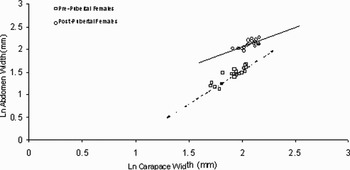
Female H. cookii showed a significant change in allometric abdomen growth from positive (b = 1.48) prior to the pubertal moult to negative (b = 0.85) when adult (Table 1; Figure 2). As the maturity moult is also a terminal moult, there is no opportunity for allometric growth in the final instar. However, mature females show an allometry of size, equivalent to allometric growth and can be termed ‘apparent growth’, as a result of females undergoing the pubertal moult over a range of sizes (Hartnoll, Reference Hartnoll and Abele1982). This ‘apparent growth’ is achieved in a single instar whereas relative growth of immature crabs is the result of real growth. Males showed negative allometric abdomen growth (b = 0.80) significantly different from 1.0 for both immature and mature crabs, without discontinuity. Males always had smaller abdomens than even immature females (Figure 2). Regression slopes of allometric abdomen growth are significantly different from 1.0 in all groups (Table 1). Relative growth rates of AW were also significantly different between all groups (df = 1, 182 (males); 58 (immature females); 203 (mature females), P < 0.001 in all cases) (Table 2). Increase in AW is limited by how wide the sternum is because the abdomen is coapted (Guinot & Bouchard, Reference Guinot and Bouchard1998, p. 614) to fit tightly against the sternum to form the brood chamber.
Relative growth rate of the abdomen width to carapace width in Halicarcinus cookii. Ln abdomen width plotted against Ln carapace width, N = 184 males, 205 mature females and 62 immature females. Regression equations and R2 values are given in Table 1.

Equations for linear regressions of relative growth of abdomen width (AW), propodus length (PL) and propodus height (PH) for Halicarcinus cookii. a, y-intercept; b, relative growth rate; R2, determination coefficient; N, sample size; F, F value; S, significant (P < 0.05) (“−” and “+” indicate negative and positive allometry respectively); and NS, not significant (P > 0.05).

Analysis of covariance of allometric growth rates of abdomen width, propodus length and propodus height of both male and female Halicarcinus cookii. F, F statistic; df, degrees of freedom; P, level of significance.

Propodus size
Both immature and mature females showed negative allometric growth in propodus length (b = 0.67 and 0.84 respectively) while males showed a positive allometric growth rate (b = 1.21) (Table 1). There appears to be little difference in propodus length between male and female mature groups (Figure 3), however, propodus length was still significantly different between the three groups, being longest in males and shortest in immature females (df = 1, 182 (males); 58 (immature females); 203 (mature females), P < 0.001 in all cases) (Table 2).
Relative growth rate of propodus length to carapace width in Halicarcinus cookii. Ln propodus length plotted against Ln carapace width, N = 184 males, 205 mature females and 62 immature females. Regression equations and R2 values are given in Table 1.

Males showed significantly positive allometric growth in propodus height (b = 1.45) while in females, growth in propodus height changed from negatively allometric in immature females (b = 0.89) to isometric in mature females (1.07) (Figure 4; Table 1). Relative growth in propodus height was significantly different between all groups (df = 1, 182 (males); 58 (immature females); 203 (mature females), P < 0.001 in all cases) (Table 2).
Relative growth rate of propodus height to carapace width in Halicarcinus cookii. Ln propodus width plotted against Ln carapace width, N = 184 males, 205 mature females and 62 immature females. R2 values and regression equations are given in Table 1.

There was no discontinuity in the relationship between propodus height and carapace width in males (Figure 4), as is common in brachyurans, so there was no indication of the size when males mature. An arbitrary criterion was therefore established to separate mature from immature males for convenience. Male dissections suggest that males in a size range of 6–8 mm CW begin to produce spermatophores (see Van den Brink, Reference Van den Brink2006). This provides an estimate of CWMmin but we cannot measure CWImax for males. For calculation of sex ratios, male H. cookii were regarded as immature with a CW < 7 mm and mature with CW > 7 mm.
Pubertal moult in captive females
By monitoring 19 females in their penultimate instar through their maturity moult, it was possible to produce the percentage moult increments (PMI) for the carapace width and abdomen width. The PMI for carapace width ranged from 5.8%–41.29% with a mean of 17.96% (±2.55). This suggests that on average females increased close to 20% in overall size over the pubertal moult. In contrast, the PMI for abdomen width ranged from 46.115–146.58% with a mean of 96.13% (±6.02). Therefore, while increasing in overall size by approximately 20%, females increased their abdomen width by close to 100%. The pubertal moult marks the transition to sexual maturity when the female produces her first clutch of eggs that will be stored in the abdominal brood chamber, the size of which is determined by the moult increment (coaptation of sternum and abdomen; see Guinot & Bouchard, Reference Guinot and Bouchard1998).
A plot of measurements of pre- and post-pubertal moult females with the regression lines from the allometric growth study (see Figure 2) shows females monitored through their pubertal moult in the laboratory and regression lines derived from females found in the field (Figure 5) are close. The slope of these lines is 1.4755 for immature crabs (positively allometric) but only 0.85 for mature females (negatively allometric). This difference is explained by the negative relationship between the moult increments and pre-moult CW with larger crabs tending to have smaller increments (see Figure 6).

Growth in abdomen width (AW) and carapace width (CW) in relation to pre-moult carapace width at the pubertal moult in Halicarcinus cookii. Equations of regression lines fitted to data (N = 19) and R2 shown above (see Figure 5 for original data).

Size at the pubertal moult
There was a substantial overlap in CW of mature and immature females. Using abdomen width, immature females ranged in CW from 4.05–9.01 mm while mature females ranged from 5.44–11.51 mm. The pre-moult CW of the smallest mature female (5.44 mm) must be (5.44/1.18) = 4.61 mm, rather than the 5.51 mm CW of the smallest penultimate female found in the field. This calculation provides a range for the penultimate instar pre-moult CW of 4.61–9.01 mm.
For females the overlap between mature and immature phases is:

How many times would the smallest crab that made the pubertal moult have to moult in order to reach the maximum immature size (i.e. grow from 4.61 to 9.01 mm)? The mean moult increment of the 19 captive pubertal females was 18%, so beginning with CW 4.61 and growing at 18% per moult we could have up to 4 additional pre-pubertal instars of CW 5.44 mm, 6.42 mm, 7.57 mm and 8.94 mm.
The relationship between brood size and CW is Ln m = 1.17 + 0.9408 Ln CW (R2 = 0.69) (see Van den Brink & McLay, Reference Van den Brink and McLay2009). For the smallest mature female H. cookii me = 316 eggs/brood so that over 6 brood cycles, with only half of the females surviving to produce the next brood, an early moulter would produce 622 larvae. But if females delayed the pubertal moult, and reproduced at the largest CW, so that md = 2818 eggs/brood, and commenced their first brood in the fourth brood cycle (half-way) they could produce approximately the same number of larvae (617), even though their number had been reduced to only 12.5% (0.5 × 0.5 × 0.5). Given these assumptions the ratio Ro e/ Ro d = 622/617 = 1.01 is not significantly different from 1.0.
DISCUSSION
Relative growth
Secondary sexual characteristics are the result of allometric growth and in most crabs are indicators of ability to produce gametes. For females this usually involves the abdomen and for males chelae size relative to carapace width (Watson, Reference Watson1970; Comeau & Conan, Reference Comeau and Conan1986, Reference Comeau and Conan1992; Sainte-Marie & Hazel, Reference Sainte-Marie and Hazel1992; Stevens et al., Reference Stevens, Donaldson, Haaga and Munk1993; Claxton et al., Reference Claxton, Govind and Elner1994). For species with indeterminate growth, separate phases of relative growth are the result of a sequence of several moults, but in crabs such as hymenosomatids and majids, which have determinate growth, the apparent ‘growth’ of mature animals is the result of a single pubertal moult that occurs over a range of pre-moult sizes.
The relative growth of abdomen width in Halicarcinus cookii males was negatively allometric. The male abdomen changes little throughout development, remaining triangular and covering only the gonopods and a small part of the sternum. In contrast, two distinct phases of abdomen growth were seen in females. Immature females showed positive allometry in abdomen width, while after the pubertal moult abdomen width became negatively allometric and the abdomen changed in shape. In female H. cookii, the abdomen changes from being flat and only partially covering the sternum, to convex and completely covering the sternum, creating a brood chamber in which the embryos will be incubated. Thus the size of the brood chamber is set by the sternal area because the abdomen is coapted (Guinot & Bouchard, Reference Guinot and Bouchard1998, p. 614) to fit tightly against the sternum. Immature and mature females are easily recognized in the field. Similar patterns of abdominal growth are seen in other hymenosomatids such as Rhynchoplax coralicola (Gao et al., Reference Gao, Tsuchida and Watanabe1994), Amarinus laevis (Lucas & Hodgkin, 1970a), Halicarcinus innominatus (Dunnington, Reference Dunnington1999) and H. varius (Hosie, Reference Hosie2004).
For chelipeds, H. cookii males showed strong positive allometry of both propodus length and height throughout development. This pattern is typical of brachyurans (Hartnoll, Reference Hartnoll1978, Reference Hartnoll and Abele1982, Reference Hartnoll and Wenner1985) and was reported for the hymenosomatids Rhynchoplax coralicola (Gao et al., Reference Gao, Tsuchida and Watanabe1994), Amarinus laevis (Lucas & Hodgkin, Reference Lucas and Hodgkin1970), H. innominatus (Dunnington, Reference Dunnington1999) and H. varius (Hosie, Reference Hosie2004). Female H. cookii showed negative or isometric growth in their chelipeds. Overall male chelae size increases at a much higher rate than in females, resulting in males having obviously larger chelipeds than females. In male H. cookii, there was no distinguishable difference in chelae size relative to carapace width that would indicate more than one growth phase. Male H. cookii use their chelipeds to guard females which they mate with, so for them size does matter (Van den Brink, Reference Van den Brink2006).
Chelae morphology can also be used as an indication of male maturity in some brachyurans. Changes in the size, shape, setation and dentition of the chelae over the maturity moult have been used to distinguish between immature and mature males of the Majidae (Hartnoll, Reference Hartnoll1965; Comeau & Conan, Reference Comeau and Conan1992; Claxton et al., Reference Claxton, Govind and Elner1994). Over the maturity moult, males of the hymenosomatid A. laevis develop pulvini (prominent sacs) between the fingers of the chelae (Lucas & Hodgkin, Reference Lucas and Hodgkin1970) and similar sacs are seen in Hemigrapsus sexdentatus (McLay, Reference McLay1988). Males of Elamena spp., Cyclohombronia depressum, Halicarcinus innominatus and H. varius develop an extra tooth on the dactyl of the cheliped that becomes more pronounced and is an indication of maturity (Melrose, Reference Melrose1975; Lucas, Reference Lucas1980). Male H. cookii, however, lack this tooth and show no distinct change in morphology of the cheliped fingers throughout development (Melrose, Reference Melrose1975).
Secondary sexual characters normally indicate ability to mate, however Lucas (Reference Lucas1980) reported that in the hymenosomatids Amarinus lacustris and A. paralacustris, males classified by chelae size as immature, were capable of ‘copulating’. Also in Chionoecetes opilio, morphologically immature males have been reported to produce sperm (Comeau & Conan, Reference Comeau and Conan1992), but were unable to successfully restrain and therefore mate with, multiparous females in the wild (Stevens et al., Reference Stevens, Donaldson, Haaga and Munk1993; Claxton et al., Reference Claxton, Govind and Elner1994, respectively). However, immature males of C. bairdi can restrain soft, primiparous females long enough to copulate (Paul & Paul, Reference Paul and Paul1992). If cheliped size is not an adaptation primarily for restraining females, competition between males is a likely causal factor for the development of such weapons for purposes of fending off rival males (Andersson, Reference Andersson1994). In H. cookii, chelipeds are not used in courting displays, but they are used in agonistic encounters between males (Van den Brink, Reference Van den Brink2006). Males with larger chelipeds have an advantage over those with smaller chelipeds, providing one selective force favouring large chelipeds in males. With their precocious mating habits hymenosomatids, are an interesting case where lack of fully developed secondary sexual characters does not necessarily mean that the crabs cannot mate. Female H. cookii, in their penultimate instar, are attractive to males and can copulate so that both sexes are precocious maters.
In most hymenosomatids, the pubertal moult is also the terminal moult, after which growth no longer occurs. This cessation in growth restricts the individual from shedding damaged or parasitized integument, and replacing lost limbs (Lucas, Reference Lucas1980). A terminal, pubertal moult for both males and females is thought to occur in Amarinus and Halicarcinus species (Lucas, Reference Lucas1980). Such a terminal moult was obvious in female H. innominatus (Dunnington, Reference Dunnington1999) and H. varius (Hosie, Reference Hosie2004). Similarly, a terminal, pubertal moult was obvious in female H. cookii, but there was little evidence suggesting a terminal moult in males. Only one phase of cheliped growth is evident, which could be interpreted as indicating that males do not have determinate growth. However, no captive large male H. cookii were observed to moult and no limb buds were apparent in crabs that had lost pereopods. If male H. cookii did not experience a terminal moult, they would be expected to grow much larger than females. As this was not observed, a terminal moult in males can probably be assumed to occur.
Mature and immature size overlap in hymenosomatids
For such a wide size-range over which maturation occurs there must be advantages to moulting at a small size as well as advantages to moulting at a large size. Perhaps moulting small means earlier maturation and more chances to reproduce, but moulting large means that females have a larger brood size and males get more copulations. However, the longer that maturation is delayed the fewer crabs that survive, but for both growth strategies to coexist Ro e/Ro d = 1.0.
Studies of seven hymenosomatids are available in which size overlap between mature and immature crabs can be assessed from relative growth data (Table 3). Amarinus laevis, Hymenosoma orbiculare, Halicarcinus planatus and H. innominatus are much larger than the others, growing to around +20 mm CW, while H. cookii and H. varius grow to about 14 mm CW, but Rhynchoplax coralicola is very small only growing to around 4 mm CW. Typically hymenosomatid males grow larger than females: for the species listed in Table 3, males are on average 20% larger than females. For hymenosomatids with indirect development (the majority) there are normally 3 zoeal instars, the last of which moults to the first crab stage as there is no megalopa. The number of crab instars is variable in hymenosomatids: A. lacustris has 8, A. paralacustris can have between 10 to 12 or 13 instars (Lucas, Reference Lucas1980), and for H. planatus the pubertal moult is the 11th instar (Richer de Forges, Reference Richer de Forges1977). The number of instars is evidently not fixed.
Percentage overlap in size at which hymenosomatid crabs undergo their pubertal moult in relation to the adult size-range, i.e. pre-moult size range/post-moult size-range and the ratio of maximum mature carapace width (CWMmax) to minimum mature carapace (CWMmin) width.

The overlap between immature and mature animals of the same CW is mostly more than 50% (Table 3), greater in males of A. laevis, R. coralicola and H. varius than in females, but in H. innominatus and H. planatus the reverse seems to be true. For all species the mean overlap for males is 68.5% and for females 64.4%. A similar pattern is revealed using the ratio CWMmax/CWMmin although the difference between males and females is accentuated (2.13 versus 1.87). Whatever the CW at which H. cookii makes its terminal moult, the longer it delays the smaller will be the moult increment, because of the negative relationship between MI and CW (see Figure 6). The other consequence for delaying the moult is that there are fewer survivors. In the case of H. cookii the largest mature crabs would have the same net reproductive rate (Ro) as the smallest mature crabs if they produced at least 3 broods, which is not unreasonable. With Ro e/Ro d = 1.0 for H. cookii females the conditions for coexistence of both growth strategies seem to have been met. If this were not true then one would expect one extreme or the other to dominate. One would expect the same to hold true for males.
It seems unlikely that the large size-range over which the pubertal moult occurs could be solely due to the cumulative effects of variation in growth rate within a fixed number of instars. An alternative explanation is that individuals vary in the number of instars they take to reach sexual maturity (see discussion by Hartnoll, Reference Hartnoll1978, p. 291; Schejter & Spivak, Reference Schejter and Spivak2005). Therefore, it is reasonable to hypothesize that H. cookii has a flexible moulting pattern and a variable number of moults before reaching maturity. If a 4.6 mm CW crab (the smallest size at which females undertake their pubertal moult) chose to continue moulting, increasing at 18% per moult we could have up to 4 additional pre-pubertal moults to reach the CW of the largest immature crab, 9.0 mm (instar sizes would be 5.44 mm, 6.42 mm, 7.57 mm and 8.94 mm). This spans the size-range where mature and immature crabs overlap. The answer to the question ‘Why are some crabs precocious (or delayed) moulters?’ can be answered for females by saying that they both have roughly the same net reproductive rate. The flexible moulting strategy may allow the crabs to take advantage of seasonal changes. This hypothesis could be tested by recording the number of moults by captive crabs, under natural conditions, during warm and cold months.
A complicating factor in the coexistence of multiple growth strategies is the occurrence of precocious mating. Mating can occur prior to the pubertal moult and females usually lay their first clutch of eggs within a couple days of moulting, indicating that their ovaries were well developed during the last immature instar. In some species precocious mating has been demonstrated for both males and females. Male Amarinus lacustris and A. paralacustris can impregnate females as early as 3 moults before the pubertal moult (Lucas, Reference Lucas1980). While the reproductive output of females can be easily estimated by the number of eggs produced, it is more difficult to estimate the number of fertilizations achieved by males. Females can only lay eggs after the pubertal moult, when they have a brood chamber, but males can begin spreading their ‘seed’ beforehand and so their reproductive output is not so closely tied to the pubertal moult. Sperm competition resulting from females storing sperm from multiple partners, adds to the problem of estimating the number of fertilizations achieved by a male. Male mate guarding behaviour, that affects sperm precedence in H. cookii and therefore fertilizations, is dealt with by Van den Brink & McLay (in preparation).
A feature of growth in hymenosomatids is that most species have determinate growth, but a few species have indeterminate growth. Hymenosoma orbiculare (Broekhuysen, Reference Broekhuysen1955) and Elamenopsis lineata (Lucas, Reference Lucas1980) continue to grow after reaching maturity. In Hymenosoma moult increments decrease and inter-moult durations increase with crab size, slowing the rate of growth. Multiparous females delay laying their eggs until about 2 months after moulting–mating indicating that their ovaries were not mature at the time of mating. The significance of this observation is that mate attraction by females must be the result of a moult-linked signal rather than an ovarian maturation signal. Although there is a delay in fertilization of about 2 months, H. orbiculare has retained the ancestral link between moulting and mating (see Thompson & McLay, Reference Thompson and McLay2005), whereas the majority of hymenosomatids have a terminal moult and both sexes are hard-shelled when they mate. In these species mate attraction must be the result of an ovarian signal. This difference in mate attraction was an important step in the evolution of hymenosomatid mating strategies. Given that moulting + mating (indeterminate growth) is the plesiomorphic state, the presence of species with no link between moulting and mating (determinate growth) suggests that determinate growth may well have evolved independently in the hymenosomatids, perhaps as part of the strategy of small body size and a frenetic pace of reproduction. Apart from hymenosomatids, determinate growth is common amongst the spider crabs (Majidae) (Hartnoll, Reference Hartnoll1978; Schejter & Spivak, Reference Schejter and Spivak2005).
The overlap in size between immature and mature crabs should be minimal in species that have a fixed number of immature instars and indeterminate growth, perhaps as much as the percentage moult increment for the pubertal moult (15–25%), whereas in species with determinate growth and a variable number of instars, the overlap should be much greater. In Hymenosoma orbiculare, the only indeterminate growth species studied, the overlap is 44%, which is the smallest of all the species, but the ratio CWMmax/CWMmin is close to the mean for all species (1.87) (see Table 3). Both of these measures of overlap are greater than might be expected, so that it is possible that this species also has a variable growth strategy. Overlap in CW between immature and mature instars may well be an ancestral feature of hymenosomatids, perhaps shared with majids (a symplesiomorphy).
An alternative explanation of the large size-range over which H. cookii moult to maturity is that the timing of the pubertal moult may be affected by season/temperature. During winter when growth is slow, crabs could moult to maturity when they are small, but in the warmer months they could grow larger and make the pubertal moult at a larger size. If this were true then one would expect to find seasonal changes in occurrence of the largest size-classes. The population of H. cookii at Kaikoura is unimodal dominated by crabs of CW 8–10 mm and with no evidence of cohorts that reach a larger size during the summer (Van den Brink, Reference Van den Brink2006). The mean size throughout the year for both sexes ranges between 7 and 9.5 mm CW with a tendency to be lower during the colder months. For Halicarcinus planatus, from Kerguelen where temperatures are very low year round (mean monthly temperature range 1.7°–7.3°C), there is no evidence of seasonal occurrence of larger crabs (Richer de Forges, Reference Richer de Forges1977). However, in Rhynchoplax coralicola from Japan, which is a very small hymenosomatid (maximum CW 4.0 mm), there are clear seasonal changes in population structure with larger crabs becoming progressively more common during the summer (Gao et al., Reference Gao, Tsuchida and Watanabe1994). So seasonal changes might explain the moulting pattern and the 80% size overlap for males and 48% overlap for females in this species.
ACKNOWLEDGEMENTS
We would like to acknowledge and thank Jack van Berkel at the Edward Percival Field Station for all his help, and Kimberley Seaward for keeping one of us (A.vdB.) sane. Many other people gave vital help, in particular the parents and family of A.vdB. who of course set the wheels (genes) in motion. We would also like to thank two anonymous referees whose suggestions greatly improved this paper.