Introduction
There is a growing research evidence that subjective cognitive decline (SCD), i.e. the self-perceived feeling of worsening cognitive function while objective cognitive deficits are absent, could be the earliest manifestation of preclinical Alzheimer's disease (AD) and other dementias (Jessen et al., Reference Jessen2014; Mendonça et al., Reference Mendonça, Alves and Bugalho2016). SCD is a frequent phenomenon among older adults: the prevalence of SCD lies between 25% and 50% (Jonker et al., Reference Jonker, Geerlings and Schmand2000). However, SCD does not exclusively occur as an early sign of dementia, but it is a rather unspecific symptom that is also associated with depression and anxiety, or it may be related to medication and substance use, for example (Jessen et al., Reference Jessen2014). Moreover, concerns due to SCD are a common issue (Mendonça et al., Reference Mendonça, Alves and Bugalho2016), and SCD seems to be concerning enough to have an impact on daily life routines (Jonker et al., Reference Jonker, Geerlings and Schmand2000). In fact, cross-sectional studies have consistently reported an association of SCD and lower quality of life (QoL) (Mol et al., Reference Mol, Carpay, Ramakers, Rozendaal, Verhey and Jolles2007). However, less is known about such an association over time. To the best of our knowledge, there is only one longitudinal study that addressed “subjective forgetfulness” and QoL based on measures of satisfaction with life, mental well-being and symptoms of anxiety and depression (Mol et al., Reference Mol, Van Boxtel, Willems, Verhey and Jolles2009). The authors found that in 412 participants aged 54 years and older, subjective forgetfulness was persistently associated with lower QoL during a nine year follow-up period. Our study aims to add-on to those previous results by investigating the long-term effect of SCD on health-related quality of life (HRQoL), specifically.
HRQoL is conceptually related to health conditions such as dementia, depression, and anxiety, which again affect instrumental and other activities of daily living (IADL/ADL) in the elderly. As SCD (a) has been established as a potential syndrome of pre-clinical AD and other dementias (Jessen et al., Reference Jessen2014), (b) is associated with depression and anxiety (Mendonça et al., Reference Mendonça, Alves and Bugalho2016), and (c) is associated with a weaker performance in IADL (Montejo et al., Reference Montejo, Montenegro, Fernández and Maestú2012), we might also assume an association of SCD and HRQoL. Knowledge on levels of HRQoL in SCD is of practical clinical relevance as it can help to estimate the relevance that SCD might potentially have for older individuals.
Aims of the study
To investigate the longitudinal association of SCD and HRQoL, we followed a large sample of older primary care patients (≥75 years) without cognitive impairment. We specifically aimed to examine SCD in memory, one particular type of SCD, as there is strong evidence on the association of memory function and preclinical AD (Jessen et al., Reference Jessen2014). Furthermore, we aimed to investigate the association of HRQoL and SCD in regard to related concerns, specifically. We hypothesized, that SCD would be longitudinally associated with lower HRQoL, and that this association would be more pronounced in individuals who additionally express concerns about SCD.
Methods
Study population and study design
Data were derived from the German Study on Ageing, Cognition, and Dementia in Primary Care Patients (AgeCoDe), a prospective longitudinal study on the early detection of mild cognitive impairment (MCI) and dementia in general practice. The AgeCoDe-study was conducted in six German cities (Bonn, Duesseldorf, Hamburg, Leipzig, Mannheim, Munich). Participants were recruited by 138 general practitioners (GP) between January 1, 2003 and November 30, 2004. Inclusion criteria were 75 years of age or older, no dementia, and at least one contact with the GP within the last 12 months. Exclusion criteria comprised GP consultation at home only, nursing home residence, severe illness with an expected fatal outcome within three months, German language insufficiency, deaf- or blindness, and the inability to provide informed consent.
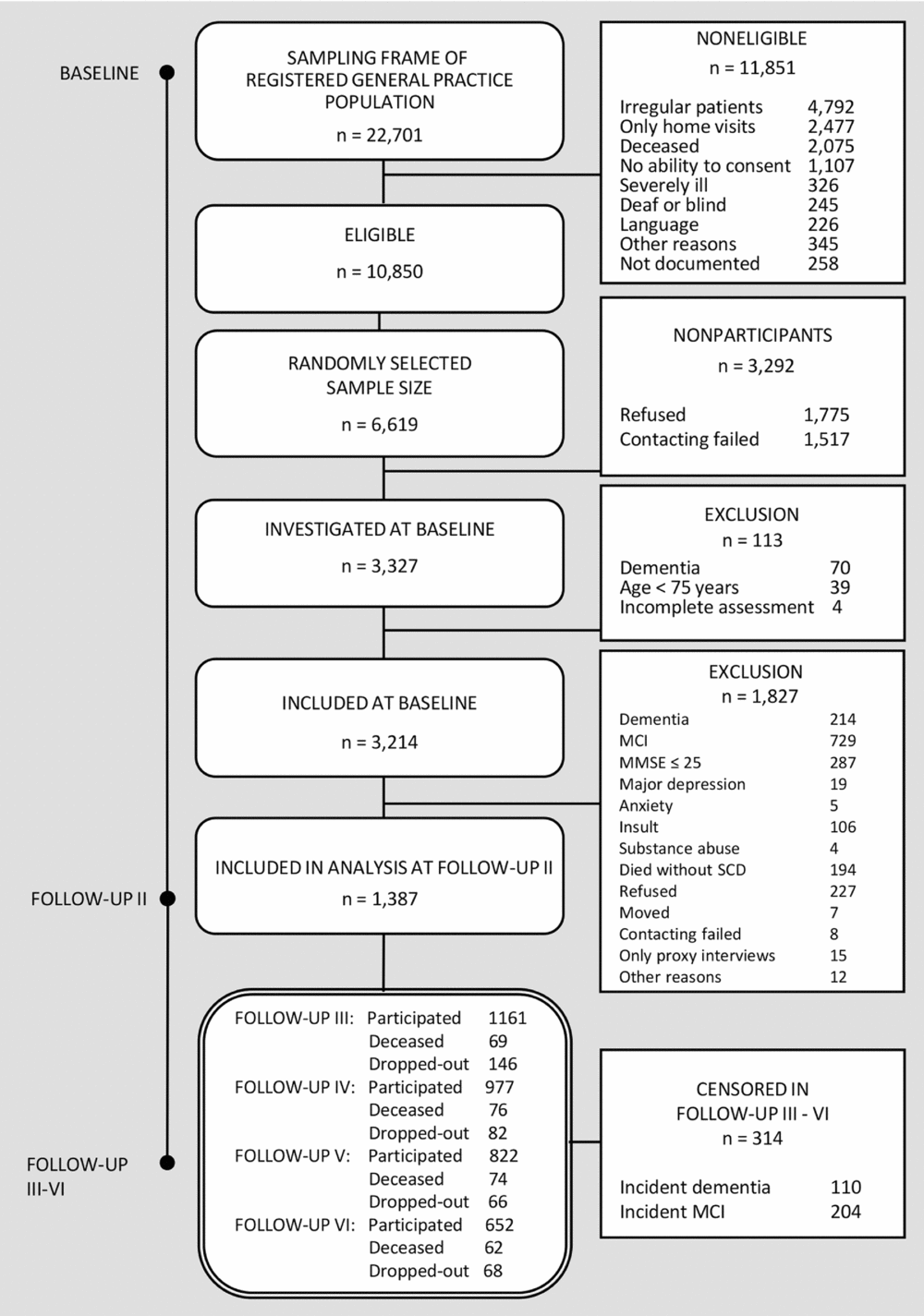
Initially, 3,327 GP patients were investigated, of which 2,326 (69.9%) were women. A total of 113 (3.4%) individuals were excluded because of prevalent dementia (n = 70, 2.1%), age below 75 years (n = 39, 1.2%), and incomplete assessments (n = 4, 0.1%). Finally, 3,214 individuals constituted the AgeCoDe cohort (Figure 1). The design of the AgeCoDe study has been described in detail elsewhere (Jessen et al., Reference Jessen2011).
Sample and sample attrition.

Ethics
All AgeCoDe participants provided written informed consent. Furthermore, the study protocol has been approved by the local ethic committees of all participating centers and complies with the guidelines of the Helsinki Declaration.
Data collection
Data were analyzed from follow-up 2 (as HRQoL was not assessed before) to follow-up 6, which were collected between March 2006 (beginning of follow-up 2) and January 2014 (end of follow-up 6), comprising a total observation period of six years. Follow-up assessments took place on average every 1.5 years. Trained psychologists and physicians visited GP patients at home and conducted structured clinical interviews.
Assessment procedures
The main instrument of the AgeCoDe-study was the Structured Interview for the Diagnosis of Dementia of Alzheimer Type, Multi-infarct Dementia, and Dementia of other Aetiology according to DSM-III-R, DSM-IV, and ICD-10 (SIDAM) (Zaudig and Hiller, Reference Zaudig and Hiller2006). The SIDAM comprises a cognitive test battery, a third-party rating of psychosocial impairment with a 14-item scale for the assessment of activities of daily living (SIDAM ADL-scale) and a summary clinical diagnostic impression. The cognitive battery consists of 55 items (SIDAM score) that cover four domains of cognitive functioning: orientation, memory, intellectual abilities, and higher cortical functioning. The 55 SIDAM items include the 30 items of the Mini-Mental State Examination (MMSE) for global cognitive functioning (Folstein et al., Reference Folstein, Folstein and McHugh1975).
SCD
We assessed SCD by asking the participants “Do you feel as if your memory is worsening?” (yes or no) prior to cognitive testing at each follow-up. In case of a positive answer, we further specified if SCD was accompanied by concerns by asking “Does this worry you?” (yes or no).
HRQoL
HRQoL was assessed using the EQ-5D visual analogue scale (EQ VAS) (The EuroQol Group, 1990). By definition, the EQ VAS is a standard vertical 20-cm scale similar to a thermometer for recording an individuals’ rating for their current HRQoL state ranging from 0 (worst imaginable state) to 100 (best imaginable state). The EQ VAS score can be thought of to resemble percentages. Higher EQ VAS scores indicate better HRQoL.
Covariates
Cognitive functioning was measured by the MMSE (Folstein et al., Reference Folstein, Folstein and McHugh1975). The MMSE consists of 11 questions and activities regarding cognitive domains or function, e.g. orientation, recall, and visual construction, to quantitatively estimate the severity of cognitive impairment. The maximum score is 30. A MMSE score <24 implies significantly impaired cognitive function likely indicating dementia. For milder forms of cognitive impairment, a cut-off score of 26 has been suggested, as it exhibited higher sensitivity (0.86) and specificity (0.79) than other cut-off values ranging from 22 to 29 (Kukull et al., Reference Kukull, Larson, Teri, Bowen, McCormick and Pfanschmidt1994).
Depressive symptoms were identified with the short version of the Geriatric Depression Scale (GDS) (Sheik and Yesavage, Reference Sheikh and Yesavage1986). The GDS consists of 15 questions specific to the elderly, e.g. “Have you dropped many of your activities and interests?”. The maximum total score is 15. A score > 5 indicates increased depressive symptomatology; a score > 10 indicates severe depressive symptomatology, likely major depression.
Impairment in instrumental activities of daily living (IADL) was assessed by the Lawton-and-Brody-scale (Lawton and Brody, Reference Lawton and Brody1969), which measures function in eight domains. Historically, women were scored on all eight domains, while men were not scored in the domains of food preparation, housekeeping and laundering. A higher score indicates higher function and less dependence (max. eight for women, five for men).
Socio-demographic variables were assessed by a standardized questionnaire and included, among others, age, gender, education (low, middle, high according to the Comparative Analysis of Social Mobility in Industrial Nations (CASMIN) criteria (König et al., Reference König, Lüttinger and Müller1988), marital status, and living situation.
If participants could not be reached at follow-up, proxies (commonly spouse, children, or other relatives) were interviewed based on a standardized questionnaire, including the Global Deterioration Scale (Reisberg et al., Reference Reisberg, Ferris, De Leon and Crook1982) and the subscales “Changes on performance of everyday experiences” and “Changes in habits” of the Blessed Dementia Scale (Blessed et al., Reference Blessed, Tomlinson and Roth1986).
GPs completed standardized questionnaires about participants’ comorbidities at each study wave. In this study, we incorporated a quantitative comorbidity index reflecting a total number of diseases that are frequent among the elderly: diabetes mellitus, hypertension, cardiac arrhythmias, coronary heart disease, myocardial infarction, stroke, peripheral artery occlusive disease, stenosis of afferent brain vessels, and transient ischemic attack.
Definition of cases
SCD
In accordance with the recently proposed research criteria by the working group of the Subjective Cognitive Decline Initiative (SCD-I) (Jessen et al., Reference Jessen2014), we specified that individuals should have a normal performance on standard objective cognitive tests. Accordingly, we excluded all cases with previous or current diagnosis of dementia, MCI or cognitive functioning on the MMSE worse than 26 points before and at follow-up 2. Furthermore, we censored data on individuals who developed incident MCI or dementia at any measurement after follow-up 2. Moreover, we excluded cases in which SCD could be explained by a psychiatric, neurological or medical disorder as functional memory impairment due to the underlying condition (i.e. in case of a major depression (GDS > 10), anxiety disorders, substance abuse, and stroke as reported by the GPs).
MCI
Diagnosis of MCI followed criteria by Winblad et al. (Reference Winblad2004): (i) absence of dementia according to DSM-IV, (ii) maximum of one impairment in IADL as assessed by the SIDAM-ADL-scale, (iii) evidence of cognitive decline in self- or informant-report and in objective cognitive tests, which was given if subjects or proxies reported subjective memory complaints, and if the test performance on at least one main domain of cognitive functioning as assessed by the SIDAM was one standard deviation below the age- and education-specific norms.
Dementia
Dementia was diagnosed by interviewers and experienced geriatricians in a consensus conference according to the DSM-IV criteria that are implemented as a standardized diagnostic algorithm in the SIDAM (Zaudig and Hiller, Reference Zaudig and Hiller2006). If the SIDAM was not applicable, dementia diagnosis was based on the Global Deterioration Scale (Reisberg et al., Reference Reisberg, Ferris, De Leon and Crook1982) with a cut-off score of ≥ 4 on and the Blessed Dementia Rating (Blessed et al., Reference Blessed, Tomlinson and Roth1986) subscales “Changes on performance of everyday experiences” and “Changes in habits” with a cut-off score of ≥ 9 as judged by proxies. In this study, such proxy information was only used to censor data on individuals with a diagnosis of incident dementia.
Statistical analyses
An α level for statistical significance of 0.05 (two-tailed) was applied for all analyses that were performed using Stata 13.1 SE (Stata-Corp LP, College Station, TX) and IBM SPSS statistics version 20 (SPSS Inc., Chicago, IL).
Group differences in socio-demographic and health characteristics between (a) individuals with and without SCD and (b) individuals without SCD and individuals with SCD with and without concerns at the beginning of the observation (i.e. follow-up 2 of the AgeCoDe Study as HRQoL was not assessed before) were analyzed using Wilcoxon–Mann–Whitney tests or Kruskal–Wallis tests for continuous variables and χ 2 tests for categorical variables.
To investigate whether SCD has an effect on HRQoL, we used unadjusted and adjusted linear mixed effects models. Such models allow for the specification of fixed and random effects in order to control for unobserved individual heterogeneity in panel data. Missing information in covariates is handled autonomously by these models, such that unbalanced data do not result in the exclusion of cases. All models included (i) the point of follow-up as repeated variable (time indicator), (ii) an intercept, (iii) an autoregressive covariance structure to account for auto-correlation, (iv) fixed effects, and (v) random effects. Likelihood ratio (LR) tests were used to decide whether a covariate should be included as an additional random effect. A LR test compares a random-intercept model and a random-coefficient model with a random individual-specific slope for each time-varying variable. If the difference between a random-intercept model and a random-coefficient model is statistically significant (p < 0.05), then the less restrictive model (the one with more variables, i.e. the additional random effect) fits the data significantly better than the more restrictive model, thus, the additional random effect should be kept. We used robust variance estimation to account for clustering of study site characteristics.
In a first step, we calculated a univariate linear mixed effects model for the association of SCD and the EQ VAS scores averaged across all assessment waves. Next, we modeled multivariate linear mixed effects of SCD on the EQ VAS scores adjusted for potential confounders. Selection of covariates was based on previously established associations with HRQoL, including age (continuous), gender (male vs. female), education (low, middle vs. high), living situation (private home vs. institutionalized living), marital status (single, married/cohabiting, divorced vs. widowed), cognitive functioning (MMSE, continuous), comorbidity (continuous), depressive symptoms (GDS, continuous), and impairment in the IADL (continuous).
In a second step, we repeated the first-step analyses, but differentiated SCD in relation to concerns (no SCD, SCD without related concerns, SCD with related concerns).
Results
Participants
Of the 3,214 participants in the AgeCoDe cohort at baseline, 1,827 (56.8%) subjects had to be excluded, primarily because of MCI (n = 729, 22.7%), dementia (n = 214, 6.7%), an MMSE score below 26 points (n = 287, 8.9%) until follow-up 2, and refusing to participate further in the study at follow-up 1 and 2 (n = 227, 7.1%) (Figure 1). The final analysis pool comprised 1,387 (43.2%) study participants.
Characteristics of the study sample
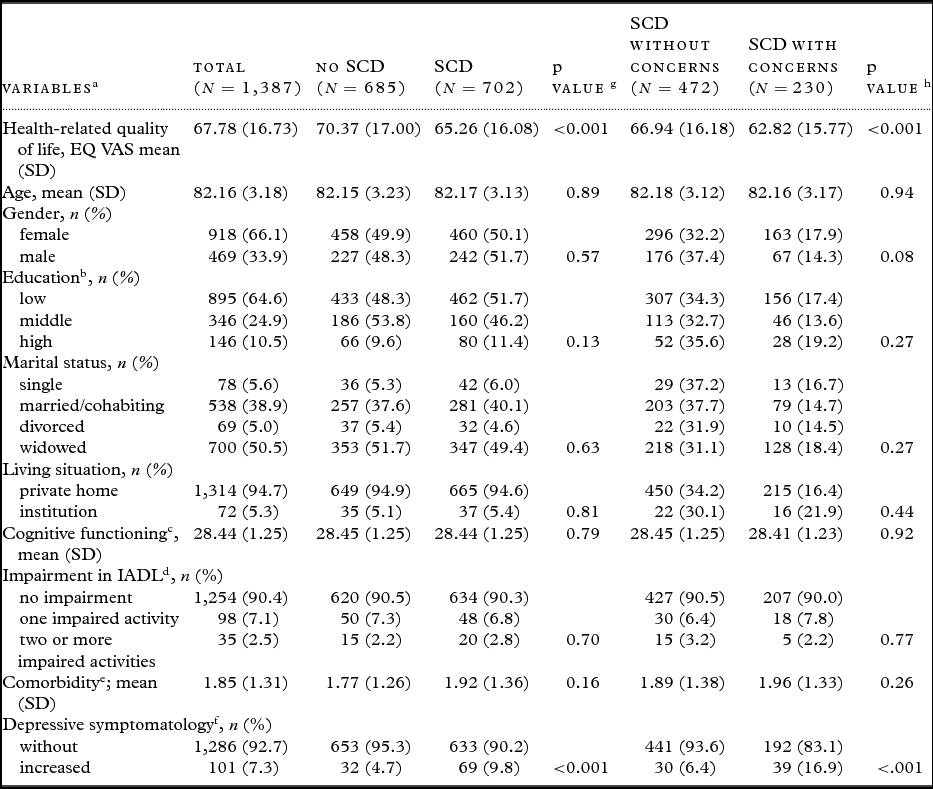
Among the 1,387 participants of the study sample, 702 (50.6%) reported SCD at the beginning of the observation period. Of those, 472 (34.0%) individuals reported no concerns related to SCD, and 230 (16.6%) individuals reported concerns due to SCD.
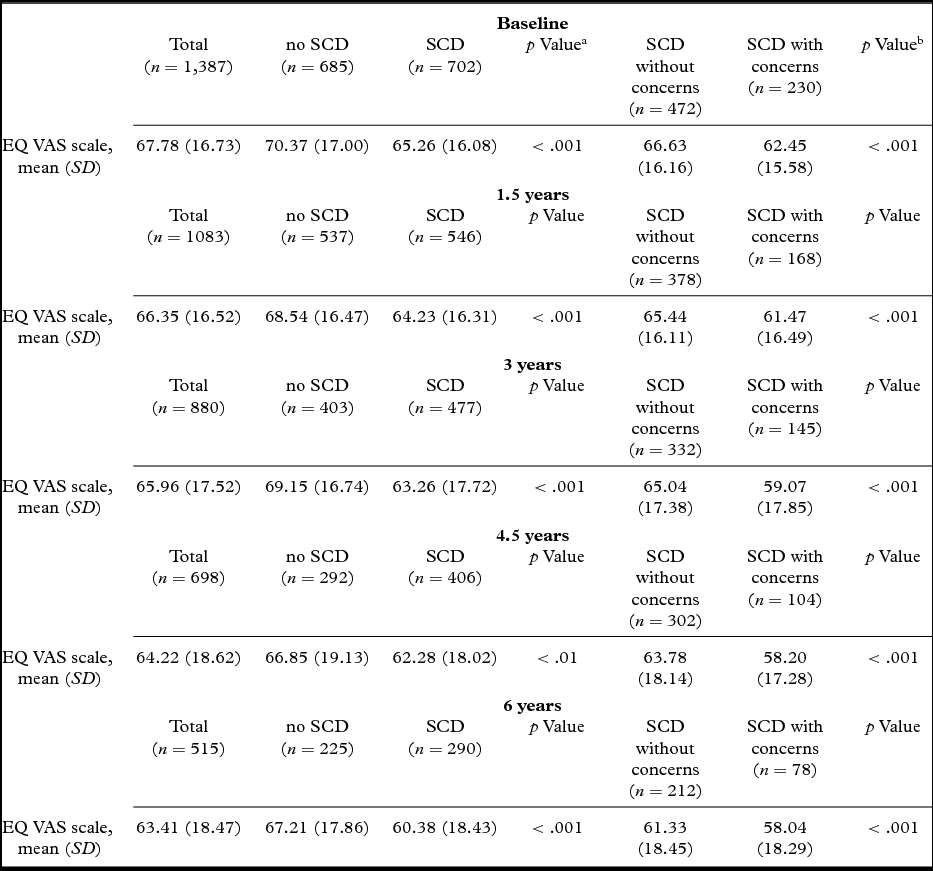
Individuals with SCD reported significantly more depressive symptoms (p < 0.001) and lower HRQoL (p < 0.001) than individuals without SCD, but did not differ in other measured socio-demographic and health characteristics (Table 1). As shown in Table 2, scores on the EQ VAS scale were significantly lower in individuals with SCD than in those without SCD at all assessment waves, and for both groups, EQ VAS scores tended to decrease over time.
Socio-demographic and health characteristics of the study sample at the beginning of observation in total and by the status of subjective cognitive decline (SCD), as well as SCD with and without concerns, respectively

a Data were missing for marital status (n = 2; 0.1%), living situation (n = 1; 0.1%), Mini-Mental State Examination (MMSE, n = 2; 0.1%), comorbidity index (n = 51; 3.7%), depressive symptoms (n = 4; 0.3%).
b According to the CASMIN criteria (König et al., Reference König, Lüttinger and Müller1988).
c Based on the MMSE total score (Folstein et al., Reference Folstein, Folstein and McHugh1975).
d Instrumental activities of daily living (IADL), based on an the Lawton and Brody scale total score (max. eight for women, five for men).
e Quantitative comorbidity index included: diabetes mellitus, hypertension, cardiac arrhythmias, coronary heart disease, myocardial infarction, peripheral artery occlusive disease (PAOD), stenosis (of afferent brain vessels), transient ischaemic attack (TIA), stroke.
f Based on the Geriatric Depression Scale (GDS) (Sheikh and Yesavage, Reference Sheikh and Yesavage1986); without depressive symptoms: 0–5 points on the GDS; increased depressive symptoms: 6–10 points on the GDS; severe depressive symptoms, likely major depression: >10 points, was excluded according to the definition of SCD (Jessen et al., Reference Jessen2014).
g Group difference between individuals without SCD versus individuals with SCD; differences in continuous variables tested with Mann–Whitney U-test, in categorical/dichotomous variables with χ2-tests.
h Group difference between individuals without SCD versus individuals with SCD without concerns versus individuals with SCD with concerns; differences in continuous variables tested with Kruskal–Wallis tests, in categorical/dichotomous variables with χ 2 tests – all tests two-tailed at 95% significance level.
Results on the health-related quality of life (HRQoL) outcome measure EQ-5D Visual Analogue scale (EQ VAS) over the course of the study period by status of subjective cognitive decline (SCD), and SCD with and without concerns, respectively

a group difference in HRQoL in individuals without SCD vs. individuals with SCD, Mann-Whitney-U-Test.
b group difference in HRQoL in individuals without SCD vs. individuals with SCD without concerns vs. individuals with SCD with concerns, Kruskal-Wallis test.
The total follow-up time was six years, the mean follow-up time cumulated in M = 4.6 years (SD = 2.1). Almost half of all participants (n = 652; 47.0%) completed all assessment waves (Figure 1). During follow-up 3 to 6, data of 314 individuals (22.6%) were censored due to incident MCI (n = 204; 14.7%) and incident dementia (n = 110; 7.9%).
Estimates of the effect of SCD on HRQoL
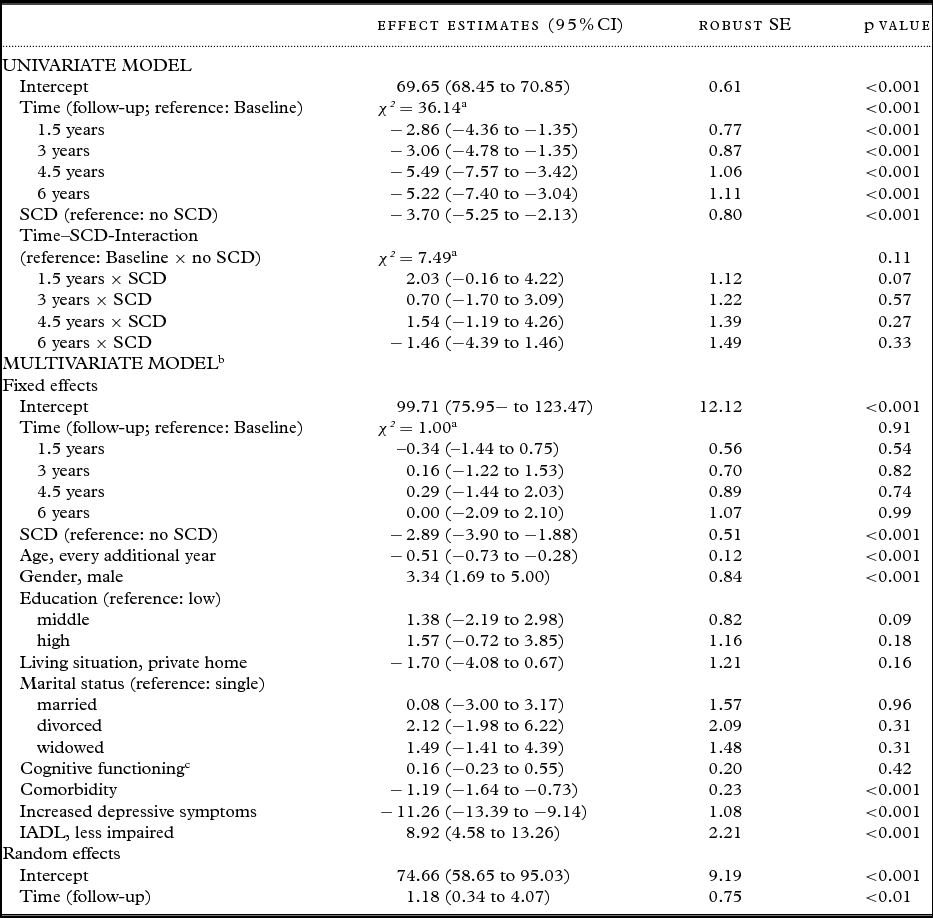
The univariate linear mixed effects model yielded a significant effect of SCD on the EQ VAS scores (Table 3). The effect estimates on the EQ VAS in individuals with SCD were an average of 3.7 points (95%CI = −5.3 to −2.1; SE = 0.8; p < 0.001) lower than in individuals without SCD over the study period. In the multivariate linear mixed effects model, this effect remained significant (average effect estimates for SCD: −2.9 points on the EQ VAS, 95%CI = −3.9 to −1.9; SE = 0.5 versus no SCD; p < 0.001).
Effect estimates of the univariate and multivariate linear mixed effects model for the impact of subjective cognitive decline (SCD) on health-related quality of life (HRQoL) as measured by the EQ-5D Visual Analogue scale (EQ VAS) (n = 1,387)

a Wald test for the overall time effect in reference to baseline.
b Likelihood ratio tests between random-intercept models and random-coefficient models were non-significant for all covariates except time (χ² = 7.27; p < 0.01), suggesting only the addition of time as an additional random effect.
c Every additional point on the Mini-Mental State Examination; MMSE; indicating better overall cognitive functioning.
Change in HRQoL over the study period
In the univariate mixed effects model, time (follow-up) was associated with a significant constant decrease in the EQ VAS scores over the study period (χ² = 36.1; p < 0.001). But this decrease was independent of SCD. There was no interaction effect of SCD and time (follow-up) (χ² = 7.5; p = 0.11) (Table 3).
Estimates of the effect of SCD on HRQoL in relation to concerns
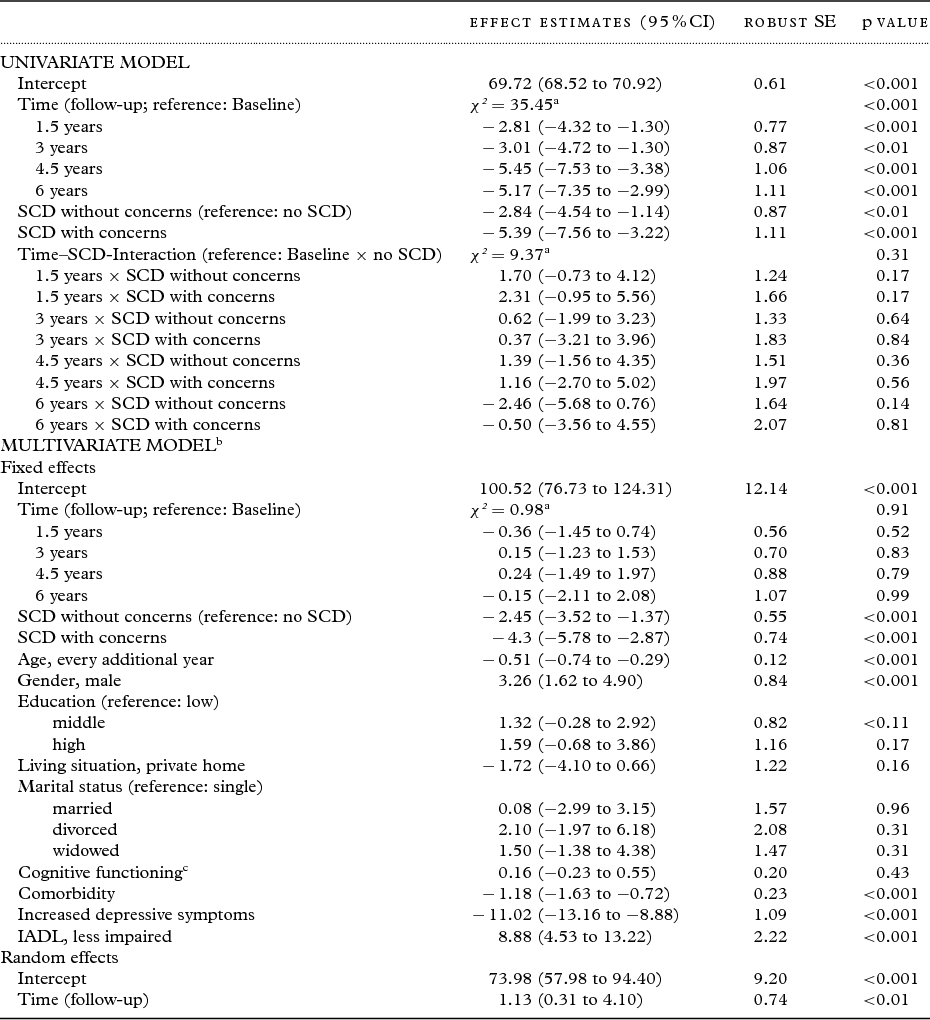
Univariate as well as multivariate linear mixed effects models for the impact of SCD on HRQoL consistently yielded more pronounced negative effect estimates for individuals who reported SCD in relation to concerns (Table 4). Unadjusted average effect estimates on the EQ VAS were 2.8 (95%CI = −4.5; −1.1; SE = 0.9; p < 0.01) points less in SCD without related concerns, but 5.4 (95%CI = −7.6; −3.2; SE = 1.1; p < 0.001) points less in SCD with related concerns in reference to no SCD. Regarding individuals with SCD only, the post-hoc estimated contrast for SCD without concerns and SCD with concerns revealed a significant difference in EQ VAS scores (Wald test: χ² = 28.04; p <0.001).
Effect estimates of the univariate and multivariate linear mixed effects model for the impact of subjective cognitive decline (SCD) in relation to concerns on health-related quality of life (HRQoL) as measured by the EQ-5D Visual Analogue scale (EQ VAS) (n = 1,387)

a Wald test for the overall time effect in reference to baseline.
b Likelihood ratio tests between random-intercept models and random-coefficient models were non-significant for all covariates except time (χ² = 6.97; p < 0.01), suggesting only the addition of time as an additional random effect.
c Every additional point on the Mini-Mental State Examination; MMSE; indicating better overall cognitive functioning.
When adjusted for covariates, the effect estimates on the EQ VAS scores were also significantly lower in SCD with concerns (average effect estimates: −4.3, 95%CI = −5.8; −2.9; SE = 0.7; p < 0.001) and SCD without concerns (average effect estimates: −2.5, 95%CI = −3.5; −1.4; SE = 0.6; p < 0.001) each compared with no SCD. Post-hoc estimated contrast for SCD without concerns and SCD with concerns also revealed a significant difference in EQ VAS scores when adjusted for covariates (Wald test: χ² = 39.50; p < 0.001).
Discussion
We aimed to investigate the longitudinal association of SCD and HRQoL in cognitively unimpaired older individuals. The main finding was persistent lower levels of HRQoL in individuals with SCD compared to individuals without SCD. The association of SCD and lower HRQoL was more pronounced in individuals who reported concerns about SCD. Levels of HRQoL tended to progressively decrease over time, but that change did not vary by SCD.
Our results are in line with previous cross-sectional studies on the relation of SCD and QoL (Mol et al., Reference Mol, Carpay, Ramakers, Rozendaal, Verhey and Jolles2007). The association of SCD and lower QoL seems to be robust since the studies were heterogeneous in their definitions and measurements of SCD and QoL as well as in the samples and age ranges studied. Thus far, one other study examined the effect of subjectively perceived memory complaints on QoL longitudinally. There, the authors found that “subjective forgetfulness” was persistently associated with lower QoL after adjusting for age, gender, and education (Mol et al., Reference Mol, Van Boxtel, Willems, Verhey and Jolles2009). Our results complement those of Mol et al. (Reference Mol, Van Boxtel, Willems, Verhey and Jolles2009), since we were able to show that SCD is also associated with persistently lower HRQoL, specifically. Thus, putting the results in context with previous studies, we could conclude that SCD has a negative effect on QoL, with a specific impact on HRQoL, the health domain of QoL.
We could also show that the association of SCD and lower HRQoL is more pronounced in individuals who are concerned about SCD as opposed to individuals with SCD who negate such concerns. Previous studies have shown that SCD with concerns is associated with an increased risk of progression to dementia compared to SCD without concerns (Jessen et al., Reference Jessen2014). In fact, the authors suggested that SCD with concerns carries a similar risk of AD dementia as early MCI, while SCD that was of no concern did not predict dementia. Potentially, SCD without concerns might just reflect normal age-related cognitive decline as opposed to SCD with concerns that may indicate a pathological process. Hence, this could explain why SCD with concerns would have a more marked effect on HRQoL. However, the specific role of concerns in SCD is not yet completely understood (Mendonça et al., Reference Mendonça, Alves and Bugalho2016).
Overall, there are several possible explanations for the persistent association of SCD and lower HRQoL. First, studies have consistently shown a relation between mood, especially depression, and SCD (e.g. Kim et al., Reference Kim, Stewart, Shin, Choi and Yoon2003). Lower levels of HRQoL are also strongly linked to depression (Sivertsen et al., Reference Sivertsen, Bjorklof, Engedal, Selbaek and Helvik2015). Subsequently, depressive symptoms might play a role in the relation between SCD and QoL (Mol et al., Reference Mol, Carpay, Ramakers, Rozendaal, Verhey and Jolles2007). Our results partly support this assumption, since once controlled for depressive symptoms, the association of SCD and lower HRQoL became less pronounced. However, as the association remained significant when controlled for depressive symptoms, our results also suggest that these symptoms could not be the only driver of a lower HRQoL in SCD.
Another explanation for an association between SCD and lower HRQoL might be fear of future dementia or general fear of aging, a common phenomenon in the 21st century, where “successful aging” or “aging well” has become a societal ideal (Angus and Reeve, Reference Angus and Reeve2006). Sensing potential cognitive losses through SCD might contradict such a perception raising stereotypes about worthlessness and dependency of the elderly which, ultimately, could induce a worse appreciation of one's own health state – which again would also explain the more pronounced negative effect in SCD with concerns.
Interestingly, in individuals with MCI and dementia, there is no such clear association with lower QoL as in individuals with SCD (Missotten et al., Reference Missotten2008; Conrad et al., Reference Conrad, Uhle, Matschinger, Kilian and Riedel-Heller2015). We assume that individuals with SCD are cognitively aware enough to realize subtle changes in one's own cognitive functioning. Such recognition of SCD, particularly when causing concerns, might result in lower QoL. By contrast, with progressing cognitive decline (i.e. MCI or dementia), individuals lose more and more of their self-awareness (Vogel et al., Reference Vogel, Stokholm, Gade, Andersen, Hejl and Waldemar2004), leading eventually to anosognosia, a lack of awareness of one's condition. Perhaps that could explain less consistent associations between QoL and MCI or dementia. Condensing study findings, subjectively perceived cognitive problems seem to be associated with lower QoL regardless of underlying or related phenomena (Mol et al., Reference Mol, Carpay, Ramakers, Rozendaal, Verhey and Jolles2007), and in line with our results, this relation persists over time (Mol et al., Reference Mol, Van Boxtel, Willems, Verhey and Jolles2009).
Apart from this, the association of SCD and lower HRQoL suggests that SCD is a serious issue to individuals, especially for those who are concerned. This poses the question of how to deal with individuals with SCD concerning their lower HRQoL. Clearly, achieving or maintaining high levels of HRQoL is a main goal of an intervention. However, previous studies have shown that cognitive training, for example, as a possible treatment strategy to foster cognitive reserve may have adverse effects, since it increased the individual's awareness of memory decline with negative consequences for self-esteem and mood (Woods, Reference Woods2002). A reasonable approach might be studying factors that are positively associated with higher levels of HRQoL in individuals with SCD.
Several limitations must be addressed. First, the sample might not be representative of the older general population even though more than 90% of the German elderly regularly consult a GP (Schröter, Reference Schröter2014). Generalizability of our results might also be limited due to a moderate response rate to the study and loss to follow-up. Second, SCD was assessed by asking two simple questions only. Subjects might summarize different kinds of cognitive problems within these questions. A more detailed assessment might therefore corroborate our findings. Nevertheless, the two questions we asked are considered valid measures for global memory functioning (Gifford et al., Reference Gifford, Dandan, Romano, Jones and Jefferson2015). Third, the measurement of global cognitive functioning with the MMSE in the AgeCoDe study may not accurately reflect the subtle cognitive changes associated with SCD. The application of a more sensitive test, e.g. the Addenbrooke's Cognitive Examination III (ACE-II; Hsieh et al., Reference Hsieh, Schubert, Hoon, Mioshi and Hodges2013), could potentially give more insight into the very early cognitive changes in individuals with SCD. Finally, HRQoL is influenced by a complex set of factors. We aimed to incorporate many such important factors, but, of course, there might be other variables associated with HRQoL (e.g. social support, medications) that could not have been investigated in this study. Such other factors could be subject to future studies.
Overall, our study could show that SCD is longitudinally associated with lower HRQoL in cognitively unimpaired elderly which is especially marked in individuals who are concerned about SCD. Depressive symptoms, which were more frequent among individuals with SCD, could not alone explain the significant association of lower HRQoL and SCD. Our results, thus, further illustrate the relevance that SCD has for older individuals.
Conflict of interest
The authors declare that they have no conflict of interest.
Description of authors’ roles
S. Roehr, T. Luck, and A. Pabst analyzed and interpreted the data and drafted the manuscript. H. Bickel, M. Pentzek, S. Weyerer, H.-H. König, W. Maier, M. Scherer, F. Jessen, and S. G. Riedel-Heller conceived and designed the study and revised the manuscript for important intellectual content. F. Jessen and S. G. Riedel-Heller furthermore supported in the analysis and interpretation of the data and the drafting of the manuscript. B. Wiese, S. Mamone, S. Wolfsgruber, A. Fuchs, D. Lühmann, J. Werle, E. Mösch, C. Brettschneider, and T. Mallon acquired the data and revised the manuscript for important intellectual content.
Acknowledgments
We want to thank both all participating patients and their general practitioners for their good collaboration.
Members of the AgeCoDe Study Group:
Principal Investigators*: Wolfgang Maier, Martin Scherer
Heinz-Harald Abholz, Christian Brettschneider, Cadja Bachmann, Horst Bickel, Wolfgang Blank, Hendrik van den Bussche, Sandra Eifflaender-Gorfer, Marion Eisele, Annette Ernst, Angela Fuchs, André Hajek, Kathrin Heser, Frank Jessen, Hanna Kaduszkiewicz, Teresa Kaufeler, Mirjam Köhler, Hans-Helmut König, Alexander Koppara, Diana Lubisch, Tobias Luck, Dagmar Lühmann, Melanie Luppa, Tina Mallon, Manfred Mayer, Edelgard Mösch, Michael Pentzek, Jana Prokein, Susanne Röhr, Anna Schumacher, Janine Stein, Susanne Steinmann, Franziska Tebarth, Carolin van der Leeden, Michael Wagner, Klaus Weckbecker, Dagmar Weeg, Jochen Werle, Siegfried Weyerer, Birgitt Wiese, Steffen Wolfsgruber, Thomas Zimmermann.
*Hendrik van den Bussche (2002–2011).
This study/publication is part of the German Research Network on Dementia (KND), the German Research Network on Degenerative Dementia (KNDD; German Study on Ageing, Cognition and Dementia in Primary Care Patients; AgeCoDe), and the Health Service Research Initiative (Study on Needs, health service use, costs and health-related quality of life in a large sample of oldest-old primary care patients (85+; AgeQualiDe)) and was funded by the German Federal Ministry of Education and Research (Grants KND: 01GI0102, 01GI0420, 01GI0422, 01GI0423, 01GI0429, 01GI0431, 01GI0433, 01GI0434; Grants KNDD: 01GI0710, 01GI0711, 01GI0712, 01GI0713, 01GI0714, 01GI0715, 01GI0716; Grants Health Service Research Initiative: 01GY1322A, 01GY1322B, 01GY1322C, 01GY1322D, 01GY1322E, 01GY1322F, 01GY1322G).