Introduction
Post-traumatic stress disorder (PTSD) is a condition associated with immense suffering and burden in terms of psychological distress and disrupted socio-occupational functioning. Ever since PTSD was first formally recognized as a psychiatric disorder in 1980, 1 the diagnosis and treatment have focused on psychiatric symptoms and their impact on psychosocial functioning. In recent years, however, a large body of empirical research has shown that PTSD is also associated with significant medical morbidity and physiological dysfunction.Reference Lohr, Palmer and Eidt 2 , Reference Wolf and Morrison 3 These physiological problems have led us and several other research groups to the conclusion that, rather than solely a psychiatric condition, PTSD is more accurately conceptualized as a systemic disorder.Reference Lohr, Palmer and Eidt 2 , Reference McLeay, Harvey and Romaniuk 4 The primary theoretical framework that has been invoked in these discussions has centered on the notion of allostatic control and an overall increase in allostatic load (AL), which is associated with multiple physiological problems.
Addressing increased AL is not a simple issue, as multiple stress-related systems are at play, including metabolic, inflammatory, and cardiovascular systems. Although the large range of AL measures may possibly be influenced by lifestyle or behavioral changes,Reference McEwen 5 pharmacological approaches have generally focused only on specific physiological subsystems, with no simple yet comprehensive approach available to address the spectrum of AL variables. Here, we present the thesis that cannabinoids may offer just such an approach and may have a potential role as “anti-AL” medications.
In this paper, we first describe and discuss the concepts of allostasis and AL, after which we provide a brief overview of the systemic effects of PTSD and their relationship with AL. With that background, we review the evidence that cannabinoids may have a potential therapeutic role for the elevations of AL seen in PTSD. Based on the available empirical data and the noted gaps in current evidence, we conclude with a suggested research agenda to further investigate the possibility of using cannabinoids as an emerging novel approach for intervention for physiological abnormalities in PTSD.
Allostasis and AL
Allostasis was initially proposed as an expansion of the concept of homeostasis, which itself began with the American physiologist Walter Cannon. Cannon drew upon the work of the great French physiologist Claude Bernard in the late 1800s about the importance of the stability of the interieur milieu, and he coined the term “homeostasis” in the 1920s to refer to the physiological reactions which maintain the majority of the steady states in the body.Reference Cannon 6 Cannon considered these necessary to ensure the continued existence of an organism in the face of powerful destabilizing environmental forces. Later developments in cybernetic control theoryReference Wiener 7 provided language that was easily adapted to this concept, so that homeostasis came to incorporate the notion of “negative feedback” mechanisms by which an organism could reach and maintain a stable optimum value , or “ setpoint ” such as a blood pH of 7.40 or a sodium concentration of 140 mEq/L.
Throughout the latter part of the 20th century, investigators began to note problems with this view of homeostasis. One of the major issues was that, in biological systems, setpoints vary in response to environmental change. Sterling and Eyer proposed that homeostasis was inadequate to model physiological activity in many such systems – for example, changes in blood pressure relating to fight or flight responses.Reference Sterling, Eyer, Fisher and Reason 8 They noted that, “to maintain stability an organism must vary all the parameters of its internal milieu and match them appropriately to environmental demands. We refer to this principle as allostasis, meaning ‘stability through change’.”Reference Sterling, Eyer, Fisher and Reason 8 Allostasis was considered by Sterling and Eyer to represent a broader and more generalized phenomenon than homeostasis, and incorporated homeostasis as a special subtype.
Bruce McEwen and colleagues elaborated on and modified the concept of allostasis in a series of articles dating from the 1990s.Reference McEwen 9 – Reference McEwen, Bowles and Gray 11 Critical to their concept of allostasis was the notion of stress, which began with the groundbreaking work of Hans Selye in an attempt to elucidate common features and physiological processes shared by most if not all diseases. One of the major problems with stress terminology, and one which still causes much confusion, is that the term “stress” came to be used to signify both a cause and an effect. Selye stated, “… when I introduced the word stress into medicine in its present meaning, my English was not yet good enough for me to distinguish between the words ‘stress’ and ‘strain.’… Actually I should have called my phenomenon the ‘strain reaction’ and that which causes it ‘stress,’ which would parallel the use of these terms in physics…. [However] ‘biologic stress’ in my sense of the word was so generally accepted… [that] I was forced to create a neologism and introduce the word stressor, for the causative agent… retaining stress for the resulting condition” (p. 5051).Reference Selye 12
Despite Selye’s attempt at clarification, considerable confusion continues to plague our terminology, as evidenced by the fact that PTSD, if using Selye’s language, should stand for “Posttraumatic Stressor Disorder.” In fact, McEwen and colleagues hoped that allostatic concepts might be employed to replace some of the confusion surrounding stress terminology, and in their work created the concept of AL:
Rather than maintaining constancy, the physiologic systems within the body fluctuate to meet demands from external forces, a state termed allostasis . In this article, we extend the concept of allostasis over the dimension of time and we define allostatic load as the cost of chronic exposure to fluctuating or heightened neural or neuroendocrine response resulting from repeated or chronic environmental challenge that an individual reacts to as being particularly stressful…. The strain on the body produced by repeated ups and downs of physiologic response, as well as by the elevated activity of physiologic systems under challenge, and the changes in metabolism and the impact of wear and tear on a number of organs and tissues, can predispose the organism to disease. (pp. 2094–2095)Reference McEwen and Stellar 13
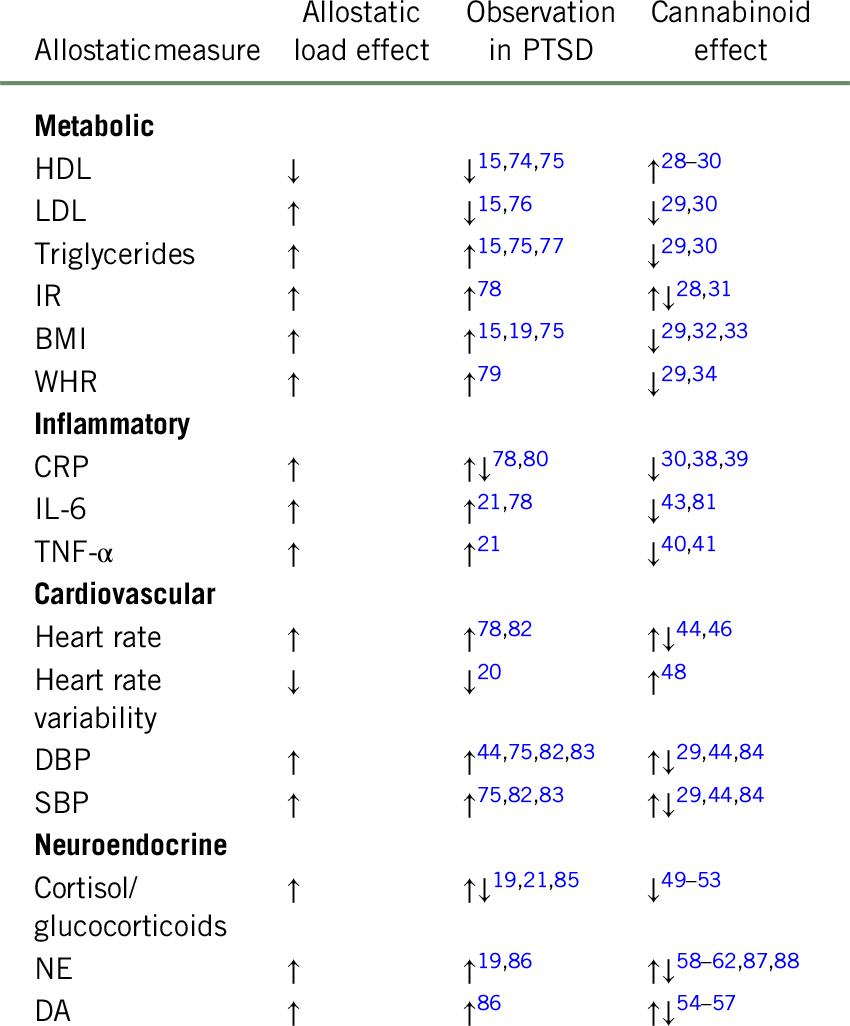
Allostasis thus involves neural processes of learning and memory to change physiological parameters in anticipation of the effects of likely future stressors, and the physiological changes wrought by these allostatic mechanisms over time are defined as the AL.Reference Sterling and Schulkin 14 Increased AL is associated with a large variety of physiological problems, including obesity, metabolic syndrome, hypertension, hyperlipidemia, inflammation, atherosclerosis, ulcers, and cardiovascular disorders.Reference McEwen 5 , Reference McFarlane 15 , Reference Mayer 16 There is no standard measure of AL, as different investigators have chosen between 7 and 11 out of a pool of 16 possible markers, which are listed in Table 1.Reference Seeman, McEwen and Rowe 17 , Reference Karlamangla, Singer and McEwen 18
Effects of allostatic load, PTSD, and cannabinoid agonist on measures of allotasis.
PTSD and AL
Many of the physiological disturbances seen in PTSD have been reported in systems which are related to increased AL.Reference Glover, Stuber and Poland 19 – Reference Vidovic, Gotovac and Vilibic 21 In our comprehensive review of the empirical literature,Reference Lohr, Palmer and Eidt 2 26 of 29 (90%) studies examining age-related biomarkers in PTSD found evidence consistent with early or accelerated aging among people with PTSD, and the biological effects of aging are itself frequently associated with increased AL.Reference Maestripieri and Hoffman 22 We reported a meta-analysis for the association of PTSD with several inflammatory biomarkers and found significant associations in terms of C-reactive protein (CRP), interleukin1-beta, interleukin-6 (IL-6), and tumor necrosis factor-alpha (TNF-α). In terms of the hypothalamic–pituitary–adrenal (HPA) axis, Neigh and AliReference Neigh and Ali 23 noted that “PTSD co-occurs with dysregulation of the HPA axis, impaired [glucocorticoid] signaling, and the development of a pro-inflammatory state” (p. 104). In fact, most markers of AL – with few exceptions (such as high-density lipoprotein (HDL)) – have been reported to be abnormal in PTSD, and these are listed in Table 1. This relationship between PTSD and AL is not surprising, considering that AL involves notions of stress as well as the importance of memory and learning, and both of these are critical to PTSD.
Cannabinoids and AL
Following the discovery of Δ-9 tetrahydrocannabinol (THC), one of the active phytocannabinoids in the cannabis plant, it was found that the body not only has two major receptors for phytocannabinoids – CB1 and CB2 – but there also exist endogenous cannabinoids (“endocannabinoids”) targeting these receptors. These endocannabinoids, which are primarily agonists at the cannabinoid receptors, appear to be produced in response to inflammation, central nervous system damage, and a host of other stressors.Reference Petrocellis, Cascio and Marzo 24 The cannabinoid system is of indisputable biological importance in the brain and periphery, but the exact role or roles for the cannabinoids in humans is not clear, although they appear involved systems relating to learning, memory, pain, and emotional salience.Reference Kendall and Yudowski 25 For our purposes, however, cannabinoids are closely associated with stress and inflammatory systems and appear to serve a very important neuromodulatory role in the promotion of extinction learning.Reference Riedel and Davies 26 By facilitating extinction learning, cannabinoids have been suggested as a potential pharmacological target for anxiety in general and for PTSD in particular.Reference Pertwee 27
Cannabinoids may theoretically relate to allostasis because of their effects on stress and extinction memory, and it would be clinically important to know whether cannabinoids actually improve measures of AL. In the remainder of this section, we present an overview of the effects of cannabinoid agonists on various measures of AL. These findings are summarized in Table 1, regarding the broad effects of cannabinoid agonists on the 16 most commonly reported measures of AL. We should note that this is not meant to be a detailed comprehensive review of the literature of cannabinoids on these measures. The cannabinoid system is complex, with multiple endocannabinoids and phytocannabinoids demonstrating many interacting effects on the two major cannabinoid receptors in the body – CB1 and CB2. We are primarily interested in presenting the main findings relating to cannabinoid agonism on AL measures, and whether they are overall supportive of the present thesis.
Metabolic assessments
The primary metabolic assessments in measures of AL include HDL, low-density lipoprotein (LDL), triglycerides, insulin resistance (IR), body mass index (BMI), and waist-to-hip ratio (WHR). Increased AL is associated with increases in all of these except HDL, where a decrease is considered abnormal. Cannabinoids have generally been found to move these measures into the opposite direction, therefore reducing AL, except for IR. Reference Muniyappa, Sable and Ouwerkerk 28 –Reference Antel, Gregory and Nordheim 34
It should be noted, however, that the effects of cannabinoids on metabolism may be complex, in that there is evidence that CB1 receptor antagonists may be useful in reducing metabolic syndrome and obesity.Reference Antel, Gregory and Nordheim 34 , Reference Gary-Bobo, Elachouri and Gallas 35 Some of these issues relate to the effect of cannabinoids on increasing appetite acutely and therefore increasing weight, but the chronic effects may be more of a reduction in weight.Reference Alshaarawy and Anthony 36 , Reference Meier, Pardini and Beardslee 37 Nevertheless, overall there is considerable evidence that cannabinoids reduce metabolic aspects of AL.
Inflammatory assessments
An increase in pro-inflammatory markers has been proposed in multiple measures of overall AL, primarily including IL-6, TNF-α, and CRP. In general, cannabinoids have been found to significantly decrease these pro-inflammatory markers.Reference Rajavashisth, Shaheen and Norris 30 , Reference Ferguson and Ennis 38 – Reference Sexton, Cudaback and Abdullah 42 For example, the anti-inflammatory effect of ajulemic acid has been shown to involve reduction of IL-6 levels through cannabinoid receptor binding.Reference Parker, Atez and Rossetti 43 For TNF-α, studies have found that THC can suppress soluble macrophage tumoricidal activity and partially inhibit TNF signals.Reference Nagarkatti, Pandey and Rieder 40 , Reference Keen and Turner 41 And CRP has found to be attenuated by the cannabidiol (CBD).Reference Ferguson and Ennis 38 , Reference Alshaarawy and Anthony 39 Thus, there is strong evidence of cannabinoid agonism reducing the pro-inflammatory components of AL.
Cardiovascular assessments
There are several cardiovascular variables that have been considered critical components of AL, including blood pressure, heart rate, and heart rate variability. In terms of cannabinoids, many of the reported cardiovascular findings have been mixed and at times conflicting, which in many cases relates to differences in acute versus chronic effects of cannabinoid administration. For example, there is general agreement that cannabinoids exert an acute hypotensive effect likely caused by activation of CB1 receptors with consequent vasodilatory effects, but this can then be associated with an acute compensatory increase in heart rate (seen primarily with inhaled cannabinoids), even though heart rate may actually be reduced with more chronic usage.Reference Ho and Kelly 44 Despite these differences, it has been suggested overall that cannabinoids can improve cardiovascular functions and may have therapeutic potential in treating various cardiovascular diseases.Reference Ho and Kelly 44 – Reference Schmid, Schonlebe and Drexler 48 It should be noted that heart rate variability, a measure which is reported to be abnormally decreased in PTSD,Reference Lee, Bissett and Carter 20 is reported to be increased with cannabinoid exposure.Reference Schmid, Schonlebe and Drexler 48
Neuroendocrine assessments – the HPA Axis and Catecholamines
The HPA axis has been closely associated with the concept of stress and is frequently included in assessments of AL, primarily using cortisol as an indicator. Several investigators have suggested that the endocannabinoid system exerts modulating and moderating effects on activity of this system.Reference Akirav 49 – Reference Ramot and Akirav 53 In general, the cannabinoid system has been proposed to play a critical role in HPA axis function and stress regulation, with cannabinoids being shown to reduce stress responses and HPA axis over-activation. More specifically, as reviewed by Crosby et al.,Reference Crosby and Bains 51 under acute stressful conditions, glucocorticoids stimulate endocannabinoid synthesis, which can then activate CB1 receptors and act to constrain HPA axis activity. It has also been proposed that the CB1 receptor downregulation effect on HPA axis may serve to protect certain brain regions from stress effects.Reference Akirav 49 – Reference Ramot and Akirav 53 In summary, there is strong evidence that cannabinoids can reduce or ameliorate stress responses through glucocorticoid and HPA deactivation.
The catecholamines that have received most attention in discussions of AL are dopamine (DA) and norepinephrine (NE). Cannabinoids, and particularly CB1 receptor agonists, have been reported to reduce dopaminergic function in studies of levodopa-induced dyskinesia, seen with treatment of Parkinson’s disease and believed to be related to excessive dopaminergic transmission.Reference Brotchie 54 – Reference Papa 56 However, there is also evidence that THC when used acutely may increase dopaminergic function.Reference Sinha, Umbreit and Sieberg 57 Norepinephrine has been reported to be regulated by cannabinoid system, although the regulation is complex, and may be dose-dependent and also related to specific cannabinoid receptors.Reference Tzavara, Davis and Perry 58 – Reference Reyes, Carvalho and Szot 62 Overall, there is evidence that cannabinoids modulate the stress-related hormonal systems involving the HPA axis and catecholamines, although this is clear for the HPA axis, with effects on catecholamines being more complex.
Summary of cannabinoid effects on AL
Out of the 16 measures that have commonly been associated with AL, in 10 cases, the evidence suggests that cannabinoids reduce AL, and in the remaining six measures, the evidence is mixed, with some evidence supporting a reduction in AL. Three of these latter six measures are related to cardiovascular effects of systolic blood pressure (SBP), diastolic blood pressure (DBP), and heart rate, and the remaining two measures are IR and the catecholamines. There is no clear evidence of cannabinoids exacerbating AL.
Caveats
There are three caveats in the assessment of the findings and suggestions proposed in this paper. First, we are not suggesting the use of cannabinoids for these physiological problems at this time, as more research is necessary before any such therapeutic guidelines could be offered. Second, we are discussing the potential utility of cannabinoids for the physiological problems that manifest in PTSD, and not for any potential effects on psychiatric symptoms, which are already under investigation.
Third, as mentioned earlier, we intend this paper to present an overview of evidence for the thesis that the cannabinoid system, and particularly cannabinoid agonism, may play a role in reducing the effects of AL, which could be therapeutically important for patients with PTSD. It is not intended to be a comprehensive literature review of AL and either PTSD or the cannabinoid systems. The cannabinoid system is complex, and it may not be possible to assign a simple effect to it, as it may depend on exactly which cannabinoids are involved, along with which cannabinoid receptors. For example, although the two predominant endocannabinoids, anandamide and 2-AG, appear to be primarily CB receptor agonists, phytocannabinoids, which number over 100 in cannabis extracts, have a whole range of functions depending on exactly which cannabinoids are studied and on their interactions with each other.Reference Pertwee 27 , Reference Parker 63 – Reference Reggio 69
Summary and Recommendations
Despite the substantial evidence that the effects of PTSD are not limited to psychiatric symptoms or even to central nervous system effects, existing treatment guidelines and evidence-based practices remain focused on reduction and management of the symptoms described within the DSM diagnostic criteria. 70 – Reference Lancaster, Teeters and Gros 72 As noted by McFarlane,Reference McFarlane 73 “the failure to attend to the somatic pathology of PTSD has not served patients well.”
The available evidence strongly suggests that cannabinoids may be a useful treatment for reduction of AL in subjects with PTSD, and hence may potentially serve to reduce long-term medical morbidity in the disorder. Out of the 16 measures that have commonly been associated with AL, in 10 cases, the evidence suggests that cannabinoids reduce AL, and in the remaining six measures, the evidence is mixed.
One important point deserving future consideration is the underlying meaning of such an anti-AL effect. It suggests that somehow cannabinoids may increase the accuracy or efficiency of allostatic mechanisms resulting in an overall reduction in AL over time. One possibility as to how this could occur involves the cannabinoid enhancement of extinction learning, which is particularly relevant in conditions like PTSD. In PTSD, there may be chronic anticipation of stressors which are unlikely to occur, but this anticipation cannot be suppressed easily. Cannabinoids could allow this anticipation to relax, particularly if there is social information strongly suggesting that the anticipation of stressors is excessive in relation to the probability of actual threat. Thus, by allowing for greater influence of social information relating to anticipated stressors and, through enhanced extinction learning, a reduction of such anticipation, cannabinoids could not only reduce some of the psychiatric symptoms of PTSD, but also potentially reduce the long-term physiological consequences of elevated AL as well.
Further research is clearly required to determine if the thesis proposed in this paper is valid and valuable, and how this information could be best translated into a therapeutic strategy for physiological problems that occur in PTSD. At the present time, we suggest that studies of cannabinoids in PTSD take into account not only their potential impact on psychiatric symptoms, but more broadly their potential impact on overall physical health.
Disclosures
Hang Chang has nothing to disclose. James Lohr reports consulting fees from Otsuka, grants from Avanir and Tonix, and is a researcher for Biogen. Barton W. Palmer receives research support from the Department of Veterans Affairs. Michelle Sexton is a consultant for Abattis Bioceuticals.