Introduction
A renewed emphasis on more sustainable agricultural practices and on improving soil health by federal agencies, farming and environmental stewardship groups has led to the increased promotion of cover crops in the USA (Hamilton et al., Reference Hamilton, Mortensen and Allen2017). Cover crops, planted on farms during the fallow period or in place of a cash crop, are used to improve soil and water quality, decrease erosion, reduce weed and pest pressure, and build on-farm resilience (Lin, Reference Lin2011; Larkin, Reference Larkin2015). Cover cropping also helps to mitigate the projected effects of climate change, which could exacerbate issues of erosion and drought and lead to reduced cropping system flexibility (Huggins et al., Reference Huggins, Pan, Schillinger, Young, Machado and Painter2013; Kirby et al., Reference Kirby, Pan, Huggins, Painter, Bista, Yorgey and Kruger2017; Morrow et al., Reference Morrow, Huggins and Reganold2017). Although the number of acres planted in cover crops in the USA has increased by nearly 50% in the past 5 yr, adoption is low in the dryland wheat-growing region of the inland Pacific Northwest (iPNW) (USDA, 2019). Historically used as forage for livestock and as a nitrogen supplement in the iPNW, cover crops became less popular during the 1950–1960s as the use of synthetic fertilizers increased (Schillinger and Papendick, Reference Schillinger and Papendick2008; Pan et al., Reference Pan, Schillinger, Young, Kirby, Yorgey, Borrelli, Brooks, McCracken, Maaz, Machado, Madsen, Johnson-Maynard, Port, Painter, Huggins, Esser, Collins, Stockle and Eigenbrode2017). However, this trend did not address issues of wind and water erosion or interest in increasing crop diversity and soil health. Interest in addressing these issues has led to renewed interest in cover crop experimentation by producers and researchers (Kirby et al., Reference Kirby, Pan, Huggins, Painter, Bista, Yorgey and Kruger2017). Yet there is an insufficient body of evidence on the effects of cover crops on crop yield and profitability, which means that producers are making decisions under high levels of uncertainty.
This paper responds to calls for research on the processes of adopting agricultural innovations and for research on region-specific factors affecting the diffusion of innovations (Pannell et al., Reference Pannell, Marshal, Barr, Curtis, Vanclay and Wilkinson2006; Hamilton et al., Reference Hamilton, Mortensen and Allen2017). We draw on the diffusion of innovations theory to explore cover crop adoption in the region. This theory has been used extensively to examine the process through which agricultural innovations are adopted over time. Diffusion of innovations has been used to explore the adoption of organic management systems, cover crops, pasture, riparian buffers and restored wetlands (Padel, Reference Padel2001; Atwell et al., Reference Atwell, Schulte and Westphal2009; Wu and Zhang, Reference Wu and Zhang2013; Senyolo et al., Reference Senyolo, Long, Blok and Omta2018). Some studies have focused specifically on how the characteristics of innovation impact the process of adoption (Ryan and Gross, Reference Ryan and Gross1943; Fliegel and Kivlin, Reference Fliegel and Kivlin1966; Wejnert, Reference Wejnert2002; Senyolo et al., Reference Senyolo, Long, Blok and Omta2018). Although cover cropping has historically been used in the iPNW, it is considered an innovative practice by some producers given the renewed promotion of the practice across the region. Additionally, as Rogers (Reference Rogers2003) posits, whether an innovation is taken up depends on how the practice is perceived by adopters and how effective it might be, rather than the novelty of the innovation. Rogers (Reference Rogers2003, Reference Rogers2010) identifies five characteristics of innovation to help explain factors that impact the rates of adoption: (1) relative advantage, (2) compatibility, (3) complexity, (4) trialability and (5) observability.
According to Pannell et al. (Reference Pannell, Marshal, Barr, Curtis, Vanclay and Wilkinson2006), relative advantage and trialability are particularly important characteristics because they can encompass the other characteristics of an innovation, thereby greatly affecting the likelihood of adoption. To be more readily adopted, a practice should appear to potential adopters as having a high relative advantage and high trialability, which encompasses a low degree of complexity and a high degree of observability (Geurin and Geurin, Reference Geurin and Geurin1994; Rogers, Reference Rogers2003). In the iPNW, recent research has shown that addressing relative advantage for cover crops in the region is needed under unique agronomic, economic and climatic conditions (Pavek, Reference Pavek2014; Kirby et al., Reference Kirby, Pan, Huggins, Painter, Bista, Yorgey and Kruger2017). Furthermore, small scale research trials have illuminated several obstacles to cover crop experimentation (i.e., identifying appropriate cover crop species and planting date (Roberts, Reference Roberts2018). We, therefore, focus our research on relative advantage and trialability.
It is critical to understand producers' perspectives on an innovative practice so that information and implementation strategies can be tailored to producers' needs and be based on particular environmental and socio-economic contexts (Vanclay, Reference Vanclay2004; Ahnström et al., Reference Ahnström, Hockert, Bergea, Francis and Skelton2008; Lemke et al., Reference Lemke, Lindenbaum, Herbert, Tear and Herkert2010; Prokopy et al., Reference Prokopy, Morton, Arbuckle, Saylor Mase and Wilke2015; Yorgey et al., Reference Yorgey, Painter, Borrelli, Kantor, Davis, Bernacchi, Kruger and Roe2017; Prokopy et al., Reference Prokopy, Floress, Arbuckle, Eanes, Gao, Gramig, Ranjan and Singh2019). Existing social science research on the feasibility of cover crops has taken place mainly in the Midwest, a region with significantly higher precipitation than the iPNW and different primary crops (e.g., corn and soybeans versus wheat) (Dunn et al., Reference Dunn, Ulrich-Schad, Prokopy, Myers, Watts and Scanlon2016; Bergtold et al., Reference Bergtold, Ramsey, Maddy and Williams2017; Roesch-McNally et al., Reference Roesch-McNally, Basche, Arbuckle, Tyndal, Miguez, Bowman and Clay2017; Plastina et al., Reference Plastina, Lie, Miguez and Carlson2018). The failure to identify and acknowledge differences in individual production systems and barriers contribute to low perceptions of feasibility by producers and thus prevent practice adoption (Barr and Cary, Reference Barr and Cary2000; Pannell et al., Reference Pannell, Marshal, Barr, Curtis, Vanclay and Wilkinson2006; Adger et al., Reference Adger, Dessai, Goulden, Hulme, Lorenzoni, Nelson, Naess, Wolf and Wreford2009). The broad aim for this research is to understand regional producer perceptions of the characteristics of cover crops, particularly within the framework of diffusion of innovations and to elicit actionable recommendations from producers and other stakeholders. We conducted semi-structured interviews and focus groups to explore the following questions:
(1) How do producers view on the relative advantage and trialability of cover crops contribute to perspectives on the feasibility of the practice region-wide?
(2) How do stakeholders view potential pathways to improve the relative advantage and trialability of cover crops?
Literature review
Diffusion of innovations theory
Diffusion of innovations theory describes the process through which an innovation is adopted over time among the members of a social system (Rogers, Reference Rogers2003, Reference Rogers2010). Historically, this theory has been employed to help extension researchers target activities that support agricultural innovations (Padel, Reference Padel2001; Rogers, Reference Rogers2003). The adoption process includes the collection, integration and evaluation of new information to inform decisions, as availability of and access to quality information that are deemed important factors in determining the adoptability of a practice (Genius et al., Reference Genius, Pantzios and Tzouvelekas2006; Baumgart-Getz et al., Reference Baumgart-Getz, Prokopy and Floress2012). As Pannell et al. (Reference Pannell, Marshal, Barr, Curtis, Vanclay and Wilkinson2006, p. 2) state of adoption, ‘early in the process, uncertainty about the innovation is high, and the quality of decision making may be low. As the process continues, if it proceeds at all, producer uncertainty may be reduced, and more informed decisions can be made.’ Social, cultural and personal influences like perceived risk (Marra et al., Reference Marra, Pannell and Abadi Ghadim2003), the effect of regional government policies (Rodriguez et al., Reference Rodriguez, Molnar, Fazio, Sydnor and Lowe2009; Bergtold et al., Reference Bergtold, Ramsey, Maddy and Williams2019), institutional factors like land tenure (Ranjan et al., Reference Ranjan, Wardropper, Eanes, Redd, Harden, Masuda and Prokopy2019) and lease arrangements (Bigelow, Borchers, Hubbs et al., Reference Bigelow, Borchers and Hubbs2016) also contribute to perceived adoptability of a practice.
There are two ways that the diffusion of innovations theory has been used to describe and evaluate the process of adopting an innovation. The first is to focus on the adopters of the innovation, characterizing producers on a spectrum from innovators to laggards (Rogers, Reference Rogers2003, Reference Rogers2010). For instance, Diederen et al. (Reference Diederen, Meifl, Wolters and Bijak2003) differentiate structural characteristics between innovators, early adopters and non-adopters. The second way the theory is used is to focus on the characteristics of the innovation itself and how those characteristics affect adoption (Ryan and Gross, Reference Ryan and Gross1943; Fliegel and Kivlin, Reference Fliegel and Kivlin1966; Rogers, Reference Rogers2003). As stated in the introduction, we focus on the relative advantage and trialability characteristics of an innovation (Pannell et al., Reference Pannell, Marshal, Barr, Curtis, Vanclay and Wilkinson2006).
Innovation characteristics
Relative advantage refers to ‘the degree to which an innovation is perceived as being better than the idea it supersedes,’ (Rogers, Reference Rogers2003, p. 229) and depends on biophysical, economic, social and environmental factors. Typically, the relative advantage is associated with the degree to which an innovation is perceived as being economically advantageous to the farmer (Reimer et al., Reference Reimer, Thompson and Prokopy2012a, Reference Reimer, Weinkauf and Prokopy2012b). Several researchers have identified that short-term input costs and the impact on long-term profitability affect adoption of on-farm conservation practices (Geurin and Geurin, Reference Geurin and Geurin1994; Ghadim et al., Reference Ghadim, Pannell and Burton2005; Melorose et al., Reference Melorose, Perroy and Careas2015; Plastina et al., Reference Plastina, Lie, Miguez and Carlson2018). As authors of other studies posit, these factors are compounded by economic risk and uncertainty (Vanclay and Lawrence, Reference Vanclay and Lawrence1994; Ghadim et al., Reference Ghadim, Pannell and Burton2005). However, the relative advantage also refers to whether or not the practice is perceived as being environmentally and socially compatible within the current management system (Nowak, Reference Nowak1983; Pannell et al., Reference Pannell, Marshal, Barr, Curtis, Vanclay and Wilkinson2006; Reimer et al., Reference Reimer, Thompson and Prokopy2012a, Reference Reimer, Weinkauf and Prokopy2012b). Producer perceptions of high relative advantage and compatibility with the farming system are important factors for increasing adoption of conservation practices (Reimer et al., Reference Reimer, Thompson and Prokopy2012a, Reference Reimer, Weinkauf and Prokopy2012b).
The characteristics of innovation can have a significant impact on its trialability. Trialability includes the relative complexity associated with implementing the practice and the degree to which results are easily observable. A low degree of complexity and high observability of results enables farmers to easily determine if the practice is workable and effective, improves the learning process from peers and reduces uncertainty regarding adoption (Pannell et al., Reference Pannell, Marshal, Barr, Curtis, Vanclay and Wilkinson2006). An innovation with delayed outcomes may be perceived as having a low short-term advantage and thus have a slower rate of adoption than innovations with clear management outcomes in the short-term (Pannell et al., Reference Pannell, Marshal, Barr, Curtis, Vanclay and Wilkinson2006). Research indicates that factors like low observability of results and a lag between treatment and observed agronomic benefits of the practice contribute to low adoption (Rodriguez et al., Reference Rodriguez, Molnar, Fazio, Sydnor and Lowe2009).
Challenges of cover crop adoption related to relative advantage and trialability
Cover crops can require significant direct and indirect costs, contributing to perceived low levels of adoptability and affecting their perceived relative advantage. The costs associated with cover crops include the direct cost of seed, fertilization and termination (i.e., killing of the cover using herbicides or tillage in preparation for planting the cash crop) and the potential cost associated with loss or reduction in yield of the following cash crop (Bergtold et al., Reference Bergtold, Duff, Hite and Raper2012; Snapp et al., 2003; Snapp et al., 2015; Bergtold et al., Reference Bergtold, Ramsey, Maddy and Williams2017). Dunn et al. (Reference Dunn, Ulrich-Schad, Prokopy, Myers, Watts and Scanlon2016) note that producers who perceive an increase in the costs associated with integrating cover crops tend to discontinue use. Across the iPNW, research indicates considerable economic challenges associated with cover crops (Thompson and Carter, Reference Thompson and Carter2014; Kirby et al., Reference Kirby, Pan, Huggins, Painter, Bista, Yorgey and Kruger2017). Environmental challenges like shorter growing seasons and low precipitation rates in the iPNW also pose compatibility challenges for incorporating cover crops into traditional crop rotations (Pavek, Reference Pavek2014; Kirby et al., Reference Kirby, Pan, Huggins, Painter, Bista, Yorgey and Kruger2017).
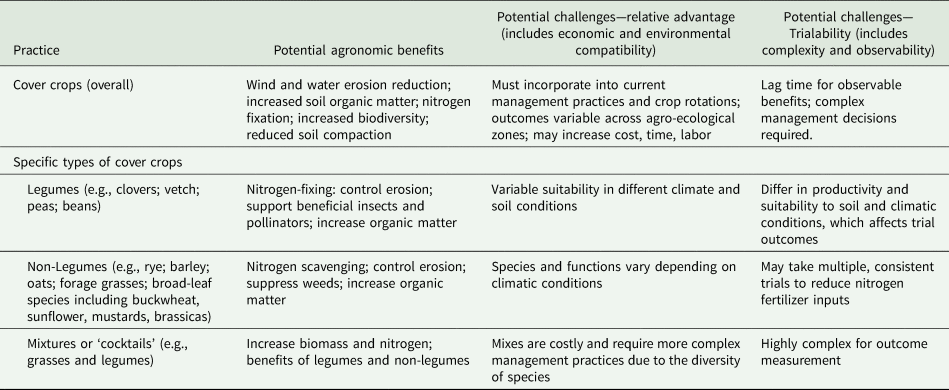
Trialing cover crops requires many context-dependent decisions, including existing crop rotations, field conditions, weather and costs (Plastina et al., Reference Plastina, Lie, Miguez and Carlson2018). Using focus groups with producers trying cover crops in Iowa, Roesch-McNally et al. (Reference Roesch-McNally, Basche, Arbuckle, Tyndal, Miguez, Bowman and Clay2017) describe several complex field-level and structural (e.g., markets) challenges that constrain producers' management decisions. In the iPNW, there are a number of factors to consider when integrating cover crops including weed competition challenges, moisture availability, planting and terminating times, and uncertainty regarding best cover crop species types (Pavek, Reference Pavek2014; Thompson and Carter, Reference Thompson and Carter2014; Kirby et al., Reference Kirby, Pan, Huggins, Painter, Bista, Yorgey and Kruger2017). See Table 1 for a summarized list of potential benefits and challenges to integrating cover crops.
Potential benefits and challenges associated with relative advantage and trialability of cover crop integration

Summarized from Pavek (Reference Pavek2014).
Pathways to increase relative advantage and trialability
The diffusion of innovations theory suggests that the adoption of an innovation is a process that takes time and may be viewed as an ‘uncertainty-reduction’ exercise. As Rogers (Reference Rogers1995, p. 216) states, ‘when individuals … pass through the innovation-decision process, they are motivated to seek information to decrease uncertainty about the relative advantage of a practice.’ Uncertainty is reduced through the acquisition of knowledge and experience.
Offering incentives to adopters may be one way to improve the relative advantage of practice. For example, the US Department of Agriculture's (USDA) Environmental Quality Incentives Program (EQIP) offers direct payments for experimenting with cover crop adoption. However, these payments are on a limited time scale (Stubbs, Reference Stubbs2014) and might not ensure long-term adoption (Rogers, Reference Rogers1995; Riley, Reference Riley2016). Producers in Iowa suggested an increase in on-farm crop diversification and through the integration of livestock (Roesch-McNally et al., Reference Roesch-McNally, Basche, Arbuckle, Tyndal, Miguez, Bowman and Clay2017) in order to improve the relative advantage of cover crops by increasing short-term profits. Integrating livestock and increasing crop diversification may be one way to reconcile economic profitability and soil health goals (Finkelnburg et al., Reference Finkelnburg, Hart and Church2016). Cover crop adoption, in particular, was associated with high compatibility with the current management system, an understanding of advantages over alternative practices and the availability of cost-share payments (Singer et al., Reference Singer, Kaspar and Pedersen2007; Reimer et al., Reference Reimer, Thompson and Prokopy2012a; Arbuckle Roesch-McNally, Reference Arbuckle and Roesch-McNally2015). Yet, cover crop adoption is not solely based on factors related to financial capital.
Improving field-level observability and clarifying the benefits of practice may improve perceptions of trialability (Dunn et al., Reference Dunn, Ulrich-Schad, Prokopy, Myers, Watts and Scanlon2016). High observability reduces the uncertainty of the practice and improves peer to peer learning by stakeholders, especially if it is deemed successful by producers and their peer groups (Shampine, Reference Shampine1998; Pannell et al., Reference Pannell, Marshal, Barr, Curtis, Vanclay and Wilkinson2006). Öhlmér et al. (Reference Öhlmér, Olson and Brehmer1998) note that producers prefer a ‘quick and simple vs detailed and elaborate analysis, small tests, and incremental implementation …’ (p. 273). Offering incentives through EQIP programs can also give farmers an opportunity to experiment with cover crops and observe the benefits, thereby improving perceptions of trialability. Identifying strategies that increase perceived relative advantage and trialability can reduce uncertainty about practice and improve decision-making processes (Rogers, Reference Rogers1995, Reference Rogers2003, Reference Rogers2010; Pannell et al., Reference Pannell, Marshal, Barr, Curtis, Vanclay and Wilkinson2006).
Methods
Study area
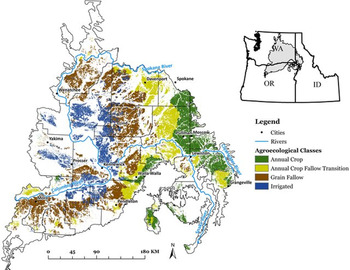
Characterized by a Mediterranean-type climate with warm, dry summers and cool, wet winters, the iPNW encompasses the semi-arid portion of Central Washington, Northeast Oregon and Northern Idaho (Fig. 1) (Huggins et al., Reference Huggins, Pan, Schillinger, Young, Machado and Painter2013). Average annual precipitation is a major limiting factor of production across the three agroecosystem classes (AECs) of the iPNW (Kirby et al., Reference Kirby, Pan, Huggins, Painter, Bista, Yorgey and Kruger2017). The three AECs include grain-fallow (40% fallow, less than 12 inches of precipitation), annual crop–fallow transition (10–40% fallow, 12–18 inches of precipitation) and the continuous cropping region (<10% fallow, 18–24 inches of precipitation). The primary purpose of the fallow period is to store winter precipitation, ensure economic crop yield and to reduce the risk of crop failure (Schillinger et al., Reference Schillinger, Papendick, Guy, Rasmussen and Kessel2003). Crop diversification in the iPNW is lower across the three AECs than other areas with similar climate types (Schillinger et al., Reference Schillinger, Papendick, Guy, Rasmussen and Kessel2003; Karimi et al., Reference Karimi, Stockle, Higgins, Nelson and Huggins2017). Winter wheat is the most profitable crop grown and accounts for 40–45% of crop area across the region. Barley, pea, lentil, chickpea, canola and condiment mustard are produced in smaller acreages across the region (Schillinger et al., Reference Schillinger, Papendick, Guy, Rasmussen and Kessel2003). Producers in this region are experimenting with a diverse range and mix of cover crop species, including brassicas (e.g., turnips, daikon radish), legumes (e.g., peas, vetch, clover, alfalfa), some grass species (e.g., millet, rye, oats) and oilseeds (e.g., sunflower, canola) (Pavek, Reference Pavek2014; Roberts, Reference Roberts2018).
The three primary agroecological classes of the iPNW of eastern, Washington, northern Idaho, and northerneastern Oregon. We do not include the irrigated cropping region as part of our study area. Map created by Harismran Kaur and used with permission.

Data collection
We utilized a multi-method qualitative research design to examine producer and stakeholder perspectives on cover crop adoption. Specifically, we employed interviews and focus groups which can, in tandem, enhance data richness and depth (Lambert and Loiselle, 2008). Our data collection design was informed by ten preliminary informational interviews with regional agricultural stakeholders including conservation district staff. These interviews aided in the development of our interview and focus group guides.
Producer interviews
We conducted semi-structured interviews with 28 crop and livestock producers. Farm and producer characteristics have been summarized in Table 2. Interviews explored producers' perspective on their experience with cover crops and the challenges associated with cover crop adoption (see Appendix A for relevant sections of the interview guide). We sought to interview both producers who are currently experimenting with cover crops and those who have not previously used cover crops. Local conservation district staff provided an initial list of crop and livestock producers. We then used snowball sampling methods to identify additional interviewees who fit the selection criteria. We conducted on-farm, face-to-face interviews during Fall 2018 and Spring 2019. Interviews were digitally recorded with producer consent (with Institutional Review Board approval, 2018), each ranging from 30 min to 2.5 h. Producers were asked to describe their agronomic management practices, including crop rotations and tillage systems, experience with conservation practices and experience with cover crop integration. Questions about cover crops included current practices, perspectives on challenges associated with cover crop integration and resources needed to facilitate adoption. Producers were also asked about where they went for information and about their response to adverse pest, weed and weather events.
Producer interview characteristics

a Farm regional average total is 3500 acres (Schillinger and Papendick, Reference Schillinger and Papendick2008).
Among our 28 producer interviewees, all grew and harvested winter wheat, spring wheat and barley within their rotations,Footnote 1 consistent with regional trends (Huggins et al., Reference Huggins, Pan, Schillinger, Young, Machado and Painter2013). Producers within the annual crop-fallow transition zone produced the highest diversity of crops, with the dominant rotations consisting of cereals, legumes and oilseed. Producers in the grain-fallow region had the least diverse rotations of a cereal and oilseed crop, though one producer in our sample integrated legumes. Eighteen producers were currently experimenting with cover crops over more than five acres, for more than one season, whereas the ten producers had not experimented with or participated in cover crop trials. Those who have adopted cover crops had experimented with summer, fall and spring plantings of a diverse range of cover crop species (both individual species and mixes) for between 1 and 6 yr. They also reported experimenting with a diverse range of warm and cool-season cover crop mixes, including brassicas, legumes, some grass species and oilseeds. Results from interviews are discussed in the sections Producer perceptions of the relative advantage of cover crops and Producer perceptions of trialability.
Focus groups
Based on results from producer interviews, we planned focus groups with producers and other agricultural stakeholders to better understand what it would take to integrate or promote cover crops in the region. We conducted eight focus groups during the Alternative Cropping Symposium on February 27, 2019 in collaboration with the Palouse Conservation District. Recruitment of participants was done by District staff and attendance was also open to the public. Conducting the focus groups at the symposium allowed researchers to hear from diverse agricultural stakeholders and offered a space for participants to openly discuss their views (Onwuegbuzie et al., Reference Onwuegbuzie, Dickinson, Leech and Zoran2009). The focus groups (n = 61) consisted of local and federal conservation agency staff, university researchers, industry agronomists, crop advisors and crop and livestock producers. We attempted to group participants by their professional orientation, but there was some heterogeneity of groups. Each focus group lasted approximately 1 h and was led by two of our team of moderators. Moderators asked participants to describe the primary differences between a cover crop and alternative crop, and the primary purpose of a cover crop. The first two questions were posed to help participants come to a common understanding of the term cover crop. Participants were then asked what it would take to be able to integrate cover crops within their current management system if they were producers or what it would take to promote cover crops if they were in advisory roles. Lastly, participants voted on the idea that most resonated or mattered to them using a prioritization process (See Appendix B for focus group questions).
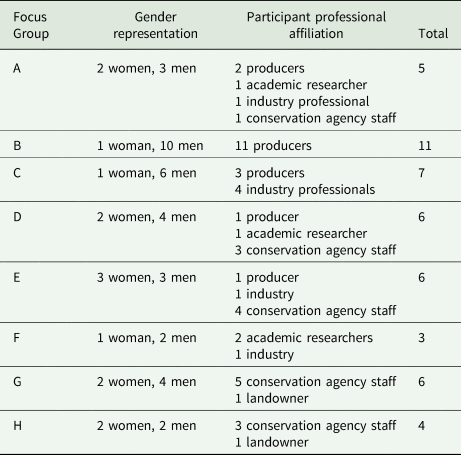
Focus groups included 20 producers, 17 conservation agency staff at the local, federal or state level, six industry professionals, three academic researchers and two non-operating agricultural landowners. See Table 3 for information on focus group characteristics. A majority of producers in the focus groups operated in the annual-cropping zone. Although there was heterogeneity in responses, there were many commonalities expressed across focus groups. Perspectives on the relative advantage and trialability of cover crops and potential pathways for improving perceptions of adoptability, as identified during focus group discussions are further discussed below in the section Focus group results: stakeholder-identified pathways to improve relative advantage and trialability.
Focus group details

Data analysis
Interview and focus group data were transcribed verbatim and analyzed using the NVivo 12 software package. This process involved both inductive and deductive coding to (a) contextualize local perspectives of cover crop adoption and then (b) examine our findings in relation to the diffusion of innovations theory (Tracy, Reference Tracy2013). We analyzed interview and focus group data following a hierarchical axial coding process (Bernard and Ryan, 2010; Tracy, Reference Tracy2013). During the primary cycle coding phase, we applied first level inductive codes to describe the economic and environmental context in which producers operated (Tracy, Reference Tracy2013). During the secondary-cycle coding process, we grouped first-level codes based on the two broad characteristics of innovation: relative advantage and trialability (Tracy, Reference Tracy2013). Secondary codes were based on Pannell et al.'s (Reference Pannell, Marshal, Barr, Curtis, Vanclay and Wilkinson2006) categorization of relative advantage and trialability. Two coders analyzed and discussed the codebook and established a high level of agreement on use and interpretation. We used a constant comparative method to review existing codes and iteratively modify the coding framework throughout the coding process (Charmaz, Reference Charmaz, Denzin and Lincoln2006). We conducted debriefings with other researchers and a producer on research memos, initial findings and manuscript drafts in order to ensure the validity of our interpretation (Lincoln and Guba, Reference Lincoln and Guba1994). For focus group transcript analysis, we followed a similar two-cycle coding process where we determined how suggested pathways may improve perceptions of the relative advantage and trialability of cover crops in the region. Interview and focus group participants were given unique IDs in order to maintain confidentiality.
Results
Producer perceptions of the relative advantage of cover crops
Producer interviewees perceived cover crops as having a low relative advantage, given two major environmental and economic factors. Producers perceived low compatibility of cover crops within their current systems due to (1) the specific climate in which they operate and (2) a lack of perceived short-term profitability. These challenges were often described as compounded by a lack of current region- and site-specific research and information. Producer 11, who operates in the annual-crop zone, explained that despite national interest in cover crops, producers are still in the process of determining the most effective strategies for integrating cover crops in the region:
I mean, in the short term, the last five years I would say, is where things have really started to change in the advent of cover cropping in the Northwest. Five years ago, it wasn't part of the discussion at all. So that's evolving as well around here. We're still trying to figure it out (11).
This producer was interested in responding to national calls to increase cover cropping but needed more information and experience.
With regard to environmental compatibility, producers often expressed how the lack of timely, seasonal moisture limited their ability to integrate an additional crop that is outside of their current crop rotations. Moisture availability was identified as a challenge for all producers in our study, regardless of their agroecological cropping zone. There is also a short planting window in the iPNW, which increases the risk of trial failure. These challenges were often discussed in comparison to the Midwestern states, which has a significantly different climate, but where a majority of research on cover cropping has taken place. Producer 2, for example, had experimented with cover crops for 5 yr in the annual cropping zone. They discussed how regional climatic characteristics and current management practices limited adequate cover crop growth and thus posed a challenge to cover crop integration:
We don't get the summer moisture like the guys in the Midwest do to grow a huge biomass of cover crops. So we're kind of limited in the growing season that we have. We plant them in May or late May and they might get one maybe two more rains for the whole season and then they don't get any moisture until October. So [we're] trying to find that mix of … cool season grasses and cool season legumes (2).
Producers across all three AECs expressed uncertainty regarding which cover crop species would be suitable for the region and their unique management goals. For instance, Producer 1, operating in the annual crop-fallow transition zone, had experimented with cover crops ‘on and off’ for 6 yr. But they had yet to determine the best species for the low moisture conditions and harsh winters on his farm.
In addition to perceptions of low environmental compatibility, cover cropping is associated with perceptions of low economic feasibility. Producer interviewees tended to associate cover crops with the displacement of a cash crop, a lack of net returns and increased inputs costs (e.g., seed, fertilizer, time and labor). These challenges were often discussed in tandem with regional concerns about the rising cost of inputs. Commodity market fluctuations also led many producers to take a conservative approach to financial risk. This approach was articulated by Producer 6, in the annual cropping zone, who has experimented with cover crops and livestock integration. They also noted the discrepancy that occurs between widespread promotion and regional feasibility of the practice:
We displaced a crop cycle … we're still spending money and having to cover the land cost hoping we get it back in some form the following year in the winter wheat. It was a long way away from happening. And it's frustrating for us. We're being pushed to go to cover crop rotations and so on because it works elsewhere (6).
Producer 10, in the annual cropping region, has been experimenting with cover crops with livestock for 3 yr. He discussed the risks associated with displacing a cash crop. He articulated how a lack of short-term profits and additional management requirements often constrain producers:
You do forego a [cash] crop. Because if you're going to do a cover crop and you put it into your rotation … you forego income … And if you're answering to landlords [for rent payments] … It's just not feasible economically for a lot of people. And it takes a different type of management that a lot of the farmers don't even have the time and wherewithal to do (10).
Despite the economic and agronomic challenges described in this section, many participants expressed a desire to continue experimenting with cover crops to improve soil health, increase crop diversity and mitigate erosion.
Producer perceptions of trialability
Many producer interviewees associated cover cropping with low trialability due to the complexity of the practice. Producers discussed having to navigate management decisions, including the function and purpose of the cover crop; the most effective planting equipment (i.e., broadcast seeders and drills); the species type (e.g., single or blended mix); planting and termination times; and potential weed, pest and disease pressure. Producer 5 described the many facets of his cover crop experiments:
One [cover crop] in the fall after harvest and one in the early spring, pretty much as early as we can get out there, and then usually one early June. And each one of those different cover-crop trials was a different mix … The hard part is there's not really a clear goal for what everybody wants to get out of it … And even if we do know what we want, we're not exactly sure how to get it (5).
For this producer, the many potential benefits of cover crops actually made it more difficult for him to create goals for his field trials. Producer 13, operating in the annual-crop, fallow transition zone, has experimented with cover crops on a five-acre trial in partnership with a local conservation district. They described the complexity of determining planting and terminating times while also navigating weed pressure. The following quote illuminates challenges associated with experimenting with cover crops when managing weeds.
We put some [cover crops] in, in the fall … but what happens is [that the field] gets full of cheatgrass. So we have to spray it out [apply herbicide] first thing in the spring. [The District] wanted us to keep [the cover crop in the ground] longer but it's like, you have to spray it out … So we weren't a big help [with the trial] (13).
In addition to complex management decisions, producers discussed the lack of directly observable outcomes from short-term cover crop trials as a challenge to trialability. Short-term and small acreage trials may be more economically feasible for producers but were often discussed as yielding inconsistent and inconclusive results. The time lag of soil health benefits after a trial has the potential to reduce producer perceptions of cover crops having a positive outcome. On the other hand, Producer 24, a crop and livestock operator in the annual crop-fallow transition zone, realized that they needed to look below the soil surface to see results:
‘You want to see something fascinating? Around the 1st of September … this was another failure: dry, dry, dry. I would have told you everything was dead until you got down on your hands and knees … You could squeeze just a little bit of something out of [the soil], juice, moisture, I don't know (24).’
As this producer suggested, cover crops may have significant below-ground impacts that are not quickly observable when walking a field.
Field-level trialability challenges are compounded by crop insurance policies that lack support for cover crop integration. Cover crops are recognized by agricultural experts as a tool for erosion control, or for other conservation purposes. However, there are vague aspects of policies, such as lacking an approved list of cover crop species, that create a perception of risk for producers. For example, Producer 19 operates in the grain-fallow region and has been trialing cover crops to improve moisture retention. They described a lack of clear protocol for determining how to ensure his trial:
I'm trying to be honest with [the crop insurance agent], I marked out this spot. I said, ‘I seeded cover crop here.’ They couldn't find it in the damn chart … They finally found something that was close. And I said, ‘Well, it's not really forage and it's not really a legume, but close enough.’ (19).
Producers experimented with cover crops despite the lack of clear protocol for cover crops in crop insurance policies. Producer 4, a crop and livestock producer in the annual-cropping zone, had integrated cover crops on approximately 500 acres. They managed a cover crop trial without the security of crop insurance on those acres. When asked how they dealt with that uncertainty, they state:
[I] Pray. When that big storm came through this summer, I was worried about the clover and other crops … they were going to get pounded. And we just didn't have any insurance on them (4).
As this producer expressed, there is a high level of risk and uncertainty associated with integrating cover crops without security from crop insurance. Many producers discussed this issue as an overarching barrier to integrating cover crops at a farm-level.
Perceptions of field-level trialability are impacted by high complexity and low observability of trial results. In addition, inflexible crop insurance policies may constrain producers from experimenting with cover crops and contribute to perceptions of low trialability. These factors may act as initial barriers to implementation and impede adoption of cover crops in the iPNW. Focus groups were used to better understand pathways to improve perceptions of the relative advantage and trialability of cover crops.
Focus group results: stakeholder-identified pathways to improve relative advantage and trialability
To improve overall perceptions of relative advantage and trialability of cover crop adoption, focus group participants identified the need for (1) research trials that can inform regionally appropriate strategies and that suit producers' existing management systems, (2) increased understanding of economic benefits of cover crops and ways to reconcile short- and long-term economic profitability and (3) increased collaboration and information sharing between producers, university researchers, industry professionals and landowners.
Conduct regionally applicable research
Several participants mentioned that producers' information and other resource needs will differ depending on their unique management goals. Participants recognized the need for research trials that are tailored to specific sites, given the differences in soil and geography across the region and across fields. A producer in Group C said, ‘We have a lot of differences within our field itself. We are doing a lot of precision agriculture to try to take advantage of those differences.’ Similarly, the following statement from the Natural Resources Conservation Service (NRCS) employee emphasized how cover crop trials need to be customized to each farm and farmer.
The issue I have is that every farmer is different, every farmer has different goals, every year is different. So you have to customize a trial or a goal of theirs to … their goals and have a proven method to show that this cover crop is beneficial to them … then you can say ‘Ok, here's a packet that covers your cost to plant this.’ (Group D-NRCS employee)
As this statement emphasized, custom trials supported by cost-share programs could demonstrate the effectiveness of the practice to the producer and reduce the financial risk associated with experimentation.
Reconciling economic feasibility
Participants across all focus groups identified the need to reconcile the short- and long-term financial viability of cover cropping. In one producer focus group, a participant said:
I really think that they need to figure out what the economics is gonna look like to the farmer … if you can really get some hard evidence that there's gonna be some economic gain if they follow the right kind of procedure, I think it will help with adoption (Group H-producer).
Although cost-share options are available, cost-benefit information would help producers make decisions about whether or not cover crop integration is feasible for their operation and address potential risks.
Part of addressing economic feasibility is considering the usefulness of the term ‘cover crop.’ Even though the terms ‘cover crops’ and ‘alternative crops’ are often used for crops with similar agronomic and environmental benefits, many participants agreed that the term ‘alternative crop’ is more frequently associated with economic feasibility than the term ‘cover crop.’ Alternative crops are usually planted with the intent to sell as a specialty crop, as opposed to cover crops, which are usually terminated in the field. One participant, a local farm laborer and private agricultural contractor said the following: ‘They're both better for the field … Alternatives, it's more about that trying to make money now, instead of spending as much money tomorrow, next year’ (Group A-industry representative). In this participant's terms, alternative crops are often associated with short-term financial profitability while cover crops are more commonly associated with long-term soil health benefits. Reconciling these two terms could be helpful to improve perceptions of cover crop feasibility.
Integrating livestock into cropping systems
One potential pathway for improving financial feasibility and relative advantage of cover crops is to incorporate livestock into existing management practices. Participants suggested this be done through direct integration or by connecting livestock and crop producers. In one focus group, a conservation staff member discussed connecting crop producers interested in cover crops with livestock producers who may be motivated to work in partnership and provide the necessary infrastructure for grazing:
Anybody that comes into my office, [I ask], ‘Do you have cattle?’ If no, go find somebody that has cattle because you can rent out your cover crops. I got a guy that's looking for land that he can rent, to put up the fence, he'll put in the water, he'll do everything if he can graze your cover crops (Group H-conservation district employee).
One producer in Group C also highlighted the need to facilitate these connections.
You know, there is a huge barrier. People are afraid of livestock and producers don't work well with ranchers all of the time. So [we need] something to help with cooperation between ranchers and producers (Group C-producer).
Many participants saw livestock integration as a viable option for increasing the use of cover crops in the region. However, it was widely recognized that more guidance is needed on specific infrastructure (i.e., fencing) and market (i.e., farm to the slaughterhouse) best practices.
Increase collaboration and information sharing
To support cover crop expansion, focus group participants suggested the need for collaboration and information sharing between producers, university researchers, industry professionals and landowners. One group, consisting mainly of producers and private agronomists, suggested that agronomists need to be more widely included in the discussion about cover crop integration. They noted that agronomists have closer connections to producers and are closely involved with making decisions about crop rotations and fertilizer use.
They are eyes on the ground and they see so many more acres than we do on things that could potentially work, but their whole livelihood is mostly surrounded around selling synthetic fertilizer or maybe a little bit of organic fertilizer here and there’ (Group C-producer).
This producer clearly sees the pros and cons of increasing the role of private agronomists in cover crop discussions. While they understand the farm context well, they may be more likely than university Extension or a conservation district to promote certain products.
Participants emphasized the importance of demonstrating examples of success, consolidating innovator knowledge and improving peer-to-peer communication. In Group H, participants recommended finding local innovators and highlighting their experiences within the community.
Find those farmers that are willing to try something new and identify those who have stuck with it long enough to find out that it works and try to have them be an advocate, or poster child for farming communities. For farming communities, there's communication from farmer to farmer and they may not listen to a scientist or something but there's a higher chance they'll listen to their fellow farmer or community member. (Group H-Department of Agriculture employee).
Several participants also suggested that increasing producer-driven research trials in collaboration with university researchers would improve the region and site-specific research outcomes. This approach could improve individual perceptions of relative advantage and trialability given producers' insights on the challenges to cover crop adoption.
Discussion
Using the diffusion of innovations theory, we found that producers associate cover crops with low relative advantage and low trialability, perceptions that were compounded by a dearth of region-specific research and recommendations. The view that relative advantage was low was largely driven by perceived low economic and environmental compatibility, while the view that trialability was low was driven by high perceived complexity and low observability of cover crop trials and outcomes. These findings are consistent with findings in other studies. Low agronomic compatibility, which can lead to low perceived relative advantage, is a challenge for producers across the USA (Atwell et al., Reference Atwell, Schulte and Westphal2009; Plastina et al., Reference Plastina, Lie, Miguez and Carlson2018). Similarly, uncertainty regarding planting and terminating times, and species type and function, are consistent with barriers identified elsewhere (Dunn et al., Reference Dunn, Ulrich-Schad, Prokopy, Myers, Watts and Scanlon2016; Roesch-McNally et al., Reference Roesch-McNally, Basche, Arbuckle, Tyndal, Miguez, Bowman and Clay2017; Plastina et al., Reference Plastina, Lie, Miguez and Carlson2018). These uncertainties, compounded by a perceived risk of losing crop insurance, impacts producers' ability to experiment with cover crops (Plastina et al., Reference Plastina, Lie, Miguez and Carlson2018; Bergtold et al., 2019). Next, we contextualize the pathways forward offered by our interview and focus group participants within the agricultural diffusion of innovations literature.
Improving relative advantage
Focus group results highlighted that reconciling short- and long-term financial profitability may improve the perceived relative advantage of cover crops and reduce the perceived risk associated with integration, which is supported by several other studies for other regions ( Snapp et al., 2003; Ghadim et al., Reference Ghadim, Pannell and Burton2005; Bergtold et al., Reference Bergtold, Ramsey, Maddy and Williams2017). Focus group participants suggested the need to better connect crop and livestock producers, measure economic impacts, and increase infrastructural support to livestock integration. Livestock integration has been found to be an important factor in promoting cover crop adoption in other places, as cover crops provide forage for livestock operations (Singer et al., Reference Singer, Kaspar and Pedersen2007; Arbuckle and Roesch-McNally, Reference Arbuckle and Roesch-McNally2015; Roesch-McNally et al., Reference Roesch-McNally, Basche, Arbuckle, Tyndal, Miguez, Bowman and Clay2017). Many producers we interviewed also shared interest in alternative crops, as a means to diversify their crop rotations, improve soil quality and meet short-term economic goals. As crop rotations diversify, cover crop integration may become more feasible (Stuart and Gillon, Reference Stuart and Gillon2013). Therefore, encouraging and supporting crop intensification and diversification could be one pathway to more widespread adoption of cover crops (Huggins et al., Reference Huggins, Pan, Schillinger, Young, Machado and Painter2013; Kirby et al., Reference Kirby, Pan, Huggins, Painter, Bista, Yorgey and Kruger2017; Pan et al., Reference Pan, Schillinger, Young, Kirby, Yorgey, Borrelli, Brooks, McCracken, Maaz, Machado, Madsen, Johnson-Maynard, Port, Painter, Huggins, Esser, Collins, Stockle and Eigenbrode2017).
Improving trialability
Focus group participants suggested the need for more regional and site-specific research on best practices, which may improve the trialability of cover crops. Other studies have identified a need for increased long-term, geographically scalable agronomic research to meet the short- and long-term economic and environmental goals (Robertson et al., Reference Robertson, Allen, Boody, Boose, Creamer, Drinkwater, Gosz, Lynch, Havlin, Jackson, Pickett, Pitelka, Randall, Reed, Seastedy, Waide and Wall2008; Yorgey et al., Reference Yorgey, Painter, Borrelli, Kantor, Davis, Bernacchi, Kruger and Roe2017; Pannell and Claassen, Reference Pannell and Claassen2020). Increasing long-term research trials may provide producers with a better understanding of the agronomic and economic benefits of the practice. Tosakana et al. (Reference Tosakana, Tassell, Wulfhorst, Mahler, Brooks and Kane2010) suggest that long-term observation sites may help to shift producers' perceptions of the feasibility of certain conservation practices. Increasing the number of these trials across the region and focusing on producers who have overcome limitations would further improve the observability of the practice (Pannell et al., Reference Pannell, Marshal, Barr, Curtis, Vanclay and Wilkinson2006; Dunn et al., Reference Dunn, Ulrich-Schad, Prokopy, Myers, Watts and Scanlon2016).
Recommendations
Our Results provide a clear insight into the complex challenges that producers face when deciding to integrate cover crops and demonstrates how perceived characteristics of cover crops affect adoption. Our findings suggest that producers have legitimate reasons for not adopting—or for discontinuing—the practice, given the perception of low relative advantage and the environmental, economic and social context in which they operate. Producer perspective on the low trialability of cover crops including the relative complexity and low observability pose real challenges, especially when there is limited regional data to support long-term economic and agronomic feasibility.
There are several limitations to this study. First, we bounded the case to the dryland wheat-growing region of the iPNW, which limits the applicability of the study due to the small sample size and geographic specificity. Second, while we sought to engage with a spectrum of producers and agricultural stakeholders across the region, we did not have a sufficient number of participants to analyze whether perspectives on cover crop adoption differed by AEC. Future research could explore possible differences in cover crop adoption across the three AECs of the region. Third, most of the interview participants were male. Although this composition is consistent with the majority of wheat producers in the iPNW, future work should include perspectives that represent diverse views and provide a greater understanding of the perceived barriers and pathways to the adoption of cover crops.
Based on our findings and literature review, we recommend the following options for improving perceptions of cover crops in the iPNW:
• Information on cover crops, including species choice and timing of planting and termination, should be regionally-specific, and ideally, information should be tailored to the unique field-level goals of the producer (Plastina et al., Reference Plastina, Lie, Miguez and Carlson2018).
• Agencies promoting cover crops should engage with diverse agricultural stakeholders to better understand the complex factors inherent in the agricultural decision-making process (Prokopy et al., Reference Prokopy, Morton, Arbuckle, Saylor Mase and Wilke2015).
• Local conservation agencies can facilitate collaboration between agricultural stakeholders, connecting networks and improving the diffusion of cover crops (Wu and Zhang, Reference Wu and Zhang2013; Kalcic et al., Reference Kalcic, Frankenberger, Chaubey, Prokopy and Bowling2015).
• Future cover crop research should be conducted in close collaboration with producers to build their capacity, demonstrate site-specific compatibility and provide the opportunity for peer-to-peer learning (Pannell et al., Reference Pannell, Marshal, Barr, Curtis, Vanclay and Wilkinson2006; Dolinska and d'Aquino, Reference Dolinska and d'Aquino2016).
Acknowledgements
This work was supported by a grant from the University of Idaho Office of Research and Economic Development, and USDA National Institute of Food and Agriculture McIntire-Stennis grant #1015330. We would like to thank our research partner, the Palouse Conservation District, who helped facilitate this work. A special thank you to the crop and livestock producers, University researchers, private industry employees and conservation staff who participated in interviews and focus group discussions.
Appendix A
Relevant Interview Questions:
(1) Could you describe what cover crops are?
(2) What types of cover crops do you use and what reason did you have for using them?
(3) What were some of the barriers associated with implementation?
(4) What are the successes?
(5) How did you navigate those challenges associated with cover crop adoption?
(6) What are the short term vs long term effects of cover crop usage?
(a) How does your use of cover crops factor into your short- and long-term management decisions?
(1) What motivates you to continue using cover crops?
(2) How do you think other farmers perceive your use of cover crops?
(3) IF relevant: Does your landlord support the use of cover crops? (only if leased)
(4) What would you suggest for other farmers thinking about adoption?
Grazing:
(1) Grazing cover crops is seen as one viable conservation practice in this region, what are your thoughts on this?
(2) Do you see cover crops being a viable practice without grazing them?
Category 4 non-use
There has been some research that shows that cover crop use builds organic matter and decreases erosion. However, it is not clear how widely they are used in the Palouse. I am interested in hearing your perspective on cover crops in this region.
(1) Could you describe what cover crops are and if you have ever used them? If not, why?
(2) What are your main concerns about the use of cover crops?
(3) What resources would allow you to try cover crops?
(4) What resources or information would be helpful if you were interested in using cover crops?
Appendix B
Focus Group Questions:
(1) What words do you think of [or what comes to mind] when you hear the term ‘alternative crop’ vs ‘cover crop’? Take the next 2 min to write down your thoughts about alternative crops on one side of the notecard and your thoughts on the term ‘cover crop’ on the other side.
(2) What do you consider a primary reason for using a cover crop?
(3) If you were to consider using a cover crop, what would it take to integrate them into your current management practice?
(4) Prioritization Process: For the last question, you have been given three colored dots that you will use to show which ideas you agree with/care about the most. We will give you a couple of minutes to place your sticky dots on the statement that you agree with the most; you can place up to two sticky dots on one idea.
(5) For those of you that chose this idea (greatest number of votes), can you describe why you went with that choice?
(6) Can someone share about why they did not agree with this statement (lowest number of sticky dots)
(7) Does anyone have anything else to add about why they chose what they did?
(a) Probing ideas: Only bring these up if discussion lulls (2–3 min).
(b) What do you think about …?
(i) Intermediaries for connecting livestock and crop producers
(ii) Equipment co-op or rental
(iii) Network development/information sharing
(iv) Direct payment-Economic inventive