Introduction
Praxelis is an annual or short-lived perennial herb belonging to the family Asteraceae with a reported native range in South America, including parts of Argentina, Bolivia, and southern Brazil (King and Robinson Reference King and Robinson1970). Outside of its native range, praxelis has been introduced and naturalized in parts of China (Waterhouse Reference Waterhouse2003) and Taiwan (APHIS 2014). It is considered highly invasive in Queensland, Australia, and consequently was placed on an alert list for invasive plants in Australia (CRCAWM 2003). In the United States, praxelis was first discovered in Orange County, FL, in 2006 in an abandoned orange grove (Abbott et al. Reference Abbott, White and Davis2008) and is now present and naturalized in at least seven central Florida counties: Hardee, Hillsborough, Lake, Manatee, Orange, Osceola, and Polk (Wunderlin et al. Reference Wunderlin, Hansen, Franck and Essig2020). Praxelis is currently listed on the USDA APHIS Not Authorized Pending Pest Risk Analysis list as a potential pest plant but is not currently listed as a Florida or federal noxious weed (APHIS 2014). USDA-APHIS risk assessments indicate that praxelis could potentially naturalize throughout the southeastern United States and in Hawaii, but this plant is currently only reported and documented in Florida.
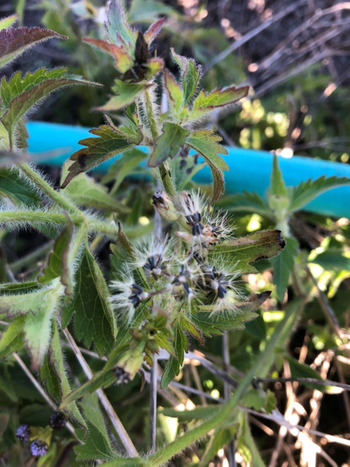
Praxelis grows in tropical and subtropical areas and tolerates partial to full sun or shade (CRCAWM 2003). It invades disturbed areas (Waterhouse Reference Waterhouse2003) and is a prolific seed producer that can produce thousands of seeds in 3 to 4 mo following germination. No reports of seed production are available in the literature. However, using seed estimation methods previously described by Saha et al. (Reference Saha, Marble, Torres and Chandler2019) for eclipta [Eclipta prostrata (L.) L.], we estimated 15,430 to 23,150 seeds being produced over the span of 4 mo on mature praxelis growing in a pasture area in Apopka, FL. It grows well in a variety of soil types, ecosystems (disturbed or intact), and areas denuded by fire (Gardner and Williges Reference Gardner and Williges2015). Praxelis is also capable of vegetative spread, with an ability to take root along stem nodes when in contact with the soil (CRCAWM 2003). When stressed by herbicide or drought, it responds by increasing seed production (FLEPPC 2014). Seeds contain a pappus or cluster of barbed bristles (15 to 40 bristles) that aid dispersal by wind or water, or by attaching themselves to animal fur and feathers, clothing, or machinery (Figure 1). It has also been reported to be spread through mulch and landscape materials (CRCAWM 2003; Waterhouse Reference Waterhouse2003).
Praxelis seeds and pappus.

Although praxelis was first reported in Florida in 2006, it may well have been introduced earlier and may be more widespread as a result of misidentification, as it is morphologically similar to several native or naturalized species in Florida (Abbott et al. Reference Abbott, White and Davis2008). Notably, praxelis is morphologically similar to Florida native species blue mistflower [Conoclinium coelestinum (L.) DC.], Siam weed [Chromolaena odorata (L.) R. M. King and H. Rob.], pink thoroughwort [Fleischmannia incarnata (Walter) R. M. King & H. Rob.], and two related exotic weed species: tropical ageratum [Ageratum conyzoides L.] and bluemink (CRCAWM 2003; Gardner and Williges Reference Gardner and Williges2015). Although several species share a resemblance to praxelis, blue mistflower and bluemink are most similar in terms of size, morphology, and distribution throughout the state, leading to misidentification (Abbott et al. Reference Abbott, White and Davis2008).
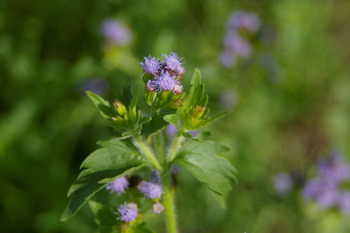
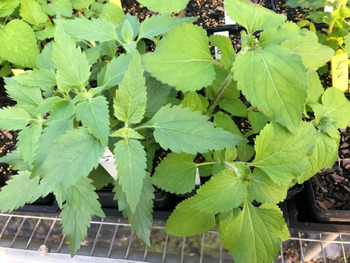
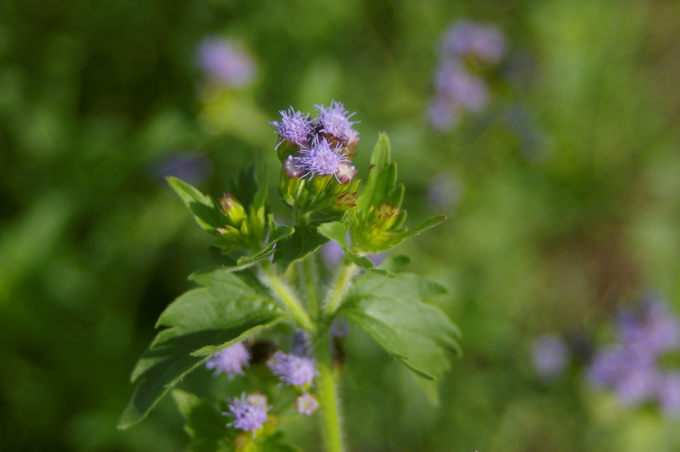
Both blue mistflower and bluemink are found throughout Florida (Wunderlin et al. Reference Wunderlin, Hansen, Franck and Essig2020), but bluemink is more problematic as an agricultural weed and is a common nuisance in container and field nurseries in central and south Florida. Bluemink is native to tropical and subtropical areas in Central America and Mexico and introduced into Europe and parts of North America as an ornamental (Johnson Reference Johnson1971). However, it has become an invasive weed in parts of the southern United States, Japan, Australia, and China (Kohli et al. Reference Kohli, Batish, Singh and Dogra2006). Both species are similar in size and appearance. Praxelis is an upright-growing herb that can mature to a height of 1 to 1.3 m (Abbott et al. Reference Abbott, White and Davis2008). The stem is cylindrical, brittle, green, and often densely pubescent. Leaves are oppositely arranged, 2.5 to 6 cm long, 1 to 4 cm wide, and tear- to diamond-shaped with large serrations along leaf blades and an acute apex. Praxelis has lavender or bluish flowers in clusters of about 35 to 40 tubular florets, growing in groups at the ends of stems (Figure 2). The key distinguishing features of praxelis are that florets are set into a highly cone-shaped receptacle and that the leaves emit a foul odor when crushed (CRCAWM 2003). The leaves of bluemink are broad or heart-shaped and have smaller finely or blunt-edged serrations on leaf blades compared with praxelis’ tear shaped leaves with large serrations (Figure 3). The bract that surrounds and supports the flower head is persistent on bluemink, unlike praxelis. Bluemink also lacks a pappus, and seeds consist of four to five small bristlelike scales. Reports of praxelis or bluemink response to different climatic conditions do not exist, but we have observed both species flowering throughout the year in central Florida when freezing temperatures have not occurred.
Praxelis inflorescence.
Shoots and foliage of praxelis (left), and bluemink (right).

In nurseries, we have observed both species growing in noncrop areas (ditches, fallow fields, row middles) throughout central and south Florida. Both species are commonly found in containerized ornamentals but are most prevalent growing from pot drain holes, in the bottom sides of nursery containers. Both species are found in unirrigated fields but are most commonly seen in close proximity to container production space where regular overhead irrigation is supplied, or in low-lying areas of nurseries where soil remains damp or moist throughout most of the year.
Currently there is no published research on the response of praxelis to herbicide control options. The Queensland Department of Agriculture, Fisheries, and Forestry in Australia recommends use of POST herbicides such as glyphosate, fluroxypyr, metsulfuron, or a combination of 2,4-D and picloram, but no efficacy reports have been published (ADAF 2020). Observational reports indicate that a 3% (by vol) glyphosate treatment was effective as a POST treatment, but the population rapidly reestablished from seed and some regrowth from treated stems (Gardner and Williges Reference Gardner and Williges2015). Similarly, few reports are available on bluemink.
As praxelis is becoming more prevalent in Florida nurseries and other agricultural or natural areas, it is important to determine its response to commonly used herbicides to provide growers with effective management options. The objective of these experiments was to determine praxelis response to PRE and POST herbicides labeled for use in nurseries or noncrop areas. As praxelis is similar in appearance to bluemink and often invades similar settings, a secondary objective was to determine efficacy of PRE herbicides for control of bluemink.
Materials and Methods
Praxelis PRE Experiment
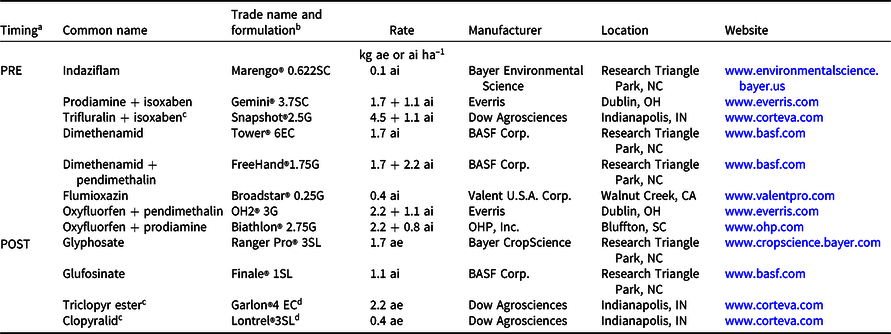
Trials were conducted in 2018 in Apopka at the Mid-Florida Research and Education Center (28.641°N, 81.546°W) and at the Gulf Coast Research and Education Center at Balm, FL (27.761°N, 82.228°W), in 2018. At Apopka, 1.7-L nursery pots were filled with a pine bark/peat/sand soilless substrate (70:30:10 by vol) that had been previously amended with Osmocote® 17-5-11 controlled-release fertilizer (ICL Specialty Fertilizers, Summerville, SC) at 8.3 kg m–3 via incorporation. PRE herbicides (Table 1) were applied on May 23 (30 C, 69% relative humidity, partly cloudy). Spray-applied herbicides (dimethenamid, indaziflam, and prodiamine + isoxaben) were applied using a CO2 backpack sprayer fitted with an 8004 flat-fan nozzle (TeeJet Technologies, Wheaton, IL) calibrated to deliver 187 L ha–1. Granular herbicides were applied by evenly placing all pots for each treatment inside square 2-m–2 frames made of polyvinyl chloride pipe and applying the herbicide carefully over the entire 2-m–2 area with a hand-shaker, making four passes. All herbicides were applied at their maximum label rate for a single application. Herbicides were chosen based on grower interest and because they are regularly used by central Florida nursery growers to control weeds either in container production or in noncrop areas adjacent to production areas. Following treatment, all pots were placed on a full-sun nursery pad and received 1.3 cm of overhead irrigation daily throughout the trial. Two days after herbicide treatment, 50 seeds of praxelis were surface sown to containers. Seeds used in Apopka trials were obtained from natural populations present at the Mid-Florida Research and Education Center and were stored for 13 d at room temperature prior to sowing. No preconditioning of the seed was performed. Data collected comprised weed counts at 4 and 8 wk after treatment (WAT) and determination of shoot fresh weights at 9 WAT by cutting plant shoots at the soil line and immediately weighing in the field using a portable digital balance. At Balm, 3.8-L nursery pots were filled on May 9, 2018, with a pine bark and peat soilless substrate (60:40 by vol) and top-dressed with Osmocote® 14-14-14 at 15 g pot–1. Herbicides were applied on May 10 (17 C, 94% relative humidity, partly cloudy) using methods similar to those at Apopka. Following treatment, pots were irrigated with 1.3 cm of overhead irrigation, and 100 praxelis seeds were surface sown to each container 1 d after treatment. Seeds were obtained from natural populations present at the Gulf Coast Research and Education Center and stored at room temperature for approximately 3 wk before sowing, and no preconditioning was performed. Pots were then placed under a shade structure (60% of ambient light) and received 1.3 cm of overhead irrigation per day. Weed counts were taken 3, 5, 7, and 9 WAT.
Herbicide rates and formulations applied in PRE and POST experiments to praxelis and bluemink in Florida.

a PRE herbicides were evaluated in outdoor pot experiments on both praxelis and bluemink in 2018 and 2019. POST herbicides were evaluated on praxelis only in 2019.
b Abbreviations: EC, emulsifiable concentrate; G, granule; SC, suspension concentration; SL, soluble liquid. Granular formulations were applied using a hand-shaker, and all other formulations were applied using a CO2 backpack sprayer.
c Applied with the addition of a nonionic surfactant at 0.25% by vol (AirCover™, Winfield Solutions, St. Paul, MN).
Experiments at both locations were completely randomized designs, with eight single-pot replications at Apopka and four single-pot replications at Balm. All data were subjected to a mixed-model ANOVA using JMP® Pro software (Ver. 14; SAS® Institute, Cary, NC) with herbicide as a fixed effect and replication as a random effect. Post hoc means comparisons were accomplished using Fisher’s protected LSD test (P ≤ 0.05). As weed counts in Apopka at 4 WAT were similar to those at 8 WAT, only 8-WAT data are presented. Similarly, only weed counts recorded at 3 and 9 WAT are reported for Balm.
Praxelis and Bluemink PRE Experiment
As praxelis and bluemink are often confused by nursery growers, an additional PRE trial was conducted at Apopka in 2018 and repeated in 2019 to determine the response of both species to PRE herbicide applications. The experiment was implemented following the same procedures described previously for Apopka. Pots were filled on September 7, 2018, and treated with PRE herbicides on September 10 (31 C, 59% relative humidity, partly cloudy). Following treatment, pots were placed in an open-sided shade structure (60% ambient light) and received 0.8 cm overhead irrigation per day. On September 12, 50 seeds of praxelis and bluemink (determined by seed weight) were surface sown to separate sets of treated containers. Praxelis seeds were obtained from Apopka populations mentioned above, whereas bluemink seeds were obtained from populations in Florida City, FL, following the same procedures. The experiment was a completely randomized block design with eight single-pot replications per treatment. Data collected comprised weed counts at 3 and 8 WAT and shoot dry-weight determination at 10 WAT by clipping plants at the soil line and drying shoots in a forced-air oven at 66 C for 7 d until reaching a constant weight. The experiment was repeated on May 7, 2019, following the same procedures. Data were analyzed in the same manner as for the praxelis-only PRE experiment. Praxelis data were not combined with the first praxelis experiments, because dry weights were determined in lieu of fresh weights when evaluated in conjunction with bluemink.
Praxelis POST Experiment
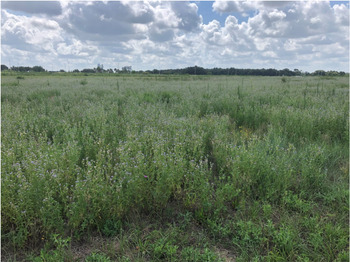
Trials were conducted at the Mid-Florida Research and Education Center in Apopka in 2019. A fallow field densely populated with praxelis was chosen as the experimental site (Figure 4). The entire experimental area was approximately 0.8 ha–1 and contained flowering praxelis that were 70 to 80 cm in height, with 8 to 12 woody stems arising from the plant base, and were growing at a density of 10 to 15 plants m–2. The soil was a Tavares millhopper fine sand with 1% organic matter and a pH of 7.1. The experimental site was divided into experimental plots measuring 1.5 m wide by 4.6 m long. POST herbicides (Table 1) were applied on July 3 (28 C, 74% relative humidity, clear skies) using a CO2 backpack sprayer with a two-nozzle boom using flat-fan nozzles (8002 TeeJet® Technologies, Wheaton, IL) calibrated to deliver an application volume of 468 L ha–1. Triclopyr and clopyralid were applied with the addition of a nonionic surfactant at 0.25% by vol (AirCoverTM, Winfield Solutions, St. Paul, MN). The trial was designed as a completely randomized block with four replications per treatment and was repeated using the same methodology on a separate but similar experimental site at the Mid-Florida Research and Education Center on July 15 (27 C, 72% relative humidity, clear skies). Control ratings, taken visually, were recorded at 4, 8, and 12 WAT on a scale of 0 to 100 where 0 = an estimated 0% control based on comparison with nontreated plots and 100 = 100% control (no visible green tissues). Visual ratings were concluded at 12 WAT, as plants within the experimental area began natural senescence at that time. Visual ratings were arcsine transformed to meet the assumptions of ANOVA. After transformation, data were analyzed in the same manner as PRE trials, and ratings from the nontreated control were excluded from the analysis. All data were back-transformed after analysis to retain biological meaning and were pooled over both experimental runs, because there were no treatment-by-experimental run interactions.
Experimental site for POST evaluations for praxelis control at Apopka, FL, in 2019.

Results and Discussion
Praxelis PRE Control
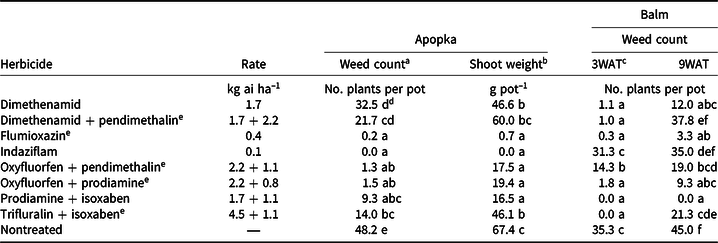
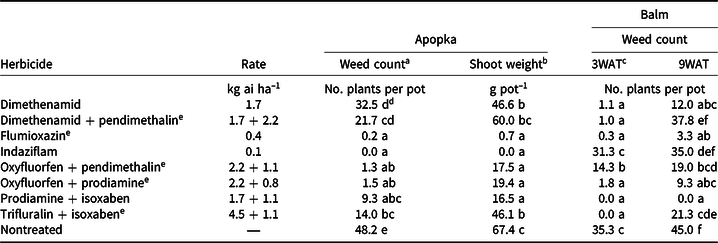
At Apopka, praxelis counts were lowest in pots treated with flumioxazin and indaziflam (100% reduction in weed counts) along with pots treated with oxyfluorfen + pendimethalin, oxyfluorfen + prodiamine, or prodiamine + isoxaben, with all having similar counts (Table 2). Although all treatments significantly reduced praxelis emergence in relation to nontreated pots, pots treated with dimethenamid or dimethenamid + pendimethalin had the highest number of emerged praxelis, followed by pots treated with trifluralin + isoxaben, which were similar. Shoot fresh weights generally followed the same trend, with the exception that pots treated with dimethenamid + pendimethalin had praxelis shoot weights similar to nontreated pots.
Response of praxelis to selected PRE herbicides at Apopka and Balm, FL in 2018.
a Weed counts were taken in Apopka at 8 wk after herbicide treatments (WAT) were applied.
b Shoot fresh weights were collected at 9 WAT by clipping praxelis at the soil line and weighing.
c Each pot was surface sown with 50 praxelis seeds at Apopka and 100 praxelis seeds at Balm following treatment.
d Means within a column followed by the same letter are not significantly different according to Fisher’s protected LSD test (P ≤ 0.05).
e Granular formulations were applied with a hand-shaker. All other treatments were spray-applied formulations.
Similar to results in Apopka, praxelis counts at Balm were lowest in pots treated with flumioxazin, oxyfluorfen + prodiamine, and prodiamine + isoxaben at 3 WAT, with at least 95% reduction. However, whereas indaziflam provided a 100% reduction in praxelis counts in Apopka at 8 WAT, praxelis in pots treated with indaziflam at Balm had counts of 31, which was similar to the nontreated control at 3 WAT. Weed counts were also lower with trifluralin + isoxaben and with both treatments containing dimethenamid. By 9 WAT, the lowest weed counts were observed in pots treated with prodiamine + isoxaben along with pots treated with dimethenamid, flumioxazin, and oxyfluorfen + prodiamine.
Flumioxazin, oxyfluorfen + prodiamine, and prodiamine + isoxaben provided a high level of praxelis control at both locations, reducing either weed counts or shoot weights by at least 70%. However, praxelis control with dimethenamid and indaziflam was inconsistent between the two locations. It is unclear why results were inconsistent between Balm and Apopka. We propose that differences could be attributed to different fertilization practices and substrate used as the potting medium. Fertilization was applied via top-dressing at Balm and incorporation at Apopka. Though data on indaziflam are lacking, top-dressing fertilizer has been shown to reduce the efficacy of prodiamine, oxyfluorfen + pendimethalin, and dimethenamid, but the effect is often dependent upon weed species (Altland et al. Reference Altland, Fain and Von Arx2004; Stewart et al. Reference Stewart, Marble, Jackson, Pearson and Wilson2018). Furthermore, a higher percentage of peat moss in the substrate at Balm may have contributed to higher observed efficacy with dimethenamid, similar to previous reports by Stewart et al. (Reference Stewart, Marble, Jackson, Pearson, Wilson and Lauer2019) with yellow woodsorrel (Oxalis stricta L.). As praxelis seeds were obtained from different populations in Florida, differential responses could also be due to presence of biotypes that respond differently to herbicides––an issue that deserves further investigation (Kohler et al. Reference Kohler, Throssell and Reicher2004; Waite et al. Reference Waite, Thomas, Peterson, Randall, Olson, Stahlman and Khatib2013; Warwick Reference Warwick1991).
Praxelis and Bluemink PRE Control
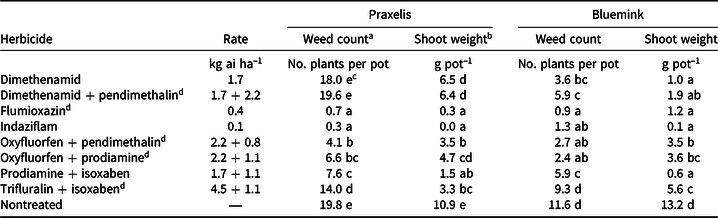
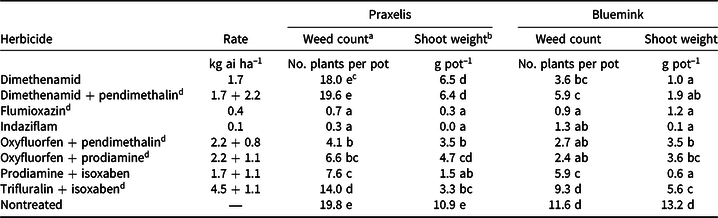
Similar to the previous study, the lowest praxelis counts were observed in pots treated with flumioxazin or indaziflam (Table 3). Both herbicides also resulted in low bluemink counts, reducing emergence by 89% to 92% at 9 WAT, although oxyfluorfen + pendimethalin and oxyfluorfen + prodiamine provided a similar reduction. Shoot dry-weight reductions in pots treated with flumioxazin, indaziflam, and prodiamine + isoxaben were similar in both praxelis and bluemink. Dimethenamid- and dimethenamid + pendimethalin–treated pots had the highest praxelis counts, similar to results in the first experiment at Apopka, where dimethenamid control was generally lower than most other herbicides. However, dimethenamid and dimethenamid + pendimethalin provided 49% to 69% reduction in bluemink counts and over 86% reduction in shoot dry weight, similar to results observed with indaziflam or flumioxazin. Oxyfluorfen + pendimethalin or prodiamine provided a greater reduction in emergence of both species in comparison with trifluralin + isoxaben, but few differences were observed in shoot weight reduction with trifluralin + isoxaben and oxyfluorfen combinations.
Response of praxelis and bluemink to selected PRE herbicides at Apopka, FL. Results are pooled over two experimental runs in 2018 and 2019.
a Weed counts were taken at 8 wk after herbicide treatment (WAT). Each pot was seeded with approximately 50 seeds of either praxelis or bluemink as determined by seed weight following herbicide treatment.
b Total shoot dry weight per pot was taken at 10 WAT.
c Means followed by the same letter within a column are not significantly different according to Fisher’s protected LSD test (P ≤ 0.05).
d Granular formulations were applied with a hand-shaker. All other treatments were spray-applied formulations.
Across all PRE trials, results indicate that flumioxazin provided the most consistent control of praxelis. Although a high level of control was observed with other herbicides depending upon location, flumioxazin may provide results that are more consistent across a wider range of environmental conditions and production practices, as has been observed in previous studies (Neal et al. Reference Neal, Chong and Williams-Woodward2017; Richardson and Zandstra Reference Richardson and Zandstra2009; Walker et al. Reference Walker, Neal and Derr2010). Similar to flumioxazin, oxyfluorfen is also a protoporphyrinogen oxidase (PPO)–inhibiting herbicide. As both oxyfluorfen + pendimethalin and oxyfluorfen + prodiamine provided ~60% to 70% control of praxelis at both locations, PPO-inhibiting herbicides may provide at least some degree of efficacy of praxelis and deserve further investigation.
When pendimethalin was applied in combination with dimethenamid, a low level of control was observed in most experiments, even though a higher rate (2.2 kg ai ha–1) was applied in comparison to the rate applied with oxyfluorfen (1.1 kg ai ha–1). Similarly, prodiamine was not evaluated alone but only in combination with oxyfluorfen at 0.8 kg ai ha–1 or with isoxaben at 1.7 kg ai ha–1. In general, combinations of oxyfluorfen or isoxaben provided similar results with respect to shoot weight reductions, with the exception that greater control was observed with the isoxaben combination in 2019 trials in Apopka when prodiamine was applied at 1.7 kg ai ha–1. Although these data do not allow a clear inference on prodiamine efficacy, our results indicate that prodiamine probably has greater activity than pendimethalin but may have to be combined with an herbicide that provides another mechanism of action, such as a PPO inhibitor or a cellulose biosynthesis inhibitor such as isoxaben.
Praxelis and bluemink tended to respond similarly to most herbicides evaluated in these experiments, with flumioxazin providing a high level of control of both species, oxyfluorfen-containing treatments and prodiamine + isoxaben generally providing acceptable control, and trifluralin + isoxaben providing less than acceptable control in most instances. Although indaziflam provided a high level of control of both species at Apopka, praxelis control at Balm was poor. In contrast, dimethenamid and dimethenamid + pendimethalin largely failed to provide acceptable control of praxelis with the exception of one trial at Balm, whereas both herbicides provided ≥86% control of bluemink at Apopka in 2019. No previous reports on dimethenamid efficacy on any Ageratum species have been reported; however, because these results suggest that dimethenamid would provide control of bluemink but not praxelis, accurately distinguishing between these two species would be critical for growers needing management recommendations.
Praxelis POST Control
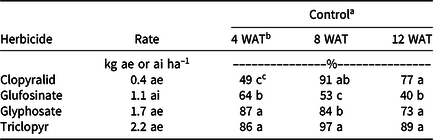
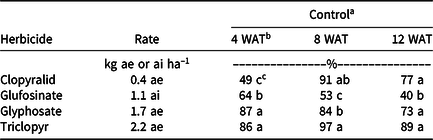
At 4 WAT, the highest visual control ratings were observed in plants treated with triclopyr and glyphosate followed by glufosinate, whereas clopyralid provided the lowest level of control (Table 4). Although clopyralid control ratings were lower than other treatments, all treated plants clearly showed signs of stunted growth, chlorosis, and epinasty. By 8 WAT, injury ratings remained relatively constant for glyphosate, or increased for triclopyr and clopyralid. At this time, glufosinate ratings decreased to 53%, primarily as a result of significant regrowth and re-sprouting from green stem tissues remaining after treatment. By 12 WAT, recovery from treated plant tissues was observed in all treatments, but most notably with glufosinate, for which injury ratings of 40% were significantly lower than the other three treatments that provided ≥73% control at this time. This result was not surprising, given glufosinate is only minimally translocated and generally less efficacious on large-flowering plants (Hoss et al. Reference Hoss, Al-Khatib, Peterson and Loughlin2003), whereas triclopyr, clopyralid, and glyphosate have generally provided more consistent results across a range of growth stages in Asteraceae plants (Morghan et al. Reference Morghan, Leger and Rice2003; Sellers et al. Reference Sellers, Ferrell, MacDonald and Kline2009; Singh and Singh Reference Singh and Singh2004).
Response of praxelis to selected POST herbicides in field studies at Apopka, FL. Results pooled over two experimental runs in 2019.
a Control was assessed visually on a 0 to 100 scale with 0 = no difference in nontreated and 100 = no visible green tissues.
b WAT, weeks after herbicide treatments were applied.
c Means followed by the same letter within a column are not significantly different according to Fisher’s protected LSD test (P ≤ 0.05).
None of the POST herbicide treatments evaluated provided ≥90% control through 12 WAT (Table 4), but it should be noted that treatments were applied to fully mature and flowering praxelis that were approximately 80 cm tall. Although there are no previous reports on efficacy of POST herbicides on praxelis, generally control is reduced on most weed species when they are at the reproductive growth stage compared to the early vegetative growth stage (Hoss et al. Reference Hoss, Al-Khatib, Peterson and Loughlin2003; Steckel et al. Reference Steckel, Wax, Simmons and Phillips1997). Glufosinate was not as effective as the other herbicide treatments, but it should be noted that it is a contact herbicide and generally not recommended for control of large established weeds if other viable herbicide options are available. Of the herbicides evaluated in this study, glufosinate would have the most applicability for use in close proximity to ornamental plants; thus, additional research is needed to determine efficacy of praxelis with glufosinate or other contact herbicides at younger growth stages. As regrowth occurred at approximately 12 WAT with all POST herbicides evaluated, sequential applications would probably be needed for long-term control if applications were delayed until later growth stages.
Results from these experiments demonstrate that flumioxazin provided the most consistent PRE control of praxelis across both experimental sites. Whereas a high level of praxelis control was achieved with indaziflam in Apopka, indaziflam failed to provide control in Balm. Flumioxazin was evaluated in these trials as a granular formulation; however, like indaziflam, flumioxazin is also available and registered for use as a suspension concentrate in field nursery production and noncrop areas (Anonymous 2011, 2015, 2017a, 2017b). Thus, growers targeting praxelis or bluemink in field nurseries or noncrop areas could utilize the suspension concentrate formulation of flumioxazin if needed. The level of control that will be considered acceptable to nursery growers will largely depend upon the ornamentals being grown, as tolerance to different PRE herbicides will vary widely among different ornamental taxa. Although oxyfluorfen-containing herbicides and prodiamine + isoxaben generally provided less control than flumioxazin, they may still provide value in praxelis management plans because of their generally greater crop safety.
Whereas control of praxelis and bluemink was generally similar when evaluating indaziflam, flumioxazin, oxyfluorfen combinations, and prodiamine + isoxaben, dimethenamid provided poor control of praxelis in most trials but over 85% control of bluemink. As dimethenamid and dimethenamid + pendimethalin are commonly used by container nursery growers in Florida, it would be especially important to correctly identify praxelis as opposed to bluemink or other Ageratum species, as poor control may be observed with these herbicide combinations.
In areas already heavily infested with praxelis, results showed that over 80% control could be achieved with POST applications of glyphosate, clopyralid, or triclopyr. Although triclopyr and clopyralid would not be labeled for use within production areas of nurseries because of phytotoxicity concerns, these herbicides could be options in noncrop areas or in areas where it was important to keep perennial grass groundcover species. In contrast, glyphosate would have more applicability in nursery production areas, as it does not pose carryover residual concerns. Regrowth from green stems remaining after treatment was the primary mechanism of reestablishment in these trials, but as previous reports show a high potential for reestablishment from seed recruitment (Gardner and Williges Reference Gardner and Williges2015), the addition of a PRE herbicide such as flumioxazin may lead to more successful long-term management. Future research should evaluate response of praxelis to additional POST herbicides, especially with focus on how growth stage affects herbicide and rate in a variety of environmental conditions. Additional PRE trials are also needed to more clearly understand what effect growing media composition has on herbicide efficacy and to focus on how praxelis responds to different mechanisms of action rather than response to combination herbicides. As inconsistent results were observed between two different praxelis populations with indaziflam and dimethenamid, more research is also needed to examine the existence of praxelis genotypes and biotypes and their response to herbicides. As praxelis has a potential range of most of the southeastern United States (APHIS 2014), research is needed to determine praxelis growth and reproduction under different soil types and environmental conditions as well as seed biology and germination requirements.
Acknowledgments
The authors wish to thank Annette Chandler and Rodrigo Bosa-Mendez for technical assistance.
Conflicts of Interest
No conflicts of interest are declared.